Physical Address
304 North Cardinal St.
Dorchester Center, MA 02124
Physical Address
304 North Cardinal St.
Dorchester Center, MA 02124
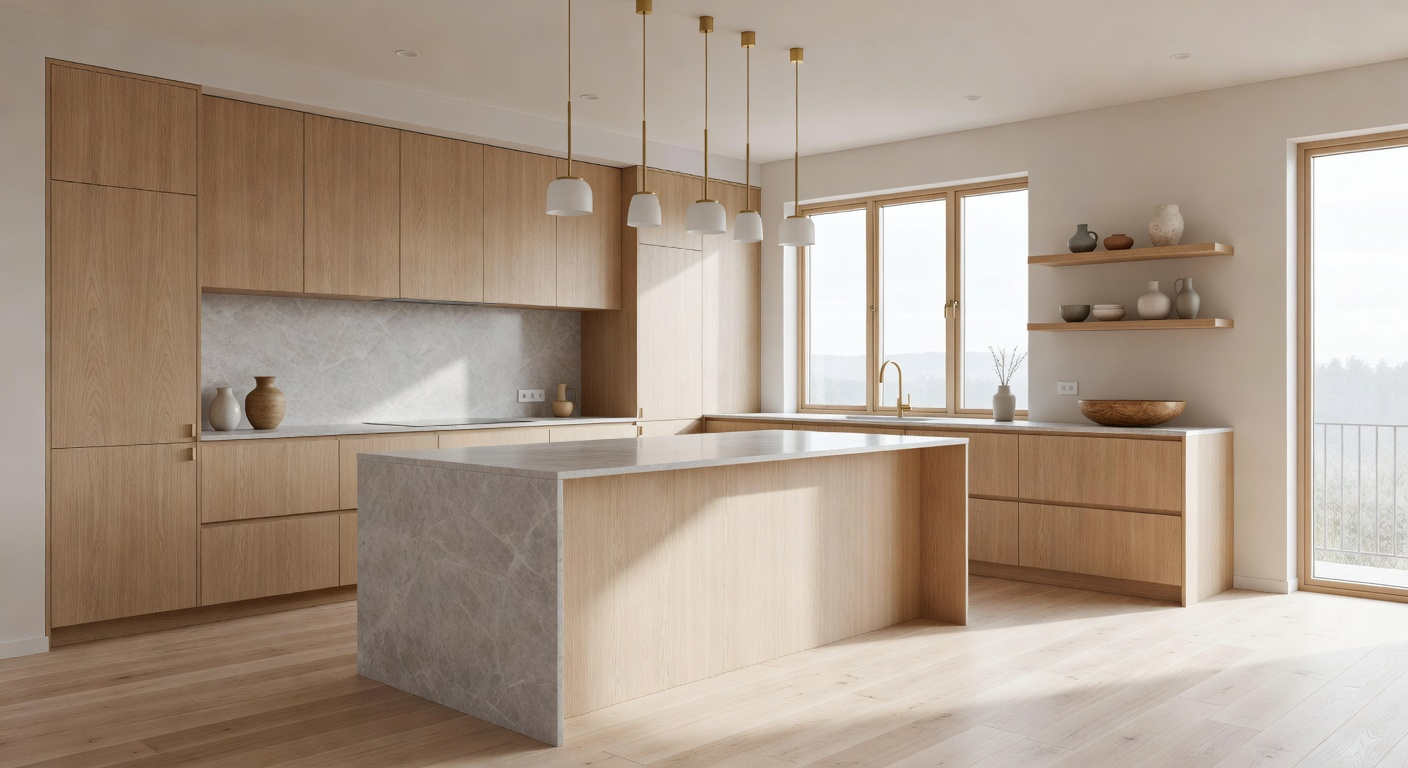
Master kitchen design modern aesthetics by blending quiet luxury with organic textures. Create a warm, minimalist sanctuary with our expert guide.
When exploring kitchen design modern trends, many homeowners worry the look will feel cold. The word “minimalism” often conjures images of a sterile laboratory rather than a home. Indeed, early modernist designs prioritized scientific hygiene above comfort. However, equating clean lines with emotional detachment is a misunderstanding of today’s principles.
In reality, “Warm Modernism” actively rebels against that isolated model. We now balance functional precision with organic, tactile elements. For instance, designers favor honed stone over glossy surfaces to create a soft, diffusing glow. Incorporating natural wood grain adds essential visual warmth. This effectively satisfies our innate connection to nature while achieving the ultimate modern luxury kitchen interior design.
This guide explores the transition from a sterile lab to a soulful sanctuary. We uncover how curvilinear forms can significantly lower stress levels. We also reveal strategies for integrating “invisible” technology to prioritize social living. Ultimately, modern design can be as cozy as it is efficient.
Scandinavian design once adhered strictly to functionalism. Consequently, spaces often felt like efficient machines. However, a significant shift toward “Soft Modernism” is reshaping our interiors. This evolving approach reintroduces humanity into the kitchen. Designers now prioritize how a space feels over mere measurable utility.
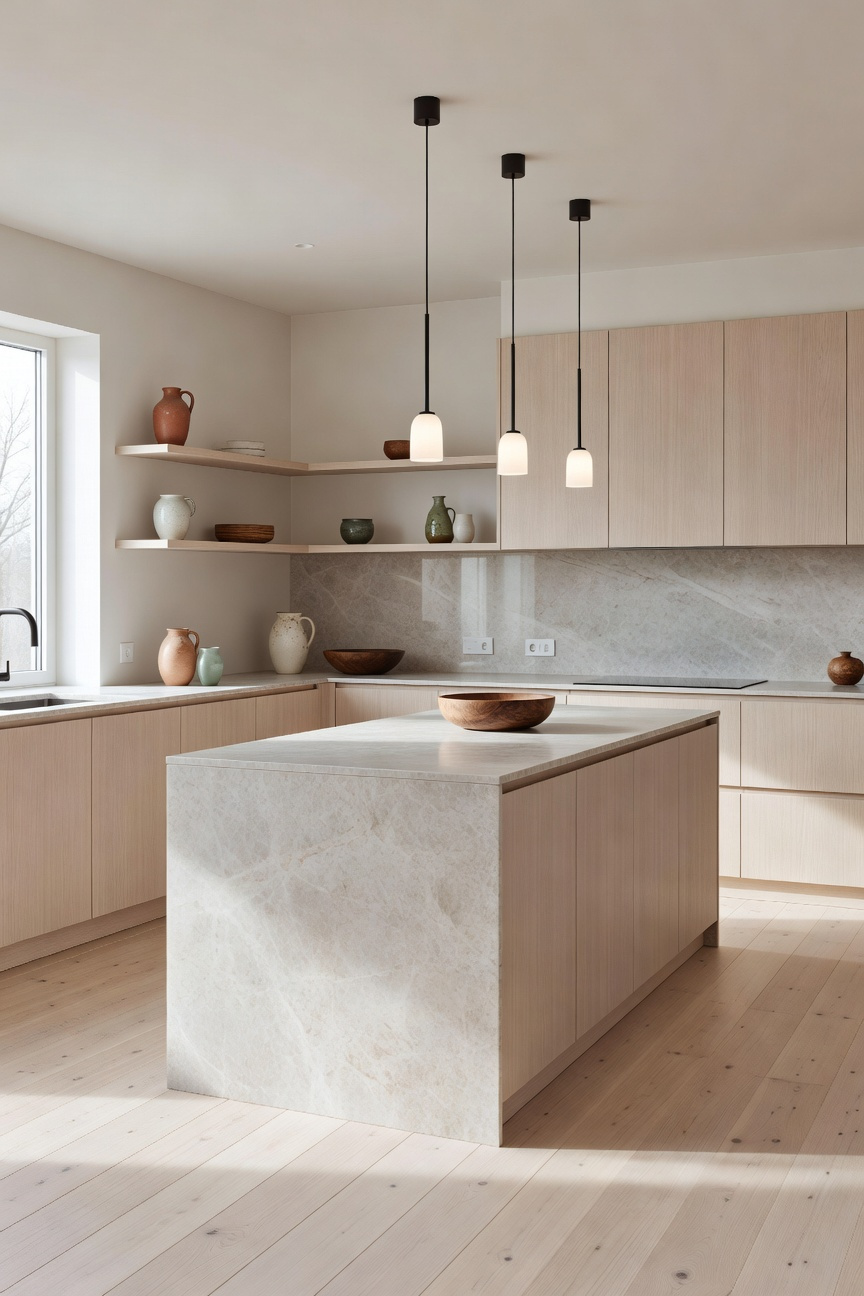
Central to this philosophy is a focus on haptics, or the sense of touch. Previously, minimalism favored slippery, high-gloss surfaces. In contrast, Soft Modernism demands tactile variety to provide comfort. We now see open-pore woods and honed stone replacing cold laminates. These organic materials actively dampen acoustic clutter. Thus, the room feels quieter and significantly calmer.
Visually, the palette is evolving beyond sterile white. Instead, designers draw inspiration directly from the Nordic landscape. We utilize complex, earthy tones like soft clay, sage, and mushroom. The architecture itself is softening alongside the colors. Removing upper cabinets allows warm light to wash over matte finishes. This creates a fluid atmosphere, blending necessary functionality with the deep warmth of a living room.
The modern kitchen is shifting from aesthetic perfection to sensory wellness. High-gloss white once symbolized hygiene and order. However, this “clinical” look causes sensory fatigue in a post-pandemic world. Therefore, designers are pivoting toward “low-chroma” hues like Greige and Sage. These earth tones offer a visual rest for the nervous system. In fact, biophilic design suggests mimicking natural colors significantly reduces cortisol levels.
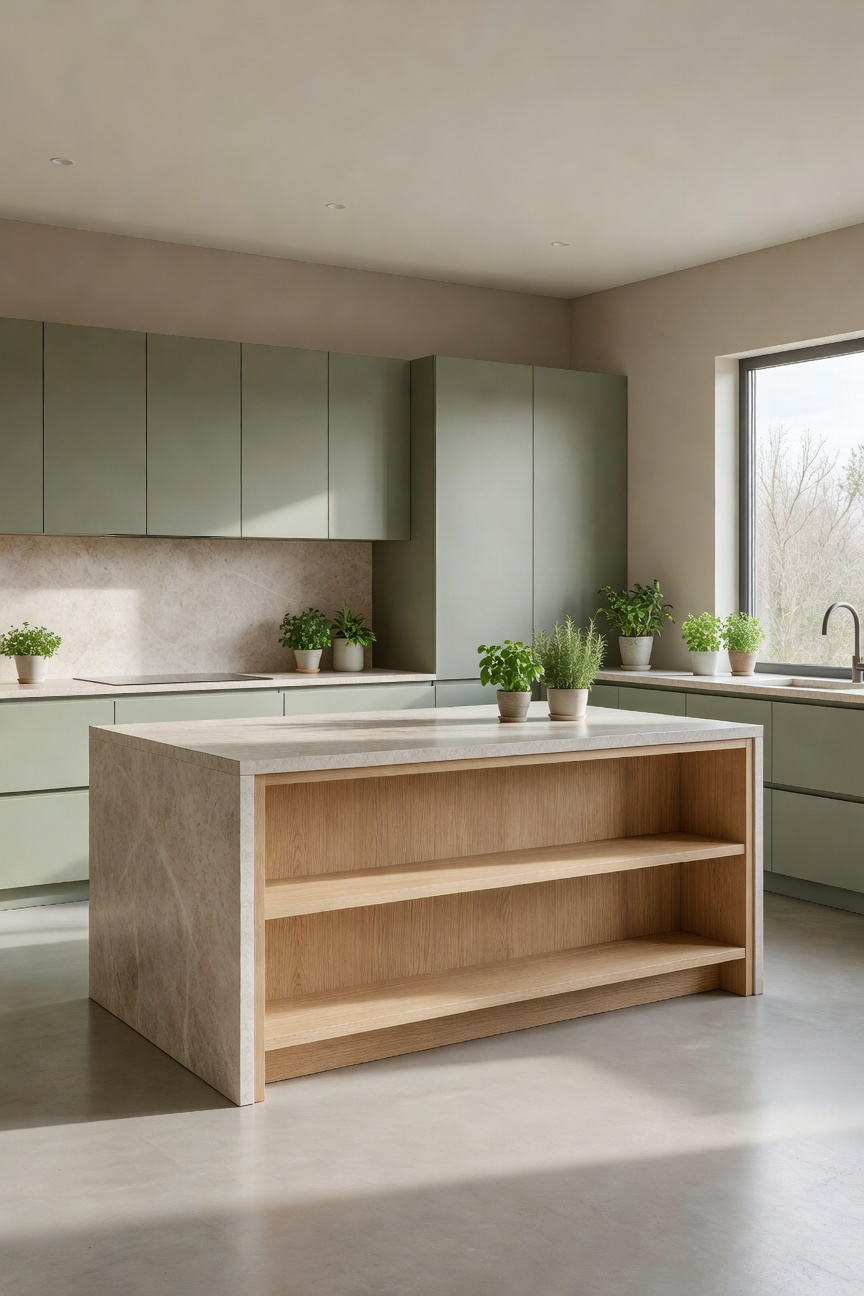
Conversely, high-gloss white frequently amplifies stress through harsh glare. This is particularly true under modern LED lighting. Glossy surfaces act as mirrors, creating blinding highlights that strain the eye. Alternatively, Greige provides chromatic stability. It remains cozy under warm light and crisp under daylight, avoiding the sickly tint white often reflects.
Furthermore, this transition is driven by a material revolution. Nanotechnology has introduced “super-matte” surfaces. Unlike the cold feel of acrylics, these materials scatter light. Consequently, they offer a “velvety” soft-touch experience. This shift signals a rejection of the “disposable” showroom aesthetic. Homeowners now seek a “lived-in” luxury. By layering muddy tones with raw wood, we create spaces that feel grounded.
Modern kitchens frequently rely on clinical materials like stainless steel. However, true material authenticity requires a warmer approach. Specifically, raw sustainable timber serves as a critical “physiological bridge” for the user. Unlike cold synthetic surfaces, oil-finished wood offers immediate tactile warmth. Finnish architect Alvar Aalto famously described this interaction as the “handshake of the home.” Touching these organic surfaces can actually lower blood pressure.
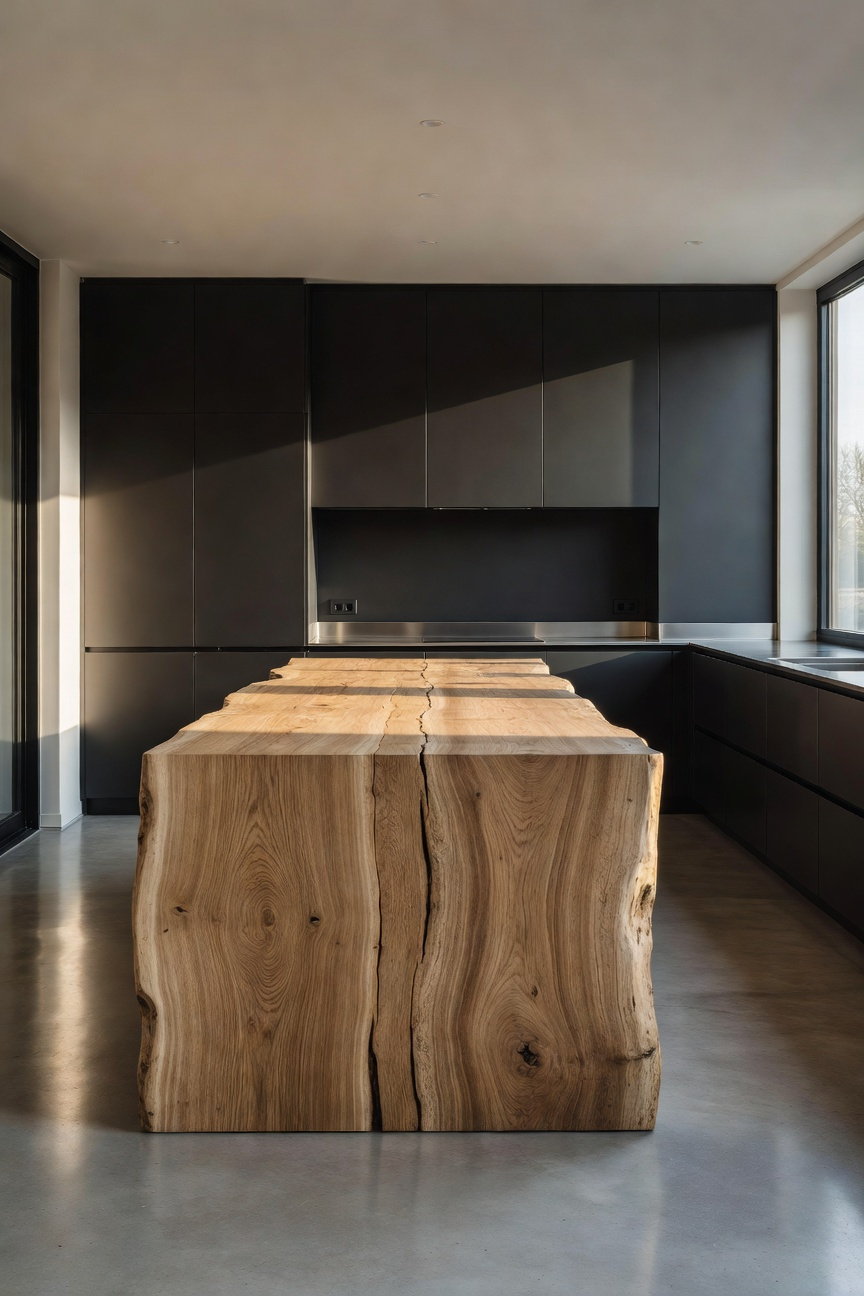
Beyond touch, timber visually anchors sleek architectural lines. Designers utilize horizontal grain sequencing to create a continuous “vanishing line.” Therefore, the kitchen feels like a solid architectural mass rather than disjointed boxes. This visual weight counteracts the “floating” nature of modern wall-hung systems.
To preserve this raw aesthetic, technical mastery is essential. Traditionally, varnishes created a plastic-like barrier. Conversely, modern “water-white” lacquers provide an invisible, flat finish. Thus, the wood appears entirely untreated while remaining protected against grease. This fusion of precision and natural imperfection creates a space that is both functional and deeply human.
True luxury creates a sensory experience, not just a visual one. The industry is shifting away from cold, polished synthetics. Instead, the focus is on the “haptic” quality of honed marble and matte quartz. Unlike high-gloss finishes, these velvety surfaces retain ambient warmth. Therefore, they feel soft to the touch rather than sterile.
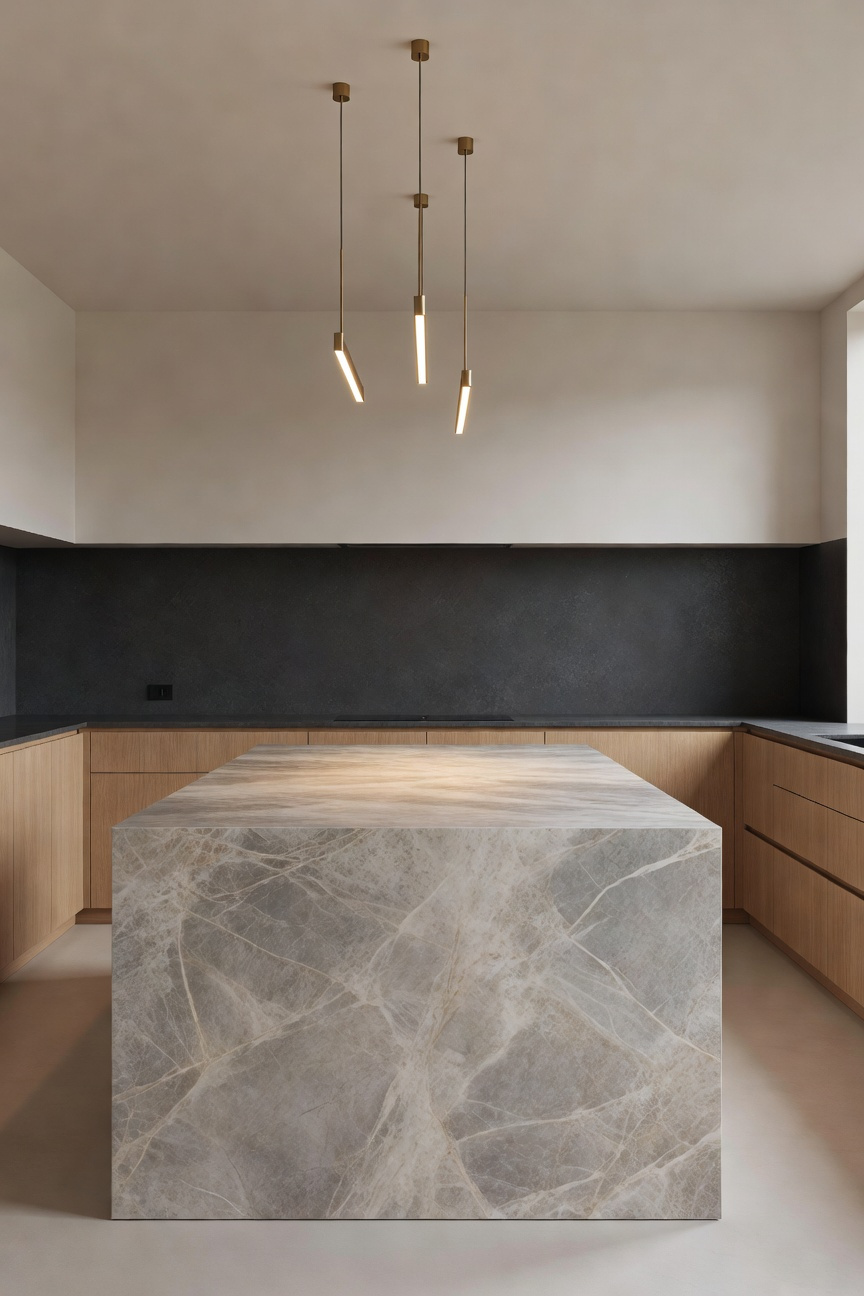
This choice heavily impacts your lighting scheme. Polished counters often create harsh glare, known as “hot spots.” Conversely, matte surfaces absorb light effectively. This creates a “soft focus” atmosphere that reduces visual fatigue. In Scandinavian interiors, this “visual quiet” allows the eye to rest.
Finally, selecting a “living finish” embraces the passage of time. Polished quartz often mimics stone patterns with printed resins. Unfortunately, scratches quickly reveal this artificiality. In contrast, honed natural stone develops a patina. Slight etching becomes a history of meals shared, adding authentic soul to your home.
Texture layering represents a shift toward “Minimalism with Soul.” Vertical grooves on classical columns were historically used to reduce visual weight. Similarly, today’s use of fluted glass and ribbed wood creates a calming “visual rhythm.” This bridges modern lines with traditional comfort.
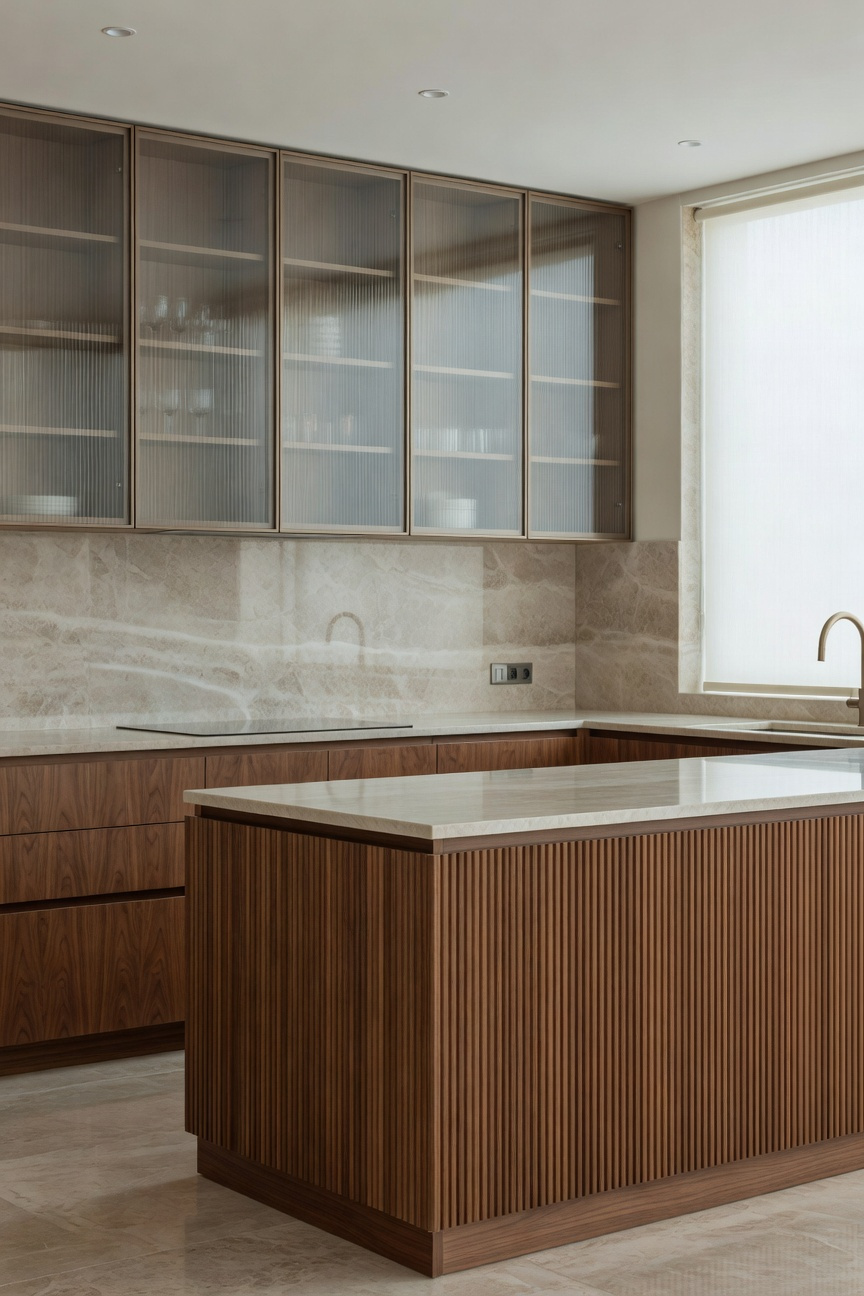
Research suggests that these organized patterns actually lower cortisol levels. Therefore, these linear details make high-activity kitchens feel more stable. Additionally, the vertical lines act as “vectors,” naturally guiding the eye upward. Consequently, even standard-height rooms feel significantly more expansive.
Beyond psychology, these materials solve practical problems. Open-plan homes often suffer from acoustic clutter. Ribbed wood acts as a natural sound diffuser. The varying peaks and valleys break up sound waves, reducing the sharp echo of clattering dishes. Meanwhile, fluted glass offers a unique light-scattering effect. The reeds refract harsh LED lighting into a soft, ambient glow. To complete the look, pair these textures with a modern kitchen backsplash in a matte finish.
The Invisible Kitchen is the pinnacle of Quiet Luxury. Fundamentally, this philosophy shifts the kitchen from a utilitarian “workroom” to a seamless extension of the living space. Early layouts prioritized scientific efficiency above all else. However, today’s approach values architectural harmony over industrial showmanship.
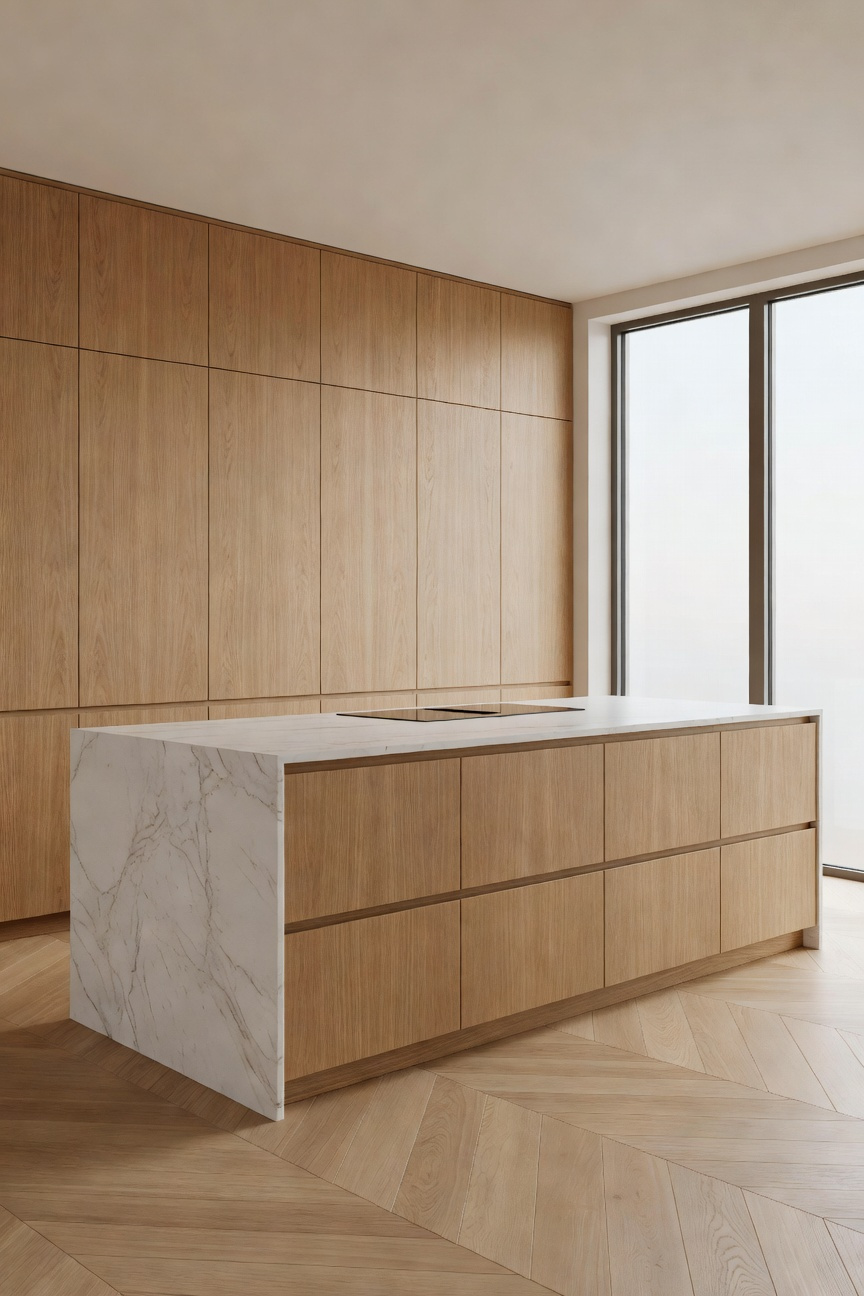
Achieving this seamless look requires mastering the “art of the flush fit.” Ideally, this relies on articulated, fixed hinges. Unlike standard sliding hinges, these allow heavy custom panels to pivot without hitting adjacent cabinetry. Consequently, the appliance disappears entirely behind the woodwork. Proper heat dissipation is also critical. High-end integrated units breathe through the toe-kick rather than visible grilles.
Beyond aesthetics, the invisible kitchen must sound invisible. Because open-plan living connects spaces, appliance noise becomes intrusive. Therefore, integrated units are engineered to operate at a hushed 38–42 dB. Designers refer to this effect as reducing “Visual Noise.” By hiding digital displays, we remove subconscious micro-distractions. Ultimately, this fostering of silence creates a “Sanctuary of Calm.”
Handleless architecture strives to create “visual silence” within the home. Originally, this concept emerged in 1960 to reflect industrial precision. Consequently, the kitchen transformed into a single, cohesive environment. By removing hardware, we eliminate “visual clutter,” allowing the eye to rest.
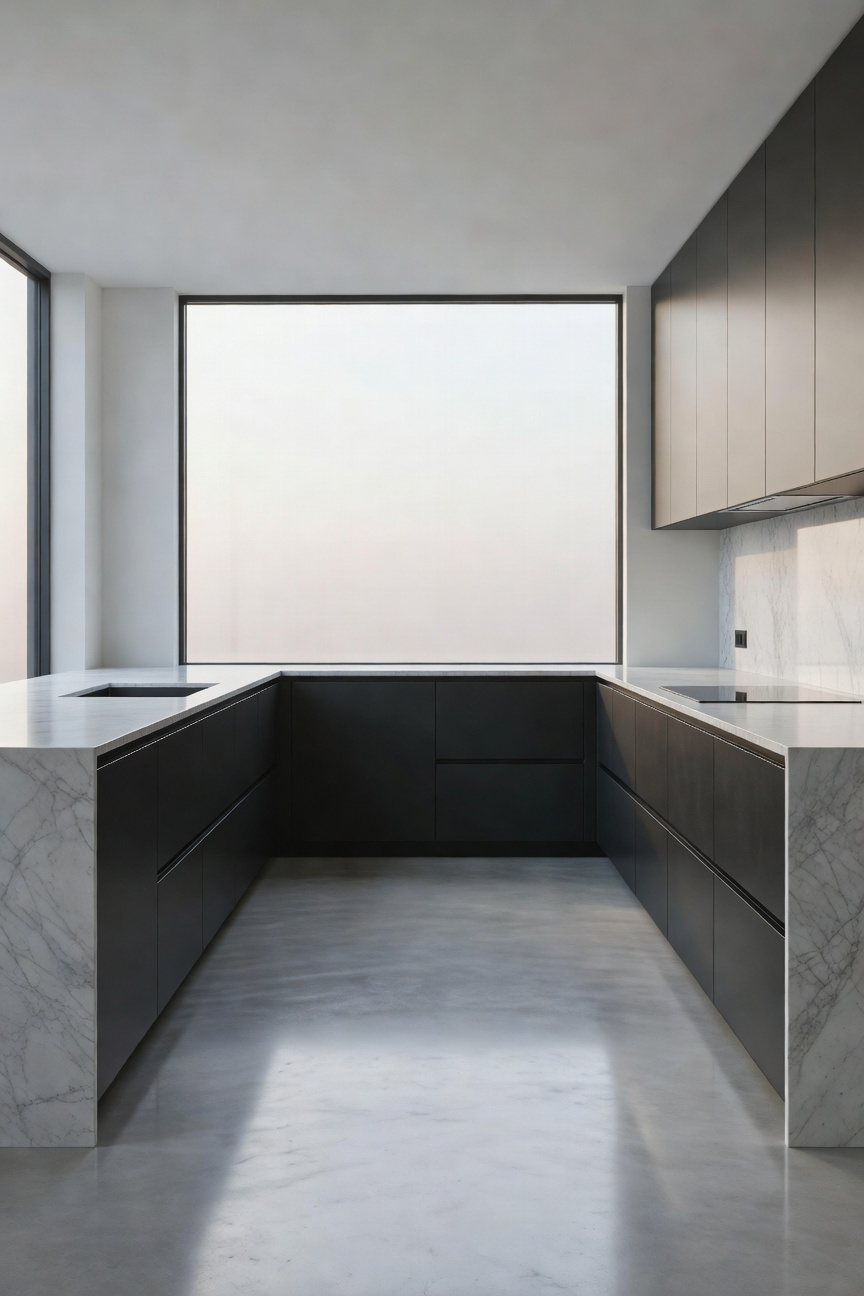
To achieve this reduction, designers employ two primary joinery methods. First, the J-pull integrates a milled groove directly into the door for a seamless look. Alternatively, the “True Handleless” Gola rail system recesses a metal profile into the cabinet. Therefore, a distinctive shadow gap forms, defining the room’s geometry.
For the ultimate monolithic appearance, push-to-open systems eliminate even these shadow lines. Drawers open with a simple, intuitive touch. Thus, cabinetry resembles architectural wall paneling rather than storage. This helps the kitchen visually recede into open-plan living spaces. Ultimately, removing these interruptions lowers cognitive load.
However, this serenity requires practical trade-offs. Gola rails can reduce internal drawer depth by roughly 10%. Furthermore, the necessary “touch points” on doors may attract oils. Fortunately, modern anti-fingerprint laminates now mitigate this issue.
Currently, kitchen design is undergoing a significant “de-bulking” phase. The monolithic “bunker” island is evolving into a refined “communal bridge.” Ideally, this shift replaces heavy toe-kicks with furniture-grade legs. This creates essential visual air, allowing the floor to extend uninterrupted. Furthermore, this transition demands high-end joinery techniques like visible dovetails.
Consequently, the surface becomes a tactile narrative. For example, designs often merge cool, honed marble prep zones with warm, timber seating bridges. This dual-height approach physically bridges the gap between standing work and seated comfort. Some designs even incorporate modern kitchen tables to expand the dining footprint. This layout supports neuroarchitecture principles. By facilitating face-to-face interaction, these spaces trigger oxytocin release.
However, modern functionality must remain invisible to sustain this aesthetic. Technology is discreetly integrated to maintain the furniture illusion. For instance, wireless charging is embedded beneath quartz, while shadow-line LEDs provide floating illumination. Ultimately, this concept creates a “humanized hearth.”
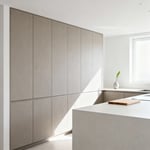
To truly integrate a kitchen, we must stop viewing cabinetry as mere furniture. Instead, treat storage as a seamless architectural envelope. This concept, known as vertical continuity, transforms units into the building’s skeleton. Consequently, the kitchen creates a sense of permanence rather than temporary occupation.
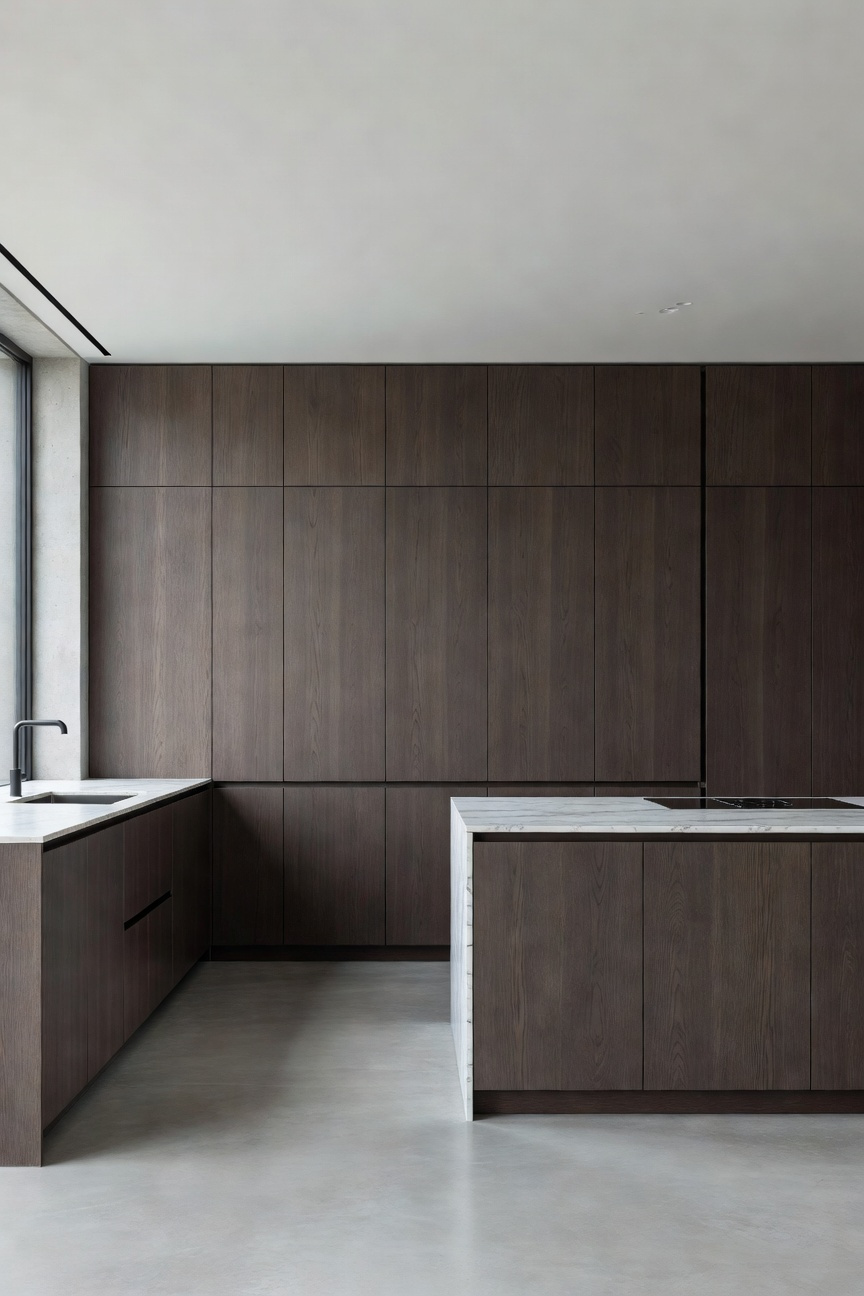
Technically, this effect relies on eliminating visual breaks. Architects often replace traditional scribing with shadow gaps. These 10mm recesses create a “negative reveal” at the ceiling and floor. Therefore, massive wooden or stone volumes appear to float, adding lightness to the structure. Similarly, a deeply recessed plinth helps the wall rise naturally.
Moreover, this strategy echoes the Modernist philosophy of “equipment.” Just as Le Corbusier hid functions within walls, modern layouts conceal appliances behind “double skins.” Thus, the daily clutter vanishes behind a serene facade. Using tactile materials like liquid metal enhances this effect. Ultimately, this approach is psychological. By removing horizontal breaks, we significantly reduce visual noise.
For decades, the “work triangle” strictly dictated kitchen layouts. However, this old concept often fails our modern, multi-cook households. Today, the kitchen serves as a social hub. Consequently, we are shifting toward Zone-Based Ergonomics to better manage flow. This approach replaces rigid lines with distinct activity centers to prevent “traffic jams.”
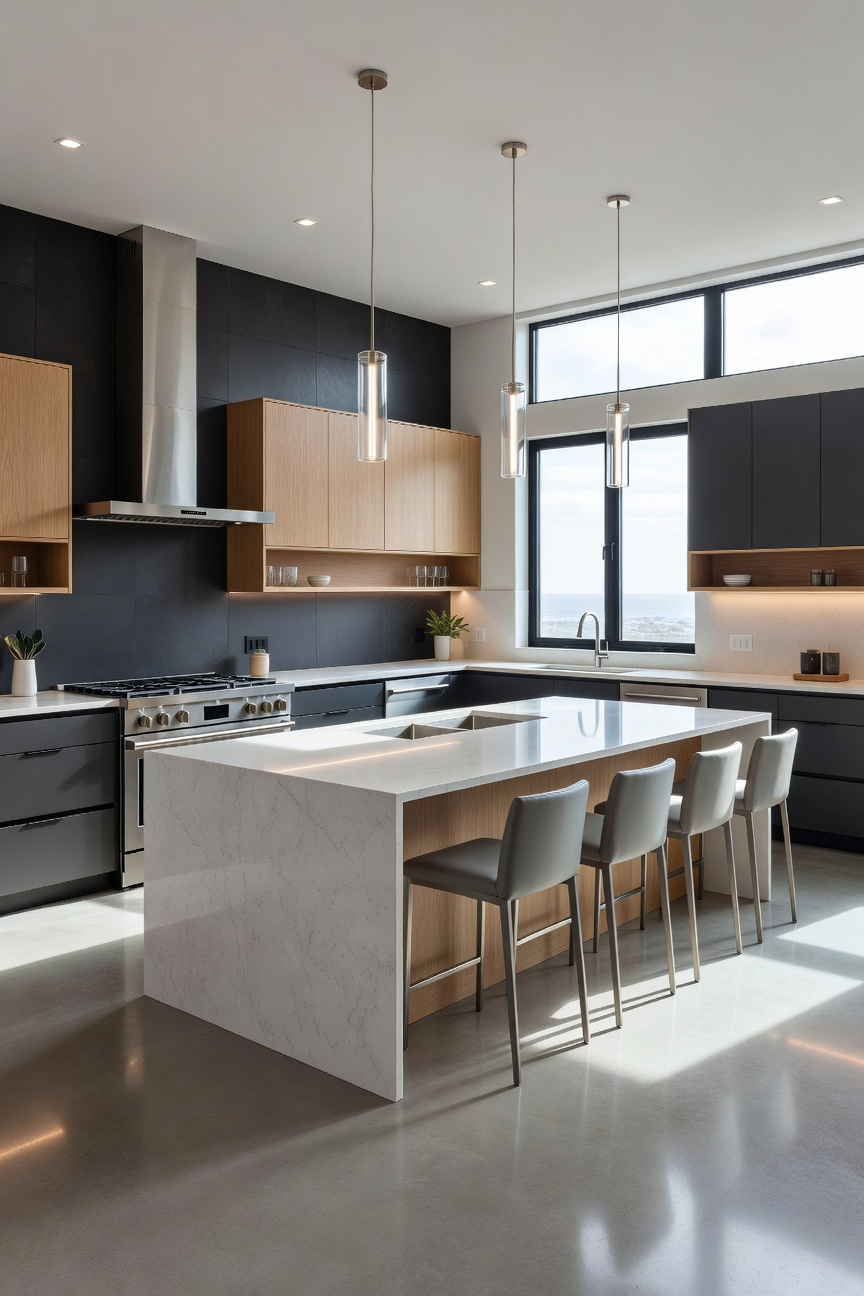
The prep area is where most spatial conflicts occur. To solve this, consider incorporating dual prep zones. Ideally, place a secondary sink on a central island. Thus, one person creates a “Switzerland” zone for rinsing vegetables while another cleans elsewhere. Furthermore, true ergonomics considers how the body interacts with materials. Variable counter heights can significantly enhance physical comfort.
Moreover, Scandinavian principles prioritize a calm sensory experience. Therefore, acoustic zoning is vital in open-plan spaces. Using soft-close mechanisms reduces auditory clutter. Similarly, layered lighting visually defines active zones without harshness. By organizing tools in predictable locations, we reduce cognitive load. In essence, the kitchen evolves into a harmonious sanctuary for everyone.
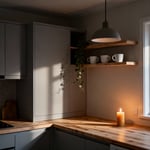
Curated minimalism transforms open shelving from simple storage into a narrative tool. Historically, kitchens relied on closed cabinetry to hide domestic life. However, modern design embraces the concept of the “wall that breathes.” Unlike bulky upper cabinets, floating shelves allow natural light to travel deeper. Consequently, the kitchen feels like a lived-in gallery.
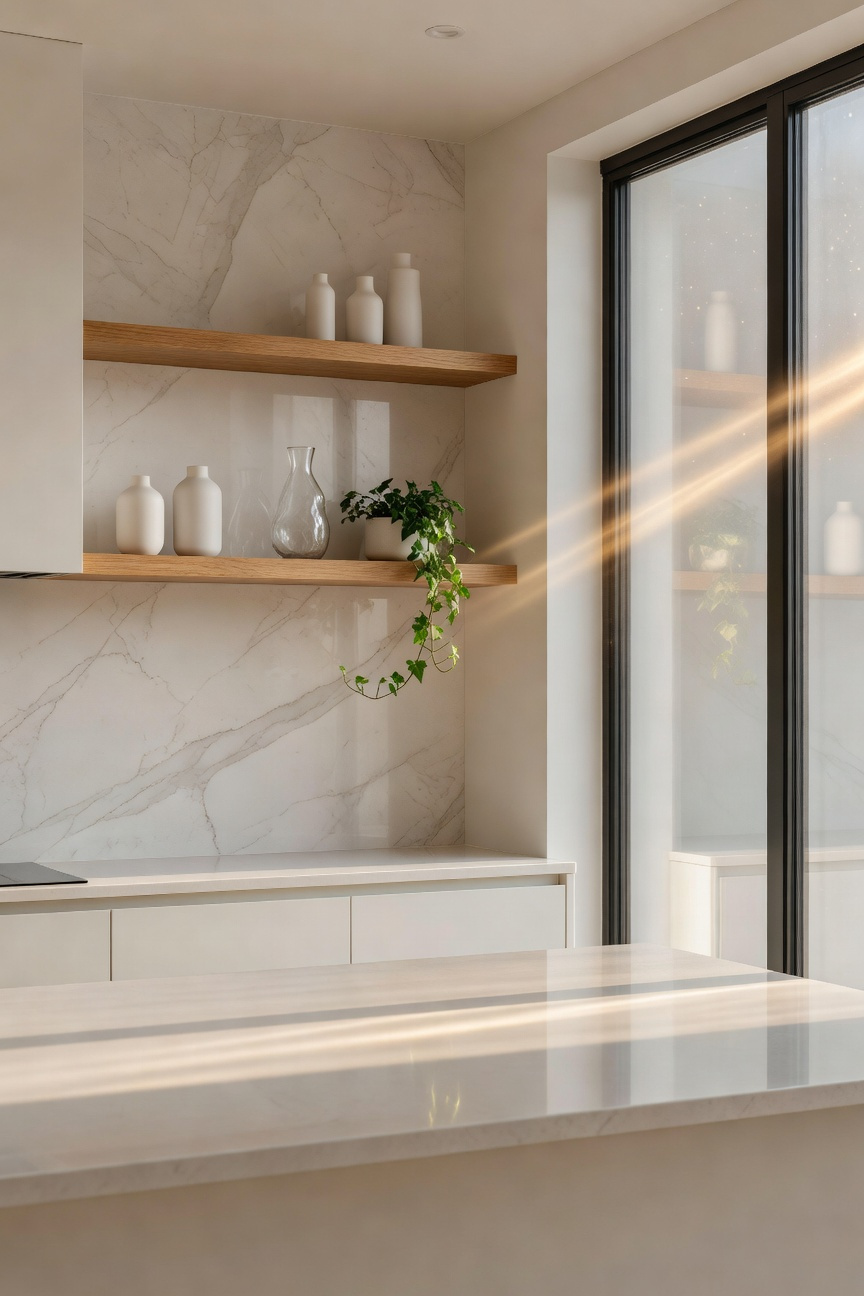
To achieve this, adopt the discipline of the “Capsule Kitchen.” This approach prioritizes high-utility items that also possess visual merit. Therefore, simply decluttering is not enough. Instead, experts recommend “decanting” dry goods into uniform glass or ceramic vessels. This removes the visual noise of commercial labels. Place darker materials like iron on lower shelves to anchor the space.
Crucially, the success of this look relies on “negative space.” For every group of items, leave an equivalent amount of empty space. This “resting point” signals that the display is intentional. Additionally, open shelving changes the psychological mood. Visible essentials invite guests to feel at home. This transparency creates a warm, authentic atmosphere.
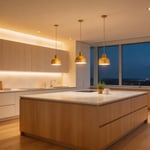
Modern kitchens often suffer from a functional identity crisis. They must serve as both a clinical laboratory and a comforting hearth. During meal prep, safety is the priority. Therefore, we utilize “surgical” task lighting to sharpen visual acuity. However, this intensity feels harsh once the cooking ends. Consequently, the transition to evening “Hygge” requires a fundamental shift by exploring modern kitchen lighting options.
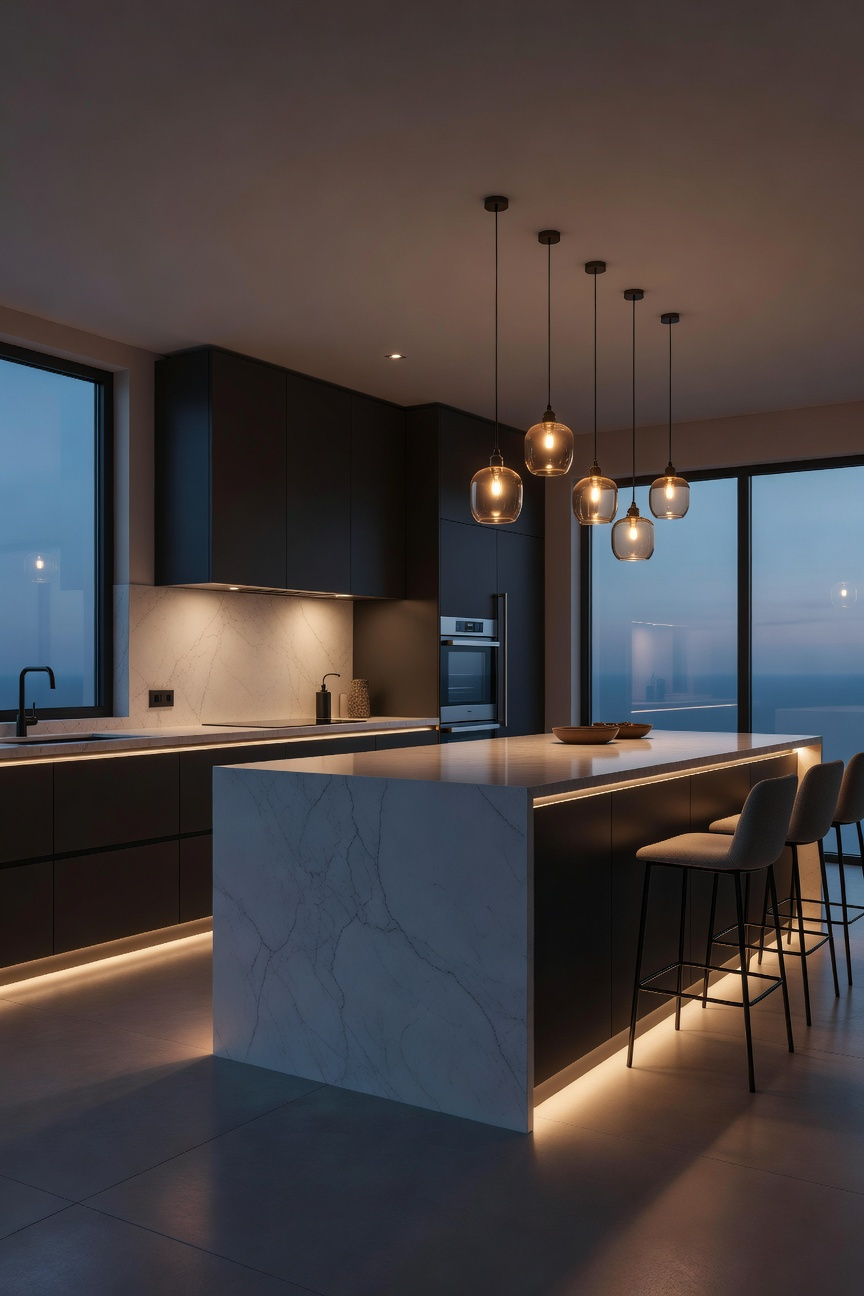
Unfortunately, standard LEDs often produce a cold “gray effect” when dimmed. Instead, the solution lies in “Dim-to-Warm” technology. Functionally, this mimics the physics of incandescent bulbs. As the brightness drops, the color temperature warms to a candle-like 2200K. Resultingly, this softness signals the nervous system to rest.
Furthermore, we must move beyond the “grid of fire” approach. True Nordic coziness relies on the strategic use of shadow. Rather than flooding the room, we create intimate pools of light. For instance, low-level toe-kick lighting transforms cabinets into ambient lanterns. Ultimately, this hierarchy turns a utilitarian workspace into a passive backdrop for living.
Integrating a biophilic connection requires more than placing potted plants on a countertop. In reality, it involves harmonizing human biology with architectural physics. Surprisingly, natural light serves as a crucial culinary ingredient. Recent research reveals that light spectrums dictate flavor profiles. Herbs like basil require mild UV stress to produce aromatic oils. Therefore, effective design incorporates “Spectrally Selective Glass” to redirect daylight specifically into herb zones.
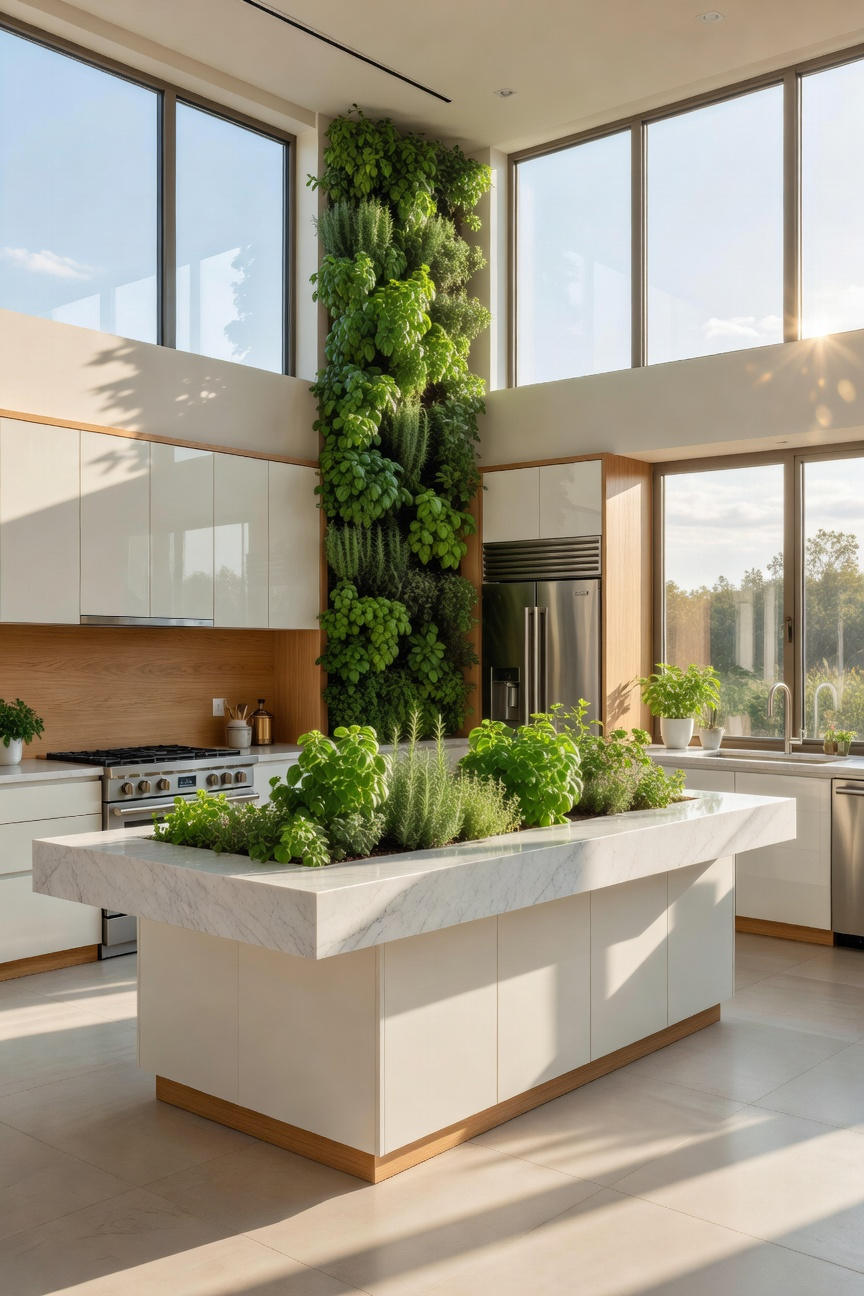
Furthermore, the modern kitchen is evolving into a self-sustaining ecosystem. We often integrate hydroponic substrates directly into the backsplash. To maximize efficiency, designers leverage materials with high Light Reflectance Values (LRV). For instance, “Paper White” cabinetry bounces 30% more light than darker tones. Thus, natural illumination reaches even the deepest corners.
Beyond functionality, this strategy addresses our psychological need for “refuge.” Simply viewing greenery while cooking can reduce stress levels significantly. However, natural light is not always consistent. As a result, we employ supplemental circadian lighting under cabinets. This blend of nature and technology creates a sanctuary that nurtures both the plants and the cook.
The modern scullery represents a significant architectural shift. Historically, these spaces hid menial labor from aristocratic view. Today, however, they serve a psychological purpose by hiding the chaos of daily consumption. Consequently, the main kitchen remains a serene sanctuary.
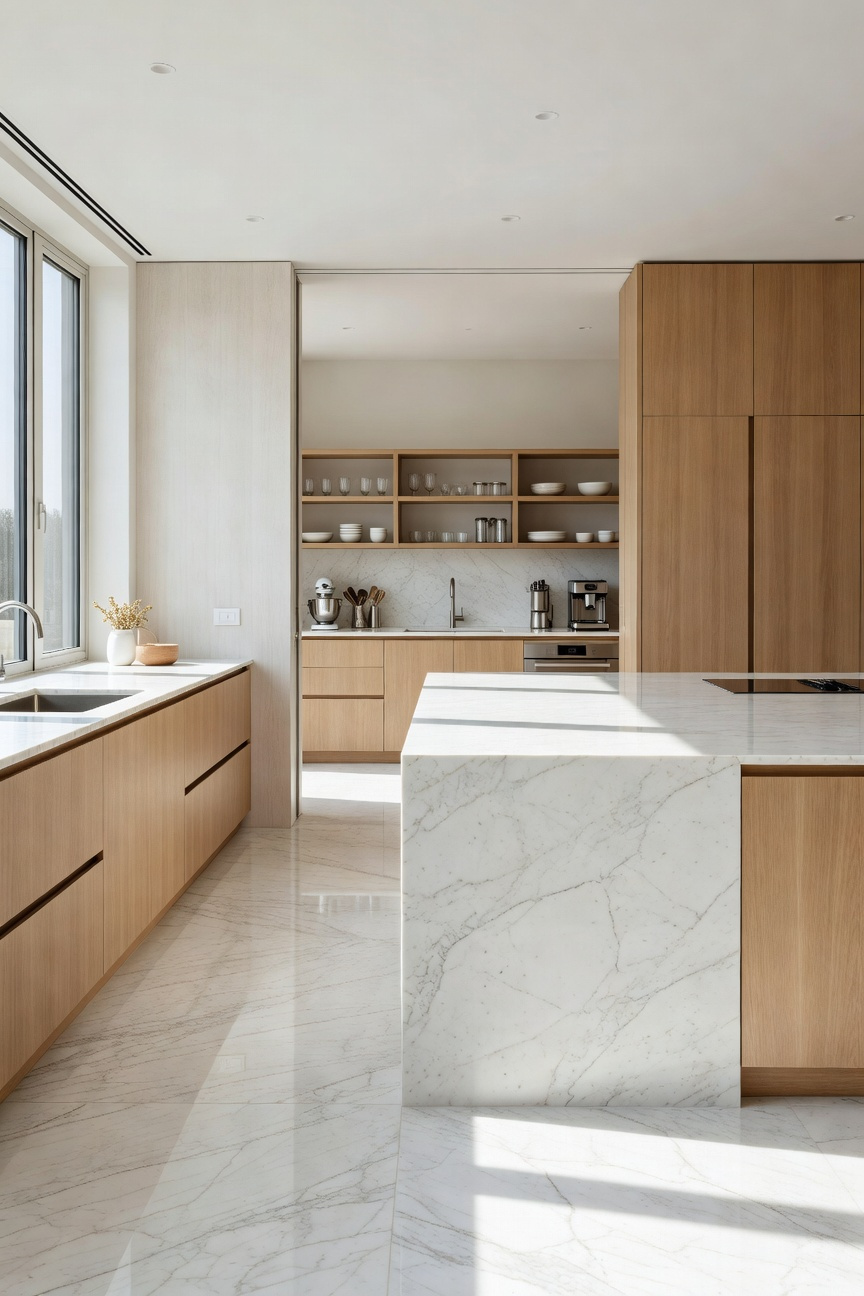
As open-concept layouts dominate, the “sensory competition” of a working kitchen triggers subtle stress. Therefore, the scullery acts as a sensory buffer. Specifically, it houses noisy appliances away from social zones. This separation manages the “cognitive load” of clutter, keeping the main space peaceful.
Furthermore, this division alters our approach to materials. The main kitchen can now feature warm woods and porous stones. In contrast, the scullery embraces “lab-like” efficiency with durable stainless steel. This “dirty kitchen” concept allows for high-heat cooking without threatening pristine surfaces. Ultimately, this revived zone balances minimalism with the reality of messy cooking.
True luxury in modern Scandinavian design is defined by silence. This applies to both auditory levels and “visual noise.” Design experts now argue that digital hubs date quickly. Therefore, the focus has shifted to “panel-ready” appliances clad in millwork. Consequently, a refrigerator becomes a seamless wall of warm oak.
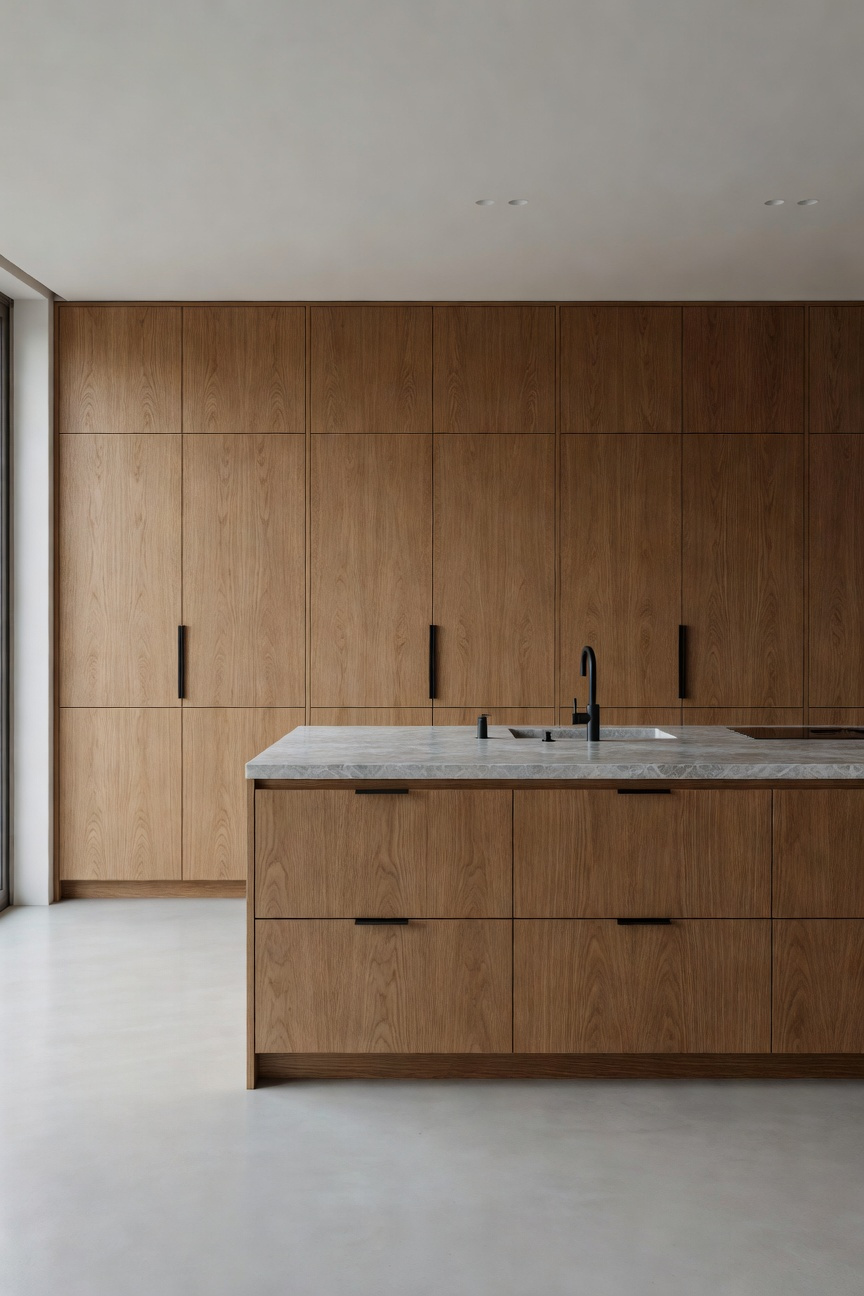
Furthermore, the auditory experience must remain calm. The kitchen acts as a social theater in open-concept homes. Thus, “quiet” is a vital technical specification. Modern silent tech uses brushless DC motors to eliminate mechanical friction. As a result, the soundscape is composed of conversation, not the hum of a compressor.
Finally, we are reclaiming the visual horizon. Traditional range hoods often block the eye’s journey. In contrast, downdraft extraction allows ventilation to live inside the cooktop. This technology pulls steam down before it rises. Hence, it creates “architectural breathing room.” The technology handles the heavy lifting in the background, letting the natural beauty of stone take center stage.
True sustainability does not mean resisting wear. Rather, it means choosing materials that improve with age. We avoid “static” finishes like chrome which often look best only on installation day. In contrast, unlacquered metals introduce a vital “living finish.” For instance, brass handles naturally darken in crevices but remain bright where touched. This oxidation creates a functional history of the home.
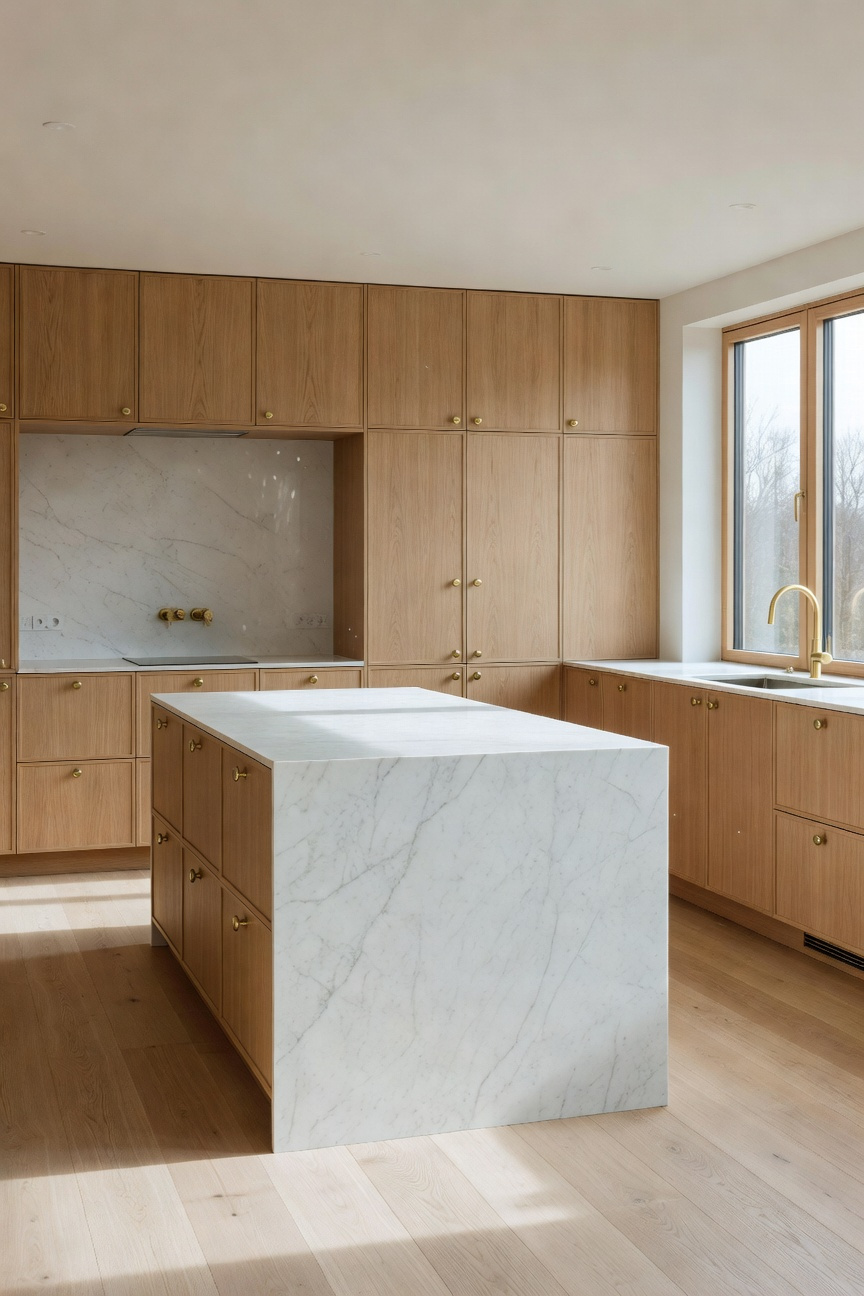
Similarly, our approach to stone must shift from “bulletproof” to “breathable.” Modern trends often favor engineered quartz for durability. However, this plastic-resin composite cannot be easily repaired. Therefore, we advocate for natural materials like honed marble or soapstone. Acidic foods will etch these surfaces, yet over decades, these marks blend into a soft patina.
Finally, longevity relies on the “repair over replacement” philosophy. Solid wood joinery typifies this mindset. Unlike MDF, solid wood breathes with the seasons. Furthermore, high-touch areas naturally “burnish” and smoothen over time. If damage occurs, you can simply sand and re-oil the wood. Ultimately, a kitchen that requires a “ritual of care” fosters a deeper connection.
A modern kitchen design is characterized by clean lines, a minimalist aesthetic, and functional efficiency. It often features handleless cabinetry, integrated appliances, and a focus on high-quality materials like natural stone and sustainable timber to create a seamless architectural look.
To add warmth to a modern kitchen, incorporate “Soft Modernism” principles. This includes using tactile organic textures such as honed marble, wood grains, and earth-toned palettes like sage or greige. Layered lighting and biophilic elements like indoor plants also help soften the space.
Yes, handleless kitchens are highly practical. They utilize push-to-open or J-pull systems that streamline the workflow and reduce visual clutter. Modern anti-fingerprint finishes ensure that these sleek surfaces remain clean and easy to maintain even with frequent touch.
Achieving a successful kitchen design modern in style is no longer about creating a sterile laboratory. Instead, the kitchen has evolved into a vibrant social ecosystem. By merging invisible technology with tactile materials, we soften the room’s atmosphere. Consequently, the design prioritizes human connection over pure industrial efficiency. The space functions not just for cooking, but for living.
Looking ahead, consider how your kitchen supports your family’s emotional rhythm. A truly sustainable home relies on spaces that provide restorative calm. Ideally, you want to create a room that ages gracefully alongside you. To start, audit your lighting layers to ensure they provide a warm, natural glow. Allow your kitchen to become the steady, inviting heartbeat of your home.