Physical Address
304 North Cardinal St.
Dorchester Center, MA 02124
Physical Address
304 North Cardinal St.
Dorchester Center, MA 02124
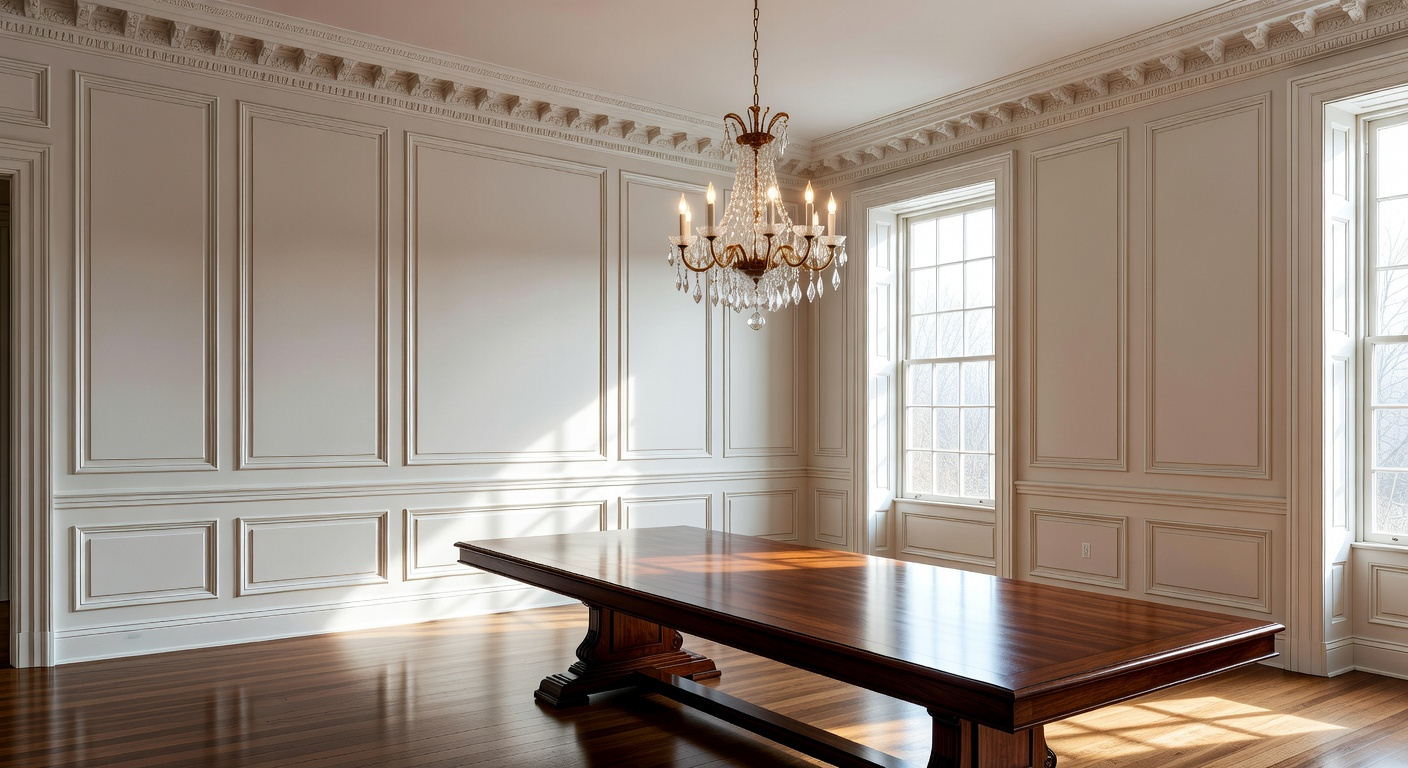
Discover the essential elements of a traditional dining room. From millwork to mahogany, elevate your home with timeless luxury. Read our expert guide!
For decades, the open-concept floor plan dominated modern home design. Many viewed the formal dining room as a stuffy, obsolete relic. Architects removed walls to create vast, multipurpose living areas.
However, a significant shift is occurring in residential architecture today. Homeowners are increasingly expressing fatigue from the visual noise of kitchen-centric living. Research highlights a renewed desire for spaces designed for separation. The dedicated traditional dining room is reclaiming its status as a vital sanctuary. This revival focuses on classical proportions and the enduring appeal of period-appropriate craftsmanship.
This revival goes beyond mere nostalgia for historical aesthetics. We will explore the psychological benefits of defined “social geometry” within the home. Furthermore, this guide examines how acoustic softness fosters deeper human connection. Finally, we analyze technical planning rules that balance tradition with modern functionality.
Restoring original millwork creates an exercise in architectural archaeology. These elements act as the home’s “inner skin,” balancing classical beauty with social function. Historically, architects viewed the room as a classical column. The baseboard serves as the plinth, while the wainscoting acts as the die.
Much like the principles found in traditional kitchen design, a common mistake involves aligning the chair rail with modern furniture heights. This error fractures the room’s visual scale. Instead, you should prioritize the “grammar” of the era. Keep proportions near the traditional thirty-inch mark.
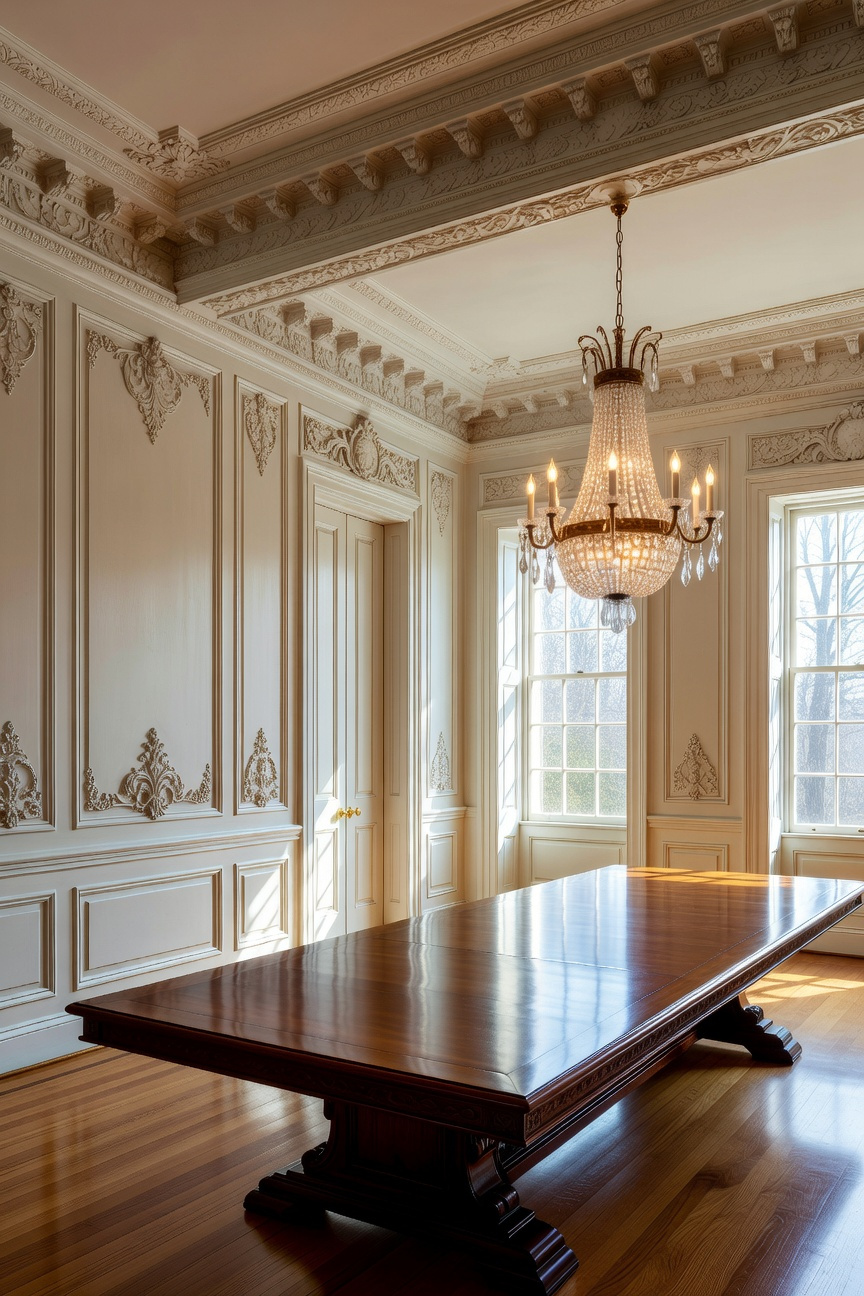
Beyond geometry, you must assess the wood’s character. Fine mahogany exhibits chatoyancy, a gem-like shift in the grain’s optical depth. Similarly, identifying the finish is critical for preservation. A simple alcohol swab determines if the coating is shellac. If so, new layers chemically bond with the old. This restores the original patina without destructive stripping.
Physical repairs require precision rather than store-bought shortcuts. Historical profiles often require custom-ground knives to match unique curves. For localized damage, experts utilize a “Dutchman” repair. This method plugs holes with matching wood, allowing the joint to disappear under the finish. Ultimately, preserving this architectural envelope maintains the room’s acoustic warmth and psychological stability.
In traditional design, the ceiling acts as a crucial “Fifth Wall.” Neglect here diminishes the room’s entire atmosphere. Specifically, the interaction between dining room chandeliers and plaster creates a phenomenon called “glancing light.”
Unlike smooth synthetics, hand-cast plaster features a porous micro-texture. Consequently, it diffuses light to create a soft, warm glow rather than a harsh reflection. These intricate shapes also serve a functional acoustic role. The geometric patterns of medallions scatter sound waves effectively. Thus, they reduce echoes and keep dining conversations intimate.
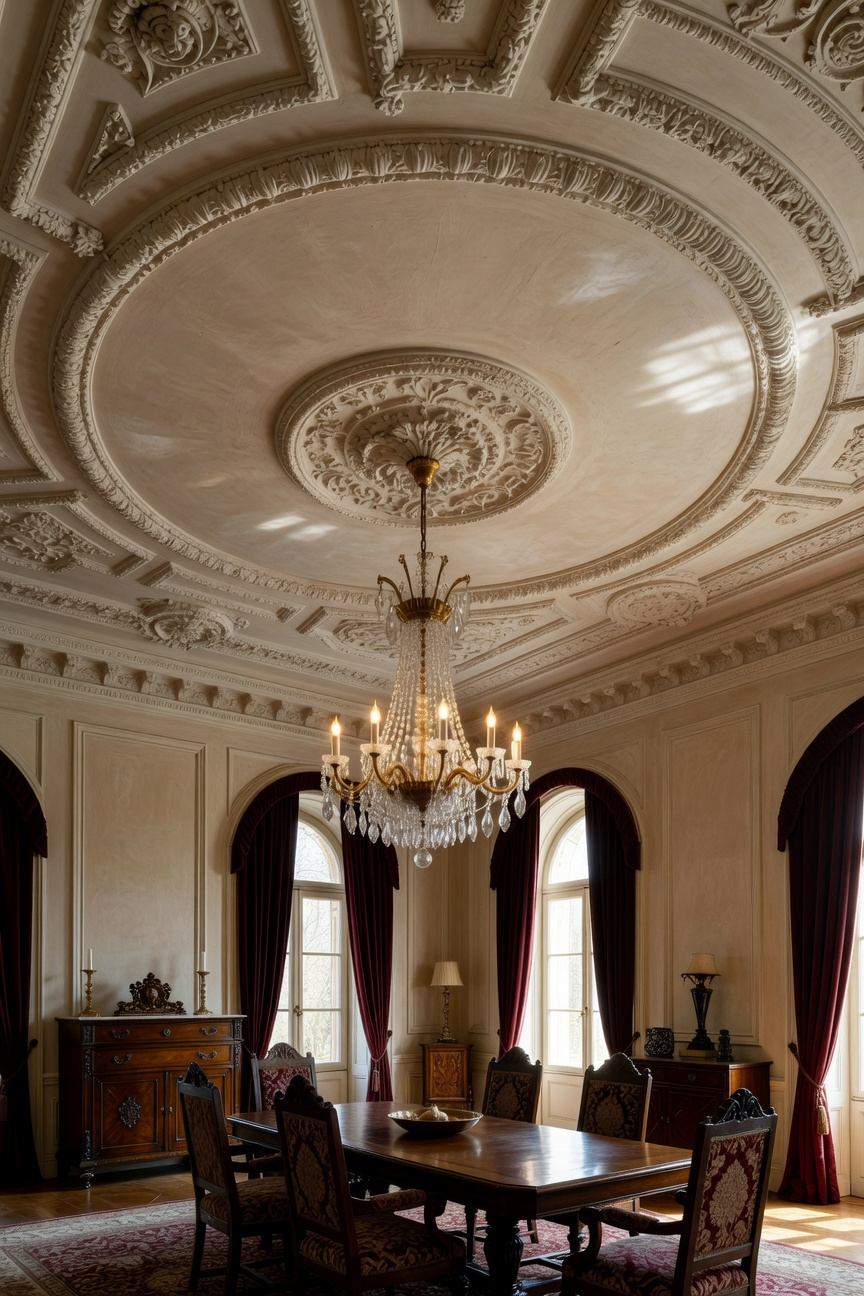
However, selecting the right size requires careful calculation. Ideally, designers use the Golden Rule to determine the medallion’s diameter. It must be larger than the chandelier’s canopy. Otherwise, identical sizes create an awkward visual column that cramps the space.
Additionally, the cornice must balance the room’s visual weight. Heavy dining tables require multi-layered moldings to ground the aesthetic. Historically, these elements protected ceilings from candle heat and soot. Today, they anchor the room with authentic character. Ultimately, plasterwork bridges the gap between historical necessity and modern ambiance.
Historically, selecting a color for a traditional dining room was never merely an aesthetic choice. It served as a calculated performance of social status and wealth. Homeowners used expensive “fancy” pigments like Prussian Blue or Cinnabar to signal their financial capability. These choices often mirrored the richness sought when designing a luxurious living room. They created a vibrant backdrop that allowed silver and porcelain settings to dazzle.
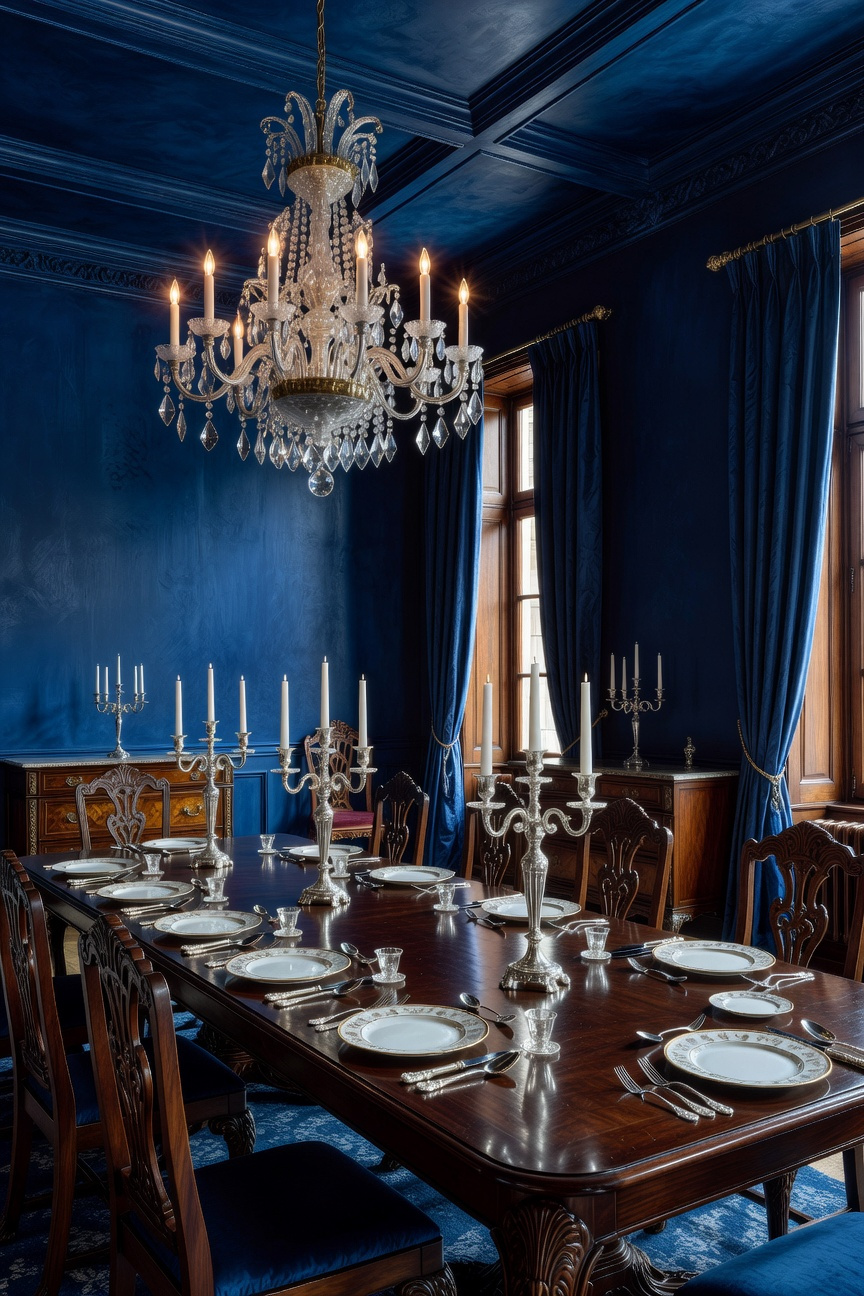
Beyond status, authentic heritage pigments possess unique optical properties that modern synthetics lack. Natural Cinnabar has a refractive index significantly higher than a diamond. Therefore, under low-Kelvin candlelight, the pigment appears to glow from within rather than simply reflecting the light. Similarly, historical Prussian Blue offers a sense of infinite depth. This makes walls feel as though they are receding.
The binder used to carry these pigments dictated the room’s physical atmosphere. Often, walls were finished in high-gloss linseed oil paints to create a dark, mirror-like surface. The lacquered walls reflected moving candle flames, effectively doubling the light source for evening entertainment.
To ground this visual intensity, architects avoided using harsh, brilliant whites on the trim. Rather, they utilized “broken whites,” which were tinted with a trace of the wall color. This tonal balance ensured the architectural moldings remained structural without destroying the immersive, dramatic mood.
In traditional dining rooms, wall coverings function as sophisticated light-management systems. Specifically, silk fibers possess a unique triangular structure. They refract light like miniature prisms. Under the warm glow of candlelight, a room hung in silk damask appears to breathe. The matte-and-gloss weave creates a living wall where patterns emerge and vanish as guests move.
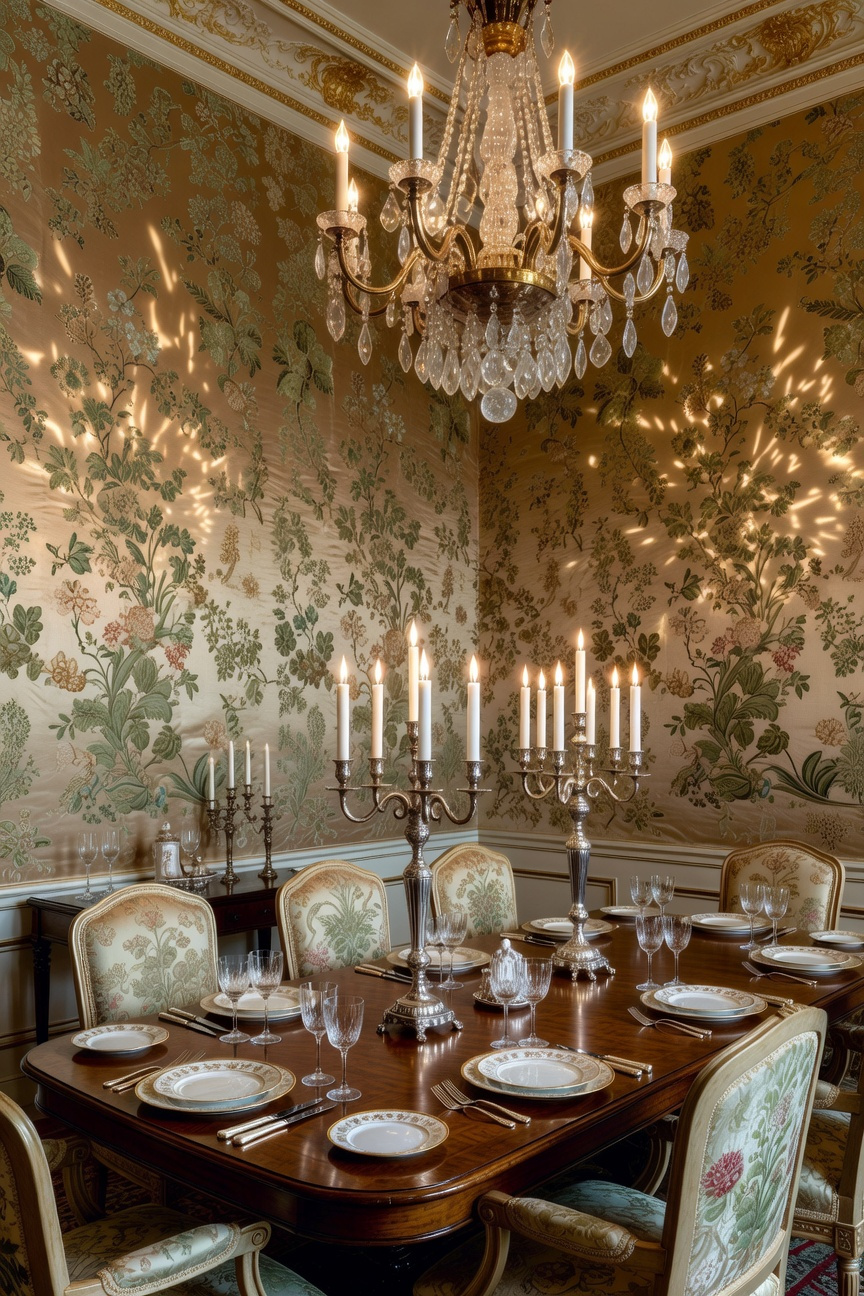
Beyond aesthetics, these materials provide essential acoustic engineering. Dining rooms frequently suffer from the noise of hard mahogany and crystal. Silk wall coverings act as high-performance sound absorbers. In fact, stretching fabric over a flannel interlining creates a distinct “soft room” effect. The sharp clatter of silverware is dampened. This ensures that intimate dinner conversation remains clear and audible without shouting.
Hand-painted Chinoiserie transforms walls into immersive storytelling portals. Unlike standard wallpaper, these bespoke murals feature continuous, non-repeating narratives. Intricate details like hidden grasshoppers or distant pagodas offer effortless conversation starters. Historically, specific motifs were chosen to bless the gathering. Peonies represented wealth, while cranes symbolized longevity for multi-generational meals.
Interestingly, the installation method itself contributes to the atmosphere. During the Georgian era, damask was often tacked rather than glued. As a result, the fabric could move slightly with the air. These sensory details elevate a simple meal into a memorable ritual.
In a traditional dining room, the floor acts as a primary stage for social rituals. Consequently, preserving original hardwood becomes an act of historical conservation. When refining your dining room design, remember that unlike modern floating floors, old-growth timber offers a distinct acoustic profile.
Solid hardwood produces a resonant, low-frequency thud when walked upon. This sound signifies density and structural permanence. Maintaining this acoustic stability is vital for the room’s atmosphere.
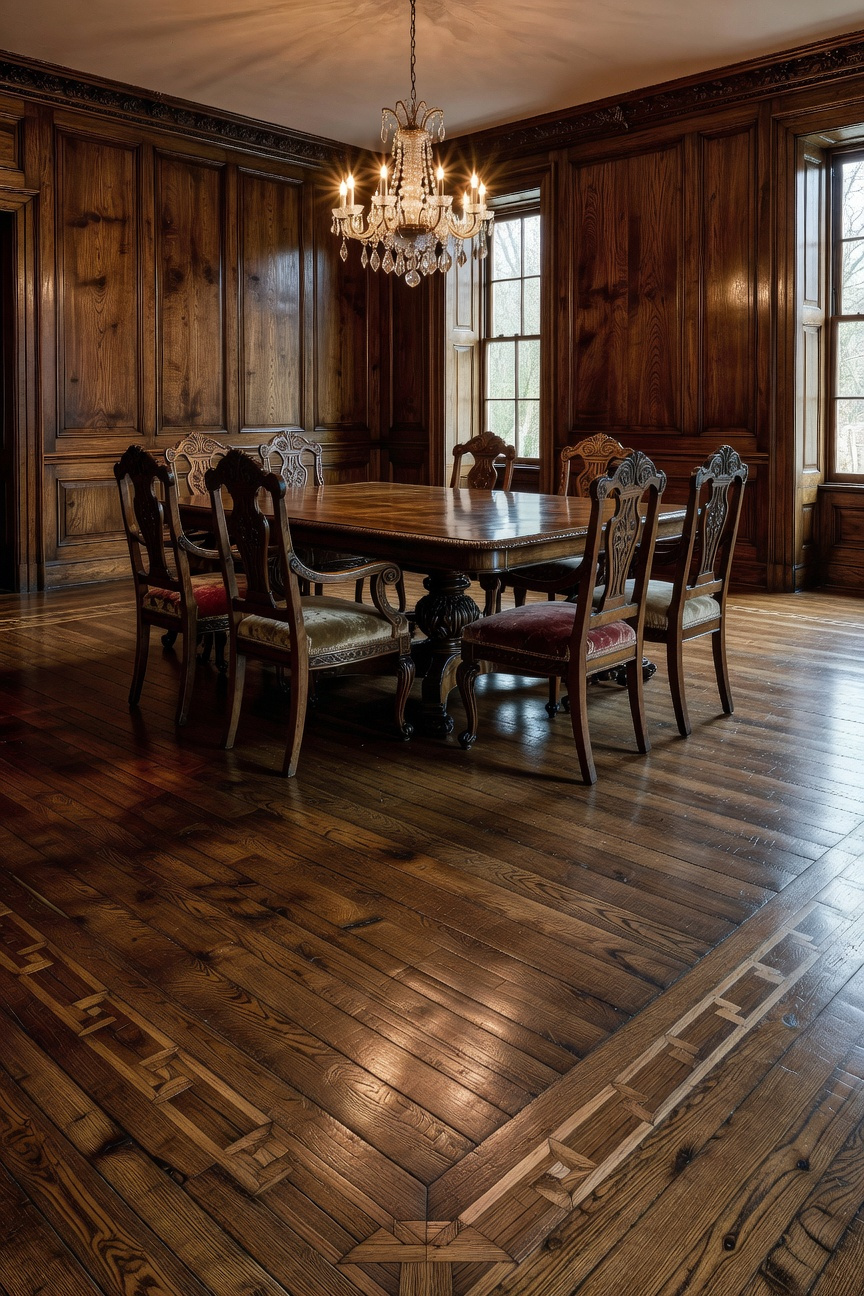
When restoring these surfaces, restraint is crucial. Aggressive sanding often destroys the wood’s patina. This removes the deep, honeyed glow developed over decades. Instead, chemical stripping preserves the “scratches of history.” Traditional finishes like beeswax allow the wood to breathe. Conversely, modern polyurethanes create an unwanted, plastic-like film.
For spaces requiring new installation, the pattern dictates the formality. Historically, complex designs like Parquet de Versailles signaled aristocratic heritage. Alternatively, Chevron patterns direct the eye toward focal points. Additionally, installing a contrasting wood border frames the dining rug effectively. Finally, repairs must use “in-kind” materials. Specifically, harvesting “closet wood” ensures the grain density matches. This prevents buckling during seasonal humidity shifts.
To source authentic rugs, one must look past surface patterns. In a dining setting, the textile is actually an architectural foundation. The “Serapi” serves as the gold standard for grounding formal furniture. While often mistaken for a place, this trade term describes refined 19th-century weavings. Unlike later, coarser Heriz rugs, a Serapi features a distinctively flat weave. It sits flush under heavy tables without causing furniture wobble.
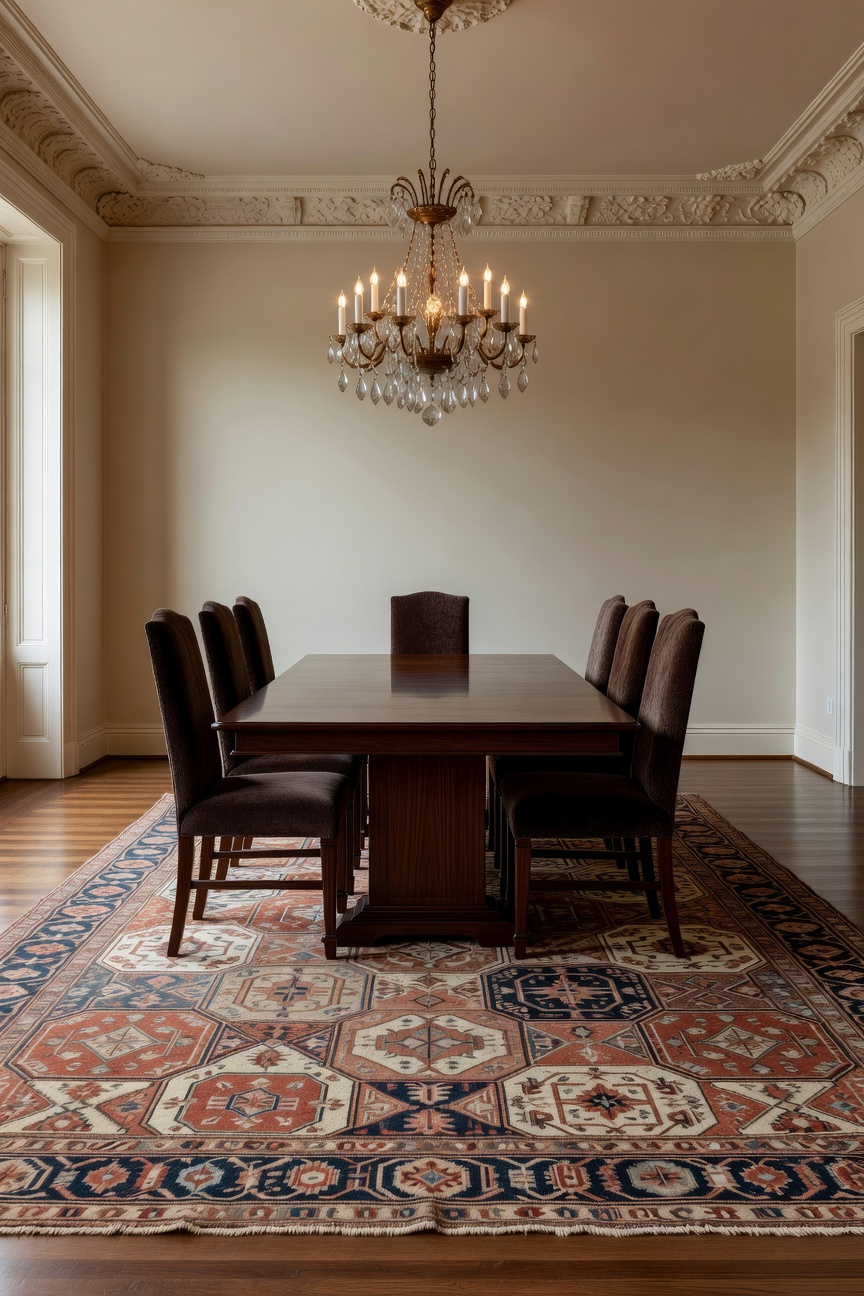
Conversely, the antique Oushak acts as a design chameleon. Originating from Western Turkey, these rugs soften the hard edges of wood finishes. Notably, the wool contains exceptional levels of natural lanolin. The pile exhibits a silky sheen that catches chandelier light. To verify authenticity, simply test the rug’s “handle.” A genuine antique Oushak should fold easily like a heavy blanket. If it feels stiff, it is likely a modern reproduction.
Beyond aesthetics, these pieces provide essential acoustic dampening. The dense, hand-spun wool absorbs the sharp clatter of silverware. The natural oils also offer surprising stain resistance against spills. Finally, expert collectors look for “abrash.” These painterly, horizontal color variations indicate different wool dye lots. This visual nuance proves the rug is a piece of living history.
In the traditional dining room, the mahogany table serves as an architectural anchor. Identifying a genuine period piece requires deciphering the wood’s unique biology. Genuine 18th-century mahogany displays chatoyancy, a gem-like shimmer where the grain appears to move. Connoisseurs look for dramatic patterns like “Flame” or the rare “Plum Pudding” figure. Furthermore, authentic Georgian tables are typically solid timber, not thin veneers over inferior wood.
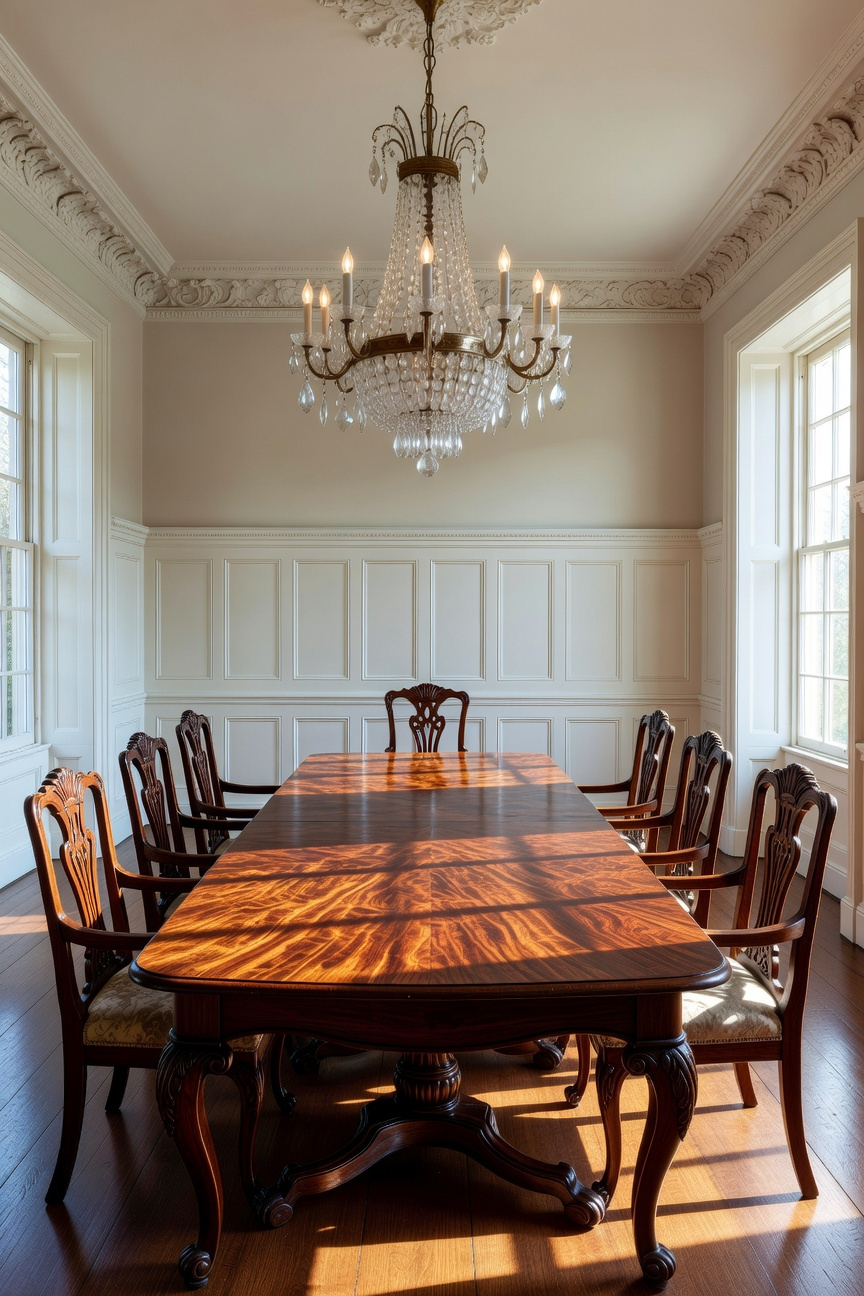
To verify age, you must examine the table’s underside. Surprisingly, a genuine period table will feel slightly undulating or “rippled” to the touch. This distinct texture results from the hand-planes used by apprentices centuries ago to level the surface. Conversely, modern reproductions feel perfectly flat and lack this tactile history. Additionally, inspect the joinery for hand-cut dovetails, which feature uneven spacing and skinny pins.
Preservation involves maintaining the wood’s unique ability to interact with light. Historically, mahogany was prized for how it warmly reflected candlelight during the “theatre of dining.” Therefore, you must protect the patina, a microscopic layer that softens this reflection. Never sand an antique table to remove scratches. This erases its historical value. Instead, use a high-quality Carnauba wax once a year to feed the wood. Finally, keep room humidity levels stable to prevent the solid wood from cracking.
The distinction between Queen Anne and Chippendale silhouettes represents a fundamental shift in the 18th-century social psyche. Design moved from a pursuit of “quiet comfort” to an expression of “global status.”
First, consider the Queen Anne style, developed around 1720. Historically, this silhouette introduced a “crooked” back intended to mimic the human spine. The sensory experience is one of ergonomic support. Crafted during the “Age of Walnut,” these chairs feature solid, vase-shaped splats. Because walnut is relatively soft, the carving remained smooth and restrained.
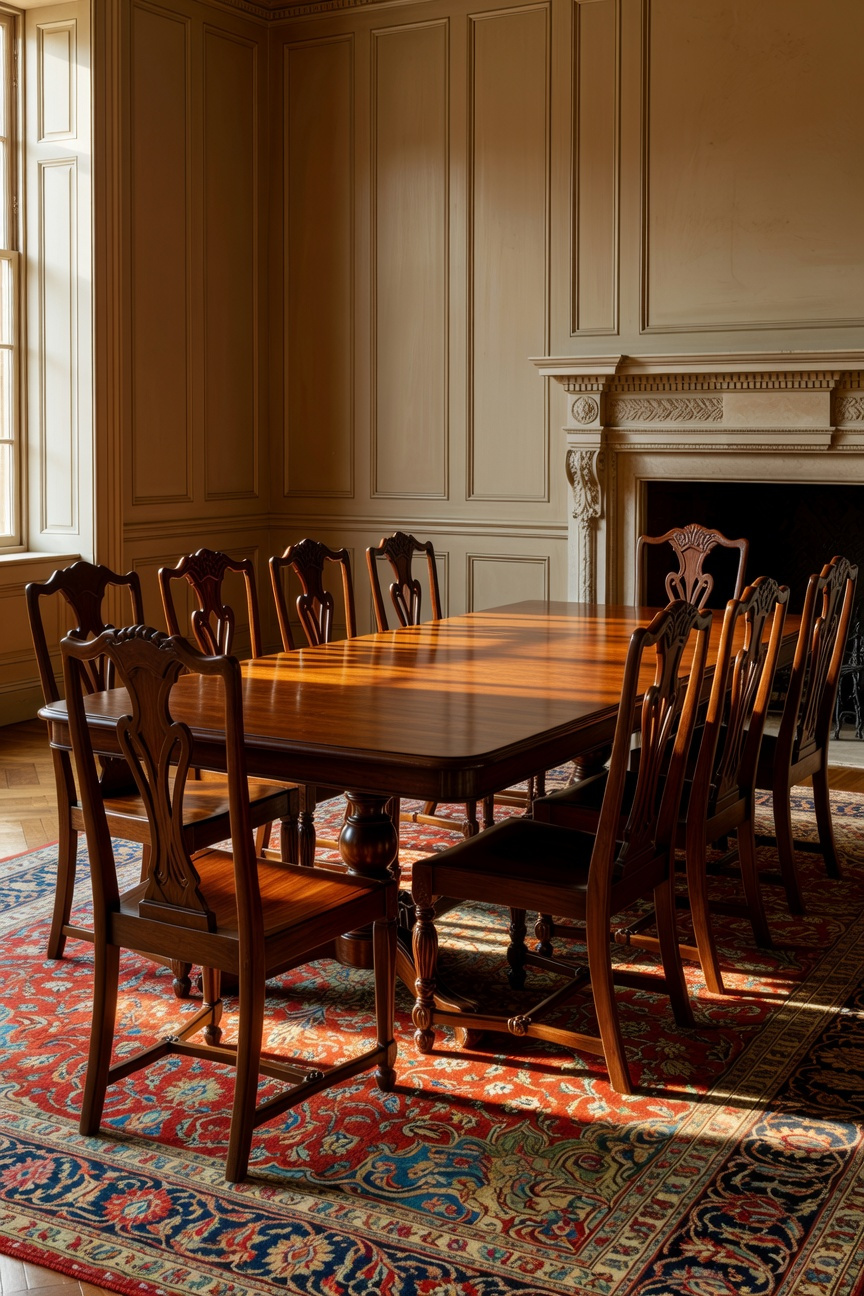
Conversely, the 1750s brought the “Majesty of Mahogany” and the Chippendale revolution. Coinciding with the importation of denser West Indian Mahogany, the physical silhouette changed. This stronger timber allowed cabinetmakers to carve intricate details that would snap in walnut. Thomas Chippendale “exploded” the solid splat into delicate, interlaced webs.
The crest rail shifted from a smooth yoke to a flaring “cupid’s bow.” Thus, a Chippendale chair offers a more architectural, crown-like presence at the table.
Structurally, both styles share the cabriole leg, known as the “leap of the goat.” However, the foot often reveals the chair’s true identity. Typically, a Queen Anne leg terminates in a simple pad foot. In contrast, a Chippendale leg often ends in a ball-and-claw foot. This motif, borrowed from Chinese mythology, signaled the owner’s awareness of international trade. Distinguishing these styles helps you balance heritage with sophisticated detail.
The reintroduction of the “Captain’s Chair” signals a distinct shift from uniform dining sets toward narrative-driven hosting. Historically, these chairs were engineered for stability on English ships before transitioning to the American Federal home. Later, they became “head chairs,” providing a physical boundary of authority. However, this hierarchy offers more than social posturing. In fact, it functions as a vital communication hub.
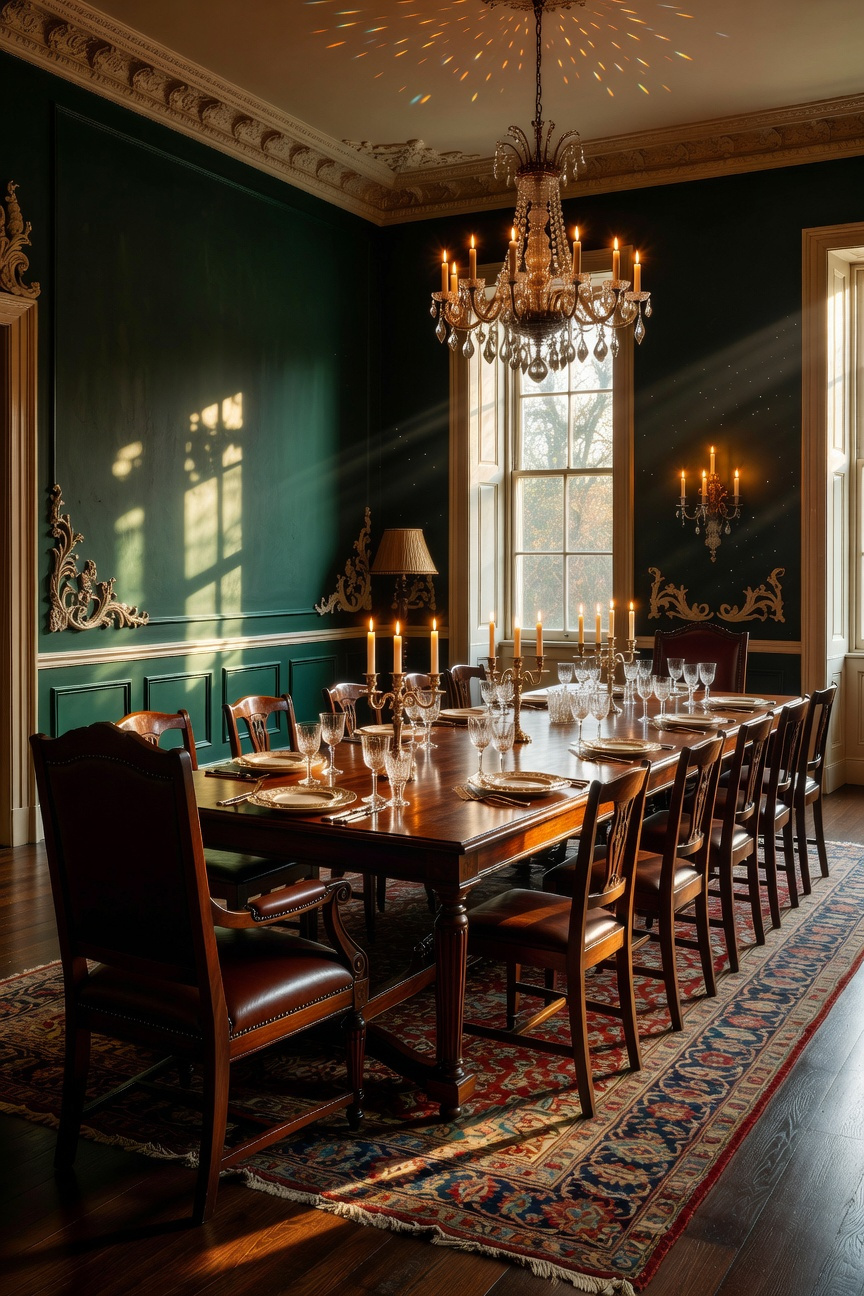
Environmental psychology suggests that defining territory with a distinct chair reduces social anxiety. When a host claims a larger seat, it signals a “safe harbor” for guests. Consequently, the host assumes the burden of directing the evening. This allows guests to relax. Technically, designers achieve this distinction through “visual weight.” Often, a traditional host chair stands inches taller than the flanking side chairs.
Current trends favor a “mismatched but curated” aesthetic. Pairing restrained linen side chairs with a statement leather host chair creates material contrast. Additionally, the “creak and settle” of quality leather adds a layer of lived-in luxury. Ideally, seat heights remain consistent to avoid a “zigzag” eye-line, while back heights vary. The modern host uses this architectural authority to include everyone. Therefore, the “Captain’s Chair” effectively steers conversation, ensuring no guest is left in the social doldrums.
In the traditional dining room, furniture was never merely about storage. Instead, the sideboard served as the architectural anchor of the dining ritual. Originally just a simple plank, the concept evolved significantly under architect Robert Adam in the 1760s.
Specifically, Adam introduced a unified three-part ensemble. This design featured a central table flanked by pedestal cupboards topped with urns. These pieces transformed from basic utility into a formal display of wealth. One pedestal often housed a lead-lined “cellarette” for cooling wine, while the other warmed plates. Therefore, the furniture became an active participant in the choreography of the meal.
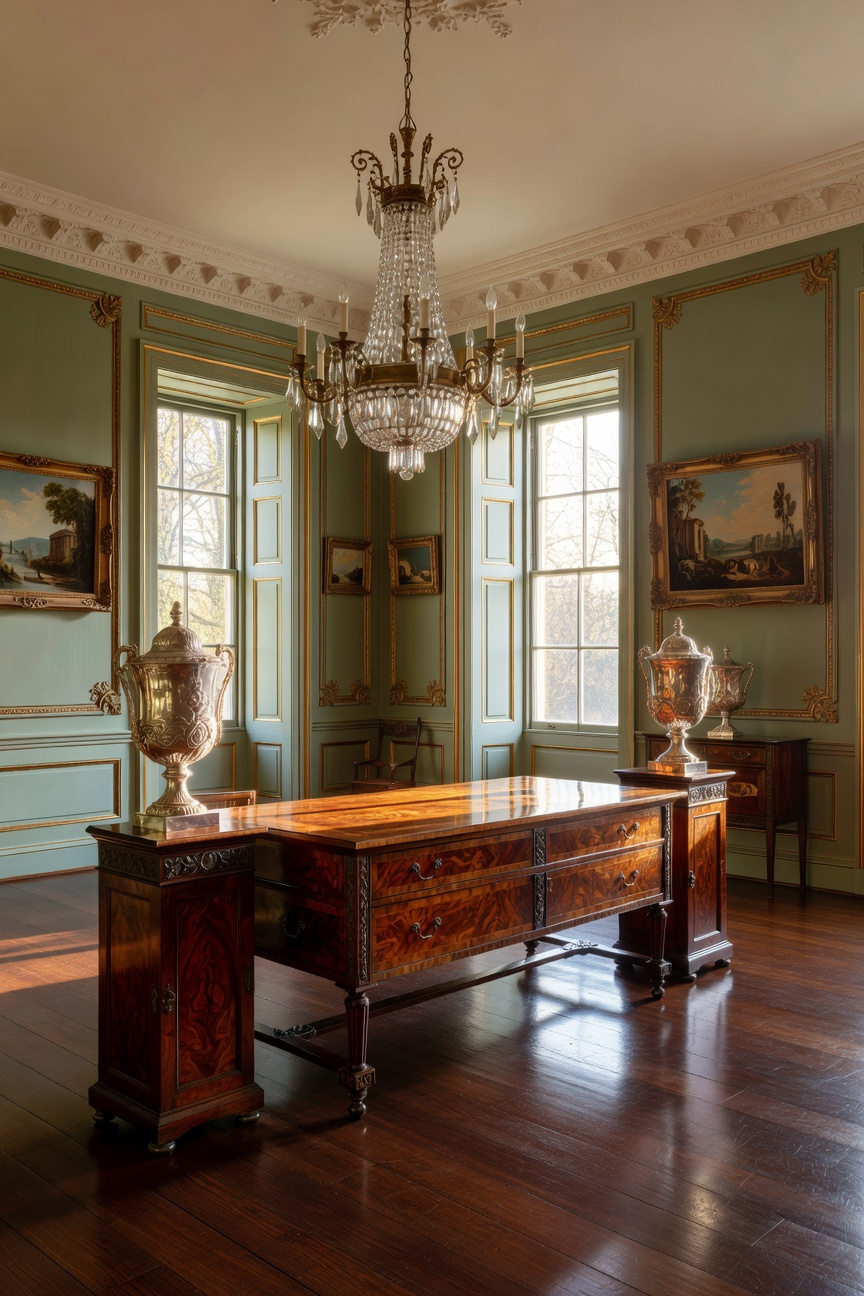
This design evolution directly reflected changes in service styles. The shift to *Service à la Russe* turned the sideboard into a high-traffic staging area. Food was carved here rather than at the table. Thus, designers prioritized waist-high, deep surfaces to allow footmen to work with surgical precision.
To support this heavy usage, mahogany became the standard material. Unlike rustic oak, mahogany is exceptionally dense and stable. Its mirror-like “French Polish” reflected candlelight. This doubled the visual glow of silver displays during dinner.
While modern retailers use terms interchangeably, distinct historical nuances remain. The “credenza” holds perhaps the most fascinating lineage. Tracing back to the Italian Renaissance, its name implies “trust.” Servants tasted food on this low cabinet to ensure it was not poisoned. Consequently, the piece was designed lower than a buffet. This allowed the seated host to witness this act of “credence.” Understanding these origins helps homeowners preserve the authentic narrative within their space.
Historically, the breakfront acted as a room’s architectural anchor. Its projecting center broke up massive walls to signal status. Successful curation treats this central section as a “vertical theater.” You should place “hero” pieces here to leverage natural shadows. Conversely, the recessed wings support the main display without competing for attention.
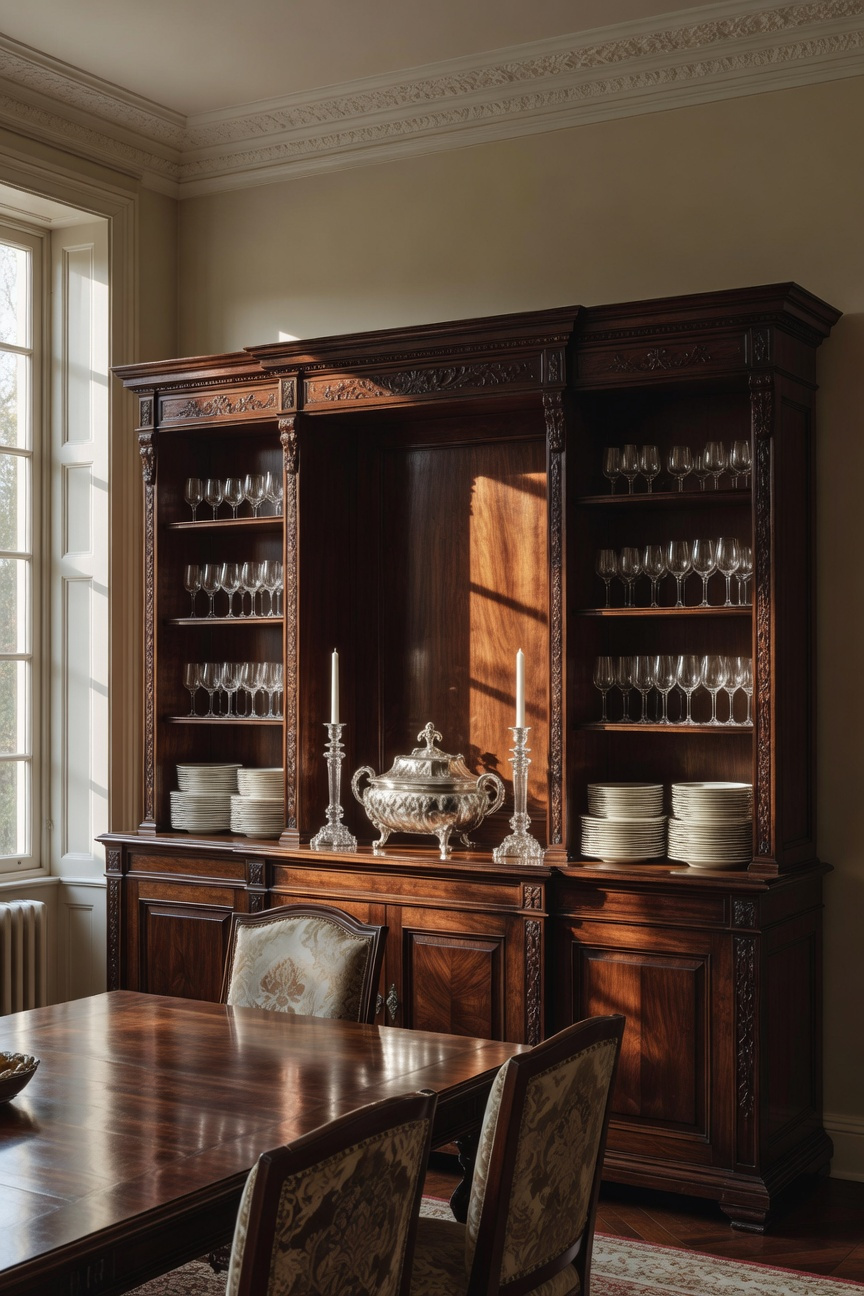
However, a common mistake is overcrowding. To avoid this, designers advocate for the 50/50 rule. Objects should occupy only half of the shelf’s surface area. This negative space acts as a frame. Furthermore, avoid lining items up rigidly. Instead, adopt a “Zig-Zag” arrangement for visual movement. Place a tall item on the left, then the middle, then the right. Consequently, the eye travels in a rhythmic “S” curve.
In addition to spacing, consider depth. Traditional cabinetry often features plate grooves for a reason. Use them to prop large platters against the back. Then, layer smaller items in the foreground using the Rule of Three.
Finally, update the sensory experience with modern technology. Specifically, install 2700K LED strips. These mimic the warmth of candlelight while preserving the wood’s “flame” grain. This approach transforms storage into a refined narrative.
Establishing a true “Illumination Hierarchy” requires understanding both social history and material science. Historically, a chandelier served as a significant status beacon. Therefore, correct placement is essential for the room’s psychology. Specifically, the fixture should hang 30 to 36 inches above the table. This height creates an intimate “halo” while maintaining clear sightlines.
Beyond placement, the material quality defines the atmosphere. Authentic lead crystal possesses a high Color Rendering Index (CRI). Consequently, this spectrum warms skin tones and enhances the vibrancy of food.
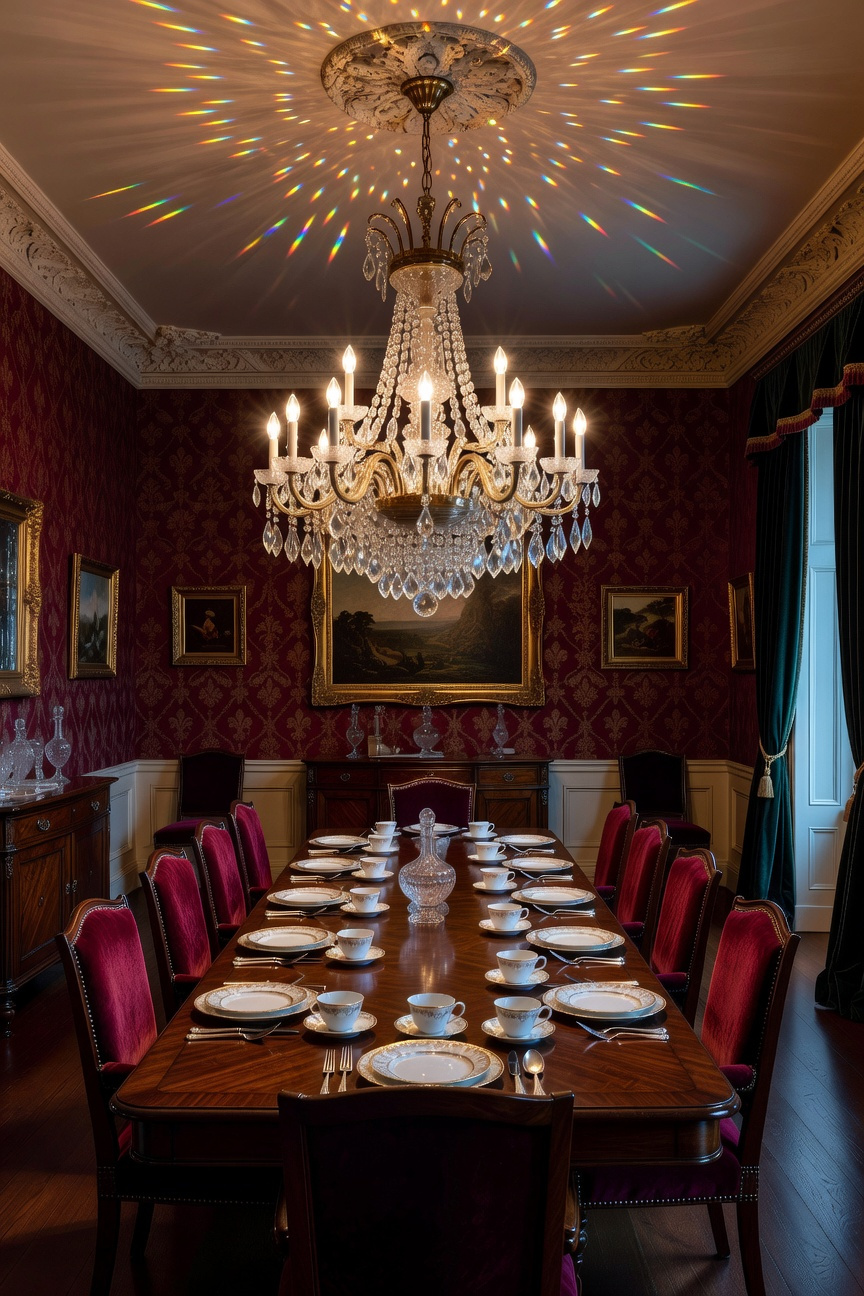
When sourcing, you must distinguish between regional philosophies. French Baccarat focuses on “rock crystal” clarity. Conversely, Irish Waterford utilizes deep cuts to create “rainbow fire” through chromatic aberration. However, acquiring the piece is only the beginning. Successful restoration balances historical purity with modern safety.
Crucially, one must preserve the “patina.” Traditionalists argue against over-polishing metal frames, as natural oxidation proves age. Instead, use non-abrasive ionic cleaners to remove grime without stripping the finish.
Furthermore, modern safety requires “invisible” rewiring. Skilled restorers snake fabric-covered wires through hollow castings to hide 21st-century technology. Finally, ensure any replacement crystals match the original “lead tint.” New, perfect glass looks dead next to the character-rich impurities of antique prisms.
In a traditional dining room, atmospheric lighting relies on more than just brightness. It requires a strategic interplay between the table and the surrounding walls. While a chandelier anchors the space, it often creates a “cave effect” where corners vanish. Therefore, wall sconces serve as an essential supporting layer to resolve this imbalance. By illuminating vertical surfaces, they define the perimeter and showcase architectural details like wainscoting.
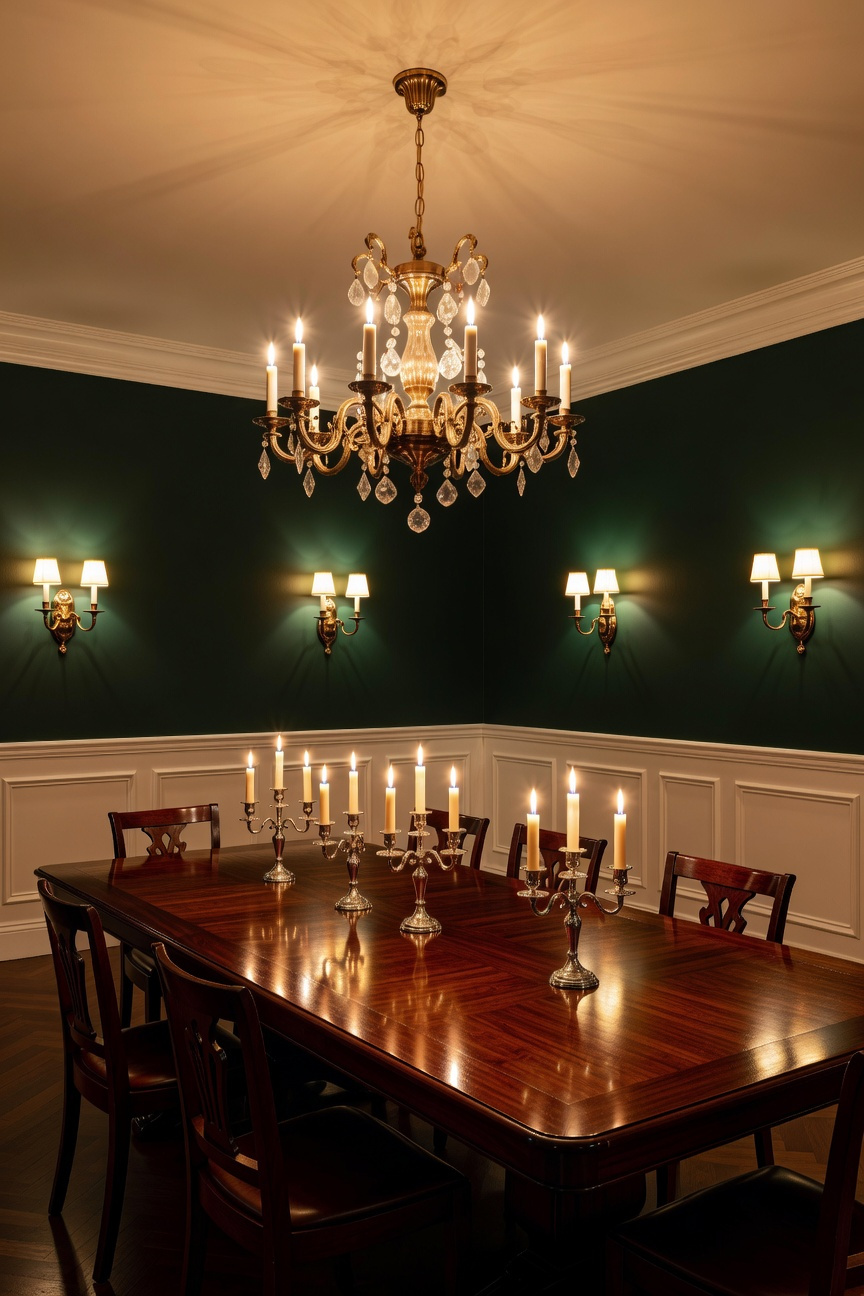
Precise placement enhances this sense of enclosure. Lighting experts recommend installing sconces at eye level, typically 60 to 66 inches from the floor. Consequently, the light remains in the peripheral vision of seated guests. Historically, builders used reflective backplates of mirror or polished brass to amplify this glow. In modern applications, this interaction creates a “seated sightline” that fosters human connection without visual clutter.
Beyond structure, these layers introduce the artistic concept of chiaroscuro. The intentional contrast between light and shadow adds three-dimensionality to the room. Additionally, the inclusion of actual candlelight provides a kinetic energy that static electric bulbs cannot match. The flame’s subtle movement gives the space a pulse, preventing a formal room from feeling sterile. Moreover, the warm 1800K color temperature acts as a biological “sunset” signal for the body. Ultimately, these atmospheric layers shift the mood from functional work to intimate ritual.
Window treatments in a traditional dining room act as more than mere decoration. In fact, they function as the room’s architectural and acoustic anchor. Professional dressing relies on mathematical ratios to ground the space effectively. For instance, the swag portion should occupy approximately one-fifth of the total vertical distance. A standard eight-foot ceiling requires a 16-inch drop to avoid looking skimpy. Furthermore, tiebacks should generally follow the Golden Mean to ensure visual balance. Position them one-third down for drama or two-thirds down for a low-slung, traditional silhouette.
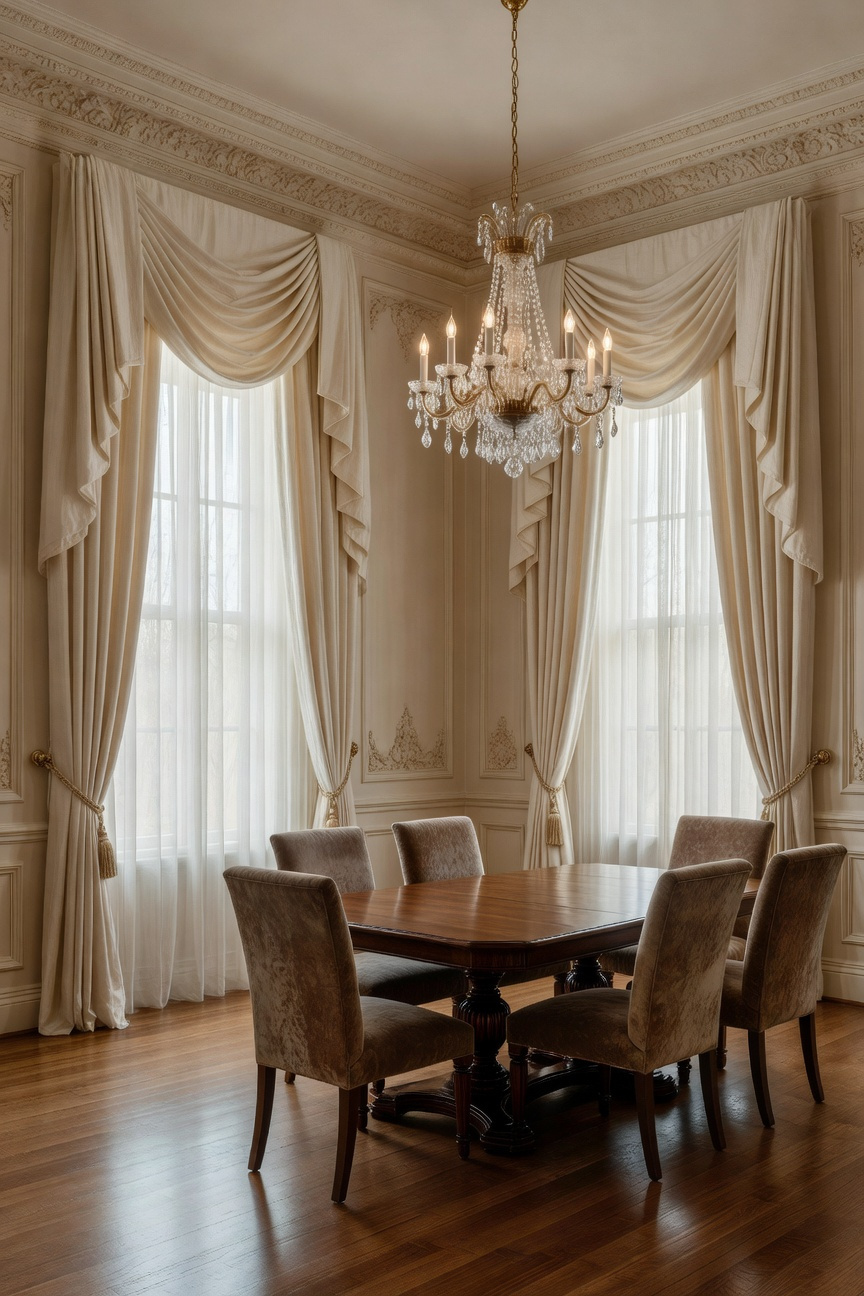
Beyond geometry, achieving the fluid “smile” shape of a swag requires technical mastery. Unlike standard curtains, masters cut these fabrics on the bias, or a 45-degree angle. This technique allows rigid linen to mold softly without angular creasing. Additionally, experts often “interline” the drapes with a thick flannel material called “bump.” As a result, this hidden layer adds thermal insulation and creates deep, three-dimensional pleats.
Historically, heavyweight linen signals a “matte luxury” reminiscent of Georgian restraint. However, modern functionality is equally important. Hard surfaces like mahogany tables often create harsh, bright echoes. Fortunately, the deep, irregular folds of lined linen act as sophisticated sound diffusers. By dampening high-frequency clatter, these treatments preserve the intimate “cone of conversation” essential for meaningful dining.
The traditional dining room serves as a distinct stage for choreographed hospitality. Upholstery choices must balance historical weight with the demands of modern living. Historically, the hallmark of luxury seating was firm horsehair padding. However, this material often lacks the plush softness required for today’s lingering meals.
To bridge this gap, designers now utilize a “technical sandwich” for the seat interior. Specifically, a high-density foam core is wrapped in layers of natural cotton batting. Consequently, the chair retains a crisp, tailored edge while yielding comfortably to the body.
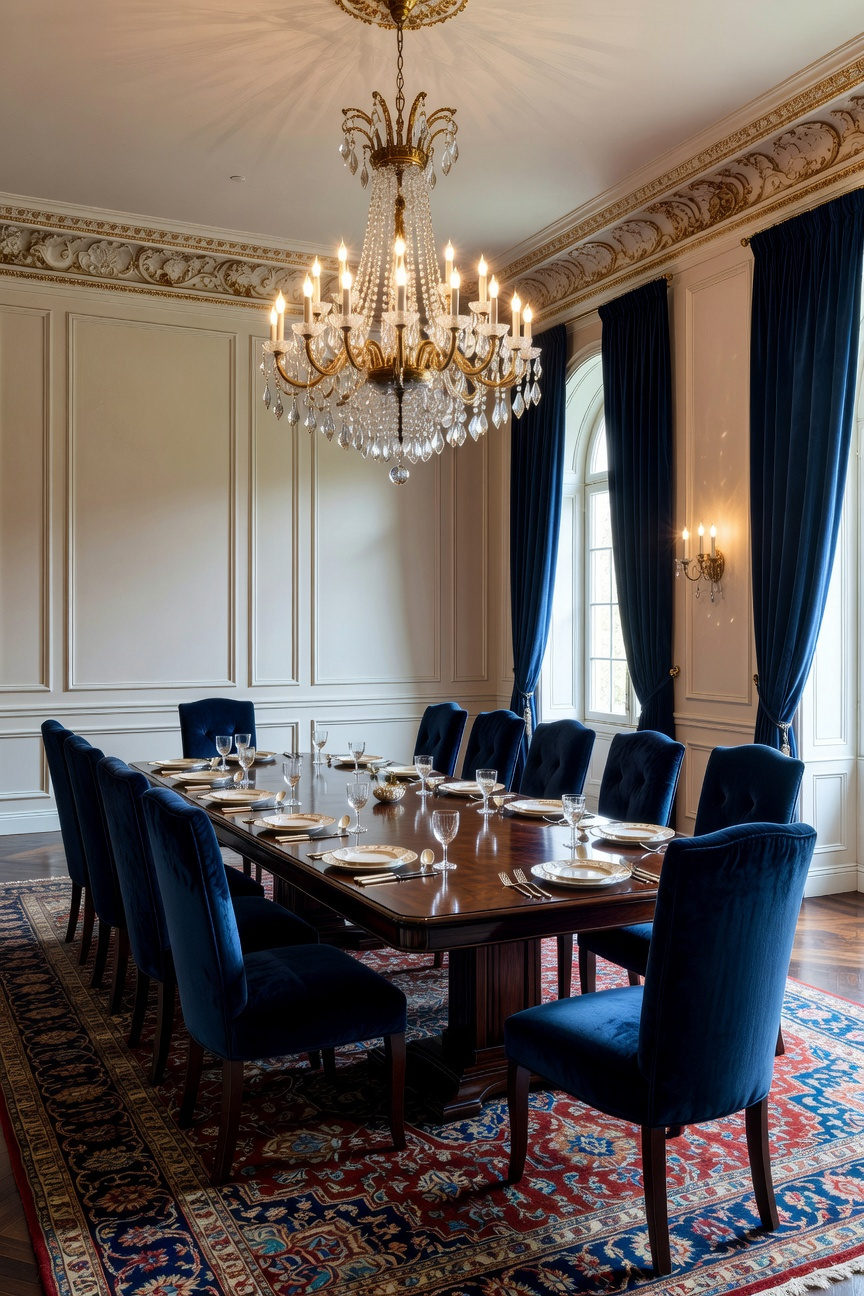
Beyond structure, the fabric itself faces the high-risk environment of dining. Previously, delicate silks or hand-blocked toiles required protective covers to survive spills. Fortunately, the narrative has shifted toward “integrated resilience.” Leading textile houses now produce performance jacquards using solution-dyed acrylics. These innovative weaves mimic the “dry” hand of 18th-century cottons perfectly. Homeowners can enjoy the visual scale of light fabrics without fearing wine stains.
Textiles also act as essential acoustic anchors within the room. Heavy-weight velvets or mohair absorb the clatter of silverware effectively. This creates the intimate “hush” associated with luxury dining experiences. Finally, the preservation of the antique furniture frame remains paramount. Rather than using damaging tacks, modern conservators often advocate for pneumatic staples. Thus, the chair survives as a functional heirloom rather than a fragile artifact.
Integrating modern technology into a historic dining room requires balancing mechanical engineering with high-stakes preservation. The goal is “sensory immersion.” Homeowners seek 21st-century comfort without breaking the aesthetic spell of the past.
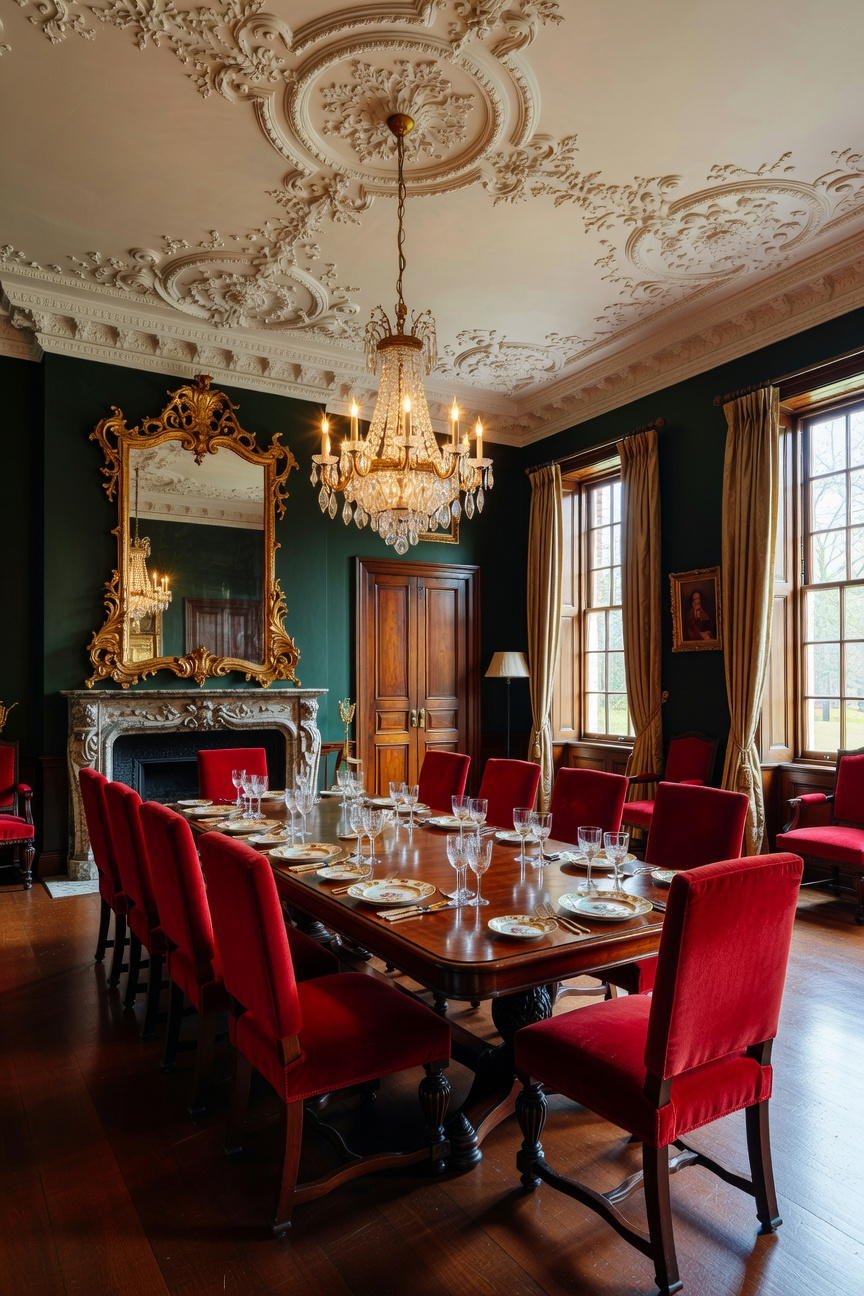
Consider the challenge of audio systems. Conventional speakers introduce “visual noise” that creates discord against ornate plasterwork. Therefore, modern restorations often utilize Vibrating Panel Technology. These invisible devices are plastered directly into the wall or ceiling. Consequently, the wall itself becomes the speaker, creating an omnidirectional “sound silk.” This eliminates the need for intrusive grilles.
Similarly, heating and cooling systems demand invisibility. Standard vents can destroy the visual integrity of period millwork. Engineers frequently use high-velocity mini-ducts snaked through floor joists. Often, the air handlers hide inside custom sideboards with breathable lattice fronts. Furthermore, the air discharges through discreet “toekicks” at the floor level.
This approach offers significant functional benefits beyond aesthetics. Jet induction technology creates a thoroughly draft-free environment. Guests seated in formal attire remain comfortable without feeling direct airflow. Moreover, the near-silence of these systems protects the nuance of dinner conversation. Finally, preservationists often employ faux artistry to conceal any necessary hardware. Magnetic vent covers are hand-painted to match mahogany paneling so perfectly they disappear. Ultimately, true luxury in a historic home is heard and felt, but never seen.
The traditional dining room serves a purpose beyond mere caloric intake. It functions as a deliberate architectural vessel for family heritage and heirloom furniture. Solid hardwoods and joinery provide physical endurance for generations to come. Meanwhile, the enclosed space creates a quiet theater for essential storytelling.
These rooms anchor our oscillating narratives against the digital world’s speed. We preserve our past while actively constructing our future identity.
Therefore, view your dining space as a long-term investment in connection. Treat it as a flexible backdrop for your family’s evolving traditions. This approach transforms a simple room into a sanctuary of continuity. Start by auditing your current furniture for authentic materiality. Look for solid woods that can accept the patina of daily life. Identify which heirlooms truly anchor your specific family story. Finally, curate your surroundings to support the history you wish to write.
A traditional dining room is defined by its formal structure, featuring architectural elements like wainscoting, crown molding, and a centered table (often mahogany or walnut). It typically emphasizes symmetry, rich color palettes, and period-appropriate lighting such as crystal chandeliers to create a sophisticated, dedicated space for social rituals.
To update a traditional space without losing its heritage, consider mixing textures. Pair a classic mahogany table with contemporary linen-upholstered chairs, or introduce modern artwork against deep, heritage-colored walls. Using “invisible technology” for audio and HVAC also provides modern comfort while maintaining a timeless aesthetic.
Deep, saturated hues like Prussian Blue, forest green, or burgundy are classic choices for a formal atmosphere. These colors provide a dramatic backdrop that makes silver and porcelain settings stand out. For a lighter approach, “broken whites” or soft champagne tones can maintain elegance while feeling more airy.