Physical Address
304 North Cardinal St.
Dorchester Center, MA 02124
Physical Address
304 North Cardinal St.
Dorchester Center, MA 02124
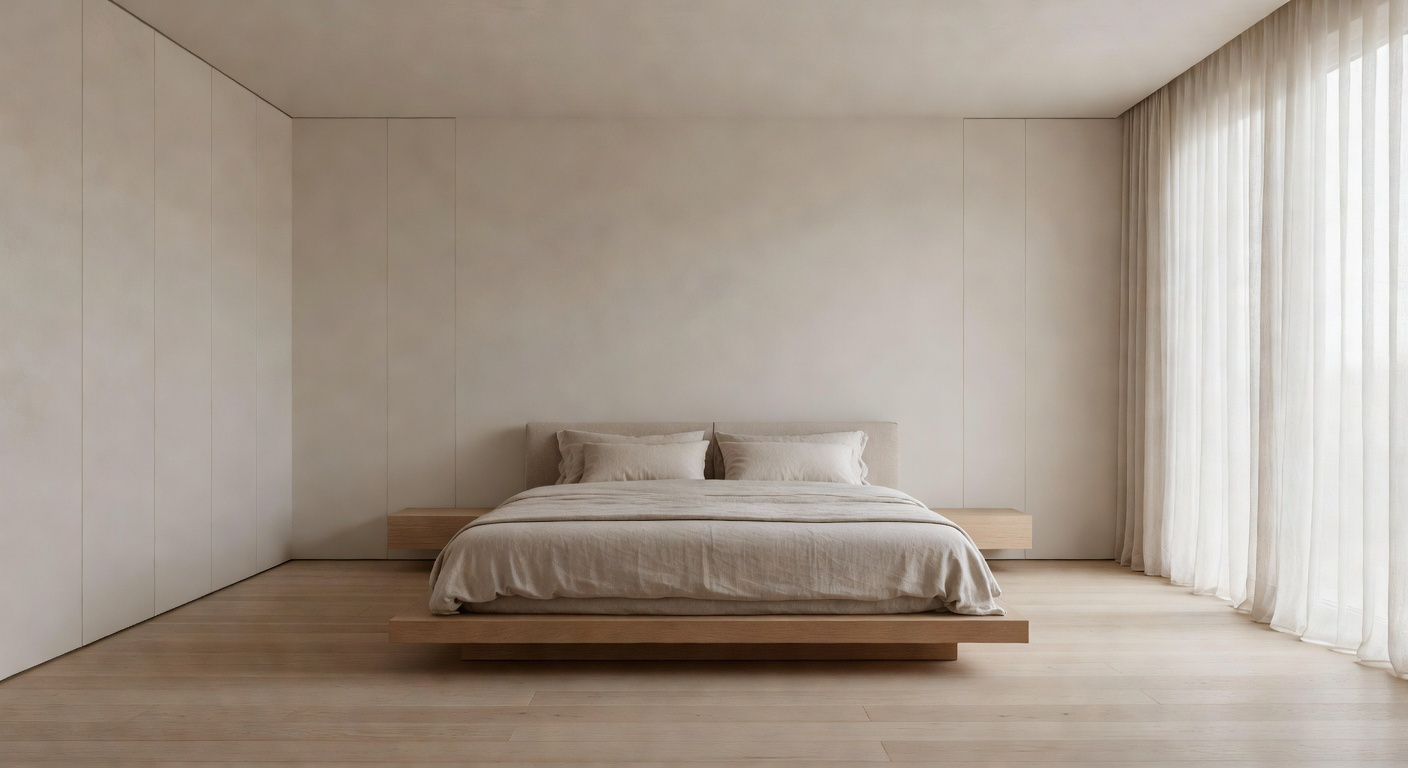
Transform your master suite into a sanctuary. Discover the 17 architectural secrets of luxury bedroom design, from acoustic mastery to circadian lighting. Read the guide.
Many view the bedroom merely as a functional space for sleep. However, deep spiritual restoration requires a deliberate separation from daily life. We navigate a world defined by constant, high-stimulation noise. Therefore, our private sanctuaries must offer a profound architectural counterpoint.
Achieving exceptional luxury bedroom design utilizes a “psychological airlock” to manage this shift. This transitional zone acts as a distinct barrier against external chaos. As a result, the mind begins to shed tension before you even enter the suite.
Once inside, the environment must actively engineer a sense of release. Acoustic dampening materials, for instance, effectively eliminate distracting environmental noise. Simultaneously, lighting plays a critical role in this physiological descent. We deliberately replace harsh overhead beams with a layered, warm-toned scheme. This soft illumination signals the body to slow down immediately.
Tactile textures also anchor the occupant in the present moment. Physical interactions with velvet or wood replace the coldness of public spaces. Finally, visual restraint completes the experience of total calm. Tonal palettes allow every hue to melt seamlessly into the next. Thus, the eye encounters no demanding contrasts or sharp edges.
Invisible storage solutions hide the distraction of daily clutter. A clutter-free room naturally creates a safer, more peaceful mental state. This guide reveals the architectural strategies used to craft this stillness. We will examine how to design a true descent into tranquility, fostering true restorative sleep.
In the modern world, silence has become the ultimate luxury commodity. Consequently, the concept of “Quiet Luxury” transcends simple soundproofing. It is actually a holistic, multi-sensory discipline. Specifically, true silence requires reducing visual “noise” alongside auditory disturbances. We utilize calming, low-chroma palettes to lower cortisol levels. This prevents mental overstimulation.
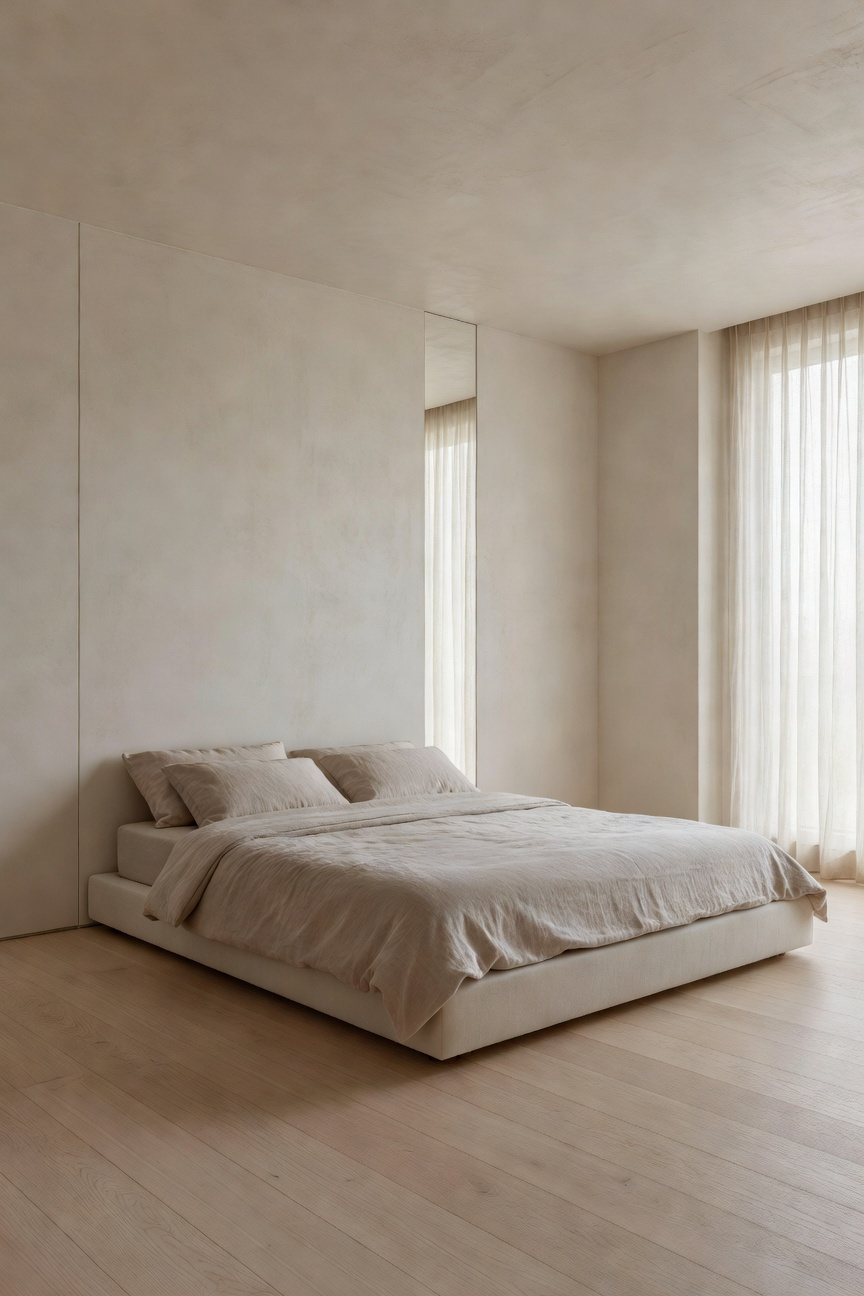
To achieve this restorative state, we must employ clinical-grade engineering. The “room-within-a-room” strategy is the architectural gold standard for isolation. Technically, this involves decoupling the interior drywall from the building’s frame using resilient clips. This physical separation prevents structure-borne sounds, like footsteps, from entering the sanctuary. Adding high-mass materials like Mass-Loaded Vinyl converts sound energy into negligible heat.
However, a peaceful bedroom should never feel clinical or sterile. Instead, we integrate sound-absorbing materials directly into the aesthetic design. Heavy floor-to-ceiling drapery creates a “cocoon-like” effect that dampens distinct echoes. Similarly, deep-pile neutral rugs anchor the sleep zone while absorbing noise. An oversized upholstered headboard even functions as a hidden sound panel behind the bed. Ultimately, these elements ensure the space meets high wellness standards for true serenity.
To truly relax, we must address the invisible architecture of sound. Minimizing noise is essential for maintaining a restorative mental state. Upholstered wall panels offer a sophisticated solution for this sensory need. While the fabric provides aesthetic beauty, the hidden acoustic core performs the heavy lifting. In fact, these high-quality cores can absorb up to 100% of incident sound. As a result, the room’s reverberation drops significantly. This creates a “symphony of silence,” effectively reducing the cognitive fatigue caused by subtle echoes.
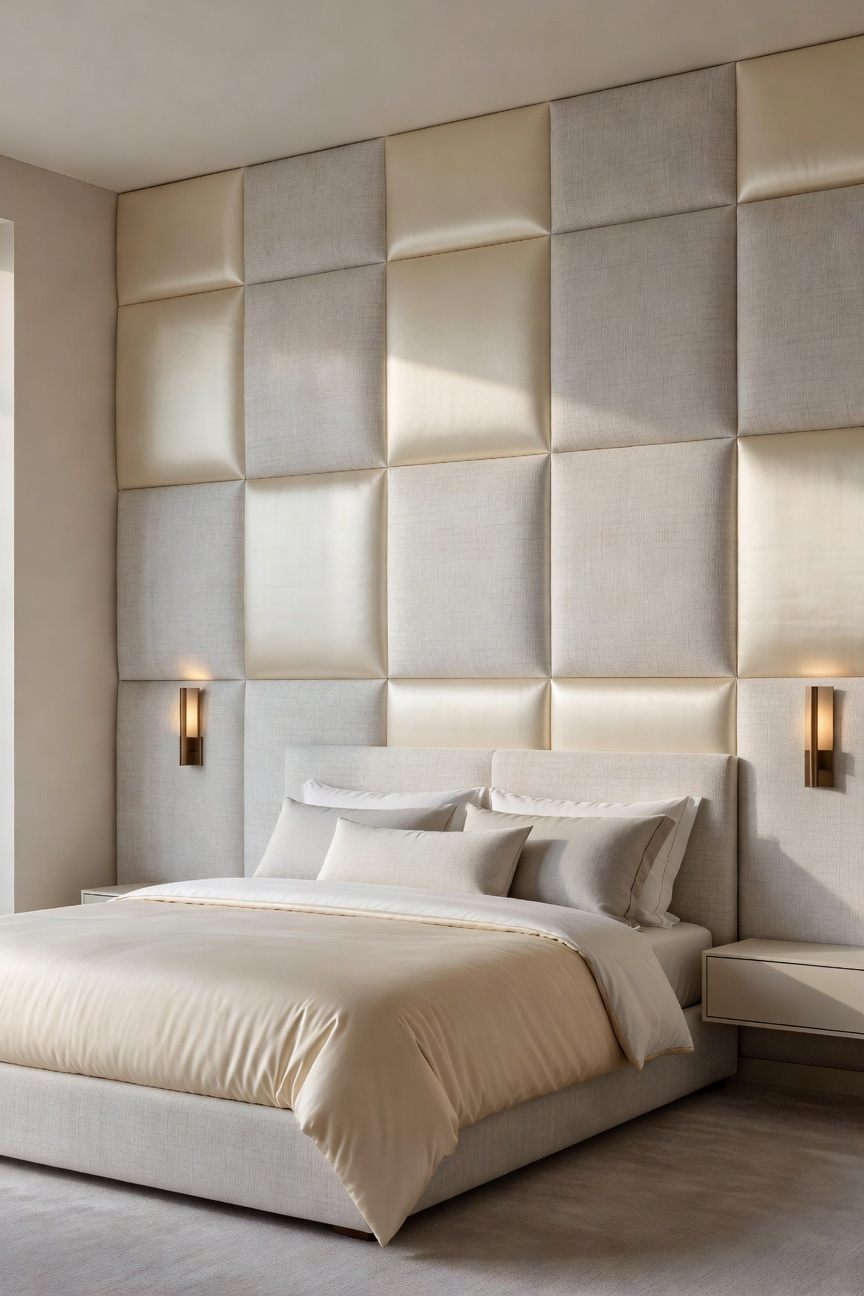
The choice of fabric sets the room’s emotional tone. Silk adds an air of formal opulence. Its natural luster catches the light, creating a soft, dramatic visual focus. Conversely, linen aligns with the principles of “Quiet Luxury” and organic modernism. Its matte, organic texture offers a grounding, earthy feel. It serves as a haptic anchor for mindfulness practices. Historically, this technique mirrors the use of heavy tapestries to dampen noise in stone castles. Today, bespoke installation transforms these walls into architectural millwork rather than simple decor.
True sanctuary requires absolute silence. Standard hollow-core doors often fail to block domestic noise. Consequently, the brain remains subconsciously vigilant against “auditory bleed,” constantly filtering out footsteps or voices. Research shows this perpetual alertness raises cortisol levels and fragments restorative sleep. A high-mass door serves as a neurological necessity rather than a mere aesthetic choice.
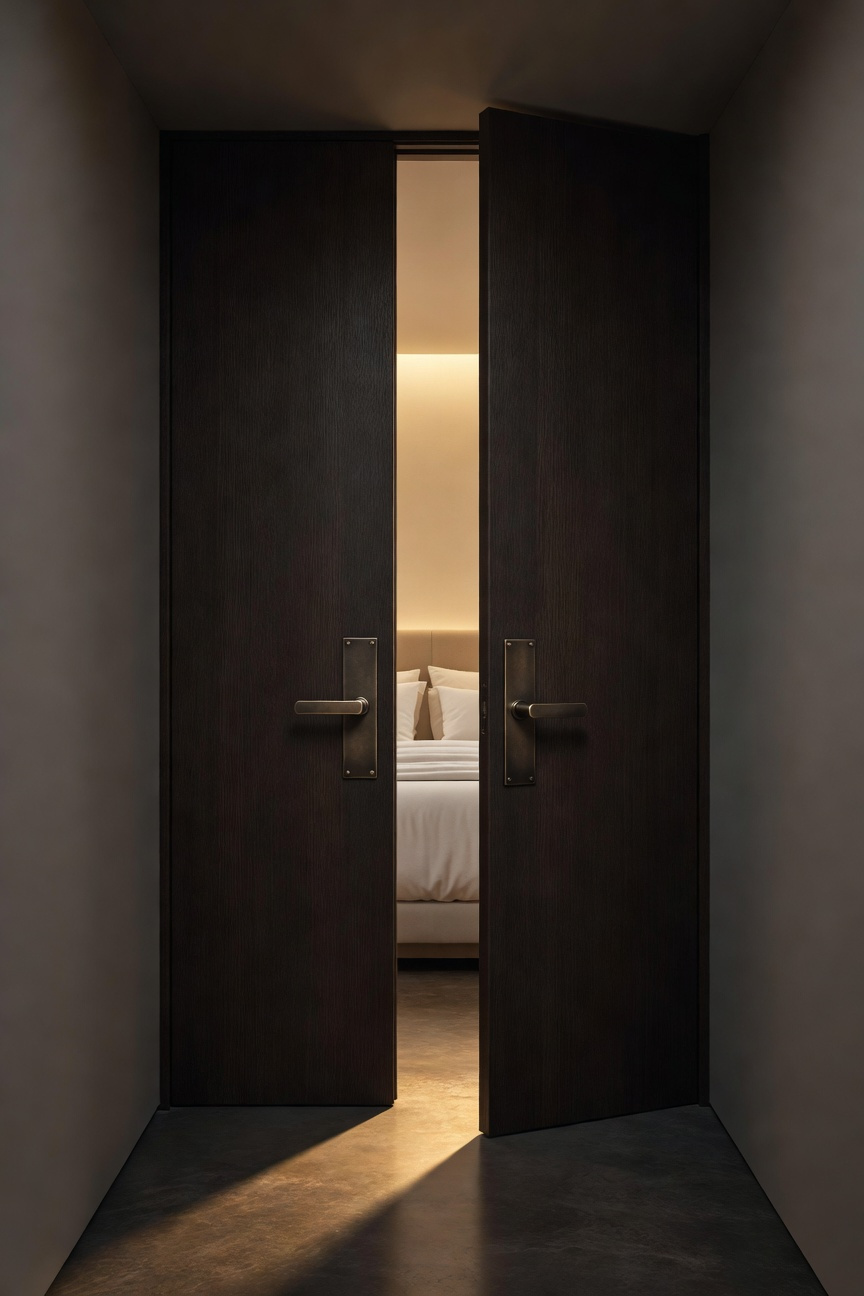
Specifically, the door assembly should achieve a Sound Transmission Class (STC) rating of 35 or higher. This density ensures that loud speech remains audible but unintelligible. The occupant gains a profound sense of control over their environment. Moreover, the physical sensation of the door communicates safety. Unlike the high-frequency rattle of standard construction, a solid core produces a grounding, low-frequency “thunk” upon closure. This acoustic signature signals solidity to the nervous system.
Hardware plays a crucial role in this tactile experience. Heavy-duty hinges and precision-machined locksets handle the door’s significant weight. Proper sealing mechanisms eliminate air gaps that allow sound to leak through. Historically, massive doors symbolized defense and power in grand architecture. Today, they effectively seal out the chaotic world.
Creating a true sanctuary requires more than just visual appeal. The “cocoon” effect relies heavily on sensory isolation. Therefore, utilizing dense textiles builds a necessary acoustic envelope. Heavy velvet drapery acts as a sophisticated sound barrier. When installed ceiling-to-floor, the thick fabric effectively absorbs reflected noise. The room becomes hushed, fostering a deeply internalized atmosphere.
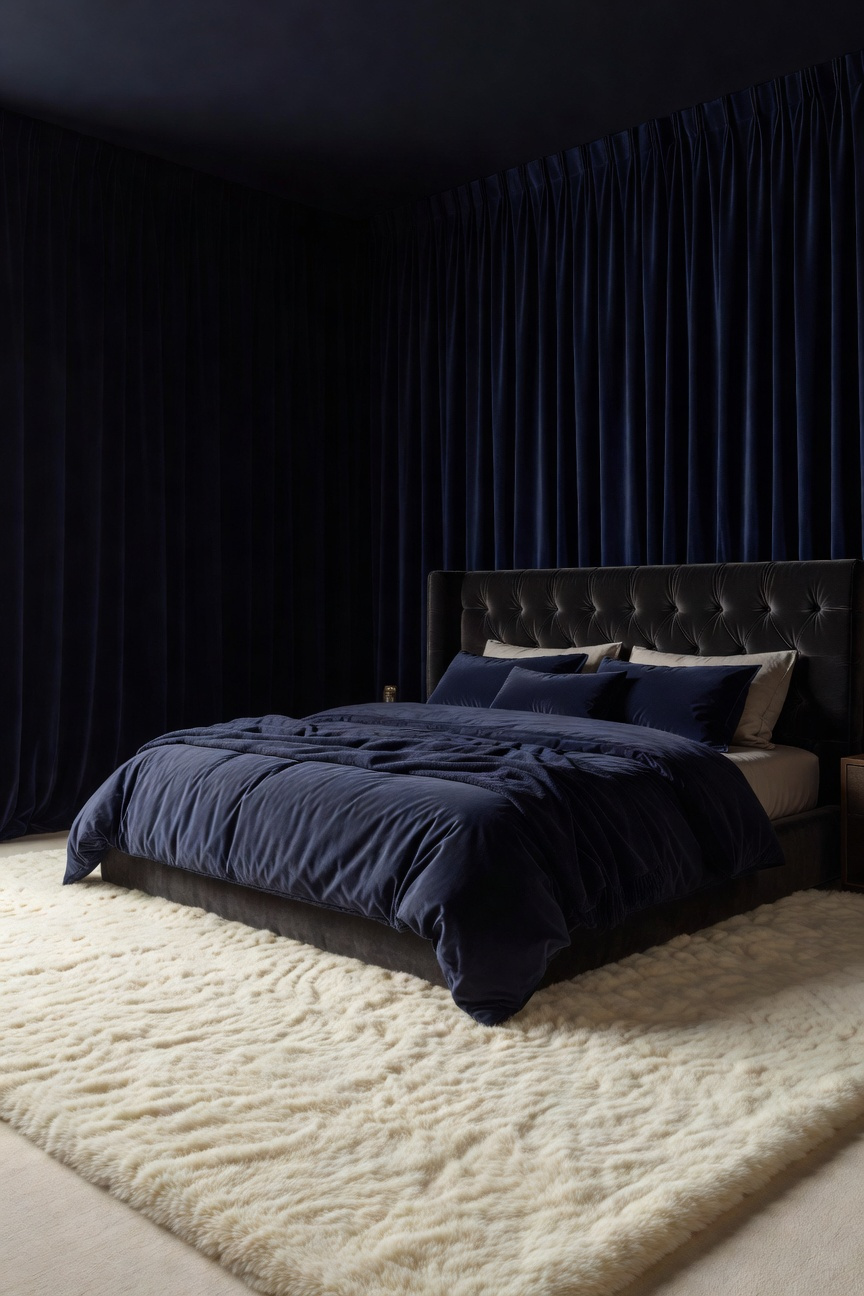
Beneath you, plush wool rugs serve a similar function. High-pile wool absorbs the sound of footsteps completely. Thus, movement within the space remains undisturbed and quiet. This silence preserves the sanctity of your meditation practice. It prevents jarring noises from disrupting a sleeping partner.
The tactile experience grounds the body physically. Stepping onto wool feels luxuriously like walking on clouds. This texture offers a gentle, inviting transition into the morning. Simultaneously, the visual depth of velvet adds significant warmth. The fabric’s nap causes colors to shift with the light. Furthermore, these layers provide practical thermal insulation against drafts. These heavy textures anchor the room, creating profound security.
True luxury design often embraces the philosophy of “Auditory Minimalism.” This concept prioritizes the complete absence of visual clutter. Therefore, we increasingly integrate sound systems directly into the room’s architecture. Invisible speakers, such as those from Stealth Acoustics, hide seamlessly behind drywall or plaster. The technology remains acoustically present but visually non-existent. This approach ensures your meditation space feels curated and serene.
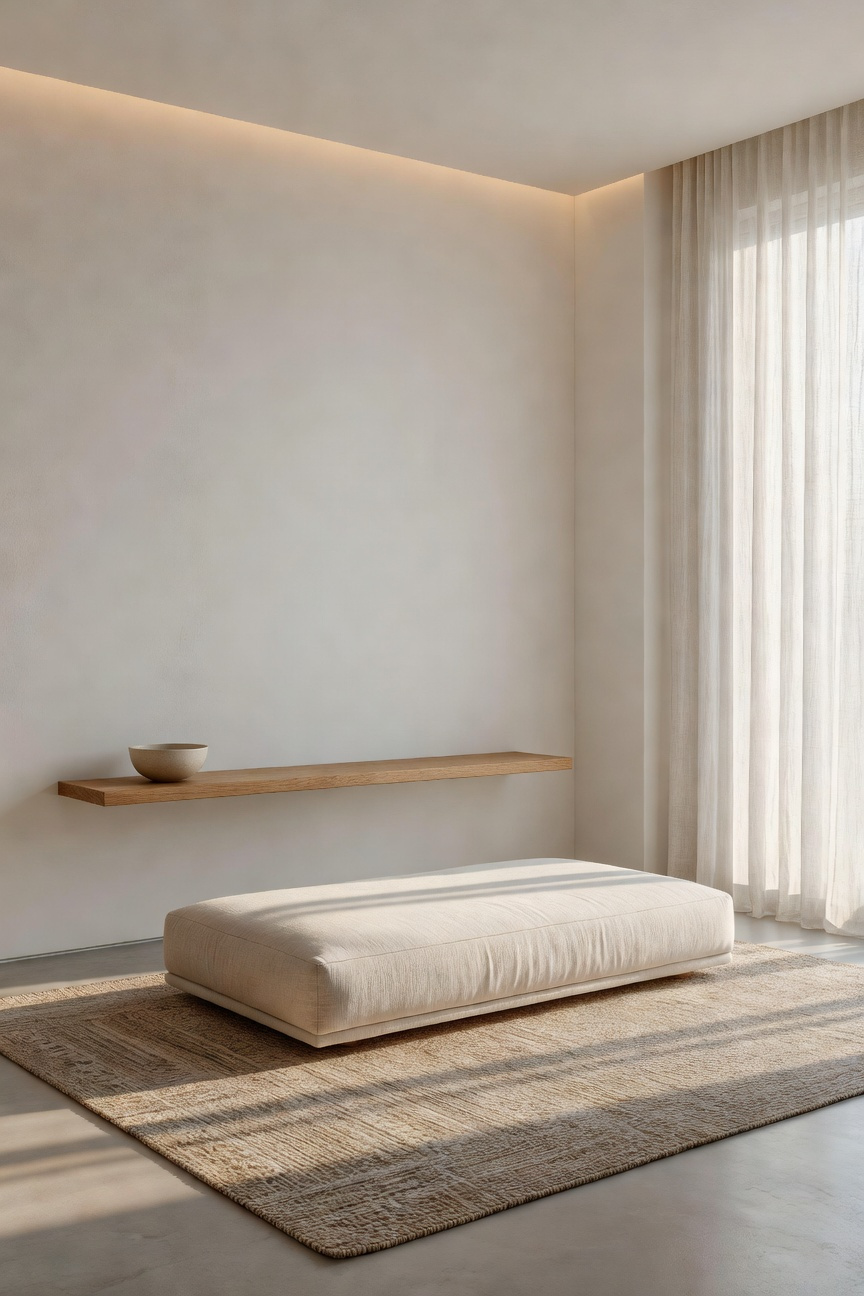
The quality of the sound is just as critical as its delivery. Traditionally, simple machines utilized “white noise,” which contains equal energy across all frequencies. Unfortunately, this often sounds harsh, resembling static. In contrast, advanced wellness designs now prefer “pink noise.” This acoustic spectrum emphasizes lower frequencies, mimicking natural textures like steady rain or wind. Research suggests pink noise synchronizes with the brain’s slow-wave oscillations. This significantly enhances deep, restorative sleep cycles.
Modern systems solve the subtle irritation of repetitive audio loops. The human brain is highly adept at recognizing patterns. Therefore, a repeating track can subconsciously disrupt your rest or focus. To combat this, we utilize generative AI algorithms. Platforms like Mubert analyze raw sounds to create non-repeating, abstract soundscapes. Thus, the audio becomes a responsive, “infinite” acoustic blanket.
Modern luxury bedroom design treats lighting as a vital biological tool. Human Centric Lighting (HCL) systems utilize Tunable White LED technology to mirror the sun. These systems adjust both color temperature and intensity automatically throughout the day. Morning settings emit a cool, bright light ranging from 4000K to 6500K. This blue-rich spectrum actively promotes alertness and cognitive function.
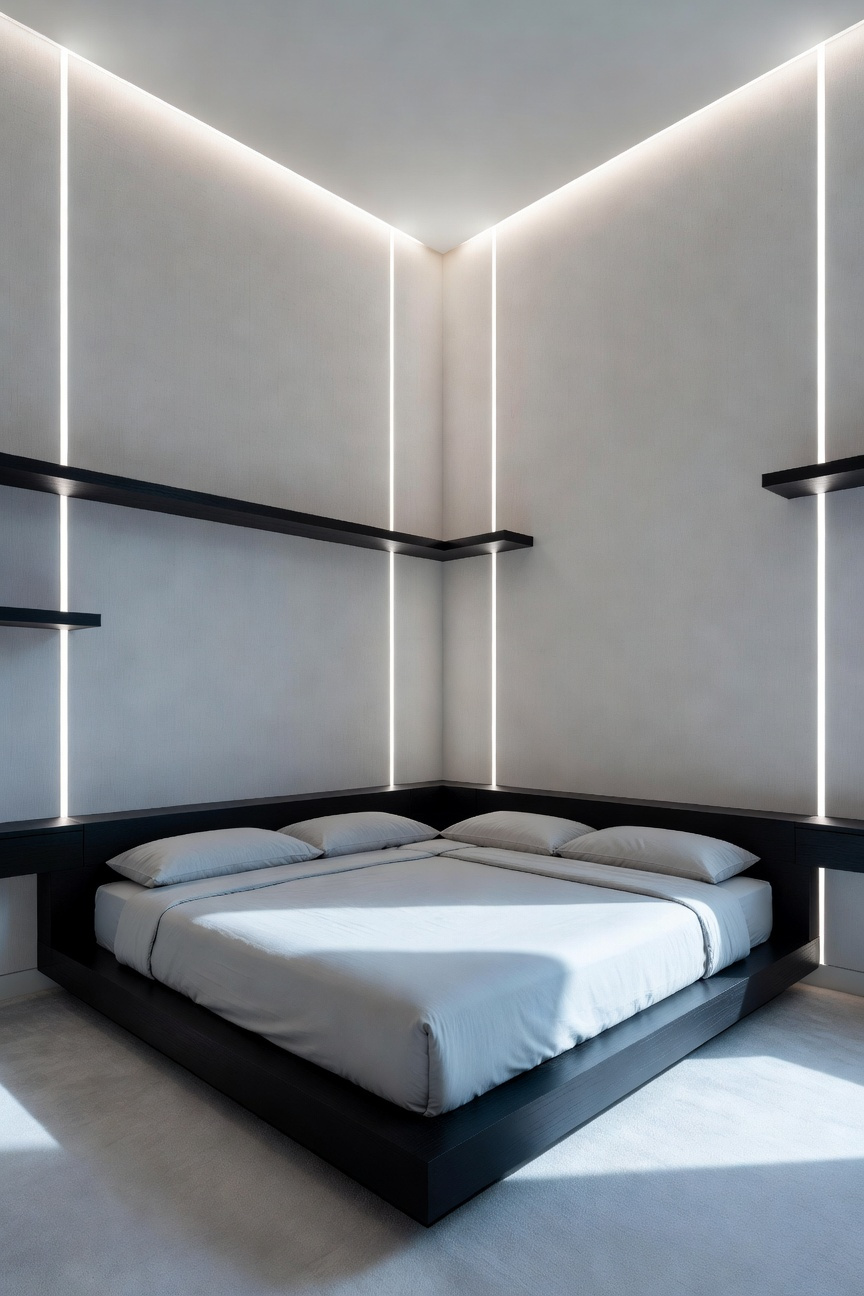
Evening modes shift to a warm, amber glow between 2200K and 3000K. In fact, advanced systems can lower temperatures to 900K, effectively mimicking a natural sunset. This reduction in blue light maximizes the body’s natural release of sleep-inducing melatonin. However, true harmony requires more than sophisticated bulbs. Ideally, design favors layers of diffused light that “wash” walls rather than harsh spotlights.
A critical principle involves the absolute elimination of “light pollution.” Concealing digital clocks, for instance, creates a “zero-blue” environment essential for rest. Interestingly, this concept is a modern revival of ancient healing philosophies. Historically, Egyptian temples and Greek solar therapy used the light spectrum for wellness. Modern automation delivers this ancient power with clinical precision, creating a sanctuary seamlessly attuned to your circadian rhythm.
True luxury now equates to absolute darkness. Physiologically, even low-level light suppresses melatonin production by over 50%. Consequently, our bodies struggle to initiate a natural night cycle without total obscurity. The goal of modern bedroom design is “zero lux.” This creates a momentary sensory deprivation experience. Ultimately, this allows the nervous system to fully reset, promoting profound rest.
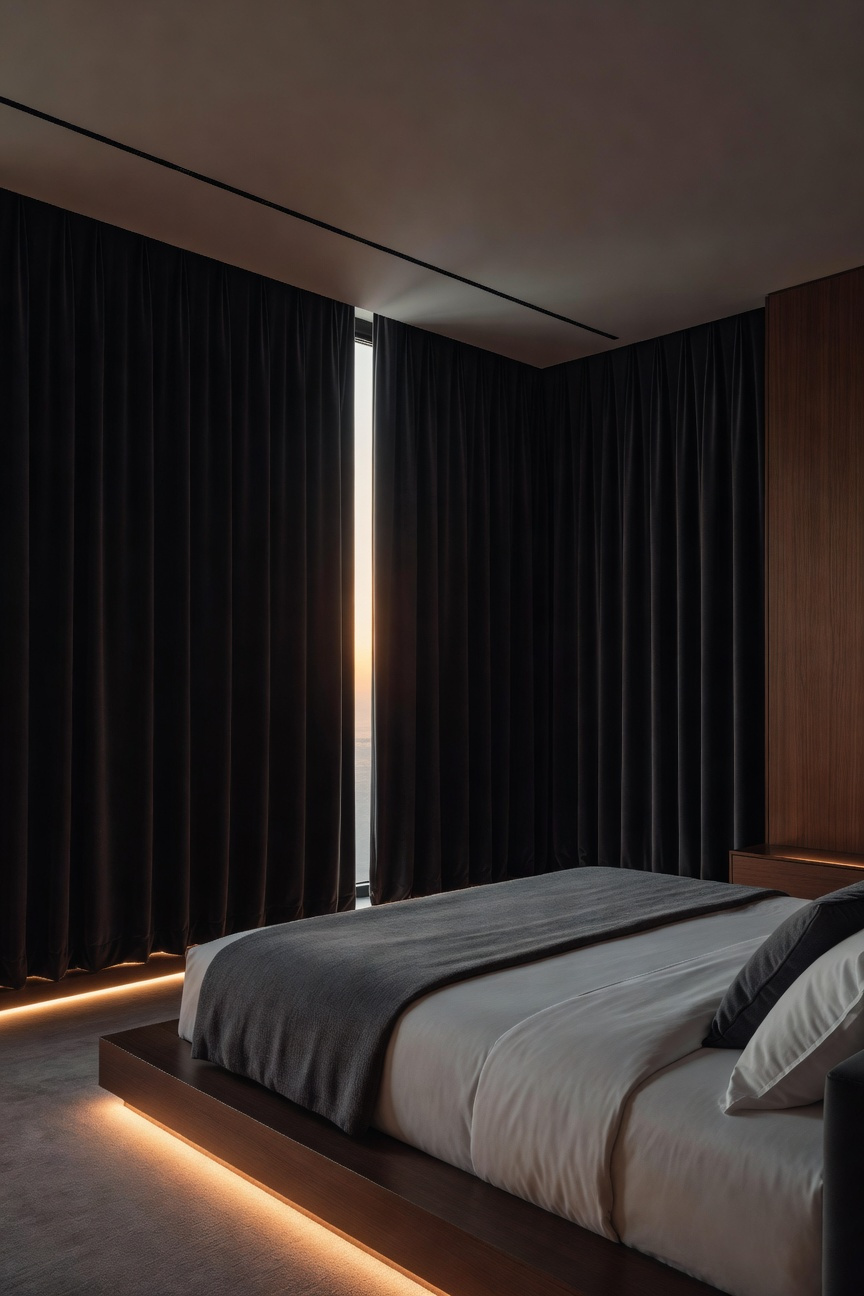
To achieve this, architects utilize recessed track systems. These “mud-in” setups hide motors within the ceiling pocket. As a result, the hardware becomes virtually invisible when the drapery opens. High-end engineering also eliminates typical light gaps. Some systems offer a minimal clearance of just 1/16 inch. This effectively seals the window aperture against urban light pollution.
Historically, achieving total blackout was a tedious chore during World War II. Modern systems transform this into an effortless command. Now, whisper-quiet motors sweep heavy custom drapery across the room. Thus, the transition to darkness becomes a soothing ritual rather than a manual task. Layered solutions combine high-performance roller shades with opulent fabrics. This ensures that bio-centric wellness seamlessly merges with elegant design.
True relaxation requires lighting that mirrors the natural world. Warm-dimming technology, often called “Dim-to-Warm,” replicates the incandescent sunset’s fade. Standard LEDs merely decrease in brightness while remaining clinically white. However, this advanced system shifts color temperature dynamically. It transitions from a functional 3000K down to a deep, candle-like 1900K.
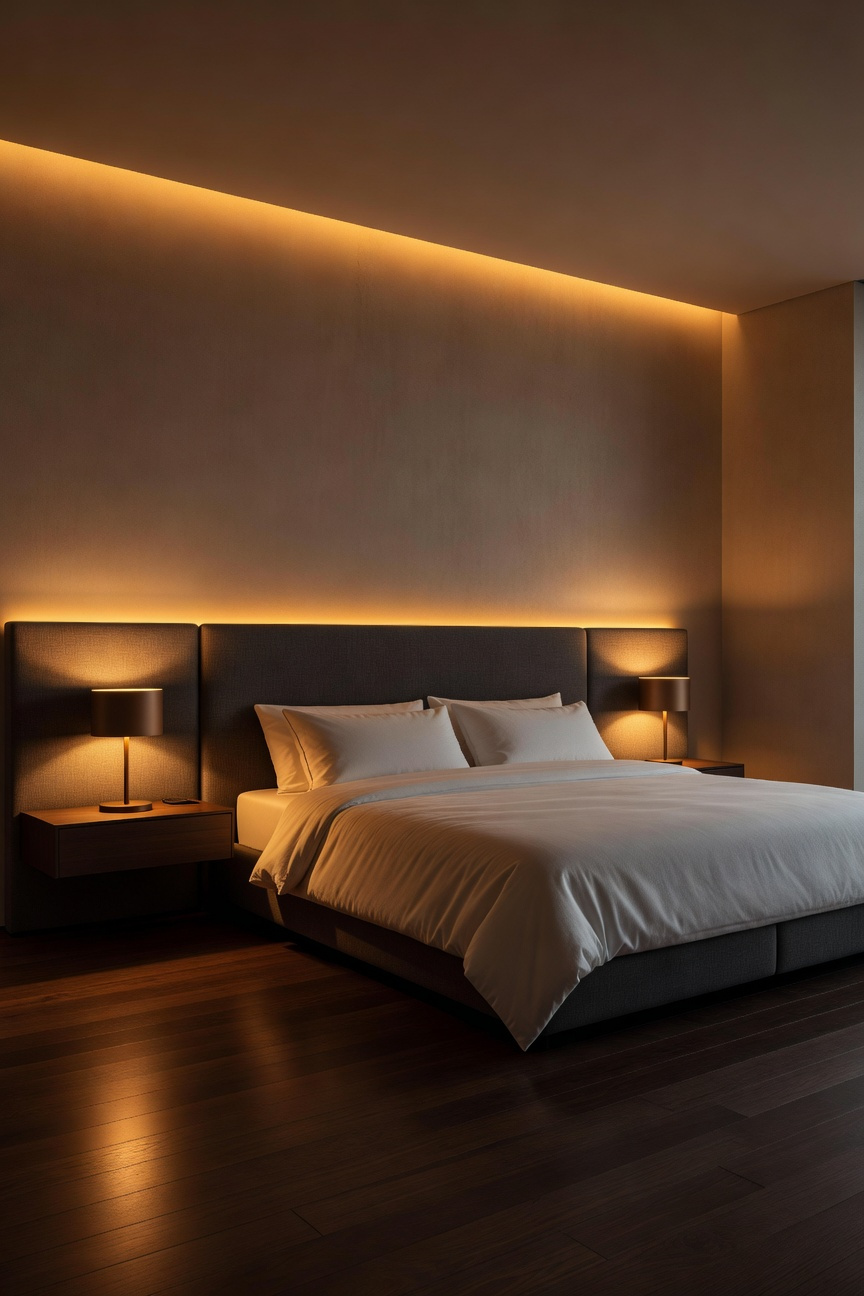
This shift is vital for your circadian rhythm. Exposure to blue light spectrums suppresses melatonin, the hormone responsible for sleep. These systems automatically filter out alert-inducing blue wavelengths as they dim. Ideally, this creates an artificial “sunset” that releases the brain’s alertness brake.
The aesthetic impact on a luxury space is profound. Warm light actively enriches the red and orange undertones of natural materials. Dark walnut woods and silk textiles appear significantly deeper and softer. Conversely, cool or static white light can make gold accents appear greenish and dull. Thus, warm-dimming serves as both a wellness tool and a curatorial necessity.
True restorative rest begins with respecting your body’s internal clock. Exposure to standard blue light suppresses melatonin production. Consequently, waking up at night often leads to fragmented sleep. Amber-hued lighting offers a scientifically backed solution. Biologically, your brain perceives this specific wavelength as darkness. You can navigate your room without signaling wakefulness. This preservation of melatonin is essential for maintaining a deep sleep cycle.
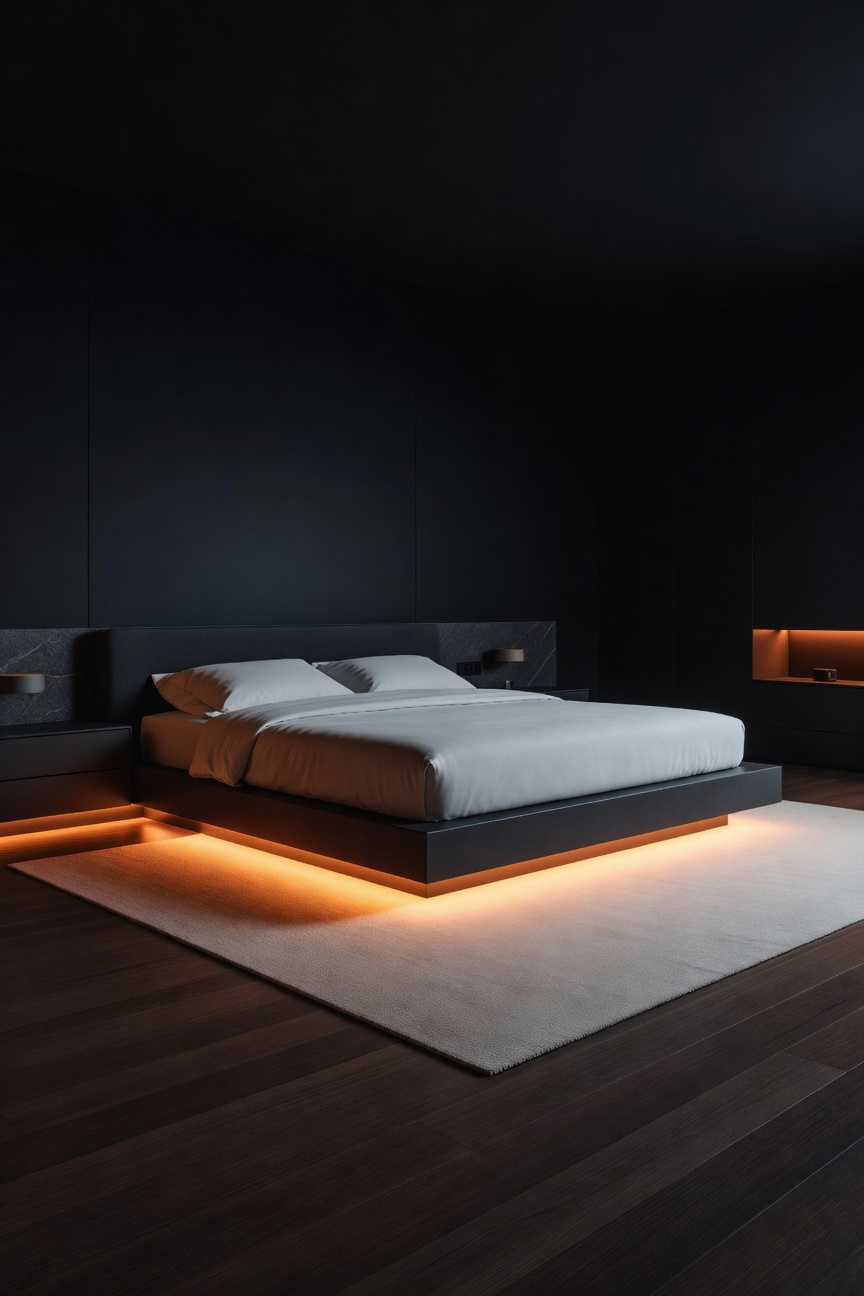
Integrating motion sensors elevates this feature to a level of anticipatory luxury. Passive infrared sensors detect movement instantly. There is no need to fumble for switches in the dark. Instead, a soft glow appears solely when your feet hit the floor. Architecturally, concealing these LEDs within toe-kicks creates a sophisticated “floating” effect. Heavy furniture appears weightless and ethereal against the floor.
The psychological effect mirrors the comfort of primal candlelight. Unlike cool lights, warm amber hues naturally promote relaxation. Ideally, extend this lighting path into the en-suite bathroom. This ensures a seamless, non-jarring transition during nighttime routines. You maintain a calm, meditative state even while moving. This design choice prioritizes both physical safety and spiritual serenity.
Positioning a bed involves much more than simple aesthetics. Fundamentally, it supports the body’s natural circadian rhythm. Exposure to early morning light suppresses melatonin production effectively. Simultaneously, it triggers cortisol and serotonin, preparing the mind for the day. Therefore, architectural experts overwhelmingly recommend an East-facing orientation for the master bedroom. This allows the space to capture vital morning warmth. Conversely, it ensures the room remains cooler during the evening hours.
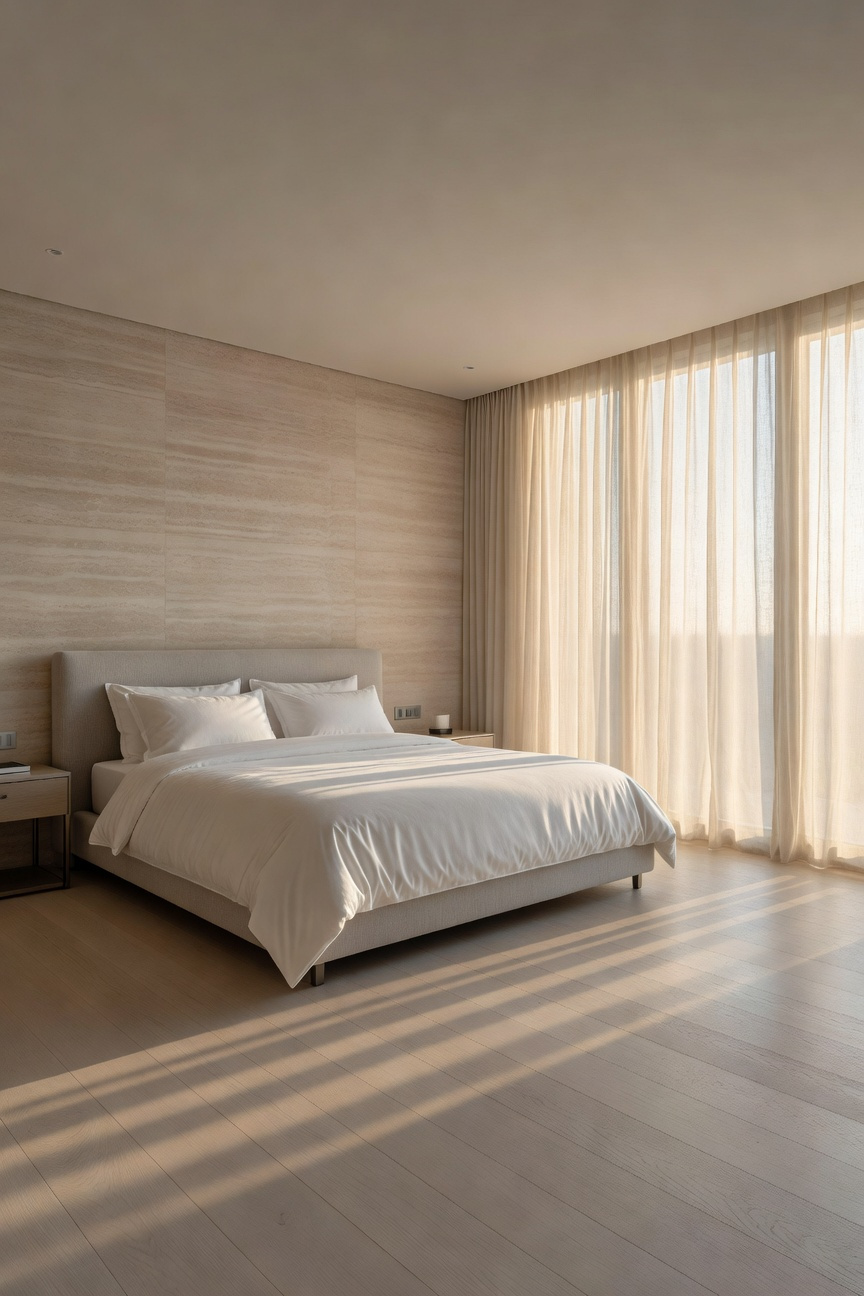
However, direct sunlight can be jarring immediately upon waking. Controlling the quality of light is essential for a calming atmosphere. High-end designs often incorporate automated sheer drapes. These treatments transform sharp rays into a soft, diffused glow. Consequently, the sleeper wakes up gradually rather than abruptly. Interior finishes play a supporting role. Matte walls and strategic mirrors reflect this gentle light deeper into the room.
This practice bridges modern design with ancient wisdom. Historically, Romans oriented beds Eastward to honor the sunrise as a symbol of renewal. Similarly, traditions like Vastu Shastra prioritize this direction for mental clarity. Aligning the bed with the sun connects the sleeper to a timeless, revitalizing cycle.
Tactile grounding utilizes material selection to influence emotional well-being deeply. This practice relies on haptic contrast to signal subconscious safety. Smooth surfaces, like polished marble, reflect light and promote mental clarity. Conversely, light-absorbing textures like velvet create a “sensory cocoon” for necessary warmth. This plushness fulfills a primal human need for security and intimacy within the sanctuary.
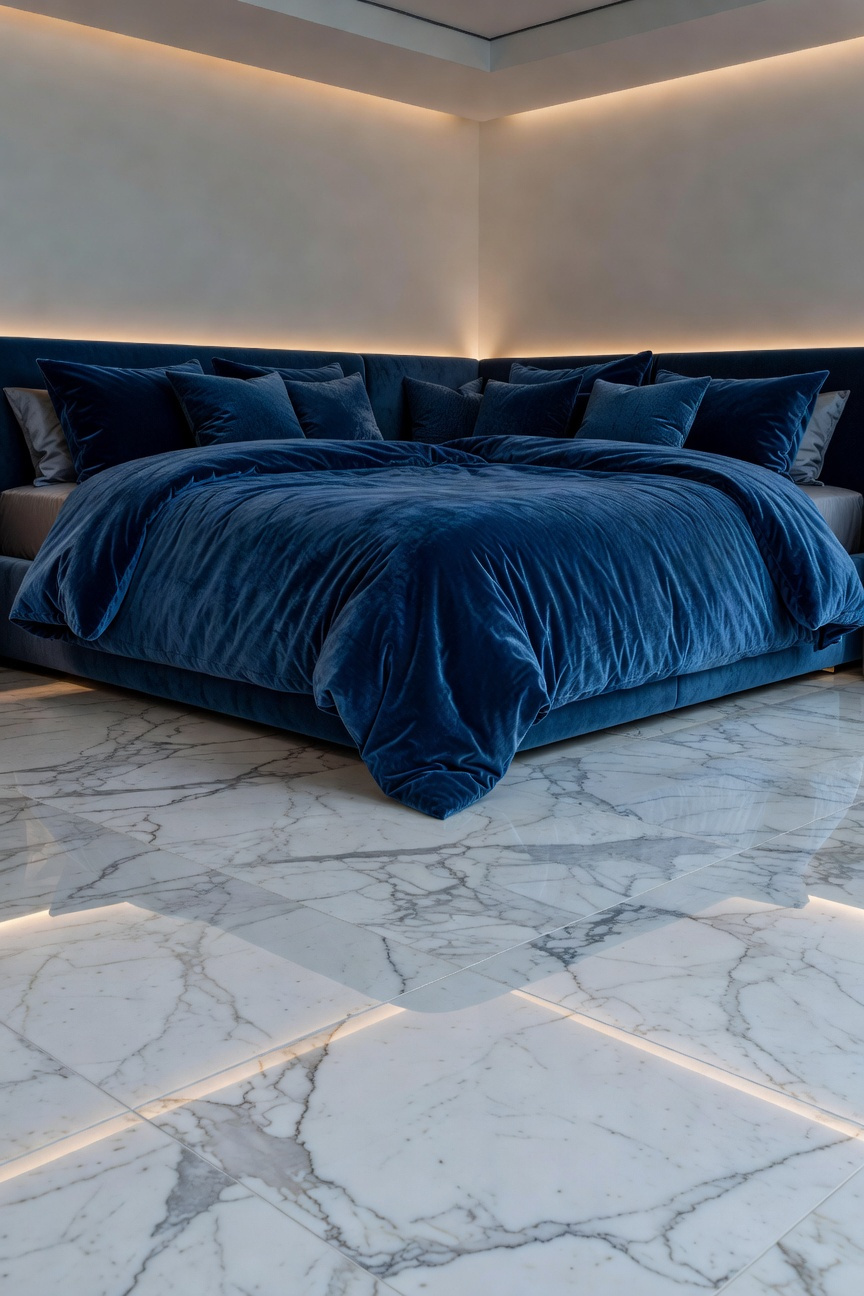
Regarding the bed itself, the weave dictates the experience more than thread count. A sateen weave exposes more thread surface for a buttery, warm glide. Alternatively, a percale weave offers a crisp, matte finish that feels refreshingly cool. The choice depends on whether one seeks distinct indulgence or breathable structure.
True grounding often comes from materials that possess authenticity. Modern luxury prioritizes elements that age gracefully, such as grain-rich wood. Over time, materials like leather develop a unique patina, offering a sense of history. This “tactile storytelling” anchors the mind and supports a meditative state.
The “Naked Floor” concept does not imply leaving a space unfinished or bare. Rather, it prioritizes the foundational material for your first barefoot step of the day. This design choice focuses on immediate grounding during the transition from sleep to wakefulness.
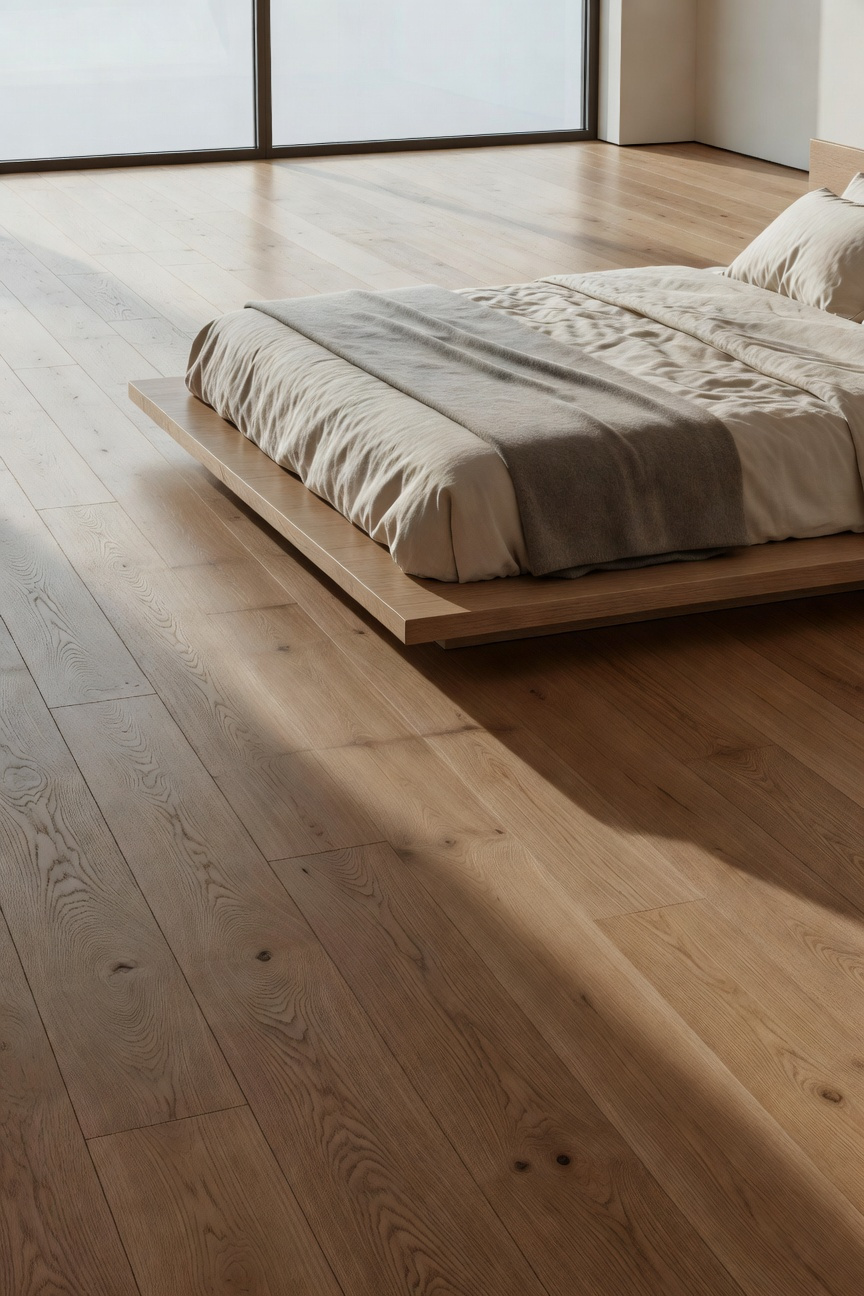
Heated wide-plank oak acts as a stunning architectural solution for this moment. Visually, planks wider than seven inches create an expansive, uninterrupted canvas. Consequently, the room feels larger and significantly more breathable. Beneath the surface, radiant heating provides an invisible, all-encompassing luxury. You experience a quiet, toe-to-heel warmth that feels organically integrated into the home. Moreover, this system eliminates the noise and allergens associated with forced air, supporting deep, mindful breathing.
Conversely, hand-knotted wool offers a deeply tactile connection. A high-density Tibetan or Persian weave transforms the floor into a cushion. The natural crimp of premium wool creates tiny air pockets. Thus, the material acts as an exceptional sound absorber, ensuring a silent and gentle landing. The artistry involved in tying thousands of knots imbues the room with a sense of soulful history.
The most effective mindfulness spaces often layer these two elements. Surprisingly, dense wool rugs allow sub-floor radiant heat to transfer effectively. As a result, you do not have to choose between the visual grounding of oak and the soft texture of wool. Instead, you create a holistic environment that supports both physical warmth and spiritual stillness.
True restoration requires a foundation of purity within your sanctuary. Investing in GOTS-certified linens represents a significant shift toward holistic luxury. Unlike standard options, these textiles strictly prohibit harsh chemicals like formaldehyde or chlorine. They offer a genuinely hypoallergenic sleep surface for deep rest. Organic fibers are often harvested with greater care. As a result, the fabric preserves its strength, feeling softer and remaining pill-resistant over time.
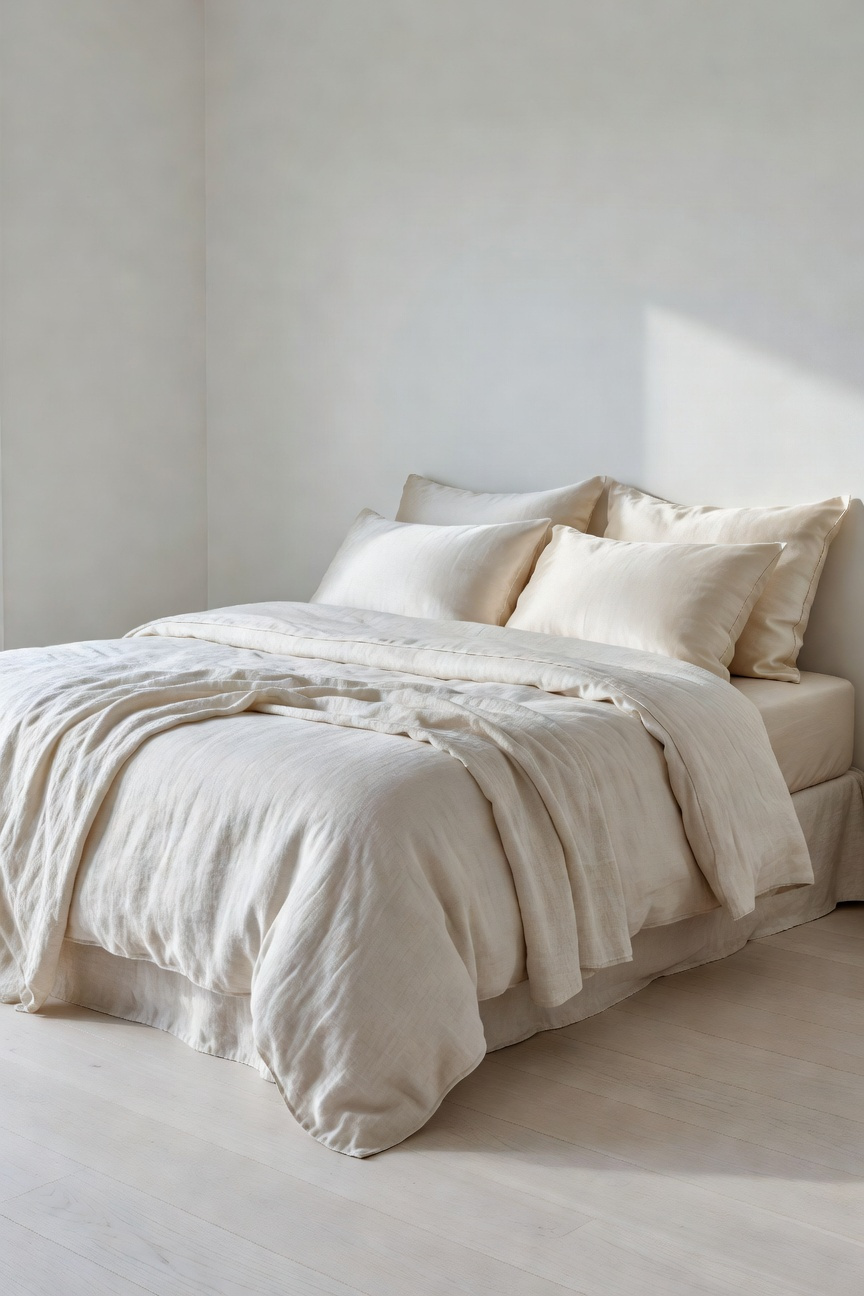
However, tactile comfort is only half the equation. Mulberry silk adds a necessary layer of sophisticated temperature regulation. Biologically, its unique protein structure creates a self-adjusting sleep environment. Thus, the material allows essential airflow during warm nights while insulating you against the cold. Moreover, this bio-fiber adapts directly to the sleeper’s body temperature.
From a design perspective, you should combine these elements for sensory balance. Layer crisp, matte organic percale sheets with lustrous silk pillowcases. In addition, silk’s remarkably smooth surface significantly reduces friction on skin and hair. Therefore, your bedding becomes a proactive part of your beauty and health ritual. This combination transforms a simple bed into a chemical-free, performance-driven wellness sanctuary.
Designing a sanctuary requires looking beyond color palettes. Actually, the very shape of your furniture with softened edges influences your nervous system. Research suggests that sharp, angular forms can create subconscious visual stress. Conversely, curved silhouettes trigger a deep sense of psychological safety. This reaction is evolutionary, as the brain perceives sharp corners as potential physical threats. Therefore, selecting furniture with softened edges significantly reduces cognitive load.
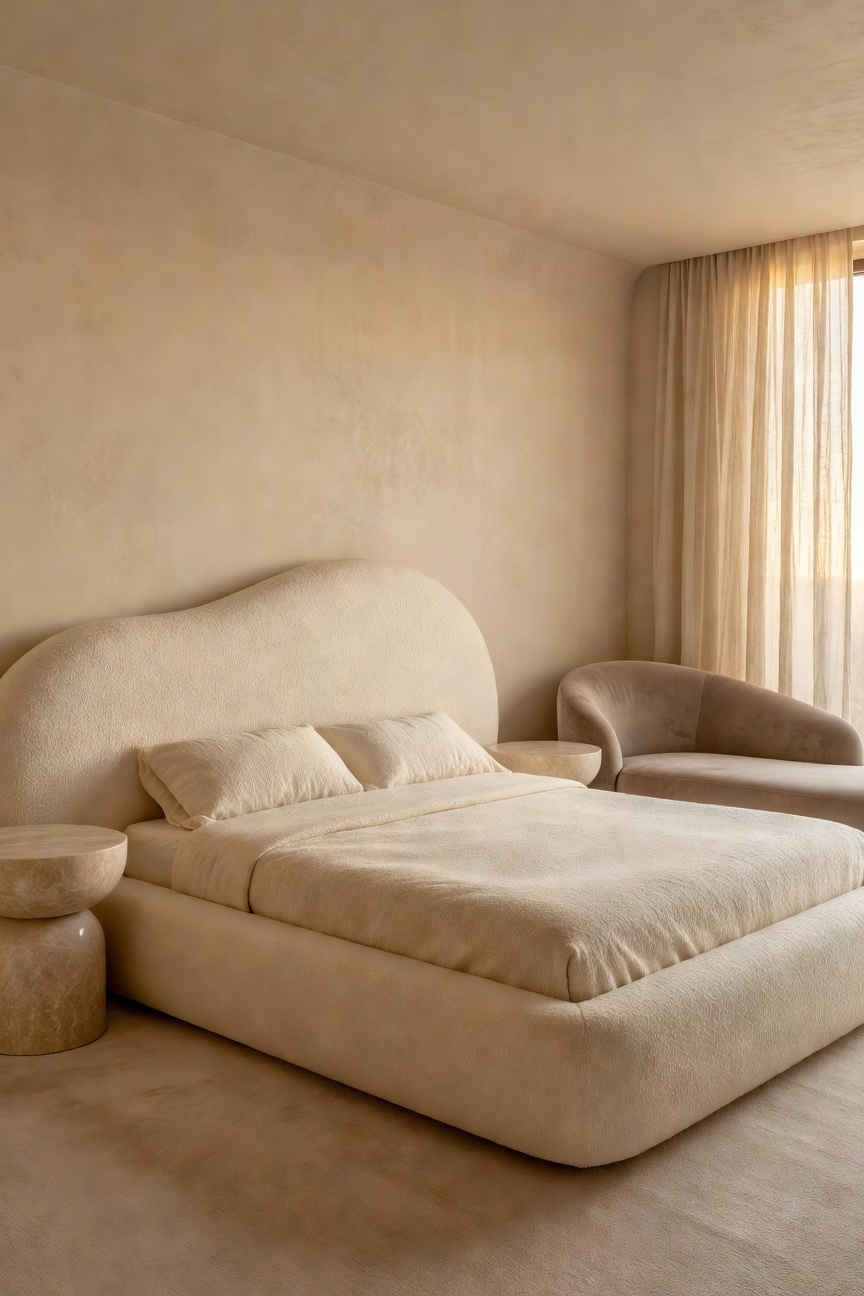
In a luxury bedroom, rounded forms create a “soft cradle effect.” Instead of feeling static or boxy, the space gains a sense of fluidity. A barrel-back chair or curved daybed encourages emotional ease. These organic shapes echo nature, mimicking rolling hills or winding rivers. Consequently, the environment feels less demanding and more intuitively nurturing.
Moreover, achieving these elegant forms requires exceptional artisanal craftsmanship. Techniques like steam-bending wood allow for seamless, durable arches without rigid joints. Physically, these pieces often feature high-density foam padding for superior support. Thus, you eliminate the risk of painful encounters with hard corners. Textile selection further enhances this tactile comfort. Fabrics like bouclé add a nubby, sculptural texture that absorbs light beautifully. Alternatively, velvet reflects light along curves for a polished, glamorous aesthetic.
Bringing earth energy indoors begins with intentional material selection. Honed marble and travertine side tables offer a profound sense of grounding. Unlike high-gloss finishes, a honed surface is uniquely matte and velvety to the touch. Therefore, it absorbs light rather than reflecting it, creating a soft ambiance. This diffusion is essential for a calming mindfulness space, as it eliminates harsh glare.
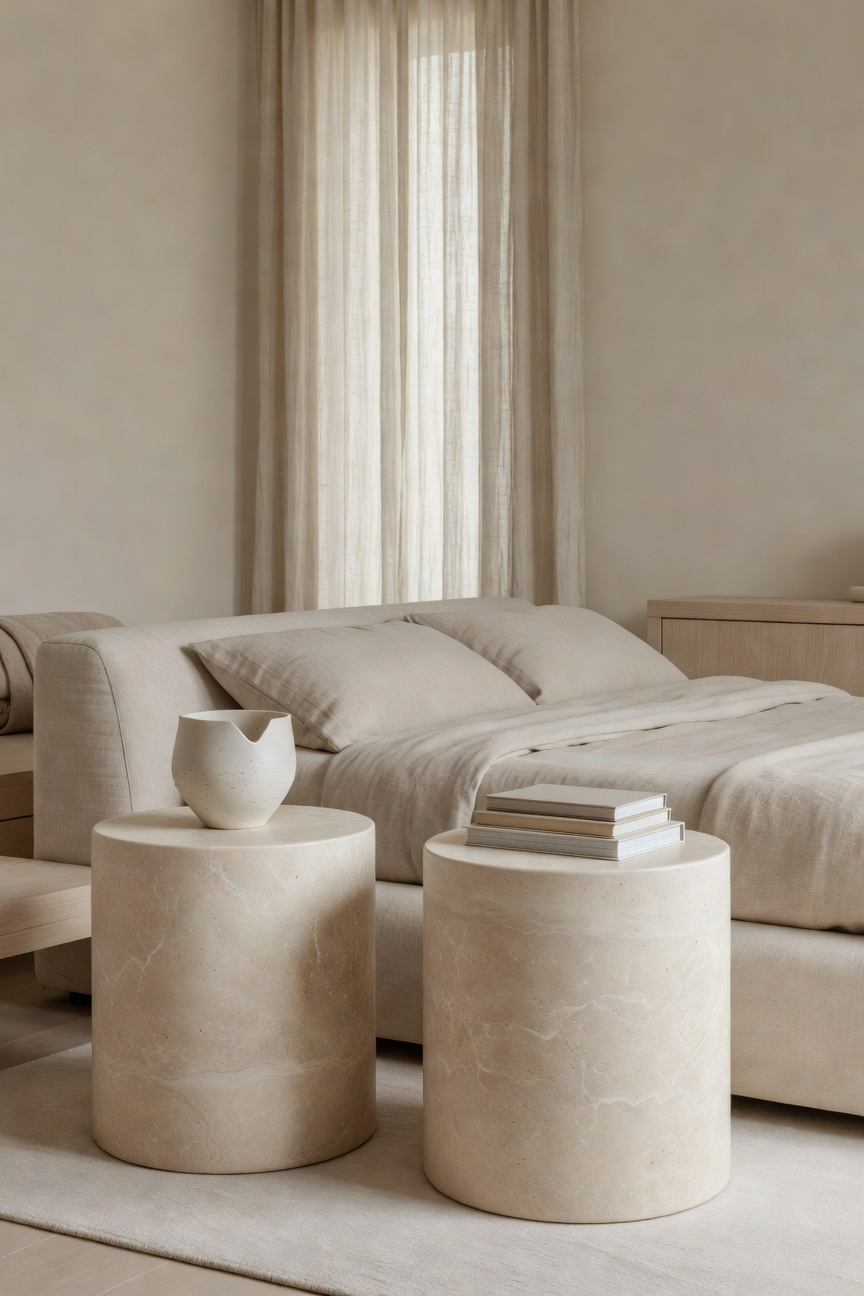
These organic materials serve as a vital biophilic anchor within the bedroom. Travertine naturally carries the warmth of its geological origins in hot springs. Its creamy, earthy tones feel inherently natural rather than forced or manufactured. Thus, placing a stone table beside your bed establishes a subconscious link to the earth.
Psychologically, this physical solidity provides deep emotional comfort. The inherent weight of stone symbolizes permanence and enduring safety. Consequently, the bedroom feels more like a lasting sanctuary and less like a temporary space. Additionally, the irregular veining offers a soft, visual complexity that helps reduce mental stress. These elements work together to support deep rest and spiritual practice.
The layout of a room directly influences mental clarity. Specifically, the “flow of mind” mirrors the flow of physical movement. Therefore, navigating a luxury bedroom should feel entirely effortless. In practice, designers prioritize wide, clear pathways that allow the body to move freely. The brain perceives this openness as safety rather than constraint.
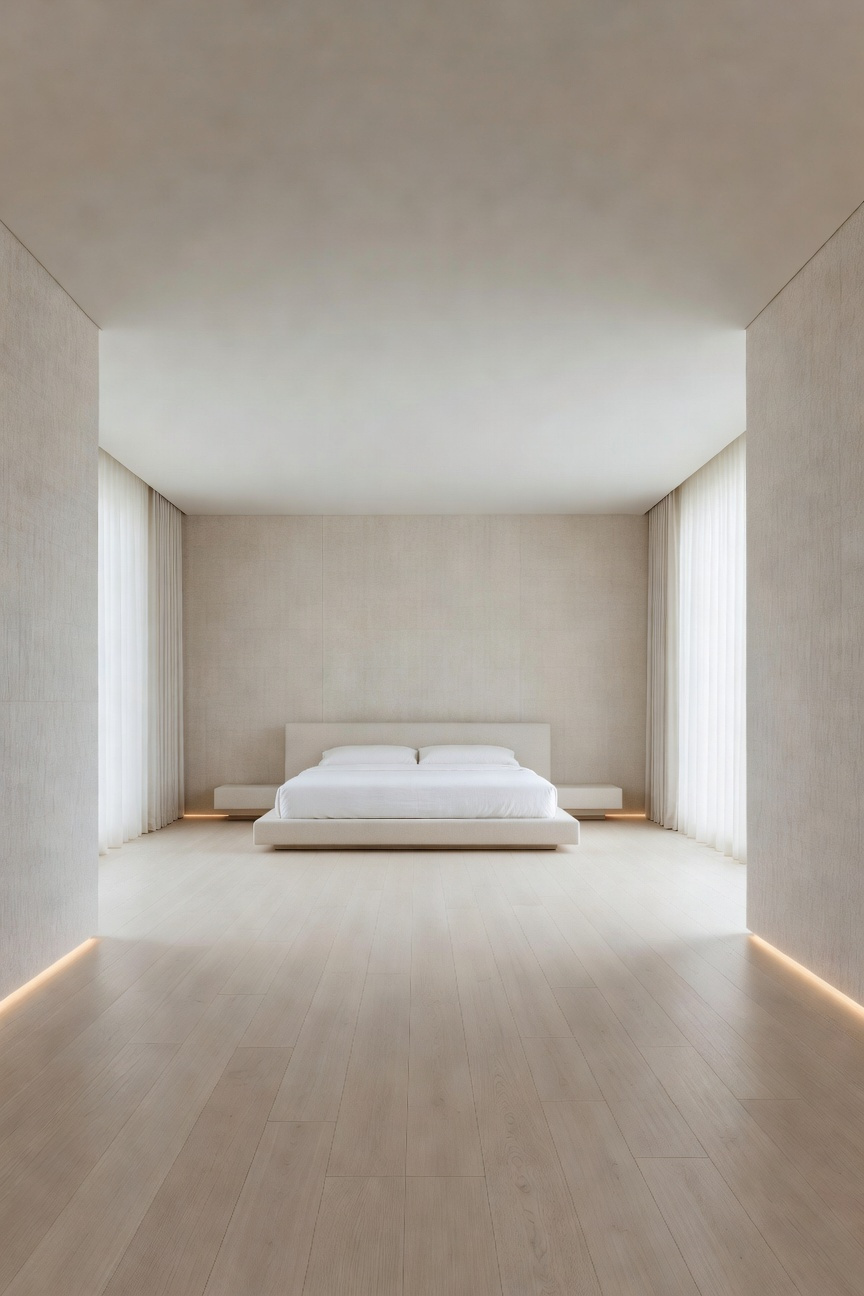
Affluent design utilizes negative space as a critical element. This concept, known as “visual breathing room,” reduces visual noise. The brain associates uncluttered environments with status and peace. Thus, furniture requires a deliberate perimeter of clear space. This emptiness allows the mind to truly unwind.
Effective planning creates a “gradient of consciousness.” Ideally, the room facilitates a soft transition from active to restorative states. A reading nook should feel distinct from the sleeping zone. Finally, the bed acts as the room’s anchor. Historically, this positioning provides a “Commanding Position” for security. As a result, the view from the pillow should focus on serenity, not chaos.
More than just a structural connector, the transition zone acts as a vital psychological airlock. It allows you to consciously shed the day’s chaos before entering your sleep sanctuary. Historically, this concept mirrors the aristocratic “antechamber,” which separated public duties from private rest. Today, it serves a similar purpose by creating a necessary cognitive buffer.
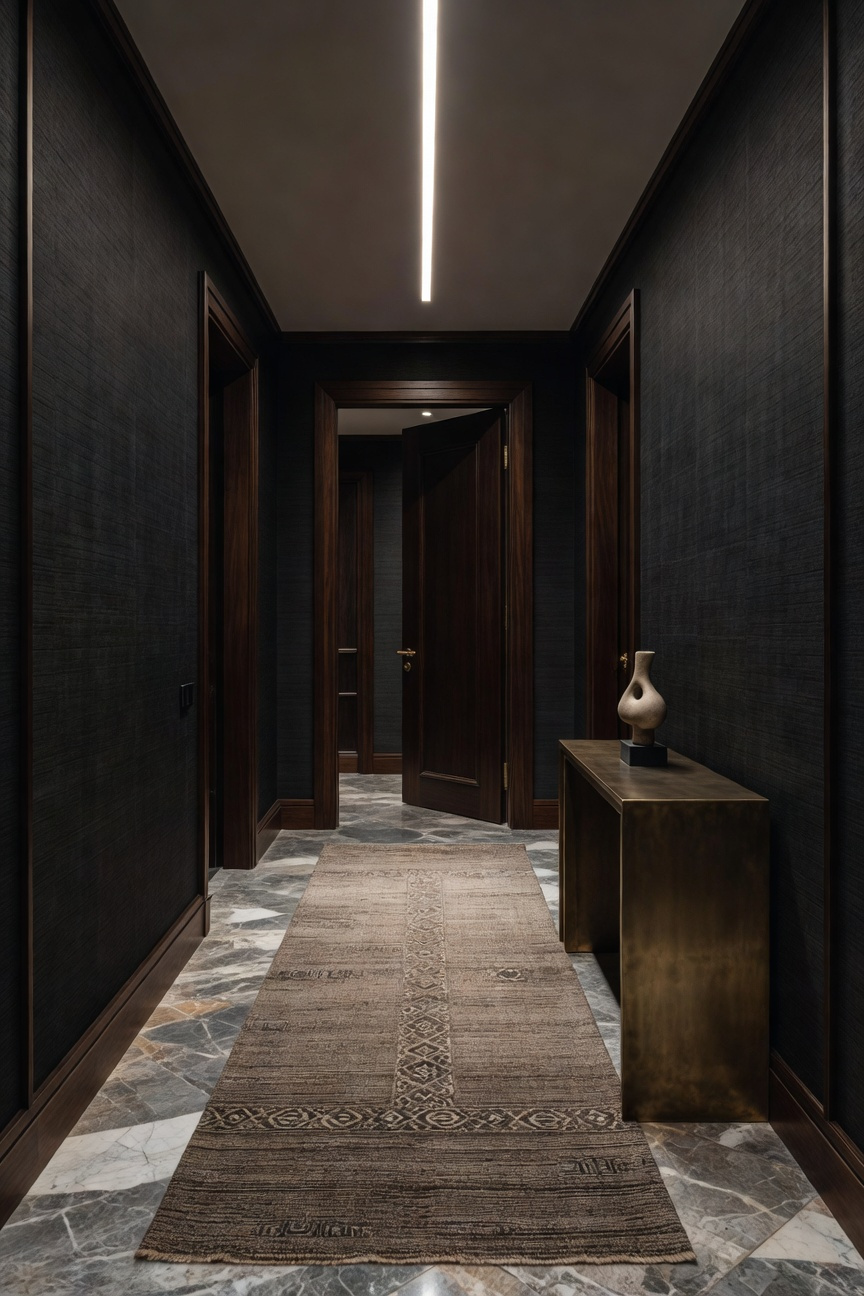
Architecturally, this vestibule manages distinct sightlines and sound. It prevents direct views from the main house into the private bedroom. This layering establishes a profound sense of security and intimacy. We can use this space to manipulate sensory experiences. Designing a slightly smaller, dimmer entry creates a “compression” effect. Then, stepping into the expansive main bedroom offers a powerful feeling of release.
Lighting plays a crucial role in this threshold. Ideally, install dimmable fixtures with warm, low-level tones. This signals your circadian rhythm to begin winding down immediately. Moreover, you can incorporate sound-absorbing materials like textile wall coverings or plush rugs. As a result, the vestibule becomes an acoustic barrier against ambient household noise. The short hallway features walls finished in rich, deep charcoal textured wallpaper and contrasting dark walnut architectural trim. The flooring is polished gray and white Italian marble, partially covered by a thick, hand-knotted taupe runner rug.
Treat this area as a practical staging ground for mindfulness. Distinctively, it allows for a brief pause between the active world and the restorative one. Thus, the simple act of walking through becomes a ritual of deep relaxation.
True restorative design begins where visual noise ends. In the bedroom, your brain subconsciously processes every visible object as data. Exposed wires, logos, and general clutter contribute significantly to cognitive load. Floor-to-ceiling millwork serves as a powerful architectural tool for creating “Visual Silence.” By completely concealing these distractions behind a clean facade, we create a sanctuary that actively lowers stress hormones.
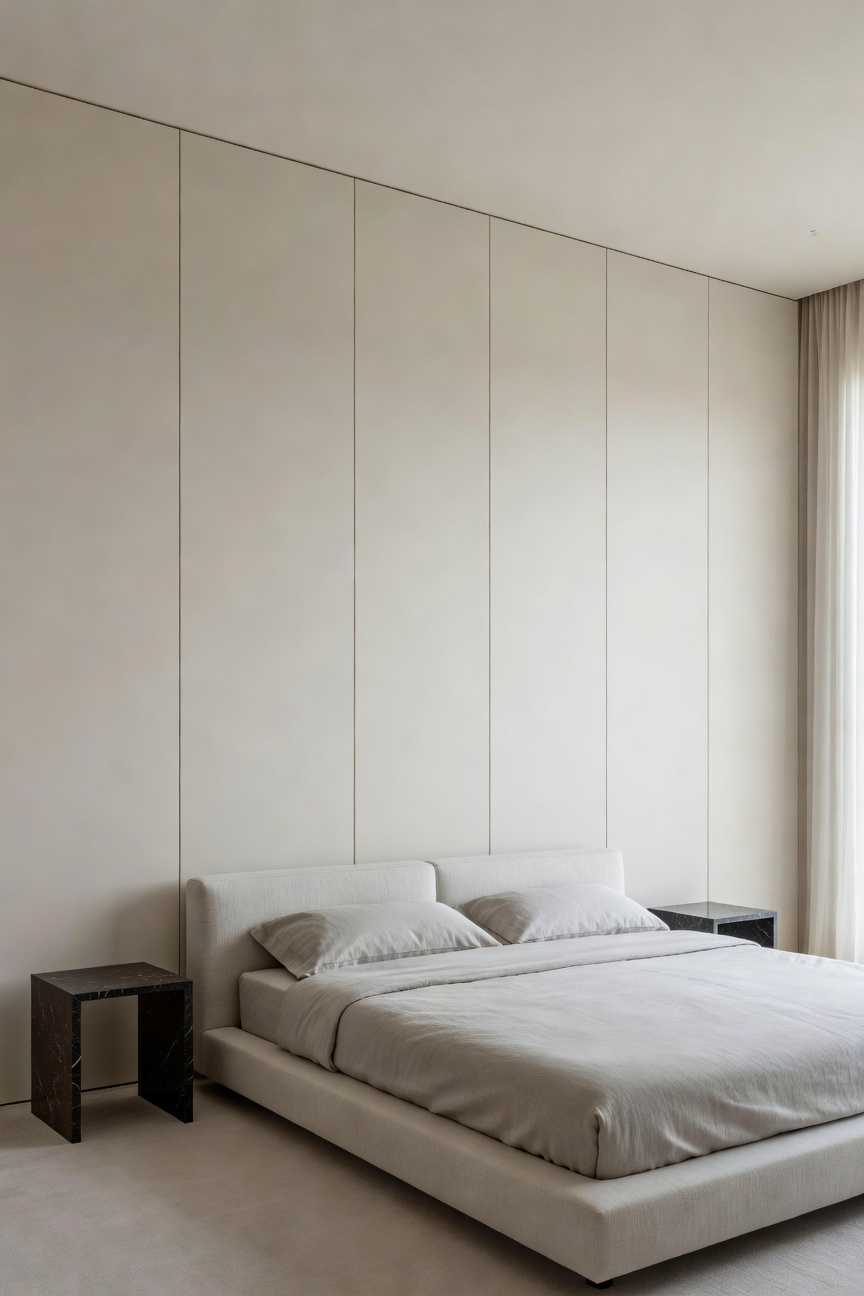
This design strategy relies on the illusion of invisible architecture. High-precision joinery transforms functional storage units into seemingly monolithic walls. Specialized hardware like concealed SOSS hinges ensures the doors disappear entirely into the facing. Additionally, push-to-open latches eliminate the need for handles, maintaining an unbroken, serene surface. The eye glides effortlessly across the room, mimicking a calming horizon line that aids relaxation.
True luxury dictates that technology remains unseen until required. In fact, the “Inverse Law of Technology” suggests that higher-quality rooms feature less visible equipment. Accordingly, motorized lifts can quietly reveal screens from within the millwork only when needed. Meanwhile, hidden ventilation systems manage heat without breaking the aesthetic silence.
Integrating a meditation nook elevates a luxury bedroom beyond mere sleep. Consequently, this space becomes a sanctuary for holistic wellness, reflecting the trend of “Quiet Luxury.” Typically, the design embraces a Japandi aesthetic, blending the warmth of Scandinavian Hygge with the imperfection of Japanese Wabi-Sabi.
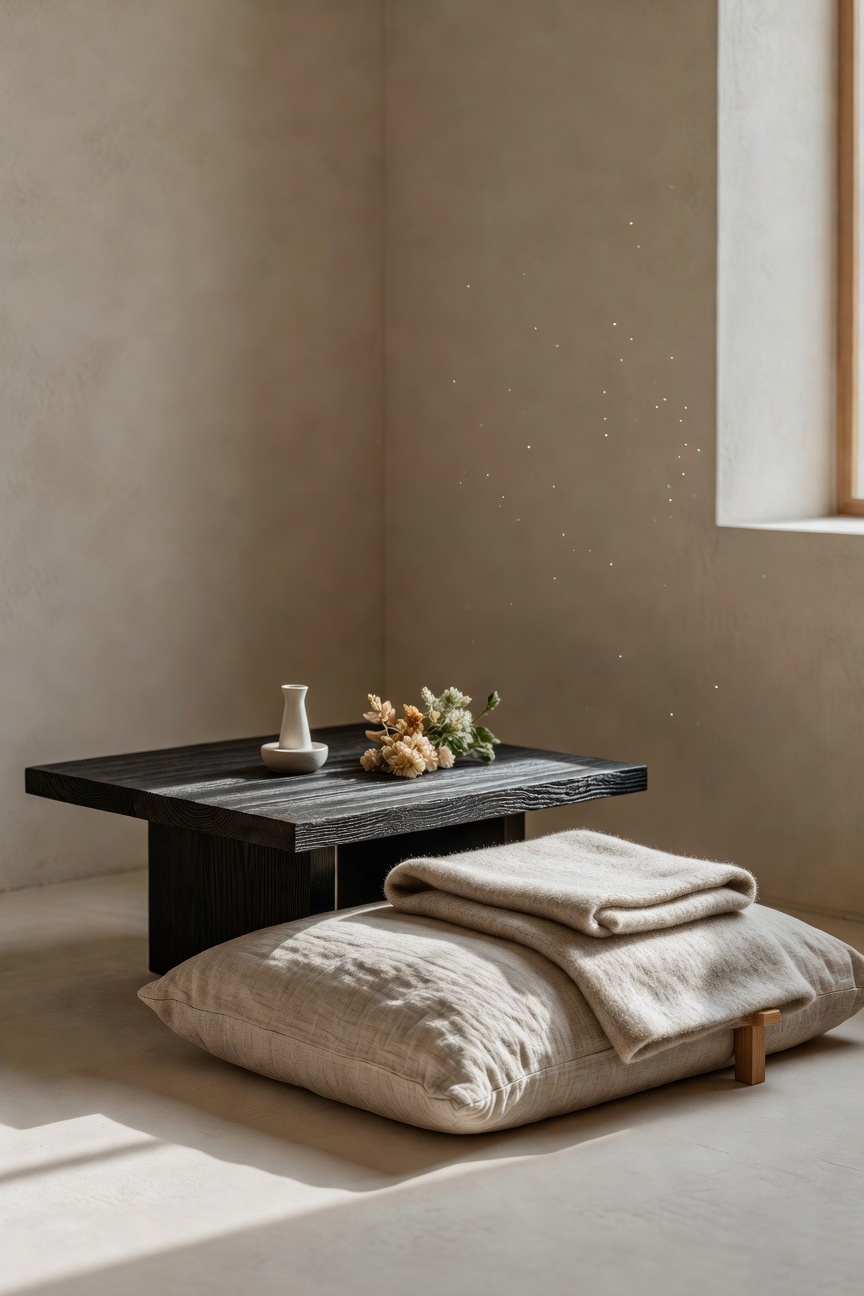
At the heart of this nook sits a low table. Often, this piece features a “live edge” or Yakisugi charred wood finish. Therefore, no two tables are identical, purposefully rejecting mass-produced perfection. Functionally, this surface acts as an “altar of intention” for your morning practice. For example, you might place a brass Tibetan singing bowl here to signal the start of your ritual. Burning low-smoke Oudh incense can engage the senses without overwhelming the room.
The physical foundation of this practice is the seating. A traditional Zafu cushion provides the necessary ergonomic support. Inside, the fill material dictates the experience. Buckwheat hulls offer firm, grounded stability for the spine. Conversely, Kapok fiber provides a softer, hypoallergenic feel similar to luxe down. Externally, high-end upholstery in unbleached linen or plush velvet connects the nook to the bedroom’s textures. This dedicated corner invites you to pause, pick up a journal, and anchor your intentions before the day begins.
In luxury design, the orientation of the bed establishes the room’s entire energetic hierarchy. The “Commanding Position” synthesizes ancient Feng Shui principles with modern environmental psychology. Ideally, place the bed diagonally across from the door, never directly in line with it. This placement grants a clear view of the entrance without aggressive exposure.
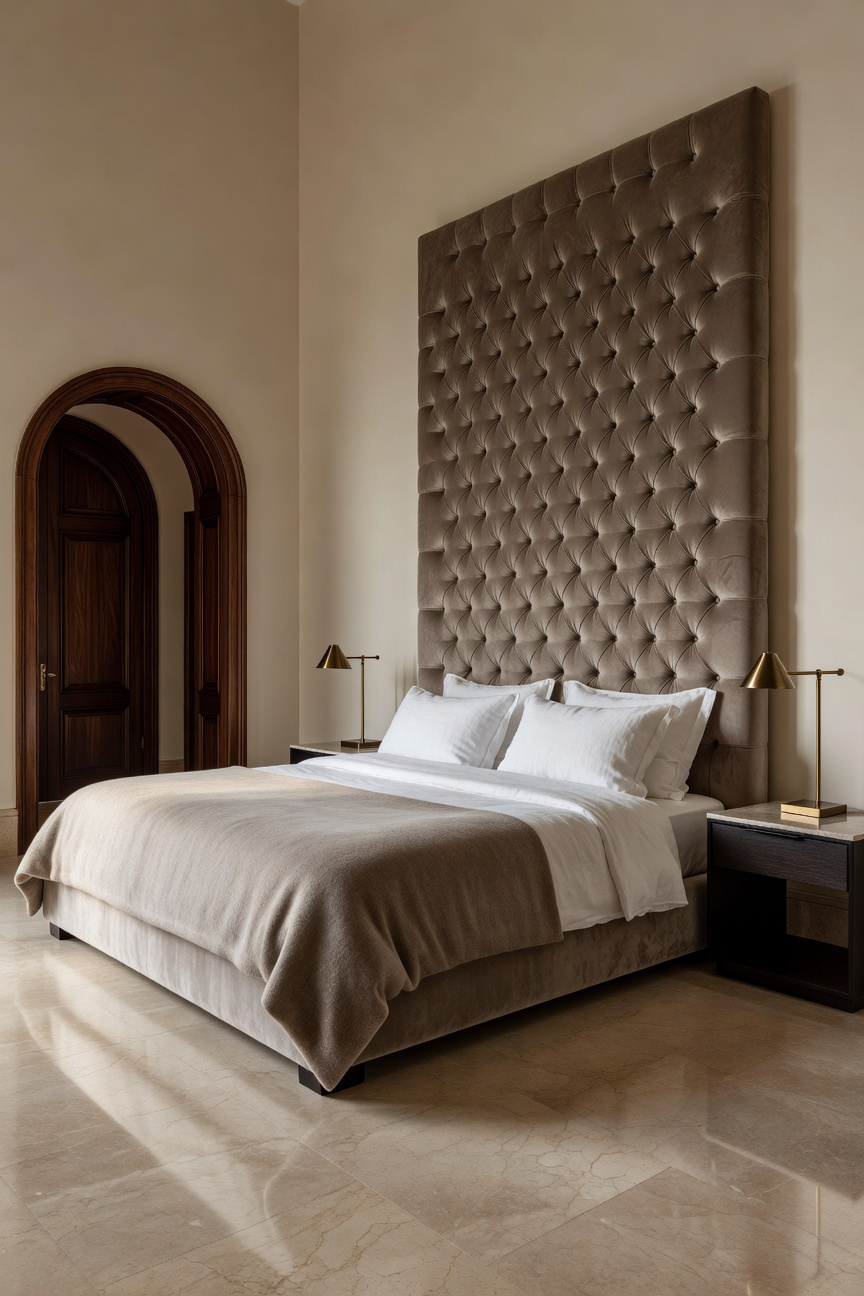
Psychologically, this satisfies our primal need for prospect and refuge. Because the sleeper can see the door, the brain’s amygdala relaxes, significantly reducing subconscious anxiety. Conversely, facing the doorway directly—known as the “coffin position”—invites rushing energy. Instead, the diagonal arrangement allows life force to circulate gently rather than rushing past the occupant.
Architecturally, the bed must serve as the undisputed focal point. Therefore, prioritize strict symmetry with matching nightstands to create a sense of visual order. Anchor the headboard against a solid wall to represent a supportive “mountain.” This solid backing offers stability, unlike the vulnerability of placing a bed against a window. This strategic layout commands the space, ensuring the bedroom remains a true sanctuary for restoration.
Historically, private greenery has always signified elite status and personal refuge. Roman aristocrats utilized the *peristyle* courtyard specifically for secluded contemplation. Today, integrating large-scale nature into the bedroom creates a similar sanctuary. Physiologically, this design choice offers profound benefits beyond simple aesthetics. Visual exposure to organic textures lowers cortisol levels. Consequently, this activates the parasympathetic nervous system, also known as the “rest and digest” state. Your environment directly improves vagal tone, preparing the body for deep, restorative sleep.
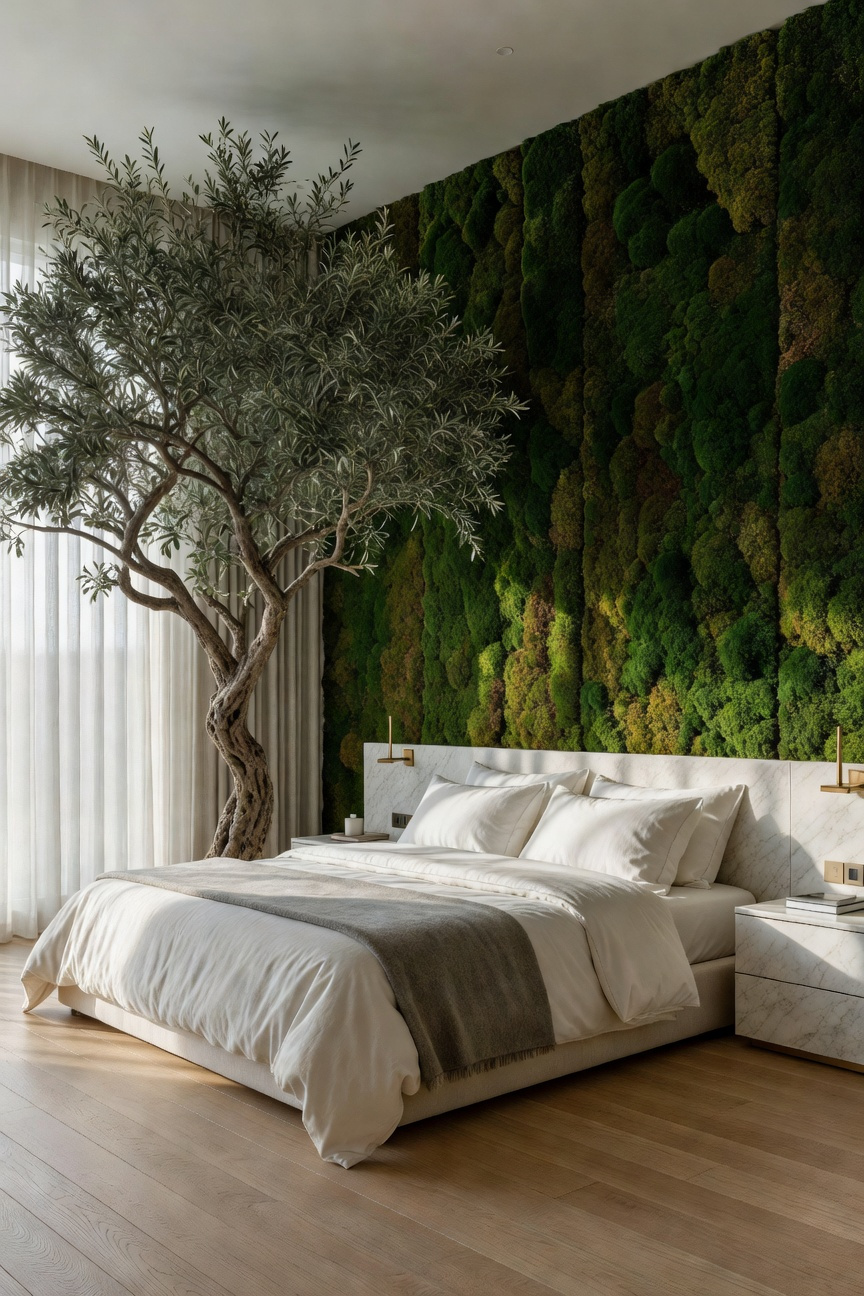
Practically, you might select a large-scale living tree, such as a Ficus. However, this feature requires significant architectural commitment. A multi-story tree demands a dedicated skylight to provide full-spectrum light. Furthermore, you must consult an arborist to design a drainage system that protects the foundation. This option represents a dynamic, living ecosystem.
Conversely, preserved moss walls offer a distinct, low-maintenance advantage. Although they do not oxygenate the air like living plants, they excel at acoustic damping. In fact, reindeer moss effectively absorbs sound, creating a hushed, cocoon-like atmosphere. Additionally, these walls add rich, sensory texture without requiring water or sunlight. Ultimately, whether through a towering tree or a tactile wall, biophilic design bridges the gap between luxury living and spiritual grounding.
Ultimately, true luxury has evolved beyond mere visual opulence or historical status symbols. Instead, it is defined by a profound sense of inner calm and biological restoration. In fact, a well-designed luxury bedroom design now serves as a cognitive command center for your mental clarity. By prioritizing tactile comfort and biophilic elements, you actively lower cortisol and support memory consolidation. The aesthetic beauty of a space is secondary to its ability to soothe the nervous system.
Consequently, viewing your bedroom as a sanctuary changes how you approach daily life. It becomes the foundation for tomorrow’s resilience, mood stability, and executive function. Thus, investing in this private space is actually an investment in your future self. To begin, audit your bedside table for visual clutter and harsh lighting today. Finally, replace these distractions with a single calming texture or organic element to invite peace.
The foundation of luxury design focuses on three key pillars: acoustic mastery (eliminating noise and echo), luminous harmony (using advanced lighting to support the circadian rhythm), and tactile grounding (using high-quality, natural materials like silk, wool, and honed stone). These elements prioritize physiological well-being over simple aesthetics.
The most luxurious bedding combines biological wellness with sophisticated texture. This includes GOTS-certified organic linens (like French flax or high-quality percale) for purity and breathability, often layered with Mulberry silk pillowcases for temperature regulation and reduced friction on skin and hair.
Luxury lighting is achieved through layering and dynamic control. Key features include Human Centric Lighting (HCL) systems that automatically shift color temperature (from bright cool white in the morning to deep amber/warm-dimming in the evening), and automated blackout architecture that ensures “zero lux” for absolute, undisturbed darkness.


