Physical Address
304 North Cardinal St.
Dorchester Center, MA 02124
Physical Address
304 North Cardinal St.
Dorchester Center, MA 02124
Transform any bathroom with 15 rustic bathroom decor ideas — reclaimed wood, clawfoot tubs, stone floors, Edison sconces, and natural fibre textiles. Start now.
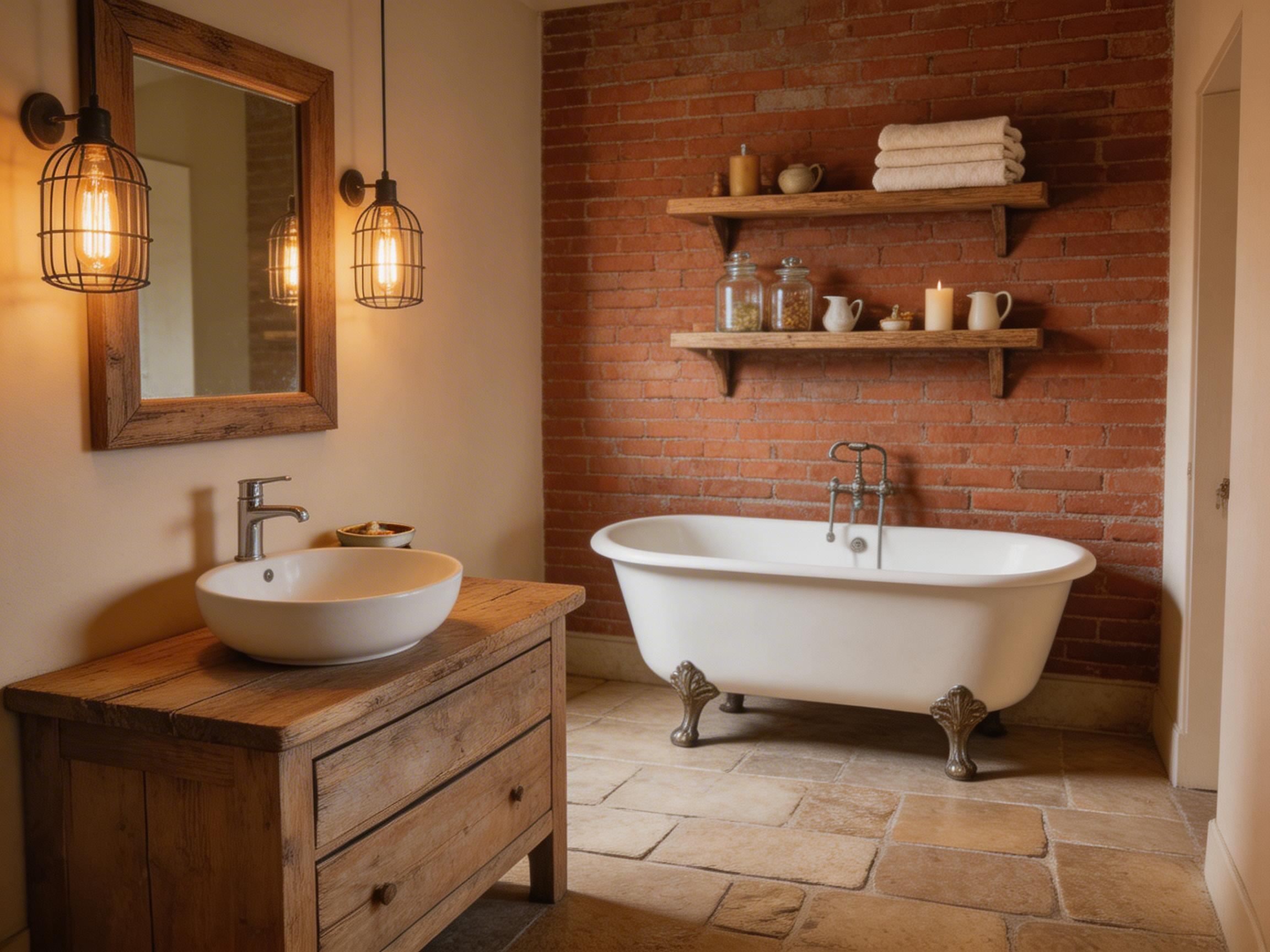
Picture a bathroom where the floor is worn travertine and the vanity is an old timber workbench with a vessel sink on top. A single wire cage sconce casts amber light across exposed brick. The plumbing is modern. The water pressure is excellent. But the room feels like it has been quietly earning its character for a hundred years.
That is what good rustic bathroom decor actually achieves — not a costume, but an atmosphere. It comes from choosing materials with real history, fixtures with genuine heritage, and accessories that earned their place rather than being assembled as a set. I’ve spent twelve years in historical renovation. That approach has worked in a Georgian townhouse, a converted mill flat, and a 1970s bungalow that nobody would have guessed had bones worth caring about.
Here are 15 ideas spanning materials, fixtures, lighting, storage, and textiles. Each one adds a layer of lived-in warmth that no amount of on-trend accessories can replicate.
Reclaimed timber is the single most transformative element in rustic bathroom decor, and there is a reason it carries a premium that freshly sawn wood cannot command: it has already lived. The 100-year-old barn boards and scaffold planks carry nail holes, weather-checks, and a grain patina that takes decades to develop. Artisan makers like Raised in a Barn Furniture and Rustic Red Door source these directly. A vanity made from this material introduces genuine history into the room from day one.
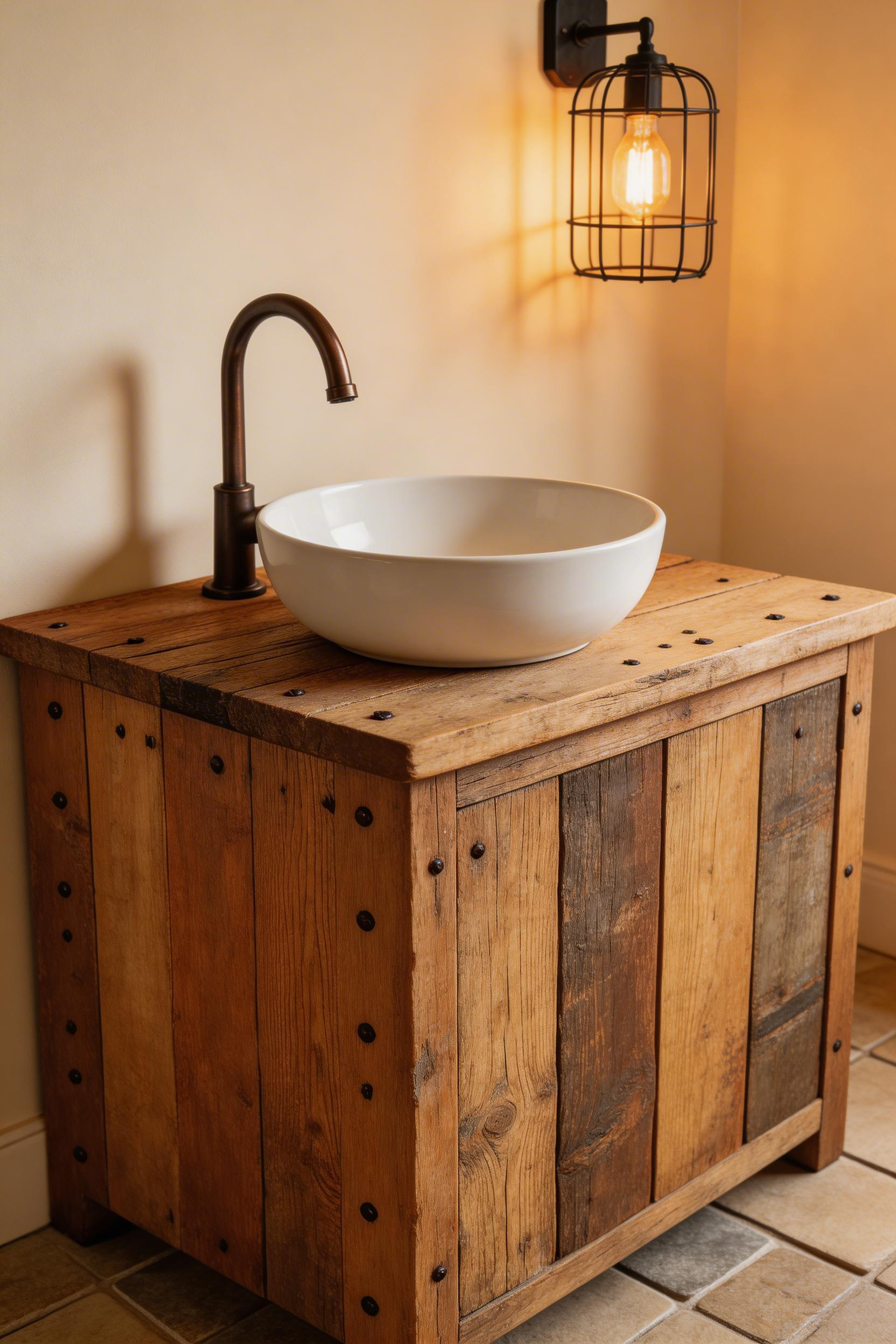
The most commonly sourced timbers are aged pine (from barn structures, with wide boards and visible knots) and reclaimed oak (dense and slow-grown, often from industrial flooring). For a 36-inch vanity base, expect to pay $400–1,200 from a specialist maker, or considerably less if you source a salvaged timber workbench or old dresser and convert it yourself. The conversion work involves reinforcing the carcass with dado joints or metal brackets. Then comes cutting the plumbing aperture and fitting a marine-grade substrate base under the sink bowl.
Protecting the wood is the part most people get wrong. Oil-wax finishes (Hardwax Oil and similar) feel appropriate to the aesthetic but degrade quickly near the sink — they require annual reapplication and won’t tolerate standing water. Pre-catalysed polyurethane or a matte-conversion varnish applied in 3–5 coats, with light 220-grit sanding between each, is the professional standard for bathroom use. It cures hard without yellowing and protects the grain without masking it.
If you’re working in a period property and weighing up your vanity options, choosing a bathroom vanity for a historic home is worth reading before you commit — there are period-appropriate dimensions and plumbing configurations worth knowing about.
Stone and pebble flooring is one of the most grounding rustic bathroom decor choices available, and it’s one of the few material decisions that genuinely improves with age. A slate or travertine floor that shows wear around the vanity paths tells the story of how the room is used. It reads as honest rather than worn-out. That quality is exactly what rustic design is reaching for.
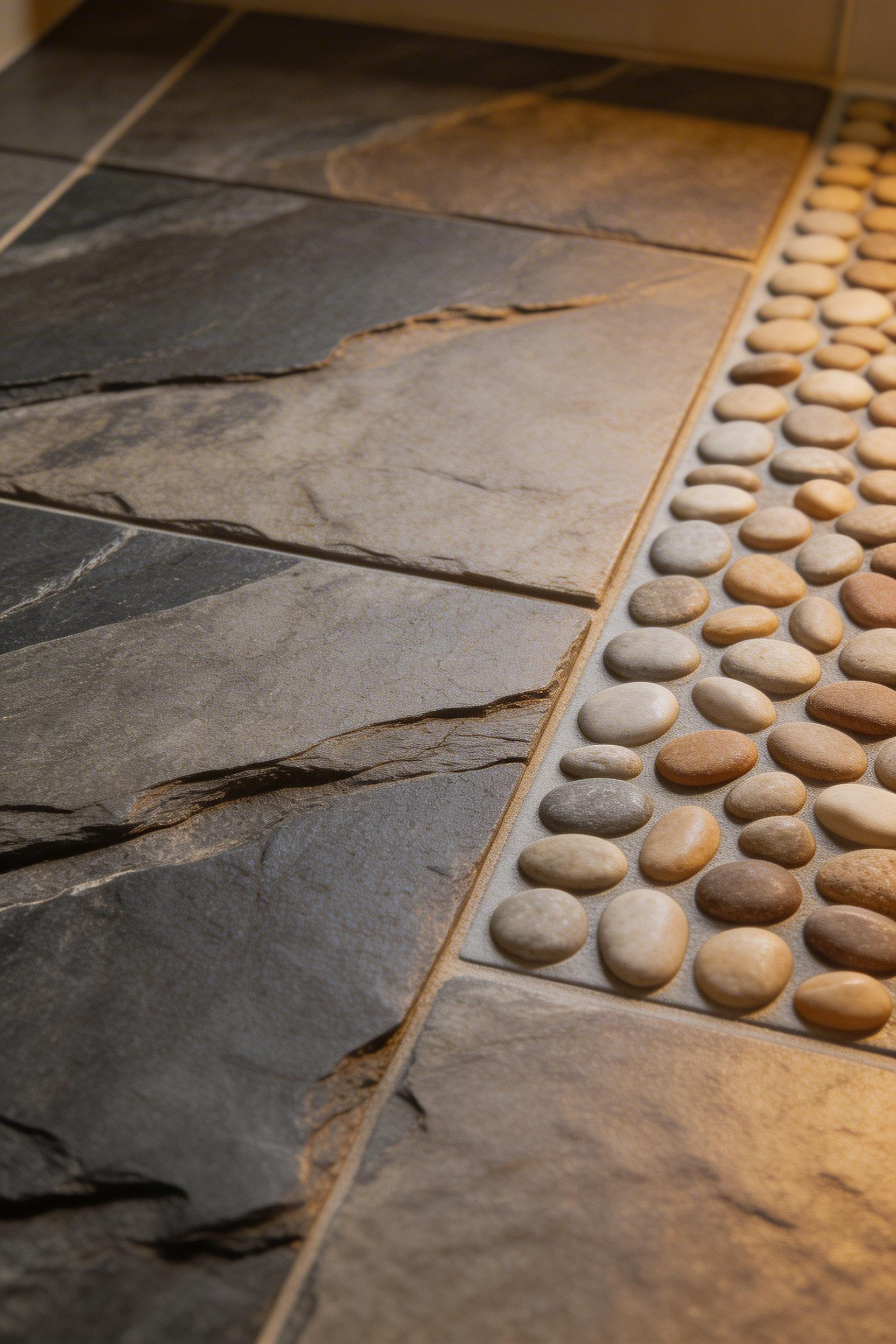
Slate is the most practical choice for bathroom floors. Its natural cleft surface is inherently slip-resistant without any additional treatment. The dense structure absorbs almost no water, and it’s available in tones from cool blue-grey to warm rust-red — a wide range that suits most rustic palettes. Travertine in a tumbled or brushed finish brings warmer honey-amber tones and more evident pitting — it suits farmhouse and Mediterranean-rustic schemes well. Avoid polished travertine on the floor; it’s dangerously slippery when wet.
River pebble mosaic tiles — tumbled river stones set in 12×12-inch mesh sheets — are worth considering for shower floors and feature areas. The rounded stones create a massaging texture underfoot and the high grout-to-tile ratio means the floor reads as texture rather than individual tiles. Choose unsanded grout for joints under 1/8 inch. Opt for buff or warm grey over bright white — white grout on natural stone competes with the stone’s own variation.
All natural stone requires sealing. Penetrating impregnating sealers (Miracle Sealants 511 or Aqua Mix) are the correct choice — they protect without creating a surface sheen that removes the stone’s matte, natural appearance. Reseal every 6–12 months; the water bead test (water soaking in within 4–5 minutes rather than beading on the surface) tells you when it’s time.
Of all the rustic bathroom decor ideas in this list, revealed brick is the one that cannot be fully replicated with a product. When a period property has genuine brickwork behind its plaster, uncovering it produces character that no faux panel can match. The variation in tone across individual bricks, the texture of aged lime mortar, the occasional repair course — these things show the house’s own maintenance history.
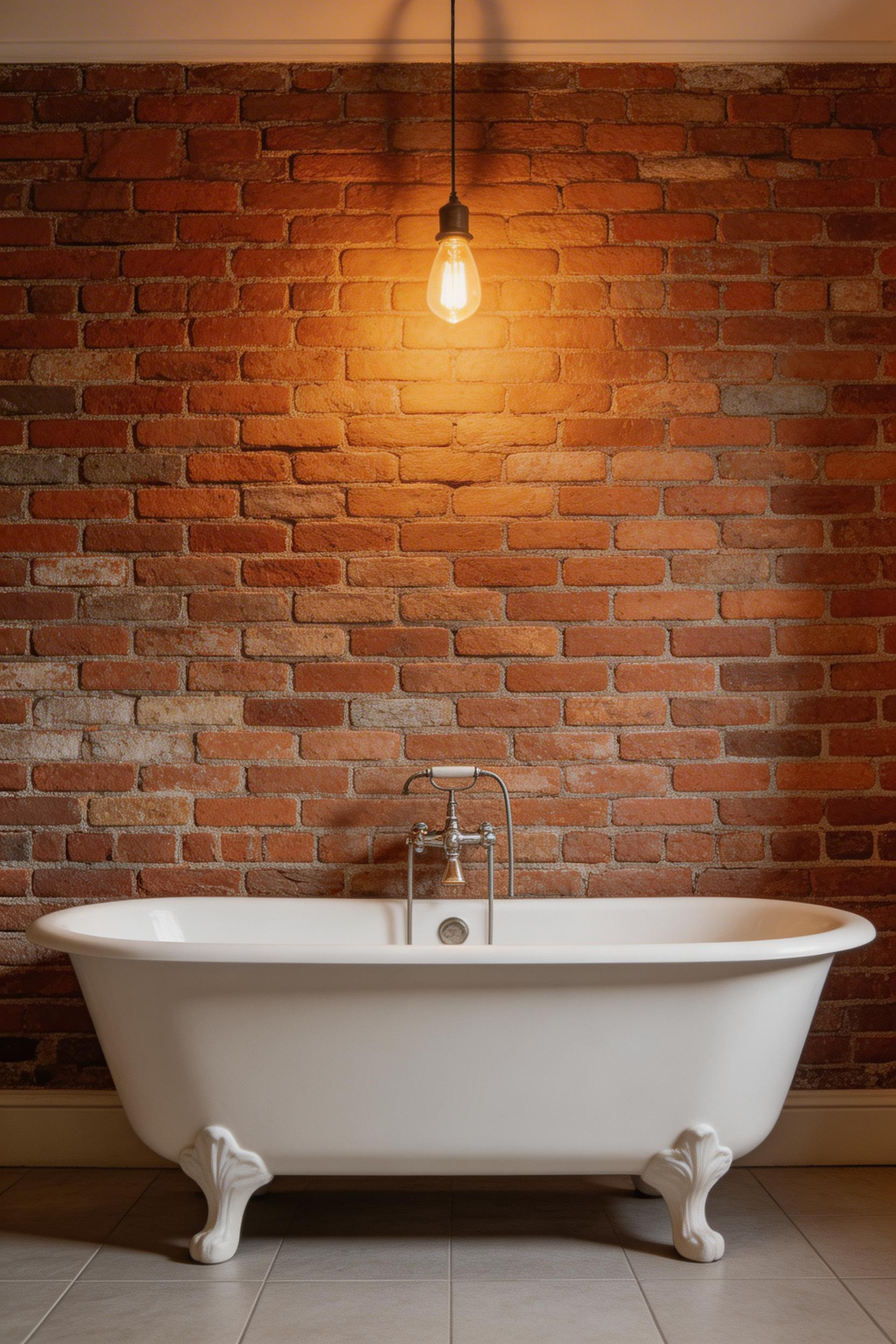
In older homes, I recommend starting with a small test patch before committing to full exposure. Victorian and Georgian brickwork is usually in excellent condition behind plaster; post-war brick (1940s–1960s) can be more variable. Once exposed and cleaned with a soft brush and pH-neutral masonry wash, the brick needs sealing. Apply a penetrating masonry sealer in two coats minimum before the bathroom can be used. In areas adjacent to the shower or bath, add a waterproofing membrane (Redgard or similar) behind the exposed surface rather than relying on the sealer alone.
For bathrooms where genuine brick isn’t available — new builds, rental properties, or rooms where the exposure work isn’t viable — high-quality polyurethane faux brick panels are a solid alternative. Panels from suppliers like Texture Plus install with adhesive and screws, arrive pre-waterproofed, and are convincing at normal viewing distance. They run $3–8 per square foot, compared to $15–30+ for professional genuine exposure including plaster removal and sealing. If you’d like to explore period-appropriate surface treatments beyond brick, vintage bathroom wallpaper is a complementary option worth researching — particularly for period properties where wallpaper and brick can coexist in a layered scheme.
Few pieces carry as much weight in rustic bathroom decor as the clawfoot tub. It arrived in American and British bathrooms in the mid-1800s, imported from the Netherlands. Cast iron holds heat for 20–30 minutes longer than acrylic. The freestanding form makes the tub a sculptural element. The exposed claw feet and plumbing give the room a visible structural honesty that no alcove bath achieves.
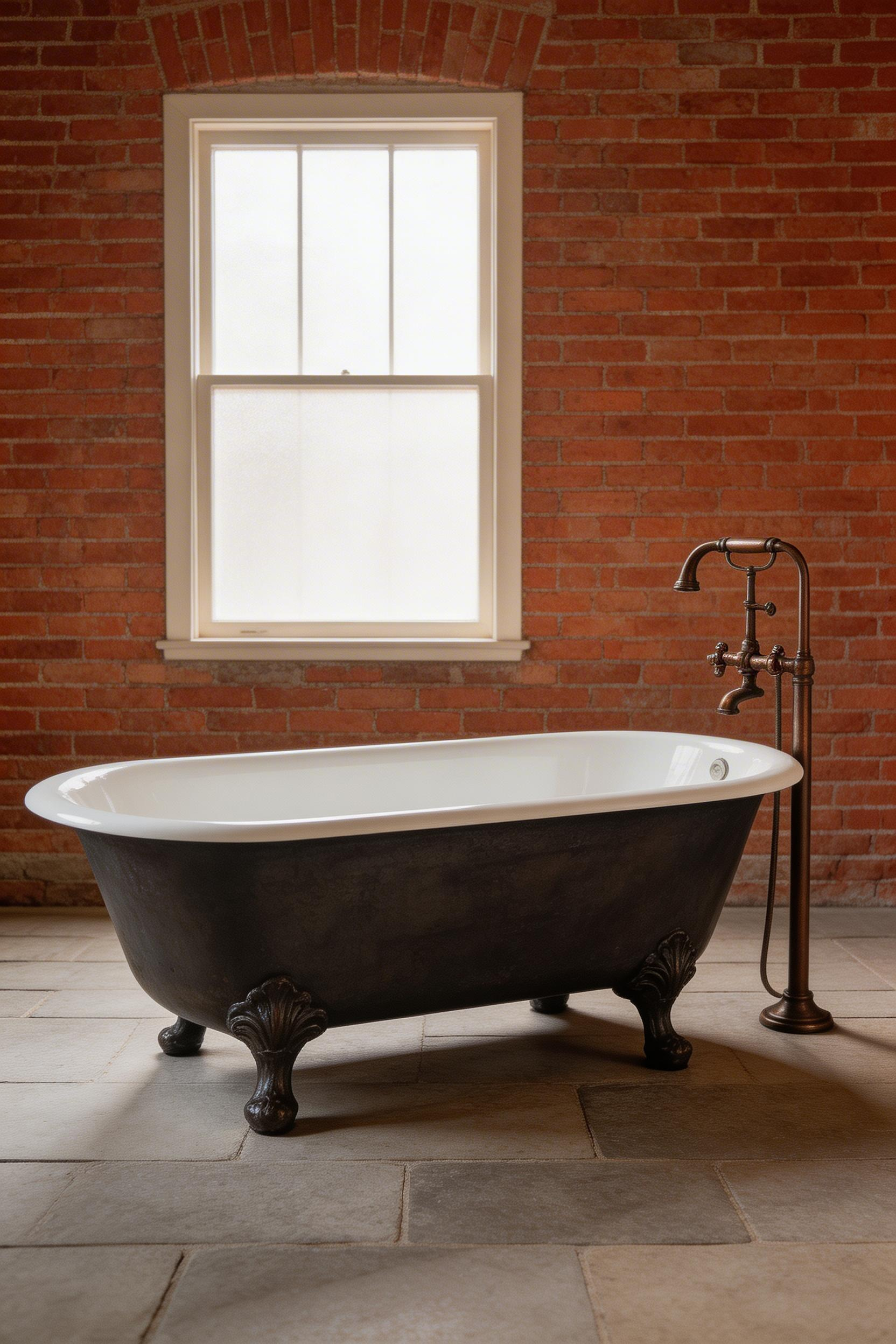
Original cast iron clawfoot tubs still surface at architectural salvage dealers, estate sales, and specialist suppliers at prices between $200 and $600 depending on condition. The interior enamel is almost always in need of work. Professional reglazing costs $300–600 and typically carries a 5-year guarantee. The process involves sandblasting and applying 3 coats of acrylic urethane enamel by spray, or kiln-firing at 1,475°F for a harder, longer-lasting result. Quality reproduction cast iron tubs from Randolph Morris or Signature Hardware start at $800 and offer consistent wall thickness — an advantage over some originals that have thinned after a century of use.
Weight is the conversation no one wants to have before installation. An empty cast iron clawfoot tub weighs 250–500 lbs; filled with water and a bather, you’re looking at a 700–1,000+ lb static load on a relatively small footprint. Floor joist assessment and reinforcement is non-negotiable before installation — a structural engineer consultation costs $200–400 and prevents a very expensive accident. Plumbing hole centres are typically standardised at 3-3/8 inches, but always measure the tub before ordering freestanding floor-mounted taps.
Swap out chrome fixtures for oil-rubbed bronze and a bathroom immediately reads as older, warmer, and more intentional. This is one of the highest-impact changes you can make in a single afternoon, and it costs less than almost any structural alteration.
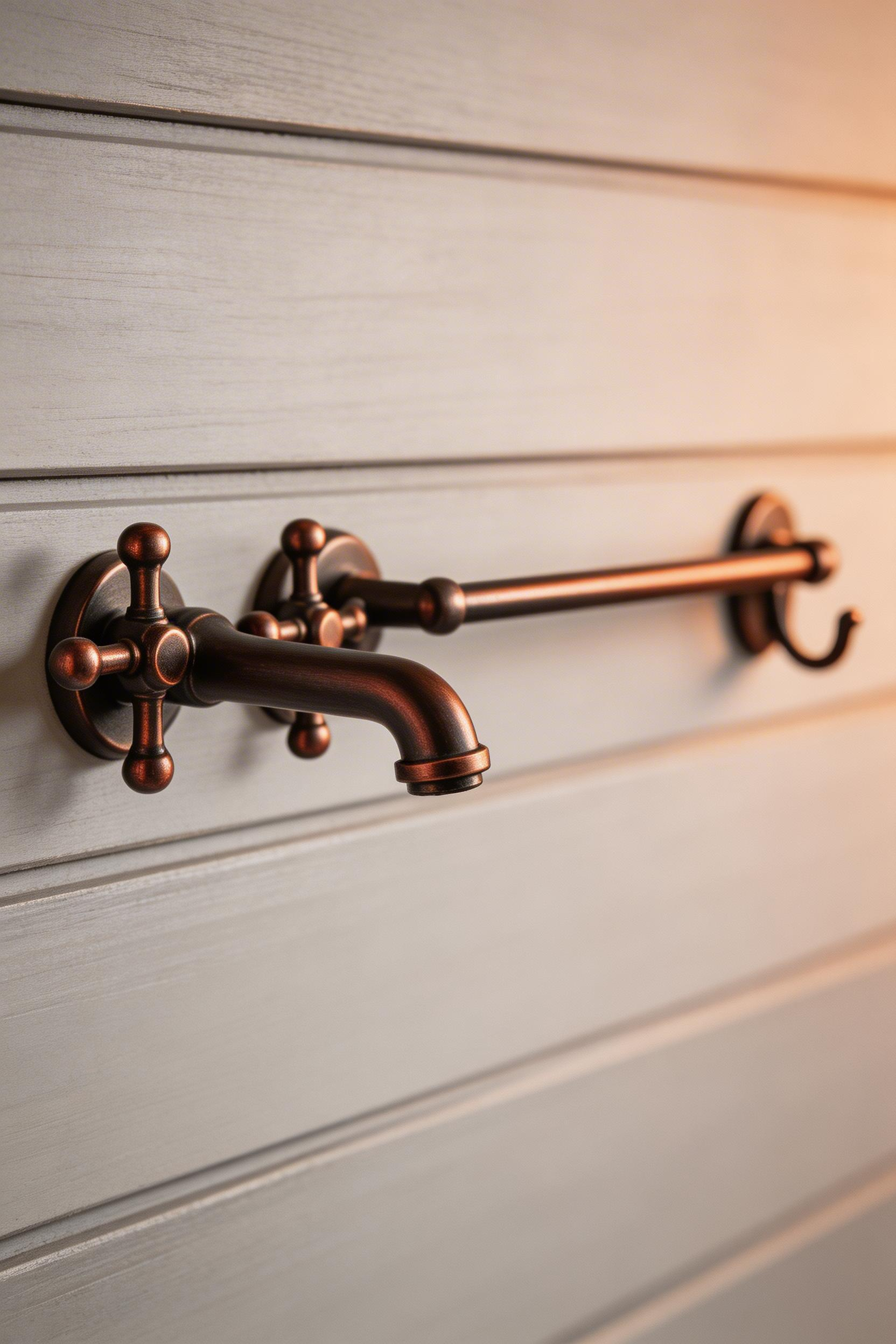
Oil-rubbed bronze is what the industry calls a living finish. The manufacturer starts with a brass base, plates it, and then coats the fixture with a dark oil that gives it the characteristic deep bronze tone with reddish-brown highlights. As the oil wears off high-contact areas — tap handles, the towel bar section you grab every morning — the lighter metal beneath shows through, creating an organic aged patina. That aging process is intentional and desirable; it’s the finish behaving the way old metal genuinely behaves.
The practical challenge is consistency. ORB varies noticeably between manufacturers — the Moen interpretation looks different from the Signature Hardware version and different again from a hand-forged Etsy piece. Venetian Bronze (offered by Delta, Moen, and American Standard) is a more uniform alternative if matching across a large number of fixtures matters to you. Where possible, buy the taps, towel bars, robe hooks, and toilet paper holder from the same collection. Signature Hardware and Rejuvenation both offer coordinated ORB bathroom ranges that include everything down to the light fittings.
Care is straightforward: soft cloth, mild soapy water, dry thoroughly. Avoid abrasive cleaners, bleach, and acidic products — these strip the oil coating and accelerate uneven patina development. A light application of WD-40 or Renaissance Wax buffed with a soft cloth restores the finish if it becomes dull or develops white mineral spots.
Shiplap is a rustic bathroom decor staple for good reason. It started life as exterior structural cladding on North American barns and farmhouses from the 1800s — the overlapping boards created a weather-tight seal without requiring expensive trim work. Its migration to interior bathroom walls brings that same utilitarian honesty indoors. The lines create rhythm, the texture adds depth, and in a period property it reads as genuinely old rather than decoratively rustic.
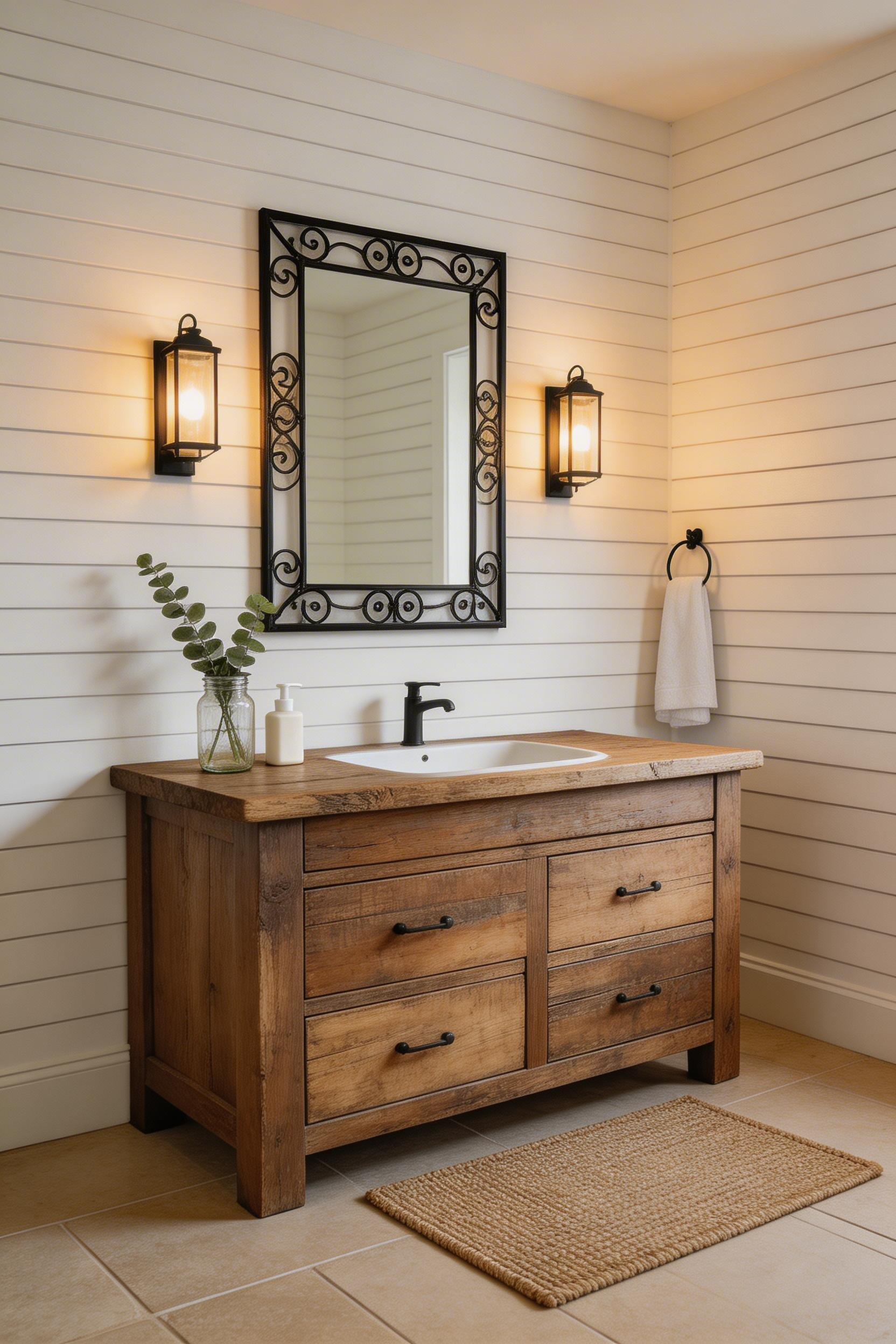
Horizontal installation is the standard for most bathrooms — the low, wide lines visually expand narrow rooms and create a calm horizontal emphasis. Vertical installation (a closer cousin to V-groove and beadboard panelling) draws the eye upward and suits bathrooms with standard 8-foot ceilings that feel cramped. Standard shiplap runs 3.5 or 5.5 inches wide; the wider the board, the more architectural the presence.
Material selection is where most bathroom shiplap projects go wrong. Standard MDF is not suitable for any bathroom with a shower or bath. It swells, bubbles, and delaminates within months of steam exposure, regardless of how well it’s painted. PVC shiplap is the moisture-safe choice: it takes paint easily, won’t warp or mould, and is indistinguishable from real wood at normal distances. Cedar and redwood are acceptable genuine wood options if you want real timber, but they need a semi-gloss or satin paint finish (never flat) to resist moisture absorption. The combination of PVC shiplap and a warm white or sage satin paint is the practical choice for bathrooms that need to look genuine without the material risks of real wood in a humid environment.
Open shelving is one of the most practical rustic bathroom decor decisions you can make, and closed cabinetry is fundamentally at odds with the aesthetic. Cabinet doors create uniform, flat surfaces that read as modern regardless of material. They hide the objects that make a rustic bathroom feel collected rather than installed. Open shelving does the opposite: the timber, the brackets, and everything placed on the shelves all contribute to the room’s character.
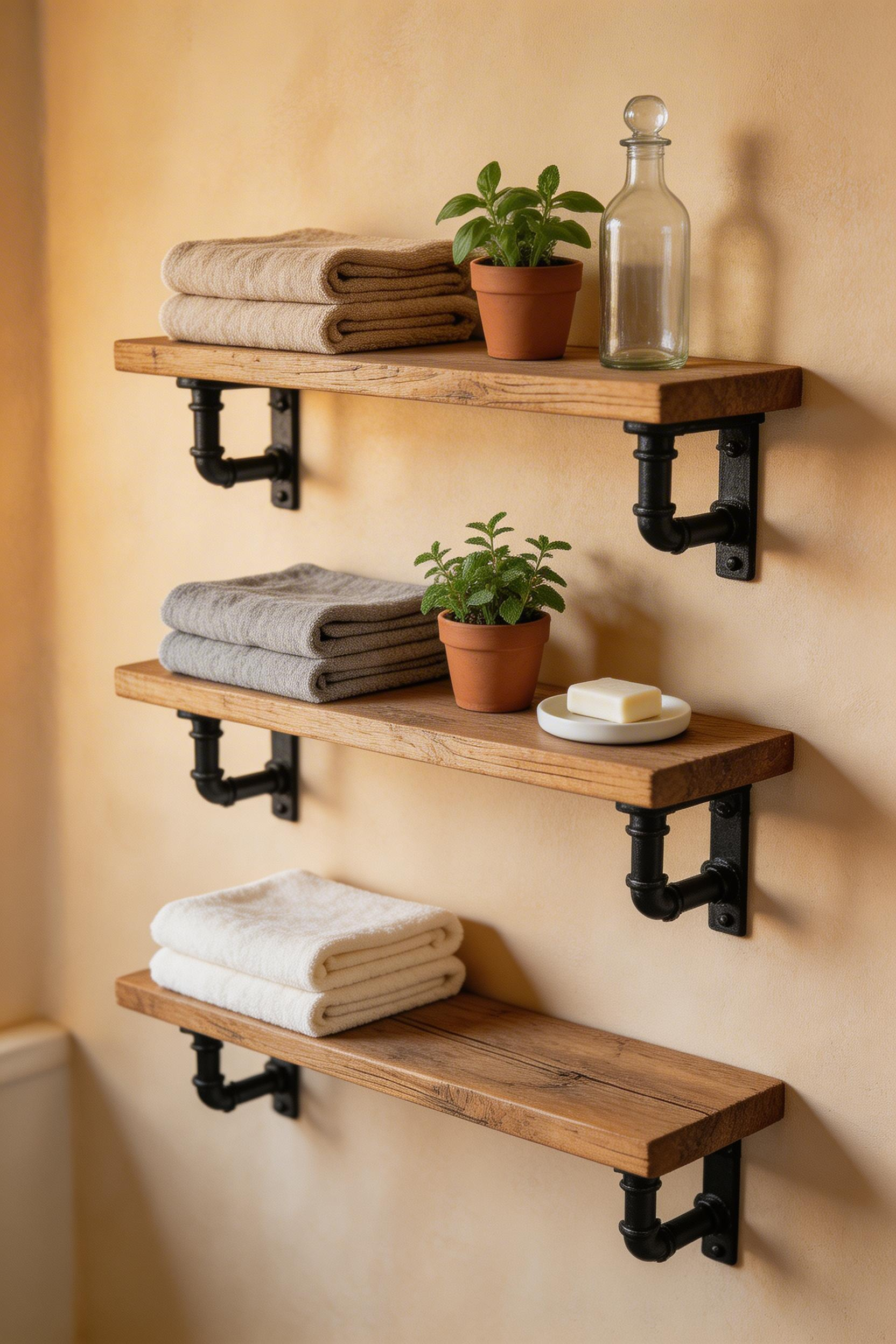
The bracket is where the rustic story begins. Industrial pipe brackets paired with a reclaimed pine or oak plank create the quintessential industrial-rustic shelf. The PIPE DECOR 8-inch double flange bracket is a widely available ready-made option. Forged iron corbels with visible hammer marks are the period-authentic choice for colonial and Victorian-era bathrooms. For timber: white oak’s tight dense grain resists moisture naturally; teak’s internal oils make it the premium option for consistently humid environments; bamboo is the budget-resistant choice. Finish any timber shelf with marine-grade polyurethane — bathroom humidity will eventually compromise an oil-only finish on a horizontal surface.
For small bathroom storage ideas that keep things accessible, open shelving consistently outperforms closed cabinetry in compact spaces — the visual lightness of the shelf prevents the room from feeling further enclosed. The styling principle is: leave 30–40% of shelf space empty, group objects in odd numbers, and layer heights within each grouping (tall, medium, low). Limit decorative categories to three per shelf: one natural element (dried herbs, small plant), one functional (folded towels, soap), one vintage (an old bottle, a small print). More than three categories reads as clutter.
Mirrors are often underestimated in rustic bathroom decor. A foxed or antiqued mirror over the vanity does two things. It reflects light back into the room — critical in bathrooms with limited natural light — and softens that reflection in a way modern mirrors never do. The slight cloudiness, the silver-grey mottling, the gentle distortion — all of these result from moisture slowly penetrating the silver backing over decades. They turn a functional object into something with atmosphere.
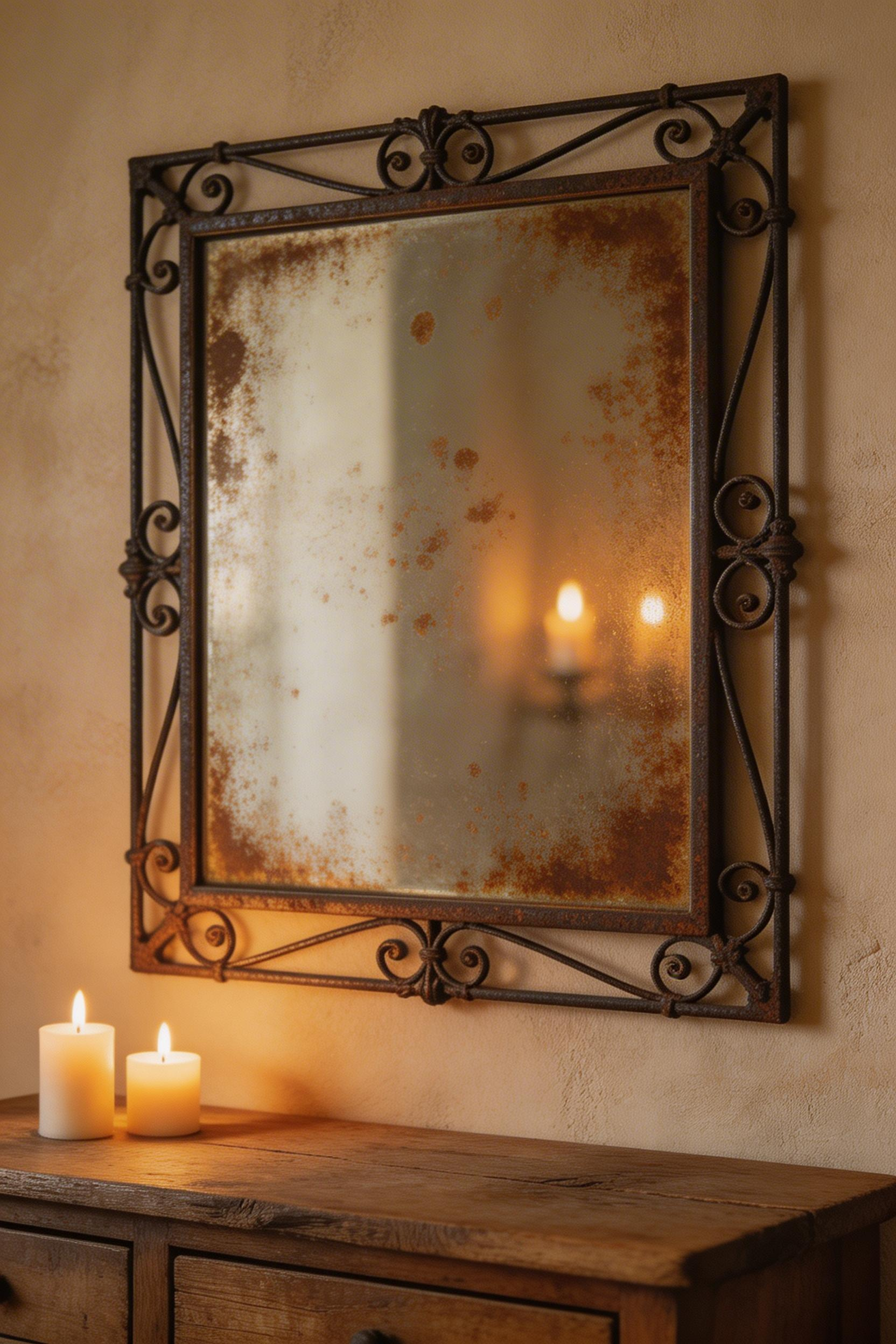
Genuine foxed mirrors are still findable at antique fairs, architectural salvage companies (Lassco in the UK, Architectural Artifacts in the US), and specialist online dealers. Unframed Victorian and Edwardian mirrors in reasonable condition run £80–250; framed pieces with original gilded or painted wood frames run £150–500 and up. The foxing on genuine pieces is irregular: heavier around the edges and corners, lighter toward the centre. That irregularity is the tell that distinguishes genuine pieces from artificially foxed reproductions.
Quality reproductions are genuinely useful, though. West Elm, Birch Lane, and specialist mirror suppliers offer reproductions with convincing artificial foxing at $100–300. Look for irregular foxing patterns, variations in the silvering depth, and frames that show genuine material variation (real wood grain rather than printed grain). For frame materials: hand-forged wrought iron is the most period-authentic choice for heritage bathrooms; aged or antique brass frames warm up the palette considerably and coordinate well with ORB hardware. For a full overview of mirror options at different scales and styles, bathroom mirror design ideas that suit every style covers the range comprehensively.
Mason jars have been manufactured in essentially the same form since Ball and Kerr began producing them in the 1880s. They were designed for food preservation — airtight, watertight, and built to last. Repurposing them as bathroom storage brings that functional heritage into an unexpected context, and the glass lets you see exactly what’s inside without any labels or labels required.
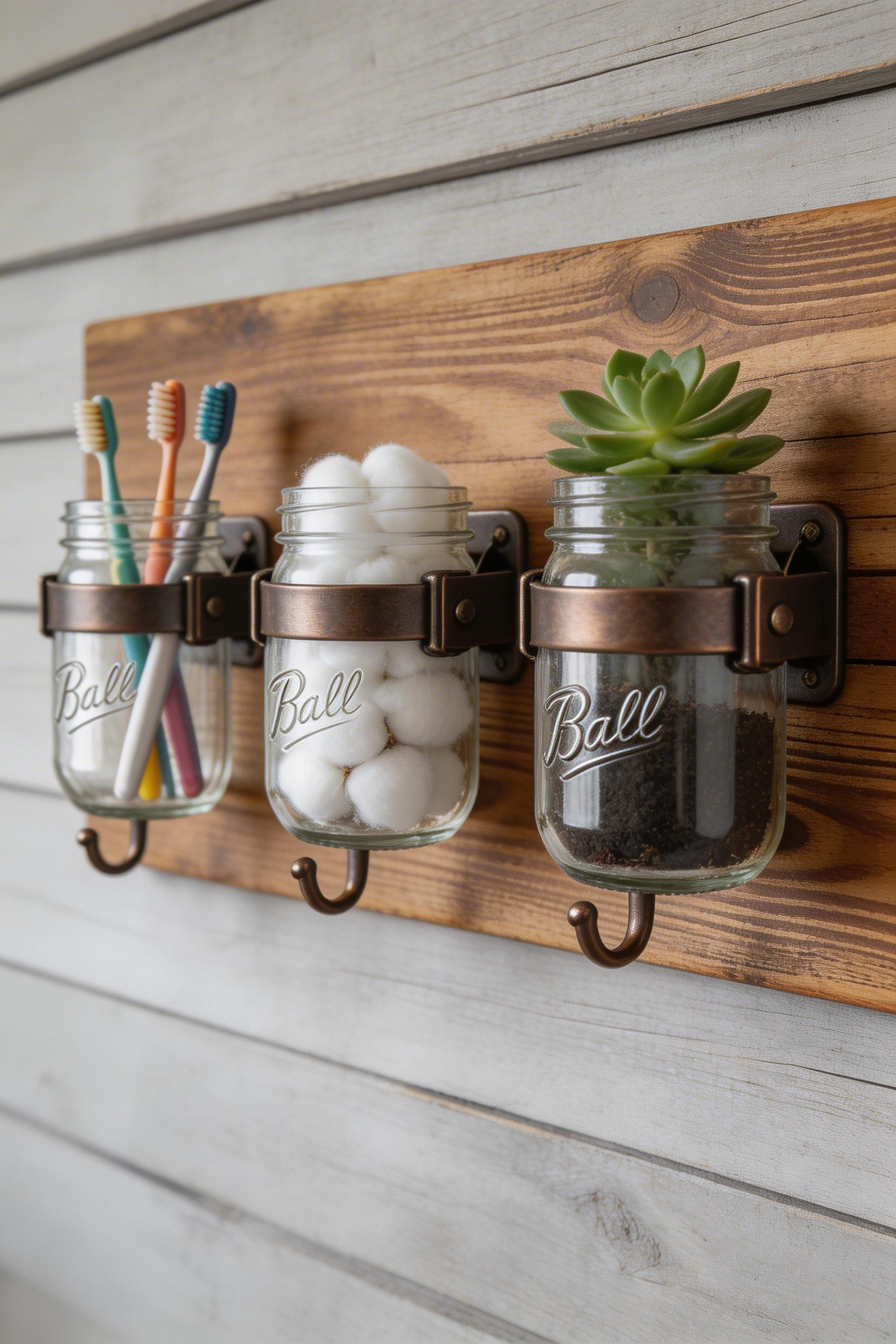
The wall-mounted board format — a stained pine board with 3–4 half-pint jars clamped in metal rings — is the most practical incarnation. BeSuerte’s grey-finish solid pine boards (15.7 inches wide, with half-pint jars at 4.1 inches tall) include keyhole routing for flat-wall mounting and arrive fully assembled. Etsy craftspeople offer custom boards in two standard sizes — 20×5 inches with 3 jars and 25×5 inches with 4 jars — with stain, wood species, and jar size options; expect to pay $35–80. The jars can hold open cotton wool and Q-tips, serve as toothbrush caddies, or be fitted with pump-top lids for liquid soap.
Pairing the mason jars with a coordinated accessory collection is what moves this from a single item to a coherent rustic bath decor scheme. Coordinate the metal clamps and hooks with your hardware finish — ORB throughout reads as intentional. Add galvanized trays for soap and small accessories, vintage enamel canisters for longer items, and a simple wood tray on the vanity top. Keep plastic accessories out entirely: even one piece breaks the natural-materials character of the display.
Synthetic textiles signal manufacturing. Their uniform sheen, their consistent pile height, their slightly too-perfect texture — these qualities read as modern in a room that’s working to feel old. Natural fibres do the opposite: linen’s slubby weave, waffle cotton’s honeycomb texture, and jute’s rough agrarian character all reinforce the rustic narrative rather than undercutting it.
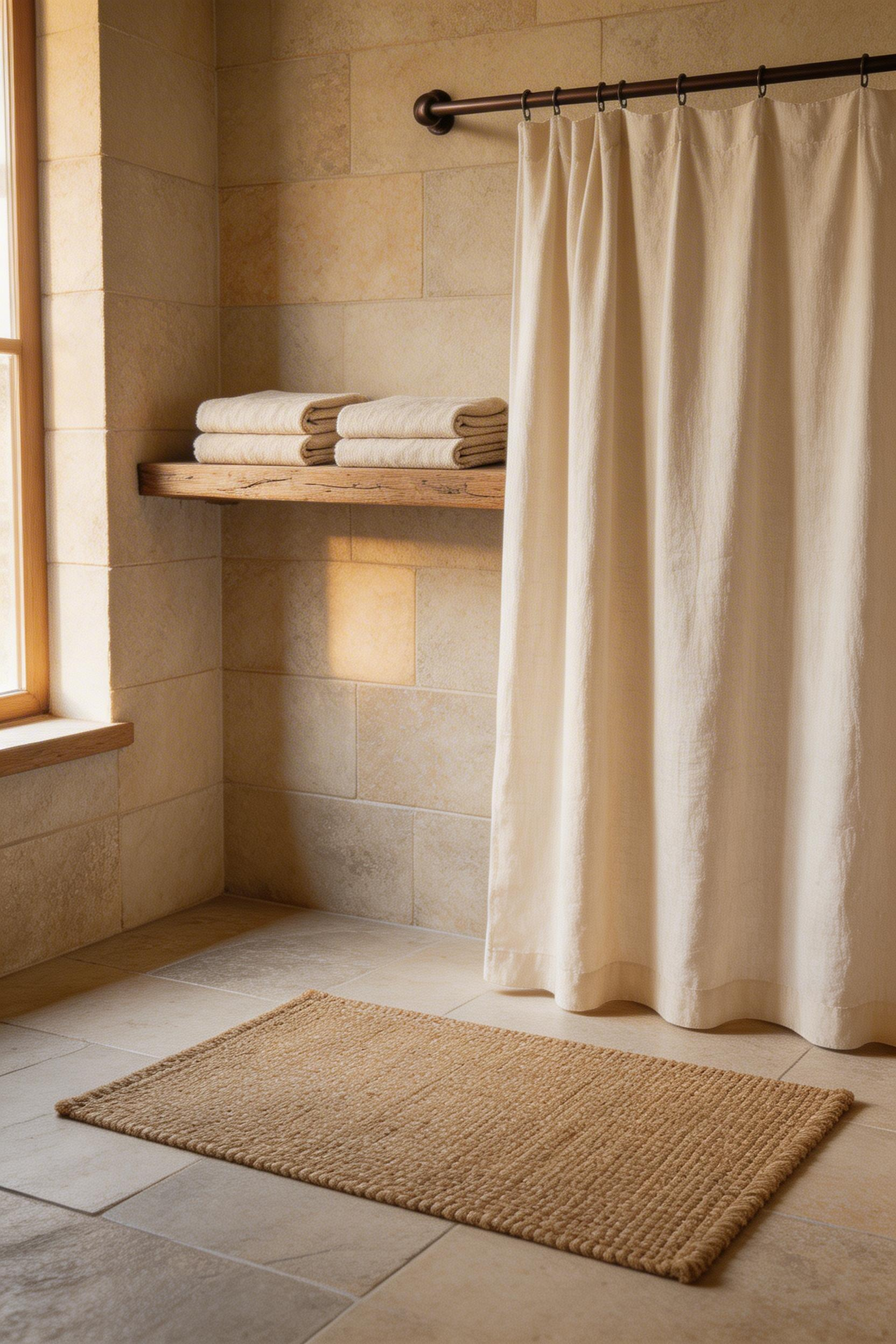
Linen (woven from flax, one of the oldest cultivated plants) is the most historically authentic choice. Flax is more absorbent than cotton by weight, naturally antibacterial, and quick-drying. Its initial roughness — the quality that puts some people off — softens significantly after 5–8 washes, and the fabric becomes more characterful over time in the same way aged wood does. It’s best for hand towels and guest towels; for daily bath towels, waffle-weave Turkish or Egyptian cotton is the more practical choice — the honeycomb weave maximises surface area for absorption and drying, and the softness improves with each wash. Spas have used waffle-weave towels for exactly this reason for decades.
For bath mats, 100% cotton is the practical standard. Jute and seagrass mats look exactly right on a stone or reclaimed wood floor. But they must be lifted and dried after every use. The underside develops mould within a few weeks if left lying flat. Lift and dry them after use. For the shower curtain, a natural cotton or undyed linen in a simple stripe or solid ecru hangs well on a wrought iron or ORB rod and ties the textile palette together. The overall textile palette should stay within 2–3 tones in the same warm neutral range — undyed linen, oatmeal cotton, and a single muted stripe is enough variation without becoming busy.
Ceiling beams are one of the most architecturally significant rustic bathroom decor additions possible — they transform a room from a functional box into a space with structural honesty. Two or three beams running across a standard bathroom ceiling immediately suggest agricultural or industrial heritage — a converted barn, an old mill, a farmhouse kitchen repurposed over centuries. They draw the eye upward in low-ceilinged rooms and bring warmth down in high-ceilinged ones.
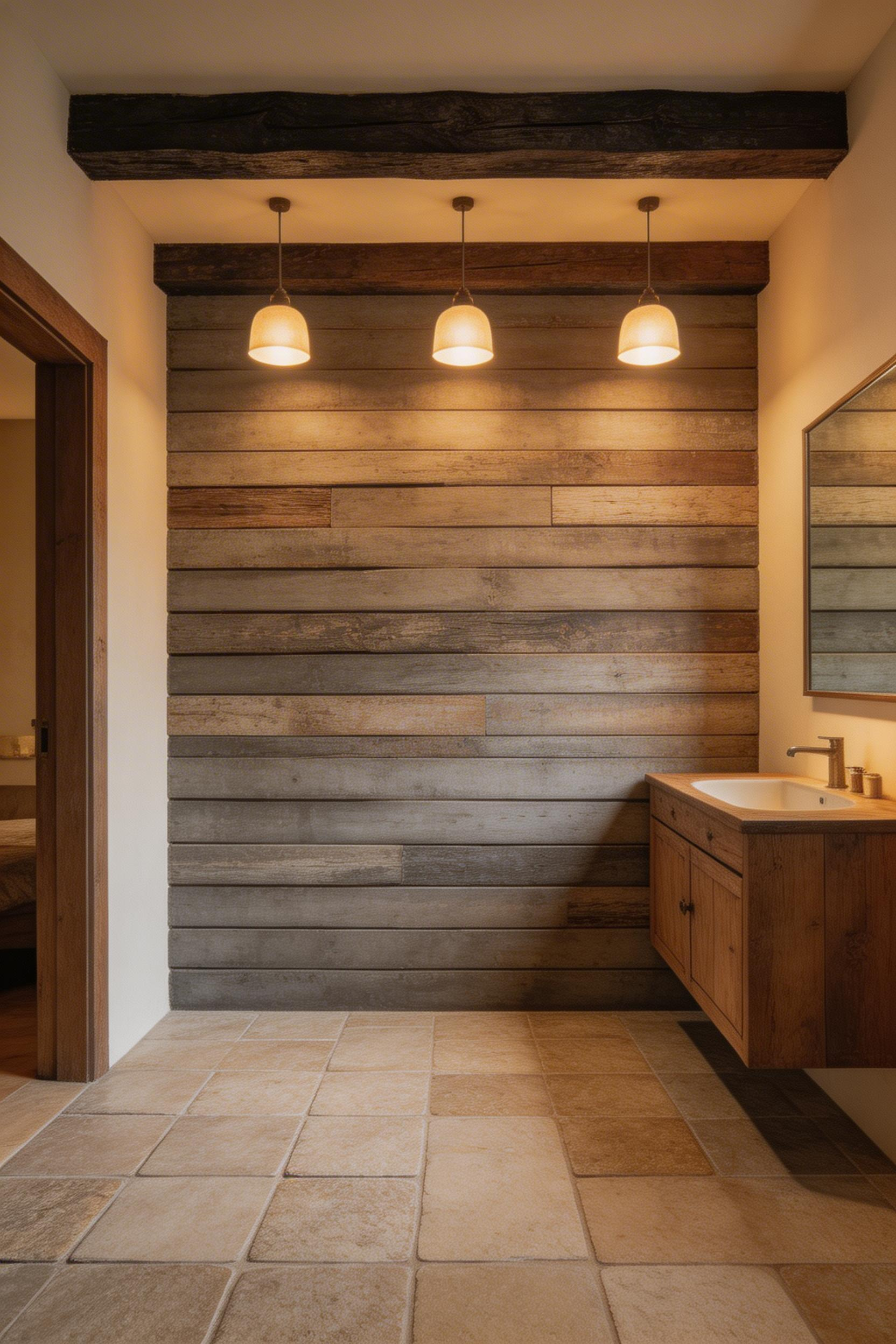
Real timber ceiling beams are the ideal but not always the practical choice. A 6×8-inch reclaimed oak beam for an 8-foot span weighs over 60 lbs. Structural assessment and joist reinforcement are required before installation, adding $500–1,500 to the project cost. Reclaimed timber beams from salvage suppliers run $30–80 per linear foot. In ground-floor bathrooms with accessible structural subfloors, real beams are achievable; in upper-floor bathrooms, faux beams are the sensible alternative.
Barron Designs has been making high-density polyurethane faux beams for over 50 years, and their Heritage and Resawn lines are the benchmarks. The closed-cell polyurethane replicates grain, knots, and check lines convincingly. They install with construction adhesive and screws into ceiling drywall, with no structural work required. Critically, the closed-cell structure resists moisture and insects, making them genuinely suitable for bathroom environments. Unfinished versions are available for custom finishing: Minwax Dark Walnut or Early American stain applied with a dry brush and wiped back creates a convincing barn wood finish; seal with matte polyurethane to protect from steam. For real reclaimed beams, use a clear penetrating oil finish rather than stain — preserve the existing patina rather than overriding it.
Galvanized steel has been used in agricultural and industrial applications since the 1850s — water towers, farm equipment, barn roofing, cattle troughs. It appears in working buildings precisely because it does the job without requiring maintenance or aestheticisation. That functional ancestry is what gives it credibility in a rustic bathroom; it doesn’t pretend to be decorative, and that honesty is the point.
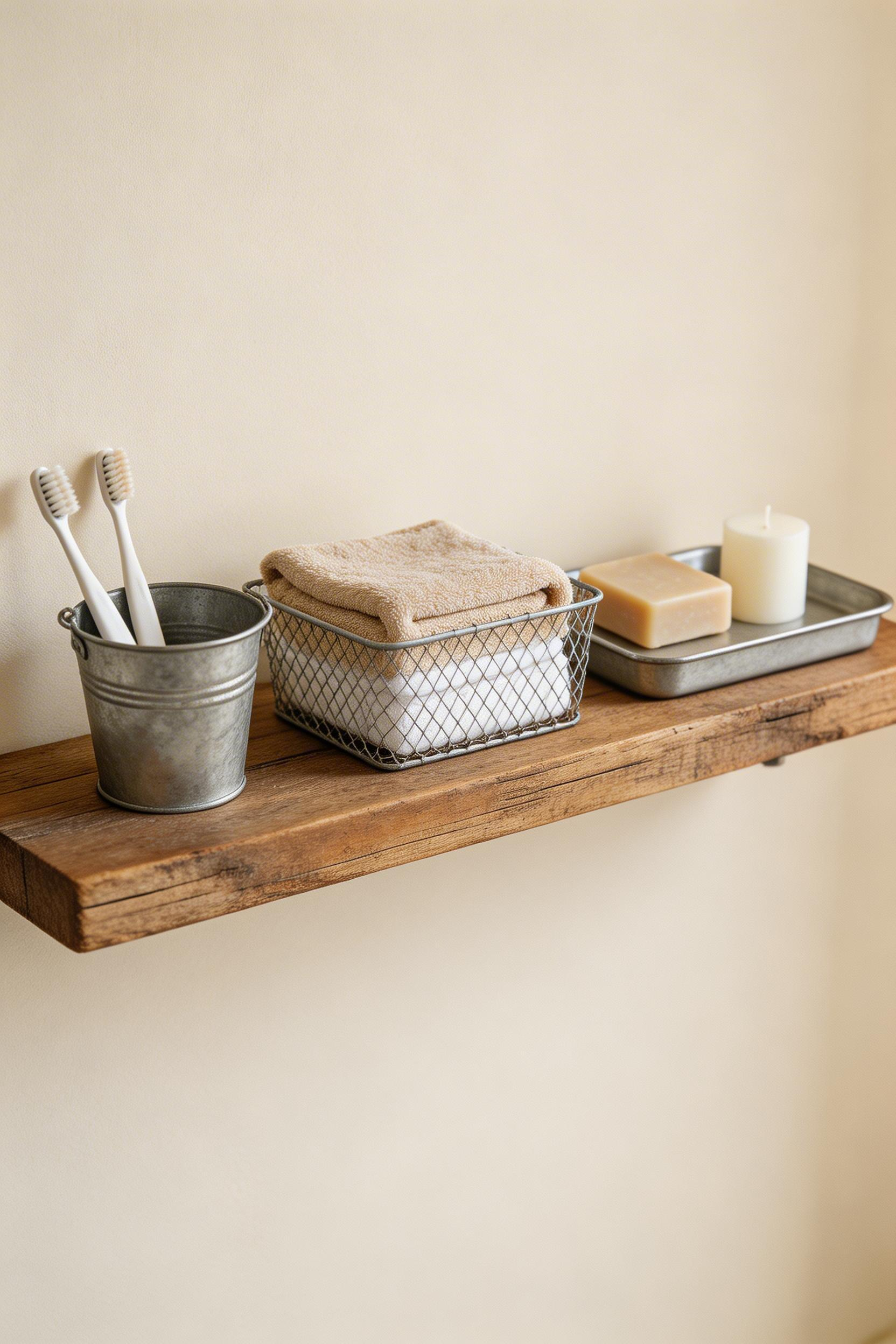
The zinc coating (approximately 80% zinc, 20% iron in standard galvanized steel) provides rust resistance by acting as a sacrificial barrier — the zinc oxidises before the steel below. In a bathroom environment, paste wax (Johnson Paste Wax or Carnauba) applied to galvanized surfaces creates an additional moisture barrier and can be reapplied annually. Keep galvanized accessories away from direct shower spray; the coating handles ambient humidity well but constant direct water contact eventually defeats it.
Products that translate best to bathroom use: GWH Industrial 2-tier pine and galvanized steel floating shelves (available in 24-inch and 36-inch widths, $60–100 assembled) for practical storage; a simple 3-gallon galvanized pail repurposed as a toilet brush holder or waste bin — available from farm supply stores for $8–15; wire cage sconces in matte black or galvanized finish that pair naturally with Edison filament bulbs. The matte silver-grey tone of galvanized metal provides cool contrast against warm reclaimed wood and terracotta tile — it prevents the palette from becoming entirely brown and adds visual definition. For more ways to work galvanized and farmhouse metals into the space, farmhouse bathroom decor ideas that last covers the approach from a slightly different angle.
The pedestal basin was the dominant bathroom fixture in British and American homes from the 1880s through the 1940s. Its form is inseparable from period authenticity — and it’s one of the few bathroom fixtures that remains available in genuinely old examples rather than only reproductions.
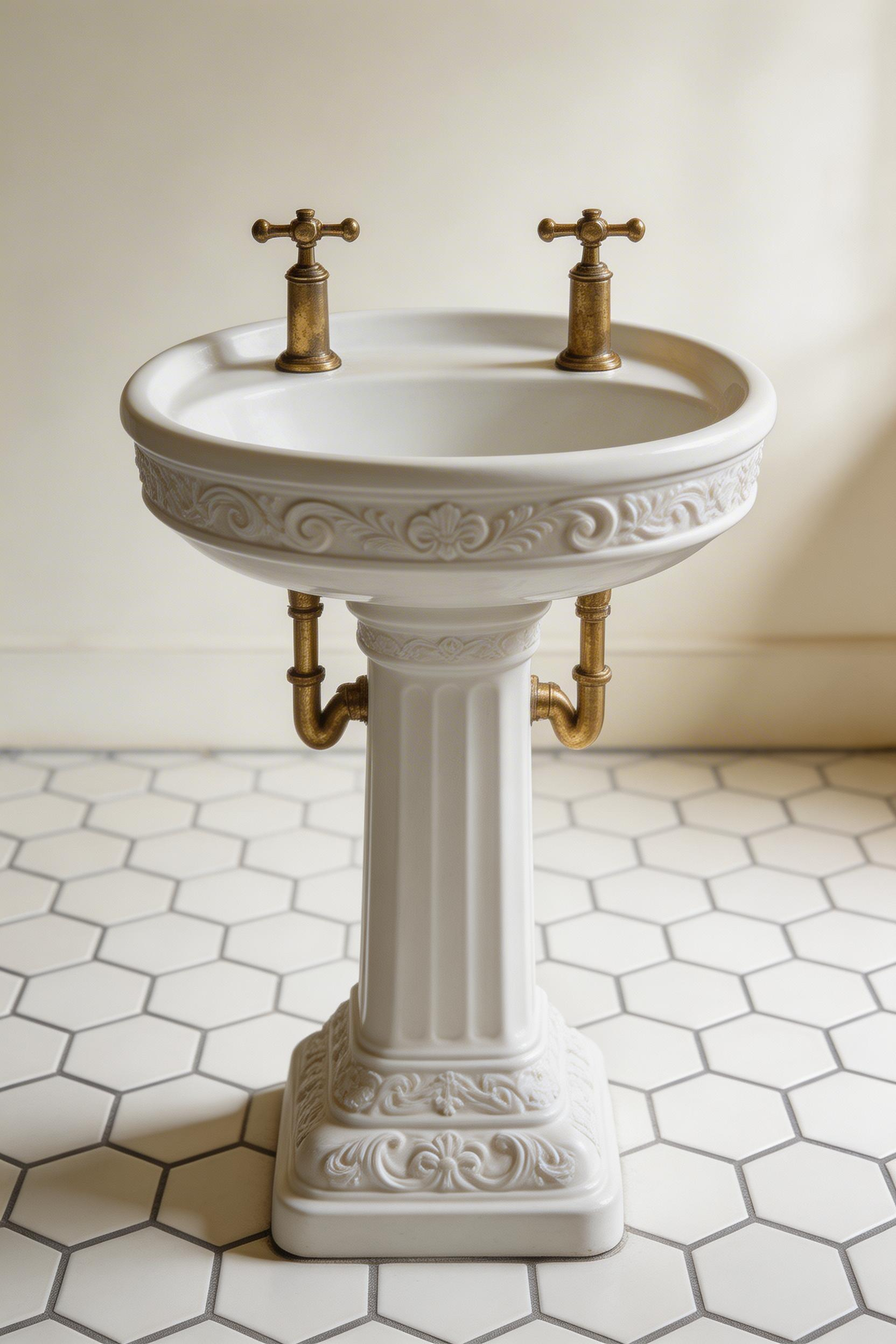
Fireclay is the traditional material. Powdered glass glaze is fired onto a clay body at high temperature, producing a dense, non-porous surface that resists chips, staining, and bacterial growth. Twyford was manufacturing glazed fireclay bathroom fixtures in the 1890s; their work still surfaces at salvage dealers in remarkably good condition. Original pedestal sinks from sources like Stiffkey Bathrooms (UK) and Historic House Parts (US) run $150–400 depending on condition. Fireclay reproductions from Cheviot start at $400–600 and offer consistent quality without the salvage uncertainty.
Victorian and Edwardian basins often feature embossed or relief patterns on the basin skirt and pedestal — these details distinguish them from modern reproductions and are worth seeking out when sourcing salvage. Console basins, supported on two or four legs with the back wall-anchored, expose their plumbing as part of their design. Cross-handle pillar taps in unlacquered brass or ORB are the authentic pairing; unlacquered brass develops a natural patina over time. Under-basin fabric skirts in toile, gingham, or white cotton with lace trim were a standard Victorian bathroom detail — they conceal under-sink storage while adding period authenticity that no vanity unit achieves. Modern plumbing adapts easily with flex connectors and standard waste adapters; the infrastructure update is straightforward, and the aesthetic dividend is substantial.
Wall art is the most personal dimension of rustic bathroom decor, and botanical prints make the strongest case. They have a centuries-long history as scientific illustration — the formal cataloguing of plant specimens in precise engraved or hand-coloured form dates to the 16th century. In a bathroom that uses natural materials throughout, hanging art that depicts the natural world is less a design decision than a logical extension of the room’s visual language.
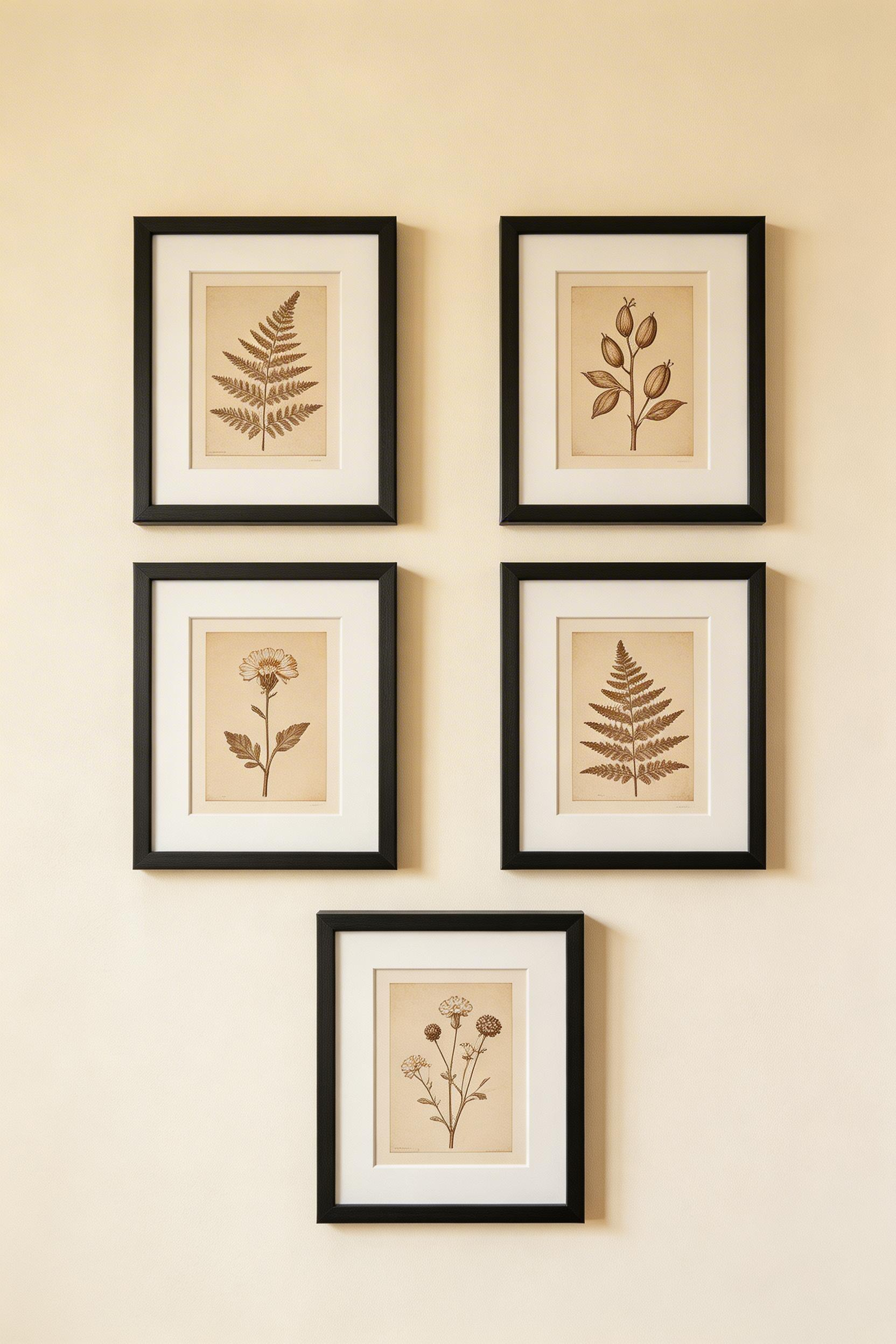
Original 18th and 19th century botanical engravings are still widely available. Antique fairs, estate sales, and specialist Etsy dealers regularly offer unframed prints in good condition at $15–200+, depending on rarity, size, and original publication. For a bathroom display, four to six prints in consistent sizes and frames work better than a single large piece. The gallery grouping creates scale without the expense of a single statement piece. High-quality reproductions (Capricorn Press’s 1786 Herbarium series, Fine Art America archival prints) are printed on acid-free watercolour paper with archival inks and are nearly indistinguishable from originals at bathroom display distance.
Framing matters considerably in a steam-heavy environment. Use sealed wood or metal frames with UV-protective acrylic glazing rather than glass — acrylic is lighter, shatter-resistant, and handles moisture condensation better than glass. Acid-free mats are non-negotiable for quality prints. Acidic mats yellow the paper around the print edges within a few years. Group 3–5 prints in matching frames with 2–3 inch gaps between pieces for a cohesive gallery wall effect. For related ideas on building a wall display that suits a character-rich space, bathroom wall decoration ideas for character-rich spaces covers the gallery wall approach in more detail.
Lighting is the final layer of rustic bathroom decor — and the one most people address last when it should be addressed first. The same reclaimed wood vanity, the same travertine floor, the same wrought iron mirror frame will look completely different under 6500K LED panels versus 2200K Edison filament sconces. The first reads as a renovation project; the second reads as a bathroom that has always looked this way.
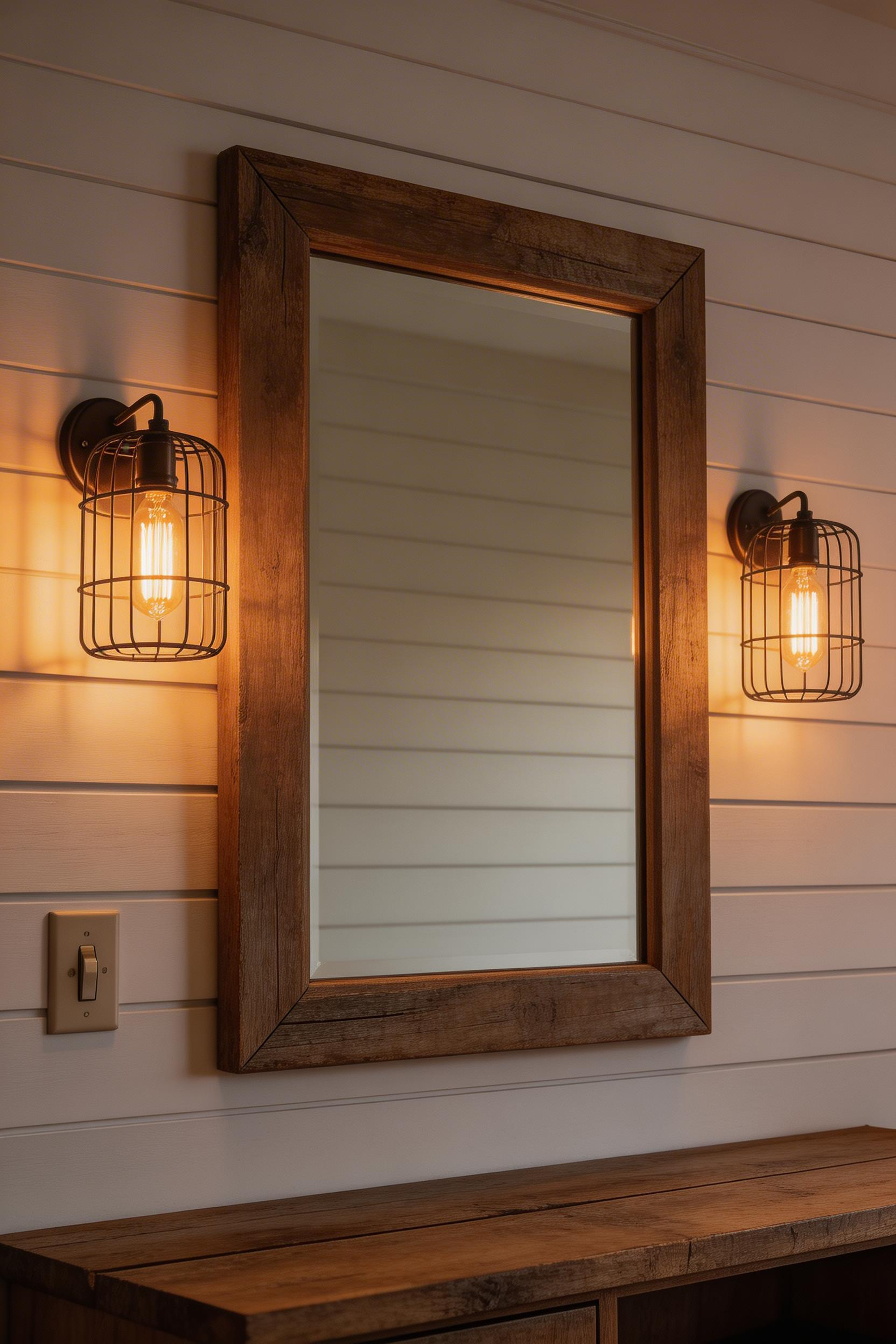
The warmth distinction is important. At 2200K, Edison filament bulbs produce an amber-orange light closest to candlelight — atmospheric and beautiful, but insufficient for task lighting. For vanity illumination, 2700K warm white filament LEDs are the balanced choice. They retain the warm visual quality of filament lighting while producing 600 lumens at just 6 watts — enough for shaving or applying makeup. Two 6W LED filament bulbs flanking a vanity mirror provide adequate task lighting without sacrificing the rustic atmosphere. Dimmer switches — $30–50 fitted — allow the room to shift from task mode to evening sanctuary mode, which is where the 2200K range becomes valuable.
For a rustic bathroom, wire cage fixtures in galvanized or matte black are the simplest and most versatile sconces. They work with pipe shelving, galvanized accessories, and reclaimed wood equally well; barn-style half-dome shades in ORB or matte black suit larger bathrooms with higher ceilings; pipe-style sconces built from industrial black iron pipe coordinate with any scheme that already incorporates pipe shelving or hardware. All bathroom wall fittings must carry a minimum IP44 rating (splash-proof) for Zone 2 installation. Zone 2 covers the area within 60cm of the bath or shower. Non-IP-rated fittings in this zone are a building code violation and a genuine safety risk in a steam-heavy environment. For more help with bathroom vanity lighting ideas that set the right tone, there’s a dedicated guide covering zone ratings, bulb types, and coordination across different rustic styles.
The most common mistake in rustic bathroom decor is starting with surface accessories. Mason jars and botanical prints look great — but they can’t fix a room that lacks character underneath them. Accessories reinforce a character the room already has; they don’t create it from scratch.
Start with lighting. Replacing overhead fluorescent or cool-white fittings with warm Edison sconces costs under $150 in most cases and changes how every other material in the room reads. Swap chrome taps and towel bars for oil-rubbed bronze in the same session — that’s one afternoon and under $200 for both changes, and the visual shift is immediate and significant.
If you have a period property, look carefully at what’s already there before buying anything. A clawfoot or freestanding tub is worth reglazing professionally rather than replacing — it costs 30–40% of replacement price and preserves an original piece that reproductions only approximate. Plain white ceramic tiles can read more rustic simply through grout colour change (buff or warm grey instead of bright white), new ORB hardware, and an open wood shelf positioned in the room. Genuine brick behind plaster is worth uncovering. Original floor tiles worth preserving.
Surface materials — shiplap, stone tile, faux beams — require the most disruption and budget, and they’re the elements to introduce once you’re certain about the overall direction. Get the lighting, the fixtures, and the textiles right first. The room will tell you what it still needs.