Physical Address
304 North Cardinal St.
Dorchester Center, MA 02124
Physical Address
304 North Cardinal St.
Dorchester Center, MA 02124
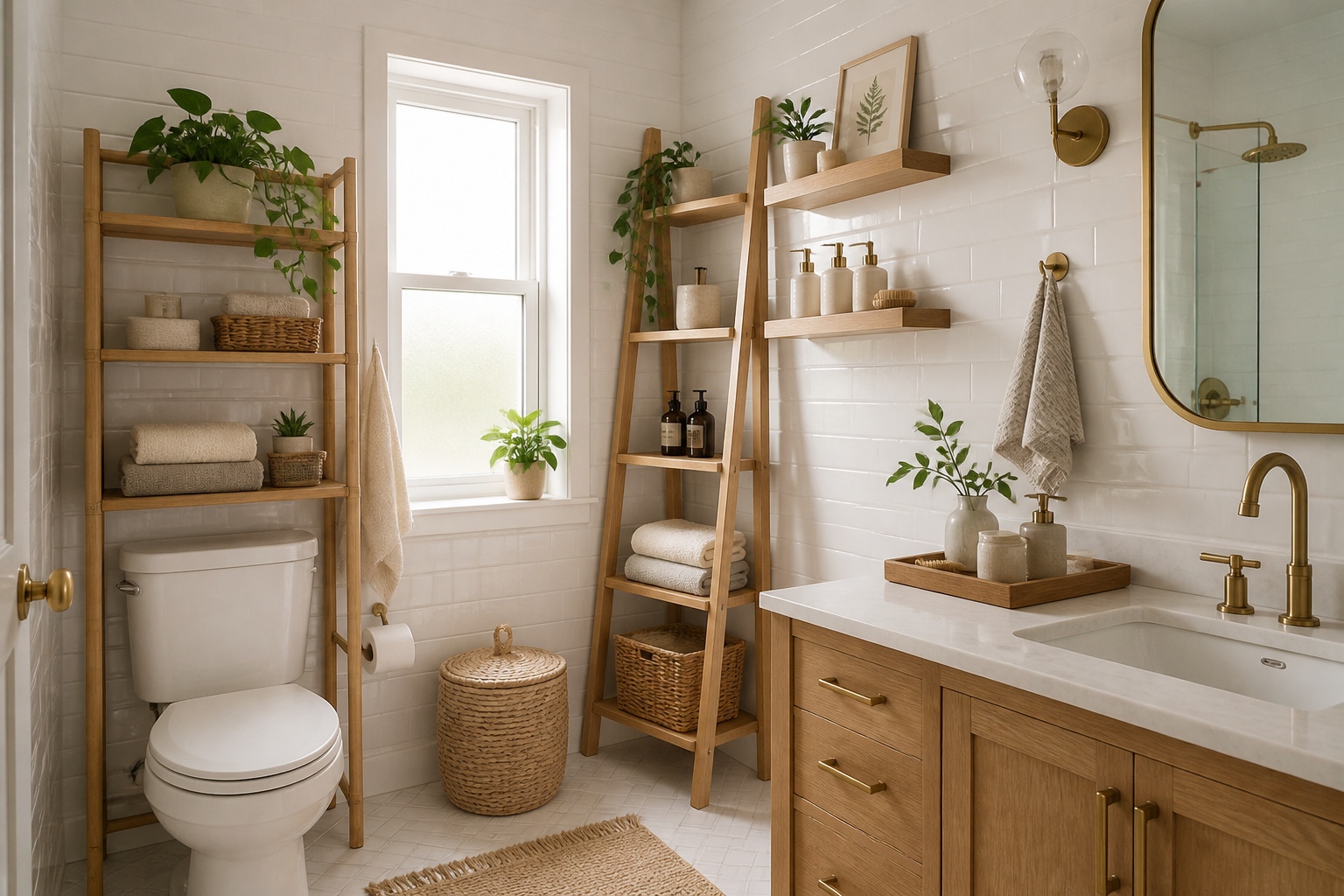
From budget-friendly baskets to permanent built-in cabinetry, discover 17 bathroom storage solutions grounded in Nordic principles of functional calm.
There is a particular kind of quiet that settles over a bathroom that has been thoughtfully organised. Nothing is hunting for space on the counter. No drawer requires force to close. Towels hang where you reach for them, not where they happened to land. In Scandinavian design, this state of functional calm is not a luxury — it is the foundation. A bathroom works for you, or it quietly works against you every single morning.
The good news is that bathroom storage solutions don’t require a full renovation to make a meaningful difference. Some of the most effective changes cost less than a weekend’s worth of coffee and take an afternoon to implement. Others are longer investments — built-in cabinetry, shower niches, recessed medicine cabinets — that become part of the home’s permanent fabric. This guide covers both ends of that spectrum, with 17 approaches that range from a five-minute fix to a considered renovation decision. What connects them is the Nordic principle that storage should be functional, honest, and invisible in the best possible sense: present when you need it, unobtrusive when you don’t.
Most bathrooms waste the space above the toilet entirely. It’s a peculiar oversight: from the top of the tank to a standard nine-foot ceiling, you have roughly 70 inches of uninterrupted vertical real estate, and the footprint is already occupied. You’re not claiming new floor space — you’re simply building upward into an area that was doing nothing.
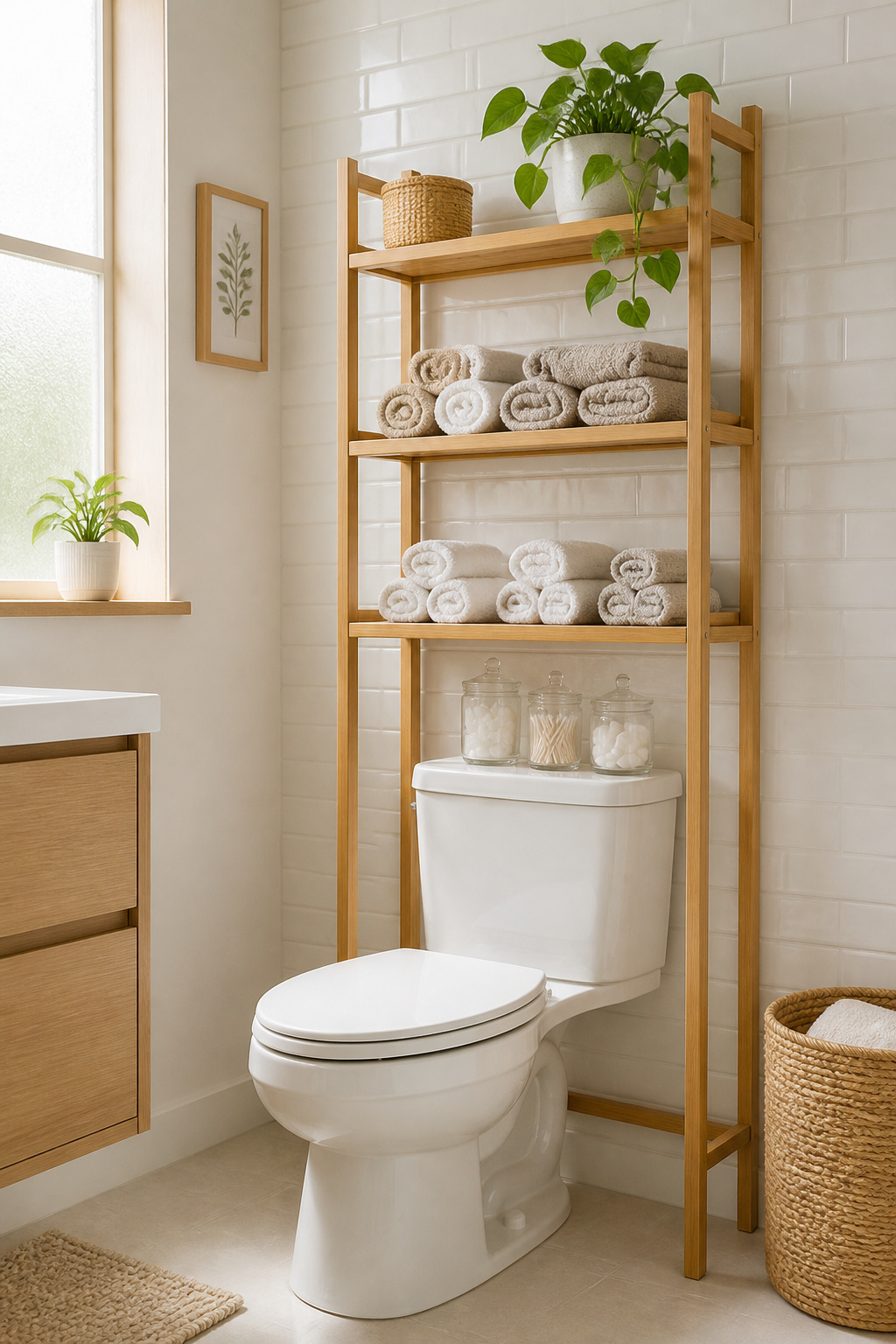
Freestanding over-toilet etageres rank among the most accessible bathroom storage solutions for renters. They slot behind the tank without drilling or permanent fixing. Bamboo is the dominant material choice for good reason: it’s naturally moisture-resistant, eco-friendly, and proportionally lighter than wood or metal at comparable sizes. Standard dimensions run 24-25 inches wide, 9-9.5 inches deep, and 66-67 inches tall — sized to clear the tank lid without sitting awkwardly behind it. Brands like VEIKOUS are widely available at Home Depot and Lowe’s, typically in the $60-120 range.
The models worth buying combine an enclosed cabinet section below with open shelves above. The lower doors handle what should be hidden: spare toilet rolls, cleaning products, first-aid supplies. The open shelves handle what earns its visual place — a pair of rolled towels in a linen or stone tone, a small trailing plant, a ceramic vessel. The Scandinavian instinct here is restraint: each shelf should breathe, no more than two-thirds full, so the eye has somewhere to rest. If you find yourself cramming items in, you have a product audit problem, not a storage problem. For guidance on what deserves to live on those open shelves, bathroom shelf decor ideas offer a more detailed treatment of the styling principles.
A cleared bathroom counter is not just aesthetically pleasing — it’s measurably calming. Nordic design has understood this for decades: open surfaces reflect more light, read as larger than they are, and remove the low-level cognitive friction of visual clutter before the day has properly started.
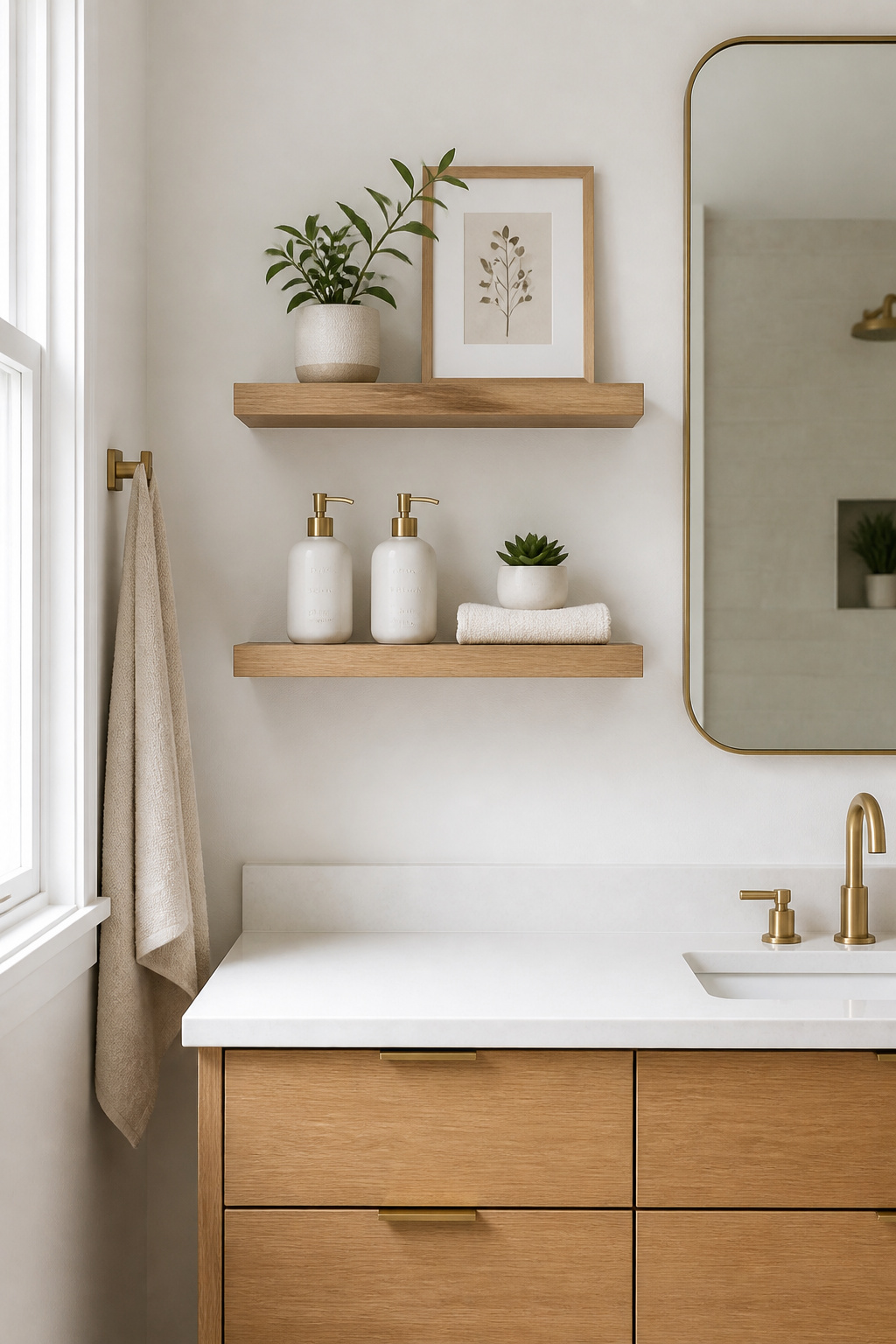
The premise of floating wall shelves is straightforward: move everything off the counter and up to eye level. Soap dispenser, cotton round jar, hand cream, the small plant that has no business taking up valuable counter space — all of it can live on a shelf 4-8 inches deep at about shoulder height, accessible as quickly as it would be on the counter, but no longer consuming the surface you need to use the sink.
Installation in a bathroom requires a few extra considerations. All hardware must be stainless steel or rust-resistant — standard zinc screws streak down the wall in a humid environment within months. If you’re going into tile, use a diamond-tipped tile bit and drill slowly; the wrong bit cracks tile and compromises the moisture barrier behind it. Toggle anchors rated for your expected load handle 20-50 lbs cleanly when you can’t hit studs. For creating a bathroom design that lasts, material choice at the outset matters enormously.
Once the shelves are up, resist the urge to use every inch. Decant liquid products into matching ceramic or glass dispensers — this single step transforms the look from ‘things on a shelf’ to ‘considered collection.’ As a display principle, odd-numbered groupings with deliberate empty space between clusters is what prevents open shelving from reverting to organised clutter.
There is a material warmth to natural fibre baskets that no plastic bin can replicate. Touch a wicker basket and a polypropylene container and the difference is immediately felt — one belongs in a space designed for wellbeing, and one belongs under a utility sink. Natural fibre baskets are, in fact, one of the more underrated bathroom storage solutions for a hygge-shaped space. The tactile distinction matters as much as the function.
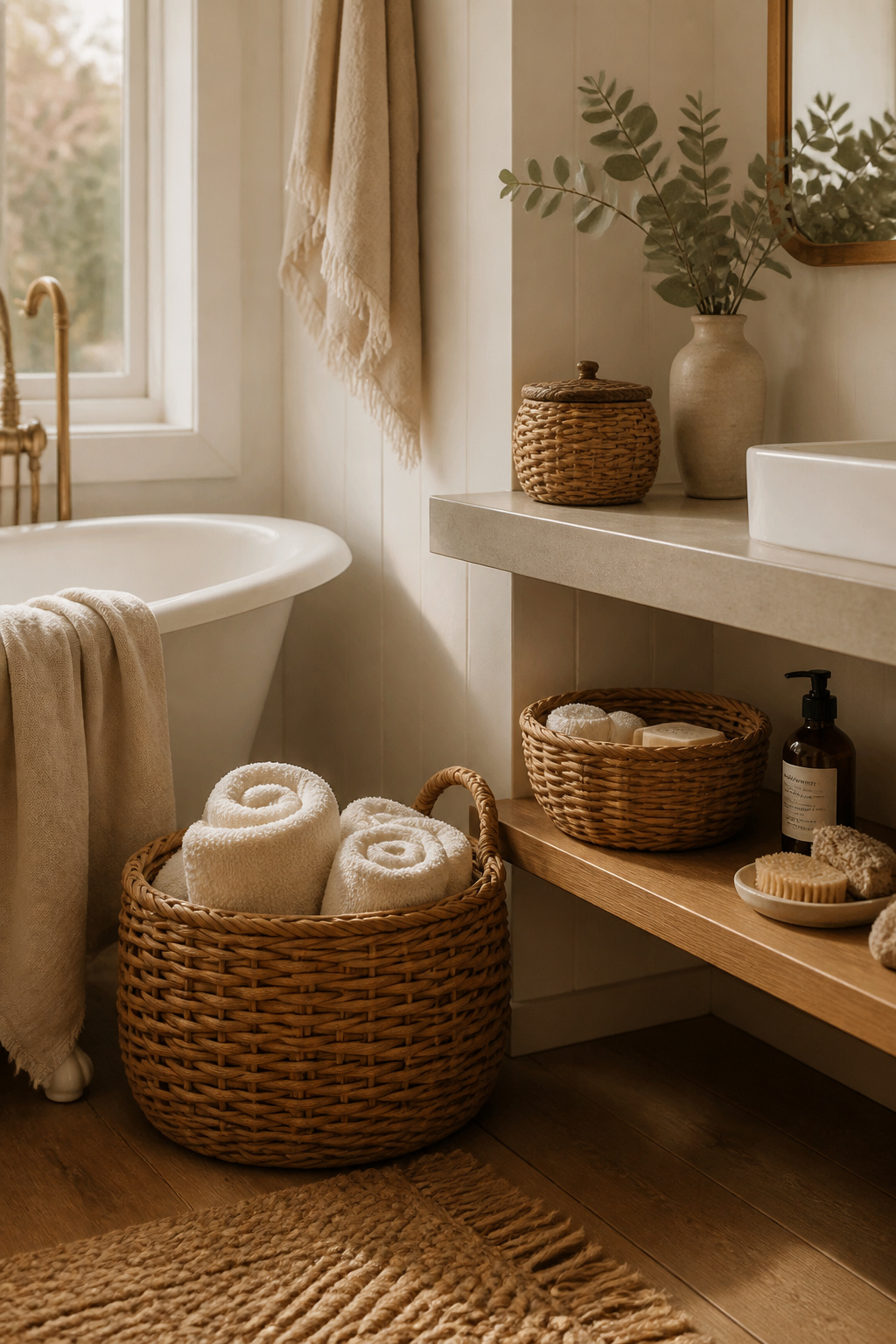
Rattan performs better than seagrass in bathroom conditions — seagrass is more susceptible to moisture damage over time, while rattan holds up well with reasonable care. The practical advantage beyond aesthetics is ventilation: natural fibre baskets allow airflow around stored towels and face cloths in a way sealed plastic bins can’t, which reduces the mildew risk that comes from storing anything slightly damp in an enclosed container.
Sizing should be deliberate. Under-sink baskets need to clear the drain pipe — measure the clear height from the cabinet floor to the P-trap, typically 10-14 inches, and choose low, wide baskets accordingly. Shelf baskets at 4-6 inches deep and 8-12 inches wide contain single categories neatly: cotton rounds, medicines, travel toiletries. Floor-level baskets beside the tub, tall laundry-basket types at 18-24 inches high, handle spare towels and bathmats without looking like overflow.
The honest note about natural fibre in bathrooms: they benefit from lining when holding moisture-prone items. A 2-4 mil polyethylene liner prevents mould from penetrating the fibres and extends basket life significantly. Fabric liners work for dry items. For the basket exterior, a water-resistant sealant adds protection without meaningfully changing their appearance. Avoid storing damp towels in unlined baskets — it creates a mildew environment within days.
Every bathroom drawer, without physical intervention, tends toward the same entropy: a jumble of cotton buds, expired lip balm, nail clippers, charging cables for devices you no longer own, and a disturbing number of hair ties. This is not a personal failing. It is physics. Without barriers, small items migrate toward each other and toward the back of the drawer, where they remain until the next house move.
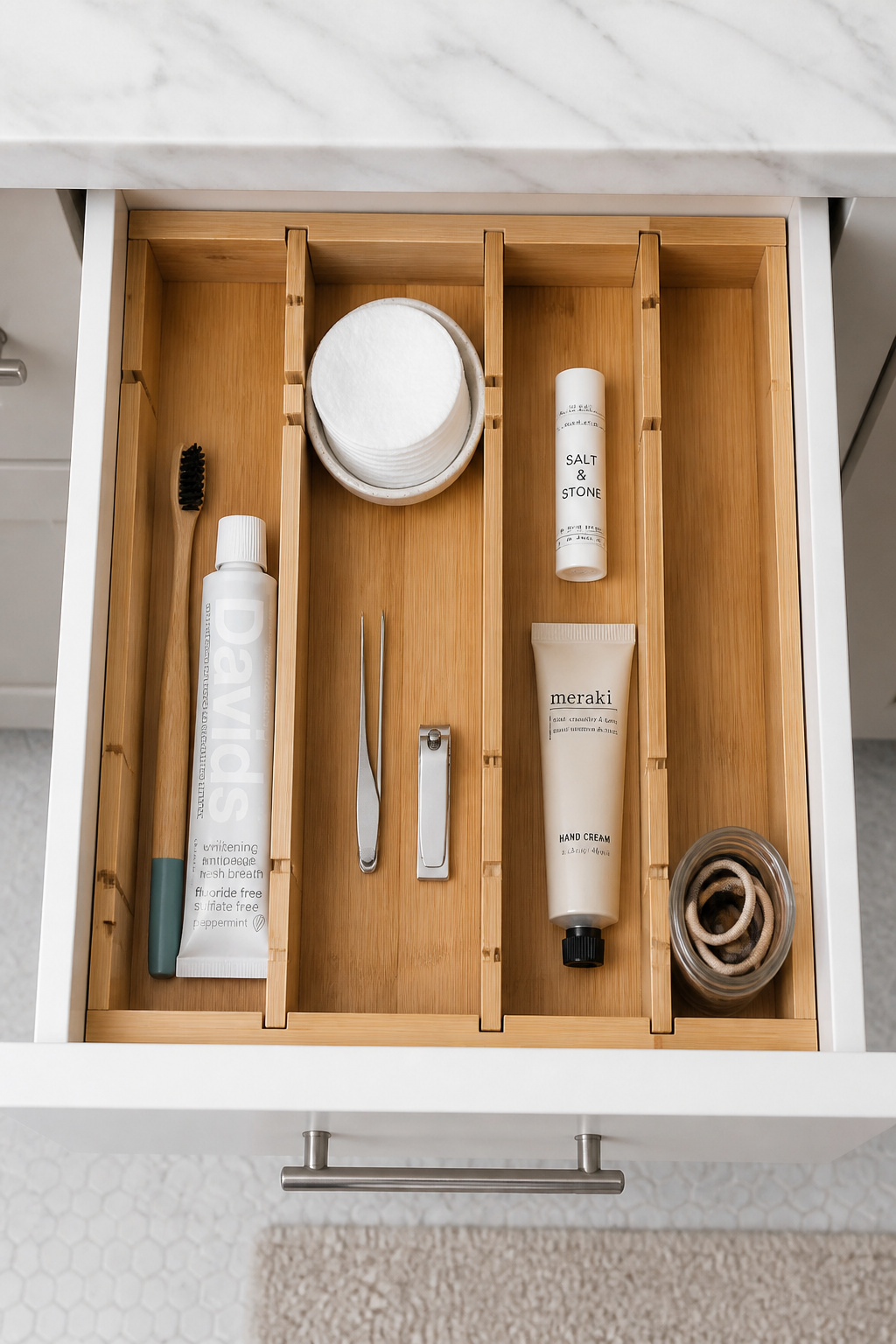
Drawer dividers are the physical intervention. Adjustable bamboo versions — VaeFae, SpaceAid, Bambusi — are the most popular option: spring-loaded ends expand from 16.8 to 21.8 inches to fit most standard bathroom drawers, grip the sides without tools, and include foam pads to protect the interior from scratching. A 6-pack costs $15-25, which makes this one of the most cost-effective bathroom storage solutions available.
The key is to audit the drawer before installing dividers. Empty it completely. Group items by type — hair, skincare, oral care, nails — and by frequency of use: daily, weekly, occasional. Discard expired products and duplicates. A drawer audit typically reveals 30-40% of items that have no good reason to remain. Only then install 3-4 dividers to create 4-5 distinct zones. More than that, and the channels become too narrow for anything useful. If the divided drawer fills back up within a month, the issue is upstream: more products arriving than leaving. The dividers are working. The purchasing behaviour needs adjustment.
The medicine cabinet is one of the most underused architectural moves available in a small bathroom. In a standard 2×4 stud wall, there are 3.5 inches of clear depth between the drywall faces — enough to recess a cabinet that provides meaningful storage while projecting zero distance into the room. The result is a mirror that also happens to hold your entire morning routine, without occupying any of the space you’re standing in.
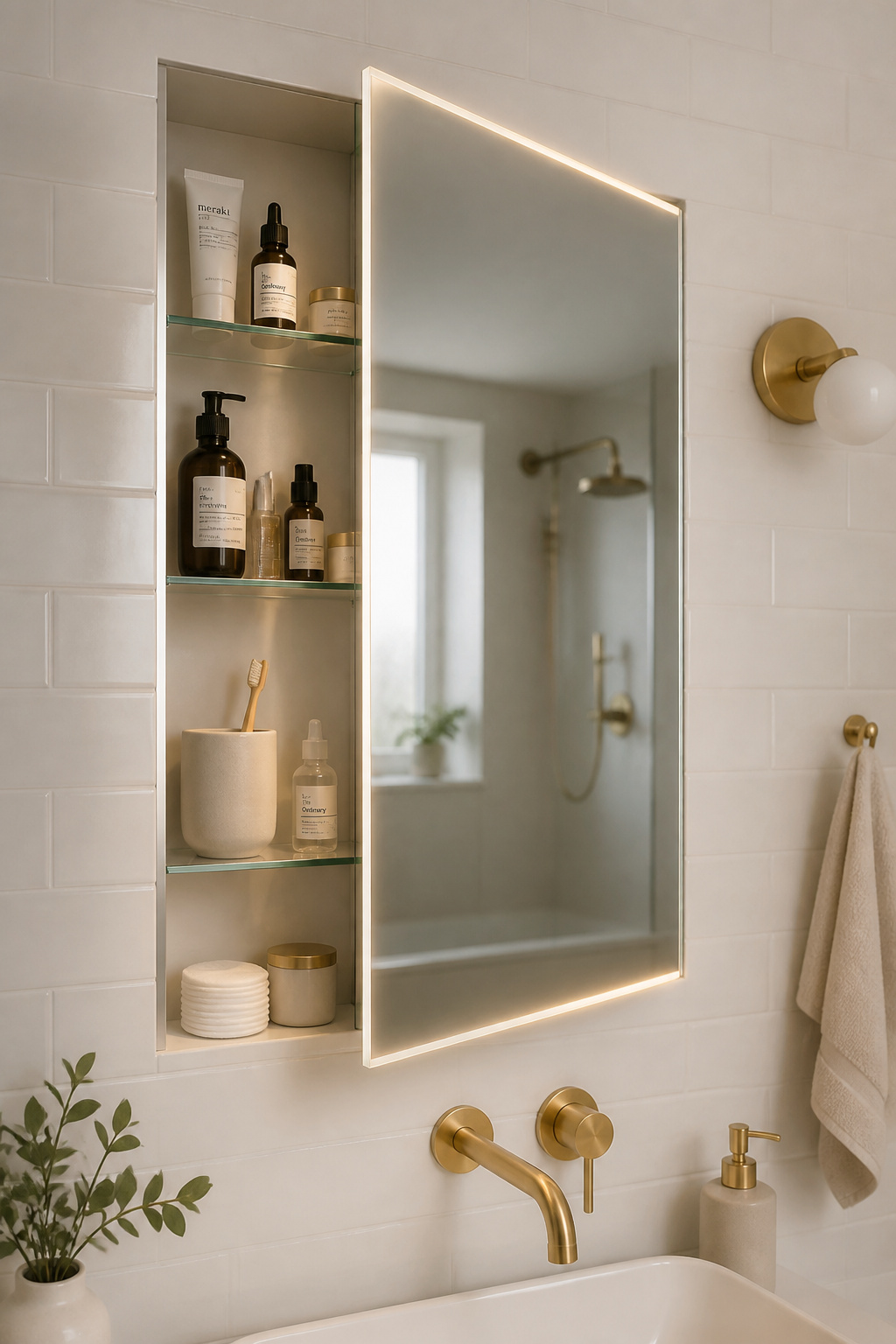
Surface-mount cabinets are simpler to install — no wall cutting required — but they project 4-8 inches outward, which can feel imposing in a small bathroom and creates shadow gaps at the sides that collect dust. When a renovation is on the table, recessing the cabinet is almost always worth the extra work. The rough-in opening is approximately 1.5 inches smaller than the finished cabinet size: a 16×30 cabinet needs roughly a 14.5×28.5 inch opening, fitting cleanly between standard 16-inch stud centres.
Standard sizes — 16×30, 20×30, and 24×30 inches — are designed to span one or two stud bays without requiring header work, keeping the installation achievable for a skilled DIYer. The mirror face reflects light back into the bathroom and visually doubles the sense of depth, a meaningful benefit in rooms under 60 square feet.
Inside the cabinet: look for adjustable glass shelves to accommodate taller mouthwash bottles, a built-in electrical outlet if you use an electric razor, and integrated LED lighting around the perimeter. For a Nordic aesthetic, frameless models with a clean bevelled edge read as a design choice rather than a bathroom accessory. Quality recessed cabinets from brands like Kohler and Fresca run $120-300.
Look at the space beside your bathroom vanity. There is almost certainly a gap — 3 to 8 inches wide — between the cabinet side panel and the adjacent wall or the toilet. Most people accept this as unusable dead space. It isn’t.
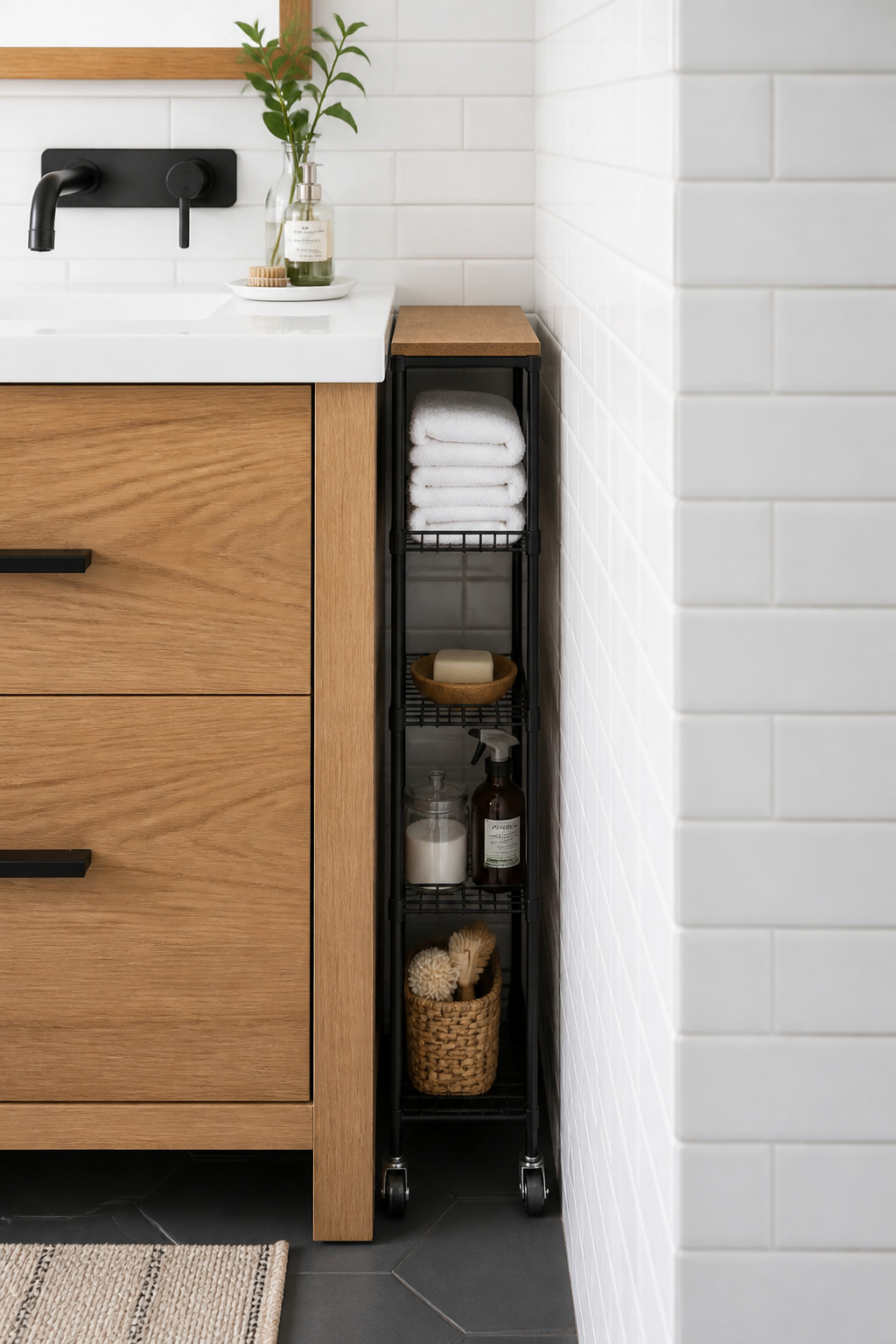
A slim rolling cart in that gap can hold hand towels, spare soap, cotton rounds, cleaning products, and extra toilet paper — far more than the gap previously offered, which was nothing. The cart rolls out when you need it and pushes back flush, maintaining the clean visual lines that matter in a small bathroom. This is the kind of modest intelligence that Scandinavian design values: using what is already there rather than adding more.
The Yamazaki Home Slim Rolling Cart (18.7 x 5.1 x 27 inches) is the design benchmark in this category: a refined steel frame with a wooden top shelf, available at West Elm. At 5.1 inches wide, it fits gaps that most carts miss. Mainstays offers a budget alternative at $20-30 — functional if aesthetically less refined. The OKZEST 4-tier cart combines powder-coated steel with a bamboo top, which suits a bathroom aesthetic better than pure metal.
Whatever you choose: powder-coated steel tubing (not chrome-plated, which chips) and four casters with at least two that lock are the specifications that matter. Avoid laminated particleboard shelving in rolling bathroom carts — the laminate edges delaminate quickly under the moisture and cleaning sprays a bathroom cart inevitably encounters. One practical note: measure the clear gap depth from the side panel of your vanity, not from the front face frame. These measurements often differ by an inch or two, and the difference determines whether the cart fits.
If you are renovating your bathroom, a shower niche is the storage decision that rewards you every single day for as long as you live in the house. It sits flush with the wall plane, projecting zero distance into the shower. It holds everything a hanging caddy holds, with none of the rusting chrome, the failed suction cups, or the limescale-trapping shelves to scrub. Once tiled, it is effectively maintenance-free.
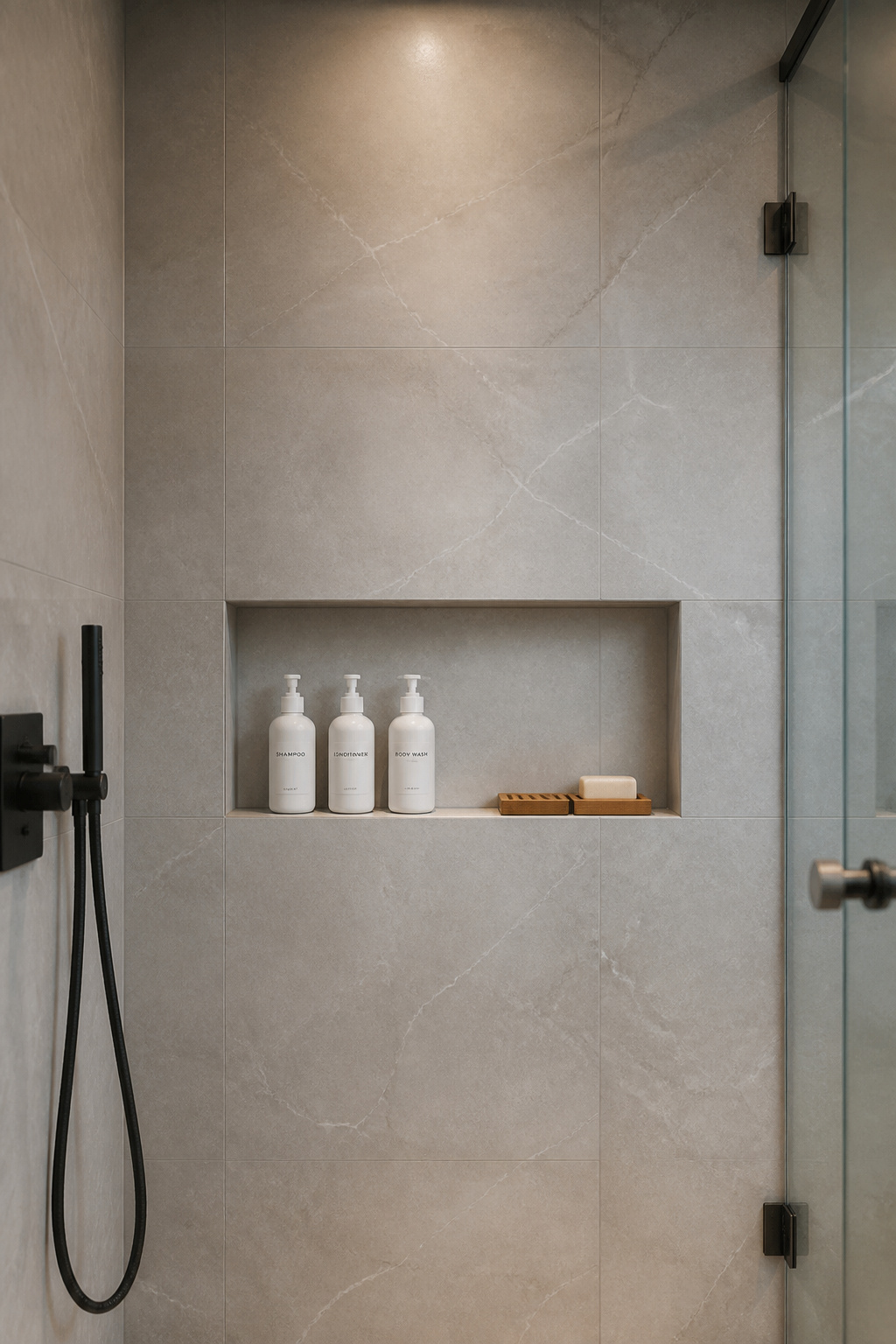
The ideal niche is planned before the tiles go in, not after. Twelve inches wide aligns with a single standard tile, which means no awkward cut tiles at the niche edges — the tile setter will thank you, and the finish will look intentional rather than improvised. Standard height options include 12×6, 12×12, 12×20, and 12×28 inches. Wedi’s pre-formed niche has a 12×24 interior dimension in a 16×28 exterior form. For the full scope of what smart shower planning involves, bathroom shower designs worth planning for goes into considerably more detail.
Pre-formed foam niche inserts from Schluter and Wedi have significantly reduced the risk of DIY niche installation. Both come waterproofed from the factory — tile directly over them without additional membrane application. Schluter’s KERDI-BOARD-SN includes KERDI-BAND waterproof tape for sealing the perimeter seams, which is the most common failure point in site-built niches. Pre-formed inserts retail for $40-120 depending on size.
One placement rule that saves significant headaches: always locate the niche on an interior wall, never an exterior wall. Exterior walls contain insulation and vapour barriers that make niche framing structurally complex and moisture-risk-prone. On an interior wall, the work is straightforward framing between studs.
A towel bar requires 24 inches of clear wall and accommodates, at most, one or two towels. Two double hooks occupy 4 inches of wall and can hang four towels — each with a designated spot, which matters enormously in a shared bathroom. The hook is also a more forgiving storage form: a child can hang a wet towel on a hook without the precision that a towel bar demands. Hooks and pegboards are, in fact, among the most budget-friendly bathroom storage solutions for towel organisation.
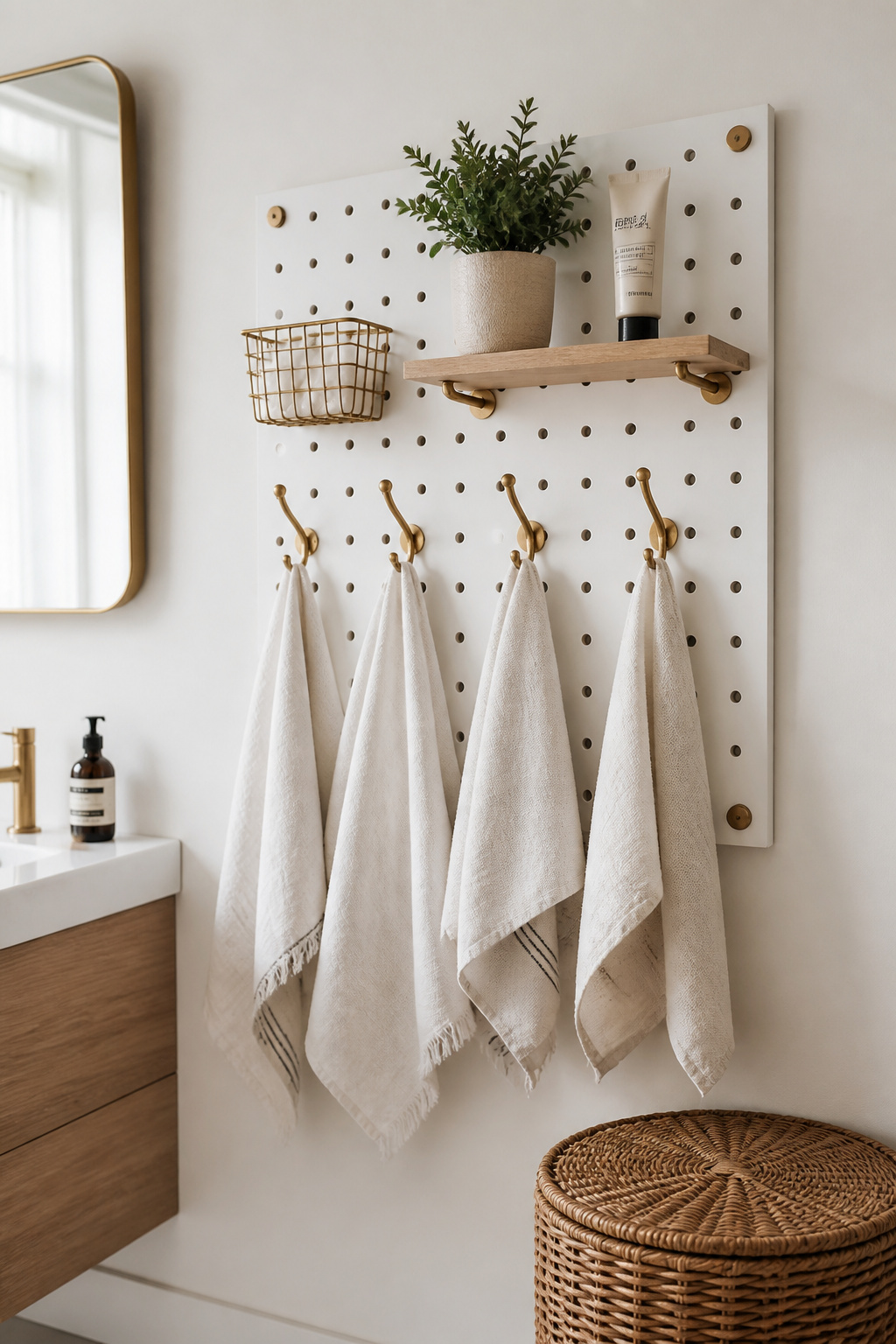
In a Nordic bathroom, hooks are both a functional and visual element. Solid brass hooks develop a natural patina and never rust or corrode — the longest-lived bathroom hook material. Stainless steel (304 grade) maintains a consistent finish in humid conditions without polishing. Both are available in single and double configurations across every finish — matte black, brushed nickel, unlacquered brass, chrome — so they integrate with existing fixtures rather than fighting them. Avoid no-name chrome-plated zinc hooks: the chrome plates chip, exposing the zinc beneath, which then oxidises visibly.
For a more flexible system, PVC pegboard (not standard hardboard or MDF) adapts to changing storage needs without additional wall holes. Mount the board on 1×2 timber spacers to create a 3/4-inch gap behind — this allows peg hooks to seat fully and enables airflow that prevents moisture building up between board and wall. PVC won’t swell, delaminate, or mould in bathroom conditions. Hooks, small baskets, and rail accessories make a pegboard section beside the vanity genuinely useful for daily-use tools that otherwise clutter the counter.
The under-sink cabinet is the bathroom’s most universally chaotic zone. The P-trap and supply lines occupy the central third of the cabinet floor, which makes standard pull-out organisers useless. Most people give up and treat the space as a black hole — things go in and are never found again without a full excavation.
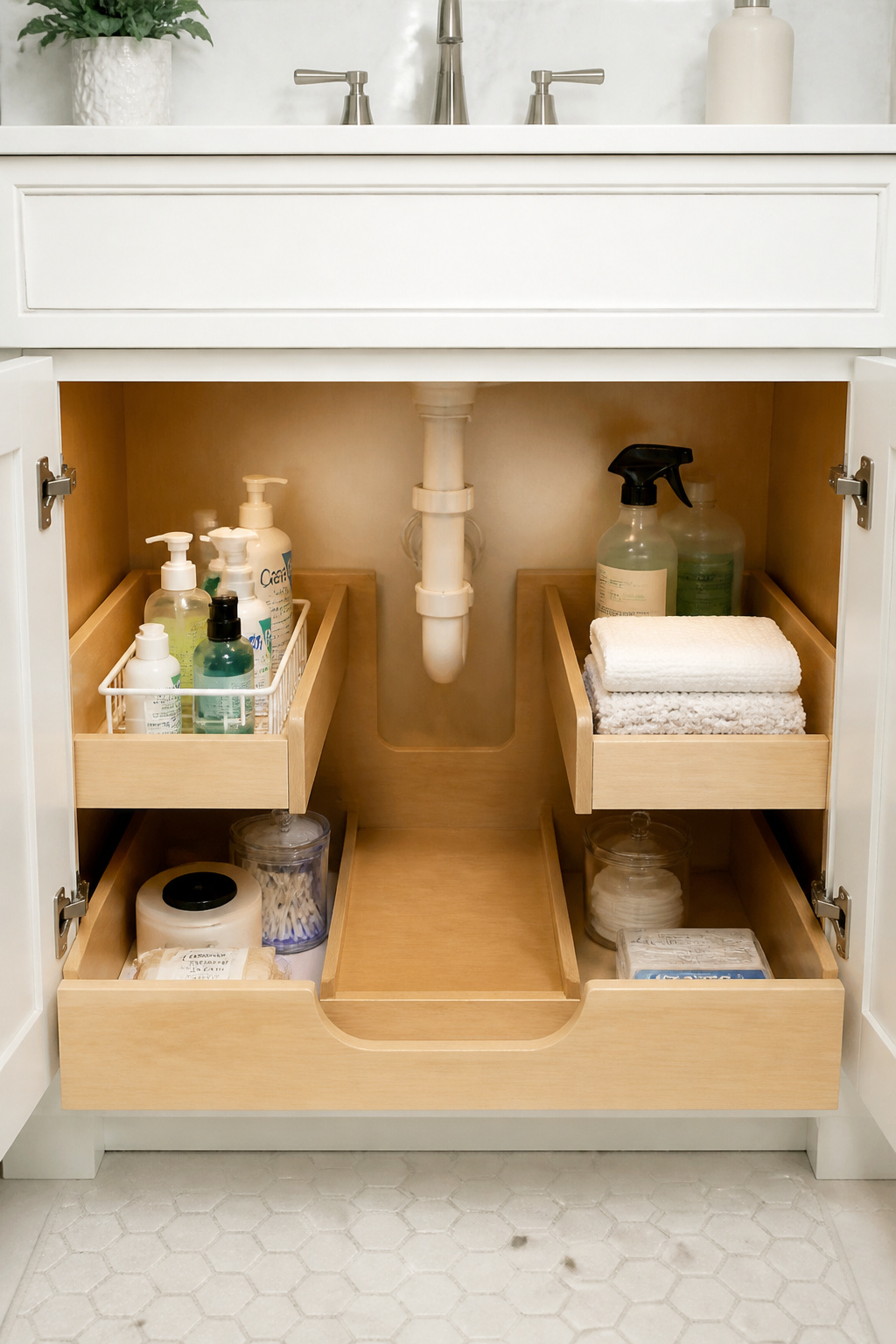
U-shaped pull-out organisers are designed specifically around this plumbing constraint. The cutout frame clears the drain assembly and uses the usable space on either side, which is considerably more generous than it initially appears. Rev-A-Shelf defines this product category. The 5786 series (chrome wire, 30 and 33-inch sizes) and the 486 series (maple construction, Blum BLUMOTION soft-close slides, non-skid vinyl lining) are the two main options. These pull-out systems represent the most effective bathroom storage solutions for the under-sink zone — replacing a space that was functionally useless with two organised, accessible arms.
Installation requires measuring the minimum cabinet opening precisely — the 30-inch unit needs a 24-3/4 inch clear interior width, so check your specific vanity dimensions before ordering. The soft-close slides are worth the slightly higher price: they protect the plumbing from impact and keep the cabinet feeling well-considered rather than improvised.
Once the pullout is installed, divide it into two functional zones: daily-use items on one side (spare soap, cotton rounds, facial products), occasional-use items on the other (cleaning sprays, spare rolls). Small secondary bins within each arm prevent individual items from shifting when the drawer slides. Store hair tools with cords in heat-resistant pouches before placing them under the sink — this prevents tangles and avoids the risk of residual heat damaging the cabinet interior.
A linen tower is one of those pieces that seems modest from the outside and reveals its true capacity once you’re using it. A standard tower at 12 inches wide and 68 inches tall — roughly the footprint of a large hardback book standing on its edge — delivers enough storage for towels, spare toiletries, medicines, and cleaning supplies. In a bathroom under 50 square feet, this is transformative.
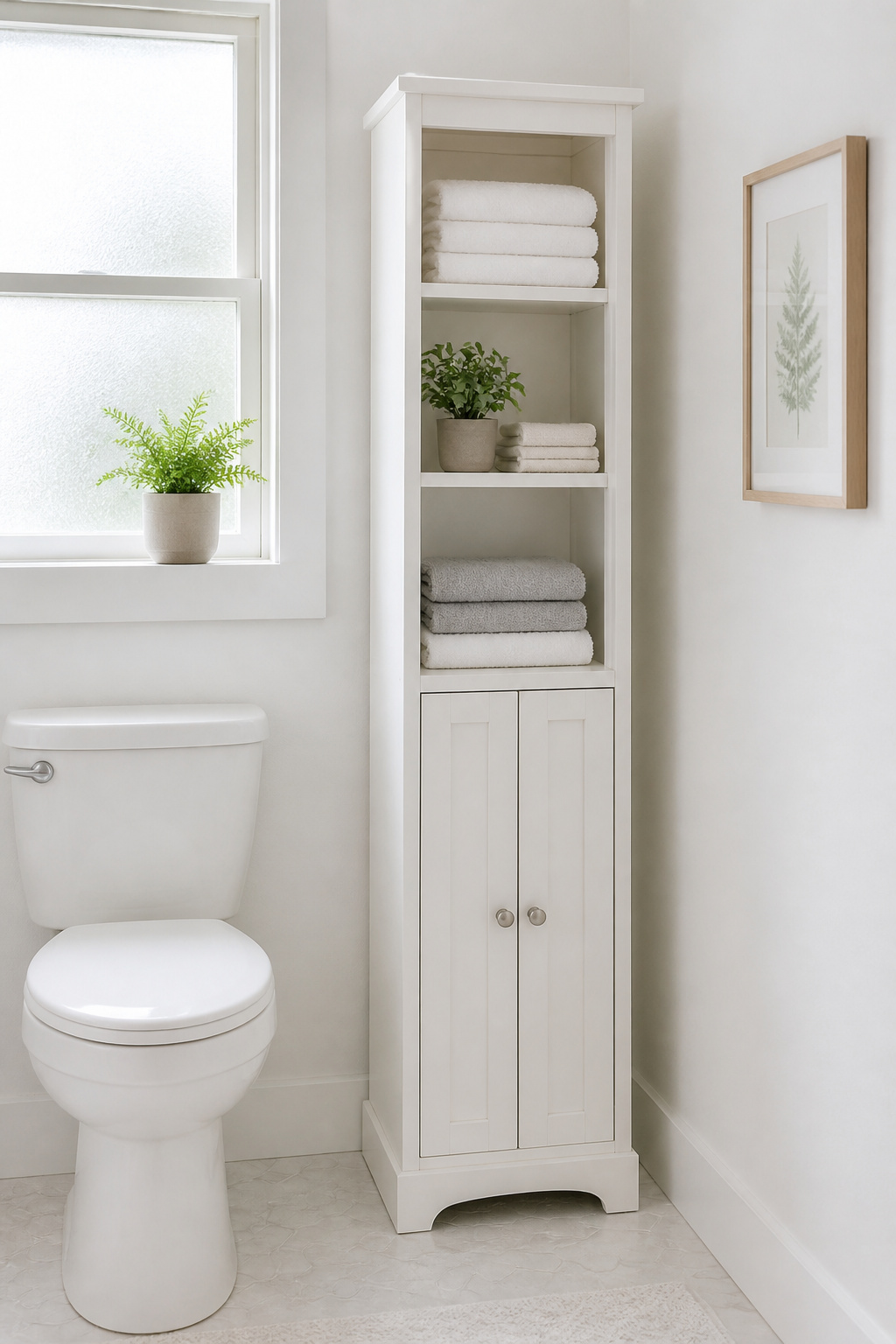
The configuration that suits most bathrooms combines enclosed cabinet doors on the lower section — for cleaning products, spare rolls, first aid — with open shelves above for displayed storage. Fully enclosed towers suit high-humidity bathrooms where condensation could affect folded textiles on open shelves; open-shelf towers create a more relaxed, light-feeling aesthetic. The mixed design is the most popular in Scandinavian-influenced spaces for good reason: it handles both functions without compromising either.
Dimensions to note: most freestanding towers run 11.97-16 inches wide and 60-72 inches tall. Check both dimensions against your available wall run before ordering — a tower that is an inch too wide for the space beside the toilet is an expensive problem to solve after delivery.
A practical note on stability: tile floors are often not perfectly level. Adjustable levelling feet allow the unit to stand without rocking. More importantly, a wall-anchoring strap kit ($8-15) is essential for any tall freestanding cabinet in a bathroom used by children or on uneven tile. The bracket screws into the cabinet back and anchors into a wall stud — a ten-minute installation that prevents a genuine safety risk. Price range for solid, well-made towers: $80-200 for bamboo or MDF, $300-400+ for solid wood.
The ladder shelf sits at the intersection of function and sculpture in a way that very few bathroom storage solutions achieve. Leaned against the wall, it reads as an object — something chosen, something considered. Then you drape a towel over a rung and slot a small plant on the next level up, and it becomes quietly useful. That combination of form and function is exactly what Nordic design values most.
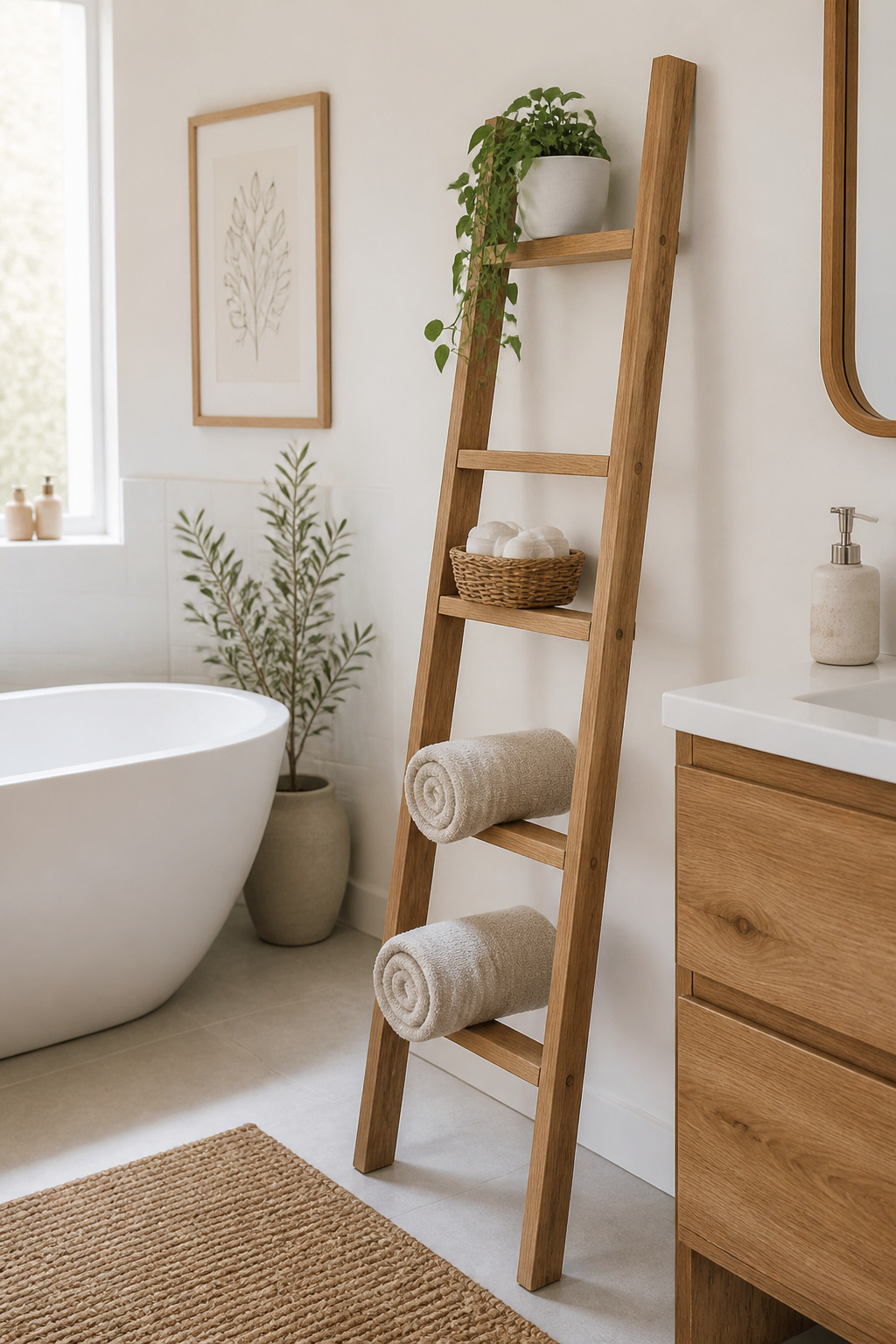
No drilling, no anchoring. Completely renter-friendly and repositionable when the bathroom is cleaned — an advantage that matters more than it seems over the course of a year. Solid wood posts with metal rungs suit Nordic-influenced bathrooms best; all-bamboo versions lean into the eco-minimalist aesthetic; metal-framed versions suit more industrial or matte-black finish schemes.
Stability on glazed tile requires attention. Most quality ladder shelves include rubber feet; if not, self-adhesive rubber pads solve the problem in under two minutes. The lean angle matters: 70-75 degrees provides stability without tipping risk. Too steep and the shelf rocks against the wall; too shallow and items slide off the rungs. For additional peace of mind, a small adhesive hook high on the wall can hold a discreet cord attached to the top of the ladder — invisible in use but sufficient to prevent tipping.
Loading the shelf correctly maximises both stability and aesthetics: heavy rolled towels on the lower rungs, where their weight contributes to stability. A small trailing pothos and a few folded face cloths on the upper rungs — lighter items that don’t compromise balance. A standard per-rung capacity of 15-25 lbs applies to solid wood ladder shelves; avoid loading any single rung unevenly. The honest caveat: wet towels stay damp on open rungs. The ladder shelf works best for dry, pre-rolled display towels rather than post-shower ones.
This is one of the genuinely clever bathroom storage solutions — the kind that, once implemented, makes you wonder why you tolerated the alternative for so long. Bobby pins, nail clippers, tweezers, small scissors, and safety pins are all naturally magnetic. A magnetic knife strip mounted inside a cabinet door or on the wall beside the vanity collects all of them in one retrievable place.
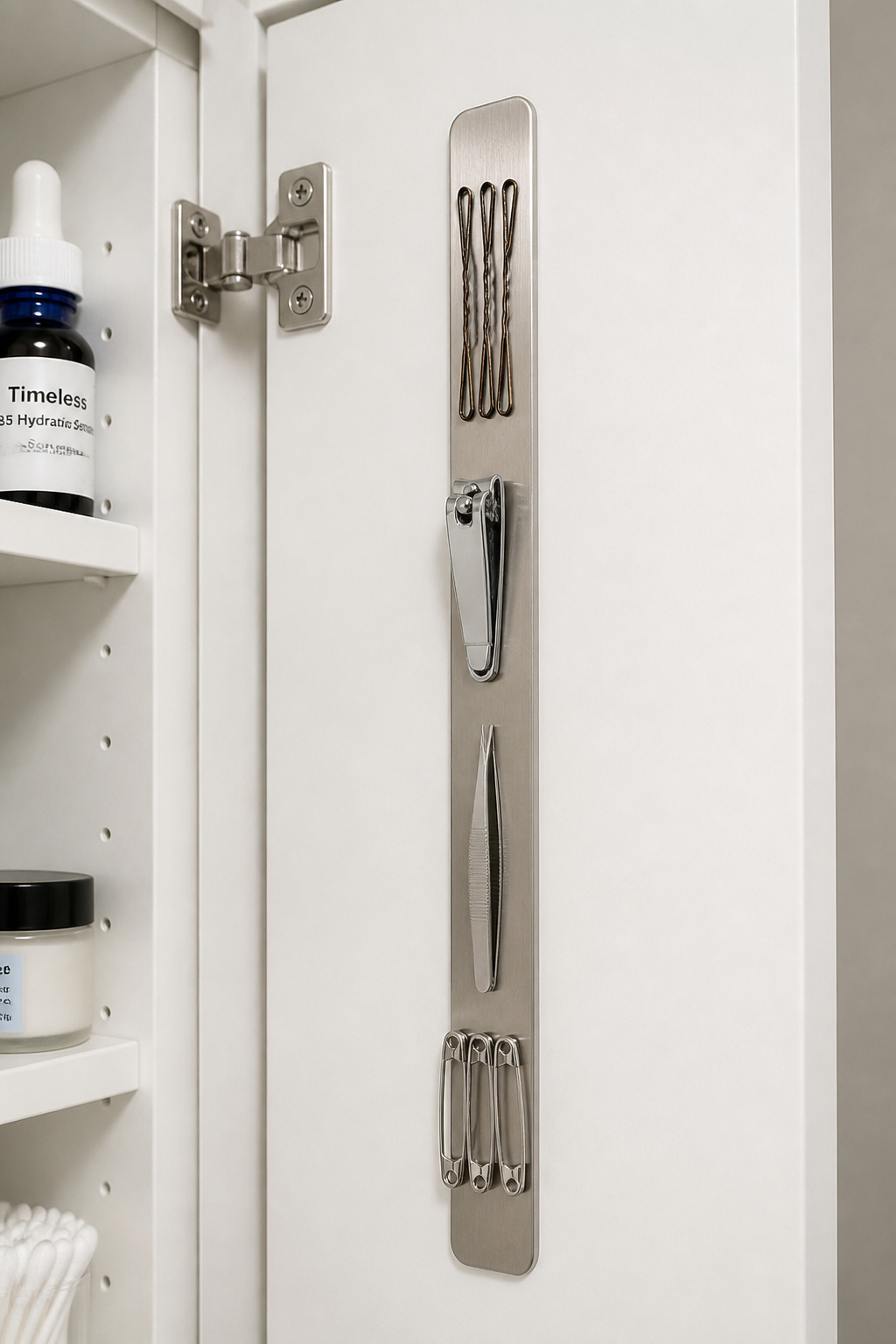
The problem it solves is specific and universal: small metal items fall to the bottom of drawers and are never findable. You know you own three pairs of tweezers. You cannot find any of them. A magnetic strip mounted vertically inside the medicine cabinet door holds all three at eye height, retrievable in one motion.
Installation takes under five minutes with an adhesive-backed strip on smooth tile or painted drywall. Clean the surface thoroughly — any soap residue, grease, or moisture prevents the adhesive from bonding properly — and allow 24 hours before loading. Screw-mounted strips are more permanent and better for heavier items; adhesive works reliably for the weights these items involve. Choose strips labelled ‘strong’ or ‘heavy duty’ and test with your heaviest item (usually nail clippers) before final installation. Budget strips fail under metal objects heavier than bobby pins.
The magnetic storage idea extends further. Wall-mounted magnetic toothbrush holders lift brushes off the counter entirely, which is a meaningful hygiene improvement — counter-resting toothbrushes collect splash contamination. Magnetic makeup palette organisers — thin adhesive-mounted metal sheets inside a cabinet door — work on the same principle for magnetic powder pan refills.
Open shelving in a bathroom is not inherently good or bad — it is entirely dependent on how it is edited and maintained. The shelves that look like a cluttered pharmacy are not a style problem. They are a quantity problem. The shelves that look like a Nordic spa are not a skill problem. They are an editing problem that someone solved.
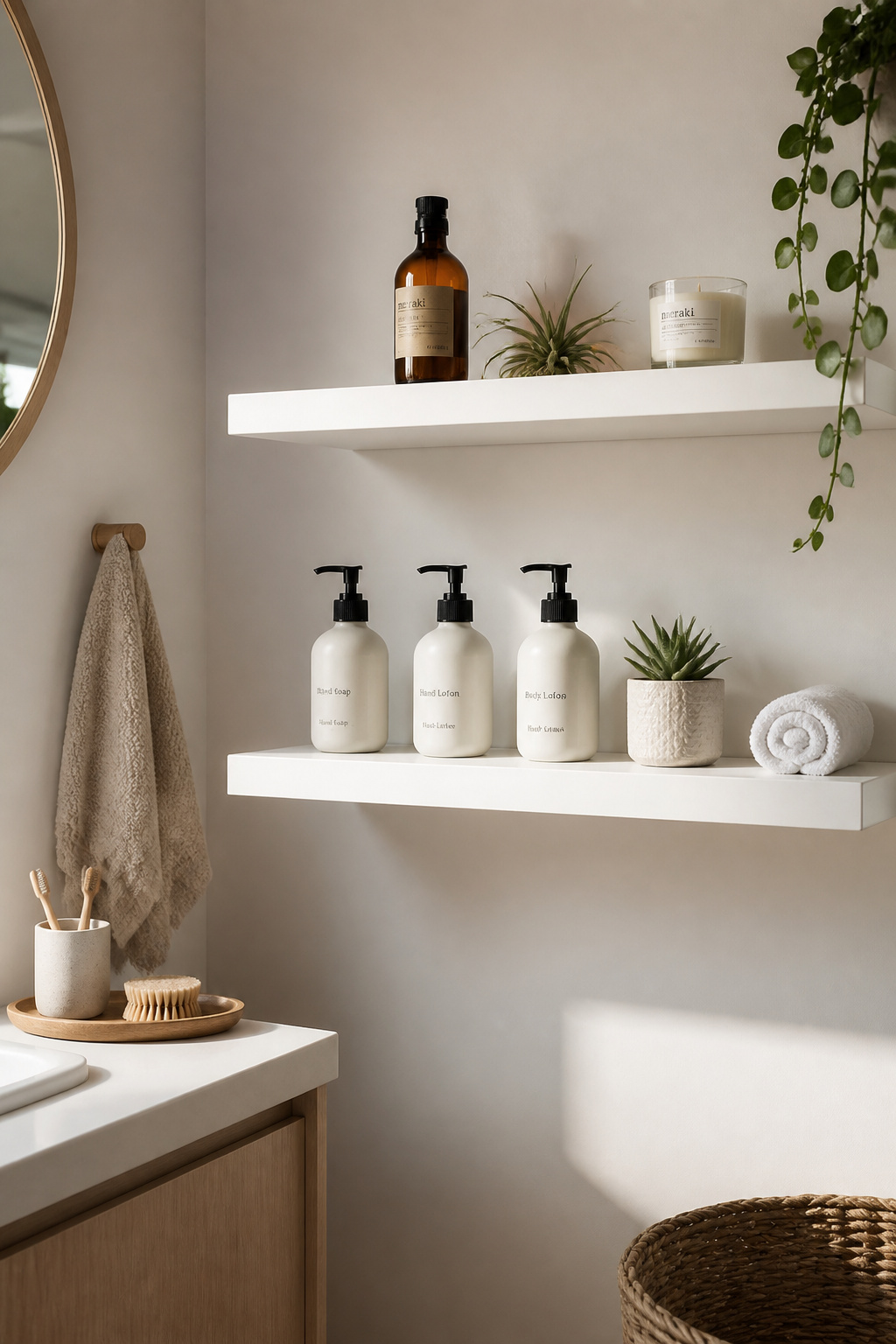
The determining factor is not styling — it is how many things are on the shelf before you start styling. A shelf holding ten items almost always looks cluttered regardless of arrangement. A shelf holding four items in matching containers looks considered, even without deliberate styling. This is the principle behind Scandinavian open-shelf design: at least one-third of every shelf should be empty. Not as a stylistic preference, but as a practical enforcement mechanism. The empty third is where you notice when things are accumulating and where you put them back.
Decanting is the single most impactful change available to open bathroom shelving. Moving shampoo, conditioner, body wash, and hand soap from branded plastic bottles into matching pump dispensers — white ceramic, amber glass, matte black — immediately creates coherence. Nordic-style ceramic dispensers are available at $15-25 each; matching sets create instant visual continuity. For cotton rounds, buds, and hair ties, matching apothecary jars in graduated sizes turn a scatter of packaging into an arrangement.
For a genuinely open feel, paint the shelves the same colour as the wall behind them — they visually recede, and the objects sit as features rather than the shelf structure itself. If you find farmhouse bathroom ideas that make the most of open storage appealing, many of the same principles apply with a warmer material palette.
There is a specific quality of warmth that comes from a piece of furniture with a past. A vintage dresser converted to a bathroom vanity brings provenance, patina, and proportion that no flat-pack cabinet can replicate. For a hygge-inflected bathroom, this approach to bathroom storage solutions brings something flat-pack never can: a sense of accumulated life. The storage configuration that comes with these old pieces is often oddly well-suited to modern bathroom organisation — the drawer compartments of 1920s-1940s furniture tend to land at dimensions that work for towels, toiletries, and spare supplies without any modification.
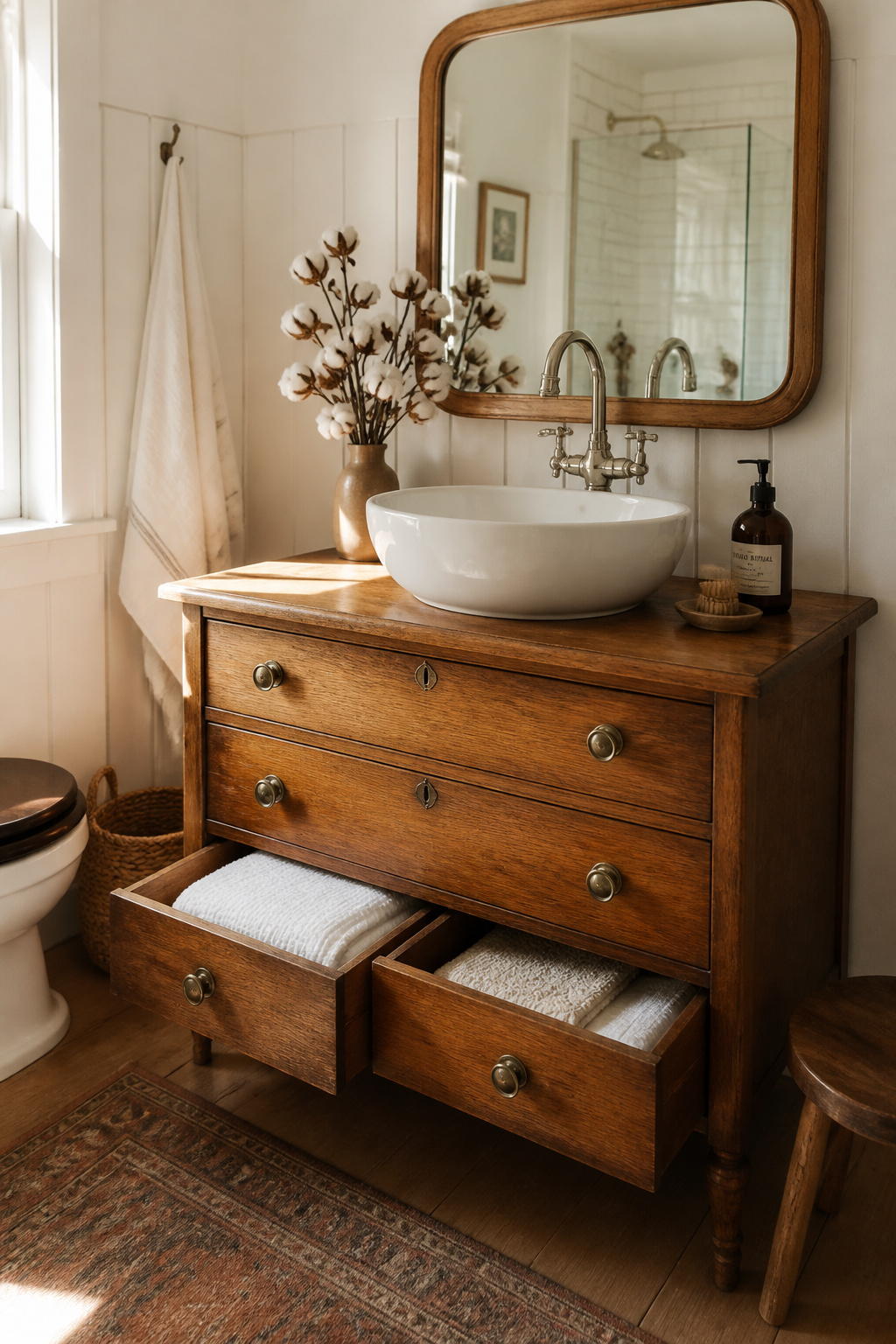
The technical requirements are clear: solid wood only. Particleboard and MDF swell and degrade quickly in humid environments even with surface sealing — once the laminate edge is exposed to moisture, the underlying substrate absorbs water and loses structural integrity. Solid pine, oak, walnut, and cherry all tolerate the bathroom’s humidity with proper treatment. Apply marine varnish, epoxy resin, or polyurethane sealant to all surfaces — including inside drawers and the undersides of shelves — in 3-5 coats on high-exposure surfaces. An exhaust fan, if the bathroom doesn’t already have one, reduces ambient humidity enough to significantly extend the life of any natural wood piece.
The conversion itself is simpler than it looks. A vessel sink requires only a hole for the drain and supply lines in the dresser top — far simpler than the template routing required for an undermount or drop-in cut. Remove the top one or two drawers for plumbing clearance; the remaining drawers become excellent organised storage. For anyone considering budget bathroom makeover ideas that go beyond the basics, a converted flea market dresser at $30-80 can become the bathroom’s most characterful piece.
The first principle of bathroom organisation is visibility. If you can see it, you can find it. If you can find it, you won’t buy a second one. This is not a minor consideration: duplicated purchases from disorganised bathroom cabinets are one of the more reliably avoidable household expenses. As bathroom storage solutions go, clear containers are the simplest upgrade available — no tools, no installation, immediate results.
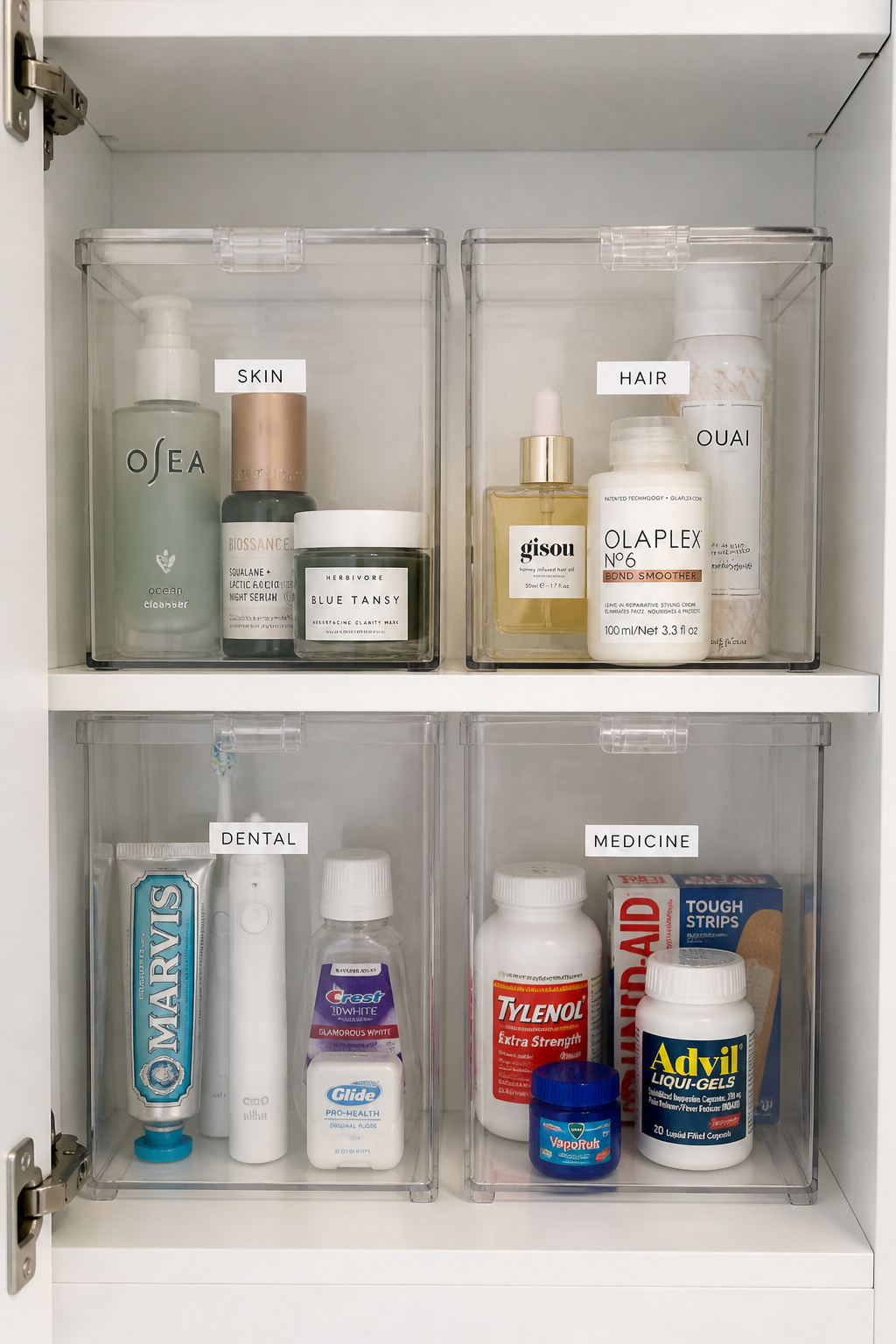
Clear containers address this directly. The mDesign Lumiere collection — hinged-lid stackable containers in clear plastic, 6.5 inches high, available in 4-packs and 8-packs — allows you to see exactly what is in each container without pulling it out, and the hinged lid opens without requiring you to unstack everything above it. This last feature is the one that determines whether a stacking system stays organised over time: if access requires disassembly, the system erodes within weeks.
iDesign’s Linus Stacking Bins are open-top, clear, 8 x 14.5 x 4 inches, and better suited to cabinet shelves where stacking height matters more than dust exclusion. Polypropylene is more durable for daily bathroom use than acrylic — it scratches less easily and holds up better to the cleaning sprays a shared bathroom inevitably receives.
Labels should be minimal to be maintained. Elaborate calligraphy systems are abandoned; Dymo tape labels survive. Label categories rather than specific products: HAIR, SKIN, MEDICINE, DENTAL — accurate even as individual products change. Place labels on the front face at eye height in their storage position, readable without pulling the container out. And measure the cabinet shelf clearance before ordering: stacked containers reach surprising heights, and a configuration that works perfectly in an online image may not clear the shelf above.
There is a category distinction between furniture that is in a bathroom and storage that is part of one. Built-in cabinetry crosses into the second category — it integrates with the architecture rather than sitting against it, and the bathroom reads as resolved rather than assembled. For owners planning to stay in a property, it is also a reliable investment: a bathroom with thoughtful built-in storage is demonstrably more valuable than one without.
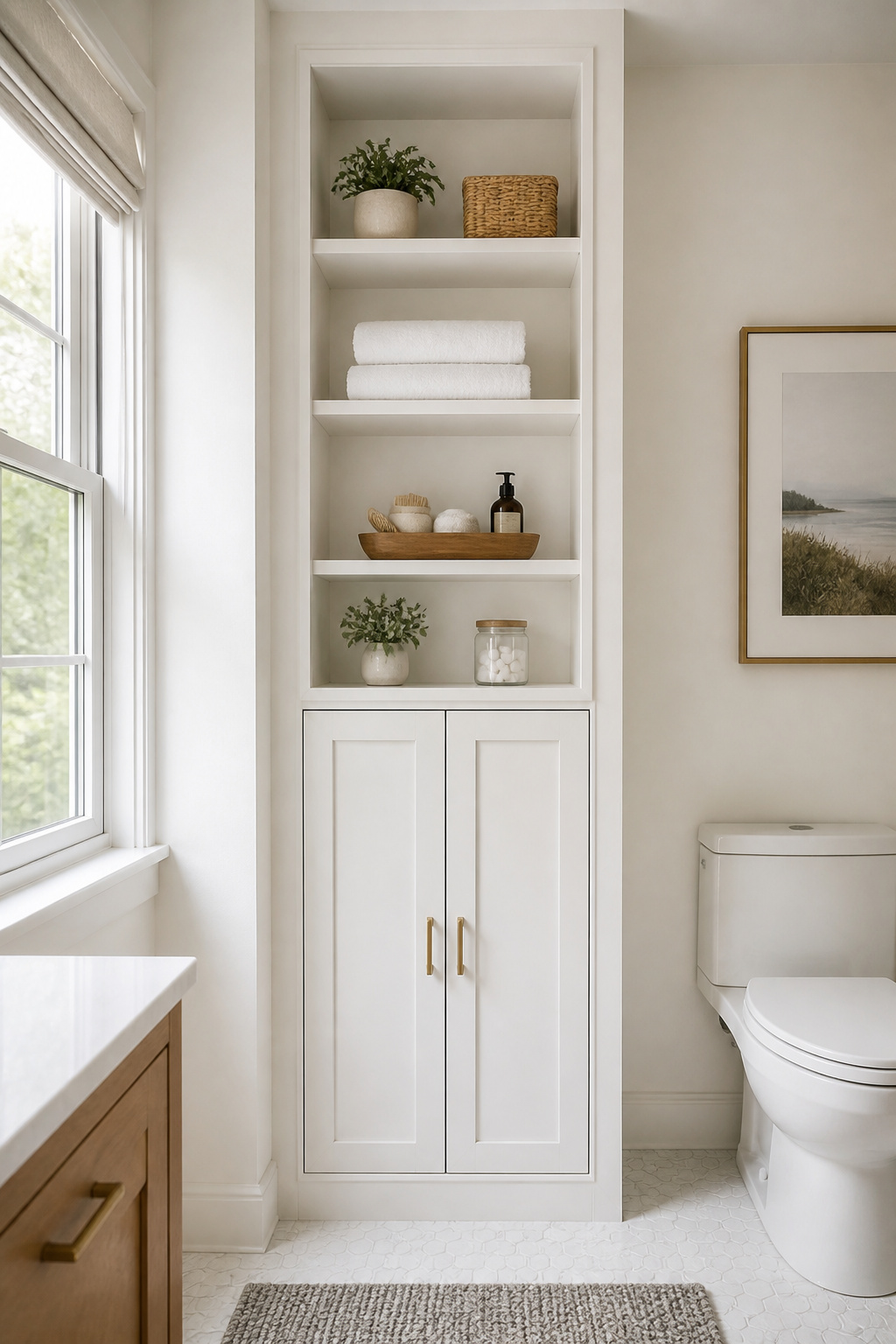
Freestanding pieces, however well chosen, leave gaps between units and walls where dust accumulates and moisture can collect. Built-ins eliminate these gaps. More importantly, they allow custom configurations that no off-the-shelf product can match: a floor-to-ceiling column of pull-out drawers beside the toilet, cabinetry flanking the vanity symmetrically, a shelf above the door at 12-18 inches below the ceiling that uses genuinely empty space for infrequently accessed items.
Cost is the honest consideration. Custom built-ins from a cabinetmaker start at $1,500-5,000+ depending on materials and configuration. IKEA’s SEKTION and METOD kitchen base cabinets offer a credible alternative at $200-600 for a full configuration — and there are documented cases of these units performing well in bathrooms for 8+ years. Key caveat: kitchen base cabinets are typically 24 inches deep, which is 3-6 inches deeper than a standard bathroom vanity. Also, MALM and particleboard IKEA units are not bathroom-appropriate; SEKTION and METOD, both coated in melamine throughout, are the specific lines that tolerate bathroom conditions. For a broader view of what bathroom renovation ideas that add lasting value involve, the distinction between surface-level updates and structural improvements is worth understanding before any significant spend.
A tray is a simple object that performs a disproportionately significant organisational function. It imposes a boundary: everything within the tray belongs; everything outside does not. This clear distinction enforces editing without requiring constant conscious effort — when the tray fills up, you remove something rather than expanding the tray. A countertop tray is arguably the most immediate bathroom storage solution available, and at $20-80, one of the most affordable.
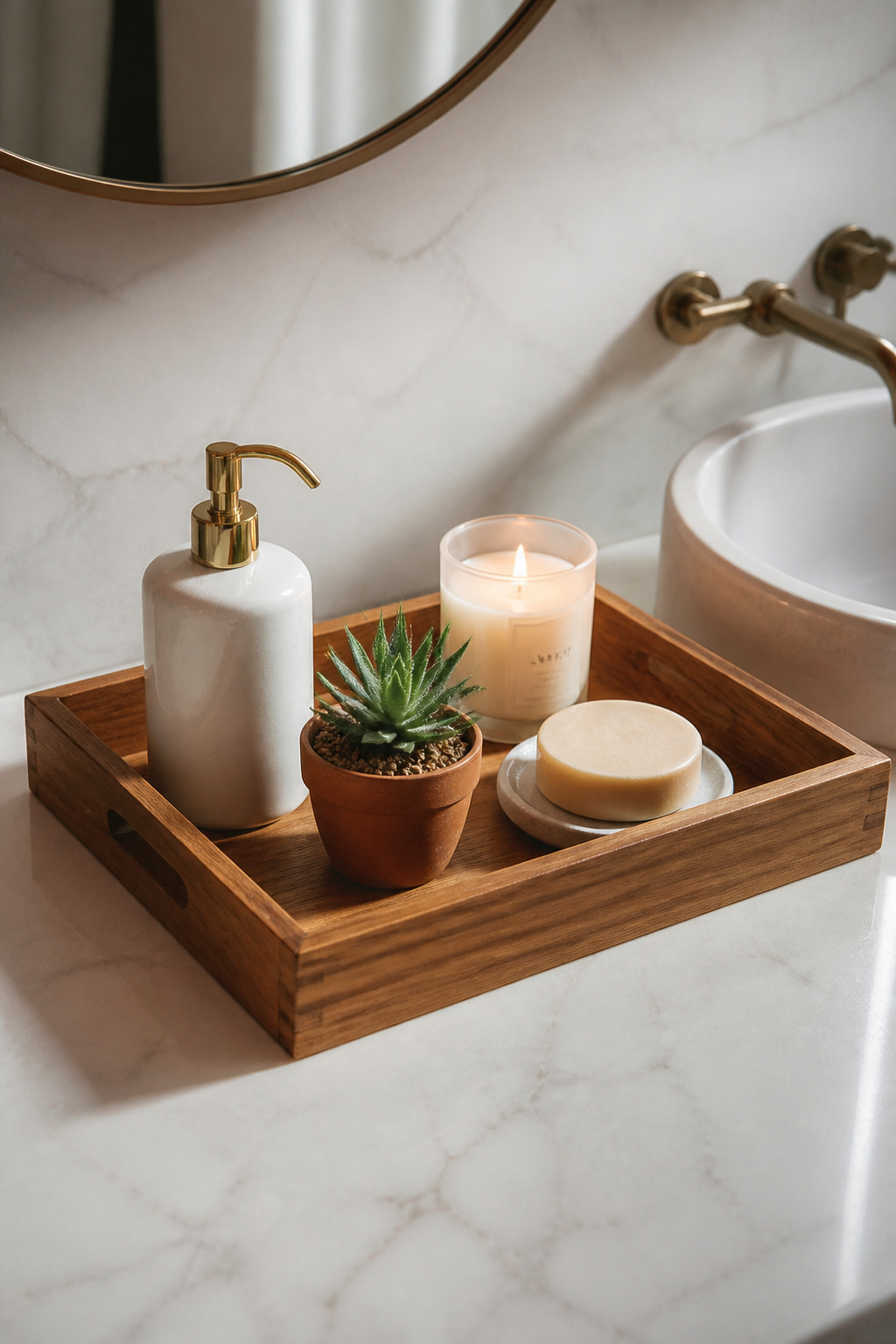
Teak is the best material choice for a bathroom counter tray. It is naturally moisture-resistant, requires minimal maintenance, and develops a silver-grey patina when left unsealed that many people find more interesting than the original honey tone. Marble is beautiful but porous — it etches under acidic products like perfume and requires sealing once or twice a year. Concrete is heat-resistant and durable with a matte-industrial quality that pairs well with matte black fixtures. In a Nordic bathroom, a small teak tray holding a soap dispenser, a small plant, and a candle is close to the canonical arrangement: functional, warm, and completely legible.
For the shower itself, the material decision is everything. Chrome-finished caddies rust at the plating seams within a year of regular shower exposure — chrome is a coating, not a material, and once it chips, the underlying steel corrodes visibly and quickly. Premium 304 stainless steel caddies are documented to last 8+ years in shower conditions, rustproof throughout. Tension-pole caddies in all-stainless construction cost $30-70 and represent genuine long-term value compared to cheaper alternatives that require replacement annually. For smaller showers where a tension pole would feel intrusive, over-arm hanging caddies or corner adhesive caddies in 304 stainless are the alternatives to investigate.
Before buying anything, spend fifteen minutes actually measuring your bathroom. Note the clear wall width and height at each potential location. Measure the cabinet interior dimensions, including the height from the floor to the bottom of the P-trap for under-sink purposes. Write down what actually bothers you: is it counter clutter? Drawer chaos? A complete lack of towel hanging space? Each pain point has a specific best answer, and starting from the problem rather than a shopping list produces better outcomes.
Consider your bathroom’s conditions too: a well-ventilated bathroom with a window and an exhaust fan can tolerate natural materials — rattan, teak, bamboo, solid wood. A windowless basement bathroom, or one where condensation forms on every surface, needs moisture-resistant synthetics and sealed MDF or metal rather than natural fibres and bare wood.
The practical framework: renters should invest entirely in non-permanent solutions — over-toilet units, rolling carts, adhesive hooks, magnetic strips, ladder shelves. No drilling, no modifications, all removable. Owners with small bathrooms should prioritise vertical storage: a linen tower and an over-toilet etagere deliver more usable storage per square foot than almost anything else. And owners planning a renovation should invest in the permanent decisions first — shower niches, recessed medicine cabinets, and built-in cabinetry — because these are the bathroom storage solutions that compound over time: working better, looking better, and adding more value the longer they are part of the home.