Physical Address
304 North Cardinal St.
Dorchester Center, MA 02124
Physical Address
304 North Cardinal St.
Dorchester Center, MA 02124
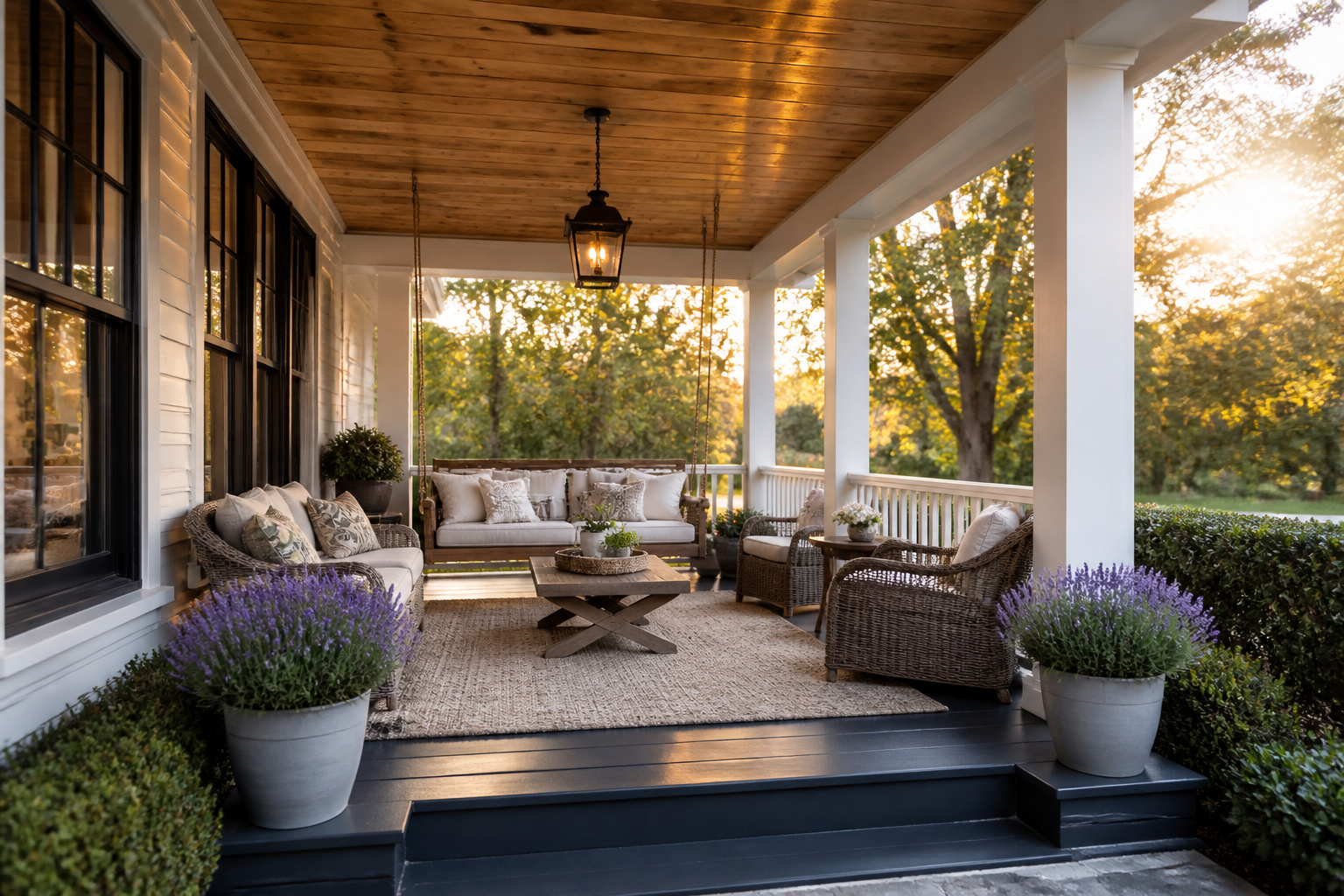
Transform your porch with 17 expert porch remodel ideas — cedar ceilings, cable railing, built-in benches, swings, and more. Full guide.
There is a particular kind of morning where you carry your coffee to the porch, ease into the swing, and realise that this — the light through the trees, the soft creak of the boards, the unhurried air — is exactly what you wanted. Not every porch delivers that. A porch remodel changes the equation entirely: it takes a passage and makes it a place, something you actually look forward to returning to.
In Scandinavian design philosophy, the transition between indoors and out is treated with as much care as any interior room. That thinking is what separates a considered porch renovation from a quick refresh. These 17 porch remodel ideas move through structure, surface, furniture, planting, and finishing detail. Some cost a weekend and a few hundred dollars. Others need a contractor and a permit. All of them are worth understanding before you start.
A wood T&G ceiling changes the emotional register of a porch faster than almost any other single move. It brings warmth overhead that turns what feels like an outdoor corridor into something that reads as a room — a complete, bounded space rather than a transitional threshold. For a porch remodel centred on warmth and character, this is the element that delivers the most per dollar spent.
Western Red Cedar is the species most people reach for, and rightly so. Its natural oils resist moisture and decay without chemical treatment, which is why it appears on well-built porches from Maine to Oregon. Douglas Fir has a tighter vertical grain that takes stain and paint more cleanly; prefinished Douglas Fir boards arrive cedar-stained and ready to install if you want to skip the site finishing step. Eastern White Pine is a softer, more affordable third option at most lumber yards.
For thickness, 3/8″ T&G is standard for porch ceilings — light enough to fasten with finish nails through the tongue. On a covered porch, a solid stain holds better than a clear coat; clear finishes show UV damage within 2-3 seasons and become a maintenance burden. A penetrating oil finish like Rubio Monocoat feeds the wood without laying a surface film over the grain — it makes the wood look more like itself, which is the Nordic ideal.
Letting cedar silver naturally is very much in keeping with Scandinavian exterior tradition. A water-repellent treatment applied before installation slows the greying slightly. If you prefer warmth year-round, stain the ceiling a honey or golden tone and watch how late afternoon light transforms the whole porch. If you’re planning the outdoor space at the same level as the ceiling, back porch patio ideas is worth reading before settling on a ceiling treatment, since the ceiling and floor define the palette for everything that follows.
The vertical rhythm of board-and-batten makes a porch look taller and more architecturally resolved. The pattern has farmhouse roots in 19th-century American building, where the batten existed as practical weather protection over the gap between boards — not merely as decorative trim. Modern applications use slightly refined proportions: narrower battens (1.5–2″) over wider boards (6–8″) read as contemporary rather than rustic. The pattern works especially well on porch gable ends and knee walls below railings, areas where a flat painted surface would look bland and underworked.

Three material choices cover most porch remodel situations. Cedar runs about $2.80–3.00 per linear foot for material — beautiful grain, but it needs staining or painting every 5–7 years outdoors. Cellular PVC (Versatex, Kleer) costs $3–5/LF and never rots, never needs painting, and cleans up with a garden hose. Fiber cement — James Hardie’s vertical board-and-batten being the most widely available — costs $4–15/sq ft installed but holds paint for 15–20 years and is fire-resistant, which matters in certain regions. In cold climates with hard freeze-thaw cycles, cellular PVC is the honest choice: it doesn’t absorb moisture, so it can’t crack from expansion.
For colour, sage green — Benjamin Moore October Mist 1495 or Sherwin-Williams Dried Thyme — is the standout 2025–26 exterior trend. It reads naturally against wood, plantings, and most rooflines. A near-black (SW Iron Ore, BM Black Beauty) suits Nordic-influenced homes where contrast and simplicity are the point.
In Scandinavian design, furniture earns its space by doing more than one thing. A built-in porch bench does this several times over: it provides seating, stores cushions and throws, defines the edge of the sitting zone, and eliminates the visual clutter of freestanding furniture pushed against a railing.
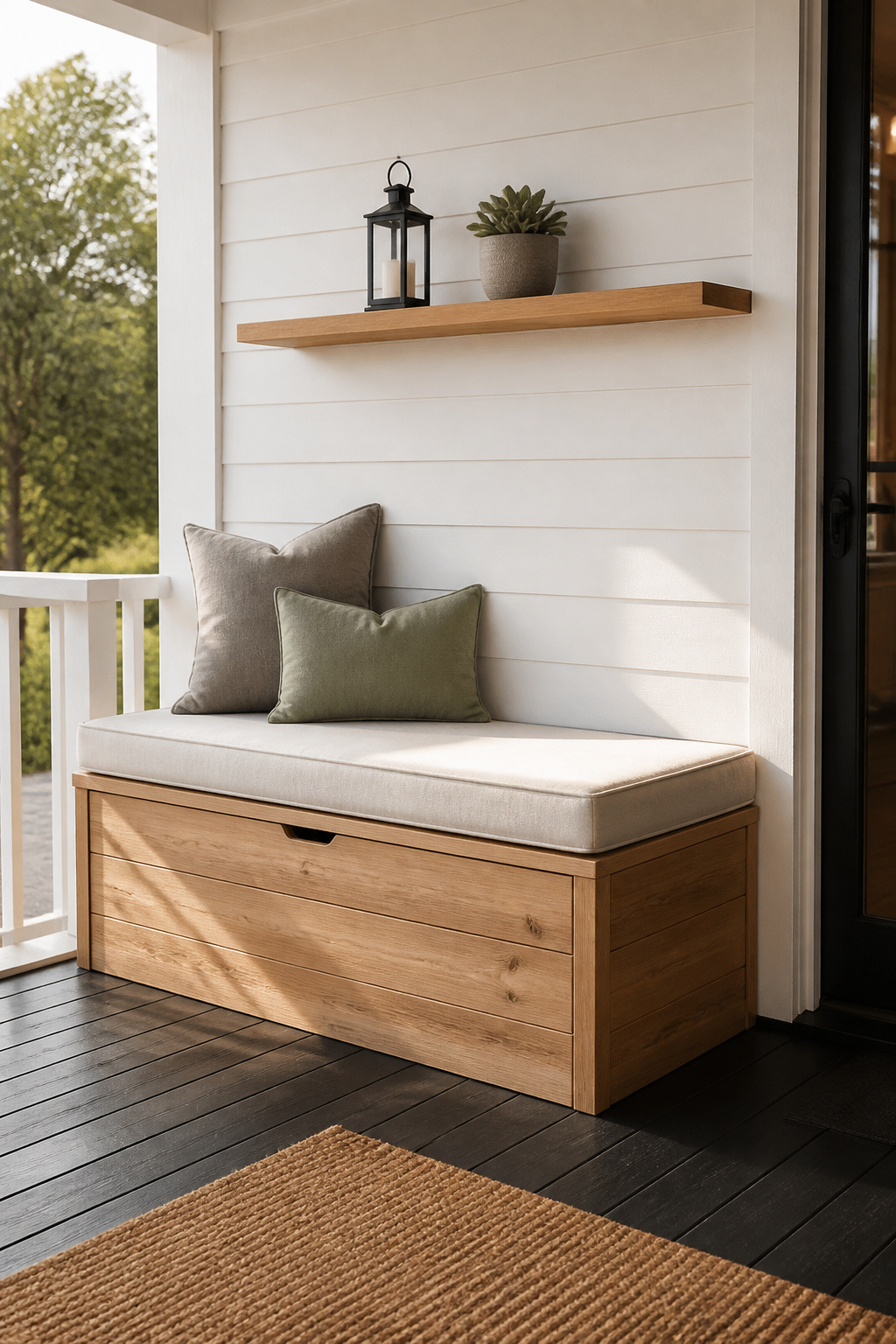
Standard proportions — 18–20″ deep, 16–18″ high — produce a comfortable seat without a cushion and a generous storage cavity with a hinged lid. Frame with pressure-treated 2x4s for any components contacting the porch deck; use cedar or composite-board cladding for visible faces. A piano hinge runs the full length of the lid and keeps it flat. Add lid support arms so the lid holds open while you’re loading it — without them, the lid falls back and will eventually crack the hinge. A 4-foot bench section delivers roughly 5 cubic feet of storage, enough for a set of seat cushions, 3–4 outdoor throws, and a few small tools.
Solution-dyed acrylic fabric — Sunbrella is the benchmark — is the correct material for any outdoor porch cushion. The pigment is in the fibre rather than applied to the surface, so UV exposure and bleach cleaning won’t fade it. Pair closed-cell foam (mildew-resistant) with a breathable outer wrap. On a Nordic-influenced porch, natural oatmeal or warm grey Sunbrella fabric with a simple welt seam is the right visual register. The rule of thumb: store the cushions in the bench storage during rain or the off-season, and a $200 cushion set will last five or more years.
The floor is the largest continuous surface on a porch. Its colour anchors the entire space — it determines whether the mood reads as warm, crisp, industrial, or organic. A fresh porch floor in the right tone costs $80–350 in materials and one solid weekend, and it delivers more visual change than almost any equivalent spend.

Greige and warm grey floors — Benjamin Moore Revere Pewter or Sherwin-Williams Accessible Beige rendered in a floor enamel — act as a natural anchor that flatters wicker furniture and natural wood. Deep charcoal floors (SW Iron Ore, BM Black Beauty in a porch enamel) are bolder and photograph well; they make furniture colours pop and give a porch a contemporary seriousness that greige doesn’t.
The product choice matters. Benjamin Moore’s Floor and Patio Latex Enamel is an epoxy-modified acrylic that touches dry in an hour and recoats in 12 — a manageable one-weekend job. Rust-Oleum’s Porch and Floor Urethane Finish uses a two-coat system (bond coat plus colour coat) that produces a harder surface and holds up particularly well near doors and steps. Solid stains are better than paints on older, weathered wood — they penetrate slightly and recoat without full stripping.
Prep is the decisive factor. Clean the floor with a TSP substitute, sand with 80-grit to scuff any gloss, and vacuum thoroughly before priming with an oil-based primer. Skip this and even the best porch enamel will start peeling within 12 months. Two finish coats across the whole floor, three on the high-traffic entry sections.
A single well-chosen pendant fixture changes the character of an outdoor space in a way a flush-mounted bulkhead never can. The pendant sits within the human field of vision rather than disappearing into the ceiling; it creates a pool of warm light at conversational height; and it signals that the porch was designed as part of a deliberate porch remodel rather than default-equipped with whatever was cheapest.

Black iron lanterns are the most broadly compatible choice — they work from farmhouse to modern to Scandinavian. For a Nordic porch, a simple cage pendant or cylindrical matte-black shade reads clean and considered. Rattan and wicker pendants add warmth and texture but need at minimum an IP44 rating for covered porch applications. For any location where direct rainfall can reach the fixture, IP65 is required.
A wired pendant over an existing ceiling box is the cleanest result. If you’re adding a new location, budget $150–400 for a licensed electrician. Plug-in outdoor pendants with IP65 ratings and 10-foot cords are a genuine no-permit alternative — adjustable height, cord channels into the ceiling surface, and costs $40–120. Solar pendants drop off in winter and overcast climates; they’re not a substitute for adequate task lighting.
On scale: a pendant diameter in inches should roughly equal the porch width in feet. Hang the bottom of the shade at 7 to 7.5 feet above the porch floor for most residential ceiling heights. Two smaller pendants flanking a central point are more interesting than one large centred fixture on a long porch, and they distribute light more evenly.
Screening is the single upgrade that does the most to change how much a porch actually gets used. It extends liveable outdoor hours across the entire mosquito season, shields a calm evening from sudden wind, and converts a porch from a spring-to-autumn amenity into something genuinely useful from March through November.

Fibreglass mesh ($0.25–0.50/sq ft) is the most common choice — easy to install, flexible, and adequate for most climates. Aluminium mesh ($0.35–0.70/sq ft) is more rigid and performs better in households with dogs or active children. Solar privacy mesh ($0.75–1.50/sq ft) blocks 80–90% of solar heat and glare, worthwhile if your porch faces west. If you have dogs, specify vinyl-coated fibreglass or aluminium; standard fibreglass gets punctured by claws within one season.
A damp-rated ceiling fan is sufficient since direct rain can’t reach through screen panels — 52″ blade span handles most screened rooms up to 200–250 sq ft. For evening ambience in a screened porch renovation, back porch decorating ideas covers string lights and ceiling treatments in useful detail. Recessed lights in the ceiling pockets between screen panels provide even illumination without attracting insects the way bare pendants do.
Traditional wood balusters make a porch feel enclosed, which is exactly the wrong feeling if the view beyond the railing is the point. Cable railing solves this in one move — the horizontal stainless lines are present but nearly transparent, keeping sightlines open to the yard, the street, the trees. For a porch remodel where the outdoor setting is the whole reason to be on the porch, this is often the right railing choice.
The specification for residential cable railing is consistent: 3/16″ diameter, 1×19 construction (low-stretch) in Type 316 stainless steel. The 316 alloy includes molybdenum, adding corrosion resistance in coastal or high-humidity environments. Posts can be stainless, powder-coated aluminium, or wood; for a Nordic aesthetic, a teak or white oak cap rail over matte black powder-coated posts is a genuinely beautiful combination.
Posts must be spaced no more than 4 feet apart to maintain tension and meet the 4-inch sphere test — no gap between cables, when loaded laterally, should allow a 4-inch ball to pass through. Plan to retighten cables after the first few weeks as they settle into their terminals, then check annually. The IRC requires a minimum 36″ guard height for residential porches; California mandates 42″. Always confirm with your local building department before ordering materials. For other exterior railing approaches, our deck railing ideas guide covers wood, composite, metal, and glass alternatives in detail.
Tile is the most durable porch flooring you can install. On the right substrate with the right material specification, it will outlast the porch framing. The key is material choice, because the wrong selection fails dramatically in a cold climate — not over years, but over a single winter.

For exterior use in any climate with freezing temperatures, specify porcelain tile with water absorption below 0.5% — look for “frost-resistant” or “exterior-rated” in the product description, indicating compliance with the ANSI A137.1 standard. Porcelain is fired at higher temperatures than ceramic, producing a denser body with absorption often below 0.1%. It doesn’t spall, doesn’t stain easily, and requires virtually no sealing. For porch use, a PEI rating of 4 or 5 is required.
Natural bluestone — a blue-grey sandstone — is frost-resistant in most gauges and costs $15–30/sq ft installed. It needs annual sealing, but the patina it develops over time is unmatched by any porcelain. Travertine is warm and appealing but is not recommended in hard-freeze climates without a committed sealing programme.
Install at a 1/8″ to 1/4″ slope per foot away from the house — water must drain clear of the foundation. Use a medium-bed exterior mortar rather than standard thinset, which doesn’t accommodate outdoor thermal movement. Leave 1/16″ minimum joints and fill with polymer-modified sanded grout containing a mildew inhibitor. The installation detail is unglamorous, but it’s the reason one tiled porch looks perfect at twenty years while another has cracked grout and lifting tiles at five.
A bare slab or deck with no overhead cover is one weather event away from being unusable. Adding a roof — even a partial one — converts a weather-dependent outdoor space into something you can count on. A covered porch addition is often the highest-impact structural porch remodel project available.
A pergola runs $1,450–5,750 installed: open slatted rafters, dappled shade, no rain protection. Polycarbonate panels laid over pergola rafters bridge the gap — they’re rainproof and let diffused natural light through. Suntuf twin-wall panels run roughly $50–80 for a 12-foot length. The combination of a DIY pergola kit and polycarbonate panels gives a waterproof outdoor room for a fraction of the cost of a full timber-framed patio cover, which typically runs $13,000–30,000.
Any structure attached to the house requires a permit in most jurisdictions. The permit cost ($50–200) is genuinely minor relative to the cost of unpermitted work discovered at resale.
Once the cover is in, the finishing makes it a room. A T&G ceiling over the rafters completes the overhead plane. A large outdoor rug defines the furniture zone. Outdoor curtains on rings hung from a ceiling track create privacy and frame the opening. For more on how to connect an extended porch with the surrounding landscape, backyard patio designs is worth a read before committing to a layout.
A porch furnished with synthetic resin wicker and teak tables in a neutral palette — oatmeal, warm white, natural grey — reads as curated rather than assembled from a catalogue. The materials are honest about what they are; they weather predictably; and they don’t require the seasonal storage logistics of more fragile pieces. This combination suits a porch remodel designed for long-term, low-maintenance use.
The critical distinction on wicker: natural rattan is not waterproof. It mildews in humid conditions and deteriorates when it cycles between wet and dry regularly. Synthetic HDPE resin wicker is the correct outdoor material — it handles rain, UV, and temperature swings without cracking or fading, and it cleans with soapy water. Premium HDPE wicker (Lloyd Flanders, Telescope Casual) is noticeably denser and holds its shape through years of outdoor use. Mid-range options from Pottery Barn Outdoor and CB2 offer good value. IKEA’s HÄLLÖ range is a credible entry-level option.
On teak: Grade A teak, cut from the heartwood of mature trees, contains a high concentration of natural oils that make it genuinely low-maintenance outdoors. Left alone, it weathers to a silver-grey patina over 6–18 months. If you prefer the warm golden colour, wash once or twice a year with mild soap and apply a penetrating sealer. Grade A teak furniture lasts 50–75+ years with this approach. Grade B teak uses sapwood mixed into the cut and lasts 15–25 years. For a Nordic porch palette: natural teak tables, oatmeal cushions, dark brown wicker frames, and one accent in dusty sage or terracotta.
Plants do something no structural element can: they make a porch feel inhabited rather than installed. Container gardens along the railing or flanking the steps signal that someone tends this space and that it’s genuinely connected to the growing things beyond it. Planting is the finishing touch that completes any porch renovation.

Tall architectural containers at porch corners — ornamental grasses, cordyline, feather reed grass — frame the space and create a sense of enclosure without blocking views. Climbing plants beside the porch (climbing hydrangea, jasmine, or a well-trained wisteria) soften the transition between the built structure and the landscape gradually, in a way no paint colour achieves.
Native species are the practical recommendation for anyone who doesn’t want container gardening to become a part-time job. Once established — usually one to two seasons — most native plants need no supplemental watering. Lavender in a well-draining container in full sun is close to perfect: drought-tolerant after establishment, productive for 6–8 weeks of bloom, and genuinely low maintenance.
Unglazed terra cotta is porous and breathable — ideal for lavender and Mediterranean herbs, but it cracks in a hard freeze if holding moist soil. Powder-coated steel planters in matte black or dark green are maintenance-free, freeze-safe, and look intentional against natural wood porch surfaces. Self-watering planters with a reservoir and wicking system cut watering frequency by 50–60%. Drainage holes are non-negotiable — even self-watering planters need a bottom drainage path in heavy rain.
A ceiling fan does two things most people don’t credit it for: it moves air in summer in a way that makes the porch feel several degrees cooler, and in winter, run clockwise at low speed, it pushes warm air trapped at the ceiling back down to occupants. On any porch remodel that includes a radiant heater or gas fire table for cooler months, the second function extends the comfortable season considerably.
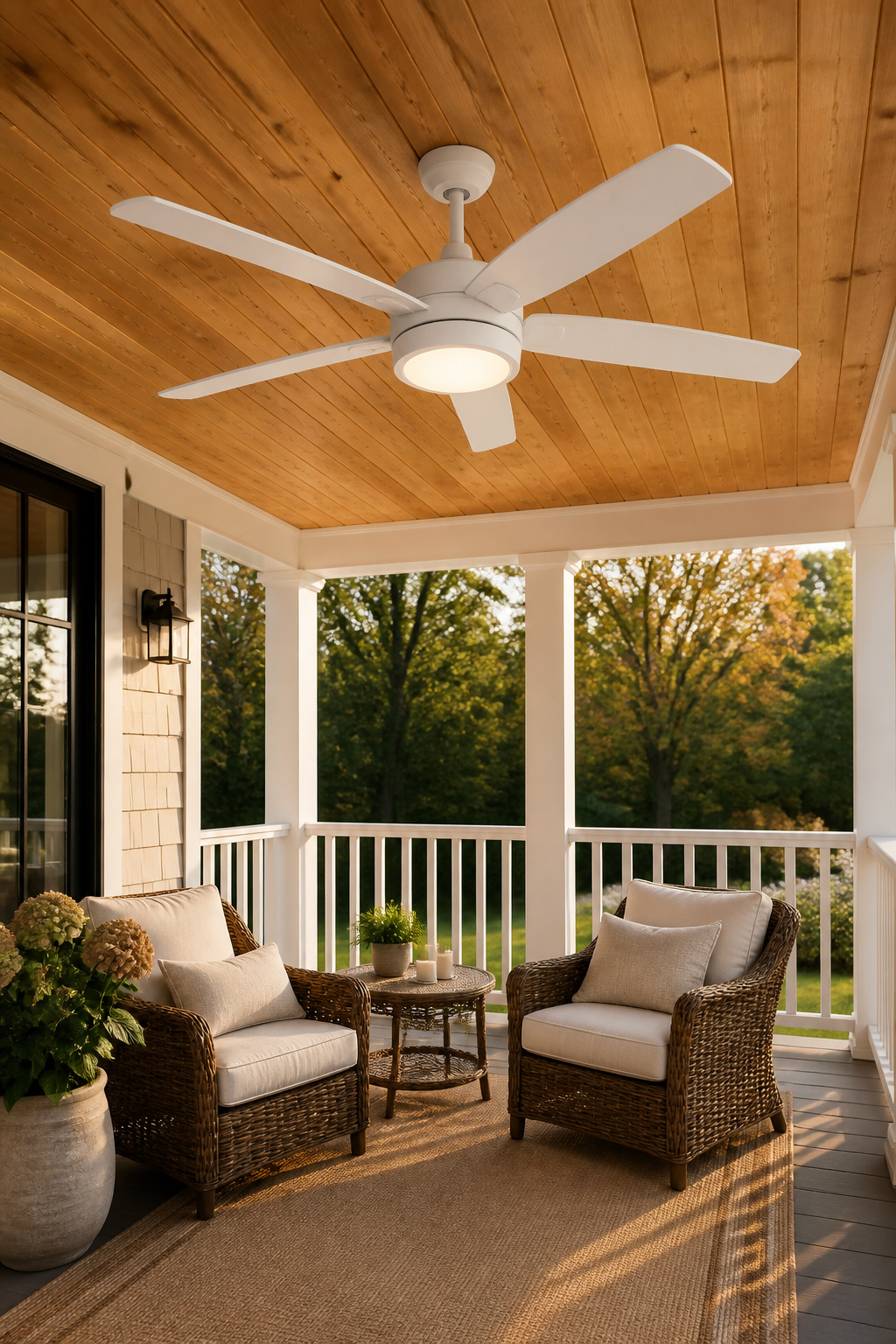
The outdoor rating question must be answered before purchase. A covered porch qualifies as a damp location — damp-rated fans handle moisture and condensation but not direct rain. An open pergola or any porch where rain blows in under the roof requires a wet-rated fan. Installing a damp-rated fan in a wet location will cause motor failure — this is not a marginal difference.
Blade span sizing: 42″ for porches under 100 square feet; 42–52″ for 100–300 square feet; 52–60″ for larger screened rooms. Hunter’s WhisperWind motor consistently ranks as the most reliable across outdoor conditions, and their limited lifetime warranty is honoured without friction. Minka-Aire’s Slipstream and Concept II have a cleaner profile that suits a Scandinavian-influenced porch — both available in matte white or brushed nickel. A reversible motor at low speed clockwise in winter adds months to porch comfort with no additional cost.
A porch swing is the physical form of the hygge principle. It is explicitly designed for doing one thing at a time: sitting, looking, talking, or not talking. You cannot effectively scroll a phone on a swing in motion; you cannot rush through a coffee; you cannot multitask. This piece of furniture earns its place in any porch makeover more than any other.
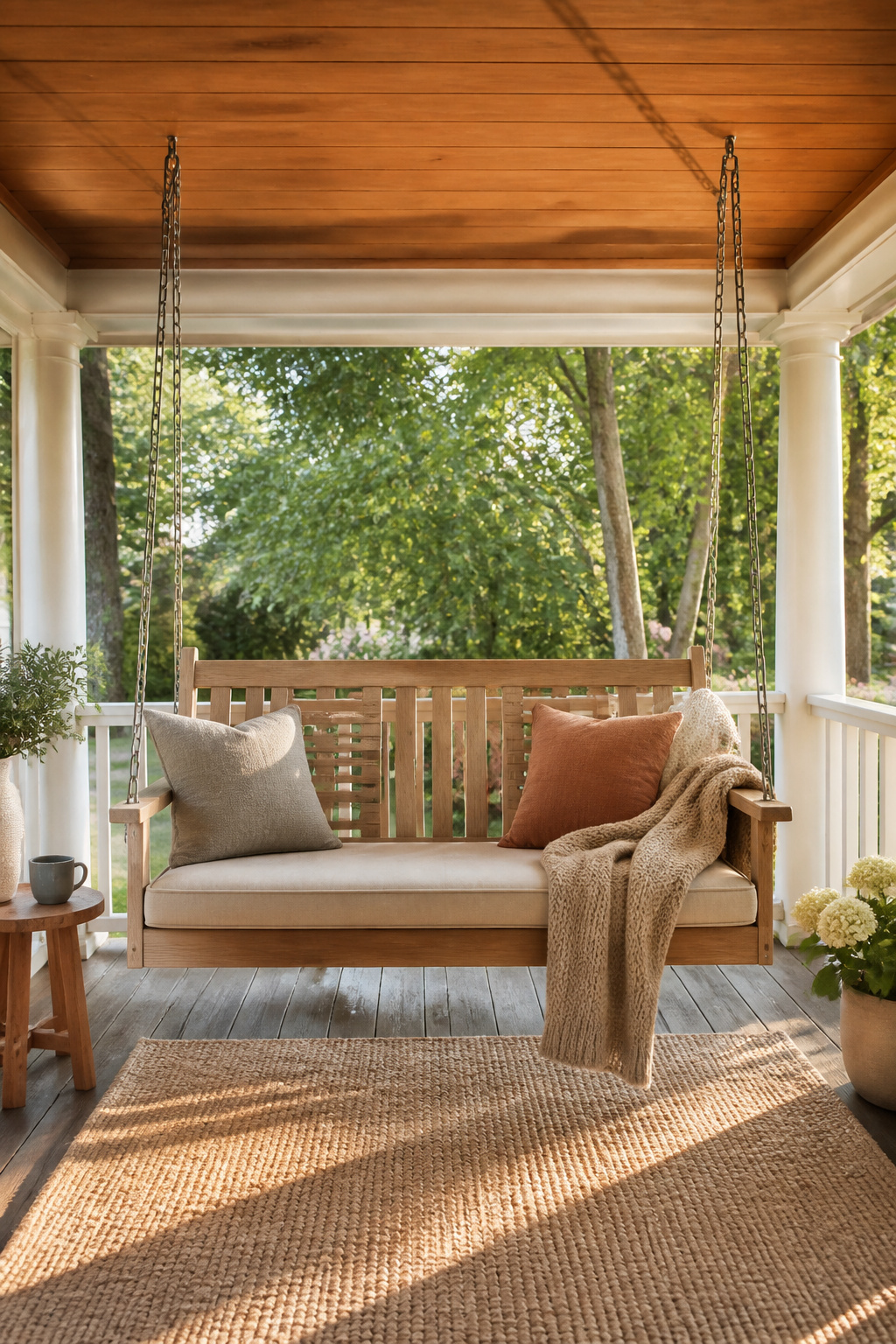
Hardware is safety-critical. Eye bolts should be rated for at least 500 lbs; a standard two-person swing typically rates to 550 lbs. Mount into at least two ceiling joists — a single 2×8, two 2x6s, or three 2x4s will carry the load. Use 5/16″ or 3/8″ galvanised lag screws through the ceiling into the joists — not toggle bolts or hollow-wall anchors, which can fail catastrophically under dynamic load. Chain should be galvanised or stainless steel.
Standard 4-foot swings seat two adults; 5-foot swings allow a single adult to stretch out; 6-foot versions function as full loungers. Cedar and cypress are the most practical wood choices — both naturally resist rot and insects without treatment. White oak offers a more refined, furniture-grade feel. For a Scandinavian porch, a cedar swing with a simple Sunbrella cushion in natural linen or oatmeal reads authentic rather than decorative. For those planning the broader outdoor space alongside a porch makeover, planning the layout of structural elements across a connected outdoor space is worth doing before committing to a final arrangement.
Before any structural work, before new furniture, before a single planter is placed — paint. Fresh paint on porch columns, railing, and ceiling is the highest-return investment in a porch remodel. It signals immediately that the space has been tended, and it sets the palette that every subsequent decision responds to. The material cost for a typical front porch runs $100–400.

The Haint Blue porch ceiling tradition is worth preserving. The blue ceiling originated in the American South in the 19th century; the practical effect is that a cool blue overhead reads as sky even at night and creates a particular restfulness that white or off-white ceilings don’t. Benjamin Moore Lookout Point 2060-40 and Sherwin-Williams Watery SW 6478 are the go-to picks. Comfort Gray by Sherwin-Williams is a more neutral, green-leaning option if you want the tradition without the full blue commitment.
Benjamin Moore Aura Exterior is the longest-lasting on the market — it holds colour and resists failure longer than competing products. For columns and trim, semi-gloss or gloss finish in exterior latex is correct: durable, wipeable, and mildew-resistant. Flat finishes are correct for porch ceilings, where sheen would show every surface imperfection. Paint in this order: ceiling first, then columns and trim, then railing — this prevents drips landing on finished surfaces. For front door decorations that complement a freshly painted porch, a deep navy or matte black door against white columns is a combination that holds across design trends.
Textiles are the bridge between interior and exterior. When you bring a rug, cushions, and a throw blanket to a porch, the space stops being an outdoor structure and starts being an extension of how you live inside. This is a key step in any porch remodel that aims for genuine daily use rather than occasional outdoor occasions.
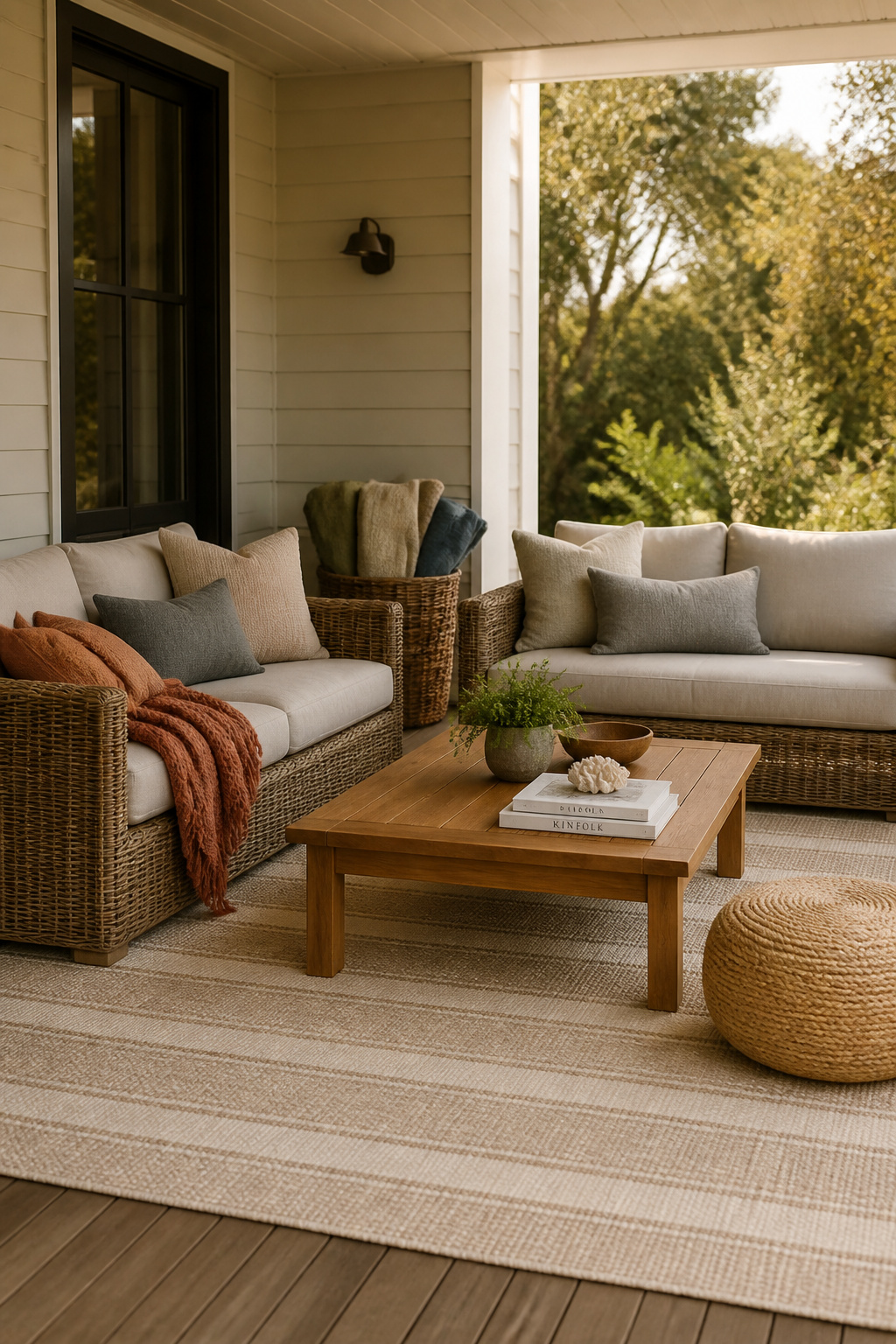
Polypropylene is the outdoor rug material to understand. Its molecular structure contains no natural oils or cellulose that UV light breaks down, which means it resists fading without chemical UV treatment. Standard polypropylene rugs in direct sun hold their colour for 3–4 years; premium solution-dyed polypropylene runs longer. Low-pile versions (0.4″ or less) clean easily and work better under furniture legs. Dash & Albert make the most consistently attractive patterns; nuLOOM offers good value across a wide range; IKEA’s TOSTERÖ range is the budget entry point.
For cushion covers, Sunbrella-grade solution-dyed acrylic is the standard worth matching — bleach-cleanable and mildew-resistant. A wicker basket by the seating holding 3–4 folded outdoor throws is a detail of unusually high value-to-cost ratio. It makes the porch look inhabited and makes the space genuinely more useful on cool evenings. Change textile colours seasonally: warm terracotta and burgundy in autumn; cool linen and sage in summer. Rolling outdoor poufs add flexible seating and stack against the wall in one motion when not needed. For additional approaches to layering furniture and textiles into a cohesive outdoor room, patio decorating ideas is a useful companion read.
An accent wall behind the main seating area gives the porch a focal point and makes furniture placement feel resolved. Without it, a porch is a perimeter of seating looking inward at nothing. With it, there’s a visual surface that anchors the room and makes the space look more designed than the cost suggests. This is one of the most cost-effective visual upgrades in any porch remodel budget.
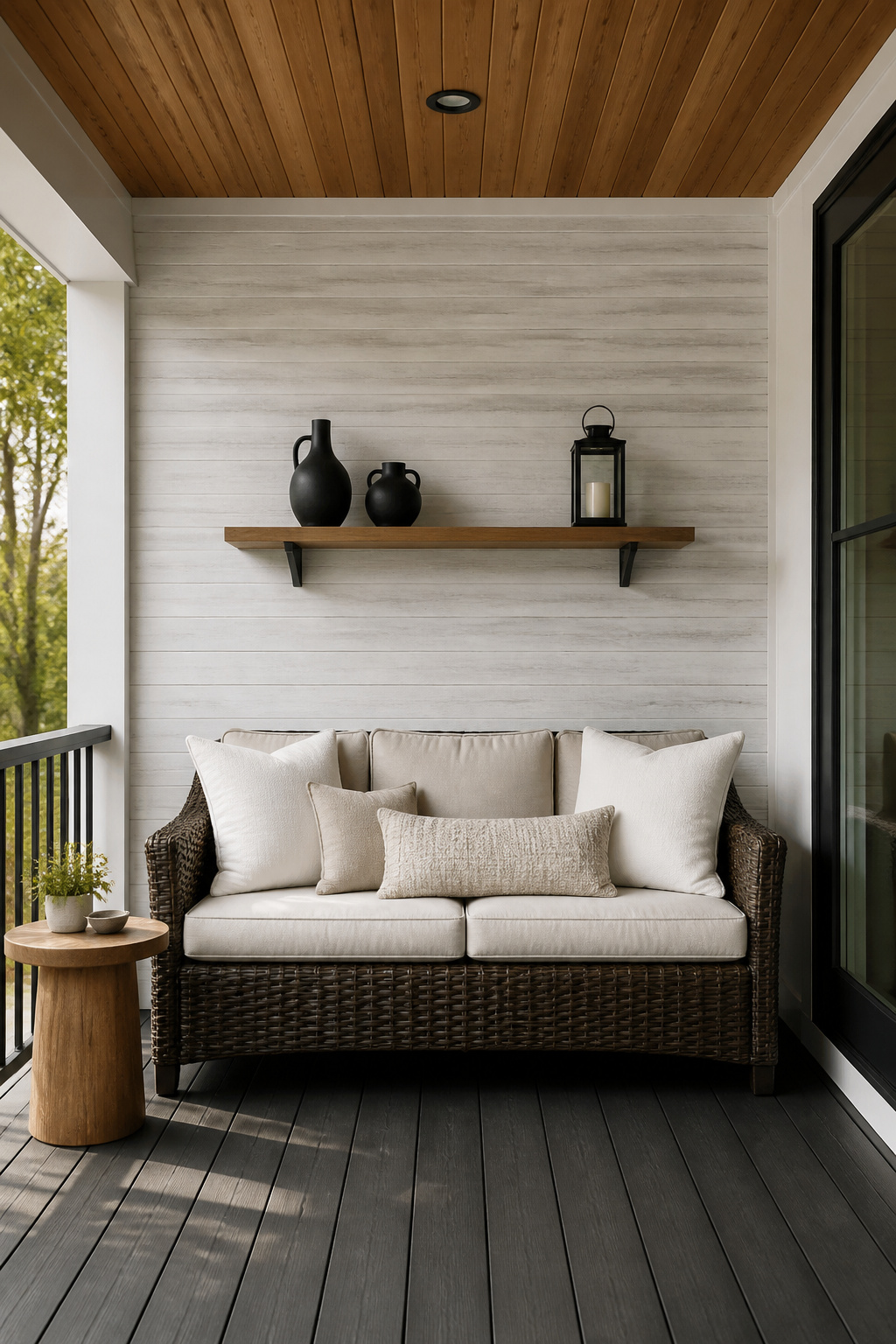
Horizontal shiplap registers as calm and grounded. For most covered porches, a painted white shiplap accent wall with a console table or pair of lanterns in front of it is a complete, clean result. Vertical planks are less common and add a sense of height — useful on a low-ceilinged porch.
Material selection is driven by moisture exposure. Real cedar shiplap is beautiful and workable; it needs priming on all six sides before installation and repainting every 5–7 years on an exterior wall. Cellular PVC shiplap (Elite Trimworks, Westlake Royal) is 100% waterproof, never rots, and can be painted with 100% acrylic latex — it’s the right material for any porch that sees rain splash. Composite (WPC) shiplap is capped on all sides and resists moisture, fade, rot, and insects.
Limewash paint on a shiplap accent wall creates a soft, chalky texture that reads as weathered and intentional — very Nordic in character. Portola Paints and Roman Clay by Sherwin-Williams create this effect on primed wood or composite. Solid exterior stain in warm white or pale grey is the most durable option on a surface that faces outward, holding colour longer than standard paint. Avoid dark stains on horizontal shiplap — lap marks are more visible on dark backgrounds.
Porch electrical is almost always the afterthought and almost always the thing people wish they’d addressed first. A porch remodel without adequate outlets means extension cords trailing across the floor — a trip hazard, a safety issue, and an aesthetic problem that undermines every other upgrade you’ve made.

The NEC requires GFCI protection on all outdoor 15A and 20A, 125-volt receptacles — no exceptions. On a covered porch (a damp location), outlets must be weather-resistant (WR) rated, installed in a weatherproof box, and equipped with a spring-loaded cover. On an exposed porch where rain reaches the outlet, an in-use weatherproof cover is required — the type that seals even with a plug inserted. Leviton and Faith both make excellent GFCI WR receptacle and cover combinations rated for outdoor installation.
Lutron Caseta smart dimmers don’t require a neutral wire, which makes retrofit installation into older porch wiring straightforward. At low dim settings — 20% output — the pendant creates the warm, intimate pool of light that makes a porch feel like an evening destination. Kasa Smart outdoor smart plugs (TP-Link) are a no-permit shortcut: plug into existing outlets, control via app, and manage string lights or small appliances. A motion sensor switch on the entry light means the porch is always lit when someone approaches. The cost to add a new outdoor circuit runs $200–600 for a licensed electrician — modest infrastructure that changes how a space is used every single day.
The most useful piece of advice in any porch remodel is to sequence the work correctly: structure before surface, function before decoration. Start with any work that opens walls or ceilings — electrical rough-in, framing for a covered addition, structural railing posts. Then do the ceiling and flooring, which set the palette all subsequent choices respond to. Furniture, textiles, and planting come last.
Budget range is a genuine guide here. A cosmetic refresh — paint, a new pendant fixture, a ceiling fan, an outdoor rug, cushions, and planters — runs $500–2,000 and can be done over a few weekends without any permit. A mid-range porch renovation covering flooring, railing, a built-in bench, and a wood ceiling runs $3,000–8,000 with some professional work. A screened enclosure, covered addition, or full structural rebuild is $10,000–30,000 and above.
Within any budget, the highest-ROI categories are paint, lighting fixtures, and front porch curb appeal — all three measurably improve perceived value and daily quality of use. On the DIY question: paint, textiles, container planting, and furniture are confident DIY territory. Electrical work, structural framing, tile installation, and screened enclosures are worth hiring out — the cost of correcting a professional’s mistake is manageable. The cost of correcting your own electrical work five years later is not.
Start with what bothers you most about the current porch. Fix that first, and notice what else becomes clear.