Physical Address
304 North Cardinal St.
Dorchester Center, MA 02124
Physical Address
304 North Cardinal St.
Dorchester Center, MA 02124
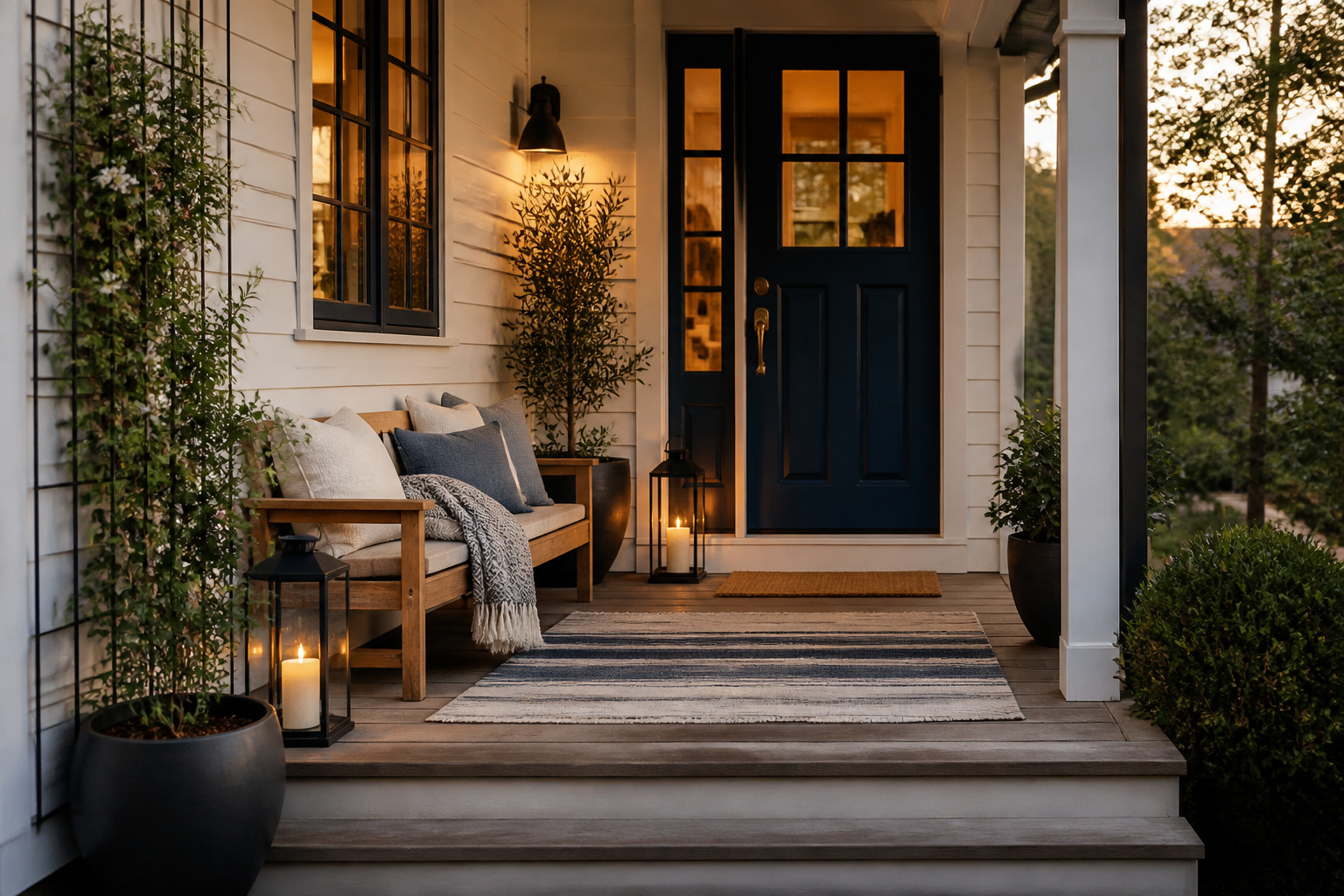
Discover 15 front porch decor ideas — layered rugs, statement door colours, string lights, climbing trellises, and cohesive palettes for every home style.
In Scandinavian design, the entry to a home is called the threshold space — and it is treated with a seriousness that most of us reserve for the living room or kitchen. The idea is simple: what you encounter before you step inside sets the emotional tone for everything that follows. A cold, bare, neglected porch communicates something. So does one that is clearly considered, even in small ways.
Good front porch decor isn’t about spending a lot or filling every surface. It’s about making deliberate choices — a rug that defines the space, a door colour that signals welcome, plants that bring life, and lighting that turns the porch into somewhere you’d actually want to spend an evening. These fifteen front porch ideas range from structural improvements to small additions, and all of them can be adapted to nearly any home style or budget. Start with one that resonates and build outward from there.
Most porches have a structural problem that no amount of furniture fixes: without a rug, the space reads as a transit zone rather than a destination. A rug draws a boundary. It says that this is a room — one that happens to be outdoors — and that people are meant to stop here, not just pass through. For front porch decor, it is the foundational decision that everything else builds on.
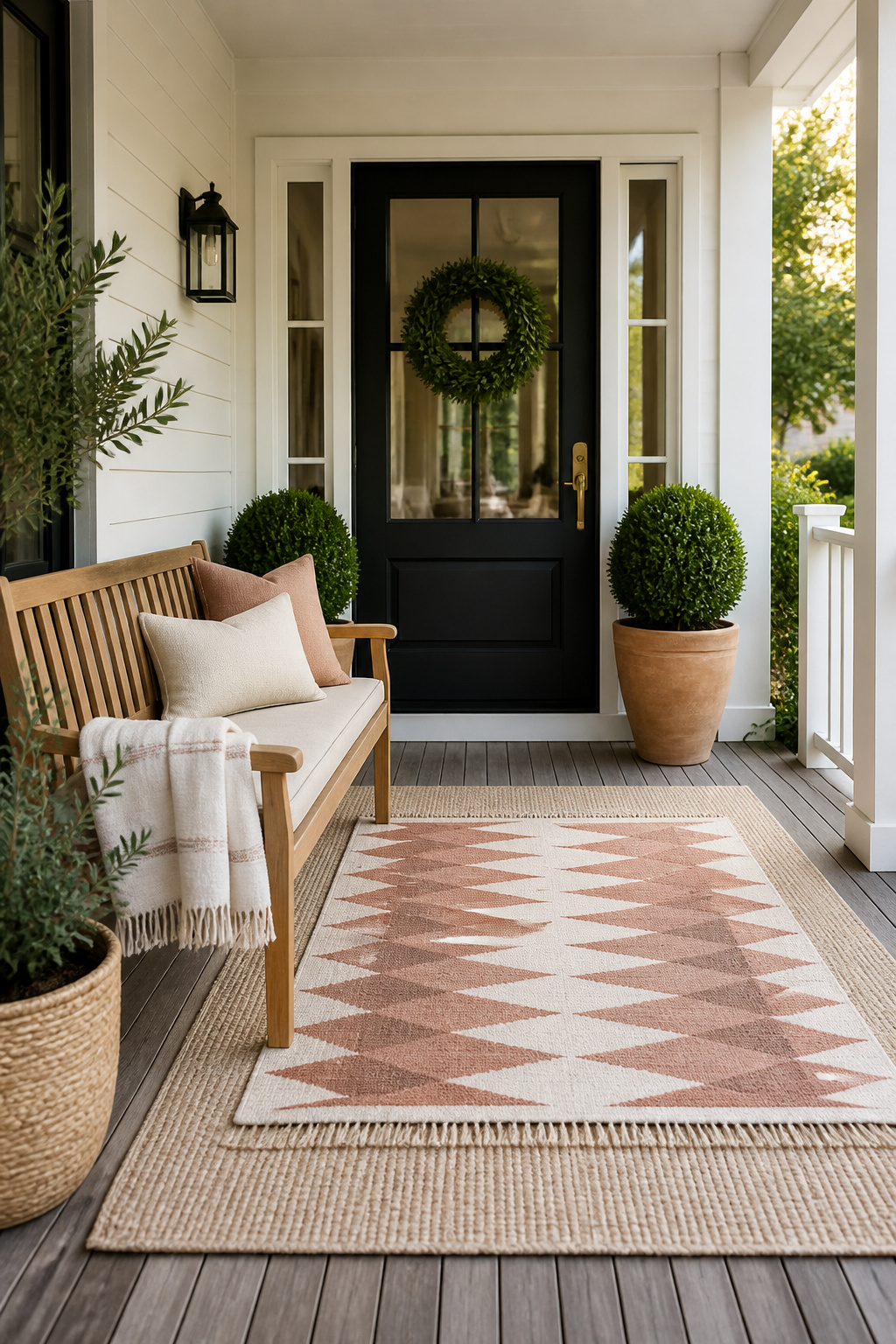
Choosing the right outdoor rug requires more material knowledge than most buyers expect. Polypropylene is the answer for any exposed porch — it resists moisture, resists UV fading for up to four years of direct sun, and handles foot traffic without matting. The misconception that you need to sacrifice warmth for durability is largely obsolete: polypropylene is now manufactured in weaves that convincingly mimic jute, sisal, and wool textures. Genuine jute is beautiful and worth using, but only on covered or screened porches; one wet season outdoors and it will mold. Recycled PET rugs (made from plastic bottles) are worth considering if sustainability matters — they perform comparably to polypropylene and are a better material story. For broader outdoor inspiration, these deck ideas on a budget show how the same layering principles apply across different outdoor surfaces.
For a designer-level finish, layer a smaller patterned or geometric piece over a larger neutral base. A 5×7 rug laid on an 8×10 base creates depth and visual richness for a fraction of what a single premium rug would cost. The Nordic approach: a subtle natural-tone flatweave underneath, a simple geometric or stripe on top — collected-looking rather than matchy. One practical note: always use an outdoor-rated non-slip rug pad beneath both layers. Wind moves rugs, and an unsecured rug edge becomes a tripping hazard within days.
If there is a single front porch change with the highest return on investment, painting the front door is it. The door is seen at close range by everyone who visits, and at street distance by everyone who passes — its colour does a disproportionate amount of visual work. A weekend and a tin of exterior paint can change the entire personality of a home’s outdoor entryway decor.
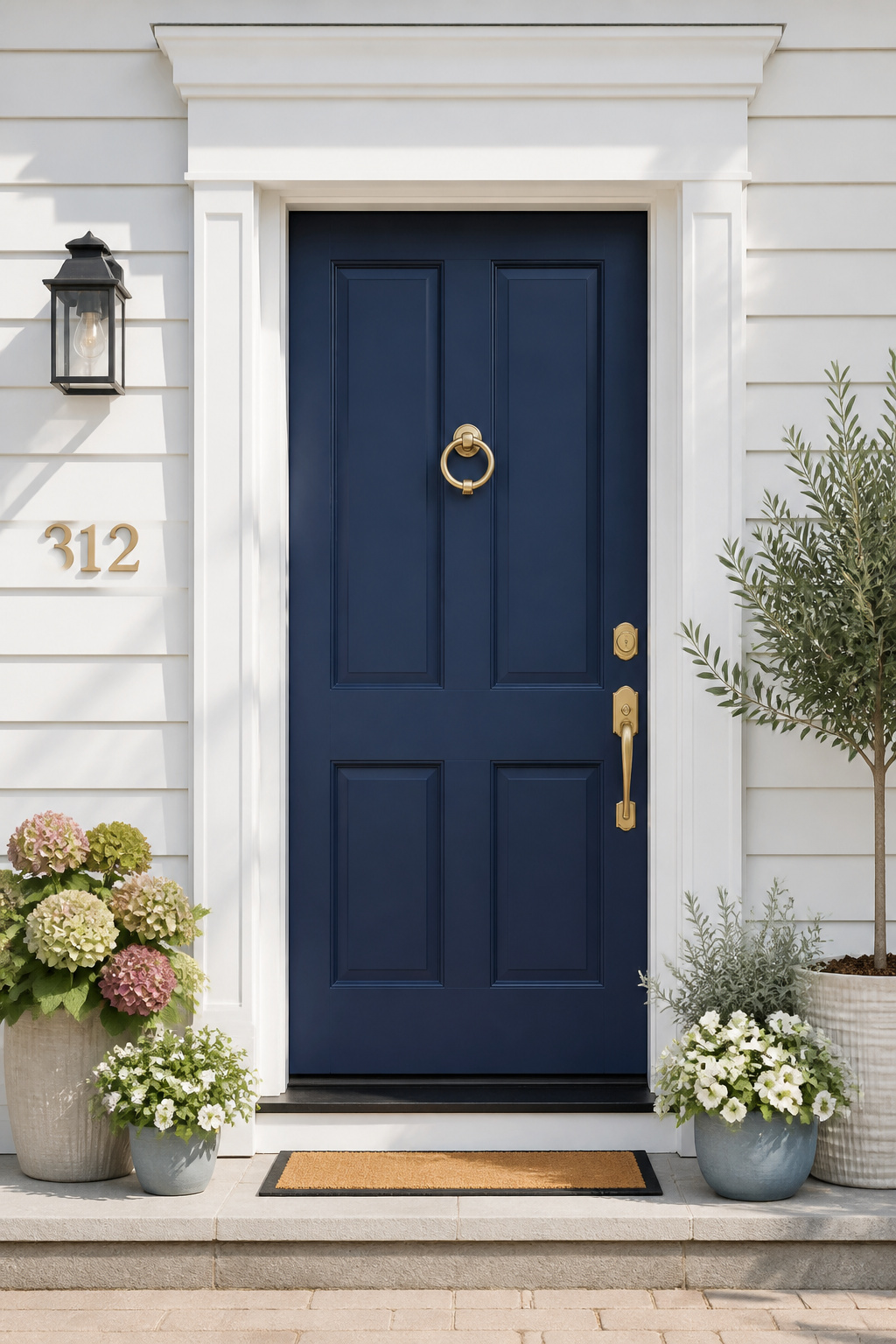
For 2026, the data is consistent: a Fixr survey of interior designers and architects found that 64% named black as a top front door choice, and navy blue has been identified as the colour set to dominate this year. Both read as authoritative, timeless, and intentional. Forest greens and deep botanical shades are the more interesting choice for those wanting porch decorating ideas with more personality — grounded in nature, they pair naturally with plant-heavy front porch design ideas. For homes with warm-toned brick or beige siding, a forest green door with brushed brass hardware is close to an ideal Nordic-influenced entry palette. You can explore stunning front door decorations to see how colour coordinates with other entryway elements.
Pairing strategy matters as much as the colour itself. A black door on a white-trimmed house is a classic contrast that reads as intentional and clean. A navy door on cream siding with dark lanterns flanking it is the hygge entry at its most effective — welcoming, warm-lit, and quietly confident. Before committing, photograph your home’s exterior in natural light and study the full palette: siding, trim, brick or stone, and the porch floor. The door colour should feel like a decision within that context, not a collision with it. Hardware finish should match: matte black handles on a black or navy door; brushed brass or antique bronze on green or warm-neutral doors.
Plants are the most alive and forgiving element of front porch decoration. They bring colour, texture, scale, and constant gentle change — the pot that looked one way in April looks entirely different in July, and that dynamism is exactly what a good porch needs. The key is matching plants to your actual light conditions and using a design formula that produces professional-looking results without professional knowledge.
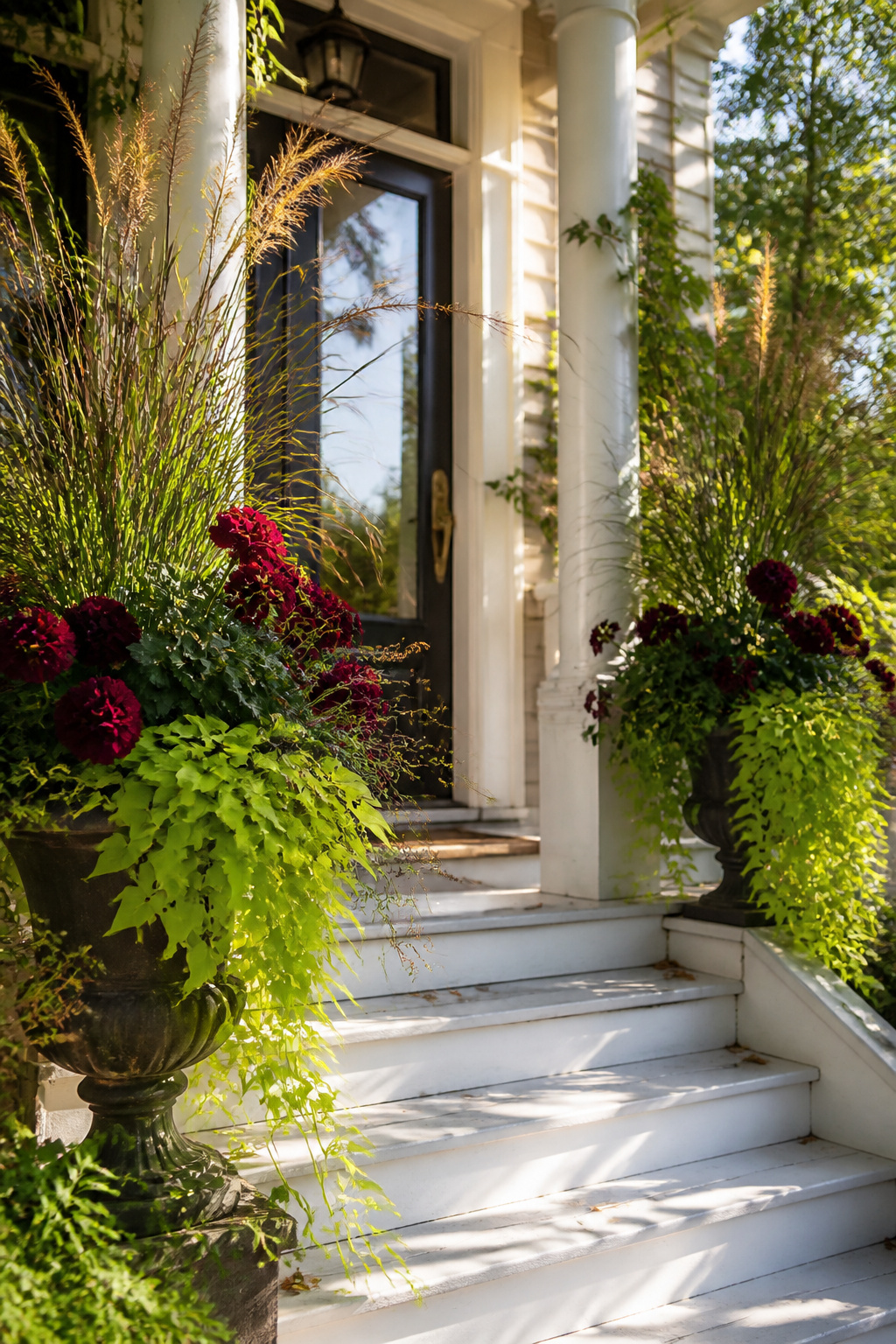
The thriller-filler-spiller formula works on every porch, in every season. The thriller is the tall centrepiece plant — a bold grass, a standard-form topiary, a dramatic elephant ear. The filler is the medium-height bushy plant that surrounds it and adds colour or texture. The spiller trails over the pot’s edge and creates movement. In a sunny porch situation: an ornamental grass as the thriller, geraniums or lantana as fillers, and trailing sweet potato vine or petunia as the spiller. In a shaded porch: a large hosta at centre, coral bells (Heuchera) for colour variation, and a trailing fern or ivy to cascade. Choosing patio plants that transform outdoor spaces doesn’t require a green thumb — just an honest assessment of your light conditions before you buy.
For year-round structure, anchor each arrangement with at least one evergreen plant that holds its form through winter. A potted miniature spruce, a clipped boxwood ball, or an ornamental grass provides the bones that seasonal annuals surround. In autumn, swap summer geraniums for ornamental kale, mums, and pansies; in winter, add berry branches and evergreen cuttings around the permanent structure. This approach means the porch never looks stripped bare between seasons — just gradually transitioning. Always choose containers with drainage holes and fill them with a quality potting mix rather than potting soil. The mix’s looser structure and better aeration make a real difference in how quickly roots establish.
A porch that looks excellent by day and disappears at night is only half-designed. String lights are the simplest way to extend the porch’s functional season — not just into autumn, but past sunset on every evening in summer. And because they add warmth rather than brightness, they contribute something overhead porch fixtures rarely do: genuine atmosphere.
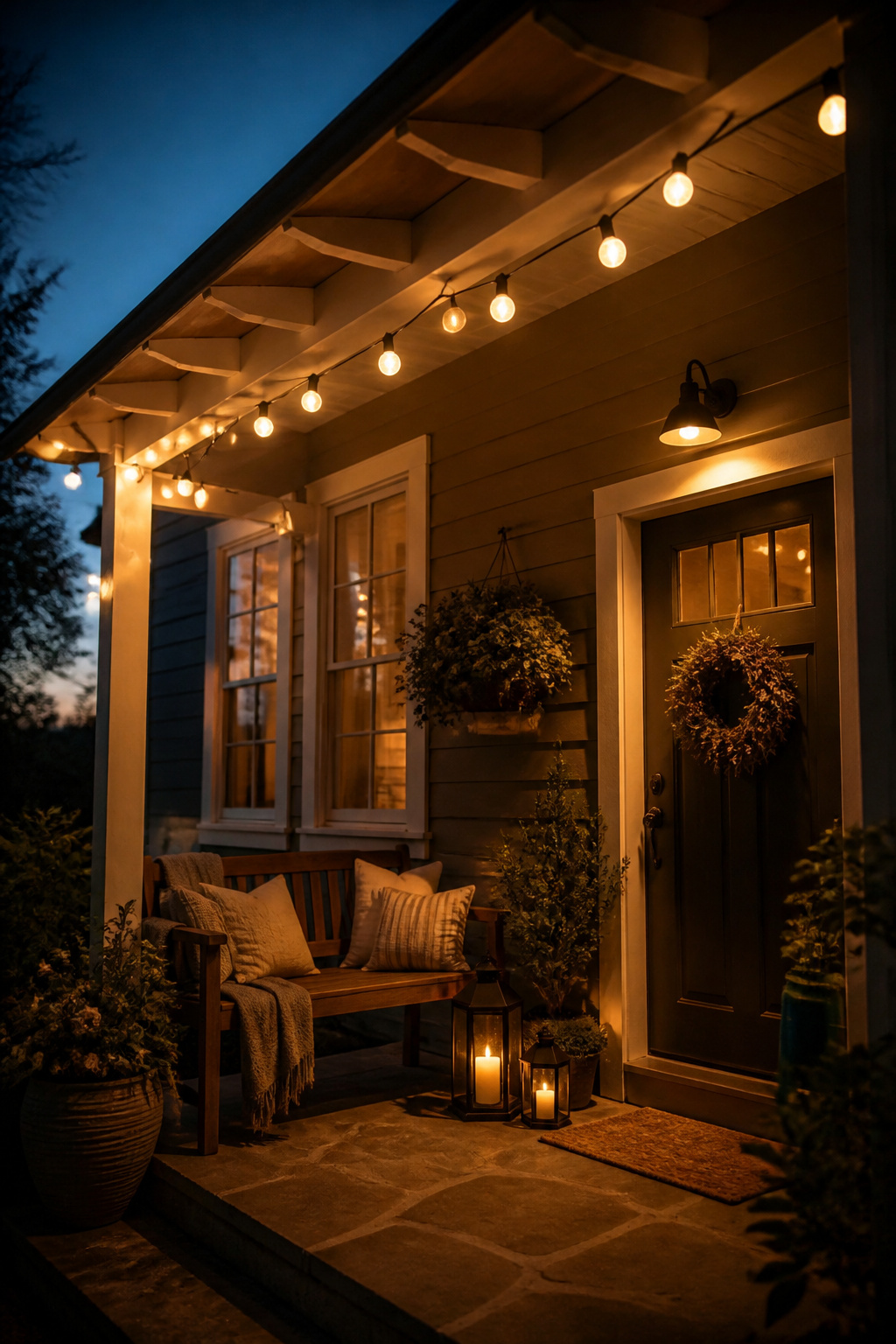
The right colour temperature is the most important choice. Look for lights rated at 2,700K — the warm-white range that mimics candlelight and creates the cosy, amber quality associated with Scandinavian hygge interiors. G40 globe bulbs give a soft, diffused glow across the whole porch; Edison-style filament bulbs cast a more directional, vintage warmth. Both work; the choice is aesthetic. For durability, insist on IP65 for any uncovered porch exposed to rain — this means the lights handle direct water jets, not just the occasional splash. IP44 is sufficient for covered porches and screened rooms.
Hanging method determines whether the result looks professional or improvised. Under-eave screw hooks give a clean, permanent installation. Heavy-duty adhesive hooks work for renters who can’t drill — test the weight before committing to a full run. The classic setup is a single run of lights along the porch ceiling or across the face of the eave at 8-9 feet height — just above head level, where the warm glow falls on people rather than on the ceiling. Run the cable first, then install bulbs — it prevents damage during the stringing process. A smart plug with a dusk-to-dawn sensor automates the on/off entirely, which is the hygge ideal: comfort that requires no effort to maintain.
There is a particular quality to natural wood furniture on a porch that nothing synthetic quite replicates. It reads as permanent. It signals that someone chose quality over convenience and intends to be here for many seasons. In the Nordic tradition, materials are selected for authenticity and longevity — a teak bench weathering slowly to silver-grey is not considered neglected; it is considered honest.
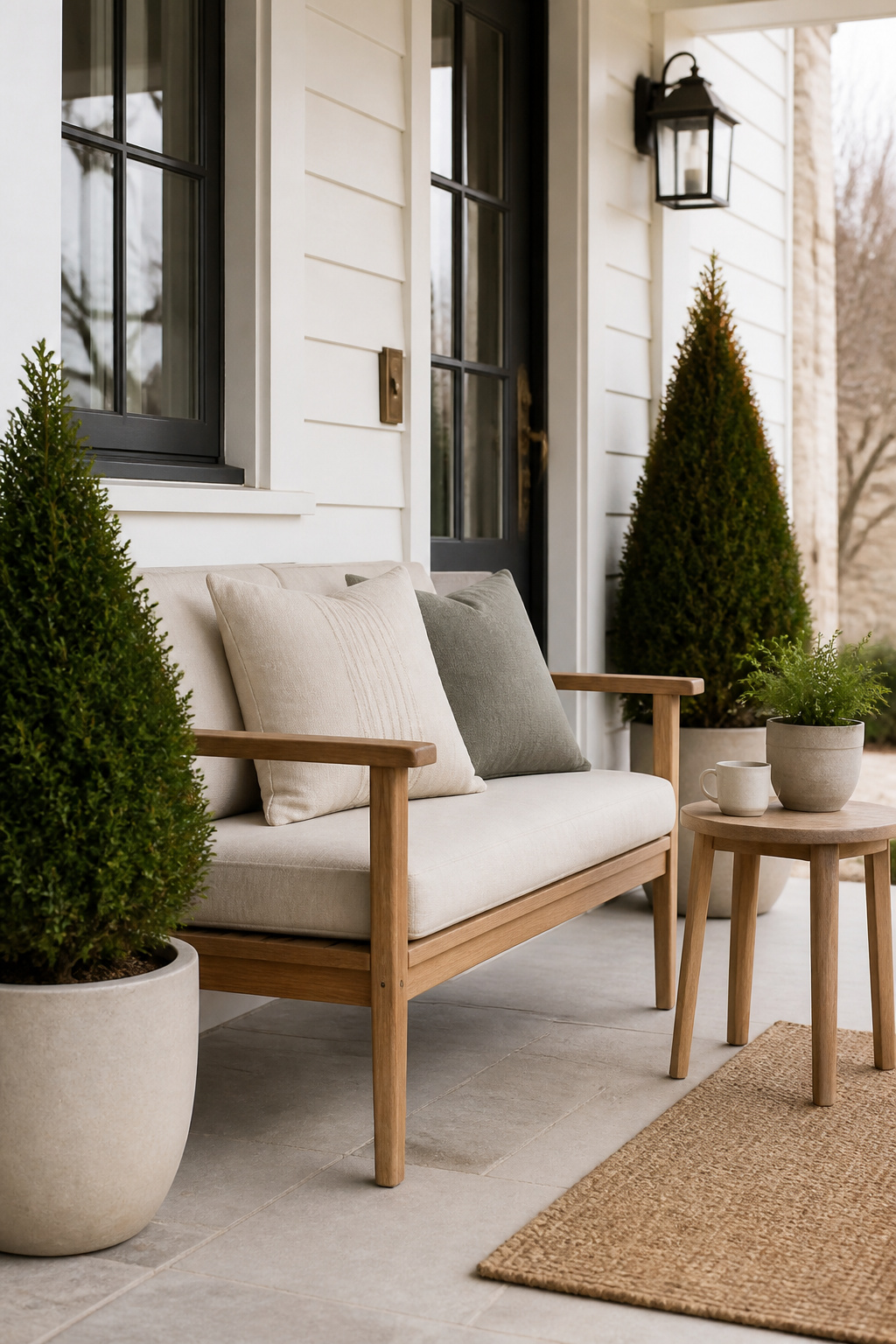
Teak is the benchmark material. Its natural oil content makes it resistant to moisture, insects, and UV without annual treatment — a Janka hardness of around 1,070 lbf and genuine structural density mean teak furniture lasts 50 years or more with basic care. Acacia is the more accessible mid-range choice: very hard (Janka 1,700+), handsome, and widely available, but it requires annual oiling every six to twelve months to prevent cracking. Cedar is the budget option and a genuinely good one — naturally resistant to rot and insects, lightweight, and easy to finish, with a lifespan of 10-15 years. When browsing porch furniture for an outdoor reading retreat, it’s worth understanding these distinctions before committing to a piece you expect to last a decade.
For a hygge-influenced front porch decor scheme, simplicity in form matters as much as quality of material. A straight-armed teak bench with a linen-blend cushion, paired with a small side table in the same wood — this is the Nordic porch at its most elemental. Allow teak to weather to silver-grey for a maintenance-free look that only improves with age, or apply teak oil once in spring to preserve the honey tone. One practical rule with any outdoor wood: use rubber feet or furniture glides to elevate pieces off concrete or stone. Moisture wicking upward through contact degrades wood faster than rain from above.
The wreath is doing more visual work than its scale suggests. Positioned at eye level at the centre of the door, it is the first close-range detail anyone sees as they approach — and it is entirely within your control to make it excellent. The investment required is small; the impact on front porch decor is consistently outsized.
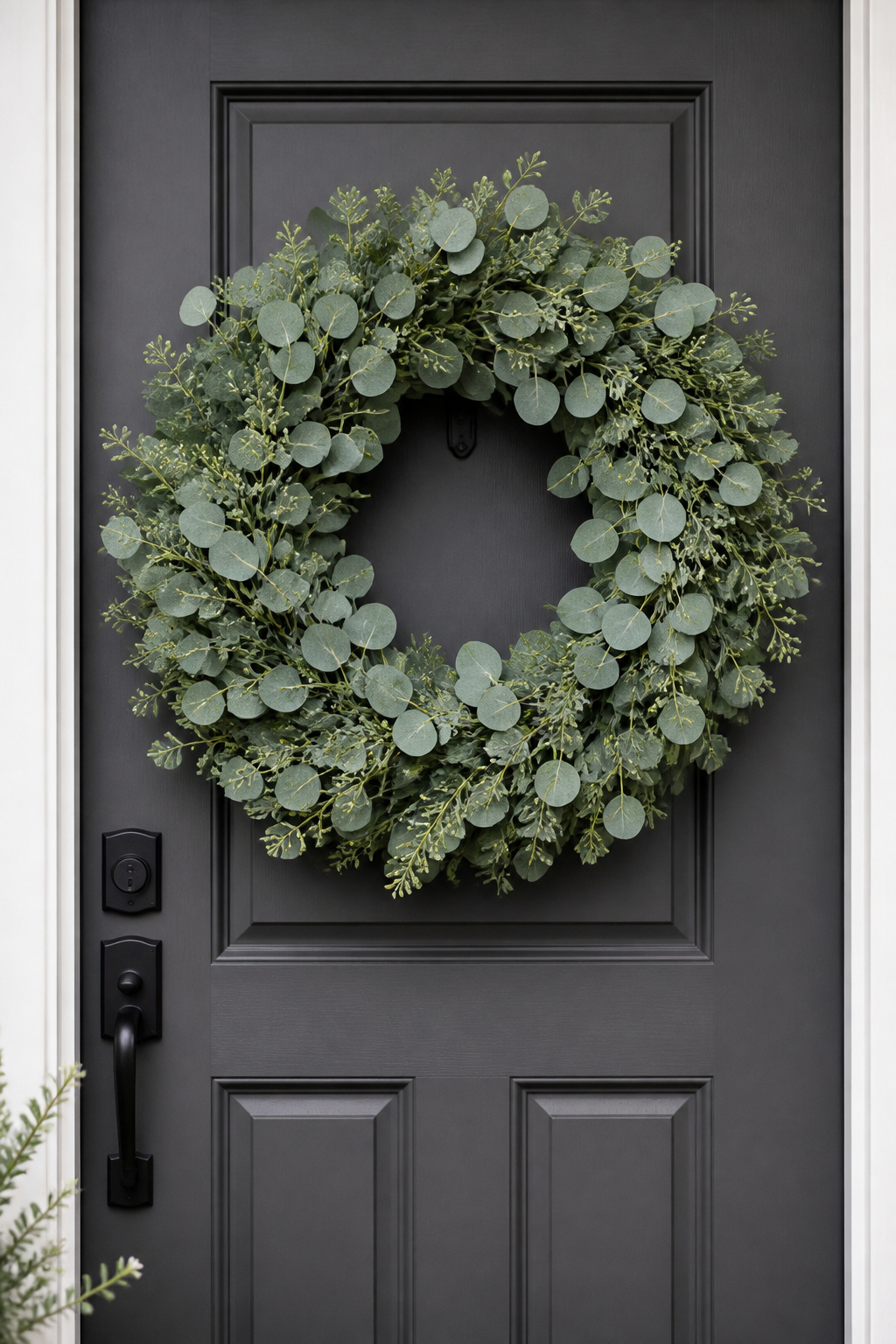
Sizing is the variable most people get wrong: go one size larger than feels instinctive. A 20-inch wreath that reads as ample in a shop will look modest on a standard 36-inch exterior door at conversational distance. For a 36-inch door, a 24-inch wreath is the minimum; 26-30 inches reads as confident. Use a proper wreath hanger rather than a nail — it protects the door’s finish, allows easy seasonal changes without re-hanging hardware, and positions the wreath at the correct height more reliably than improvised solutions.
For material, preserved eucalyptus is the Nordic wreath choice: the glycerine-preservation process stabilises colour and shape for one to three years outdoors on a covered porch, requiring no watering or maintenance. Fresh eucalyptus is more intensely fragrant and immediately beautiful — it will gradually dry and shift to a muted silver-brown, which on a farmhouse or Scandinavian-style porch reads as beautifully as a freshly made piece. Avoid highly seasonal or theme-heavy wreaths unless you commit to changing them promptly. A neutral botanical wreath in preserved greenery, dried cotton stems, or mixed herbs suits all twelve months and ages gracefully.
Overhead lights illuminate. Lanterns and candles create atmosphere. The distinction matters: a porch with only a ceiling fixture has adequate light but little warmth. Add a pair of floor lanterns flanking the door, and the same porch begins to feel like a threshold worth pausing at.
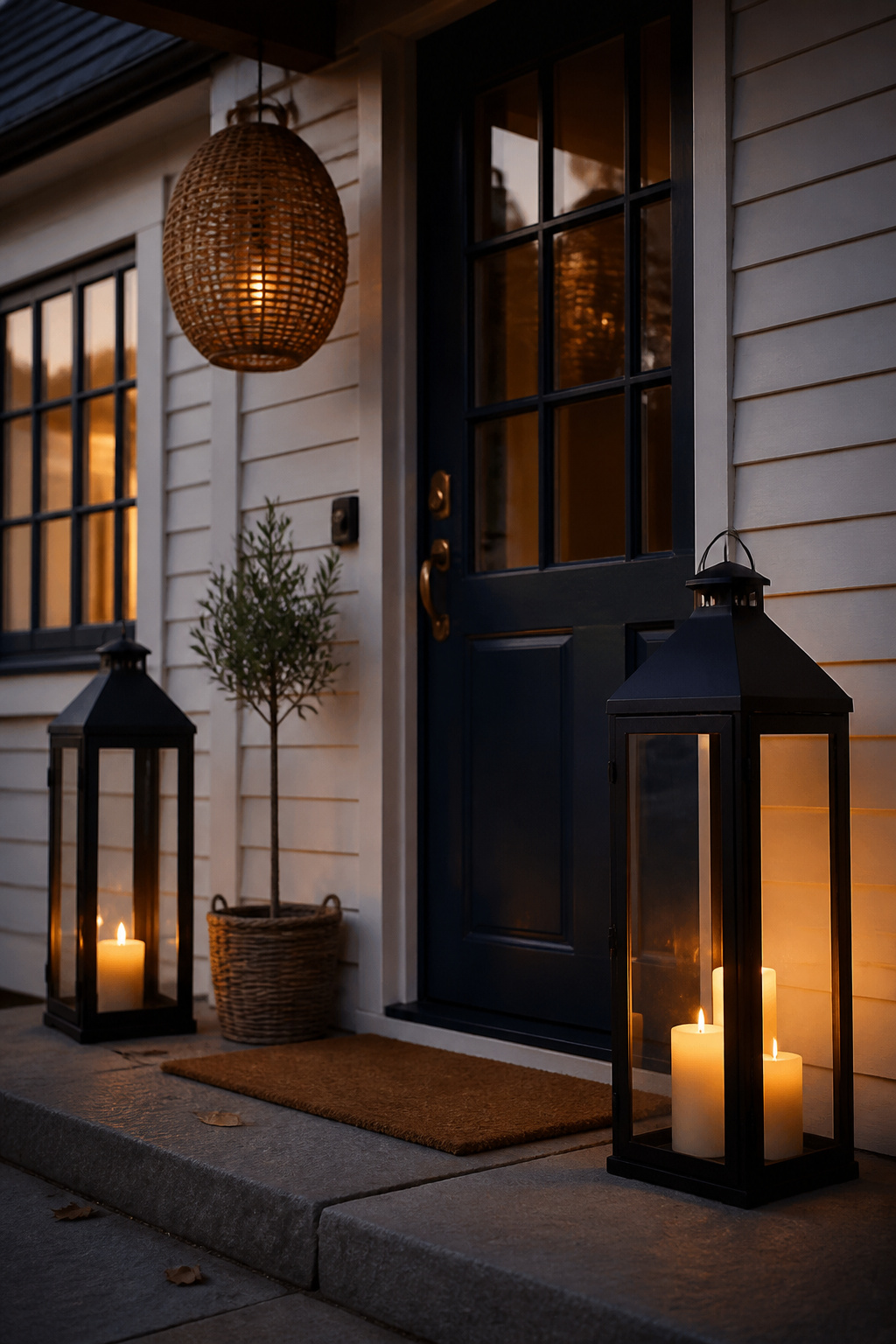
The sizing rule for lanterns is straightforward: the lantern should be approximately one-quarter to one-third the height of the front door. For a standard 80-inch door, that means 20-27 inch lanterns; for a 90-inch door, 23-30 inch. A lantern that is too small looks lost; one correctly proportioned reads as architecturally considered. Powder-coated steel in matte black or weathered bronze is the most reliable material — rust-resistant, UV-stable, and appropriate for any home style. Rattan lanterns over a steel frame add natural texture that suits the organic end of the Scandinavian aesthetic; look for ‘powder-coated steel with PP rattan’ rather than all-rattan, which deteriorates faster in direct rain. Any lantern on an uncovered porch should carry a minimum IP65 rating.
Battery-operated LED flame candles have genuinely matured as a technology. Top-tier options use a moving-flame LED mechanism that is convincingly realistic inside a glass-panelled lantern, particularly in low light. They eliminate every fire-safety concern on a wood porch, handle rain without damage, and most include a four or eight-hour timer that automates the evening glow. For the hygge philosophy of comfort without effort, this is the right solution: lanterns that come on at dusk and off at a set hour, requiring nothing of you except the initial setup.
Container pots at ground level do important work. But window boxes add something they cannot: vertical presence. A well-planted box beneath a porch window or mounted to a porch railing lifts the planting to eye level, frames the architecture, and creates a layered garden effect that reads as intentional from the street.
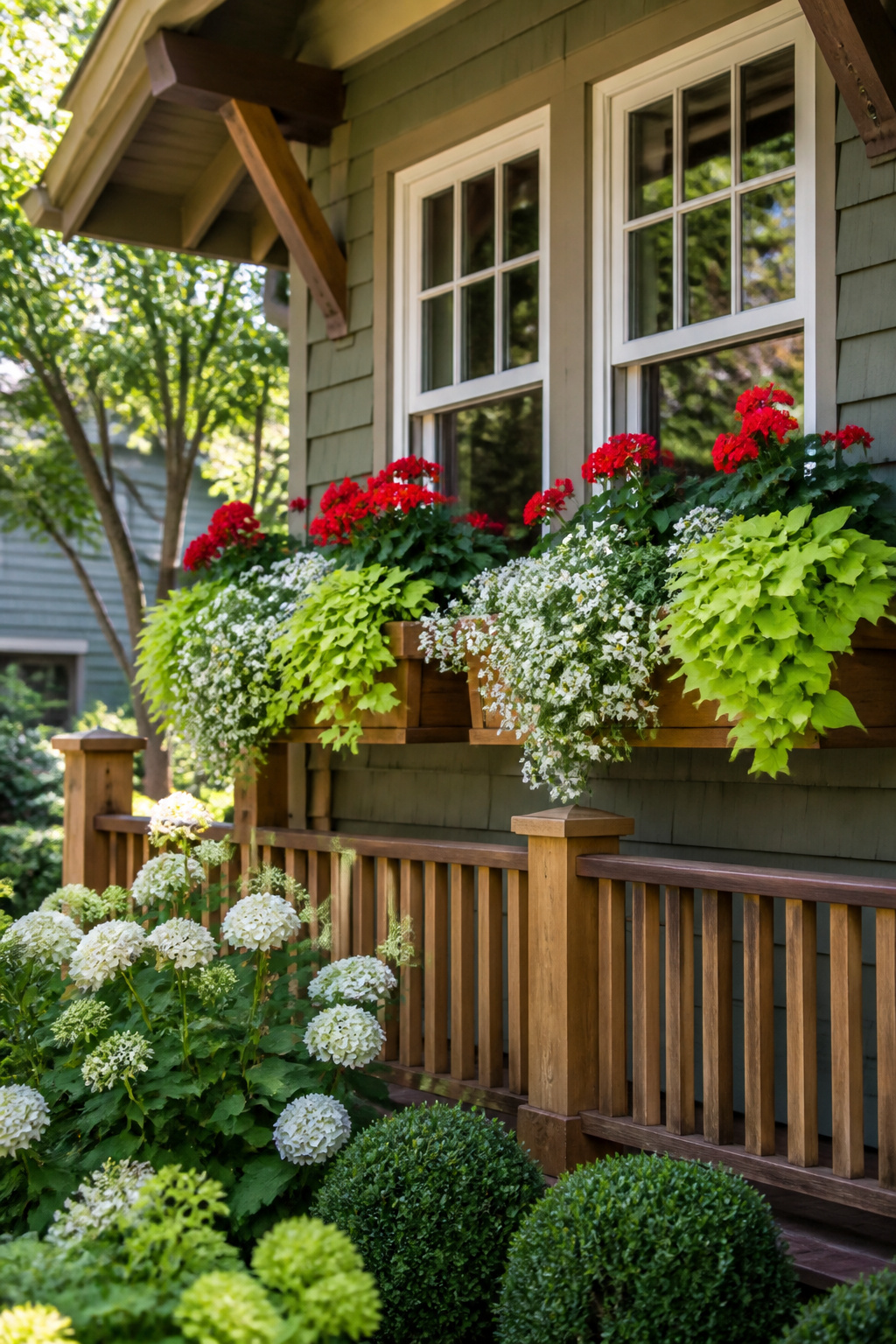
The critical sizing rule: the box should span the full width of the window (or slightly overhang each side), and the planting should sit at or just above the windowsill height when viewed from outside. An undersized box beneath a wide window looks like an afterthought rather than a design element. Cedar remains the classic window box material — naturally resistant to rot and insects, takes paint or stain cleanly, and is dimensionally stable in most climates. Composite (wood-fibre and plastic blend) is the lower-maintenance alternative: it won’t swell or crack, and accepts paint well for a clean finish. Metal boxes in powder-coated steel are the most durable in wet climates.
For mounting, use stainless steel screws into wood siding — standard steel screws will rust and leave brown staining streaks down the facade over time. Drill a minimum of four quarter-inch drainage holes in the bottom of any box; without drainage, the box becomes a root-rot environment within weeks of rain. A coconut coir liner inside the box slows water loss and prevents soil washout without blocking drainage. For rental properties or those wanting no wall penetration, bracket-mounted boxes that hook over porch railings are rated up to 50 lbs when fully planted and require zero screws. For the planting itself, scale choices to box depth and avoid tall plants that will obscure the window from inside; trailing plants — petunias, bacopa, calibrachoa — give the fullest, most generous look at distance.
There is no piece of porch furniture that communicates welcome as directly as a swing. It is not purely a seat — it is a signal. It says that this home values rest, that people who sit here intend to stay for a while, and that visitors are likely to be offered something cold to drink. In cultures from the American South to rural Scandinavia, the outdoor seat that invites lingering is a hospitality marker.
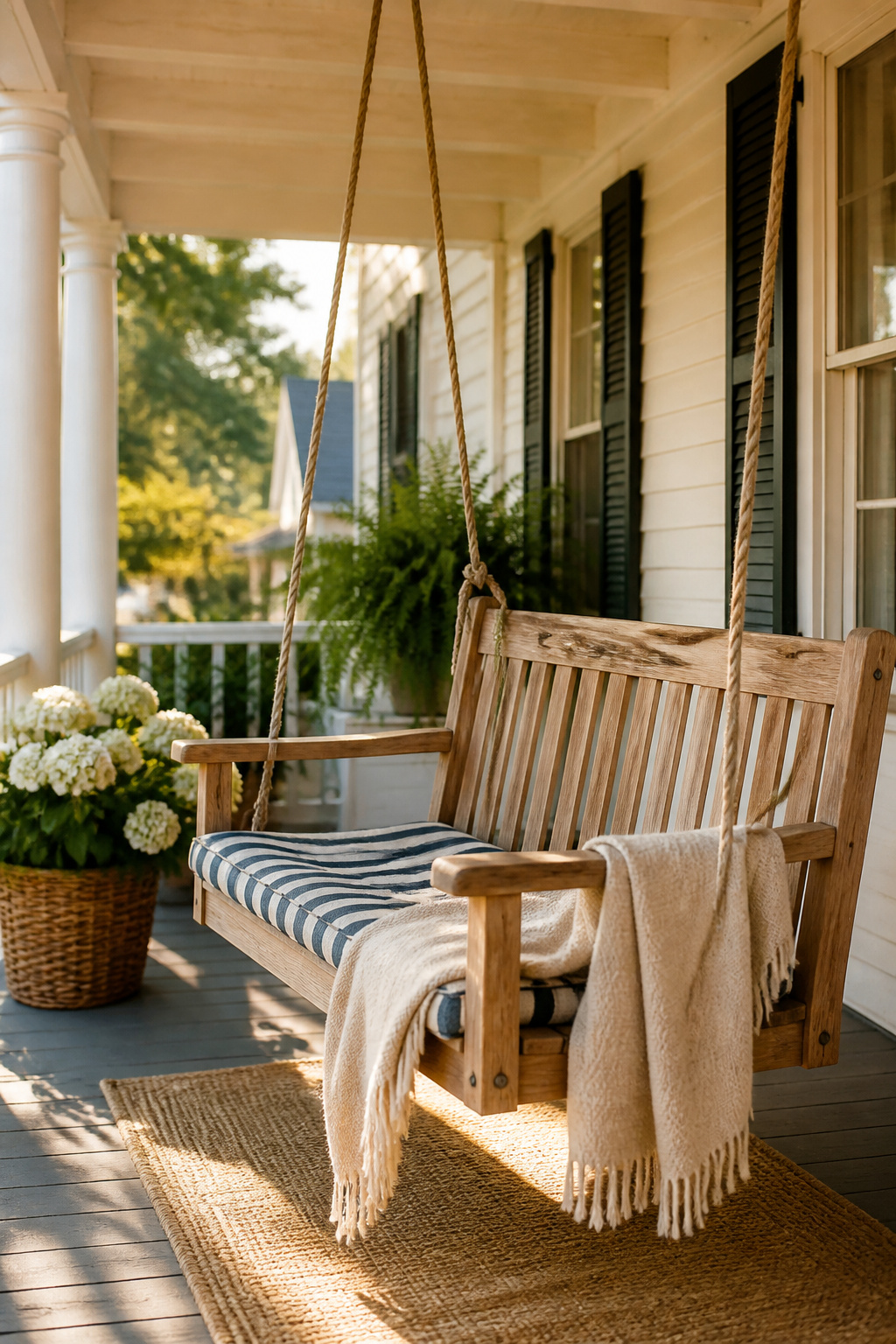
Standard two-person swings run 48-52 inches wide; loveseat swings extend to 60-66 inches and accommodate two adults comfortably. Before choosing between a swing and a rocking chair, measure your porch depth honestly. Both need approximately three feet of clearance in front and behind to move safely — on a porch shallower than six feet, neither will function well without blocking the walkway. A stationary bench with a deep cushion is the better solution for tight porches. For those with adequate depth, a swing has the edge for atmosphere; a rocker has the edge for ease of access and a narrower footprint. Similarly, back porch decorating ideas offer useful context for how seating choices scale across different outdoor settings.
The ceiling must have at least one 2×8 joist, two 2×6 joists, or three 2×4 joists rated to support 500 pounds minimum. Use a stud finder to locate joists, then install 6-inch galvanized or stainless steel eye bolts — rated at 250 lbs each — threaded through the joist with nuts. Hang the seat so the cushion surface sits 17-19 inches from the porch floor. If joists are undersized, ‘sistering’ (bolting a new joist alongside the existing one) distributes the load — a straightforward fix that most experienced DIYers can manage in an afternoon. Never attach swing hardware to the porch ceiling’s decorative fascia board; it cannot bear weight regardless of how solid it looks.
Hard wood or metal furniture without cushions communicates ‘sit briefly, then move on.’ Cushions and throw pillows communicate the opposite: ‘stay as long as you like.’ This is not a subtle distinction. The presence of comfortable outdoor textiles is one of the clearest signals front porch decor can send about how the space is meant to be used.
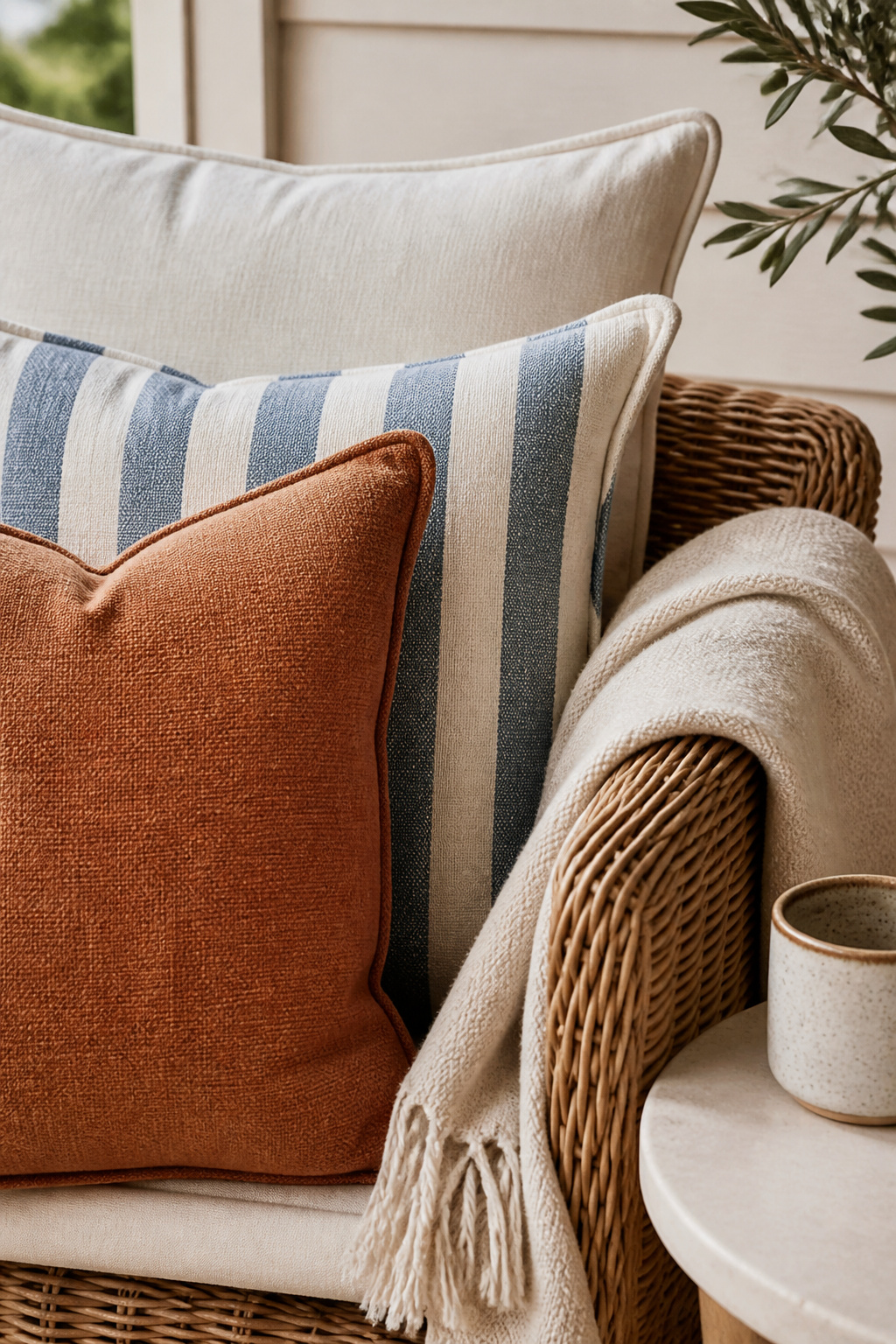
Sunbrella is the fabric standard for a reason. Its UV-stable pigments are embedded in the fibre before weaving — not printed on top — which is why Sunbrella holds a genuine 5-year limited warranty against colour fading. It is also mold and mildew resistant, and tolerates bleach cleaning (a diluted quarter-cup bleach per gallon of water) without damage. Most outdoor fabrics cannot survive bleach; Sunbrella’s structural integrity doesn’t depend on a surface treatment that bleach would strip. For budget-conscious options, olefin-based fabrics are adequate on covered porches and work well for seasonal replacement. The patio decorating ideas on our sister pages illustrate how textiles unify an outdoor space in ways that single furniture pieces cannot.
Pattern mixing for outdoor cushions follows the same logic as interior design. The Scandinavian approach: choose one solid in your dominant colour, one subtle stripe or simple geometric in a tonal variation, and one textured solid in a neutral — linen-tone or warm white. All three should share at least one common colour. Vary scale: one large-pattern cushion as the anchor, one medium stripe, one small textured solid. The rule of odd numbers applies here too — three or five pillows reads as styled; two reads as a matching retail pair; four reads as symmetry. For a single armchair, one well-chosen cushion plus a small throw folded across the arm is the hygge ideal: effortless comfort, nothing superfluous.
A trellis changes the geometry of the porch. It lifts the garden from ankle height to eight feet, creates a sense of enclosure and soft privacy, and introduces living architecture — the kind of structure that looks more beautiful in its third year than its first. It is also one of the most cost-effective investments for front porch decorating: a quality freestanding trellis and a well-chosen climber will outperform almost any piece of furniture in long-term visual return.
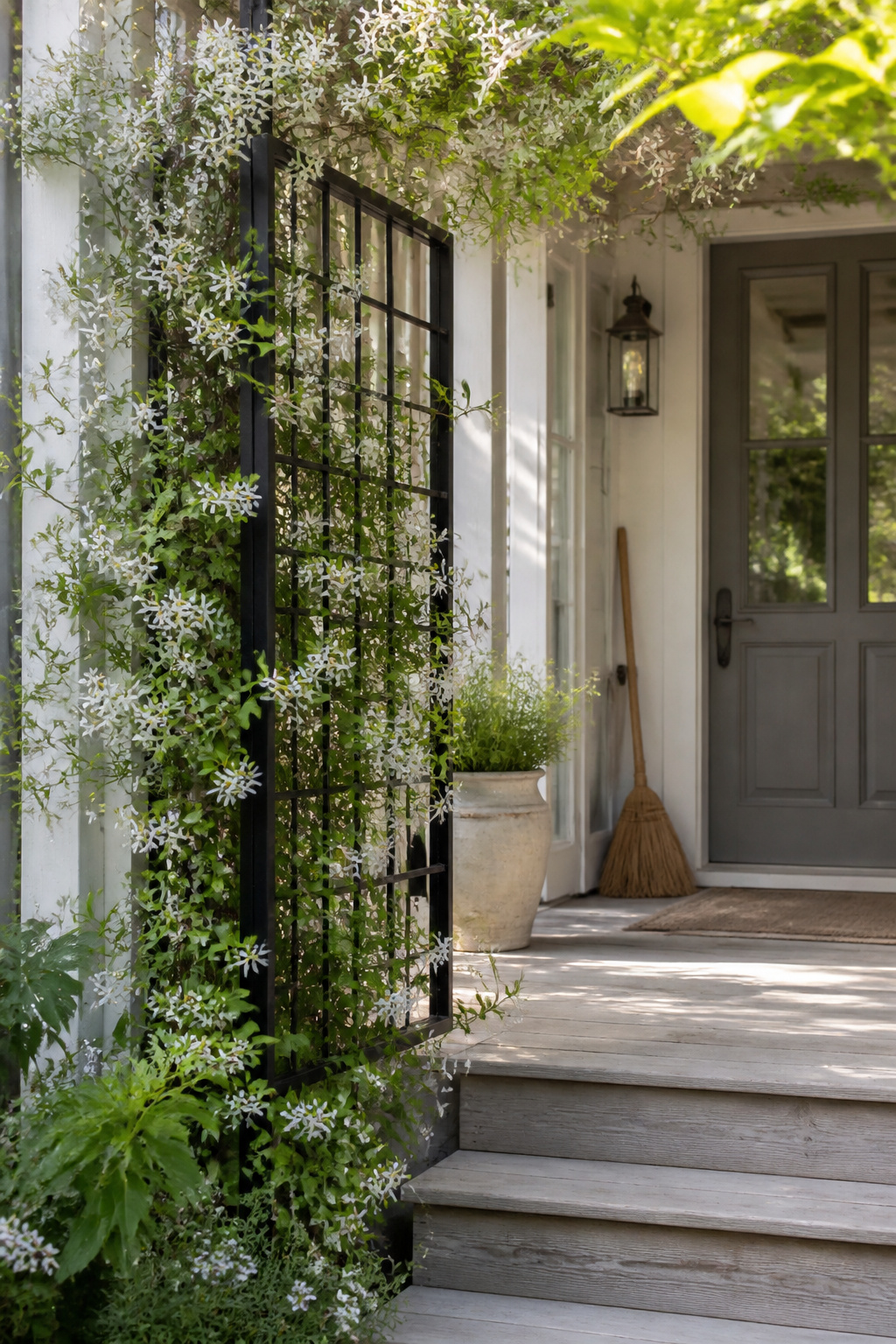
Freestanding trellis designs are the practical choice for anyone wanting to avoid wall damage. A panel or obelisk form in powder-coated steel requires no wall attachment at all — planted in a large container or set in the ground beside the porch, it creates permanent vertical structure with full flexibility to move. This is also the rental-friendly solution and a principle that extends to back porch patio design wherever screening without structural commitment is needed.
Star jasmine (Trachelospermum jasminoides) is the closest thing to a guaranteed success: evergreen, fragrant white flowers in early summer, reaches 10-15 feet on a support structure, and attaches by self-twining rather than clinging — which means it works with any trellis without gripping the wall beneath. Clematis is the choice for dramatic seasonal colour — it grows 6-10 feet per season, comes in cultivars from white through deep violet, and its bare winter silhouette on a trellis has a quiet sculptural quality. For a classic cottage look, climbing roses (‘New Dawn’ and ‘Climbing Iceberg’ are reliably disease-resistant) establish slowly but are spectacular long-term. Avoid wisteria near any structure regardless of how beautiful it looks in bloom — its woody stems are strong enough to pry apart gutters and soffits as the plant matures.
Hardware is the detail that reveals whether a porch was designed or simply decorated. The front door handle, knocker, mailbox, and house numbers are all seen at close range by everyone who approaches — and mismatched or neglected hardware undermines even the most beautiful planting and furniture. The good news is that updating hardware is quick, affordable, and disproportionately effective for porch design.
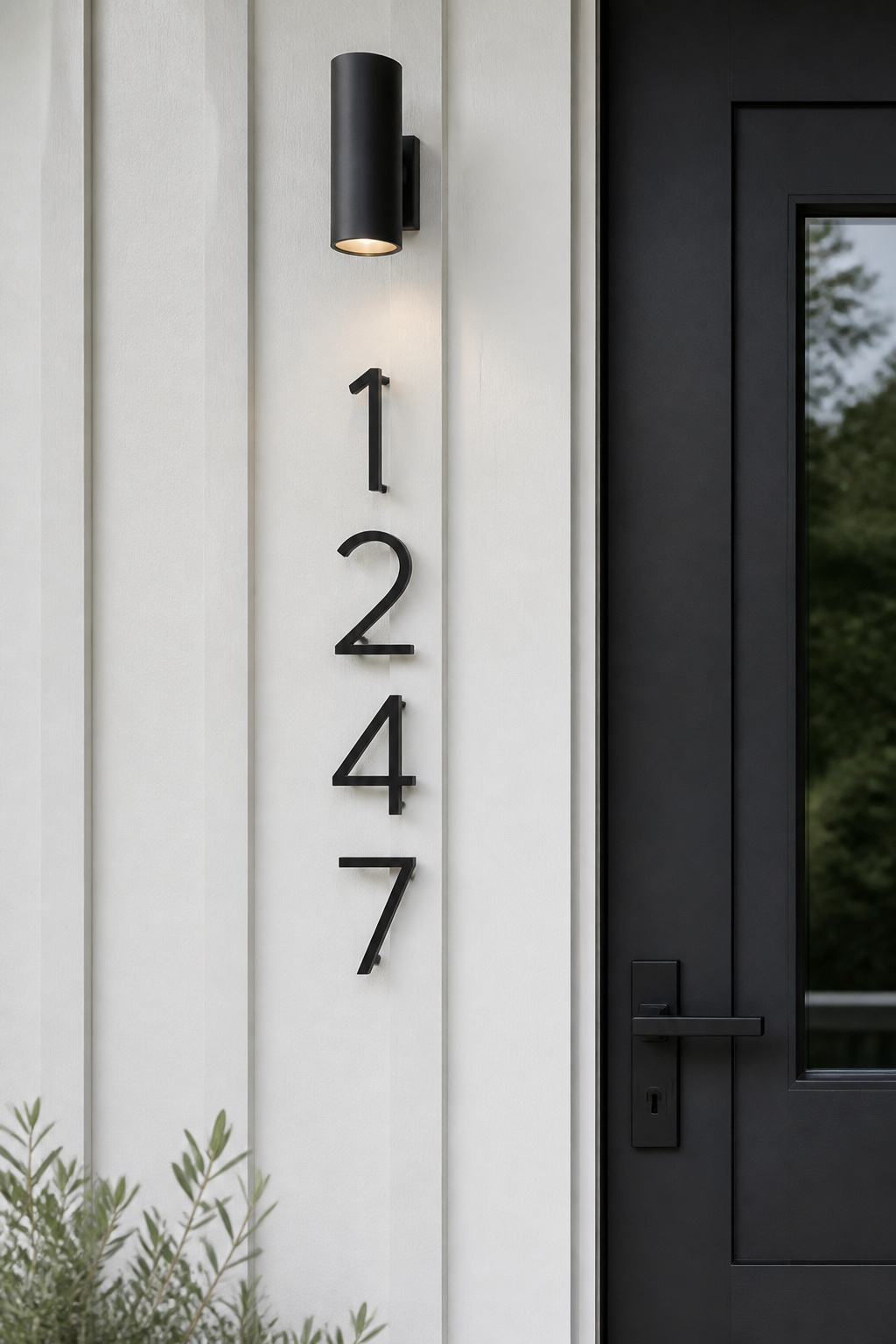
Finish coordination is the single most important decision. Choose one finish and apply it consistently across every metal element visible from the door: handle, deadbolt, knocker or bell, mailbox, and house numbers. For 2026, matte black continues to lead — it works on every architectural style, every door colour, and every home aesthetic. Brushed (satin) brass is the warm-toned alternative, particularly strong with green, navy, or warm-neutral doors and natural wood accents. If two finishes are mixed, the most sophisticated pairing is matte black with brushed brass — a combination that reads as intentional rather than accidental. Graphite and gunmetal finishes are emerging as a more textured, depth-rich alternative to flat matte black.
Scale up on house numbers. A 4-6 inch numeral in a clean sans-serif typeface, mounted with spacers that create a small shadow gap, is both highly readable from the street and genuinely architectural in quality. LED backlit numbers are a growing option that adds a soft glow at night without competing with porch lighting — an elegant solution for entries lacking strong overhead lighting. Position numbers where they are clearly visible from a moving car: legibility from the road is a functional requirement as much as it is a porch decorating consideration.
Of all the elements in this list, wall art on the porch is the most revealing. Plants signal a love of nature; hardware signals attention to craft; but a chosen piece of wall art signals how you think and what you value. It humanises the porch in a way that other elements, however beautiful, do not.
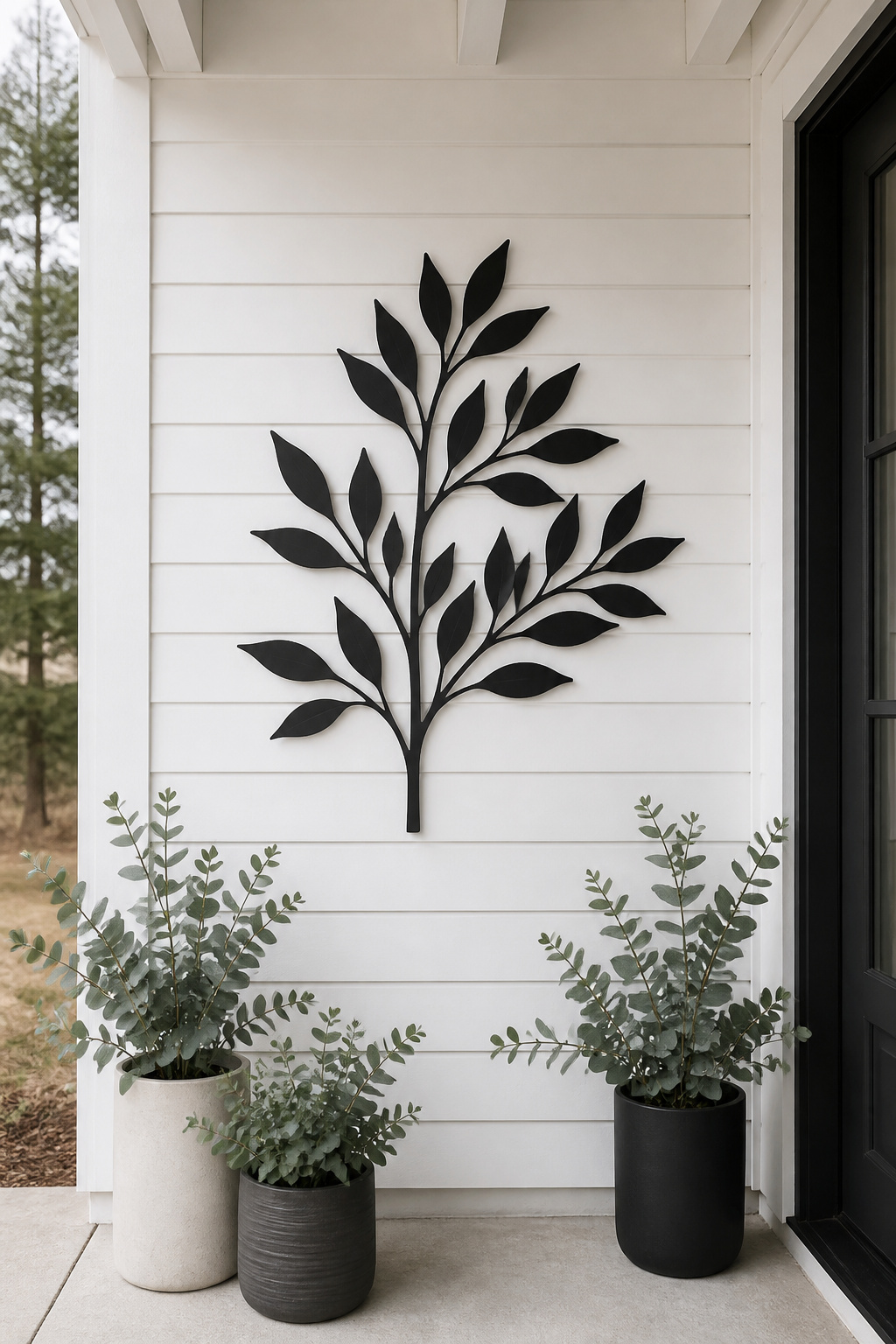
The material requirement for outdoor wall art is structural durability. Powder-coated steel is the reliable choice: the electrostatic application creates a finish harder than paint that bonds molecularly to the metal. Look for pieces with both a zinc primer layer and a powder topcoat — the zinc prevents rust from forming beneath the coating, the powder provides UV and impact resistance on top. For more architectural porches, Corten (weathering steel) develops a self-sealing rust patina that is both beautiful and structurally protective — it looks intentional and ages gracefully. Ceramic wall pieces are beautiful indoors but risk cracking outdoors in freeze-thaw climates; keep them for covered porches in temperate regions only.
Scale is the most common mistake in outdoor wall art selection. A piece that reads as a statement indoors will look small against a full-height porch wall — anything under 24×24 inches is effectively invisible at any useful distance. The minimum for a porch wall is 24×24 inches; pieces at 36 inches or larger make genuine architectural statements. The Scandinavian design maxim applies here exactly: one strong piece rather than an accumulation of smaller ones. A single laser-cut botanical silhouette in matte black, or an abstract geometric form in brushed steel, will outperform a gallery-wall collection of six smaller seasonal signs in both design quality and longevity.
A chair without a surface beside it invites you to sit and nothing else. Add a side table, and the porch becomes a place where you can set a cup of coffee, open a book, and settle in. It sounds like a small distinction; in practice, it is what separates a porch you visit briefly from one you return to every evening. In the context of front porch decor, the side table is the detail that makes seating feel genuinely usable.
The best material for an outdoor side table depends on the porch’s exposure and maintenance tolerance. Concrete-top tables — particularly those with an FSC-certified teak or powder-coated steel base — are extremely stable and will not blow over in wind; seal with a breathable masonry sealer every 12-18 months to prevent staining. Teak side tables offer the same quality-to-maintenance ratio as teak furniture: oil annually for honey tone preservation, or let weather naturally to silver for zero-maintenance beauty. Powder-coated steel is the most versatile and affordable option — clean with gentle soap and a soft sponge; avoid abrasives that scratch the coating. For narrow porches, an 18-22 inch round table fits beside a chair without blocking the walkway.
The tray is the design tool that makes a side table look considered rather than cluttered. Place three to five objects inside it — a small battery candle, a compact succulent in a ceramic pot, a set of stone coasters — and the collection reads as a deliberate composition. Without the tray, the same objects read as scattered. The Nordic edit is simple and effective: one tall object (a small lantern or pillar candle), one living element (a sedum, an air plant, or a small bowl of smooth river stones), one practical element (coasters, a small cloth). Three objects, clear intention, nothing superfluous. The space between objects is as important as the objects themselves.
Everything on this list can be done individually and still result in a porch that feels assembled rather than designed. The difference between those two outcomes is almost always a colour palette — or the absence of one. When each element is chosen in isolation, the porch becomes a collection of individually nice things that do not speak to each other. When they share a colour relationship, even imperfectly, the whole is significantly greater than the sum of its parts.
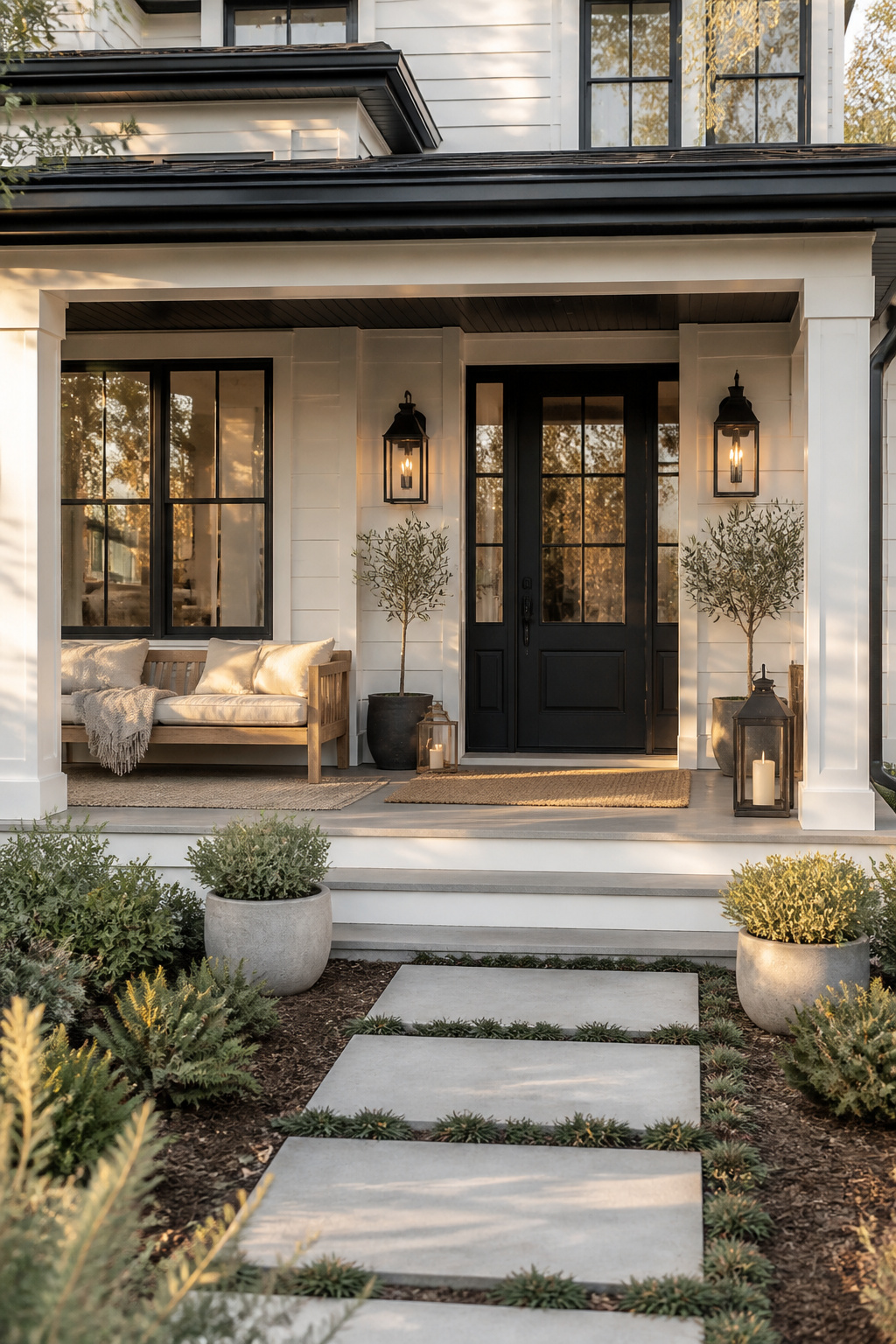
The 60-30-10 rule translates cleanly to exterior spaces. The dominant 60% is the siding or wall colour — typically fixed, and the reality all other choices must work with. The secondary 30% covers trim, railings, porch floor, and large furniture pieces — usually a lighter or darker version of the dominant colour, or a neutral. The accent 10% is where personality lives: the door colour, cushion tones, pot colours, and wall art. This accent element should be present consistently — not scattered across five different colours, but expressed in one or two tones that appear repeatedly in small doses throughout the front porch decor scheme.
Four palette formulas cover most home styles. The Nordic neutral: white or greige siding, dark charcoal or black trim, natural wood and muted sage green accents — clean, contemporary, and suited to farmhouse and modern architecture equally. Coastal: pale grey or white siding, navy or denim accents, natural rattan and rope textures with soft terracotta touches. Warm cottage: cream or warm beige siding, a sage green or dusty blue door, terracotta pots and warm honey-toned wood. Bold contemporary: dark slate or deep navy siding, crisp white trim, a single accent colour (rust, olive, or brass) expressed through hardware and accessories. In each case, the key porch design principle holds: the palette should feel like an extension of the home’s existing exterior character, not a correction of it. You can see how similar thinking applies to adjacent outdoor areas in these decking decor ideas for outdoor transformation.
The hygge principle of starting with what brings genuine comfort applies directly here: choose one anchor piece from this list — the element that will give you the most satisfaction to look at each morning — and make every other decision in relation to it. If the anchor is a teak bench, natural wood, linen, and muted greens will feel right everywhere. If it’s a pair of black lanterns flanking a bold-coloured door, matte black hardware and coordinating cushions follow naturally. The anchor sets the material language; everything else is a response to it.
Budget intelligently. Invest 60-70% of your porch budget in the one or two elements that are most visible, most durable, and most foundational — typically the furniture or the door colour. The rest can go toward renewable elements: plants, cushions, seasonal accents that change as your taste evolves or the seasons shift. This is the Scandinavian logic of quality over quantity — one excellent piece that ages well rather than six adequate pieces that don’t.
For seasonal maintenance, think in two rhythms: a larger refresh in spring and autumn when plants and textiles swap, and small adjustments monthly as the garden evolves and the light changes. Invest in quality cushion inserts and keep two or three sets of removable covers in different seasonal tones — this costs far less than buying full cushion sets each year and allows the front porch decor to shift from warm summer brights to autumnal neutrals without a full re-decoration. Year-round anchors — furniture, lanterns, hardware, rugs — stay put; seasonal elements rotate. The result is a porch that remains alive, considered, and genuinely welcoming in every month of the year.