Physical Address
304 North Cardinal St.
Dorchester Center, MA 02124
Physical Address
304 North Cardinal St.
Dorchester Center, MA 02124
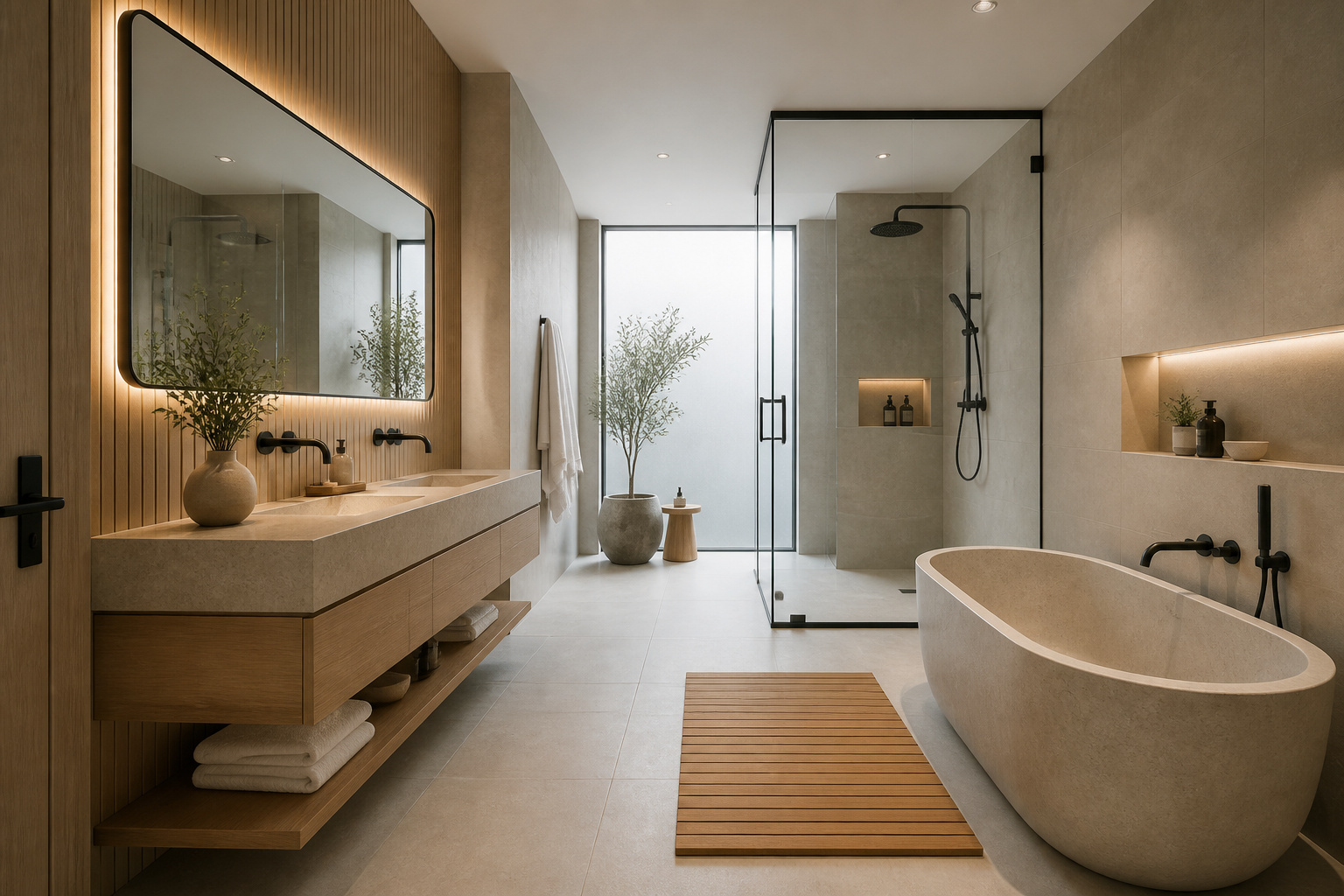
Discover 16 modern bathroom decor ideas — floating vanities, frameless glass, zellige tile, and smart upgrades that genuinely transform any bathroom.
There is a version of every bathroom that feels designed, and a version that feels assembled. The difference isn’t always cost — I’ve seen $50,000 renovations that still feel like a hotel corridor, and $8,000 bathrooms that feel genuinely considered. The gap usually comes down to decisions: which surfaces get the space to breathe, which materials earn their place, and which functional elements do double duty as design elements.
The best modern bathroom decor borrows from the same logic that drives Scandinavian interior design: restraint as an active choice, quality over quantity, and material honesty. You work with what the space offers rather than papering over its limitations with decoration. After eleven years helping homeowners navigate these decisions, the sixteen ideas below represent the upgrades that actually deliver — not just on the day the renovation finishes, but five years in, when everything else has dated and these choices still look right.
A wall-mounted vanity does something a floor-standing unit cannot: it reveals the floor beneath. That 10 inches of unobstructed floor plane makes a bathroom look larger without changing a single tile, and it makes mopping a two-second task rather than an obstacle course around a pedestal.
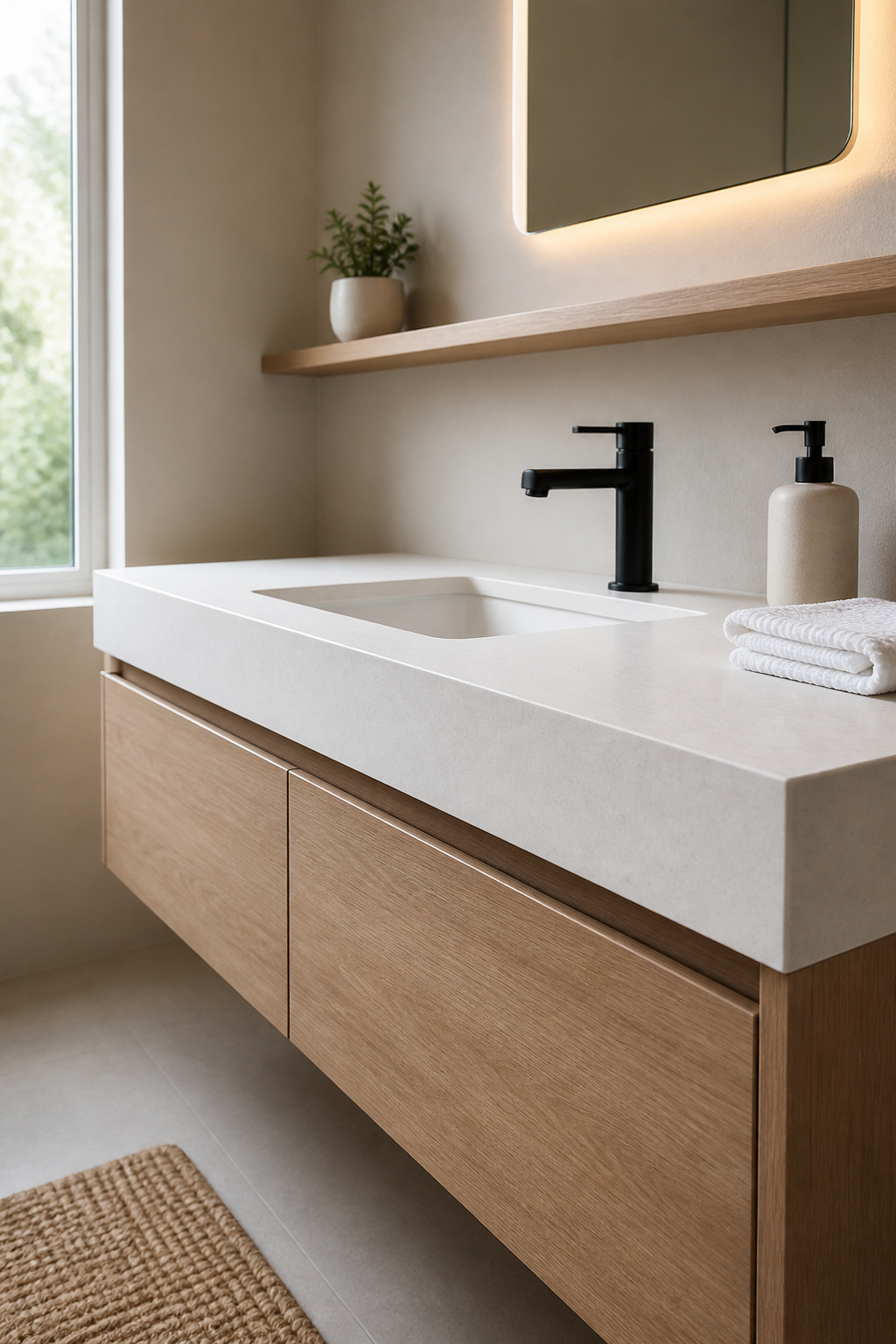
The installation is more involved than dropping a cabinet into place. Floating vanities must attach to wall studs or solid timber blocking — never to drywall anchors alone — because a standard single vanity can hold up to 220 lbs once loaded with a stone countertop, basin, and everything under the sink. The rough-in phase is the time to get the blocking in; retrofitting it after the tiles are done means taking the wall apart.
On countertop materials: quartz is the practical choice for most bathrooms. It’s non-porous, never needs sealing, and resists both staining from skincare products and etching from toothpaste — the acidic damage that slowly destroys unsealed marble surfaces. Quartz runs $50–$200 per square foot depending on thickness and finish; marble is $80–$250 and requires annual sealing. Concrete ($75–$200/sq ft) is worth considering if you want the industrial warmth of a bespoke poured surface.
Standard vanity depth is 21 inches; compact floating models for tight bathrooms go as shallow as 14 inches while remaining functional. Mounting height is typically 34–36 inches from finished floor to countertop top, though floating units offer the flexibility to set any custom height. For those who want more guidance on choosing a bathroom vanity for your space, the options across width, depth, and finish are worth thinking through carefully before committing.
The framed shower screen — that aluminium border around every edge — was never a design choice. It was a practical solution to the problem of holding glass in place cheaply. Frameless glass enclosures solve the same problem with better results: the glass is held by minimal hardware at the hinge and wall clip points, and nothing interrupts the tile work behind it.
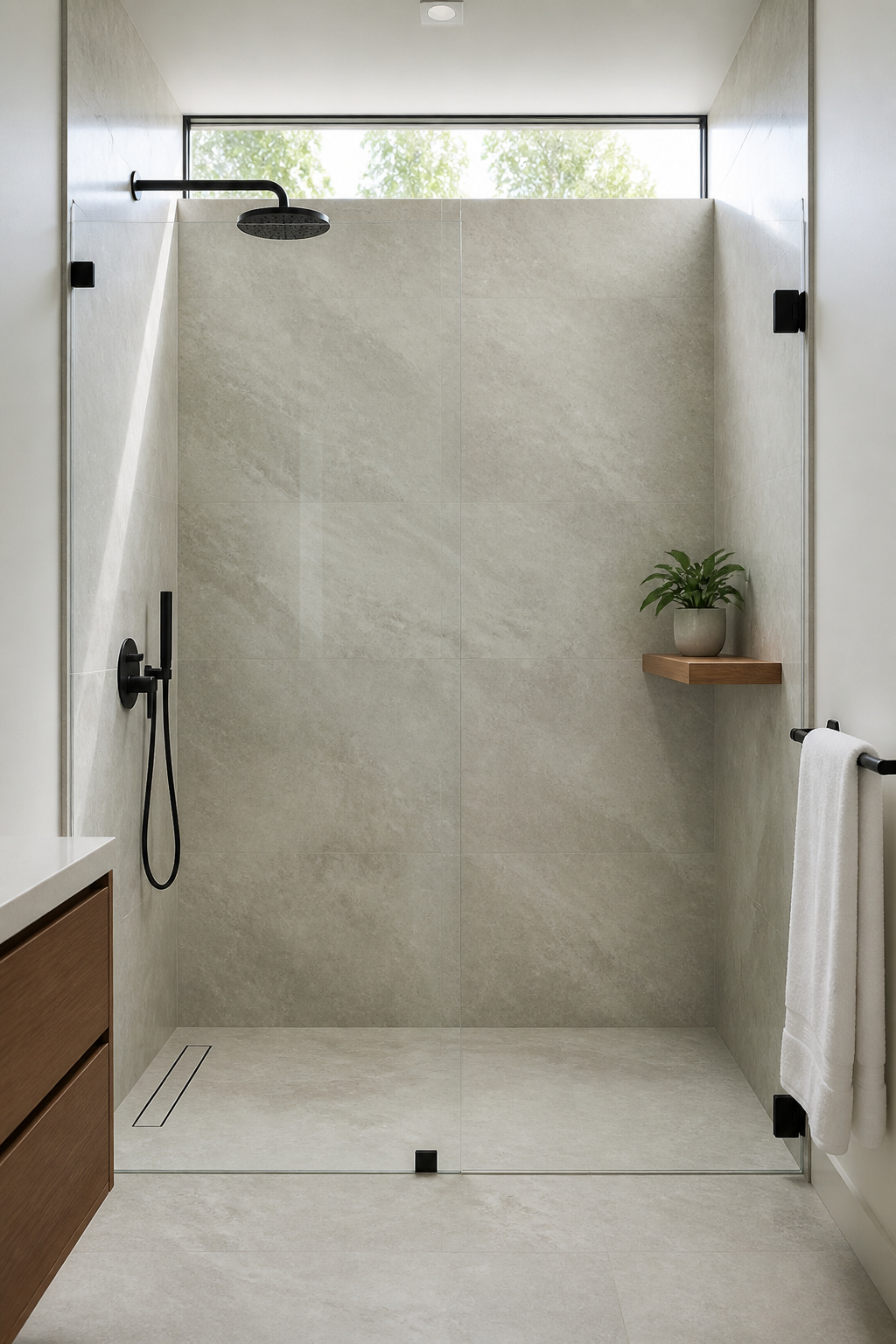
There’s a practical side effect too. The crevices between frame and glass in a framed screen are the most reliable mould habitat in any bathroom — impossible to clean properly, always slightly damp. Frameless enclosures eliminate those gaps entirely. The glass itself is the only surface to clean.
The key specification decision is glass thickness. For a standard shower under 28 square feet, 8mm tempered glass is adequate and costs roughly 20–30% less than 10mm. For larger enclosures, steam showers, or any door wider than 36 inches, 10mm is the right choice — the extra rigidity eliminates the flex and door-rattle that comes with heavier usage. Budget $400–$800 more for a fully installed 10mm frameless setup compared to an equivalent 8mm system.
The simplest configuration for a modern bathroom is a fixed panel walk-in design with no door at all — a low glass panel on one side and an open entry point. It requires more floor area to prevent water spray reaching the rest of the bathroom, but when space allows, it’s the most effortless option. A hinged door in matching matte black hardware is the alternative that works in tighter footprints. For broader inspiration, there are plenty of bathroom shower design ideas that show what’s possible across different bathroom sizes.
A freestanding tub is the one element in a bathroom renovation that functions like a piece of furniture. It sits in the room rather than against a wall, it commands attention, and it shifts the bathroom from a service space to a room worth spending time in.
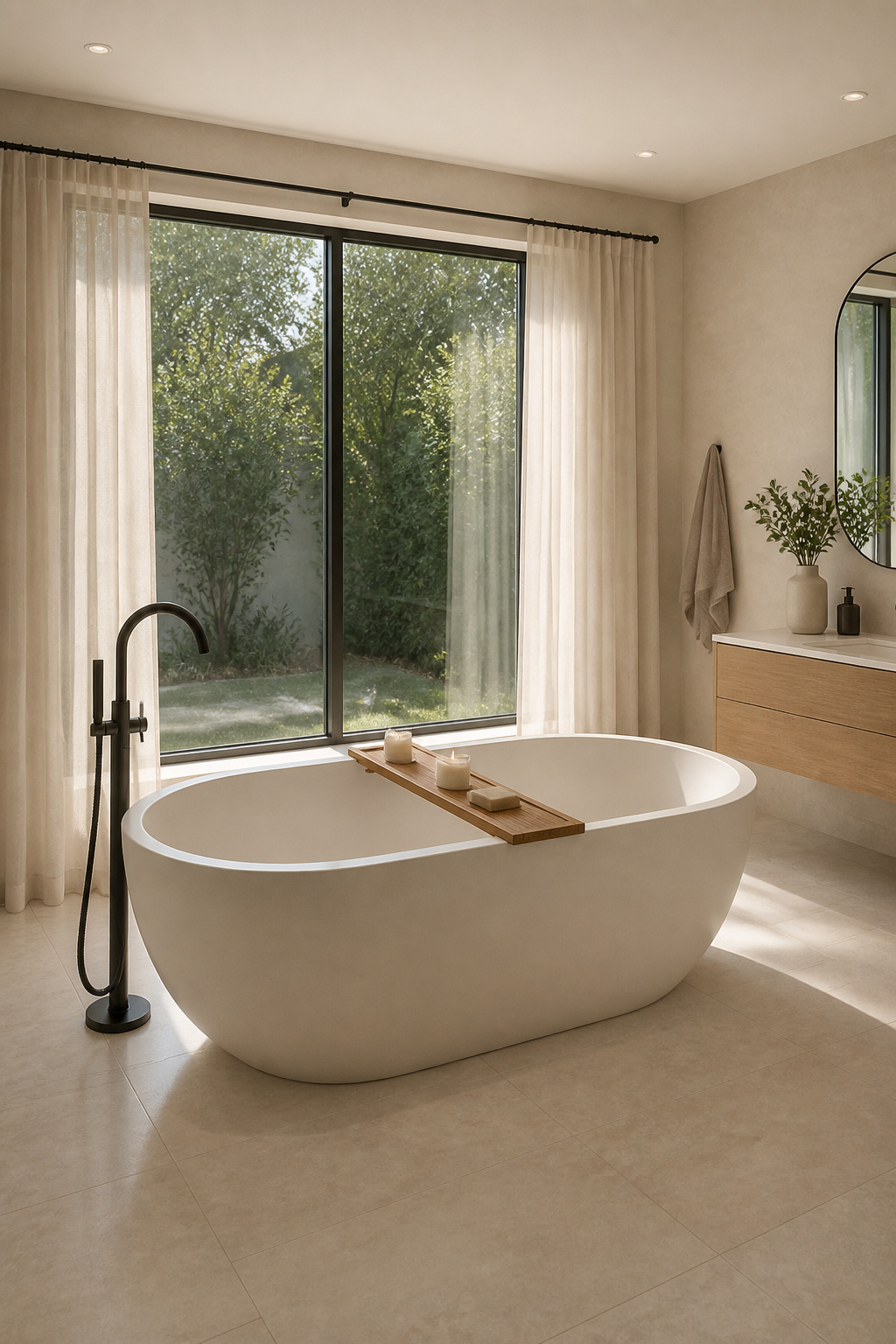
This only works when there’s enough room around the tub to justify the claim. Allow 24–30 inches of clear space on the sides and foot of the tub; anything less and the tub reads as cramped rather than considered. Most primary suite bathrooms with 8 feet or more of width can accommodate this — smaller bathrooms usually can’t, and forcing a freestanding tub into a tight space is one of the more common renovation regrets I see.
Material selection determines both the feel and the lifetime of the tub. Acrylic is the lightest option (50–100 lbs) and the most affordable ($400–$2,000), but it scratches and can yellow over a 15–20 year lifespan. Cast iron at the other end of the spectrum lasts 50+ years, retains heat brilliantly, and costs $1,500–$5,000+; its weight (300–600 lbs) requires a structural floor check before ordering.
Stone resin — a composite of crushed stone and binders — sits between them: 250–400 lbs, a 25+ year lifespan, better scratch resistance than acrylic, and a matte surface finish that works naturally in Scandinavian-influenced modern bathrooms. Stone resin in white or warm greige is my recommendation for a contemporary renovation.
The plumbing detail matters too: a freestanding tub needs a floor-mounted filler, which means planning the water supply lines to come up through the floor before the tiles go in. More ideas on configuration and style are worth exploring in any overview of bathtub ideas for your renovation. Leave 6–12 inches between the tub and any adjacent wall for cleaning access.
The visual logic of large-format floor tiles is straightforward: fewer grout lines mean fewer visual interruptions across the floor plane. A 300x300mm tile produces three to four times more grout joints per square metre than a 600x600mm tile. Each of those joints is a line the eye tracks across the floor. Fewer lines, more material — the room reads as calmer and larger.
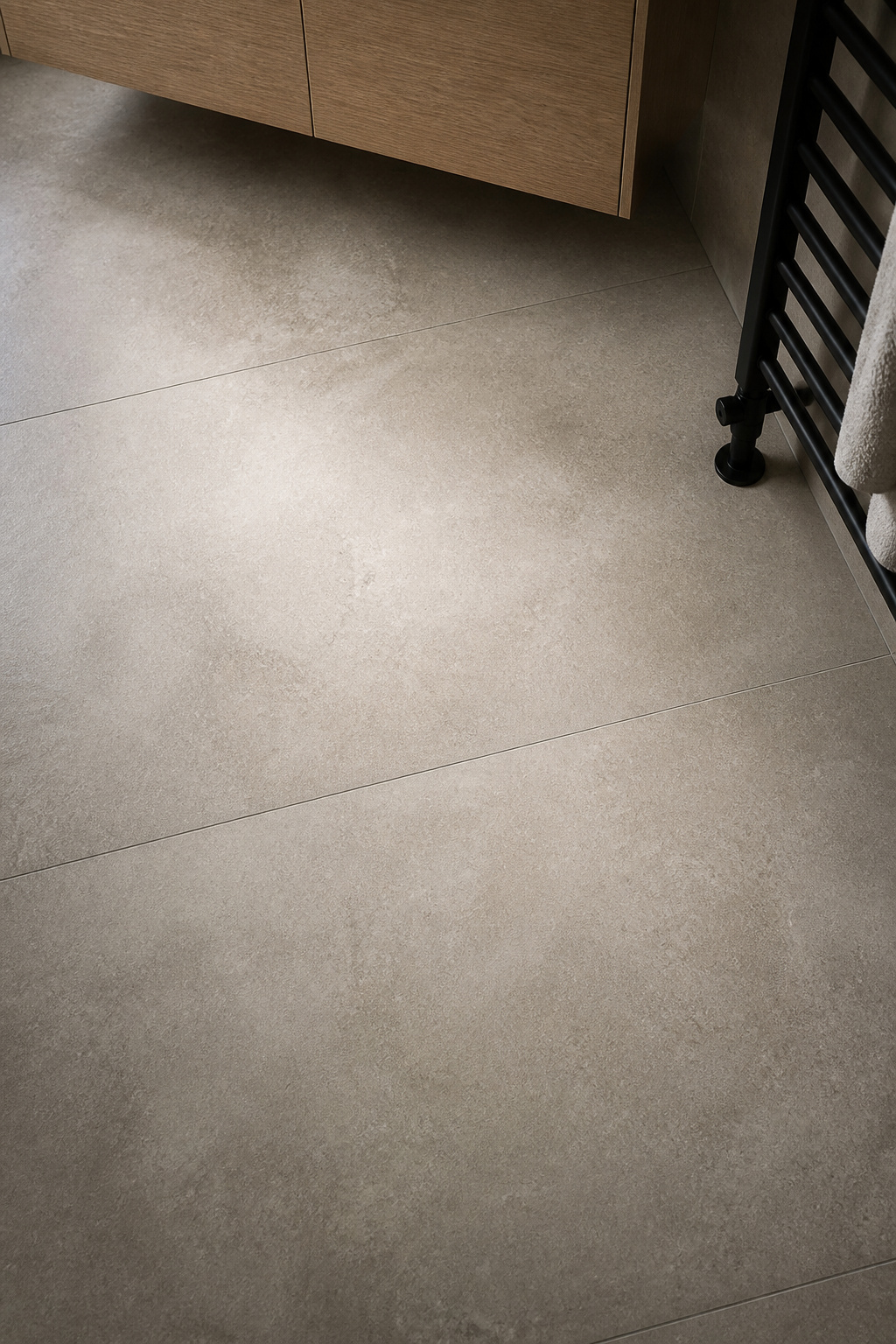
For a modern bathroom floor, 600x600mm is the practical starting point for most bathrooms. It works without feeling disproportionate in rooms down to about 4 square metres. At 1200x600mm — the next step up — the floor begins to read almost like a continuous surface, particularly in the concrete-effect or stone-effect finishes that are doing a lot of work in current modern bathroom renovations. The 800x800mm format is growing in use for primary suites where the extra scale genuinely registers.
Rectified tiles are important here. A rectified tile has mechanically cut edges — all four sides perfectly straight — which allows 3mm grout joints. That near-invisible grout line is what makes a large-format floor appear seamless. Non-rectified tiles have slight dimensional tolerances that require wider joints (5–8mm) to accommodate, and those wider joints visually interrupt the surface in a way that partially defeats the purpose of a large format.
Installation has its own requirements. Large tiles need a tile levelling system — wedge-type or screw-type clip systems that sit between adjacent tiles and are set with a pliers-like tool before the adhesive cures. Without levelling, the slight variation in subfloor flatness telegraphs through as lippage: one tile edge higher than its neighbour, creating a trip hazard and an obvious installation flaw. Full-bed adhesive coverage (using a notched trowel rather than spot bonding) is non-negotiable. For more context on what bathroom tile ideas that create a seamless look actually require in execution, it’s worth reading through the technical requirements before choosing your format.
Fluted wall panels — vertical grooves cut or moulded into a flat panel — add tactile depth and a shifting shadow effect without introducing any colour. The wall becomes subtly animated as the light changes throughout the day, catching the recesses differently at morning and evening. This is the kind of surface interest that reads as calm rather than busy, which is exactly what makes it a natural fit for modern bathroom decor that draws on Scandinavian principles.
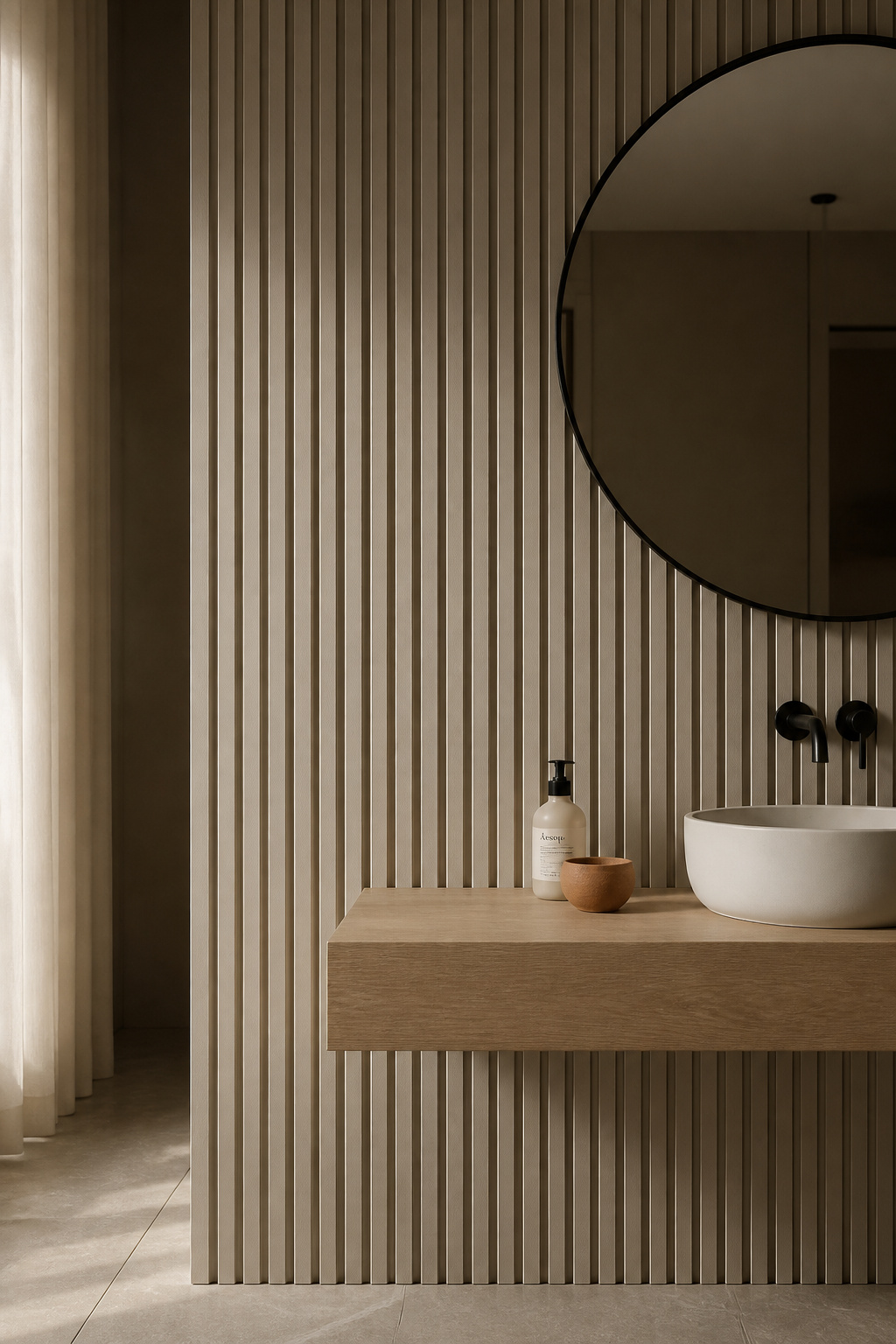
The key material decision is moisture resistance. Standard MDF has no place in a bathroom — it swells and delaminates under consistent humidity. Moisture-resistant MDF (Finsa Hidrofugo, or equivalent green-core MDF) with a PVC film backing is the appropriate spec for painted bathroom panels. These install via construction adhesive and finishing nails, can be cut with a standard saw, and can be painted to any colour once primed. Common panel widths run 100–200mm with groove depths of 6–12mm.
For a higher-specification version, oak or walnut veneer panels over a moisture-resistant MDF core work well in lower-humidity zones — behind the vanity rather than directly behind a bath or shower. The natural grain variation adds warmth that painted panels can’t match. Real timber veneer panels cost roughly 2–3x what painted MDF panels do.
Placement makes the difference between a thoughtful accent and a wallpaper substitute. Behind the vanity is the most effective position: the fluted wall frames the mirror and basin as a composition, and it’s the first thing visible upon entering. Behind the toilet works as a lower-cost alternative. Keep the colour tonal rather than contrasting — the panels painted the same shade as adjacent walls or one tone darker create depth rather than a statement panel, which tends to date faster.
In a bathroom with restrained surfaces — plain tile, white walls, a simple vanity — the hardware is where the modern bathroom decor detail lives. Taps, towel rails, toilet roll holders, cabinet handles, shower head, robe hooks: in most bathrooms these are treated as afterthoughts, sourced from whatever was at the plumbing merchant on the day. In a considered modern bathroom, they’re a coordinated system.
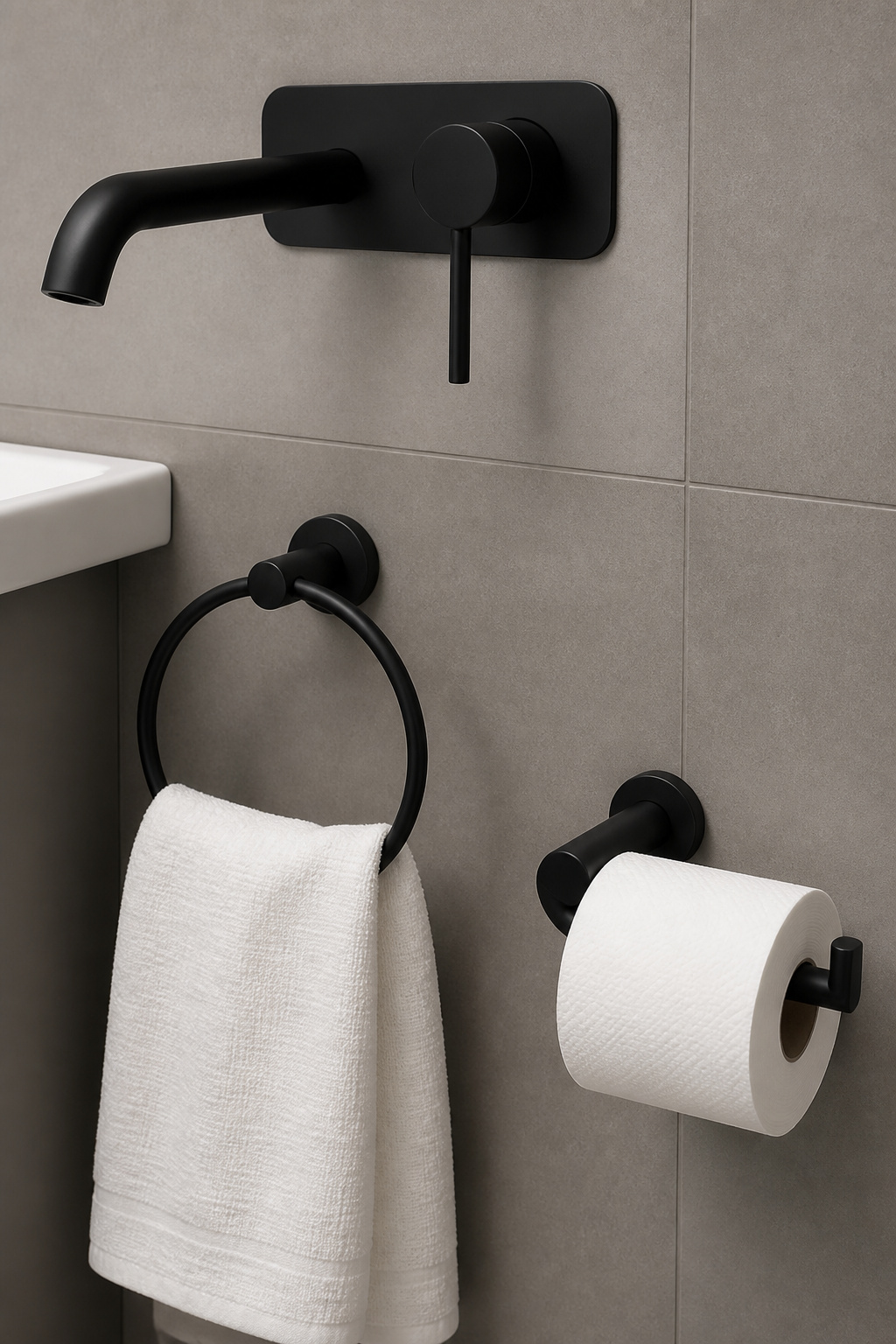
Matte black has become the dominant modern hardware finish for practical reasons as well as aesthetic ones. It doesn’t show fingerprints or water spots the way polished chrome does — a meaningful benefit on taps and handles that are touched dozens of times a day. It contrasts cleanly against white, grey, and warm neutral surfaces without the coldness of brushed stainless or the formality of polished chrome. And it creates visual coherence across a room where the finish is the thread connecting an otherwise minimal set of elements.
The durability question comes down to coating method. Powder coating is affordable and can be re-applied if damaged, but may fade over 5–10 years of exposure to cleaning products in a bathroom. PVD (Physical Vapour Deposition) coating is applied at a molecular level — 0.5–5 microns thick, four times harder than chrome, and resistant to fading and corrosion. If a piece of hardware is labelled matte black without specifying PVD, it is almost certainly powder-coated. For long-life bathroom hardware, PVD is worth the premium.
The one caution with sourcing matte black hardware across multiple brands: the colour isn’t standardised. One manufacturer’s matte black has warm brown undertones; another’s runs cool and blue-black. Ordering all hardware from a single manufacturer, or verifying finish samples side by side before purchasing, is worth the extra step.
A single overhead ceiling light in a bathroom — which describes most bathrooms — does two things simultaneously: it illuminates the room and creates unflattering downward shadows across the face. Under the jaw, under the nose, under the eye sockets. This is why so many people do their grooming in better light elsewhere.
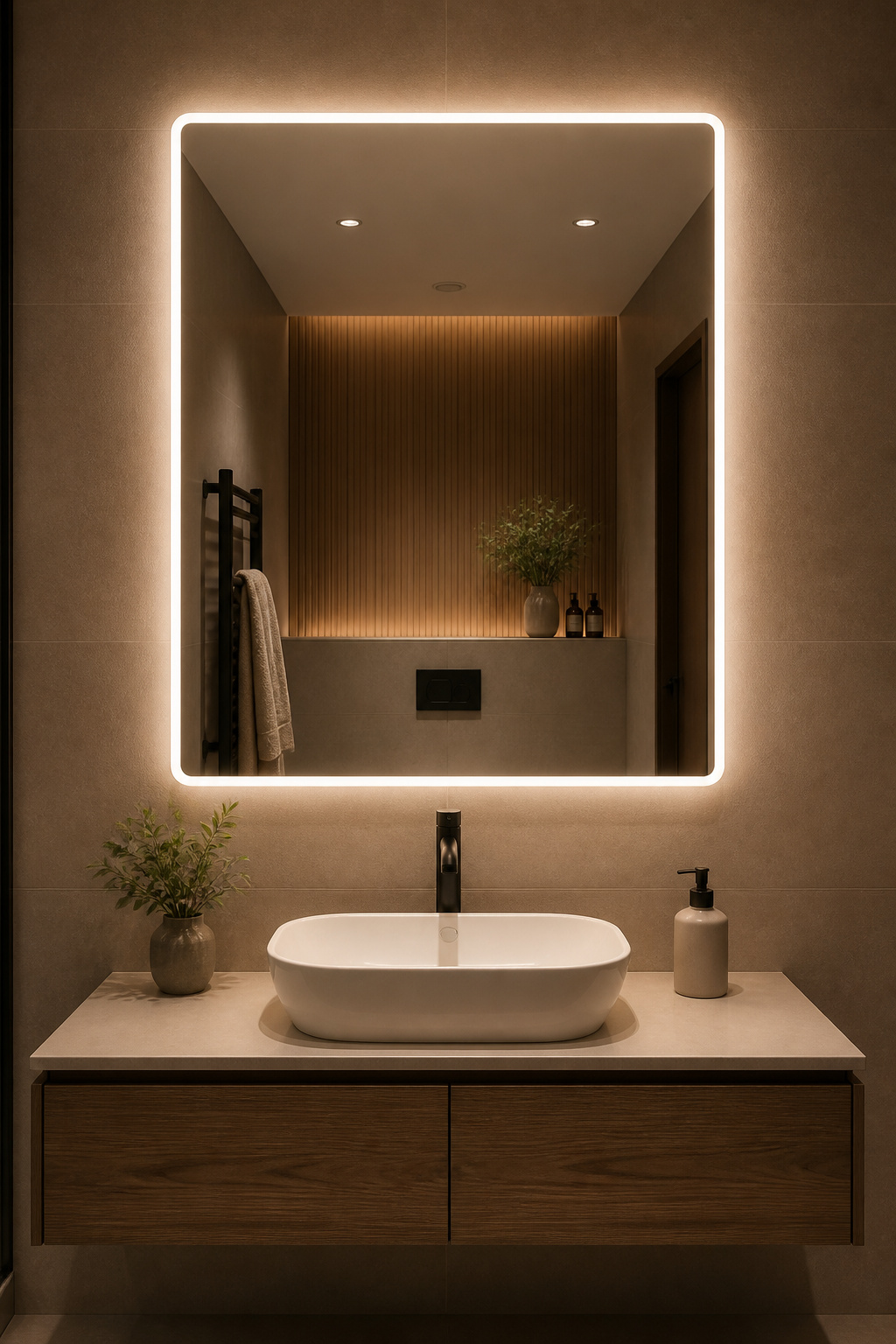
An LED backlit mirror solves this by placing the light source close to and around the mirror, which illuminates the face from multiple angles rather than from a single point above. The backlight itself — LEDs behind the mirror creating a halo effect around the perimeter — also serves as ambient light when the overhead ceiling light is off, giving the bathroom a quality it doesn’t otherwise have.
The two specs that matter most are colour temperature and CRI. Colour temperature at 4000K (neutral white) is the sweet spot for a primary bathroom: accurate enough for colour-sensitive grooming, comfortable enough for everyday use. The warm 3000K setting is flattering but shifts colours slightly yellow, making it harder to judge skin tones accurately. CRI 90+ is the minimum for accurate colour rendering; CRI 95+ is worth having for makeup application. Many quality mirrors now offer three-colour switching between 3000K, 4000K, and 6500K with a touch control.
Dimmability with memory function adds daily convenience — the mirror remembers your preferred brightness from the previous session. The anti-fog demister pad (a heated element behind the mirror face that keeps surface temperature above dew point) is a small feature with an outsized impact on a bathroom that gets regular shower use. For IP rating: any mirror within 60cm of the basin should be IP44 minimum; IP65 if it sits very close to shower spray. There are plenty of bathroom mirror design ideas across different styles and sizes if you’re navigating the choice between round, rectangular, and statement formats.
The argument against open shelving in bathrooms is legitimate: open shelves become cluttered quickly, and clutter in a bathroom is particularly dispiriting. The argument for open shelving is also legitimate: a single well-edited shelf adds warmth and humanity that built-in cabinetry alone cannot provide. The answer to this apparent contradiction is discipline.
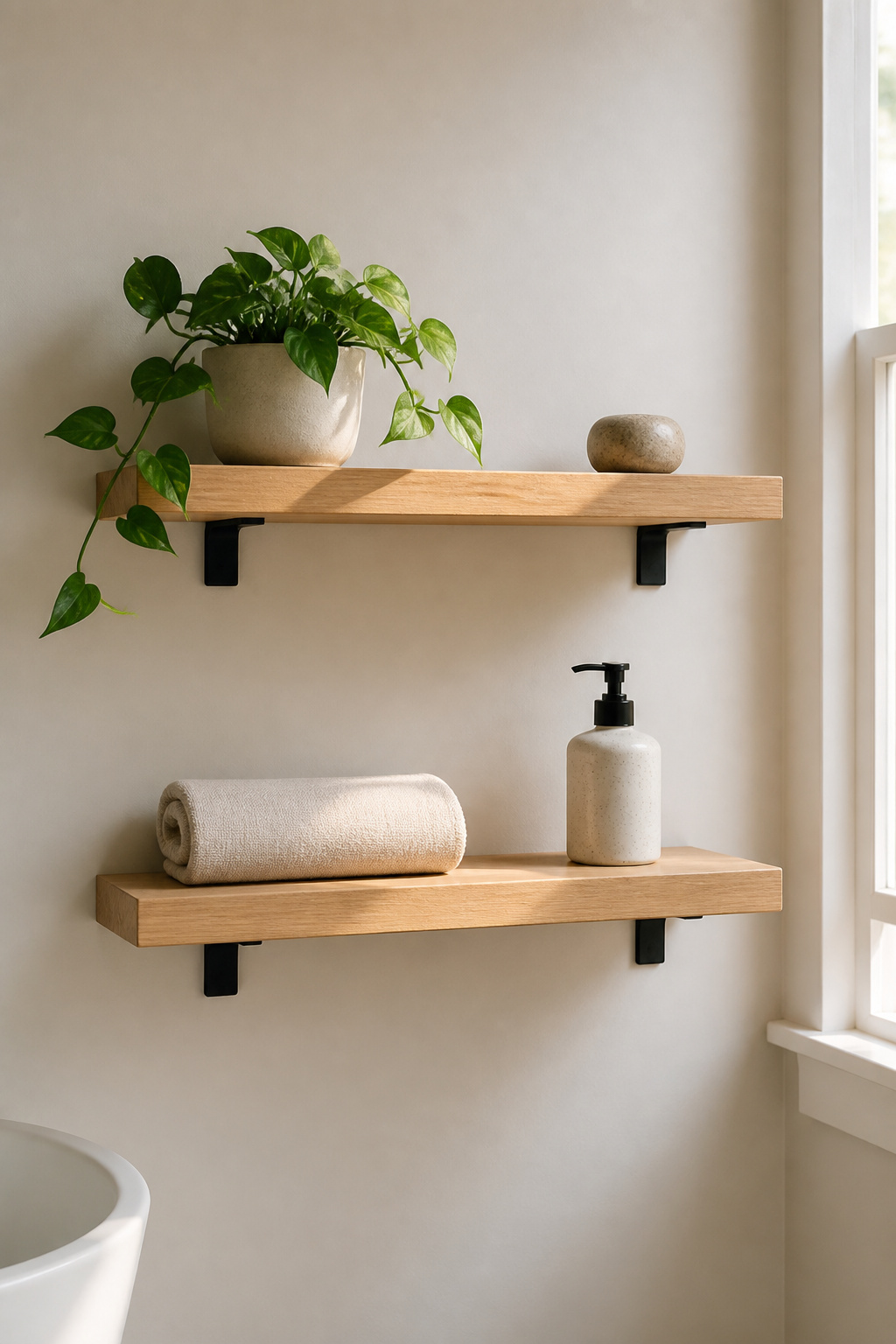
The editorial principle for bathroom open shelves is maximum three items per shelf. One tall element, one mid-height, one low or flat. Within that limit, vary the materials: a ceramic soap pump, a rolled linen towel, a small stone or terracotta vessel. Vary the heights. Leave space between objects rather than packing them to the edge. The gap between items is as important as the items themselves — it communicates that the shelf was arranged intentionally.
What not to display: anything in its original packaging, cleaning products, medicine, anything with a visible brand label, the electric toothbrush charger, cotton buds. These go in the cabinet. What does go on the shelf: a good soap pump in a material that matches the room (ceramic, brushed brass, or matte black depending on the hardware scheme), a plant that genuinely tolerates low light (pothos, ZZ plant, or snake plant), one small decorative object with material interest.
For the shelf itself: sealed white oak or teak sits naturally in a warm modern bathroom and lasts well if all surfaces — including the underside and cut ends — are treated with a marine-grade finish. Powder-coated matte black steel shelves with floating brackets are the alternative that pairs cleanly with matte black hardware. Depths of 15–20cm suit a display shelf; 25–30cm if the shelf needs to hold boxed items. For a broader range of options, there are well-considered bathroom shelf decor ideas that show how to navigate material and styling choices at different price points.
One of the more tactile modern bathroom decor upgrades, the rainfall shower head’s appeal is immediate and intuitive: water falling from directly overhead rather than spraying from the side covers the body more evenly and removes the need to turn and reposition under the spray. It’s not a luxury in any meaningful sense — it’s a more effective way to shower that happens to feel notably better.
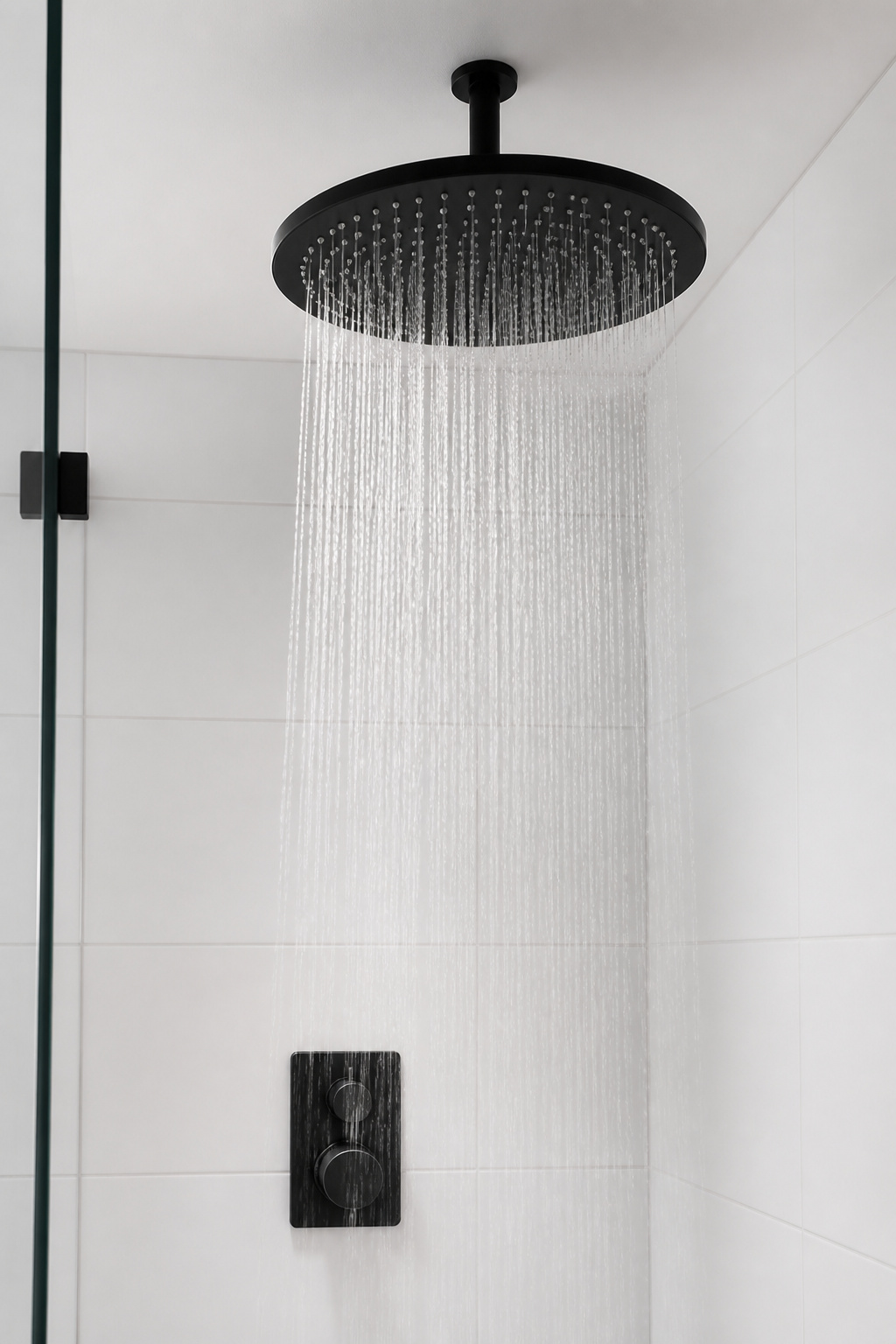
Ceiling-mounted is the cleanest installation approach. The supply pipe runs concealed within the ceiling, and the head drops flush from a ceiling outlet — no visible arm, no visible pipe. The catch is that this needs to be planned and plumbed before the ceiling is closed and the tiles go in; it cannot be easily retrofitted. A wall-mounted extension arm is the alternative: a 300–500mm arm angles the head to a position above the centre of the shower from a standard wall outlet. Less architecturally pure, but installable in an existing shower without demolition.
Head size calibrates the experience. A 200mm head works on standard domestic water pressure (1.0+ bar) and delivers a noticeably better experience than a standard shower head. At 300mm — the most common modern choice — the coverage is convincingly shower-like without demanding a boosted pump. Above 400mm, the head begins to need 2.0 bar or more for consistent coverage across the full face; in low-pressure systems, a large head can drizzle rather than rain. Testing actual outlet pressure before choosing a head size is the step most people skip and later regret.
Pairing the rainfall head with a thermostatic valve with two outlets — one for the overhead head, one for a handheld — gives full flexibility. The handheld is essential for rinsing the enclosure, washing hair without wetting everything else, and any use involving children.
Modern bathroom decor is only as good as its lighting — this is the design element most commonly treated as an afterthought and most consistently responsible for bathrooms that feel disappointing regardless of how good the tiles are. The standard bathroom — one recessed ceiling fixture centred in the room — serves the room’s overall illumination adequately while creating the worst possible conditions for grooming: downward shadows, inaccurate colour rendering, and no facial illumination at all.
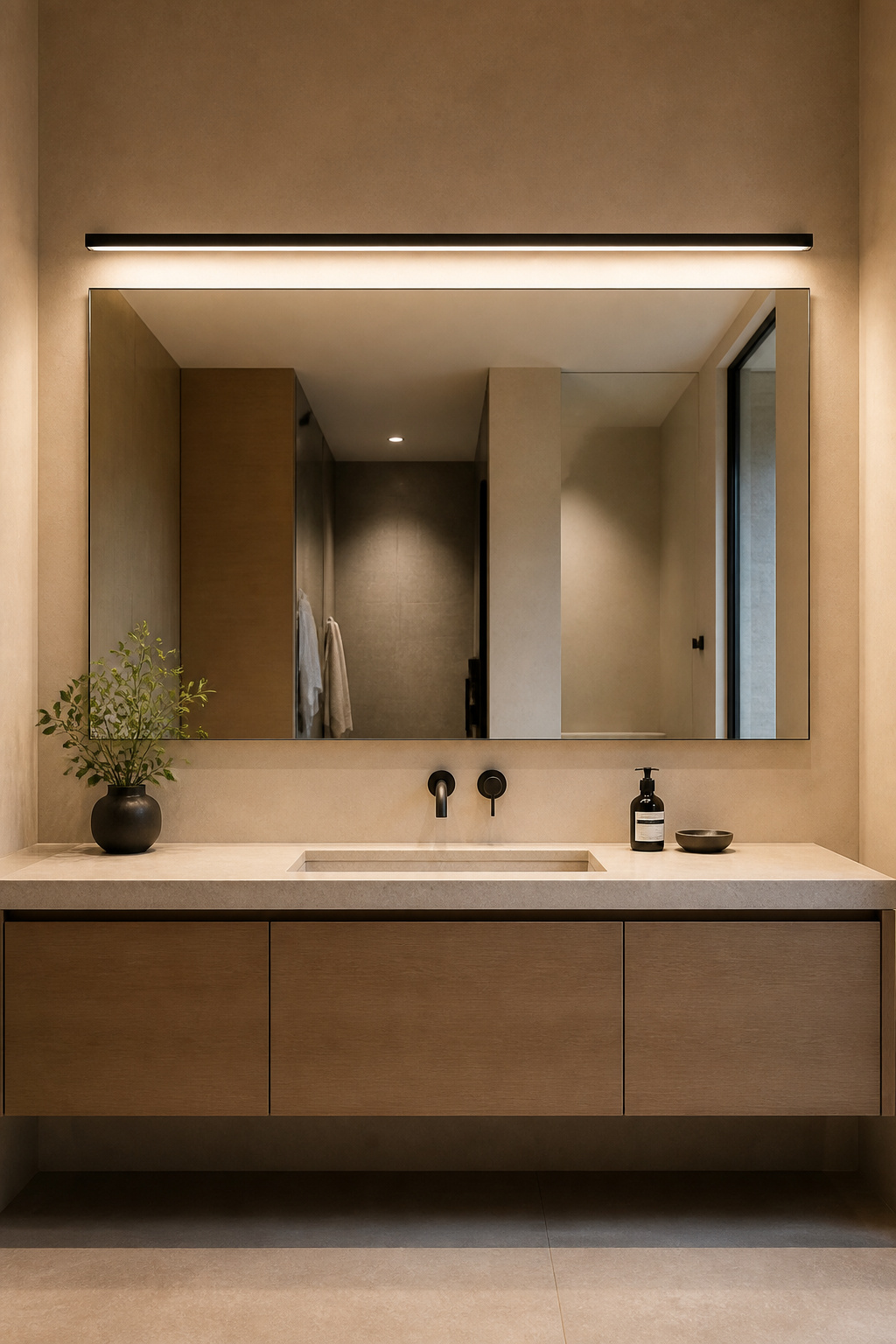
The fix is a linear light source positioned above the mirror, or lights flanking the mirror at face height. Both approaches illuminate the face from a position that eliminates the overhead shadow problem. A horizontal bar light (typically 60–120cm wide) mounted directly above the mirror at or just above head height is the cleanest modern solution — it reads as a deliberate design element as well as solving the functional problem.
IP rating matters for placement. Zone 2 — which covers the 60cm radius around any tap or basin — requires IP44 minimum for any light fitting. If the vanity light sits within 60cm of the basin taps (which a mirror-mounted bar light usually does), IP44 is the floor specification. Zone 1, directly above the bath or shower up to 2.25m from the floor, requires IP65. A ceiling-mounted pendant above the shower must be IP65; a pendant outside the shower zone but in a general bathroom position can be IP44.
Colour temperature at 3500–4000K gives the best balance for a main vanity light: accurate enough for grooming, comfortable for everyday use. Pairing a dimmable vanity bar with the LED backlit mirror gives independent control of task and ambient light — the most complete lighting setup for a modern bathroom. For a comprehensive look at what’s available, the range of bathroom vanity lighting ideas spans everything from integrated mirror lighting to wall-mounted fixtures.
Modern bathroom design has a failure mode in pure minimalism: all hard, reflective surfaces. Tile, glass, chrome, painted walls — when every element in a bathroom is manufactured to precision, the room can feel transient and cold. A single natural material element changes this. Not as an accent or an afterthought, but as a considered part of the room’s material palette.
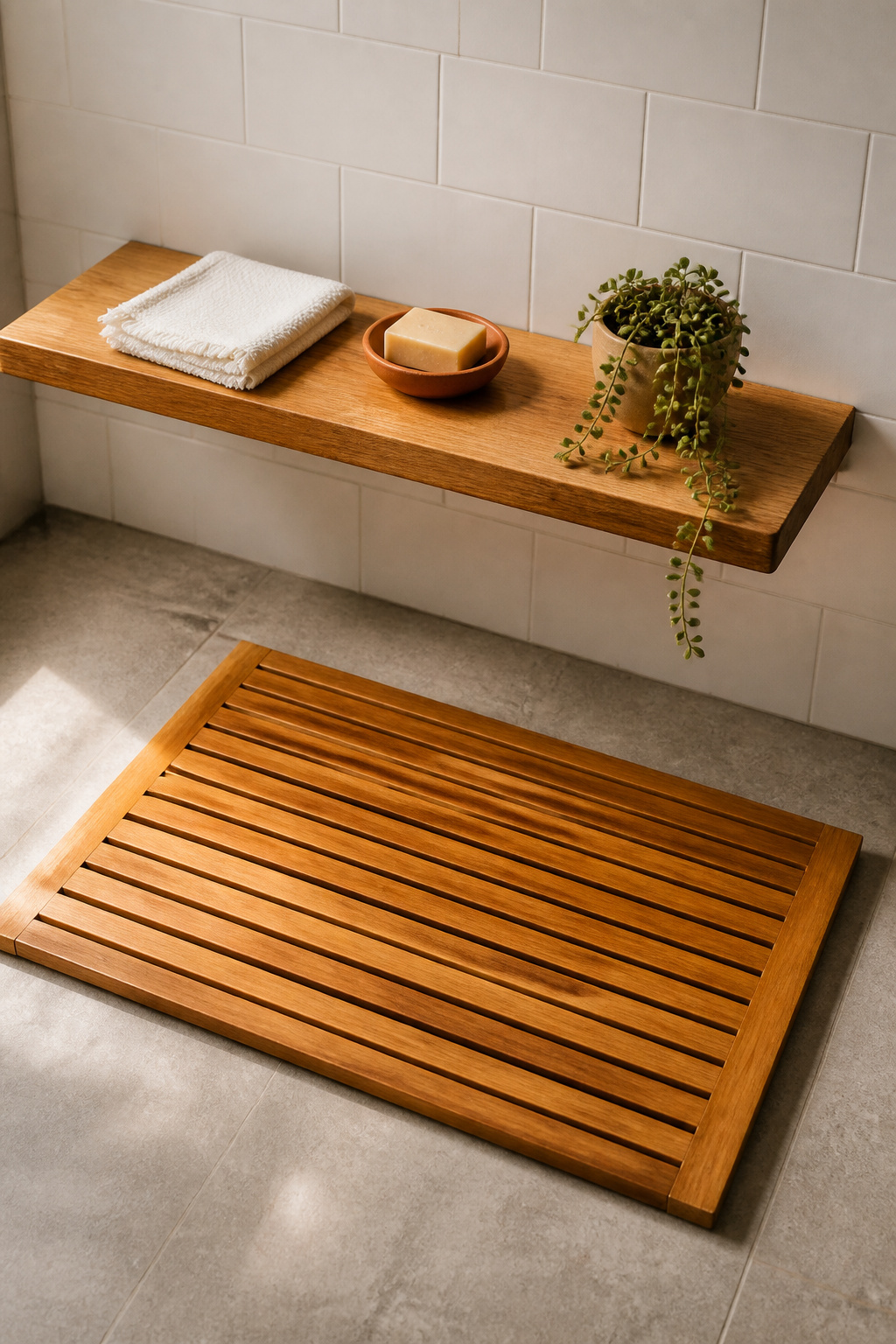
Timber is the most effective natural material in a bathroom for this purpose. Teak is the benchmark: its natural oils actively repel water and resist decay, it needs nothing more than annual oiling to stay in excellent condition, and it lasts 50 years or more in a well-maintained bathroom. The cost is proportional — teak runs 2–3x more than oak per metre. Oak is the practical alternative. It’s a genuine hardwood with good structural properties, but it lacks teak’s natural oil content and needs a marine-grade polyurethane finish applied to every surface, including the underside of shelves and the cut ends, to perform reliably in humid conditions.
Bamboo offers a more affordable and sustainable option. It’s dense and strong, but in its natural state it’s not waterproof; anti-mildew and anti-rot chemical treatment is required before it’s appropriate for bathroom use. For bath mats and accessories, treated bamboo works well. For structural shelving, teak or well-sealed oak is more reliable.
Beyond timber: a linen hand towel in an undyed natural tone, a small ceramic or terracotta accessory on the vanity, a river stone soap dish. None of these are expensive choices. Together, they give the bathroom a quality of permanence and warmth that manufactured materials alone consistently fail to achieve. The hygge principle applies directly here — the lived-in comfort of natural textures over the pristine perfection of synthetic surfaces.
The most consistently successful modern bathroom decor decisions share a common characteristic: they commit to a palette rather than assembling one element at a time. When each tile, wall colour, and fitting is chosen in isolation, the results often feel disconnected. When a single tonal direction is established first and every choice is made in relation to it, the room holds together.
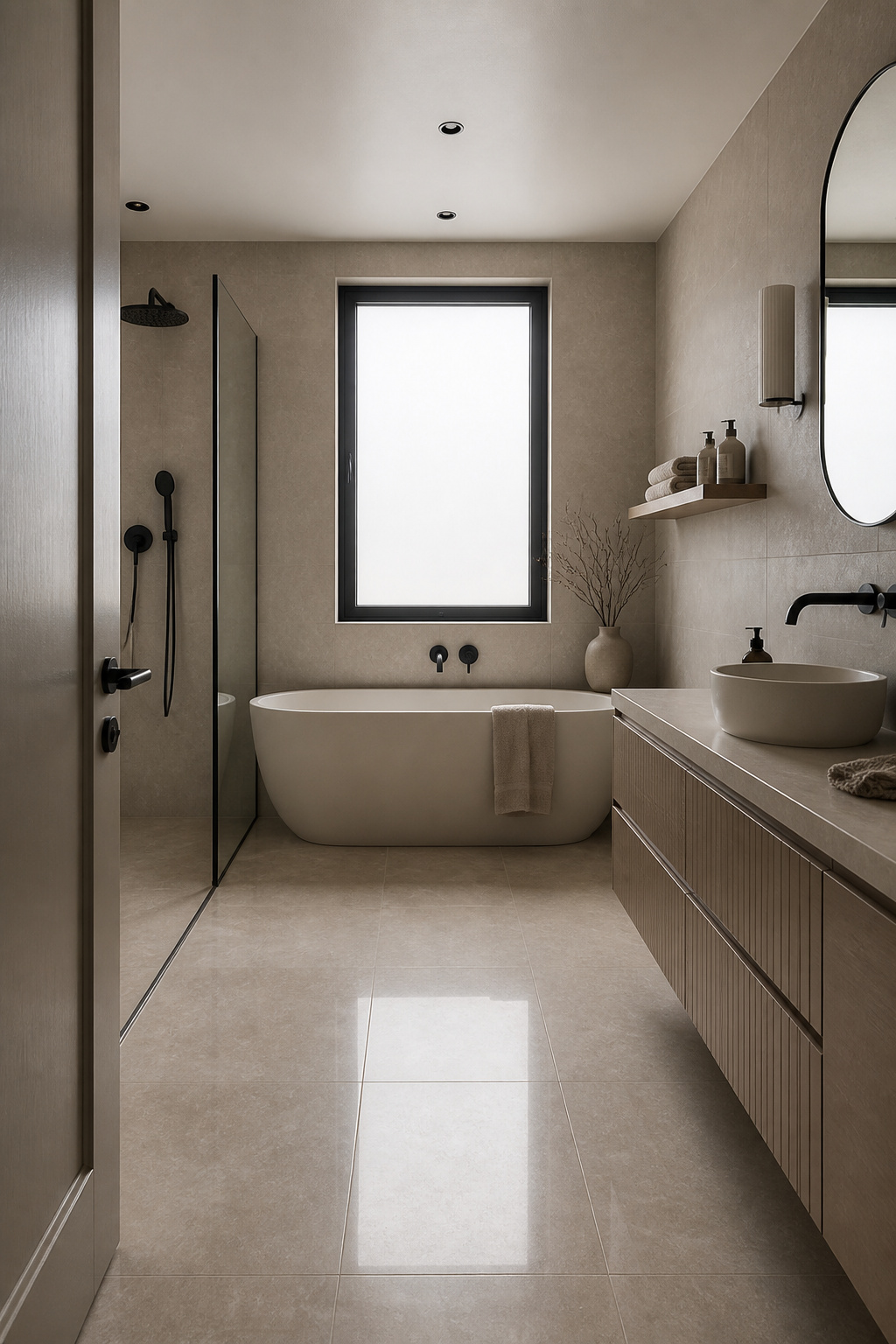
A monochromatic scheme uses 3–4 shades of the same base colour across walls, floor tile, and surfaces. The colour boundary the eye tracks across is removed — instead the room reads as a continuous material environment, which makes it appear larger and calmer than it is.
Three dominant directions in current modern bathroom decor: all-white is the most timeless and space-maximising option, but it shows every imperfection and requires consistently good material quality to avoid looking sterile. Warm greige (grey with beige undertones) has become the default palette for new high-specification bathrooms and renovations through 2025–2026 — it reads as neutral but has enough warmth to pair naturally with oak, linen, and matte black hardware without effort. Deep charcoal is high-risk, high-reward: it makes a small bathroom feel intimate rather than small when the lighting is handled well, and it pairs particularly effectively with brass or warm copper hardware that seems to glow against the dark background.
In any of these three directions, texture becomes the design work. Matte tile beside a polished tile insert, rough linen beside a smooth marble surface, natural grain beside a painted wall — the monochromatic scheme creates the conditions for material contrast rather than colour contrast. One natural material departure (a teak shelf, a white oak panel) prevents the scheme from feeling flat. For a deeper dive into the principles behind lasting bathroom design, the ideas around creating a bathroom design classic are directly applicable to palette decisions.
The defining visual characteristic of modern bathroom decor is the clear countertop and unobstructed wall. Achieving this in practice requires one thing: adequate concealed storage. Not aspirationally adequate — actually adequate for everything that gets used daily without anything needing to live on the counter.
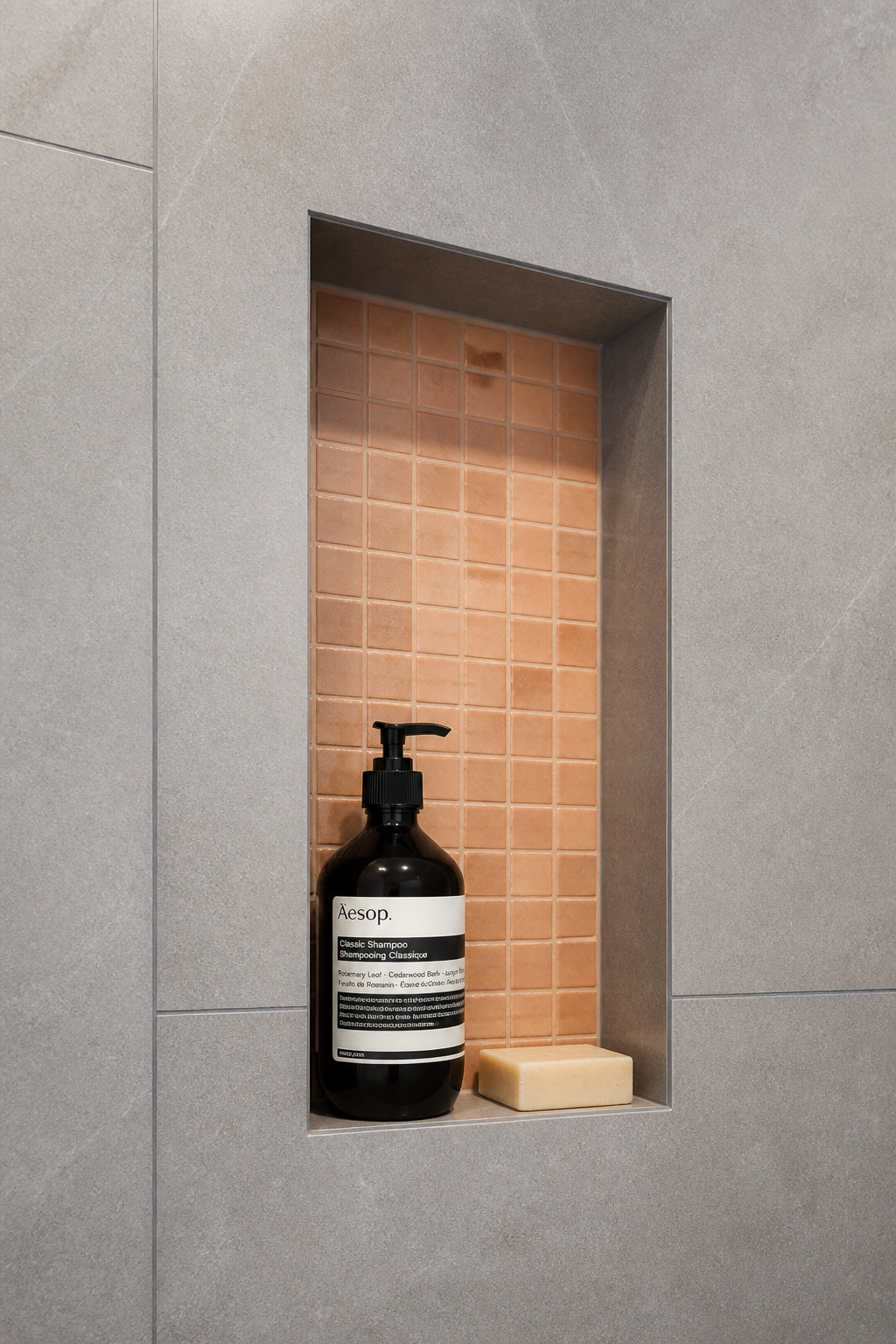
The most common reason bathroom surfaces stay cluttered is insufficient storage designed in from the start. Drawers in the vanity unit, a recessed medicine cabinet behind the mirror, a shower niche for in-shower products — each of these designed in from the beginning removes a category of daily-use items from the visible surfaces. Retrofitting any of them later is expensive; planning them during the renovation is straightforward.
A 300x600mm shower niche (portrait orientation) is the most practical standard size — it holds shampoo bottles upright without tipping. Pre-made niche systems from Schluter (KERDI-BOARD), Wedi, and Laticrete arrive as a sealed waterproof box sized to fit between standard stud spacings; they install before the shower tile and eliminate the waterproofing complexity of a site-built niche. Site-built niches are also possible but require a 2–3 coat liquid waterproofing membrane application on all interior surfaces, with the niche floor angled 1/8 inch toward the shower to drain standing water. A flat niche floor is the most reliable way to develop mould behind the tiles.
A standard recessed medicine cabinet (14–16 inches wide, 25–30 inches tall, 3.5 inches deep) sits flush with the wall face and doubles as a mirror. It represents no visual projection into the room but adds meaningful storage for the items that otherwise colonise the countertop. The space behind the toilet wall — between studs — is the most underused storage opportunity in most bathrooms.
No other single upgrade signals a commitment to modern bathroom decor as clearly as a wall-hung toilet. The floor-standing pedestal is such a standard element of conventional bathrooms that its removal reads immediately as an intentional renovation decision rather than a cost-cutting one.
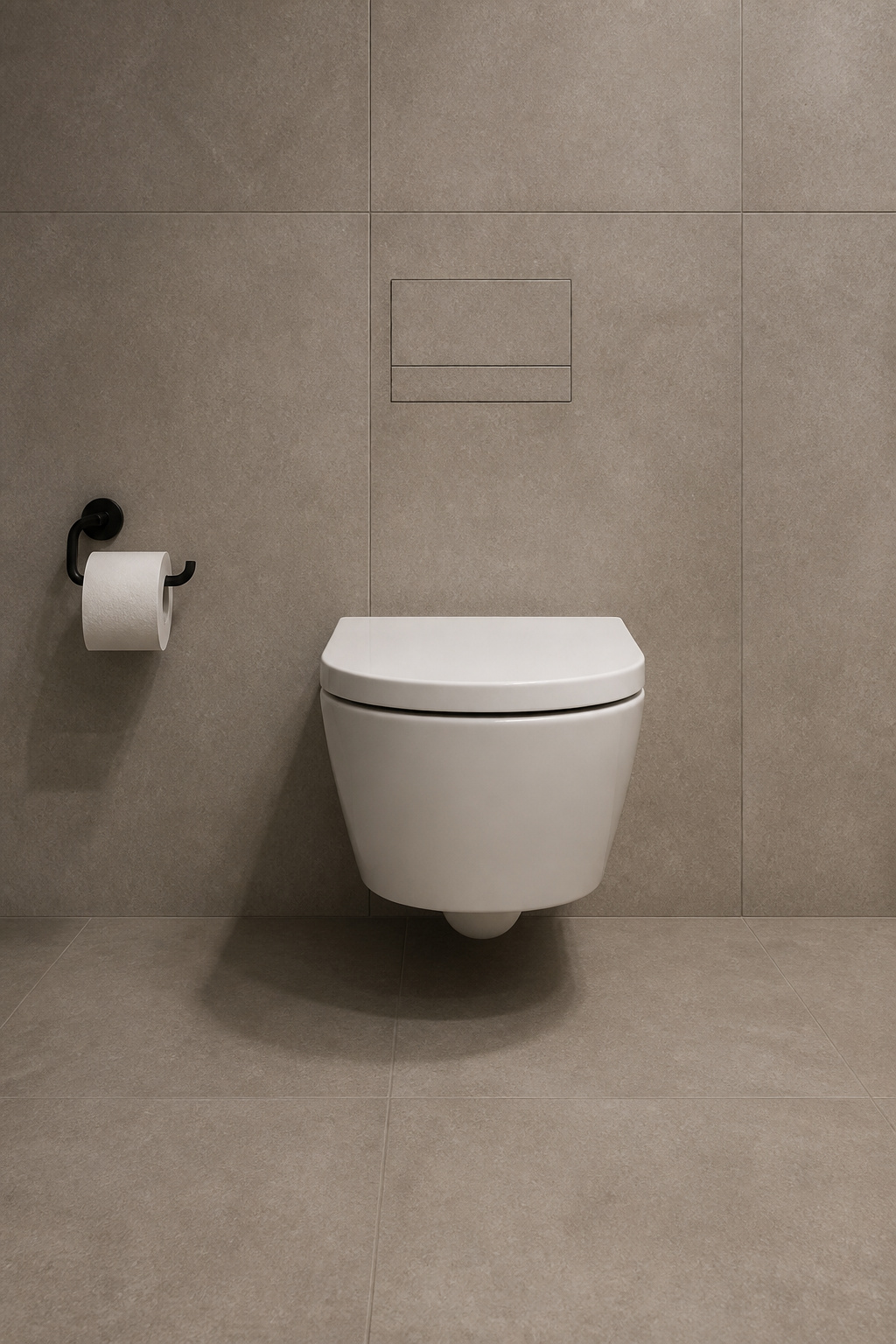
The practical benefits are real and daily. The floor beneath a wall-hung toilet is completely unobstructed — cleaning takes seconds rather than the careful manoeuvring required around a pedestal base. The bowl height is set during installation (adjustable between 380–480mm from finished floor during the rough-in phase, before the surrounding tile is placed), which means it can be set higher than the 400mm standard if taller occupants find conventional toilets uncomfortable.
The system behind the wall is a steel in-wall frame — Geberit DuoFix and Grohe Rapid SL are the two dominant brands, with Geberit holding the largest market share globally. The frame sits within a partition wall or false wall of approximately 140–200mm finished depth, and houses the cistern internally. The only visible elements on the finished wall are the bowl itself and the flush plate — a face plate in glass, matte white, matte black, or chrome that releases the flush. The flush plate is a legitimate design element; choosing it in matte black to match the room’s hardware scheme ties the toilet into the overall hardware narrative.
Rimless bowl design is the other significant specification choice. Traditional rimmed bowls channel flush water through a horizontal channel around the bowl’s upper rim — a channel that is impossible to clean properly and reliably harbours bacteria. Rimless bowls direct flush water in a targeted arc that covers the entire bowl surface. Geberit, Duravit, Roca, and Villeroy & Boch all offer rimless options at the mid-to-premium end. The full installed cost of a wall-hung toilet including frame, bowl, seat, and flush plate runs approximately $800–$2,500 before professional installation.
Every other element on this list is, to some degree, precision-manufactured. Zellige tile is the deliberate exception. These handmade Moroccan clay tiles are cut while the clay is still soft and then kiln-fired, with a glaze applied that pools and breaks differently on each tile’s slightly uneven surface. No two tiles are identical. The variation in glaze depth, surface texture, and thickness is the point — it creates a surface that catches light differently at different angles and different times of day.
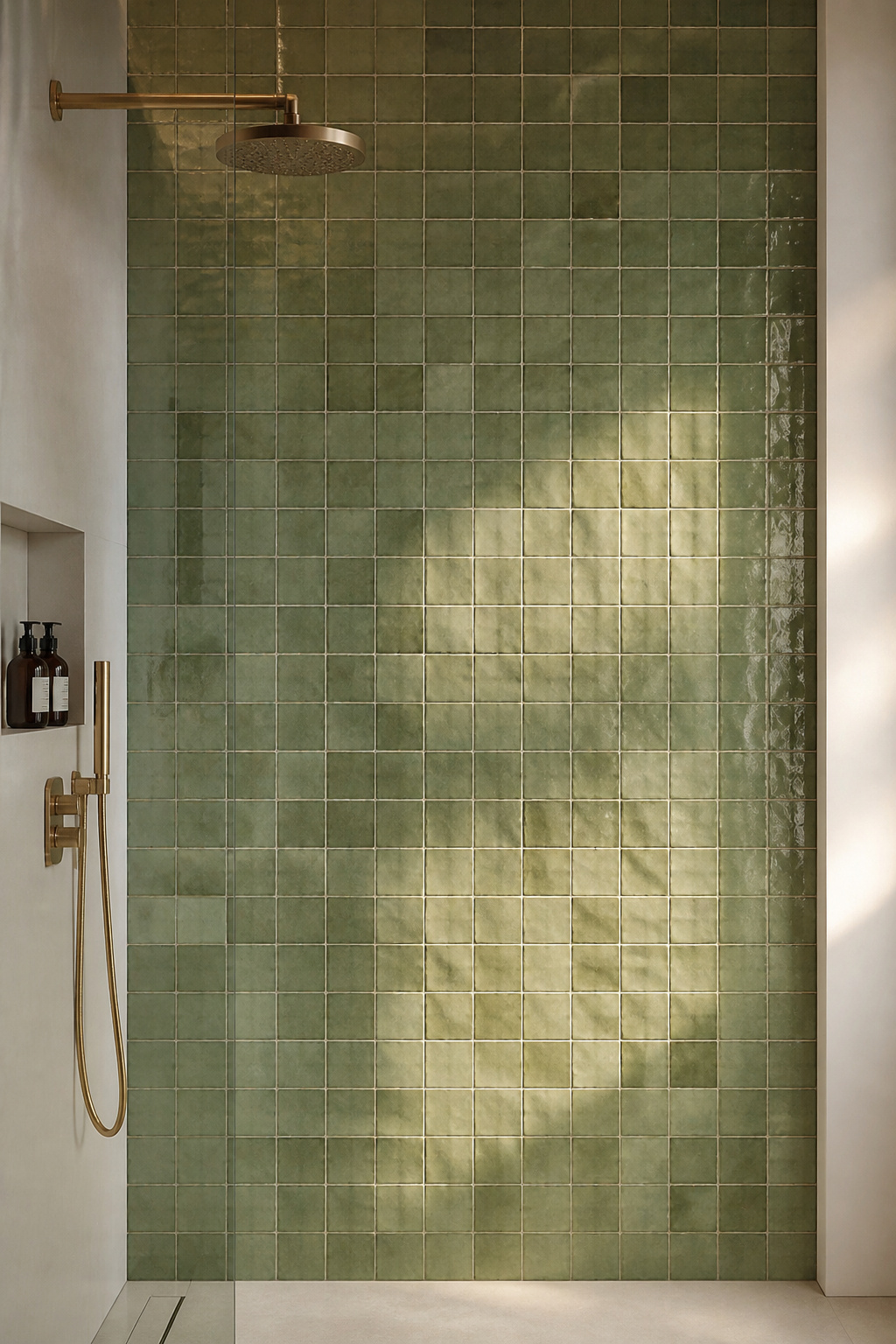
This is what machine-made porcelain tile with a ‘handmade look’ texture cannot replicate. A photograph of a surface versus the actual surface. Zellige has continued to appear in high-quality modern bathroom renovations through 2025–2026 precisely because it introduces warmth and human craft into rooms that would otherwise be composed entirely of manufactured perfection.
Authentic handmade zellige costs $18–$28 per square foot for materials. Machine-made zellige-look porcelain is available at $7–$10/sq ft — a reasonable alternative for larger areas where the full handmade material cost would be prohibitive. The most effective approach in many bathrooms is using authentic zellige on a single limited surface (a shower niche, a narrow feature strip, one wall behind the bath) where the detail registers clearly, and a complementary plain tile everywhere else.
Grout colour for zellige should be neutral — light to medium grey is the standard recommendation. White grout can look unfinished; dark grout creates strong geometric emphasis that competes with the tile’s own surface variation. Use ultra-narrow joints (1/16 to 1/8 inch) to emphasise the handmade character. Order 15% overage rather than the usual 10% — the irregular edges and occasional breakage during cutting the tiles to fit make the higher margin necessary.
Smart home technology has a well-earned reputation for adding complexity without proportional benefit. In modern bathroom decor, however, a handful of specific technologies deliver genuine, daily improvement. The bathroom is one of the few rooms where specific technology genuinely improves the experience of using the space every day, and where the upgrade compounds over years of daily use rather than becoming invisible.
Electric underfloor heating is the standout upgrade by this measure. A heated bathroom floor — warm by the time you step out of bed — changes how the bathroom feels at the most basic level. The cost for a 50–100 sq ft bathroom is $265–$700 fully installed, including the heating mat embedded in the tile adhesive layer and a programmable WiFi thermostat. Running costs run $14–$20 per month for most households programming the system to operate for 1–2 hours each morning. This system must be installed before the floor tile goes in — the mat sits in the adhesive layer, and retrofitting it means removing the entire floor.
A thermostatic shower valve is the second-priority smart upgrade. It locks water temperature regardless of demand elsewhere in the house (no scalding when a tap is used), allows temperature memory so the shower reaches the right temperature before you step in, and in digital versions allows pre-set shower programmes. Mira, Aqualisa, and Grohe Grohtherm are the leading brands across the price spectrum.
The LED backlit mirror with demister handles the third daily frustration automatically — the mirror is clear when you need it. Beyond these three, smart bathroom technology becomes a matter of personal preference rather than universal benefit. A ceiling-mounted IP67-rated smart speaker brings audio into the shower cleanly; a smart mirror with an embedded screen adds features that a dedicated tablet on the vanity would serve equally well at lower cost.
If budget allows only one smart upgrade: underfloor heating. It is the only bathroom technology that genuinely changes the experience of the room on every cold morning of the year.
The renovation sequencing matters as much as the renovation decisions. Get it wrong and you’ll be taking tiles off to fix plumbing, or pulling out a fitted cabinet to install a medicine niche that should have gone in during the rough-in phase.
The order is this: structural and waterproofing work first (in-wall toilet frame, shower liner, underfloor heating mat, all plumbing rough-in), then surfaces (tiles, walls, vanity unit), then fixtures (toilet, basin, taps, shower head), then lighting and mirrors, then hardware and accessories. Each category is progressively easier to swap or upgrade later without disrupting what came before. The in-wall toilet frame and the underfloor heating mat are the two elements you absolutely cannot go back and add later without a demolition budget.
If a full renovation isn’t on the table, a targeted surface refresh can deliver substantial results at far lower cost. The hardware swap — taps, towel rails, toilet roll holder, cabinet handles, all in a unified matte black or brushed finish — takes a day and costs $400–$1,200. It changes the room’s design language more effectively than most people expect. A new backlit mirror replaces a functional but forgettable detail with something that improves the lighting, resolves the fog problem, and updates the bathroom’s character in an afternoon.
Repaint — if the layout and fittings are sound — is genuinely underrated as modern bathroom decor. A bathroom repainted in warm greige with the existing white fittings retained can read as a completely different room — the colour context changes everything around it. Start there, see how much of the existing bathroom is actually fine, and build the renovation from the elements that genuinely need replacing rather than the assumption that everything does.