Physical Address
304 North Cardinal St.
Dorchester Center, MA 02124
Physical Address
304 North Cardinal St.
Dorchester Center, MA 02124
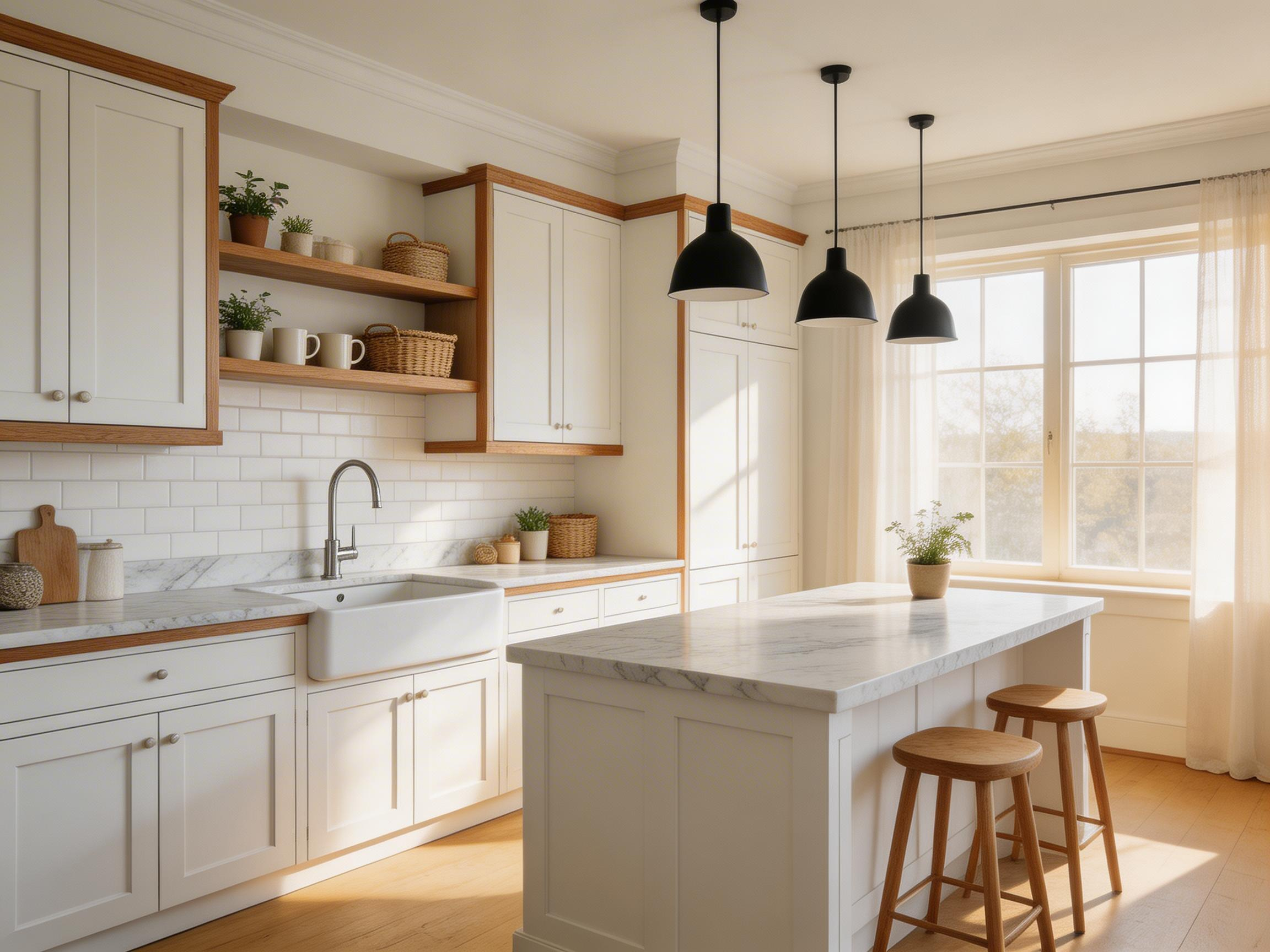
16 timeless white kitchen remodel ideas with Scandinavian style. Shaker cabinets, marble countertops, pendant lights—find your perfect Nordic kitchen today.
There’s a moment every morning when light pours across pale cabinets and the kitchen becomes something transcendent. Coffee steam catches the glow. The countertop gleams. Nothing competes for attention—no visual clutter, no color chaos. A white kitchen remodel transforms how your home breathes, especially in those quiet hours before the day accelerates. This isn’t about sterility or cold minimalism. For generations, Scandinavian homes have embraced white kitchens precisely because they amplify what matters: natural light, the warmth of wood, the quiet satisfaction of order. White is the canvas, not the destination. It’s how a 200-square-foot space can feel like the heart of your home rather than a utility box. Whether you’re starting from scratch or refreshing what you have, a white kitchen remodel grounded in Nordic principles delivers timelessness that outlasts trends. Below, you’ll find 16 ideas to guide your transformation—from cabinet selection to the final pendant light—each rooted in the design philosophy that values substance over excess and intentionality over noise.
Shaker cabinetry has endured for over a century because the proportions simply work. The stiles and rails—those vertical and horizontal frame pieces—measure 2¼ inches wide in traditional construction, creating visual rhythm without heaviness. If you want something closer to contemporary Scandinavian proportions, slim shaker variants narrow those to 0.75 to 1 inch, offering cleaner lines while maintaining the signature five-piece panel structure. Base cabinets sit at the industry standard 34.5 inches tall and 24 inches deep; wall cabinets install 18 inches above your countertop, which feels proportional without eating too much visual space above.
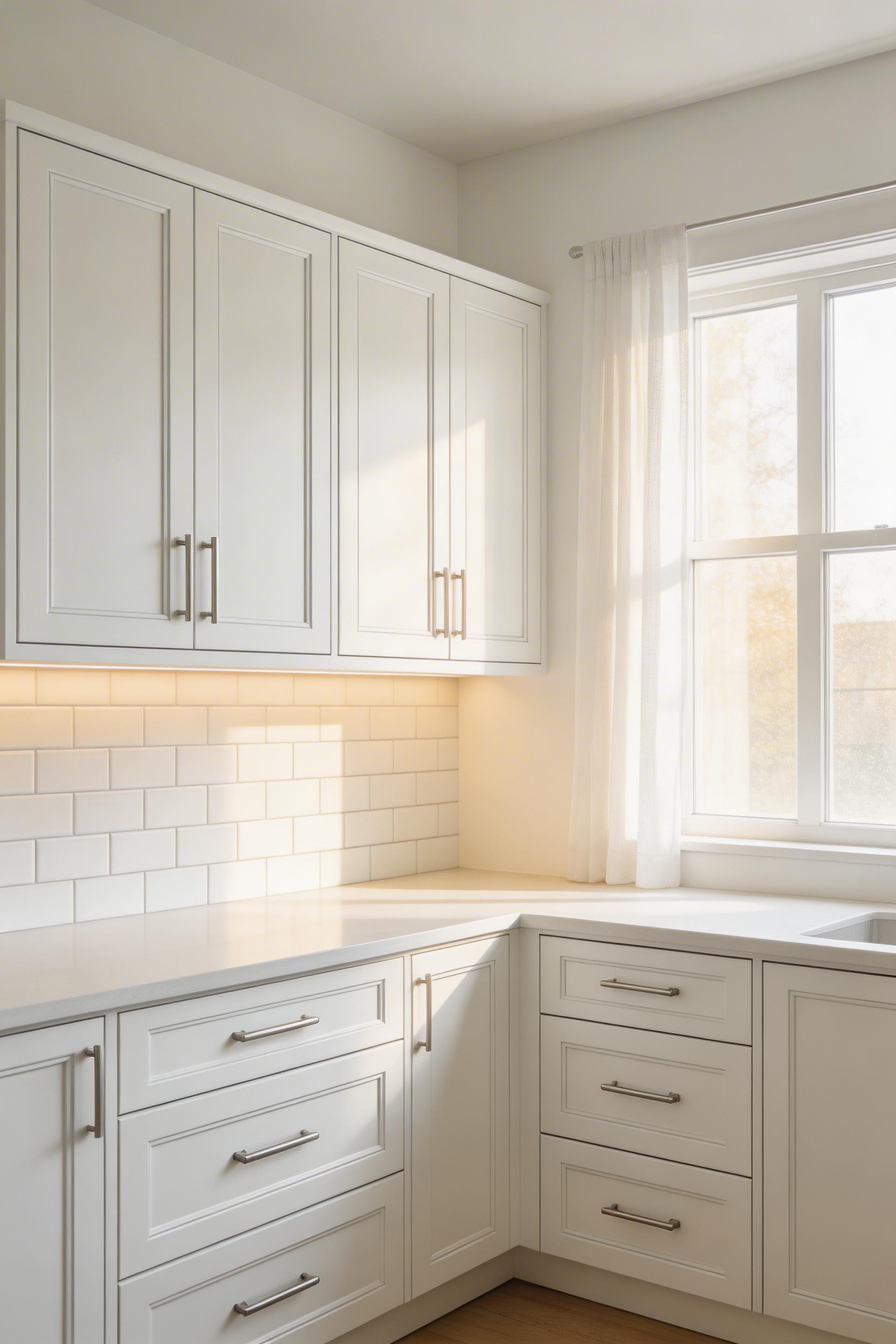
The finish matters as much as the profile. Semi-gloss painted finishes outperform satin in kitchens—they’re significantly more moisture-resistant and easier to wipe down. Satin carries a softer, more matte appearance that some prefer for a warmer aesthetic, but you’ll notice fingerprints and water spots more readily. Brushed nickel hardware from brands like Amerock, Atlas Homewares, and Top Knobs ranges from $3 to $8 per pull, and this modest investment shapes the entire cabinet personality. Brushed nickel offers a subtle, understated quality that feels professional without announcing itself. It works because it doesn’t compete with the cabinet color—it simply functions as an honest detail. If you choose flat-center shaker over a raised-panel version, you’ll land even closer to contemporary Nordic sensibilities. This is the upgrade I’d recommend first in any white kitchen remodel, because everything else builds from these foundational lines.
Open shelving represents a philosophical shift in kitchens: displaying rather than concealing. It’s very Scandinavian—trust yourself to keep things intentional and beautiful. Floating shelves typically run 10 to 12 inches deep; 12 inches accommodates dinner plates and serving dishes, while 10 inches works perfectly for everyday items without demanding as much wall projection. IKEA’s EKBY and LERBERG bracket system costs around $20 per pair and handles real weight when installed into studs, though custom steel brackets from specialty hardware suppliers ($15 to $40 per bracket) offer a more tailored appearance.
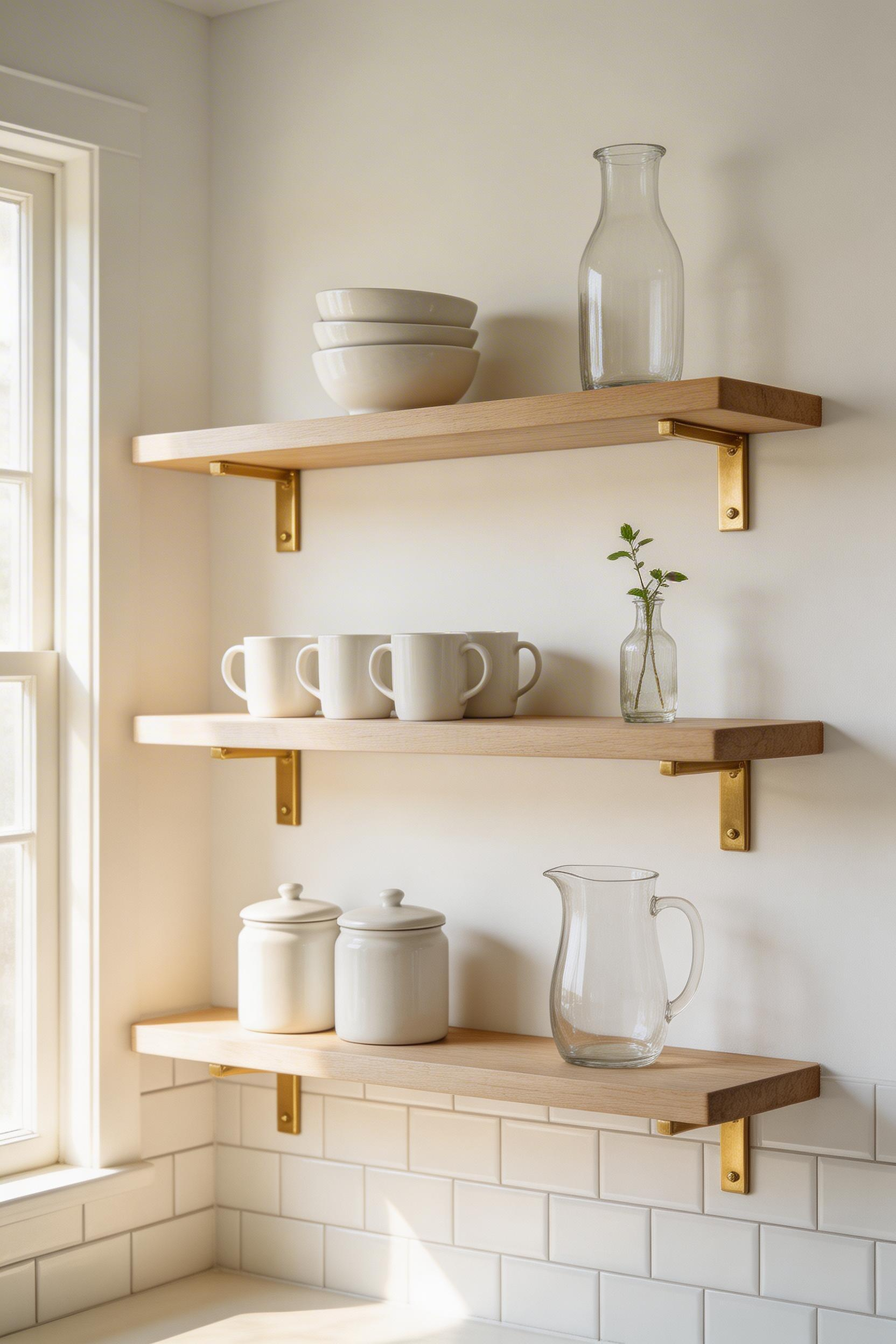
Pair white shelving with warm wood—white oak, birch, or ash—and you’ve created the essential Nordic balance. White oak has a tight grain structure and ages into beautiful honey tones. Birch is nearly blonde, economical, and reads as Scandinavian authenticity. The brass brackets add a jewelry-like warmth that feels sophisticated without trendy excess. Matte black brackets create a starker, more contemporary statement. Style your shelves in odd numbers—three glasses, five bowls, two cookbooks—and deliberately leave 20 percent empty space. Negative space prevents the shelves from feeling cluttered and reinforces that Nordic principle of intentionality. You’re not displaying a collection; you’re curating a functional art installation. The warmth of brass against white creates that subtle material conversation that makes Scandinavian kitchens feel inhabited rather than sterile.
The dream of a white kitchen interrupted only by appliances can feel expensive until you understand “panel-ready” appliances. These accept a door panel cut from your cabinet material, essentially camouflaging the machine into your cabinet run. The Bosch 800 Series dishwasher (model SHPM88Z75N) costs $1,100 to $1,400 and stands as one of the quietest, most reliable panel-ready options available. Miele’s G7000 series runs $1,500 to $2,000 and carries German engineering that justifies the premium for sustainability-minded buyers. Fisher & Paykel’s DD60DDFHX9 double dishdrawer at $1,400 panel-ready offers something different—two shallow drawers instead of one tall door, which many people find more ergonomic and accessible.
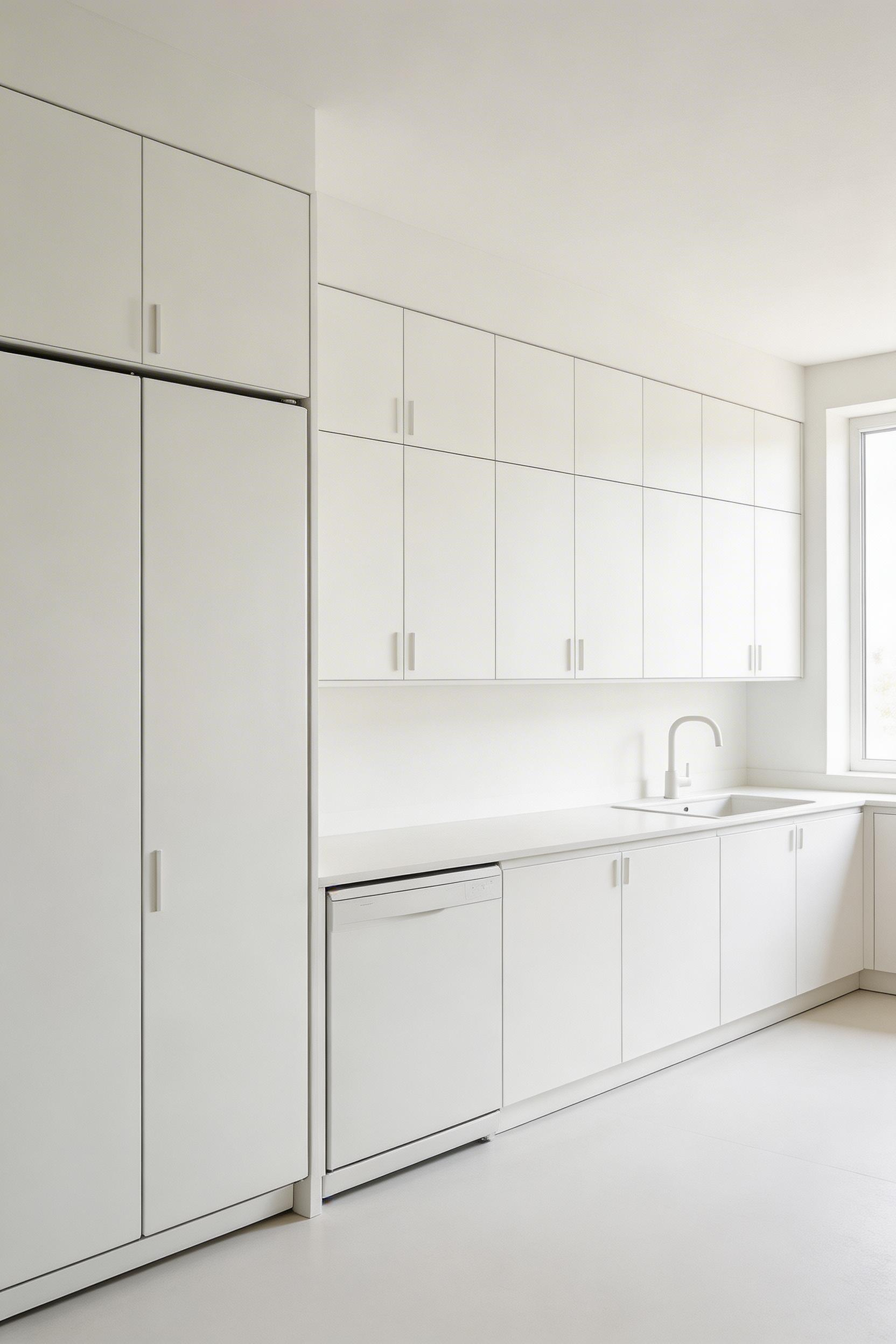
Panel-ready refrigerators demand custom panel fabrication, typically $200 to $500 in labor and materials. Your cabinet maker cuts a panel from leftover cabinet material and attaches it to the fridge door, creating visual continuity. This is worth the investment if a refrigerator dominates your kitchen’s sightline. Range hoods complicate this decision—custom panel shroud options from brands like Zephyr and Vent-A-Hood exist but add considerably to the hood cost. Many designers instead opt for a stainless steel or black hood as a subtle accent, accepting a small visual break rather than engineering an integrated solution. The integrated appliance philosophy asks: what will you notice most, and what actually matters to hide? Sometimes the honest answer is just the dishwasher and fridge. In a white kitchen remodel, this restraint—choosing to integrate only what truly matters—honors the Scandinavian principle of thoughtful editing rather than total camouflage.
Subway tile earned its dominance in white kitchens through sheer versatility and proportion. The classic 3-by-6-inch format has visual restraint—it reads as background rather than statement. Scaled-up versions like 4-by-8 inches or 4-by-12 inches feel more modern and minimize grout lines proportionally. Ceramic subway tile costs $1 to $5 per square foot; handmade or artisan versions jump to $8 to $20 per square foot. The price difference reflects durability and finish—artisan tiles often feature subtle color variation and texture that ceramic cannot match.
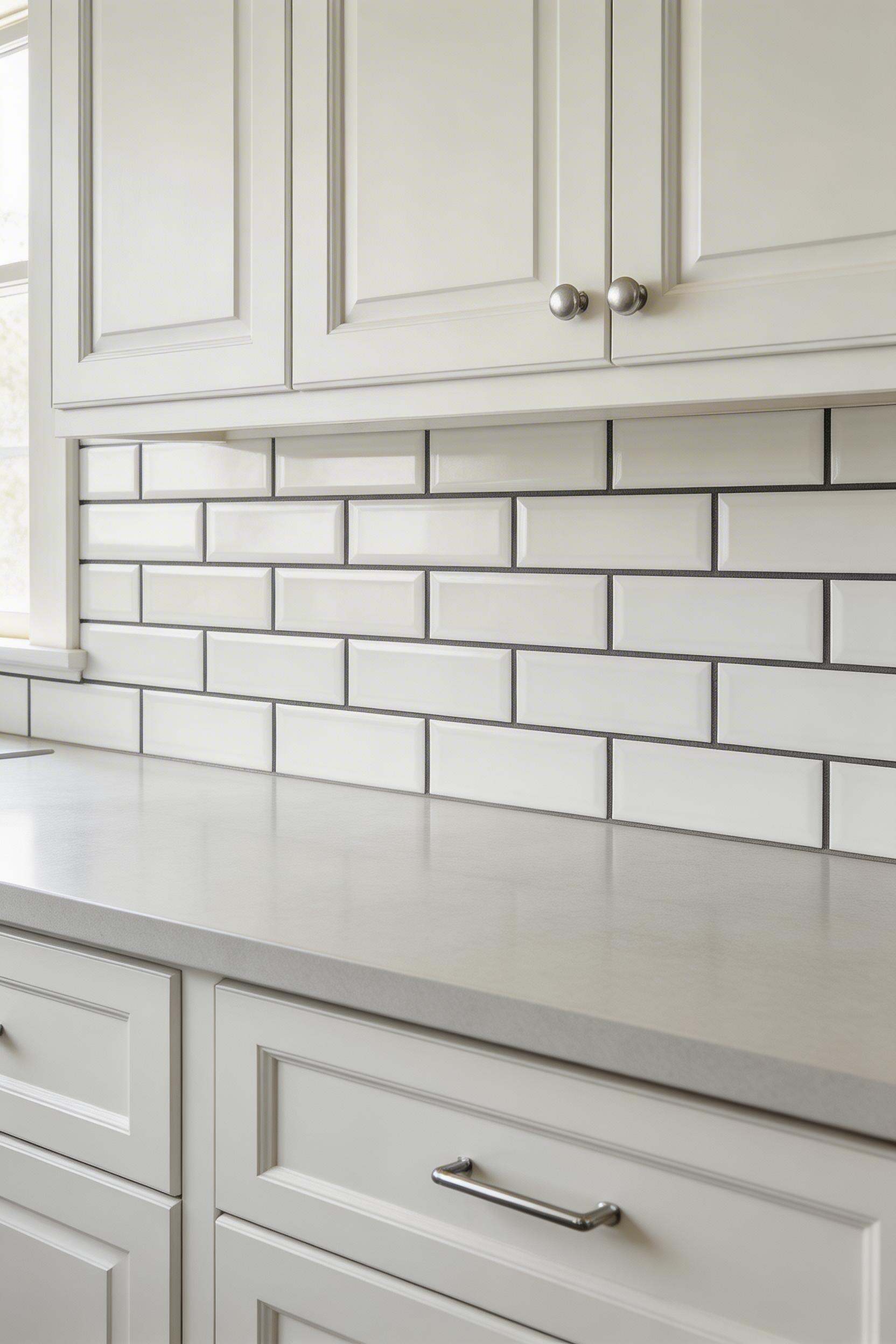
Grout color orchestrates the entire backsplash mood in your white kitchen remodel. White grout disappears into the tiles, creating a seamless spa-like quietness. Grey grout defines each tile, offering more visual structure. Charcoal grout creates bold contrast and reads contemporary. Installation patterns expand your options: running bond (the traditional offset pattern), stacked vertical arrangement, and herringbone all work with subway tile. Running bond feels classic and timeless; herringbone adds unexpected texture and movement. Grout width—1/16 inch for tight joints versus 1/8 inch for standard—affects the final impression. Tighter joints read more seamless and European; standard spacing emphasizes the tile grid. This single detail ripples through your entire kitchen aesthetic, so spend time with samples before committing.
The white kitchen’s greatest design opportunity arrives with contrast. Navy blue, forest green, sage green, and charcoal represent 2025’s most sophisticated island colors. An island painted Benjamin Moore Hale Navy or Sherwin-Williams Jasper grounds the white surrounding it without aggression. These colors carry weight and intentionality—they’re not passing trends but earned classics.
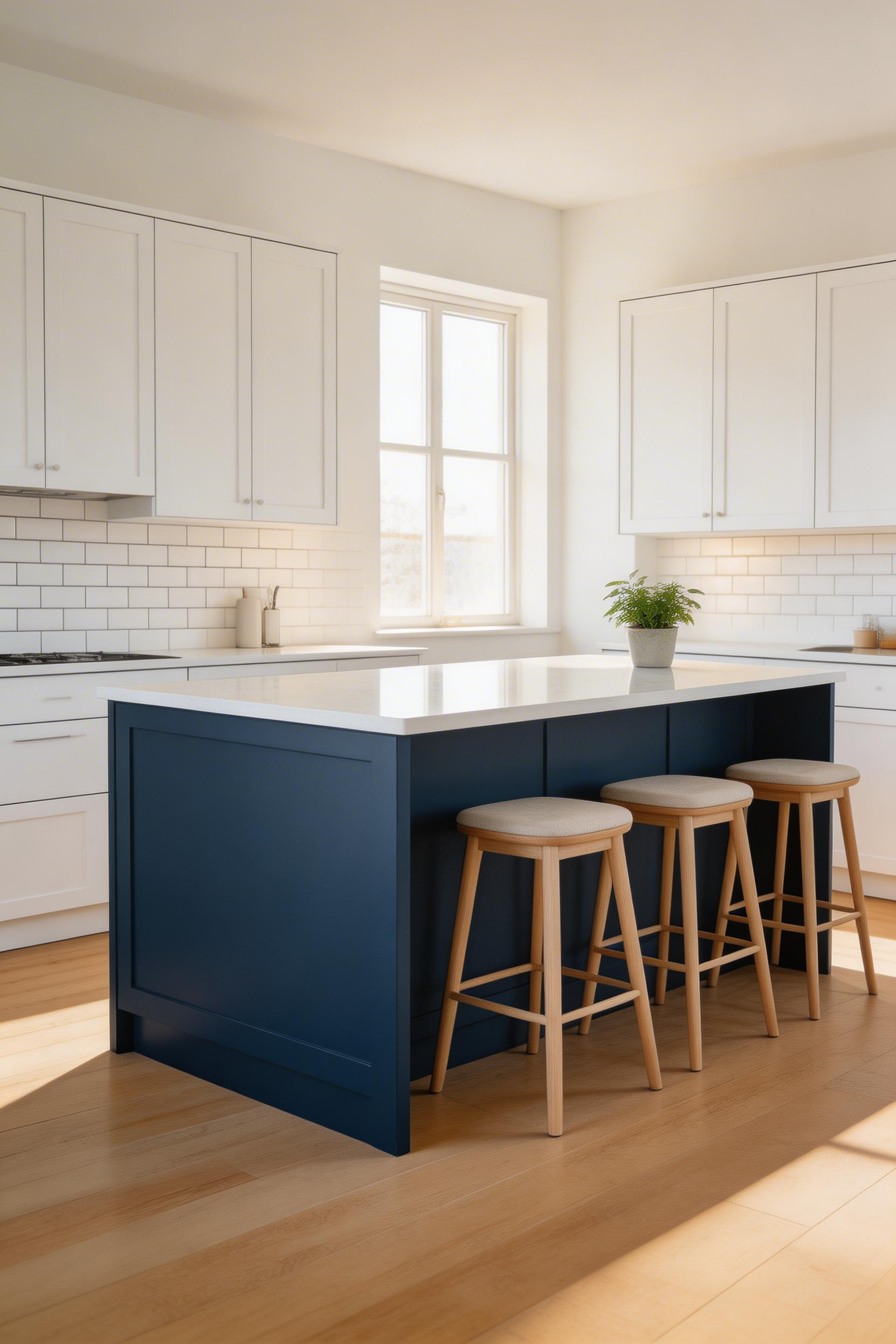
Island geometry matters before you choose color. Overhangs for seating should reach 12 inches minimum, though 15 inches feels more comfortable for actual dining. Your island width typically ranges from 2 to 4 feet depending on your kitchen, but maintain at least 42 inches of clearance around all sides (48 inches is ideal for comfortable movement). Selecting the right island size prevents an oversized or cramped feeling. Butcher block island tops run $30 to $60 per square foot installed and introduce warmth and natural texture perfectly suited to Nordic kitchens. Quartz tops cost $50 to $120 per square foot and eliminate maintenance concerns while anchoring the kitchen’s material story. Counter material selection shapes how your island functions—quartz demands less care, while butcher block requires regular oiling but rewards you with natural patina. The color choice transforms the island from functional necessity to design anchor—suddenly your white kitchen remodel has a focal point, a place where the eye naturally lands. The surrounding white amplifies the island’s impact, which is precisely the Nordic principle of restraint creating emphasis.
Marble and quartz represent the two poles of luxury countertop choice, and each tells a different story in a white kitchen. Calacatta marble features bold, dramatic grey veining across a bright white background; Carrara offers softer, more subtle grey lines on a slightly warmer white. Marble breathes authenticity but demands commitment—you’ll need to seal it 1 to 2 times annually with a penetrating sealer like Tenax Proseal or StoneTech Professional, and acidic foods will etch the surface if not immediately wiped. This is the material choice of people who value patina and character.
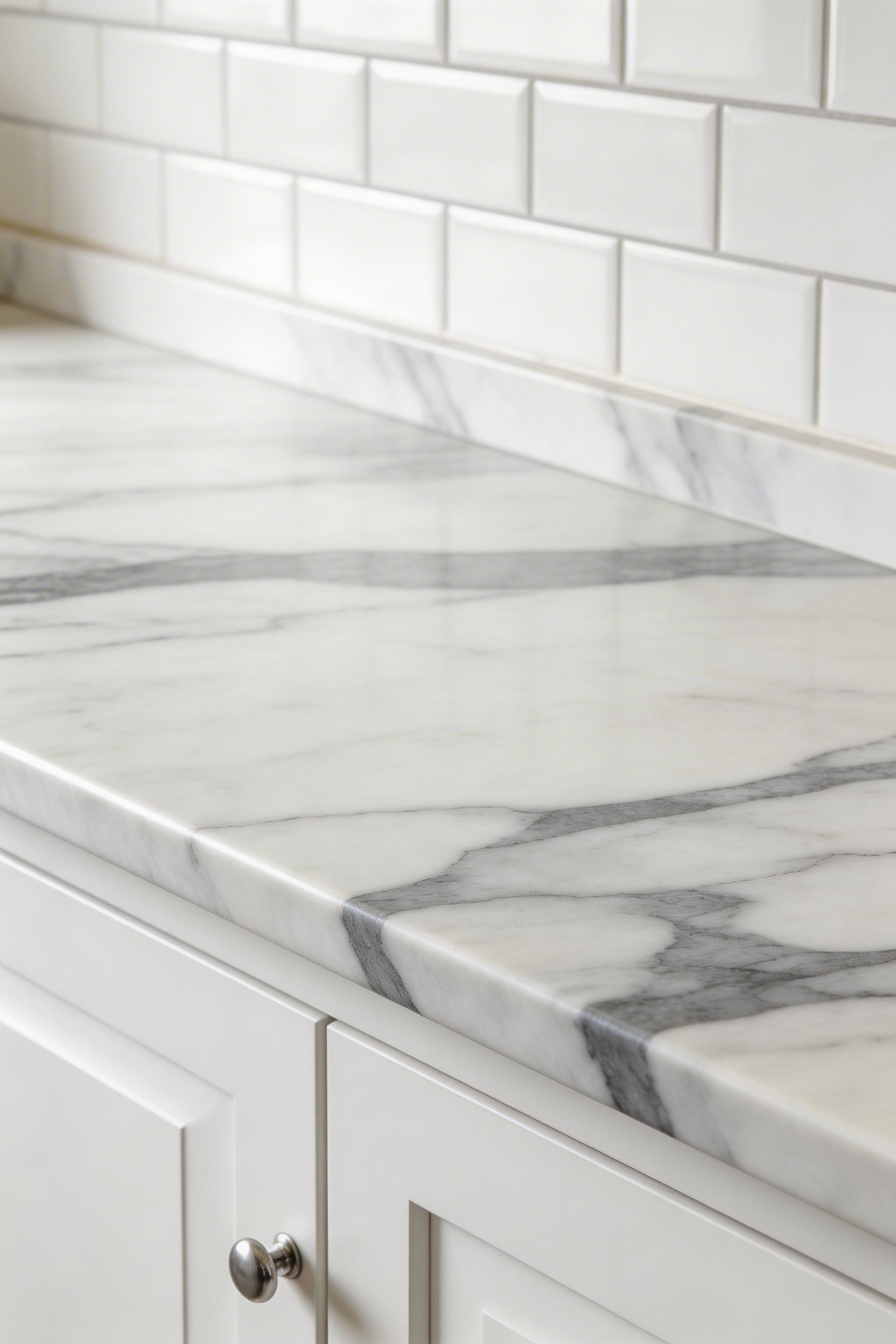
Quartz brands like Silestone, Caesarstone, and Cambria offer marble-like aesthetics without maintenance demands. Cambria Brittanicca mimics Calacatta at a fraction of the cost, while Caesarstone 5031 Statuario Maximus achieves similar drama with superior durability. Quartz runs $50 to $100 per square foot installed versus marble’s $75 to $250-plus. Edge profiles—eased for contemporary cleanness, beveled for a defined shadow line, or ogee for ornate tradition—shape how your white kitchen renovation countertop relates to your cabinet style. A leathered finish adds subtle texture; honed finishes offer matte refinement, while polished reflects light and drama. The price is real with marble, but the authenticity rewards that investment if you’re committed to caring for it. For more on pairing surfaces with cabinetry, kitchen countertop ideas cover the full range of options across budgets.
Cabinet painting delivers one of the highest returns on investment in remodeling, and the financial difference from new construction is staggering. DIY painting requires roughly $200 to $500 in materials. Professional spray painting—the only method that achieves a truly finish-like result—costs $1,500 to $4,000 for a full kitchen but justifies itself in durability and appearance.
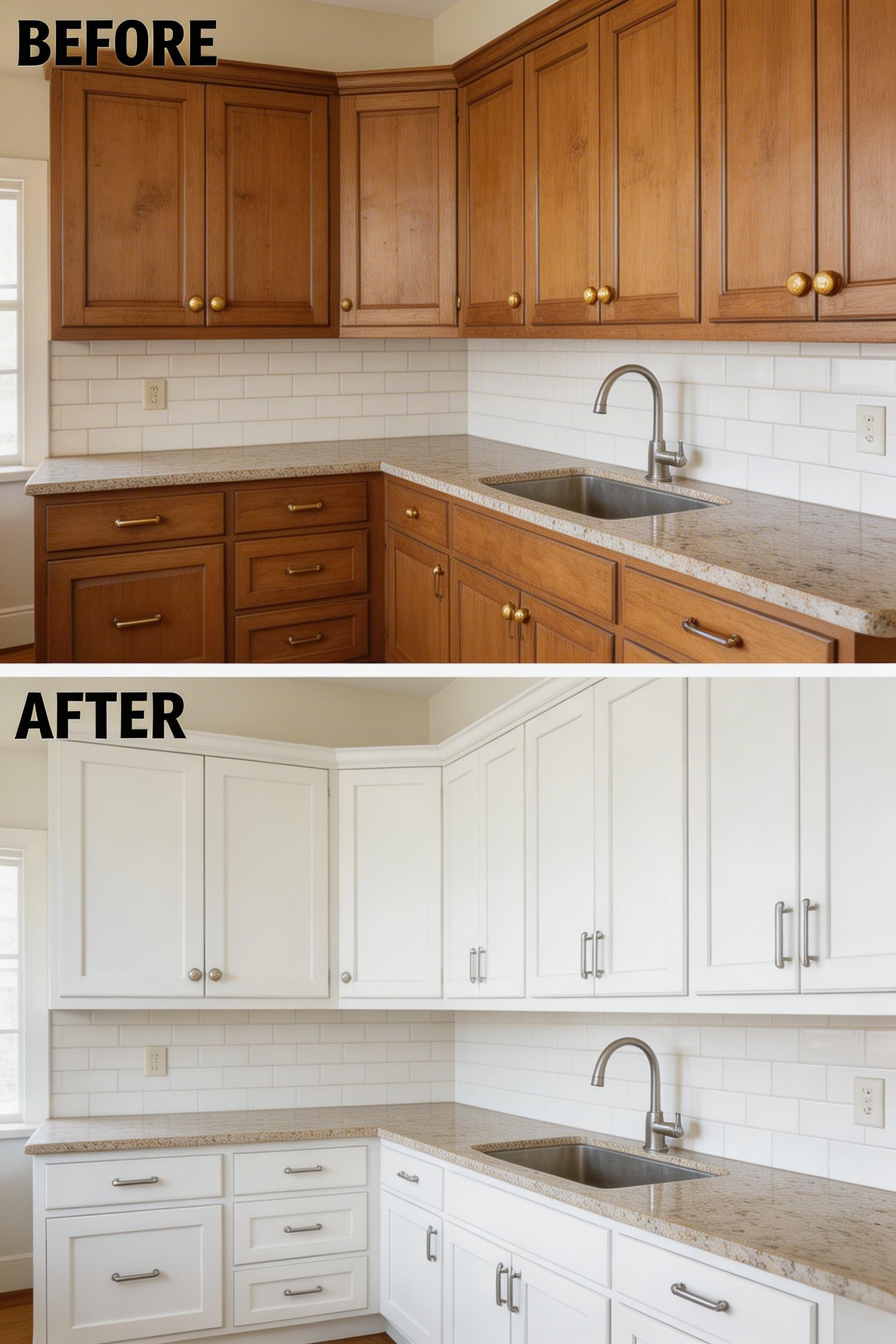
The unsexy truth: preparation determines outcome. TSP phosphate cleaner removes grease, 120-grit sandpaper opens the surface, and an oil-based primer like Zinsser Cover Stain or BIN Shellac Primer seals any discoloration. Benjamin Moore Advance (an alkyd hybrid with remarkable hardness) and Sherwin-Williams Emerald Urethane (arguably the hardest residential cabinet paint available) are the gold standard. Popular white choices include Benjamin Moore White Dove OC-17 (warm, creamy-white), Simply White OC-17 (brighter, crisper), and Chantilly Lace OC-65 (pure white with subtle warmth). Sherwin-Williams Extra White offers clean, no-nonsense whiteness. Here’s the discipline most people skip: cabinet paint needs 30 full days to cure. Don’t slam doors, don’t load shelves, don’t stress-test the finish for a month. The reward is cabinets that will look fresh for a decade.
Quality paint separates budgets that endure from those that fail. Don’t be tempted by bargain latex paints or hardware-store brands. Invest in premium cabinet-specific formulas that handle moisture, temperature swings, and constant touch without checking or peeling.
Lighting transforms a white kitchen from daytime brilliance to evening warmth. Color temperature—measured in Kelvin—shapes mood as much as function. 2700K emits warm amber tones resembling incandescent bulbs, perfect for ambience but potentially too dim for detailed work. 3000K reads as warm white and suits most kitchens, balancing task function with residential warmth. 4000K delivers cool, daylight quality excellent for focused work but can feel harsh in living spaces.
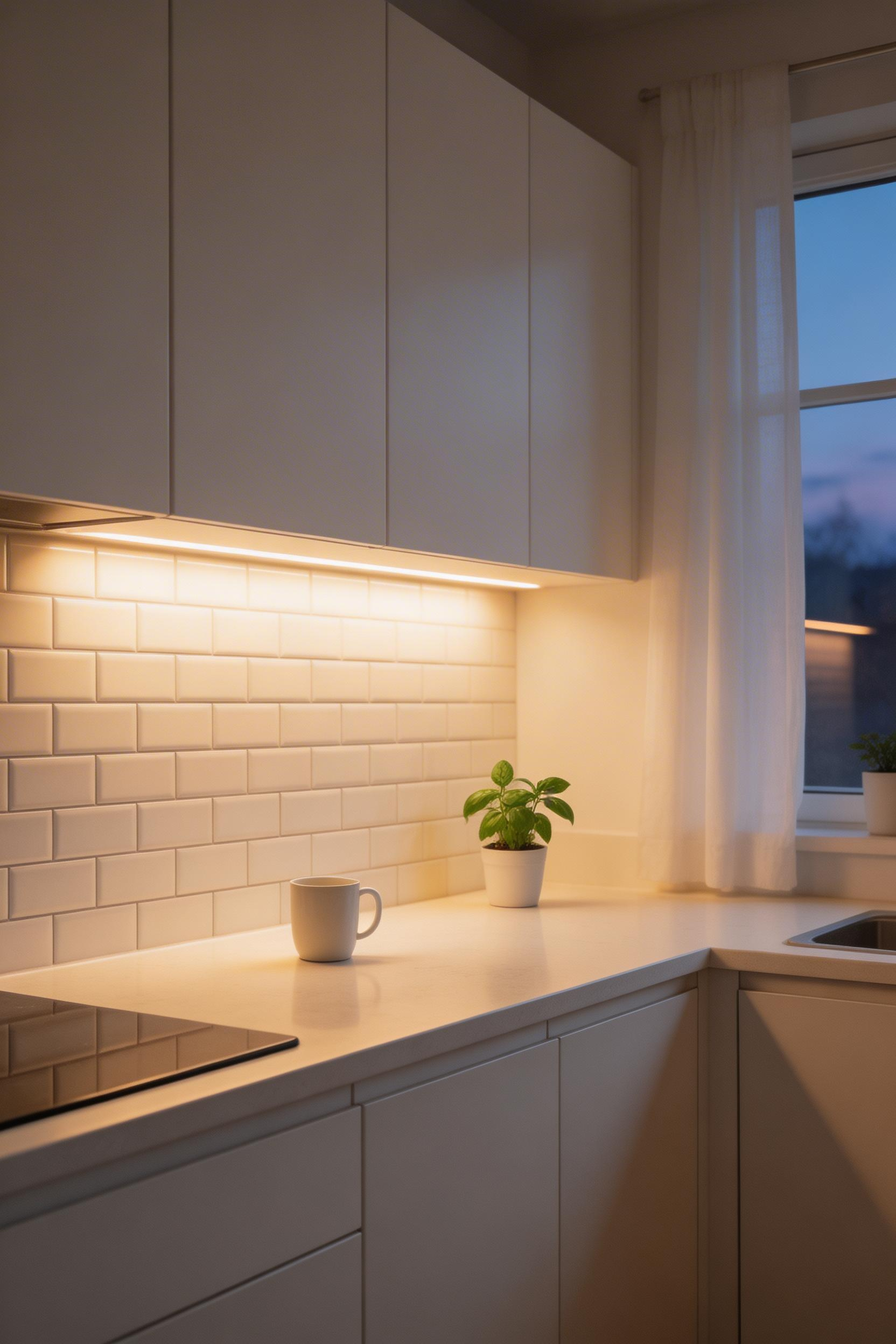
LED strip systems like Kichler Direct-Wire ($80 to $120) and WAC Lighting InvisiLED ($60 to $150) offer professional hardwired installation. Plug-in puck lights ($30 to $80 for six units) allow rental-friendly retrofitting without electrical work. The critical detail most miss: dimmer compatibility. Not all LED strips work with standard dimmers—you need TRIAC-compatible dimmers or brand-matched controllers. CRI (Color Rendering Index) of 90 or higher ensures that food colors appear true and appetizing. This modest upgrade—roughly $200 to $500 including installation—unlocks your white kitchen’s evening personality and makes cooking at dusk genuinely pleasant rather than a squint-and-search experience.
Black fixtures against white cabinetry create visual punctuation without palette shift. Matte black faucets from Kohler Purist ($350 to $550), Moen Align ($200 to $350), and Delta Trinsic ($180 to $280) anchor the sink with authority. Matte black cabinet pulls from Liberty Hardware, Top Knobs, and Rejuvenation range from $3 to $20 per pull and multiply their visual impact through repetition across 30 or 40 pull locations.
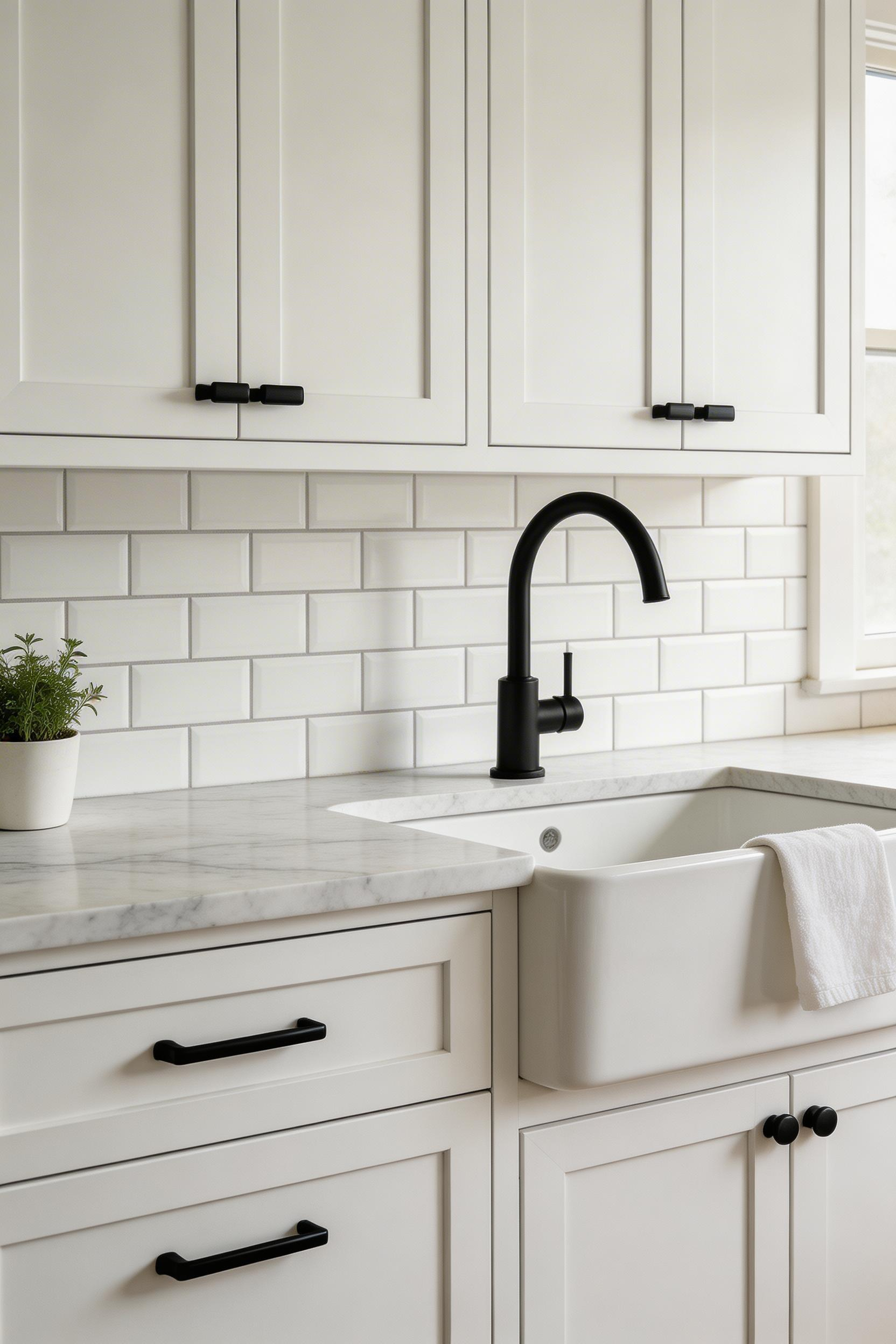
Metal mixing follows loose but sensible logic: keep functional metals (faucet, sink hardware, appliance trims) matching for visual coherence, while decorative metals (cabinet pulls, light fixtures) can contrast intentionally. Pairing matte black with warm brass is the current trend that actually works—the warm and cool metals engage in subtle conversation rather than competition. Matte black range hoods from Zephyr, BEST, and Broan start around $300 for modest CFM and climb to $2,500 for professional-grade ventilation. This hardware layer might seem secondary until you realize it accounts for half your white kitchen remodel’s tactile experience—every time you grasp a pull or adjust a faucet, that material tells a story. Consistency across plumbing fixtures—ensuring your faucet, sink hardware, and cabinet pulls coordinate rather than clash—transforms hardware from scattered details into a unified design language that feels intentional and refined.
An apron-front sink (also called a farmhouse sink) commands attention precisely because it declares intentionality. You don’t choose one casually—you choose one because you want a kitchen with a center point. Material determines durability and character. Fireclay, fired at over 1,800 degrees Fahrenheit, is non-porous and resists staining with superior durability. Cast iron carries weight and substance (some weigh over 200 pounds), but the enamel coating can chip. Stainless steel offers the most budget-friendly entry point and performs admirably in high-use kitchens.
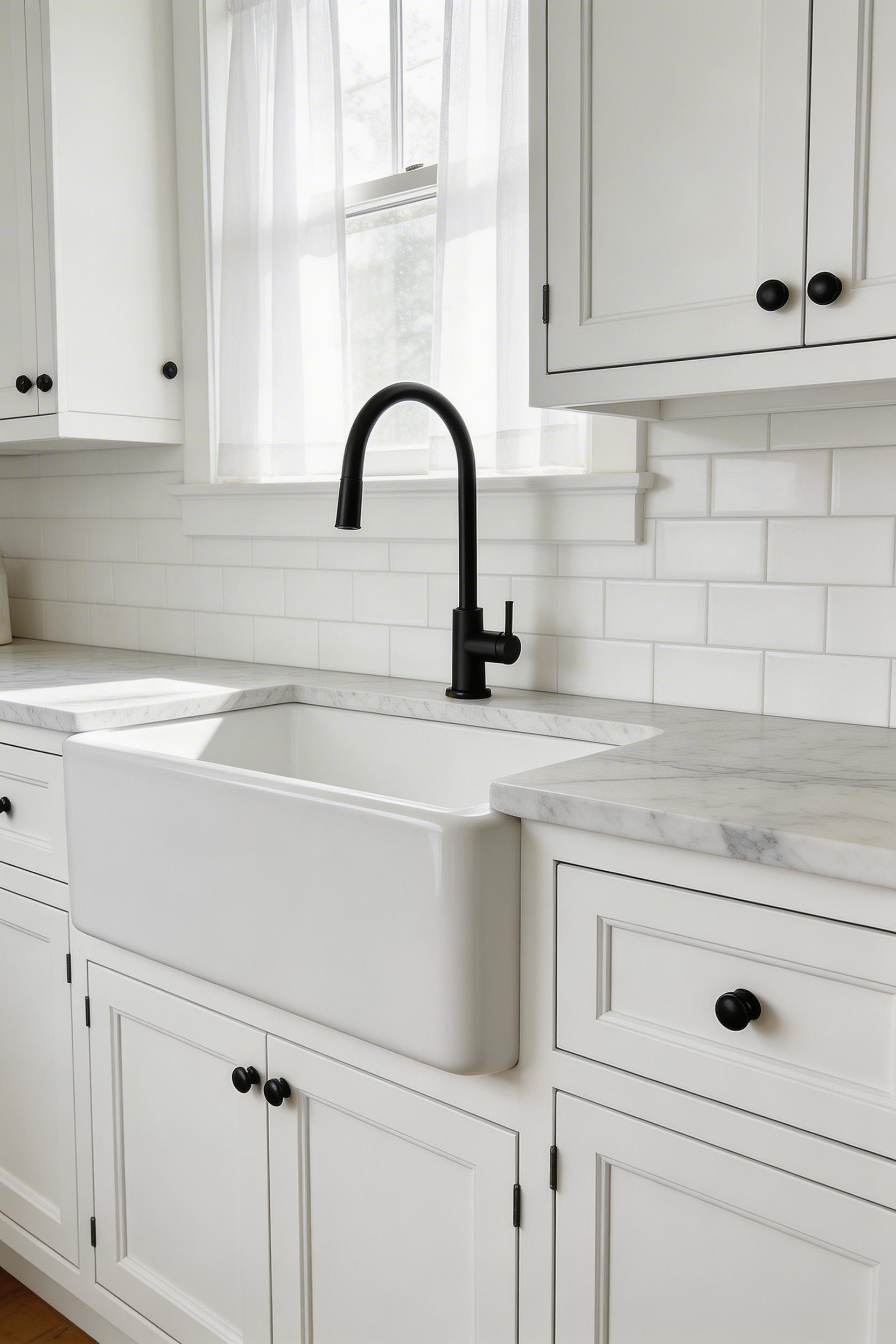
Kohler Whitehaven in fireclay measures 36 inches single-bowl and costs $1,500 to $1,800. ROHL Shaw’s Original RC3018—British-made fireclay—runs $600 to $900. IKEA’s DOMSJÖ sink in acrylic composite costs $180 and looks the part but won’t match fireclay’s longevity for daily use. Installation requires cabinet modification: you’ll remove the sink base’s front panel and sometimes lower the entire cabinet by 1 to 1.5 inches. The rough opening width should be 3 inches narrower than your sink width. This is where farmhouse kitchen decor philosophy intersects with white kitchen modernism—the apron sink works because it’s honest about its function while delivering visual warmth that pure minimalism cannot achieve.
Scandinavian design wisdom teaches that wood against white prevents coldness. It’s the principle that separates hygge from sterility. White oak, with its tight grain and warm medium-brown aging, offers visual richness without pretense. Ash appears pale and blonde, nearly white when bleached, lending an almost ethereal quality. Maple stays very light with a tight grain that accepts white stain beautifully. Birch—nearly blonde, economical, and unmistakably Scandinavian—deserves consideration for shelving or accents.
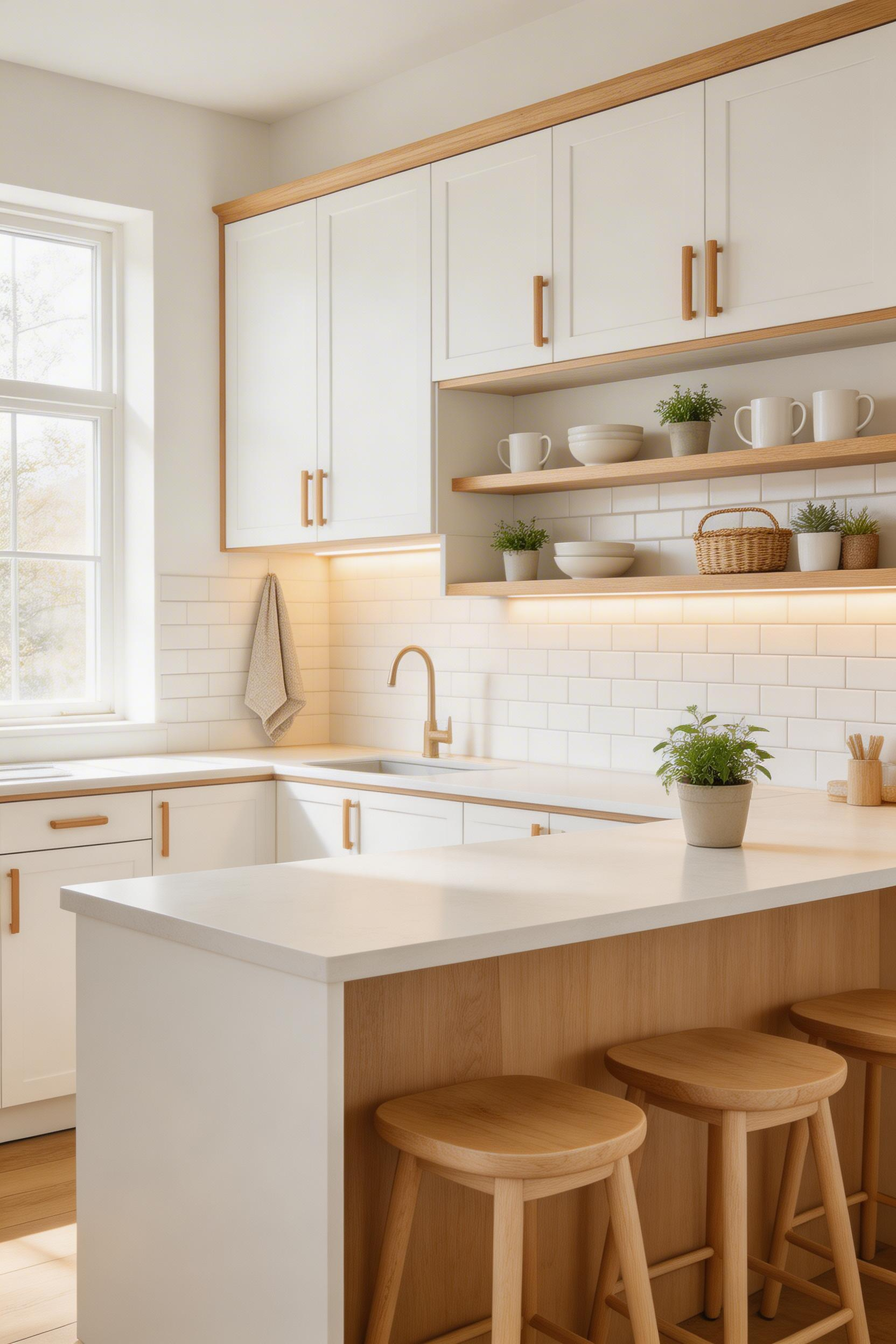
Finishing options range from Rubio Monocoat Pure (colorless, emphasizing natural wood character), Osmo Polyx Oil Raw (slight amber tone, food-safe), to IKEA’s BEHANDLA treatment (affordable and adequate). Butcher block countertops demand food-safe mineral oil every 6 to 12 months—a small ritual that connects you to your kitchen’s maintenance and authenticity. Bar stool heights follow ergonomic standards: 24 inches for 36-inch counter height, and 26 to 28 inches for island heights of 36 to 42 inches. This layering of wood tones, finishes, and proportions creates complexity within the white framework—warmth organized by restraint. The Nordic approach rejects the fear of mixing wood tones and instead celebrates how honest materials age together, developing character that planned perfection never achieves.
Standard upper cabinets end 6 to 12 inches below the ceiling, creating dead space that collects dust and visually shortens the room. Floor-to-ceiling cabinetry—whether 9-foot or 10-foot ceilings—eliminates this gap and reclaims vertical real estate. IKEA’s SEKTION system maxes out at 90 inches (7.5 feet), requiring custom or semi-custom cabinetry for taller ceiling coverage that reaches true height.
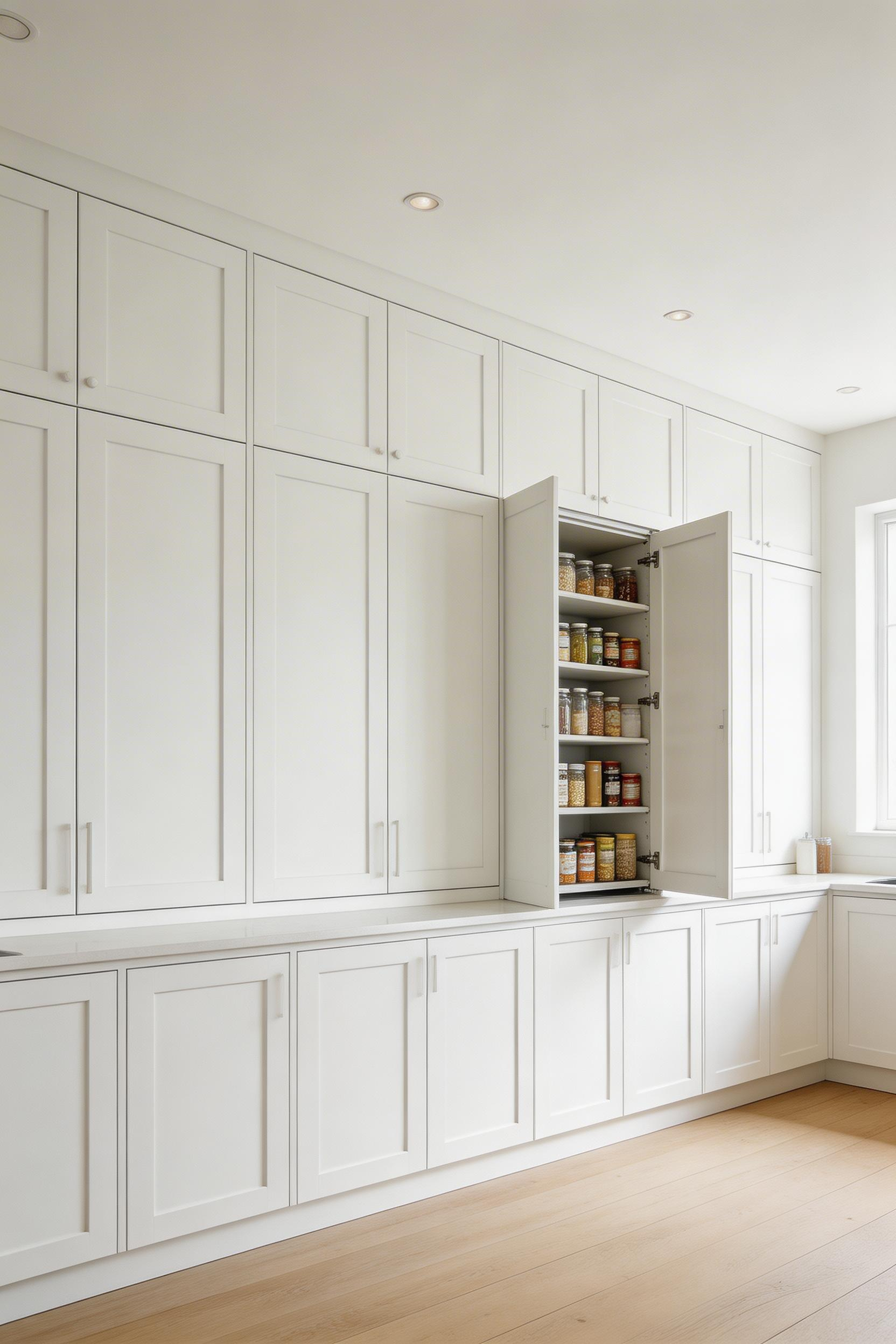
Within these ceiling-height spaces, pantry pull-out systems from Hafele, Blum, and Rev-A-Shelf ($150 to $400 per unit) organize bulk items with surprising elegance. An appliance garage—a hinged or roll-up door section 18 to 24 inches wide—houses your stand mixer, toaster, and small appliances out of sight. Crown moulding finishes the traditional look; flush-to-ceiling panels read more contemporary. The cost premium for ceiling-height versus standard upper cabinets runs 20 to 40 percent but pays dividends in perceived space and functionality. Your white kitchen gains architectural presence, and kitchen cabinet ideas become three-dimensional rather than surface-level. Planning for lighting inside tall cabinets—strip lights on the interior top or strategically placed puck lights—prevents upper reaches from becoming dark zones where you can’t find what you’ve stored.
If your white kitchen feels dated but budget constraints bite, countertop replacement alone transforms the space faster than any other single element. Laminate countertops—Wilsonart HD and Formica 180fx—now offer convincing stone and marble patterns for $15 to $40 per square foot installed. They’re not aspirational; they’re pragmatic and honest about their budget positioning. Butcher block at $30 to $60 per square foot installed (IKEA’s BADELUNDA and NORRBONN are reliable budget options) introduces warmth and material authenticity that laminate cannot match.
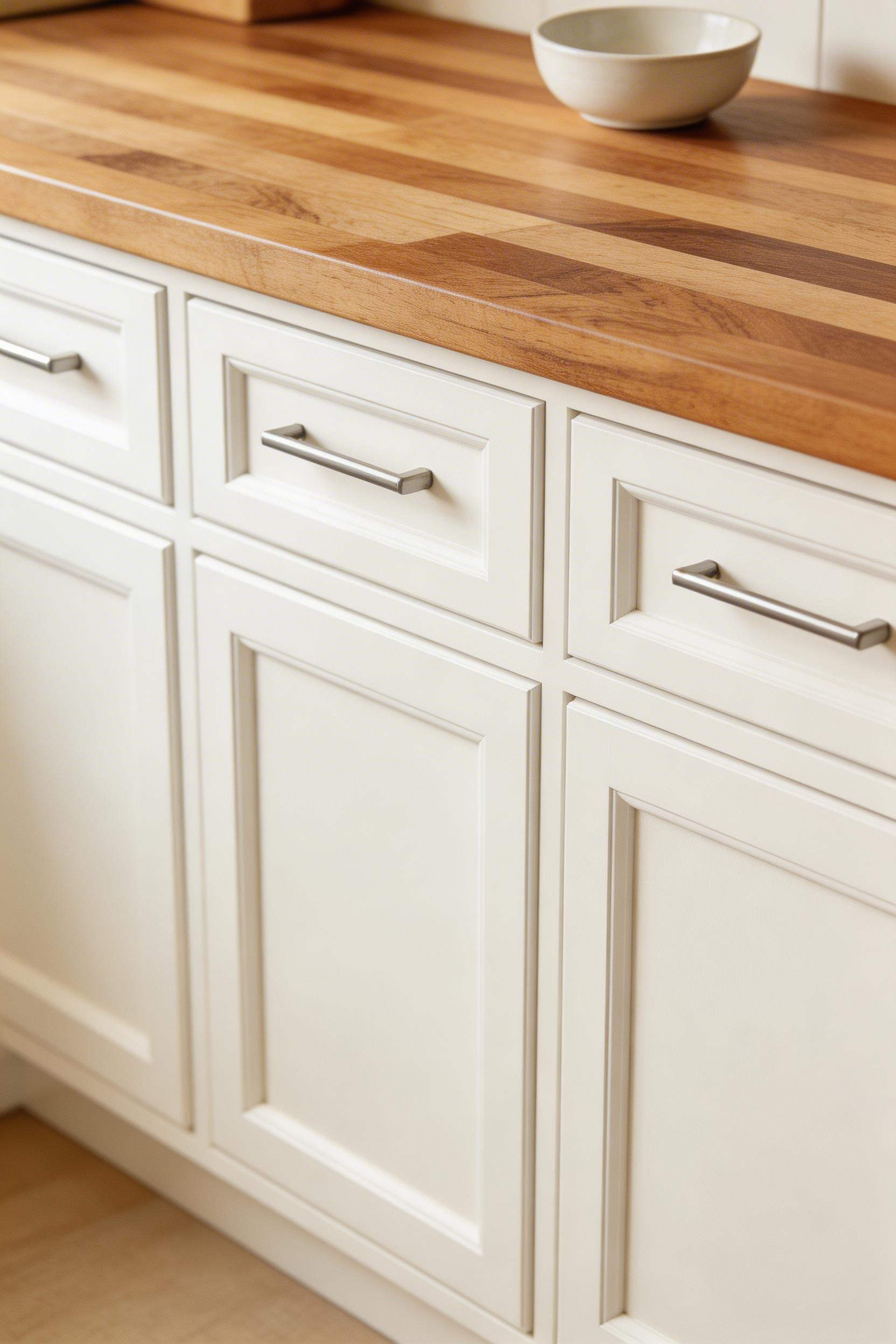
Quartz slabs deliver the marble aesthetic at $50 to $120 per square foot installed. For the handy homeowner, DIY countertop replacement is genuinely manageable—laminate installs with construction adhesive and a router for edge details, while quartz requires professional templating and installation due to weight and precision demands. Kitchen countertop replacement returns 60 to 80 percent of its cost in home value increase, making it among the smartest white kitchen remodel decisions. You’re investing not just in aesthetics but in surfaces you’ll touch thousands of times—they deserve intentionality and honest material that reflects your daily life.
Cabinet finish character profoundly shapes your kitchen’s identity. Thermofoil cabinets (vinyl-wrapped MDF) come in matte or gloss options; lacquer (solvent-based, very durable) achieves high sheen; painted finishes offer satin, semi-gloss, or matte choices. Gloss finishes reveal fingerprints and smudges readily but wipe cleaner and read more contemporary and European. Matte and satin finishes hide imperfections and fingerprints better, delivering warmer, more traditional aesthetics.
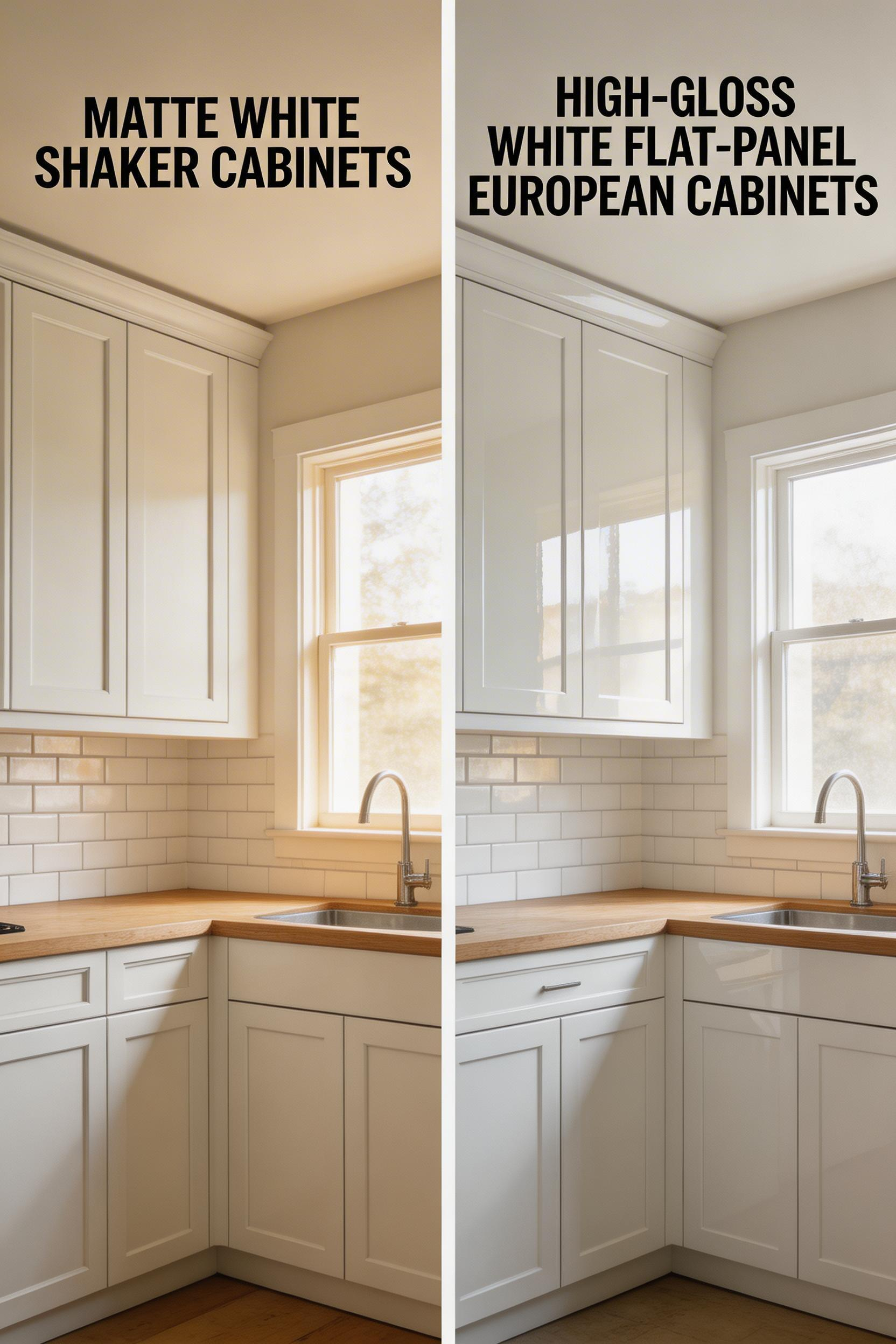
European flat-panel (slab door) cabinets from brands like Leicht, Schuller, and Pedini typically specify high-gloss white as standard. Some designers employ a mixed approach: gloss lower cabinets (more visible and requiring easier cleaning) paired with matte uppers (less prominent in sightlines). Thermofoil carries a durability caveat—the vinyl peels at edges near heat sources after 5 to 10 years. Painted or lacquered finishes near the range resist this degradation. Your choice here isn’t purely aesthetic; it’s a maintenance contract you’re signing. Matte feels warmer and more forgiving; gloss feels sharper and more urban. Choose the finish that matches not just your vision but your willingness to wipe down cabinets regularly.
Standard kitchen windows measure 30 to 36 inches wide and 24 to 36 inches tall above the sink—seemingly modest until you recognize that this is your kitchen’s primary light portal during daylight hours. Casement windows (crank-out design) offer full ventilation; 100 percent of the opening area operates. Double-hung windows only achieve 50 percent operational area. A fixed picture window maximizes glass area for light penetration while sacrificing ventilation—a sensible trade-off if you have range hood extraction and cross-ventilation from elsewhere.
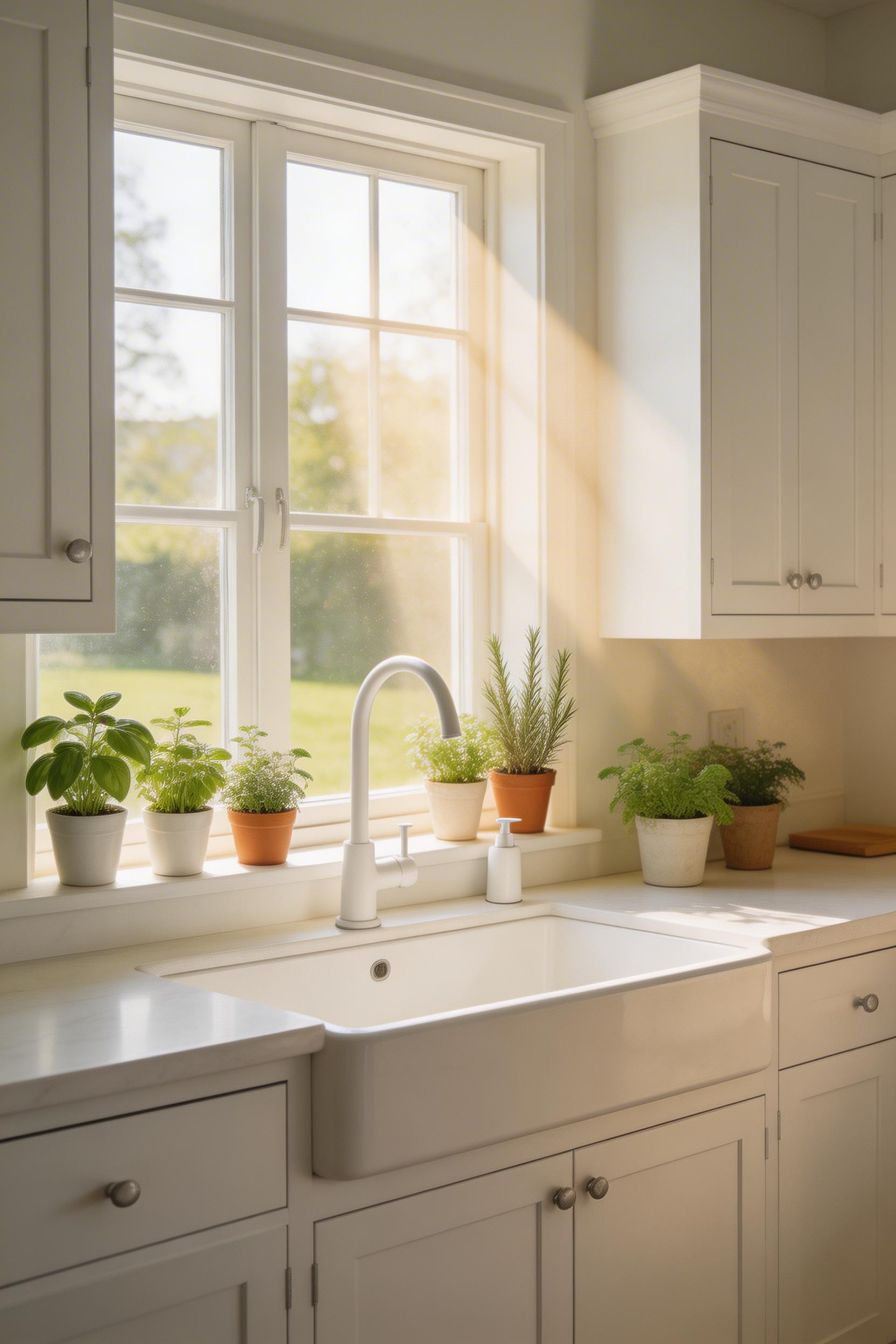
Low-E glass coatings reduce UV and heat gain, critical for south-facing kitchens where summer intensity can be overwhelming. Window trim choices shape the entire character: painted wood or MDF trim matching your cabinets creates seamless, contemporary integration in your white kitchen renovation. Natural wood trim (white oak or ash) introduces warm contrast, and kitchen lighting ideas from a different angle—daylight becomes an architectural feature. Sill depth of 3.5 to 5 inches accommodates plants or herbs, turning the window into a functional detail rather than just glass. Privacy glass options (frosted, obscured, or switchable smart glass) prevent neighbors from seeing into your kitchen while maintaining light transmission—a consideration many overlook until they’re framed by a large window. Replacement window costs range from $350 to $900 per window (materials only) to $600 to $1,500 installed depending on size and frame material. This is where your white kitchen negotiates with the exterior world—make it generous.
Pendant lighting over an island becomes both functional and sculptural. Standard sizing follows a rough rule: pendant diameter in inches should roughly equal ceiling height in feet. A 9-foot ceiling suggests 9-inch-minimum diameter pendants. For a 6-foot island, two pendants at 24 to 30 inches diameter each, or three smaller pendants at 12 to 16 inches diameter, balance proportion and function.
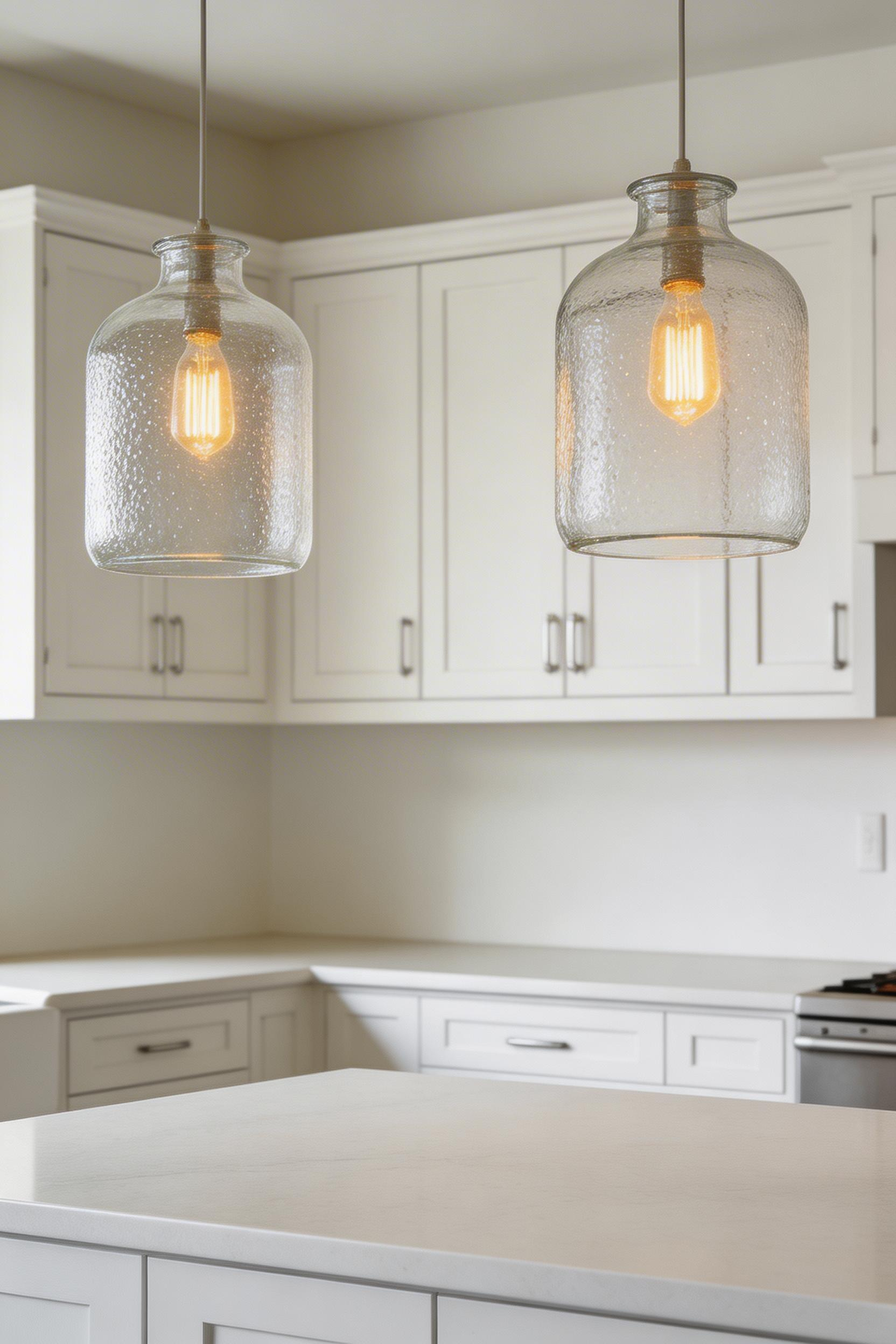
Hanging height matters with equal precision: the bottom of your pendant should sit 30 to 36 inches above the countertop (32 inches is the industry standard). Clear glass pendants in seeded, industrial, or globe styles open up the space visually and don’t compete with your white cabinetry. Rattan and wicker pendants—very on-trend for Nordic-boho kitchens—add warmth and texture through material rather than color shift. Ceramic creates a crafted, artisan statement that feels personal. Brands like West Elm ($100 to $200 per pendant), CB2, and Visual Comfort & Co. (designer tier at $300 to $800) sit above IKEA’s RANARP and SINNERLIG budget options ($30 to $60), but all achieve legitimacy if the proportion is right. Wiring requires confirmation that your ceiling box rates for pendant weight—most handle 50-pound capacity, sufficient for hardwired pendants. These lights don’t just illuminate your island; they punctuate your kitchen island ideas and invite people to gather there, transforming a work zone into a social anchor.
The sequence matters more than simultaneous decision-making. Begin with cabinets—they’re the largest investment and define everything downstream. Once cabinets are set, countertops follow. Backsplash, hardware, and fixtures layer afterward, each choice refined by what came before. Realistic budget ranges: if you’re painting existing cabinets, allocate $1,500 to $4,000 for professional spray application. New cabinetry starts around $5,000 for basic IKEA construction and climbs toward $15,000-plus for semi-custom or custom quality. Countertops add another $2,000 to $8,000 depending on material. Backsplash, lighting, and hardware might add $3,000 to $6,000 combined.
Where to splurge and where to save requires honest reflection. Invest in cabinets and countertops—surfaces you touch and see constantly. Save on backsplash by choosing classic subway tile rather than specialty shapes. Your kitchen backsplash ideas can always evolve; your cabinet framework cannot shift easily. Lighting and hardware are low-cost moves that deliver disproportionate impact—don’t underinvest here. A white kitchen remodel succeeds not because it’s expensive but because every element serves intention. Start with cabinets, honor your budget honestly, and let each decision build on the last. Your white kitchen is waiting—not as trend or trend-following, but as the enduring choice of people who understand that simplicity, when done thoughtfully, never needs revision. A white kitchen remodel, approached with the Scandinavian philosophy of quality and restraint, becomes the permanent backdrop for decades of family life.