Physical Address
304 North Cardinal St.
Dorchester Center, MA 02124
Physical Address
304 North Cardinal St.
Dorchester Center, MA 02124
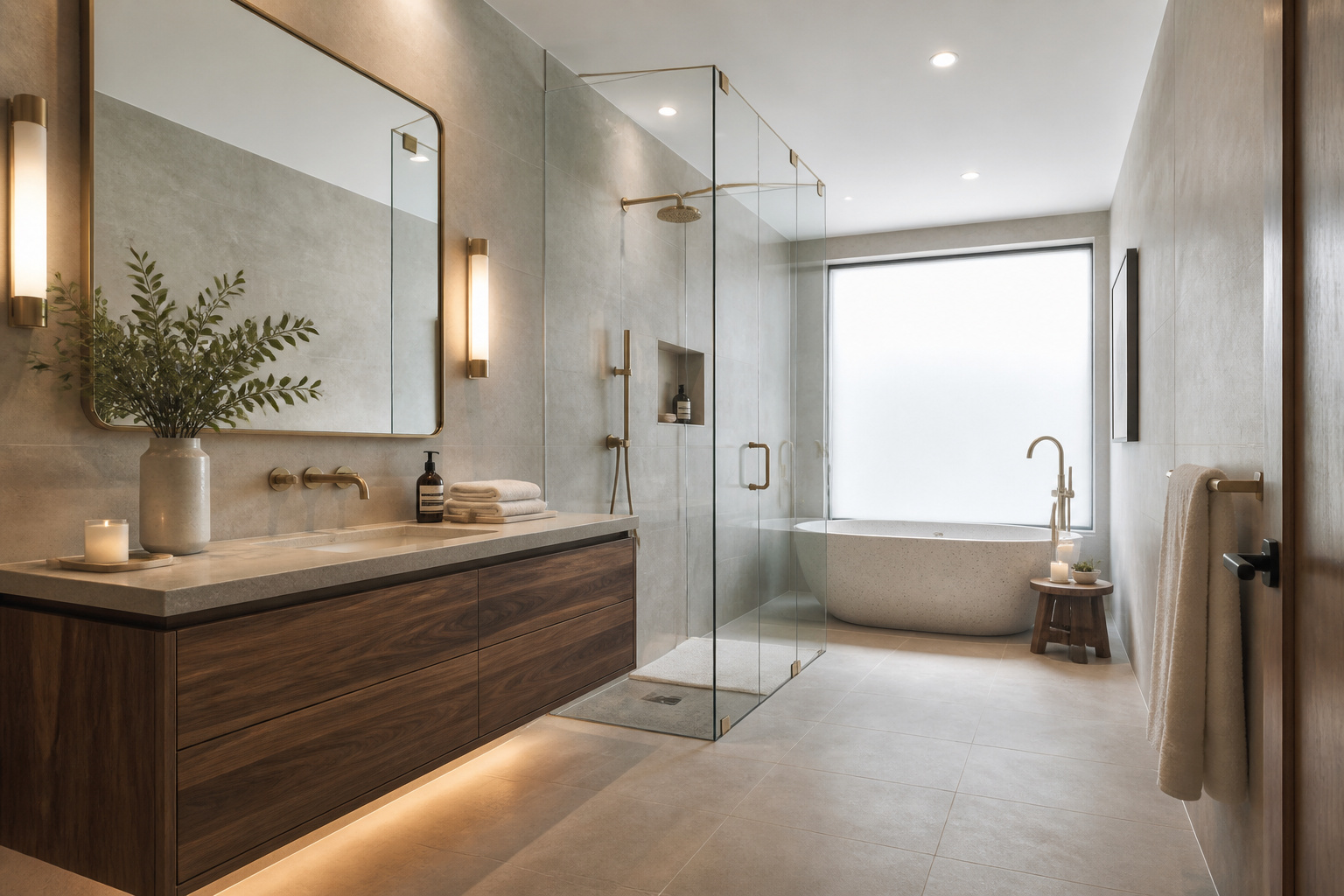
15 warm, refined modern bathroom design ideas — floating wood vanities, terrazzo floors, brushed brass fixtures. Scandinavian principles, real details.
Modern bathroom design has a reputation it doesn’t entirely deserve. Somewhere along the way, “modern” became shorthand for cold — white on white on chrome, surfaces so polished they echo. That’s not modern design. That’s modern design done badly.
I’ve spent eleven years working with Scandinavian principles. The goal was never sterility. It was always warmth through restraint. The best modern bathroom design I’ve seen shares one quality: it feels considered. Every material earns its place. Every element serves a purpose. And the room — whether it’s twelve square feet or forty — feels like somewhere you actually want to spend time.
These fifteen ideas cover the full range. Some require a contractor during a renovation. Some need only a tin of paint and a clear Saturday morning.
The fastest way to make a bathroom feel smaller is to install a floor-standing vanity. The base creates a visual barrier that cuts the floor plane in two. The horizontal line it draws across the lower wall compresses the room. A floating vanity removes all of that. The floor reads as unbroken. The room breathes. And cleaning becomes a thirty-second job.
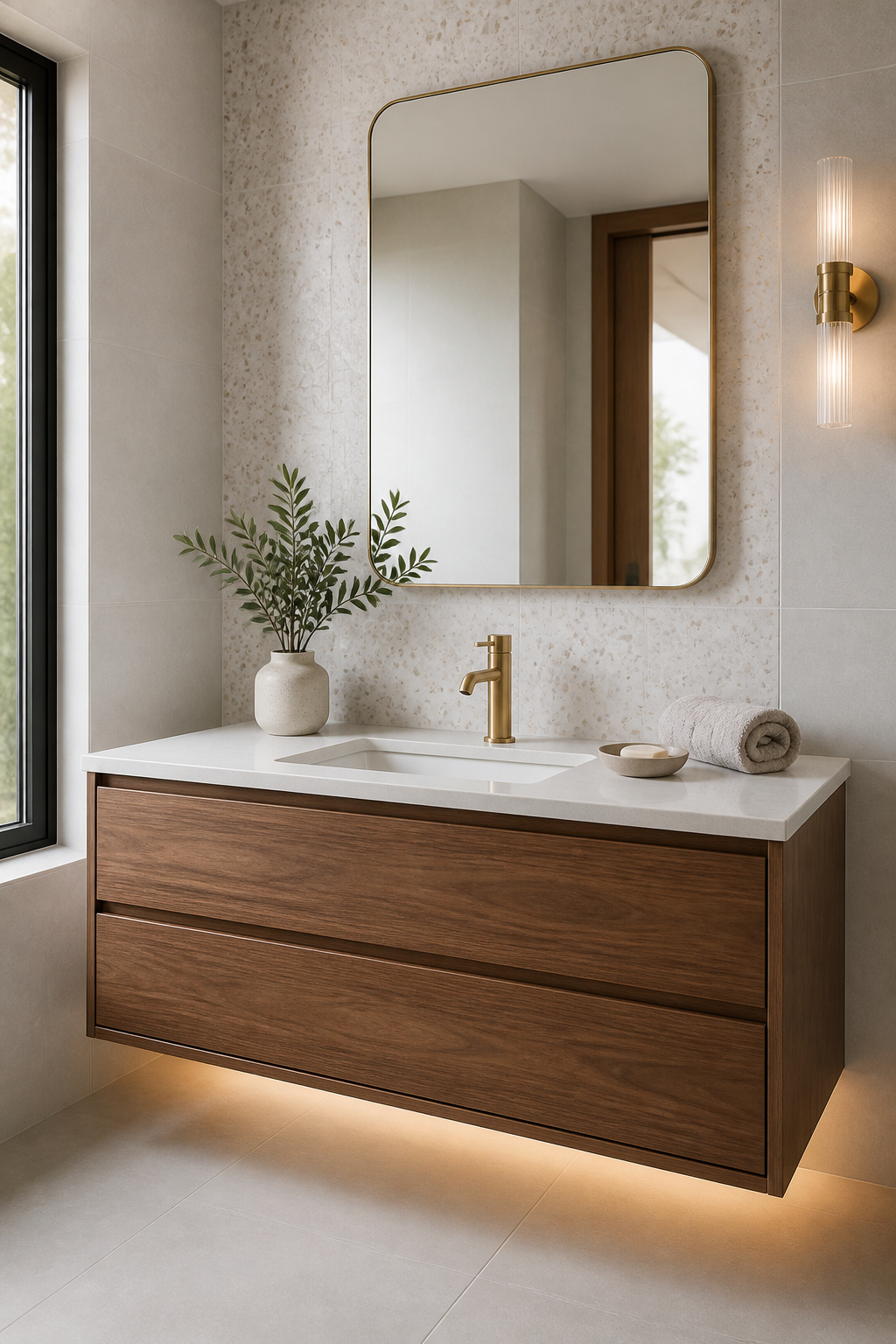
Wood tone is what prevents this look from reading as clinical. Teak and white oak are the two species worth knowing about. Teak contains natural oils that repel moisture without heavy treatment. It has been used in shipbuilding for centuries. White oak has a denser cellular structure than red oak. It absorbs far less water in humid environments.
Standard floating vanity height runs 32–36 inches from floor to countertop. The wall behind needs solid blocking — typically two horizontal 2×6 boards between studs — to carry the weight of the unit and countertop. If you’re choosing the right bathroom vanity for the first time, measure depth carefully. Older antique dressers often sit at 18–20 inches rather than the modern standard of 21–22 inches.
The maths behind large-format tiles is straightforward. Fewer tiles means fewer grout lines. Fewer grout lines means fewer visual interruptions across the floor. A 24×48-inch tile grid has roughly five times fewer joints than a standard 12×12-inch grid on the same floor area.
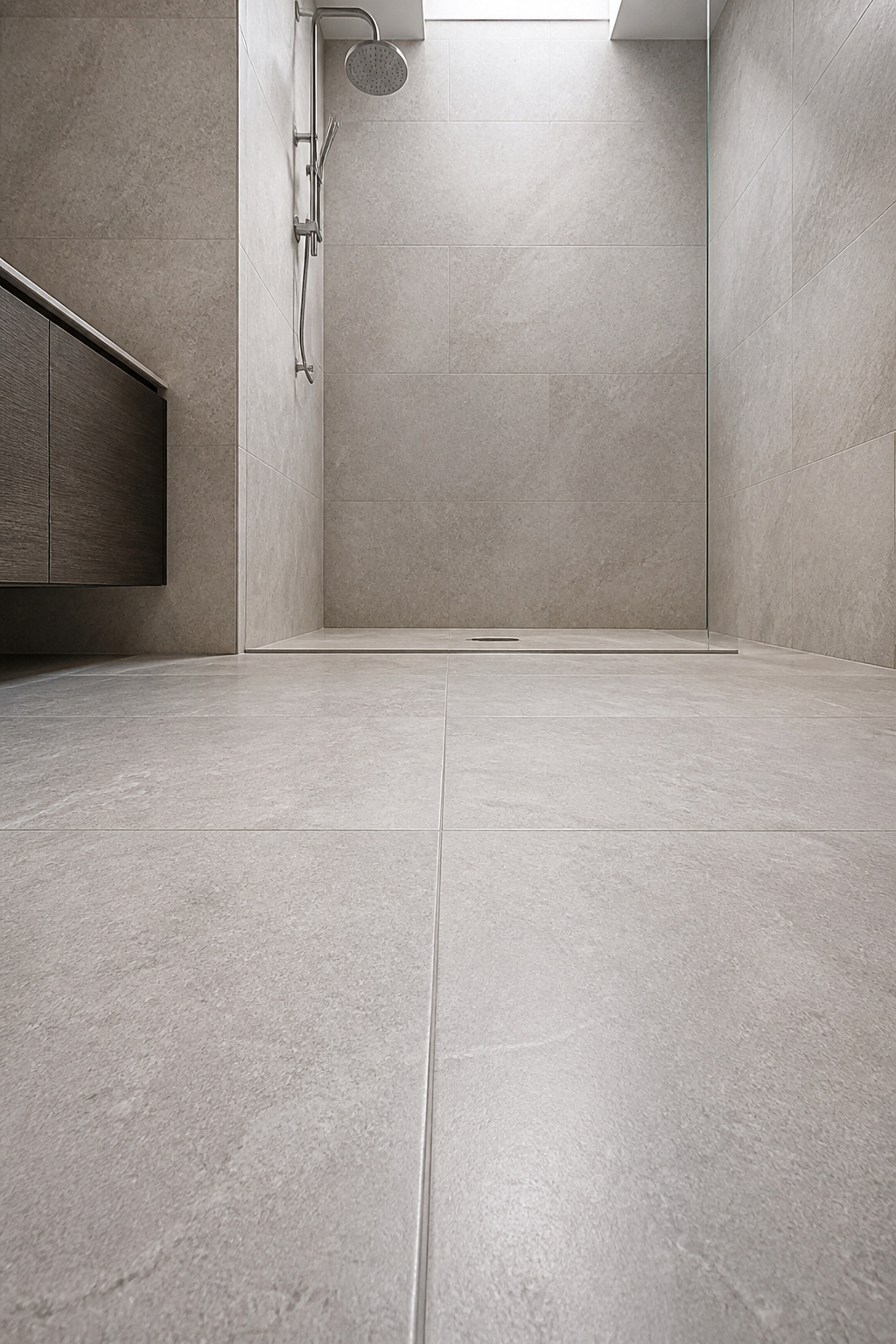
The most effective approach in contemporary bathrooms is to match grout colour closely to the tile. Warm grey tile with barely-visible warm grey grout creates something close to a continuous surface. Running the same tiles up the walls amplifies the effect further. When floor and walls share the same material, the room feels larger than its measured dimensions.
For floors, look for an R10 anti-slip rating at minimum. R11 is appropriate for wet rooms or open shower areas where bare feet on wet tile is a daily reality. The COF (coefficient of friction) value should be above 0.42 for any floor tile. Porcelain doesn’t require sealing — only the grout does, annually in shower zones. Brands worth investigating: Porcelanosa for premium large-format slabs, Floor & Decor for accessible pricing, and Bedrosians in the mid-range.
One practical note: large-format tiles require a flatter substrate. Any variation in the floor beneath will show as lippage — one tile edge higher than the next. Professional installation with a self-levelling compound before tiling is the standard fix. It adds cost, but it’s not optional when you’re using tiles over 24 inches in any dimension.
A wet room makes the shower boundary invisible. The entire bathroom floor is waterproofed and sloped toward a drain. Water is managed by gravity and geometry rather than by glass and seals. The result removes every frame line from the visual field. It’s the shower aesthetic that defines the most aspirational contemporary bathrooms.
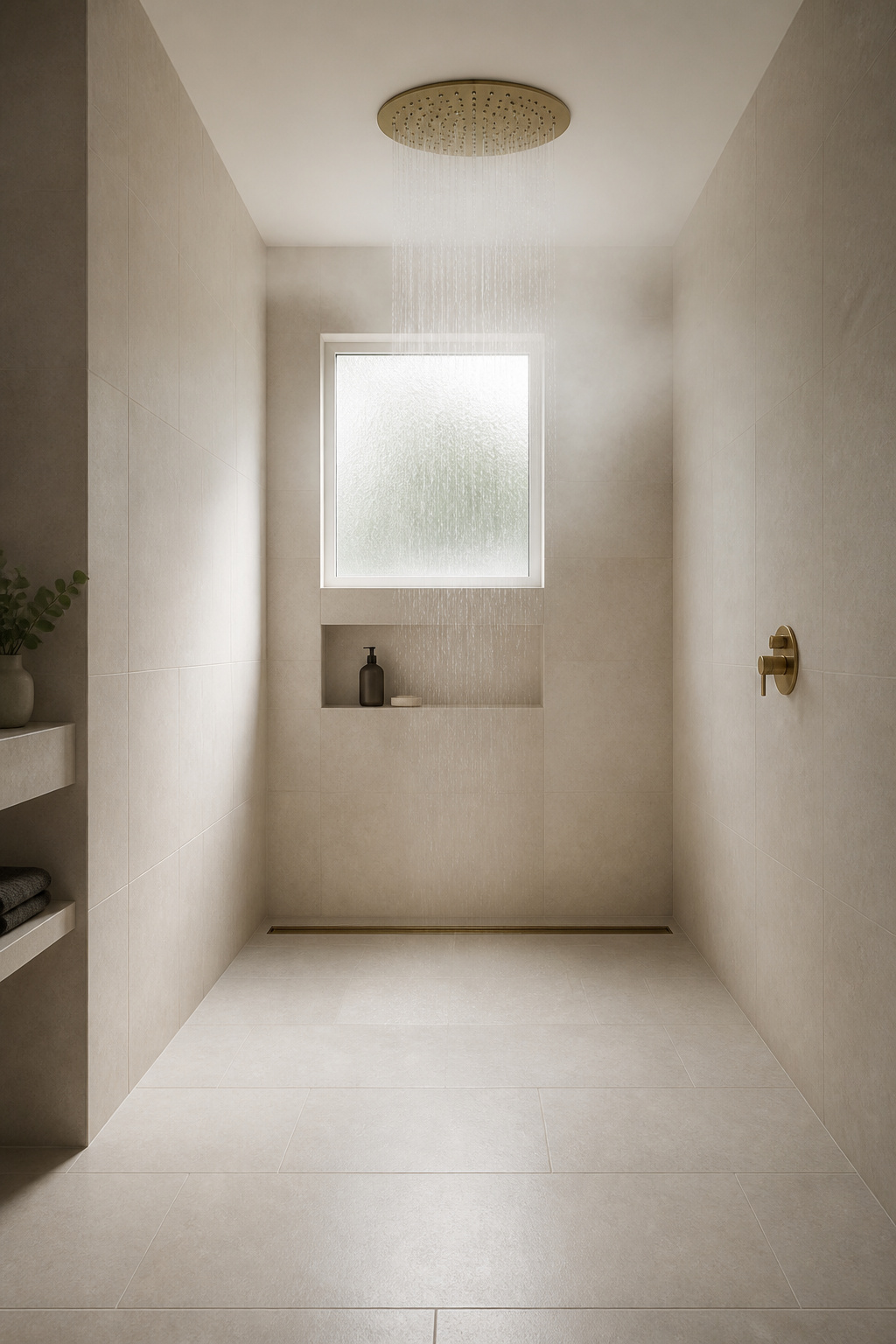
The floor must slope at 2% (about a quarter inch per foot) toward the drain. Professional installation is essential; slope errors are expensive to fix once tiles are laid. Schluter KERDI membrane and Mapei Mapelastic are the two most-used waterproofing systems. Both must extend at least six inches up the wall above the floor. For drains, Infinity Drain and Easy Drain are the premium choices. Schluter’s KERDI-LINE is the reliable mid-market option.
Ceiling-mounted rainfall heads — 8 to 16 inches in diameter — need thermostatic plumbing with a flow rate of at least 2.5 GPM to perform well. US residential 2-inch waste lines handle about 9 GPM at half-inch head. Match the drain capacity to the showerhead output. For well-designed bathroom shower ideas that work in both open and enclosed formats, the waterproofing system is always the investment that matters most.
Chrome made sense when it was the only durable option. It isn’t anymore. Matte black has moved from trend to standard fixture finish. There’s a practical reason beyond aesthetics: it hides water spots and fingerprints in daily use. A chrome tap shows every water droplet by mid-morning. A matte black tap in the same environment needs no attention between cleanings.
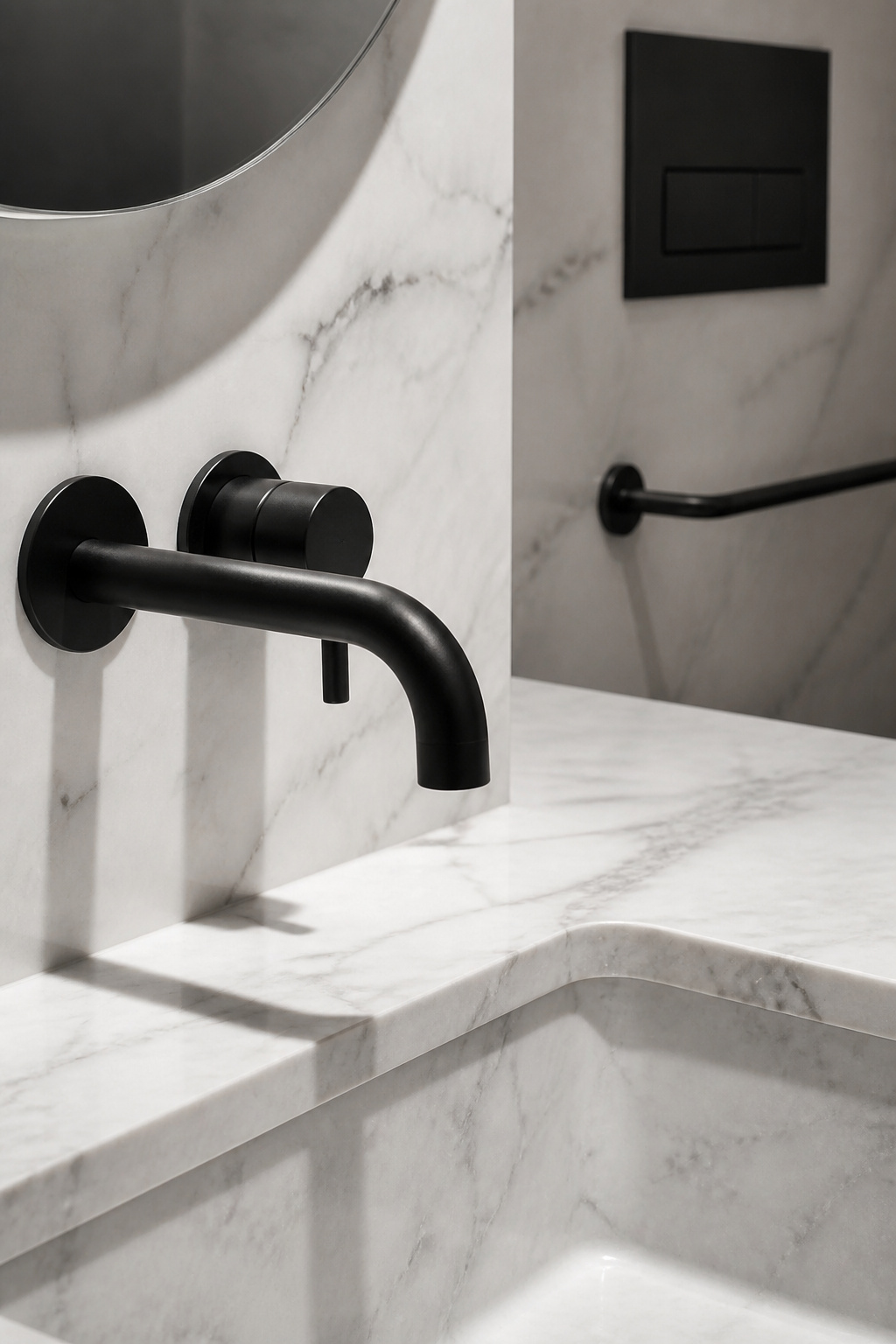
The finish quality matters more than the colour. Look for PVD (Physical Vapour Deposition) coating over solid brass or stainless steel. PVD deposits material one atom at a time in a vacuum chamber. The bond doesn’t peel, bubble, or fade under normal bathroom conditions. Avoid zinc alloy beneath any finish — it corrodes in humid environments within a few years.
For coordinated hardware, Hansgrohe and VOLA are the two brands that recur in high-specification bathrooms. VOLA — the original minimalist Scandinavian tap, made in Denmark since 1968 — is a particular favourite for clean-lined projects. Its matte black modular system covers taps, shower valves, and towel rails in an exact finish match. Hansgrohe backs their matte black range with a 5-year guarantee on hardware and 20 years on ceramics — a useful commitment in a high-use room. Source all hardware from one manufacturer. Matte black varies subtly between brands. The difference is visible in person even when it looks identical on a product page.
One common mistake: mixing matte black with cool grey stone. The combination can read as clinical rather than warm. Matte black hardware works best against creamy white stone, beige-veined marble, or warm limestone — materials that add temperature to the contrast rather than emphasising coldness.
Most bathrooms are over-lit in the wrong places and under-lit where it matters. A single overhead downlight floods the room from above. It creates shadows precisely where you need to see clearly — the face. The fix is straightforward but requires a small rewire: task lighting at the mirror, ambient lighting overhead on a separate dimmer circuit, and accent lighting wherever you want to define architecture.
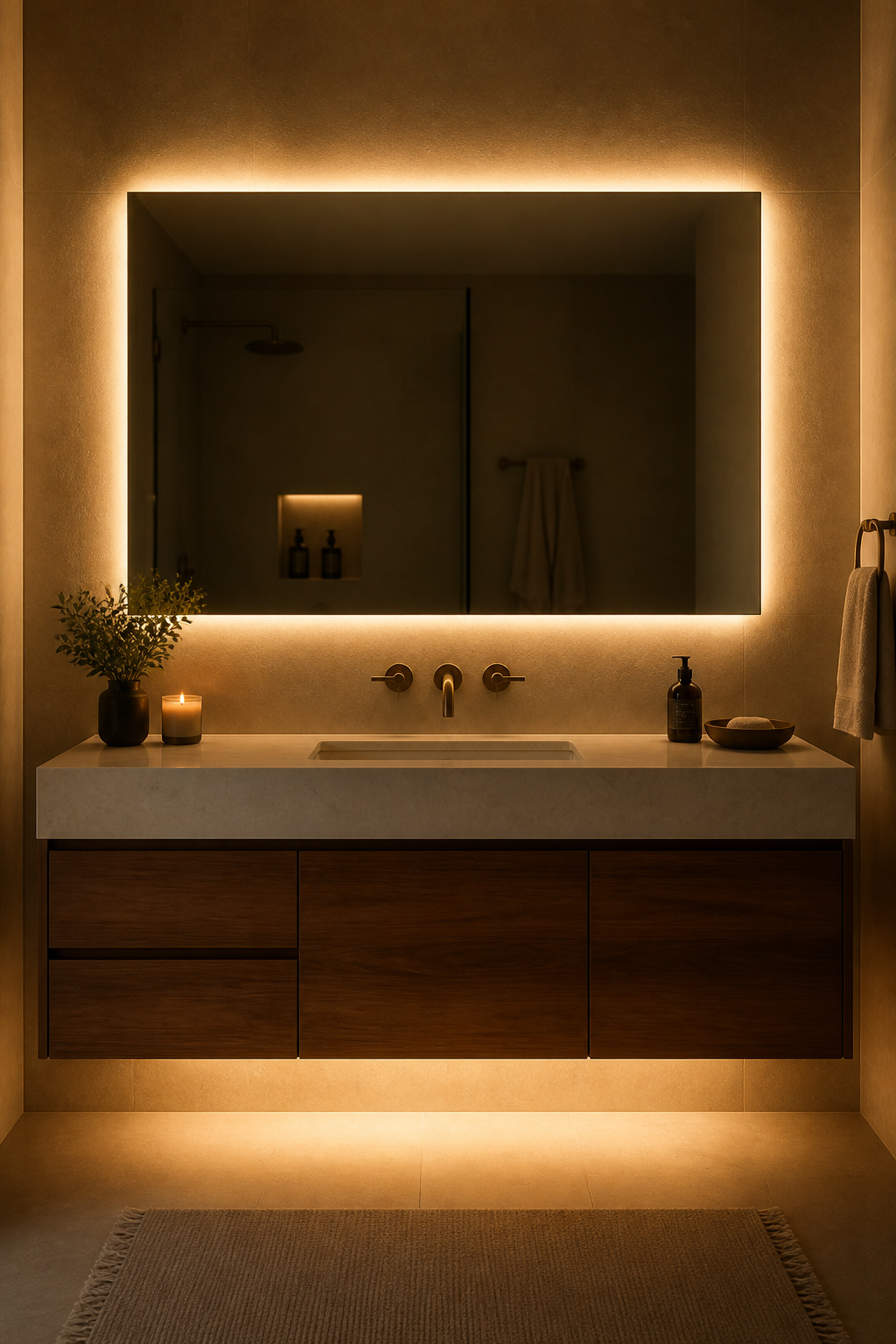
LED strip lights behind the mirror are the most impactful single change you can make in a modern bathroom design. The light spills forward and outward simultaneously. It eliminates facial shadows from both sides. The strip should sit 20–30mm back from the mirror edge in a shadow-gap reveal. No light source is visible — just a diffused halo. Use warm white (2700–3000K) throughout. Daylight temperature LEDs at 5000K look unflattering and make skin tones grey.
Under-vanity strips also serve as practical night lights. They’re useful when other household members don’t want the full bathroom circuit switched on at 2am. Check IP ratings before purchasing. Zone 1 (directly above the tub or shower) requires IP65 minimum. Zone 2 and everything beyond requires IP44 minimum. Add a trailing-edge dimmer circuit while you’re at it. The ability to dial the lighting down at night changes how the bathroom feels after sunset more than almost any other detail.
A freestanding tub is architecture more than plumbing. It occupies the room’s visual centre. The material decision sets the tone for everything else. Get this right and the bathroom has a clear hierarchy. Skip the freestanding format for a built-in tub and the room might be functional — but it will never feel truly designed.
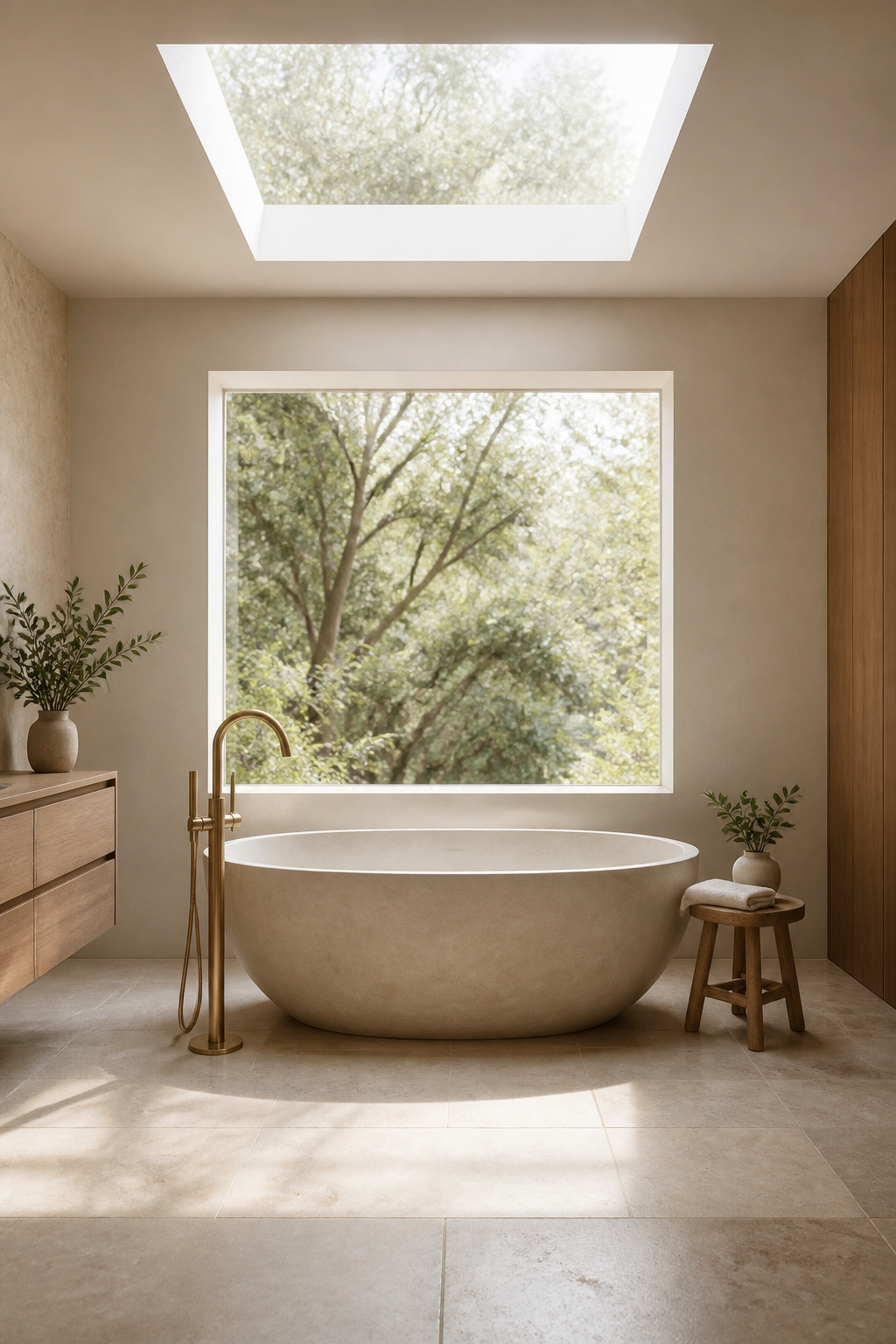
Material choice is the consequential decision. Cast iron weighs 320–500 lbs empty and retains heat better than any other option. But a cast iron tub filled with water and two adults creates about 1,230 lbs of combined floor load. Second-floor bathrooms need a structural engineer’s sign-off before ordering. Stone resin weighs 265–400 lbs and retains heat nearly as well. It has a matte surface that feels genuinely stone-like. Acrylic is lighter (80–150 lbs) and more budget-friendly but retains heat poorly. For creative bathtub ideas across all budget levels, stone resin hits the best balance of performance and weight.
Style the tub with restraint. A single floor-standing tap or floor filler in brushed brass. A small teak side table or stone stool. That’s the complete list. Every addition — caddies, hanging eucalyptus, draped towels, trailing plants — dilutes the sculptural effect.
Framed glass says: here is an enclosure. Frameless glass says: the room continues. That is the perceptual difference. The price premium is justified.
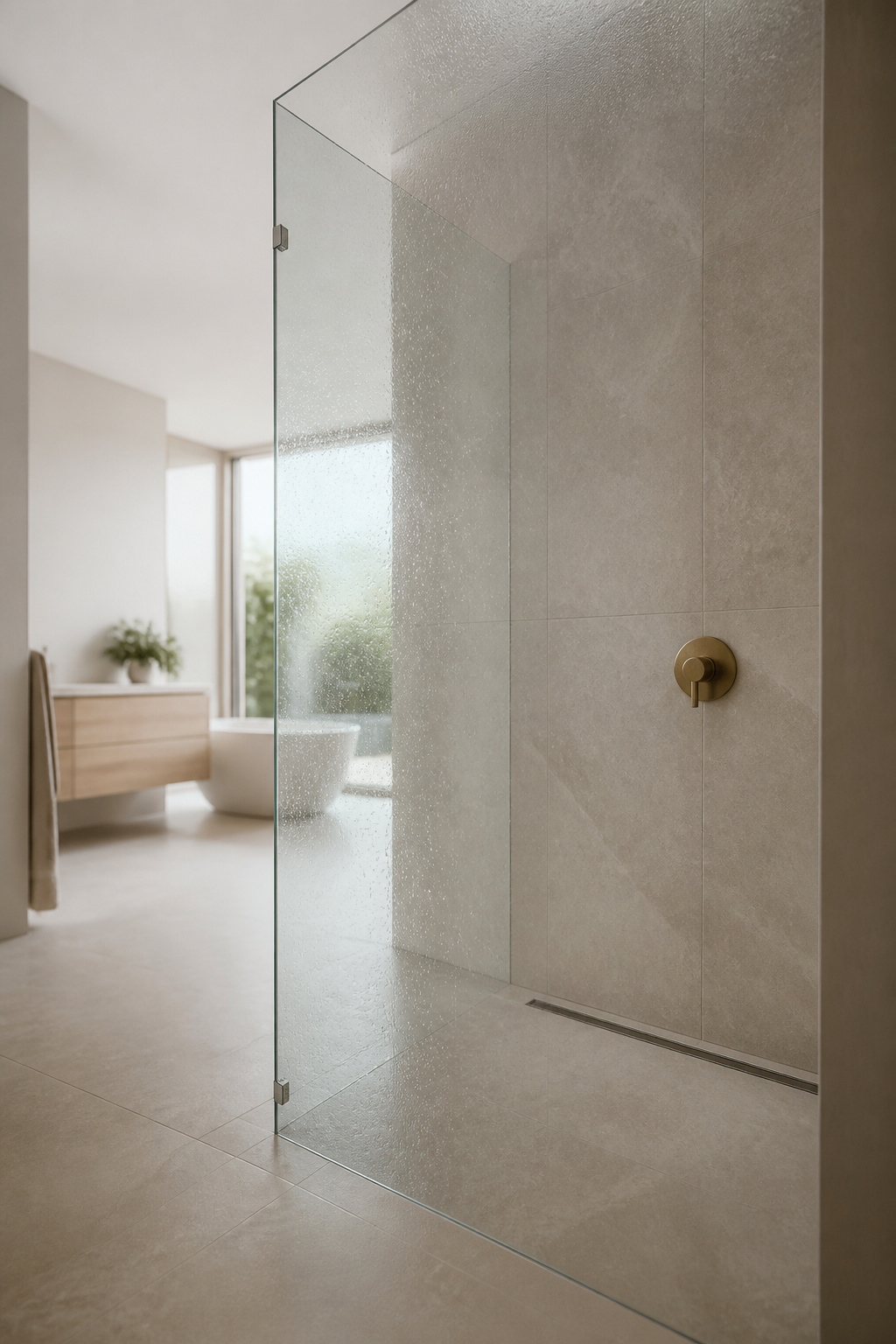
Fully frameless panels use 8mm or 10mm toughened safety glass. The glass stands independently, supported only by minimal hinge hardware. Semi-frameless retains a channel at the top and bottom edge. It uses thinner 6mm glass and is structurally reliant on those perimeter frames. For design purists, fully frameless is worth the price difference. The visual impact in a tiled bathroom is significant. Toughened safety glass is a legal requirement in most jurisdictions. It breaks into small granular fragments rather than sharp shards if it fails.
Know the maintenance reality before you commit. Frameless glass in a hard water area shows limescale faster than expected. Daily squeegee use is the most effective preventive measure. The better long-term solution is a factory-applied hydrophobic coating. EnduroShield claims to reduce cleaning time by 90%. Ritec ClearShield creates a similar barrier. Both are available on new screens and as aftermarket applications. In soft water areas, a daily squeegee is genuinely sufficient.
Open shelving in a Nordic bathroom isn’t a storage strategy. It’s a curation problem. The question isn’t how many shelves to fit. It’s what earns the right to be visible. Branded product bottles, razors, and everyday toiletries go behind closed doors. What stays on the open shelf is a small set of items that are both functional and beautiful: a ceramic soap dispenser, a small potted plant, one rolled linen towel, a candle.
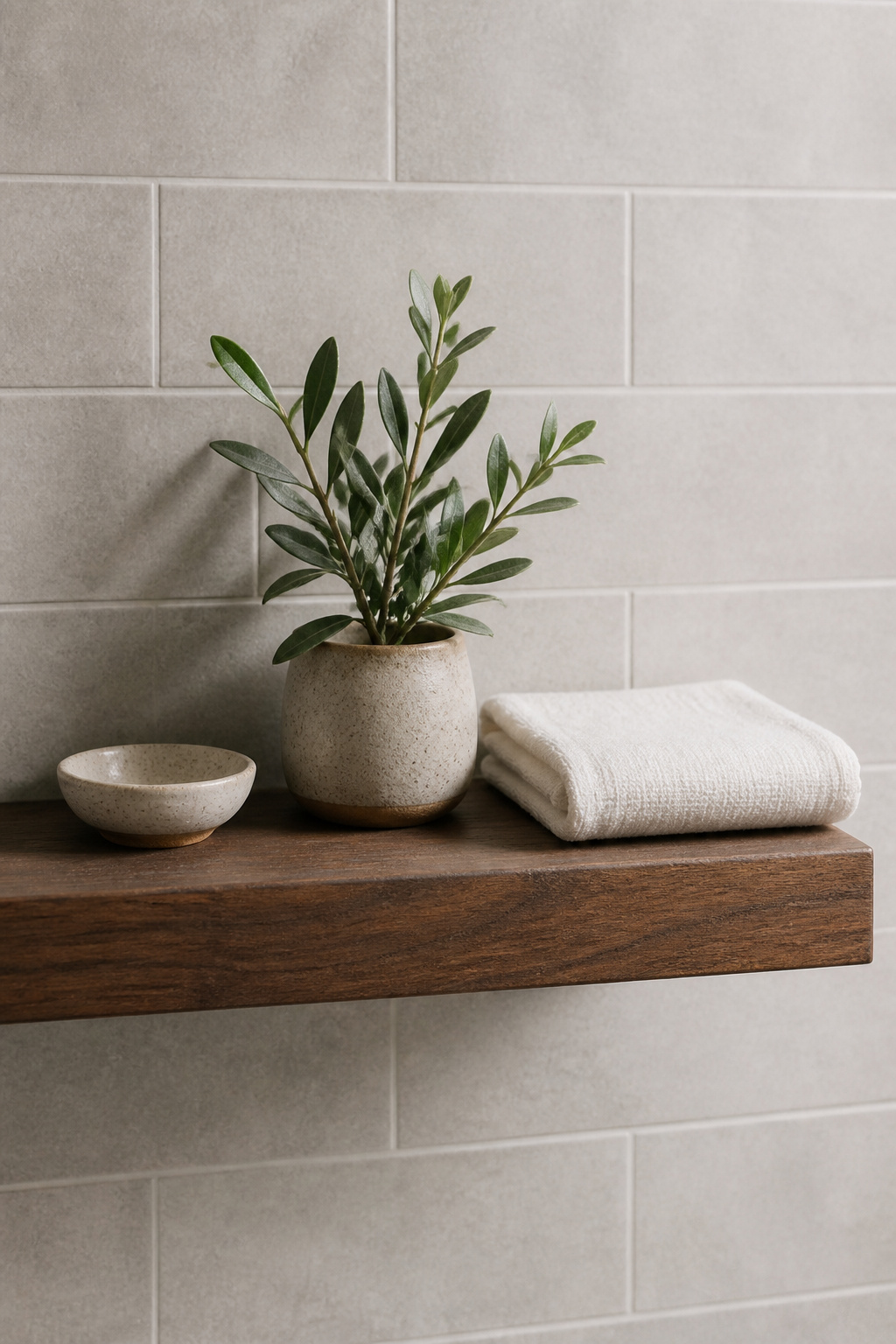
Walnut’s warm brown tones work well against cool-toned tiles — white subway, pale grey porcelain, soft limestone formats. The warmth of the wood breaks what could otherwise read as clinical. A 40mm thick shelf with invisible steel brackets creates the thinnest possible profile. The KovaScape hidden bracket system supports up to 60 lbs per pair. That’s more than adequate for bathroom display and a few bottles. Before installation, seal the walnut with hardwax oil or a water-resistant finish. Untreated timber in a humid bathroom warps and darkens within months.
The height matters too. A single shelf positioned at 60–70 inches from the floor — roughly at shoulder height — sits in the natural sightline when you enter the room. Lower shelves disappear behind the vanity top. Higher shelves read as awkward storage rather than considered display. Get the placement right and one shelf does more for the room than four shelves positioned without thought.
Terrazzo is back. The terrazzo of the 1970s — beige speckle in institutional lobbies — has been replaced by something genuinely appealing. Larger chips. Warmer base colours. Combinations of marble, granite, and glass aggregate that feel deliberately chosen rather than accidentally inherited. Contemporary terrazzo often pairs a warm grey or cream base with charcoal and cream chips. That palette works with almost any fixture finish.
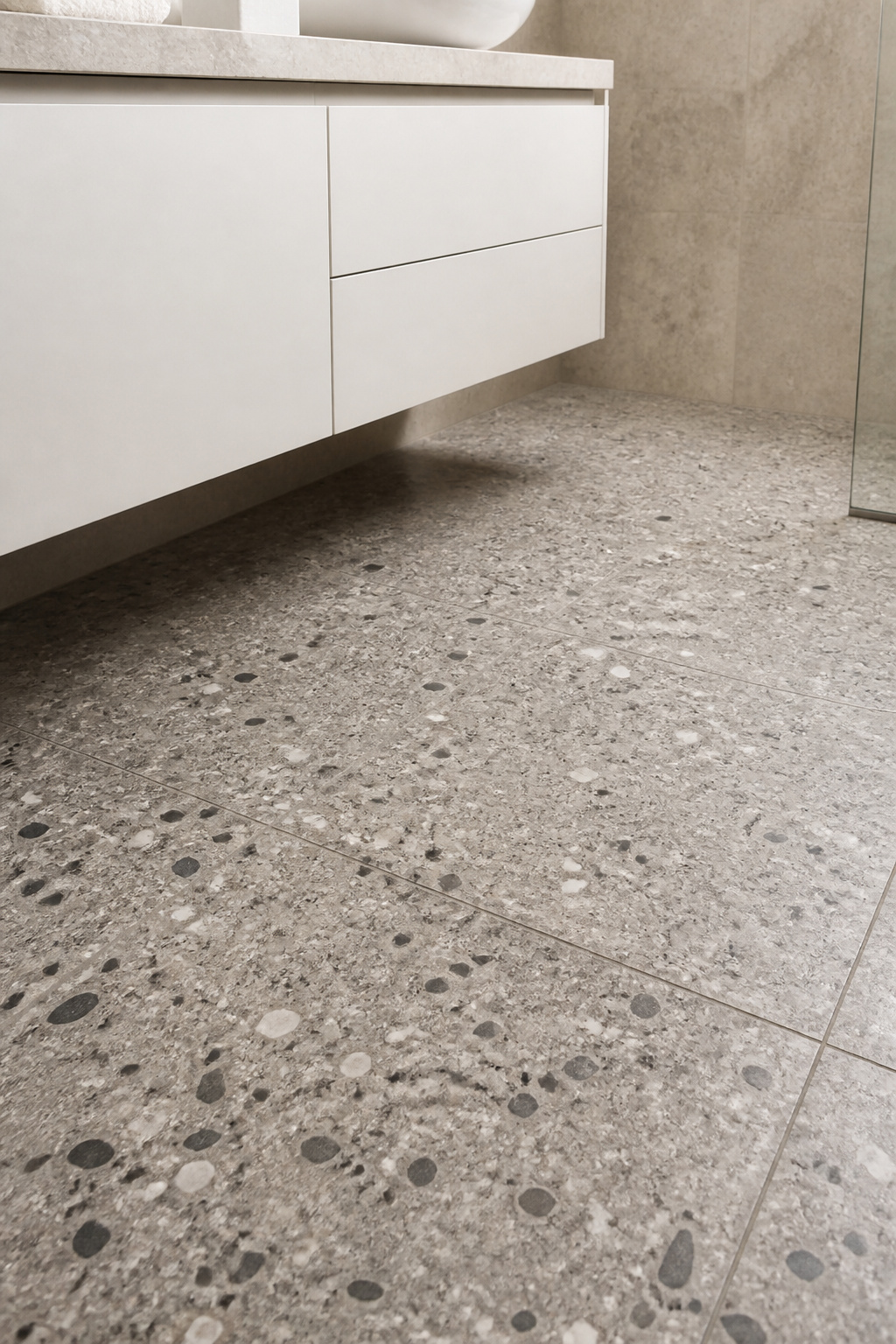
The key to making terrazzo work in a modern bathroom design is restraint about placement. Terrazzo on every surface creates visual overload. Terrazzo on one surface creates a focal point. The floor is the most effective single application. The pattern is visible from anywhere in the room but doesn’t compete with the vertical surfaces you face when standing at the basin. Countertops are a strong second choice.
If the cost of authentic cement terrazzo gives you pause — and it should — the porcelain terrazzo-look alternative is worth serious consideration. The visual difference from standing height is genuinely minimal. A practical hybrid: authentic terrazzo on the floor, porcelain terrazzo-look on the walls behind it. This combination saves 30–40% compared to using authentic material throughout. Authentic terrazzo tiles run $6–$10 per square foot. Porcelain terrazzo-look starts at $3–$6. For more bathroom tile ideas for a mindful, textured space, the principle of using one expressive tile and keeping everything else quiet applies across nearly every contemporary bathroom design.
Concrete sinks have moved from loft conversions into mainstream renovation. The appeal is clear. A concrete basin has a matte, non-reflective surface that absorbs light rather than bouncing it. That effect feels calm and deliberate in a way that ceramic or stainless steel don’t achieve. No two concrete sinks are identical. That’s part of the point.
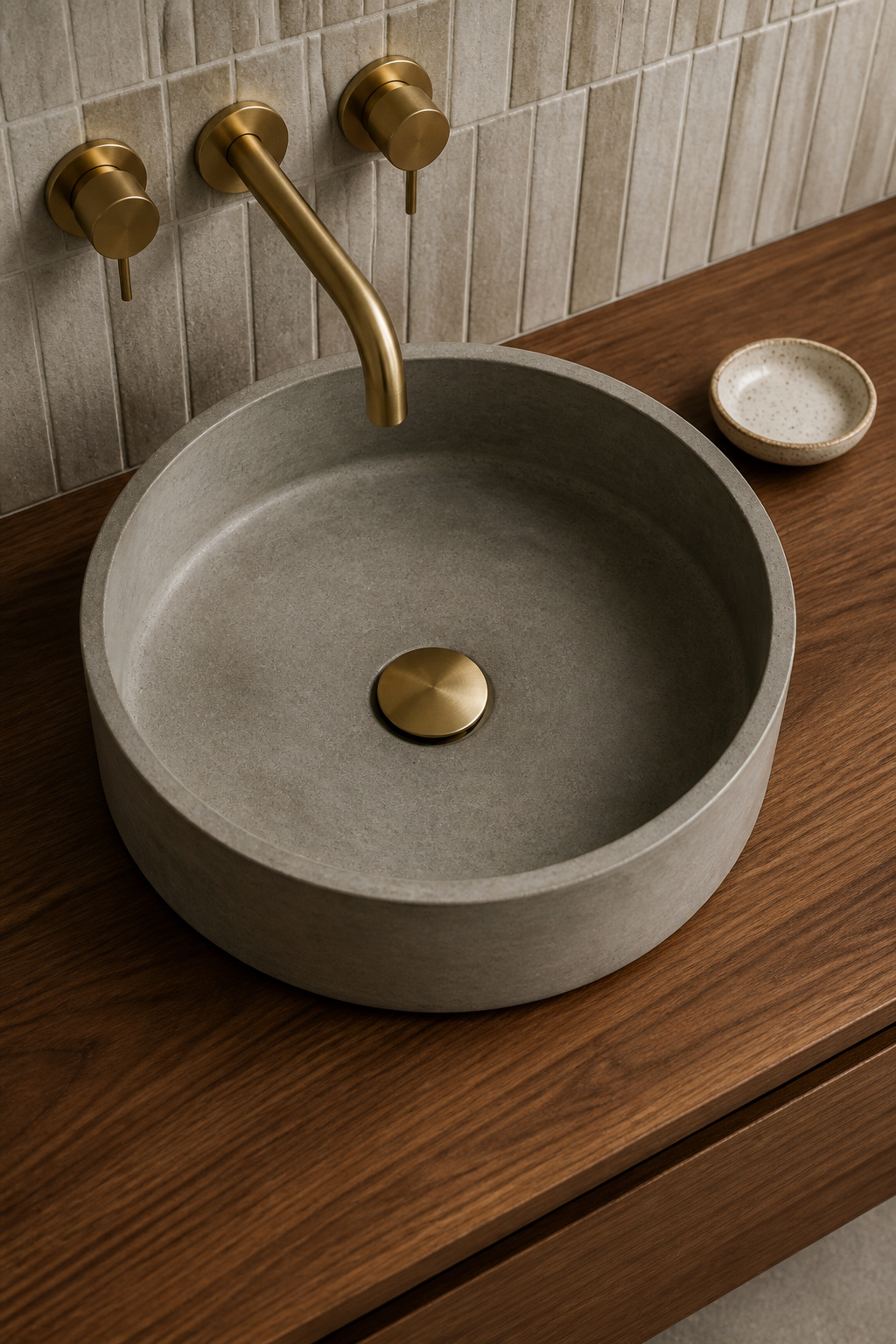
GFRC — glass fibre reinforced concrete — is the material most custom sink makers use now. It’s cast in a shell roughly 12–15mm thick. This produces the same surface quality as solid cast concrete at dramatically lower weight. A solid cast concrete sink can run 80–120 lbs. A GFRC version of the same footprint typically weighs 40–60 lbs. Custom GFRC makers like Gore Design Co. and Trueform Concrete charge $400–$1,200. Pre-made options from small studios on Etsy run $150–$400 and are often indistinguishable in finished quality.
The only ongoing commitment is sealing. Polyurethane sealer is the standard. It’s the same product used on exterior concrete countertops. Reseal every two to three years. Avoid abrasive cleaners. A diluted white vinegar solution handles limescale removal without damaging the sealer. Bathroom sinks have an easier life than kitchen sinks — they encounter soap and water, not acids and cutting boards. A properly sealed concrete basin should last decades.
The wabi-sabi principle values imperfection, transience, and the mark of the maker’s hand. A handmade textured wall carries that quality. It changes subtly over time as it acquires a patina. The principle aligns naturally with Nordic hygge — both reject the over-polished in favour of the genuine.
In a modern bathroom design, one textured feature wall alongside smooth tile and clean glass creates a tension that makes the room feel curated. It’s the difference between a bathroom that looks like it was designed and one that looks like it was ordered from a catalogue.
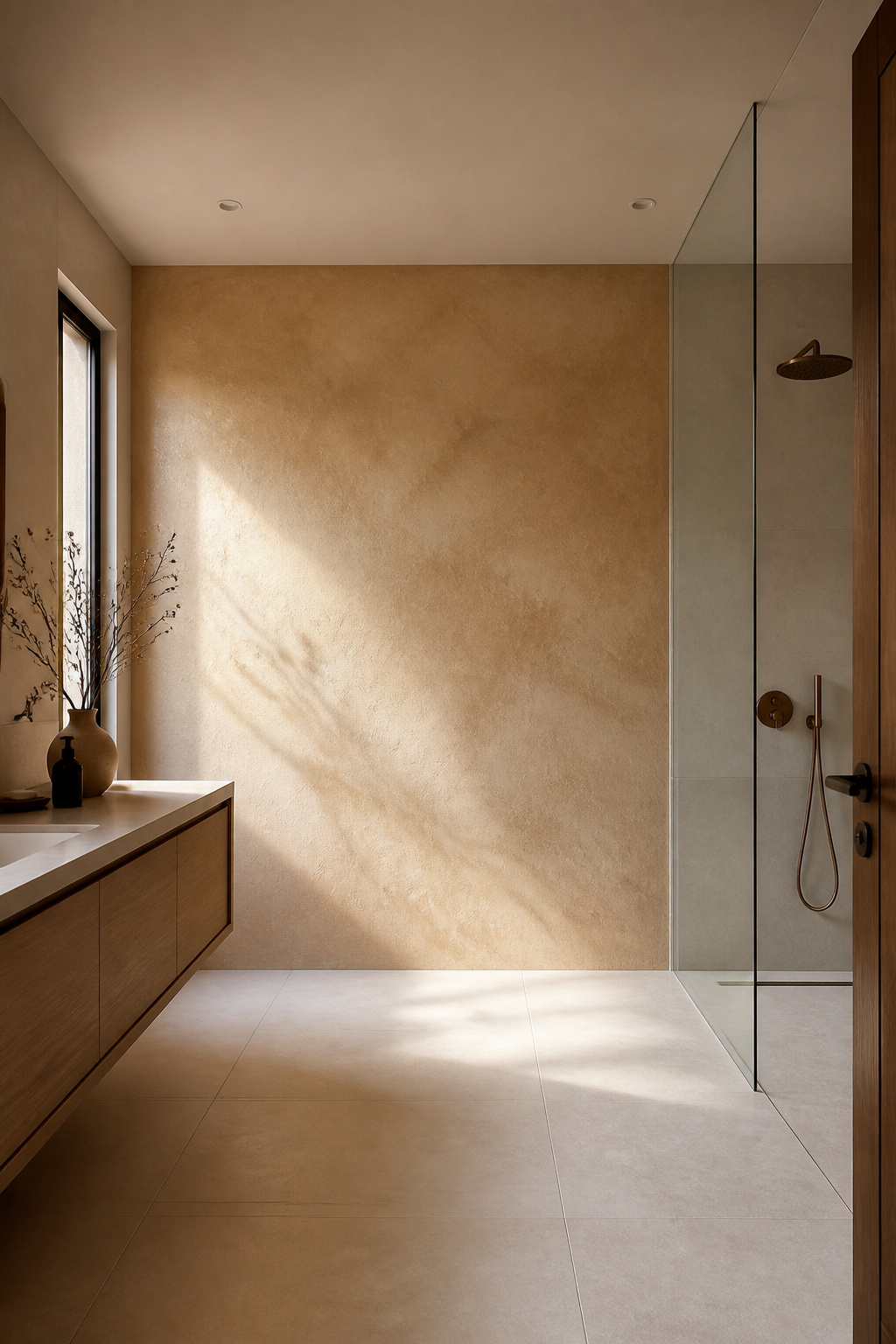
Tadelakt is the right material for shower walls. It’s a traditional Moroccan lime plaster, burnished with a smooth stone and finished with olive-oil soap. The result is waterproof, naturally mould-resistant, and carries a low silky sheen. Specialist plasterers charge $8–$18 per square foot for application. It’s not a DIY project. Limewash paint is a more accessible alternative for the main bathroom wall outside the wet area. It delivers a chalky, softly textured finish at roughly 400 square feet per gallon in two coats. It is not waterproof and must stay outside the splash zone.
Apply texture to one wall only. Behind the vanity, behind the tub, or the wall facing the entrance — one surface. Contrast makes restraint legible. Without one different surface, minimal becomes monotonous.
The cleanest modern bathroom design hides almost everything. What you see is tile, glass, wood, and a few beautiful objects. What you don’t see is where the work happens: a recessed medicine cabinet flush with the wall, in-wall shower niches instead of caddies, and a floating vanity with organized drawers.
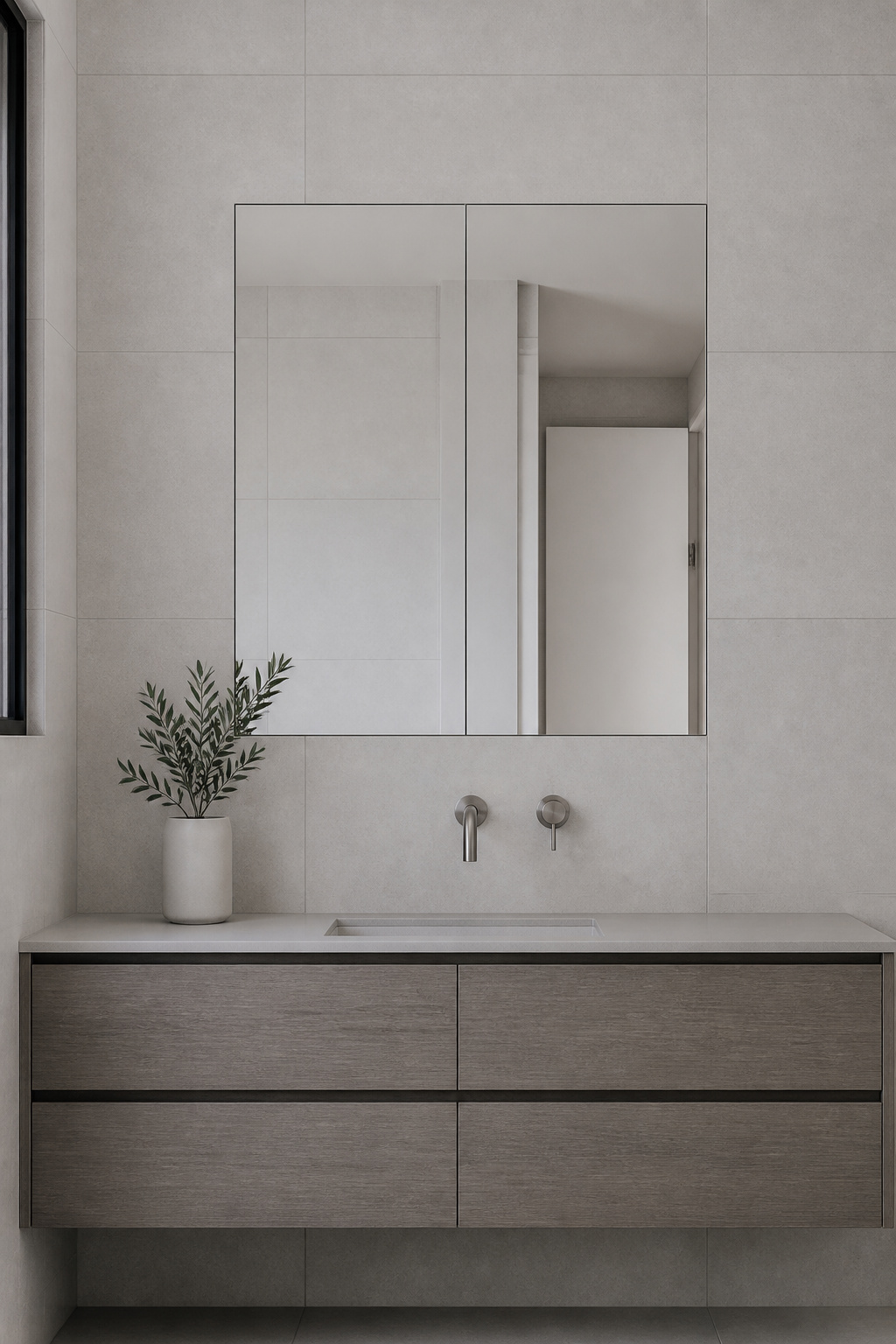
A surface-mounted medicine cabinet projects from the wall and interrupts the smooth surface behind it. A recessed cabinet sits inside the wall. Its face is flush with the surrounding plane. Robern is the premium brand in this category. Their interior heights are calibrated to standard medicine bottle sizes — a small detail that sounds minor until you realise most cabinets require you to lay things on their sides to fit.
In-wall shower niches follow the same logic. Standard sizing is 12 inches wide, 24 inches tall, and 3.5 inches deep — the depth of one stud cavity, wide enough for shampoo and soap. Prefabricated stainless steel niches eliminate the waterproofing step and install in under an hour. Tile the niche in the same tile as the surround and it disappears. Tile it in a contrasting accent tile and it becomes the most considered detail in the shower. For small bathroom storage solutions that actually work, the consistent principle is 80% closed storage and 20% curated open display.
Stark white is demanding. It requires perfect surfaces, perfect cleanliness, and perfect light. It delivers a clinical coolness that suits a magazine spread more than a daily ritual. The better approach is warm white and what sits beside it: cream, limestone tone, warm grey, sage green, clay.
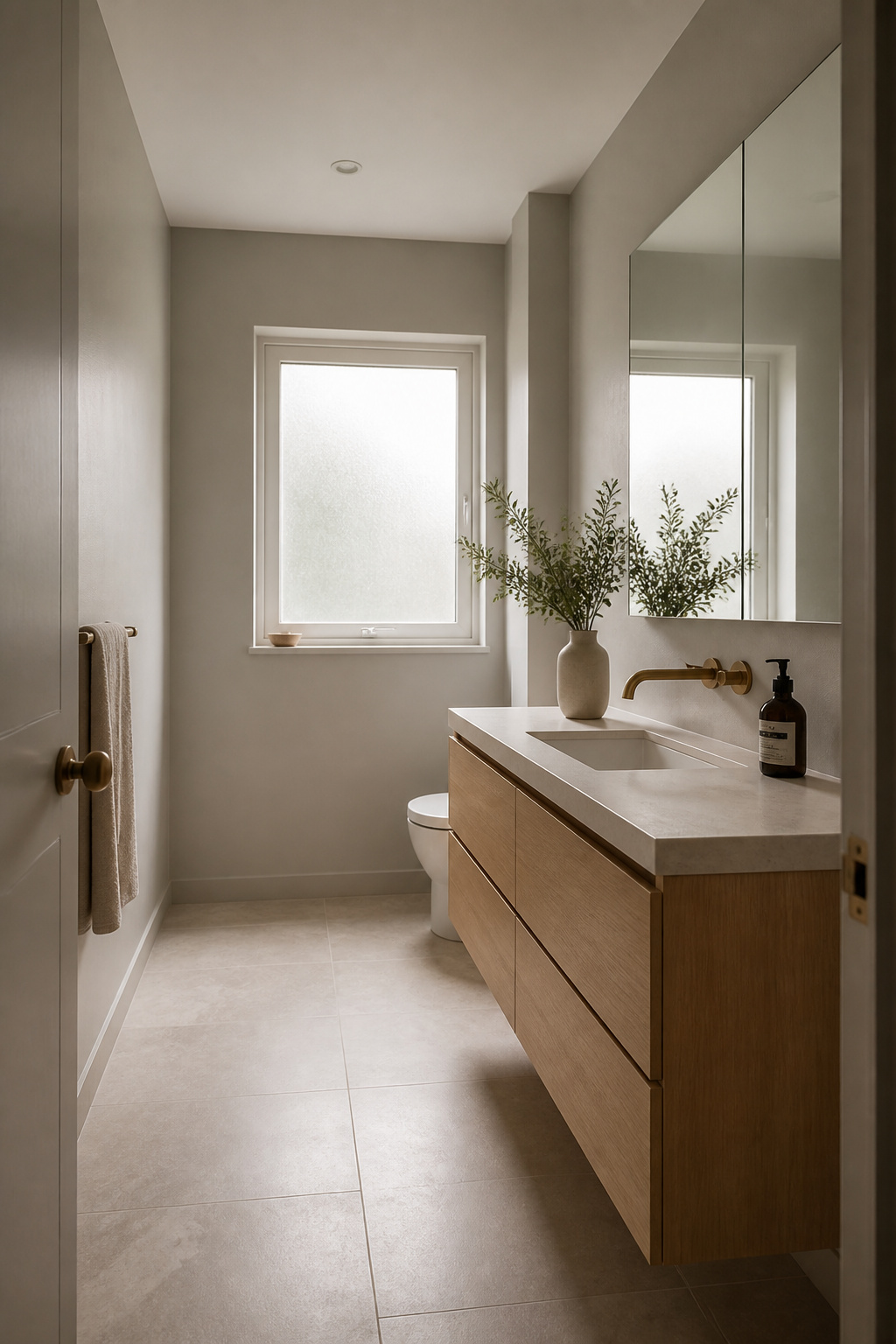
Farrow & Ball’s Modern Emulsion is the paint to know for bathrooms. It carries a 7% sheen that sits between matte and eggshell. It’s washable, mould-resistant, and available in the complex neutrals that work best in this modern bathroom design context. ‘Elephant’s Breath’ reads as a warm grey that shifts toward brown in certain light. ‘Bone’ is a creamy off-white. ‘Mole’s Breath’ is darker and dustier. These aren’t cheap — a 2.5-litre tin runs about $55 — but the formulation is genuinely better for humid rooms.
The coordination rule is simple. Keep all warm-tone elements in the same value range. Warm grey tile + warm grey-white walls + warm walnut wood reads as deliberate. Warm grey tile + cool grey walls + dark wood reads as accidental. Always test paint colour in the room itself. Tile reflects and shifts the perceived colour of surrounding walls in ways no online swatch can predict. Pull a physical sample board with your tile, paint chip, and wood veneer sample. Observe it at different times of day before committing.
Polished brass overstates itself. It catches every light, develops a patina that changes year to year, and reads differently in different lighting conditions. Brushed brass has none of these problems. Its directional texture hides small scratches. The matte finish doesn’t show fingerprints. It ages with the room rather than against it.
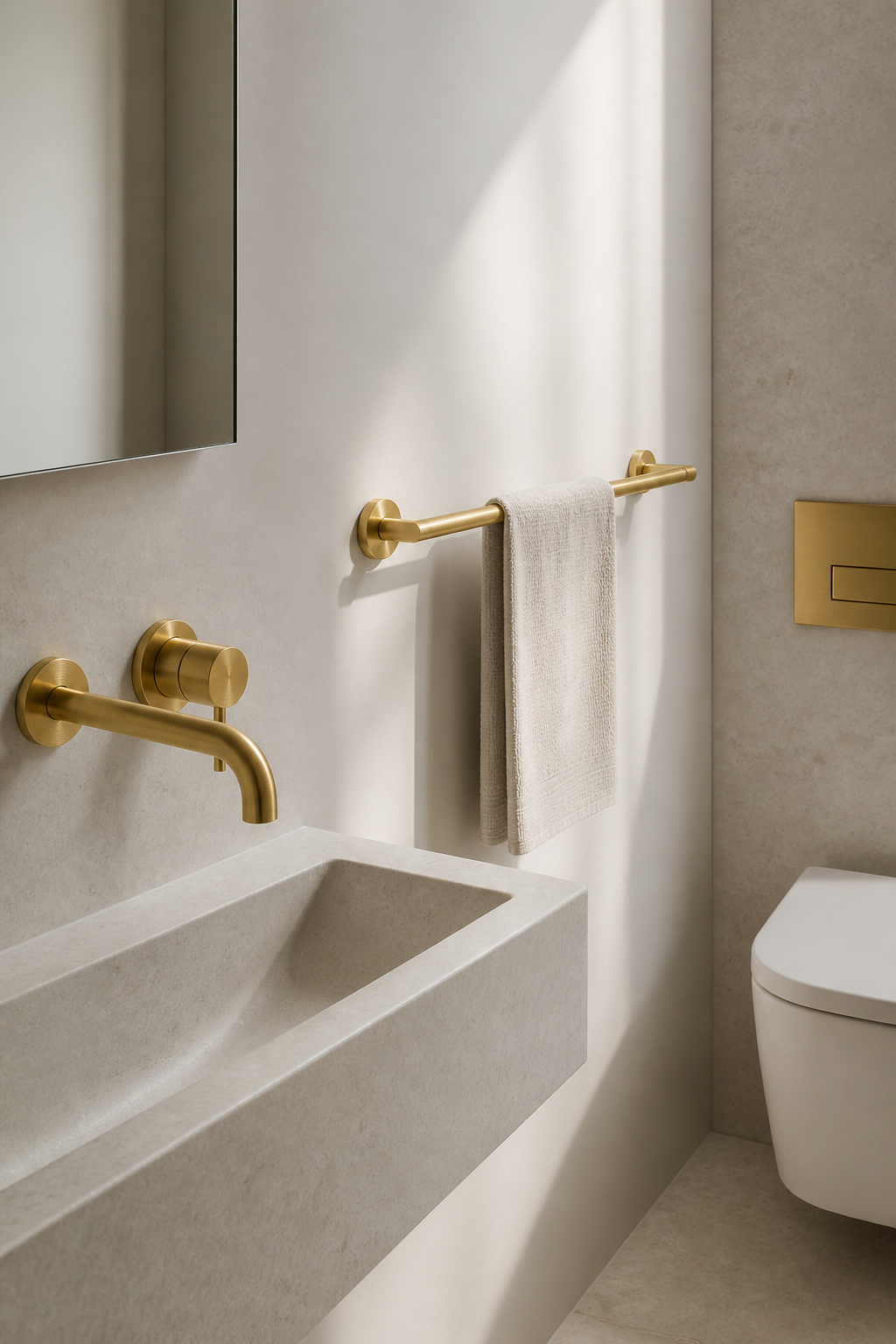
PVD (Physical Vapour Deposition) is what makes modern brushed brass reliable. The process deposits material one atom at a time in a vacuum chamber. The resulting bond resists scratching, tarnishing, and corrosion. It’s the same technology that makes high-end watch cases durable. For bathroom fixtures, look for solid brass or stainless steel beneath the PVD layer. Zinc alloy corrodes through even a good coating over several years in a wet environment.
Four touch points cover most of the brass visible in a bathroom: basin tap, towel bar, toilet flush plate, and shower valve. Source all four from one manufacturer to ensure exact tone matching. Brushed brass from different brands varies from warm champagne to deep antique. They will clash. Against natural limestone or marble with warm veining, brushed brass picks up the golden undertones. The two materials reinforce each other. Against cold grey stone, the same brass looks incongruous.
A practical note on maintenance: brushed PVD brass needs almost no upkeep. Wipe it with a damp cloth. Avoid abrasive cleaners and anything containing bleach or ammonia — these can damage the PVD layer over time. The directional texture of the brushed finish hides water spots naturally, so day-to-day use requires far less attention than polished chrome or polished brass in the same space.
Every high-design modern bathroom design has a material hierarchy. One dominant material covers most of the surface area and sets the overall tone. A secondary material appears in a significant but clearly subordinate role — the vanity, one wall, the countertop. An accent material appears in small doses and delivers the signature detail. Three levels. Not four. Not five.
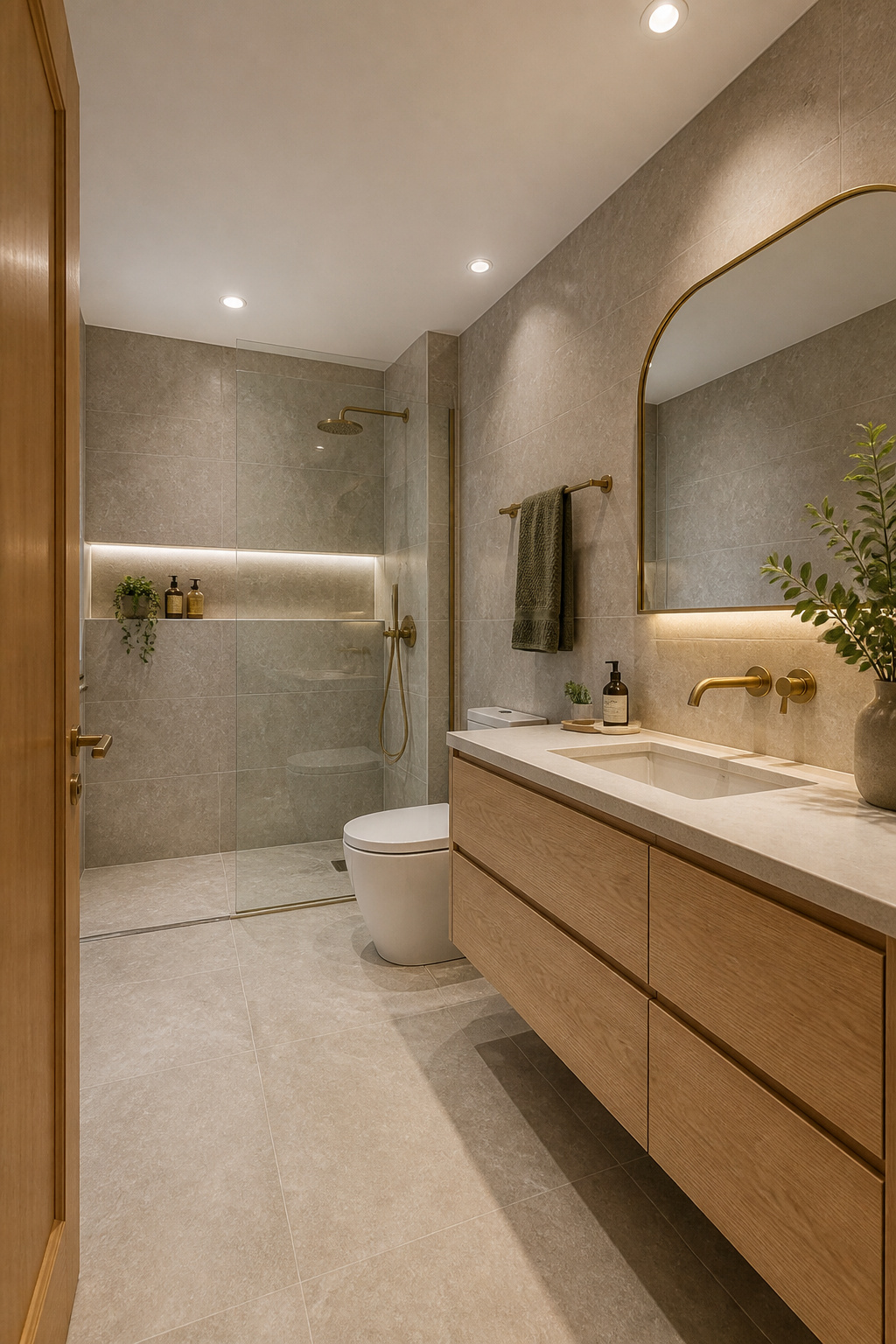
The 60/30/10 proportion is the working model. Dominant material: 60% of visual surface area — typically the floor and main wall tiles in a neutral, low-pattern format. Secondary material: 30% — the vanity or feature wall in warm wood. Accent material: 10% — the metal hardware. The discipline is in what you don’t add. A fourth material breaks the hierarchy and makes the room look unsettled.
Texture contrast is what makes three-material rooms succeed. Smooth stone tile alongside rough-hewn wood grain alongside smooth glass creates a sensory rhythm. Three smooth surfaces at the same finish level is a flat composition. Three reliable combinations: warm grey limestone-look porcelain + white oak vanity + brushed brass hardware (the quintessential modern Nordic bathroom design); polished Calacatta marble tiles + smoked oak shelving + matte black hardware (more dramatic, suits larger spaces); concrete-look porcelain + tadelakt plaster feature wall + brushed copper fixtures (warmer and earthier, for anyone drawn to the wabi-sabi approach). For bathroom design classics built to last, this three-material hierarchy appears across almost every lasting example.
Start with the structural decisions. They come first. A wet room, a freestanding tub positioned away from walls, or a ceiling-mounted rainfall head all require plumbing and waterproofing work that happens before tiles go down. Commit to these early — or accept that you’ll be retiling to reach them later.
If you’re refreshing rather than renovating, four changes deliver the highest return for the least disruption. First: coordinated hardware in a single finish (brushed brass or matte black, from one manufacturer). Second: a backlit mirror. Third: a warm-toned paint in a humidity-resistant formulation. Fourth: sealed wood shelving in place of whatever generic accessory is currently there. None of these require a contractor. All are visible every time you use the room.
Budget reality for 2025: a simple refresh costs $4,500–$7,000 depending on fixture quality. A mid-range modern bathroom design remodel — new tiles, vanity, shower — runs $8,000–$15,000. A full gut-and-replace renovation with structural changes reaches $16,000–$25,000 and beyond. Set aside 10–20% contingency in any case. Bathrooms have a reliable talent for revealing surprises once the walls are opened.
The underlying principle across all fifteen ideas is the same: choose less, but choose better. A single concrete sink in an otherwise plain bathroom is more interesting than a room full of competing details. One textured wall against smooth tile is more effective than four textured walls. Two materials in conversation are more resolved than five materials trying to coexist. That restraint is what makes modern bathroom design feel warm rather than cold — and it turns out those two qualities are not opposites at all.