Physical Address
304 North Cardinal St.
Dorchester Center, MA 02124
Physical Address
304 North Cardinal St.
Dorchester Center, MA 02124
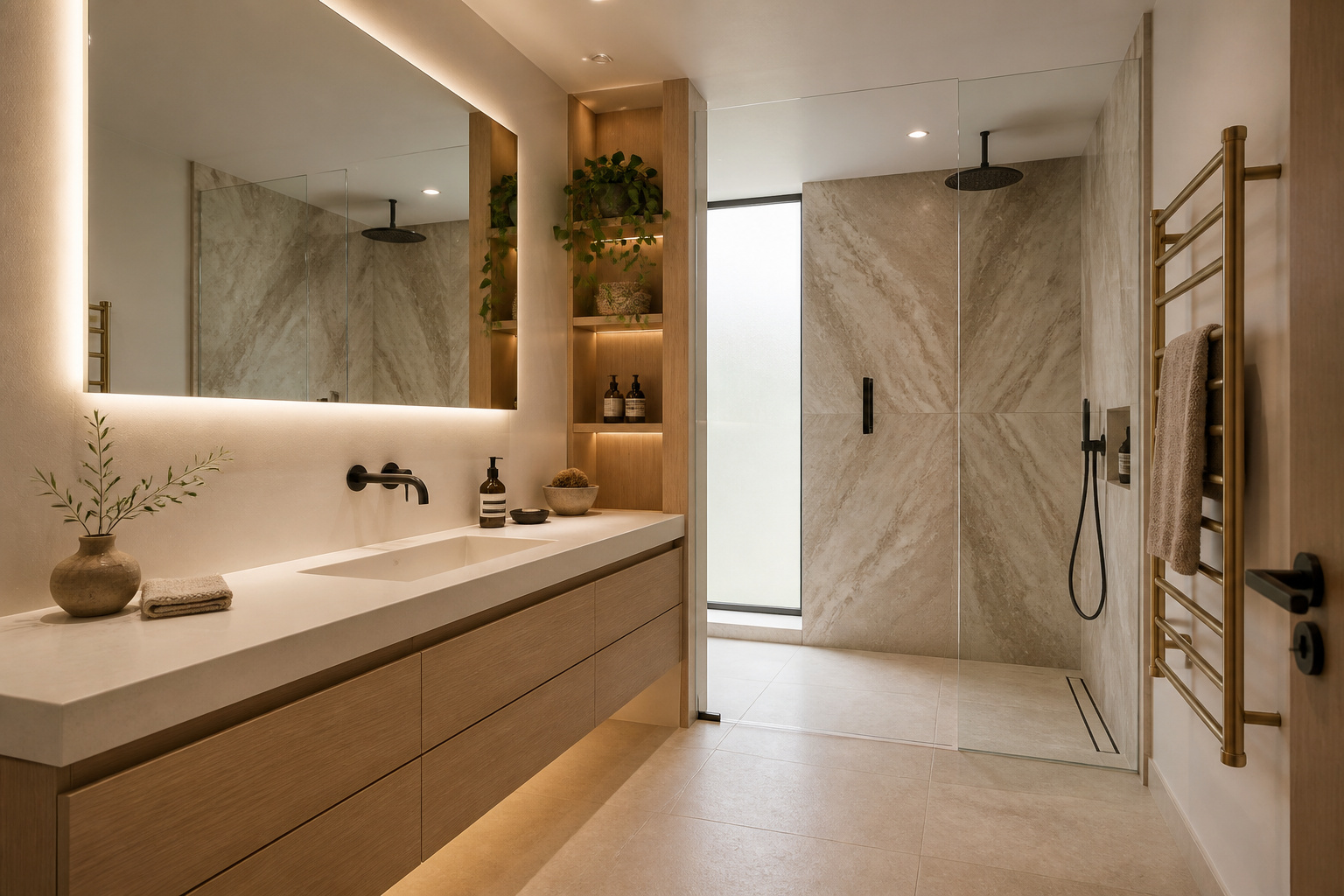
Explore 15 modern bathroom decoration ideas — from floating oak vanities to aged brass fixtures — for a Nordic-inspired bathroom that balances function and calm.
The bathroom has quietly become the most designed room in most homes. Not the kitchen, not the living room — the bathroom. It’s the one space where the logic of Scandinavian design applies in its purest form: nothing extra, everything considered, and quality of material over quantity of decoration. Modern bathroom decoration isn’t about adding things. It’s about choosing the right few things and letting them speak.
I’ve spent years working with Nordic design principles, and what I find consistently is that bathrooms respond well to a clear design brief. A floating vanity in warm oak, a frameless shower enclosure, a backlit mirror — these aren’t trends. They’re decisions that improve how a room functions and how it feels every morning. The fifteen ideas here aren’t a mood board of aspirational images. They’re real choices that work in real homes, from materials and fixtures to lighting and texture, each chosen because it earns its place.
The range covers different budgets and different approaches. Some require structural planning (wall-mounted taps, frameless glass). Others are immediate (plants, ceramics, a towel rail in the right finish). Start with what your space needs most.
The shift from painted bathroom cabinets to natural wood has been one of the more decisive changes in bathroom design. White gloss cabinetry dominated for over a decade, and it still has its place, but it’s the grain and warmth of real oak or walnut that’s defining contemporary bathrooms in 2026. Homeowners want to see and feel the material — not a surface that disguises it.
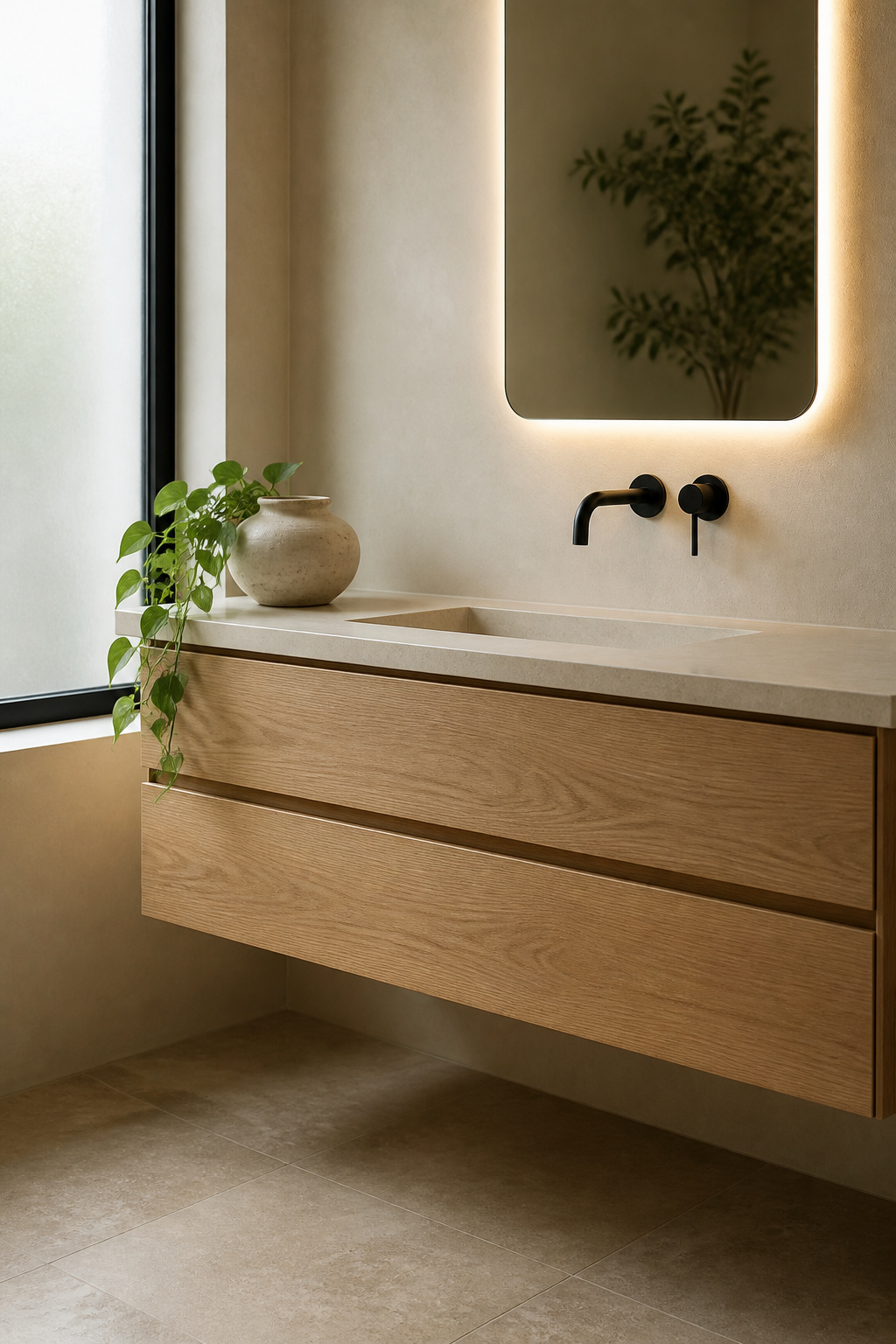
Wall-hung vanities take this further. By lifting the cabinet off the floor, you return the visual space of the room to the floor itself — tiles run uninterrupted beneath, making even a small bathroom feel larger. It’s a fundamental principle of Nordic design: let space breathe. A floating vanity in warm natural walnut, set against a cool honed stone floor, creates exactly the kind of tonal contrast that reads as deliberate rather than accidental.
The choice between oak and walnut comes down to the room’s palette. White oak is lighter, airier — it suits bathrooms with coastal or Scandinavian leanings, where the goal is simplicity and a sense of calm. Walnut is richer and deeper, particularly effective in larger bathrooms where the vanity needs to anchor the space rather than dissolve into it. Either way, moisture resistance requires a proper seal: polyurethane or a marine-grade oil finish is the practical choice, not a standard furniture lacquer.
Width-wise, standard single vanities run from 24 to 36 inches. Consider mounting slightly higher than the standard 32-inch countertop height — 34 to 36 inches reads as more intentional and is more comfortable to use in practice. For guidance on choosing the right vanity configuration, bathroom vanity designs for historic homes covers the decision framework in depth, including storage priorities and proportional logic.
Matte black moved into bathrooms as a contrast reaction to chrome and stayed because it does something chrome doesn’t: it settles into a room rather than competing with it. Chrome reflects. Matte black absorbs. In a space where the design is built on restraint and natural material, that difference matters considerably.
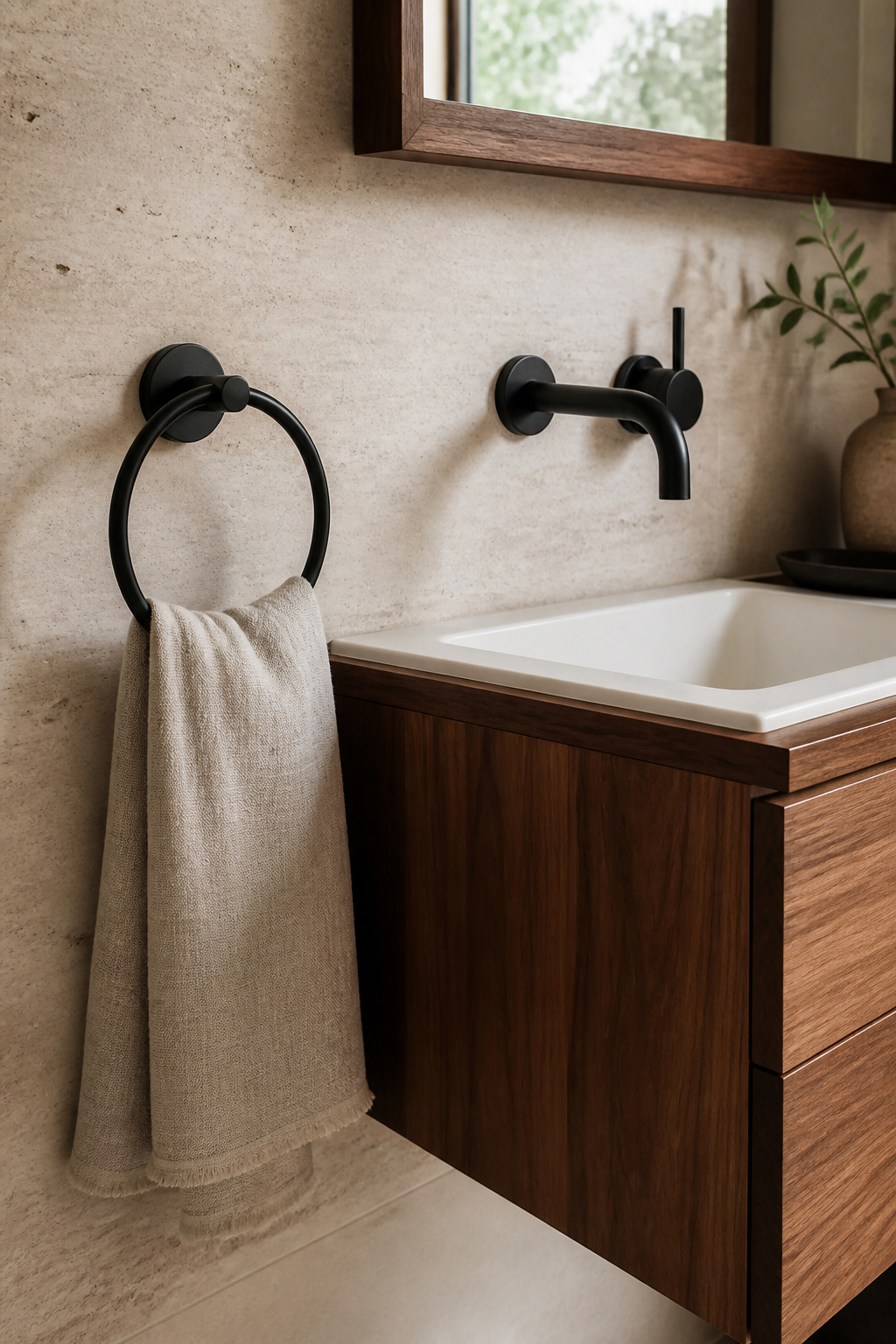
The most important decision when specifying matte black isn’t the design; it’s the finish technology. PVD (Physical Vapour Deposition) matte black is molecularly bonded to the base metal, making it resistant to corrosion, tarnishing, and fading in humid bathroom environments. Powder-coated matte black — which most budget-range fixtures use — can develop a chalky, grey tone within five to ten years of bathroom use, particularly near steam sources. PVD commands a premium but you can see it in the quality of brands like Hansgrohe and Grohe. That premium is worth paying.
One practical note: once PVD is scratched, it cannot be reapplied. The material is durable but not indestructible — avoid abrasive cleaners entirely.
There’s something satisfying about terrazzo’s origin story. Venetian craftspeople in the 15th century used offcuts of marble to surface floors — a material born of economy that has become one of the most sought-after finishes in contemporary interiors. Its revival in modern bathrooms makes complete sense: no two floors are identical, and in a space that otherwise tends toward precision and uniformity, that individuality is real value.
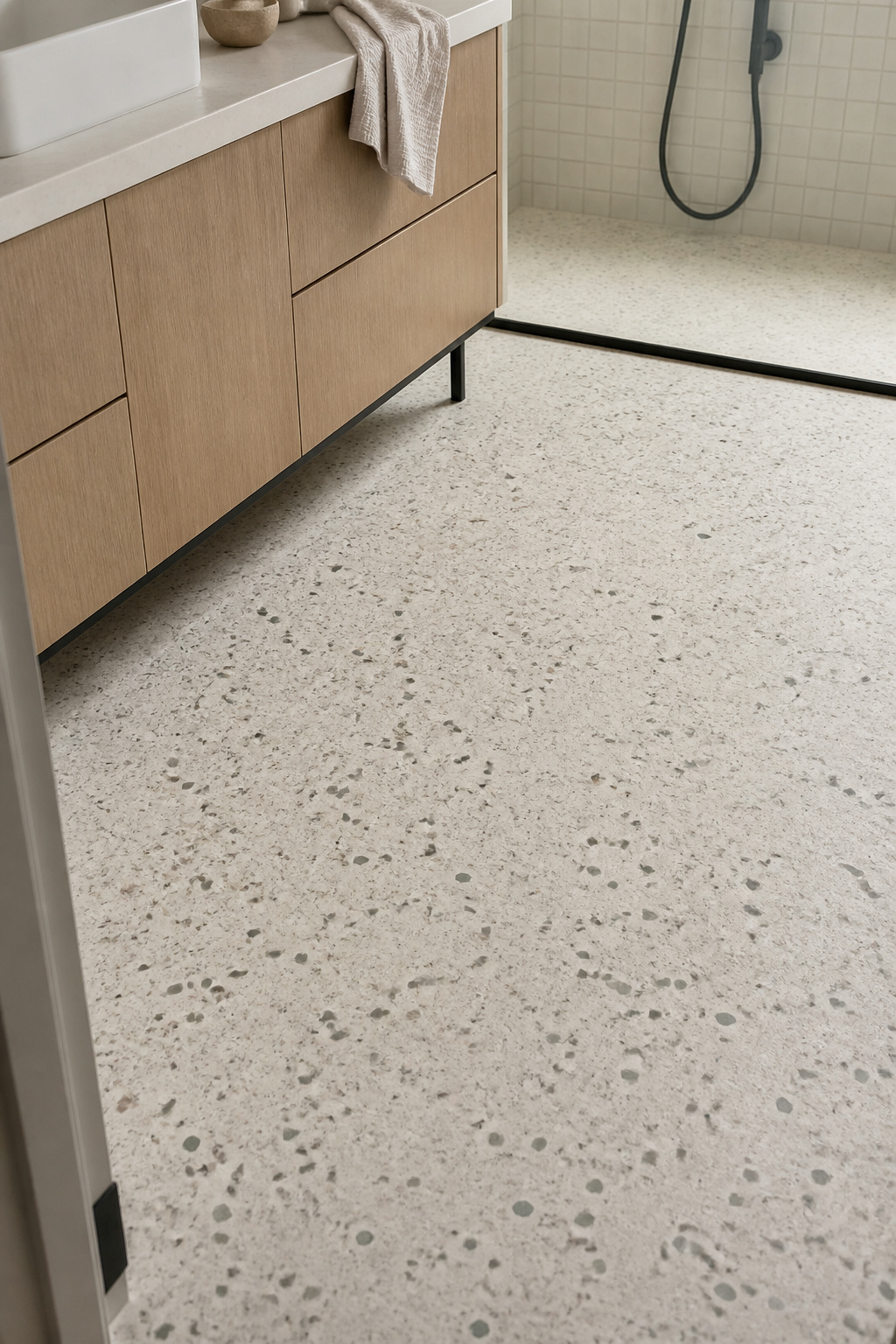
The practical question is real terrazzo versus terrazzo-look porcelain. Authentic terrazzo tiles cost $9–$22 per square foot installed (materials plus labour); poured-in-place terrazzo is significantly more. Porcelain terrazzo-look tiles run $5–$15 per square foot and are easier to install, but the repeated pattern and flatter surface lacks the depth of the real material. For a bathroom under fifteen square metres, authentic terrazzo tiles offer the best balance between cost and authenticity.
Slip resistance is the non-negotiable specification for a wet bathroom floor. Look for an R10 or R11 rating, and specify a honed rather than polished finish — polished terrazzo is hazardous when wet. Epoxy grout in a tone that matches the cement base is worth the premium; it resists staining from toiletries and stays clean longer than cementitious grout in a wet environment.
A framed shower screen is a visual interruption. The metal frame creates a hard line that the eye registers as a boundary, making the bathroom read as two separate zones rather than one continuous space. Frameless glass removes that boundary entirely — the sightline from the door to the far shower wall is unobstructed, and the whole room benefits.
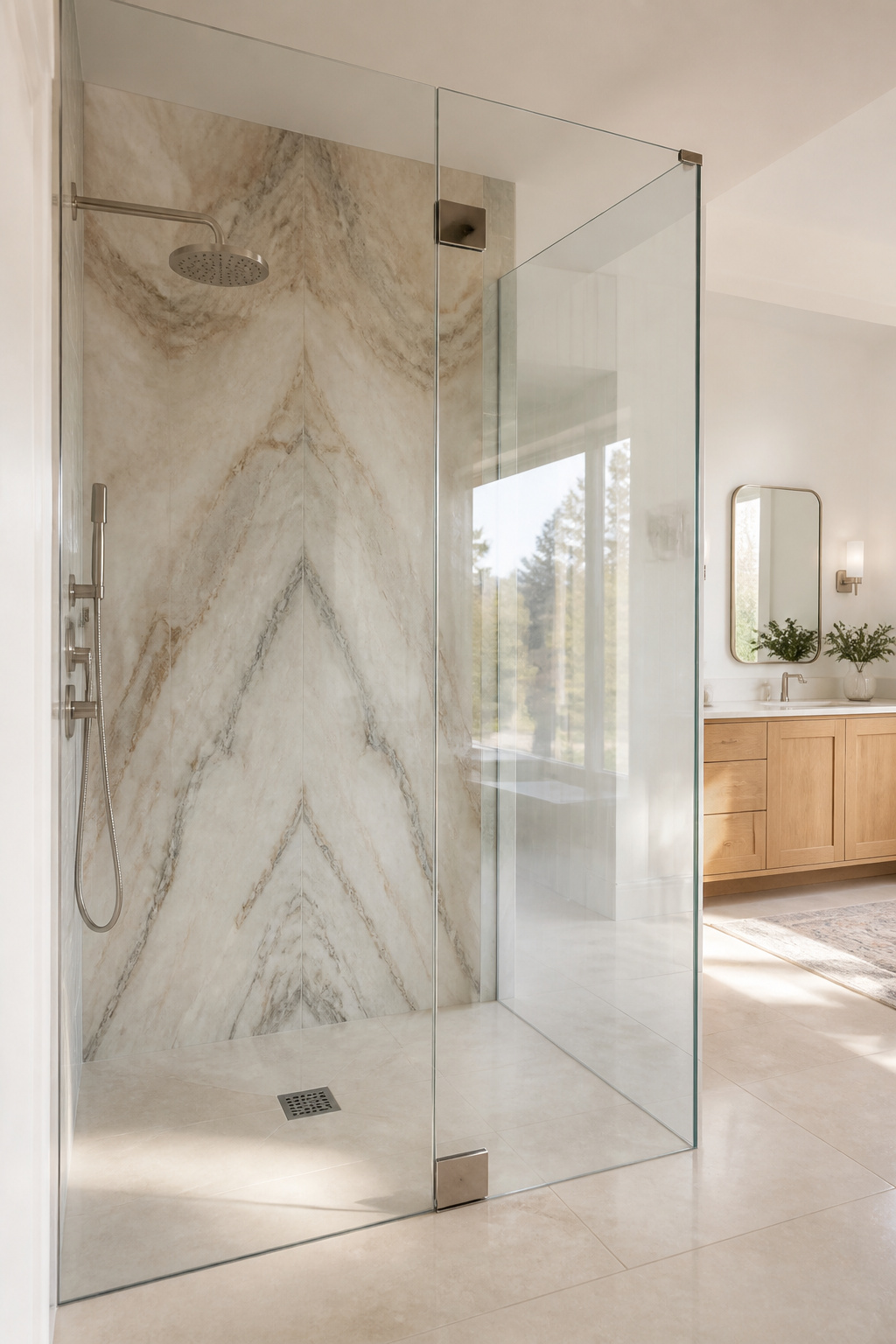
Glass thickness determines quality of feel. Eight-millimetre toughened glass is appropriate for smaller enclosures and sliding systems; ten-millimetre is the benchmark for large pivot doors. The difference is tactile — a ten-millimetre pivot door has a gravity and quiet certainty when it closes that eight-millimetre doesn’t quite match. The word used most often by people who’ve experienced both is the same: the ten-millimetre closes with a ‘dead thud’ rather than a light click. Both must be toughened (tempered) to safety standard; never accept anything else in a shower.
The one specification worth adding at installation rather than as an afterthought is a factory-applied hydrophobic coating on the glass surface. This nano-coating repels water, soap, and limescale, significantly reducing the cleaning that frameless glass otherwise requires. For broader ideas on how shower design choices shape the overall room, bathroom shower designs to transform your space covers the full range of enclosure and layout approaches.
Fluted glass — sometimes called reeded or ribbed glass — is having a moment that isn’t purely trend-driven. It solves a genuine problem: how do you maintain privacy in a shower enclosure or cabinet without blocking light? Clear glass lets too much in; frosted glass closes the space down. Fluted glass diffuses light through its vertical channels, providing enough opacity for privacy while keeping the room bright and open.
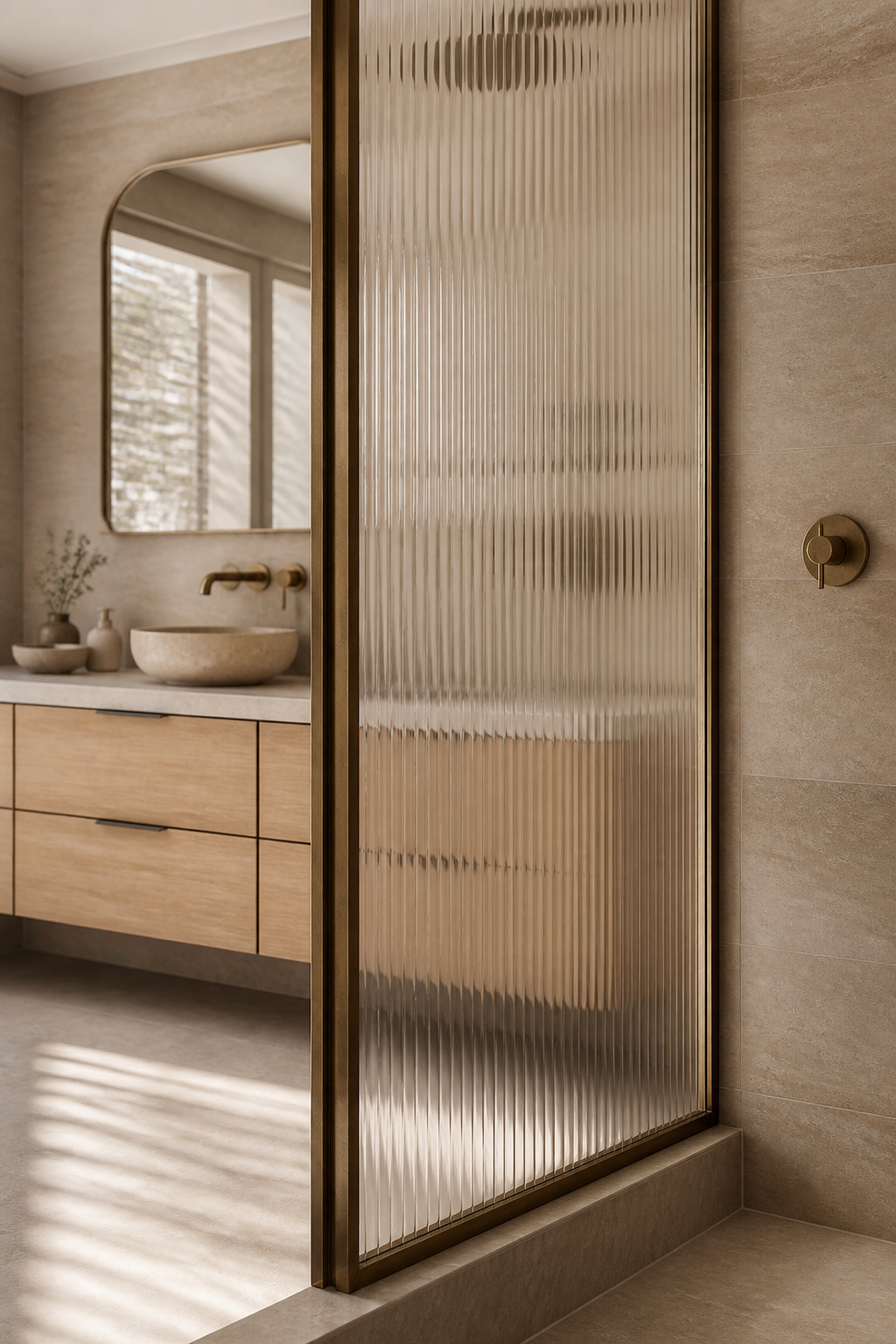
Applications have expanded well beyond shower screens. Cabinet door fronts with fluted glass inserts are increasingly replacing solid timber panels in contemporary vanity designs — they make storage feel lighter and less closed while maintaining a visual layering between the interior and the room. As a fixed panel separating a bath zone from a shower zone, fluted glass provides structure without a hard divide.
Warm metal frames — brushed brass, aged bronze, even warm champagne tones — pair most naturally with fluted glass. They pick up the ribbed texture’s warmth and prevent the material from reading as industrial. Matte black framing can work, but it needs significant warmth elsewhere in the room to prevent the combination reading as cold. The restraint rule applies here: one or two fluted glass panels make a design statement. Cover every surface and it becomes visual noise.
A bathroom styled entirely with precision — frameless glass, honed stone, matte black fixtures — can start to feel like a showroom. The solution is almost always a handmade object. Wabi-sabi ceramics, with their slightly lopsided rims, unpredictable glazes, and visible hand-marks, bring the quality of having been made by a person rather than produced by a machine. That distinction reads immediately.
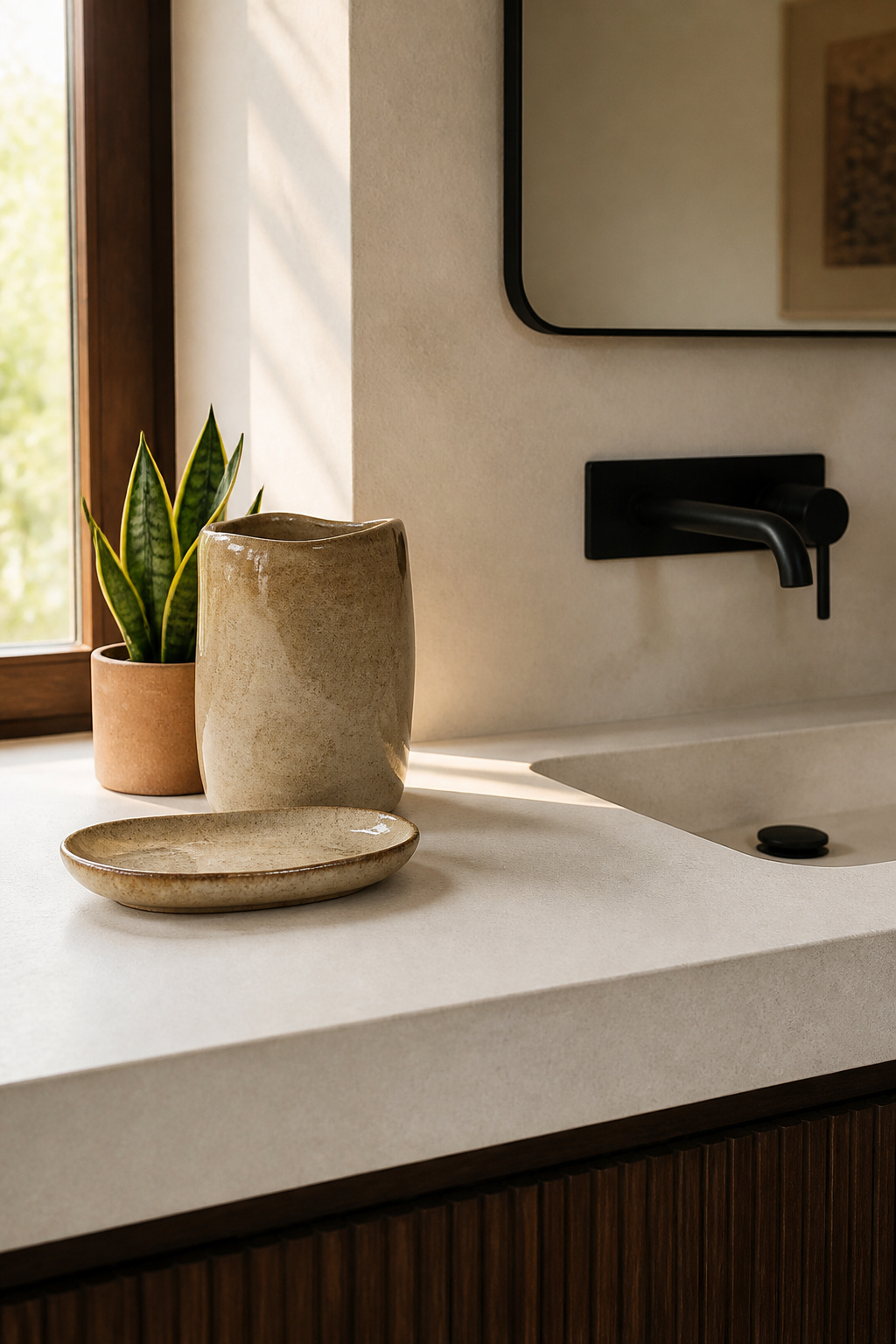
For the countertop to work, restrict it to two or three items at most. Apply the rule that Scandinavian stylists use instinctively: group items asymmetrically at one end of the vanity top rather than distributing them across the surface. One tall vessel, one flat dish, one small plant — all in the same muted colour family. The empty surface that remains is part of the composition.
Look for muted, earthy glazes when sourcing: pale sand, warm grey, sage, raw terracotta. Machine-made pieces attempting the wabi-sabi aesthetic are too uniform to have the same effect — the asymmetry and variation in handmade work is what makes it convincing. Local ceramicists, Etsy studios, and Scandinavian lifestyle brands like HAY are reliable starting points.
Concrete belongs in a serious bathroom. Not because it’s fashionable — though it is — but because its raw, mineral quality does something few other materials can: it sits at the intersection of industrial and organic, modern and ancient. A concrete sink with an oak floating vanity and warm brass taps is a combination with real material tension. In design terms, tension is interesting.
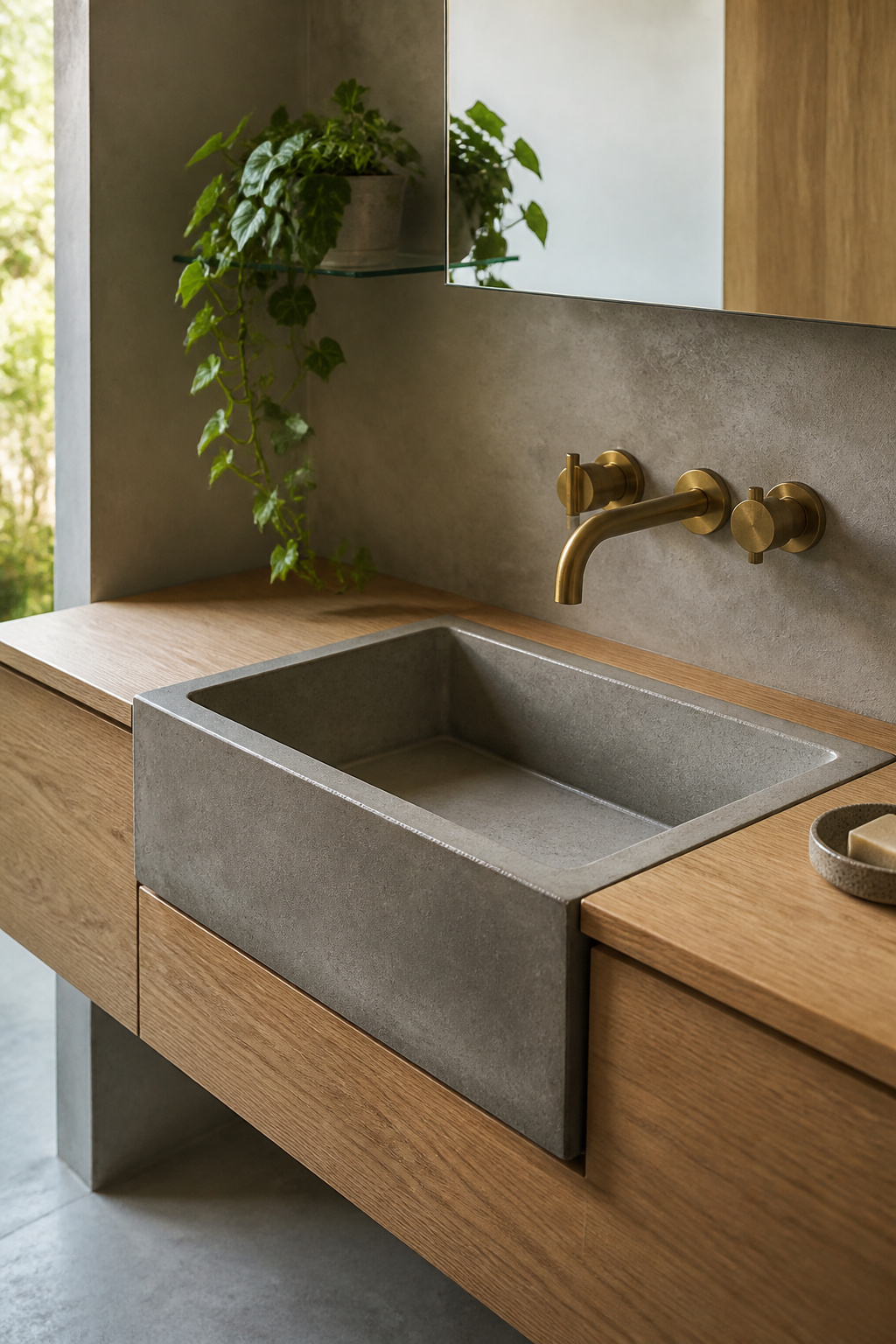
The practical question is precast versus poured-in-place. Poured concrete — done on site, ground, and sealed in place — gives complete dimensional freedom and a seamless integration with the countertop, but costs upward of $3,000 for a powder room sink before installation, and requires specialist contractors. Precast concrete sinks, made off-site in moulds and installed like any other basin, run $500–$1,500 for the sink alone and are far more practical for most renovation budgets. Weight is a genuine structural consideration for both: ensure the vanity cabinet and wall fixings are rated for the additional load before specifying.
The maintenance reality is more nuanced than most articles suggest. Bathroom use is actually gentle on concrete — toothpaste and face wash are considerably less aggressive than kitchen acids and oils. A properly sealed precast sink, maintained with mild detergent and re-sealed when water stops beading on the surface, will perform well for years. Avoid abrasive cleaners entirely — they compromise the sealant layer.
The modern bathroom has a materials problem: stone, glass, tile, metal, and timber are all hard surfaces that reflect sound and light with equal efficiency. One plant doesn’t solve this, but three plants in the right positions transform a precision-engineered bathroom into a room that feels inhabited rather than staged.
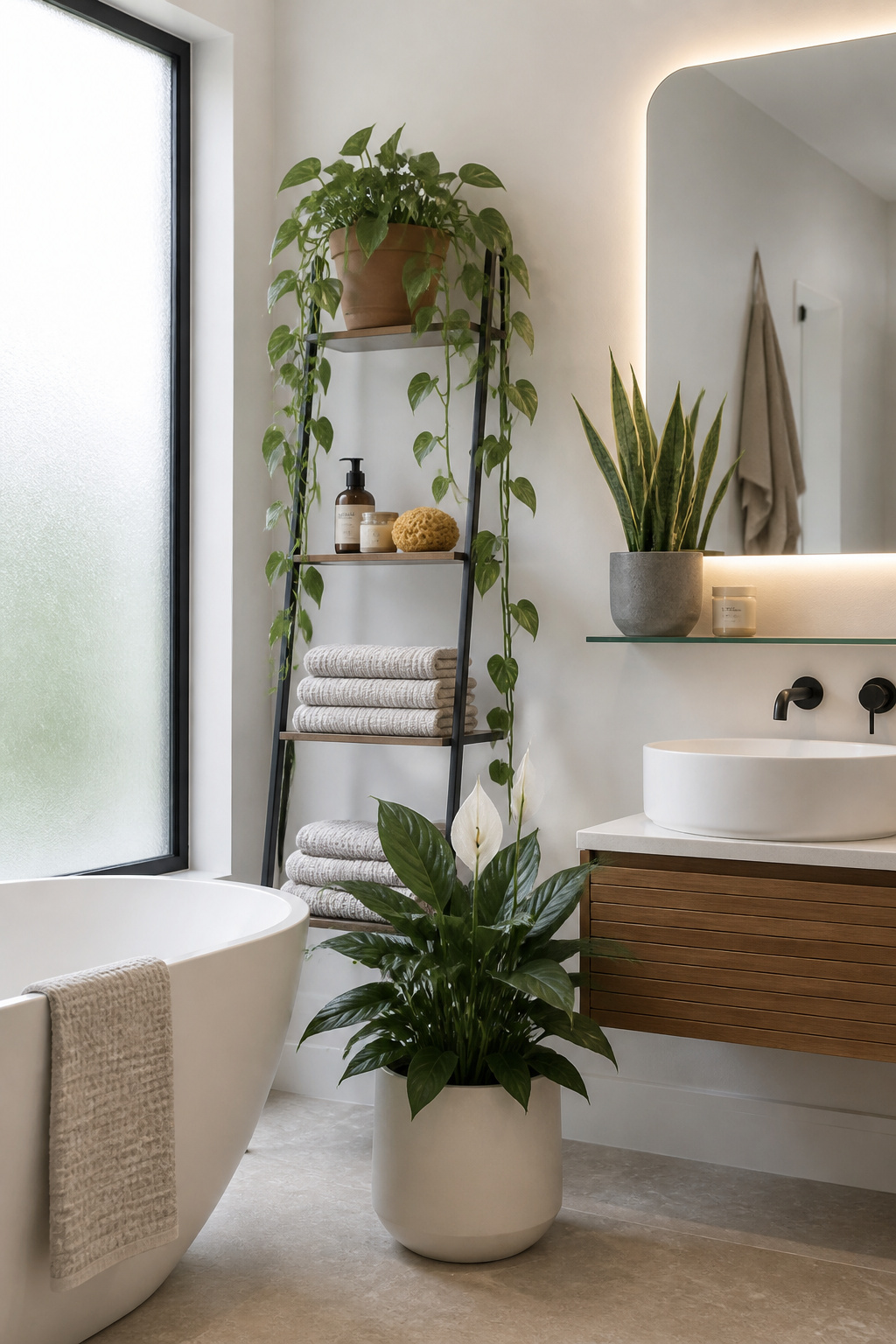
Placement is as important as species selection. A trailing pothos at the top of a tall cabinet or ladder shelf provides a cascade of green that reads as architectural rather than botanical. A peace lily beside the bath, at floor level, gives scale to the room’s focal point. A small snake plant on an open shelf adds a structural accent without demanding attention. Avoid placing plants directly in the shower splash zone — even moisture-tolerant species don’t perform well with direct, high-pressure water exposure.
Pot choice matters more than most people expect. Raw terracotta complements oak and stone naturally; matte white ceramic suits a monochrome palette; a concrete composite pot aligns with the industrial-modern materials language. Glossy plastic, in any colour, undermines the effect immediately.
Standard bathroom lighting — a single ceiling fixture — creates a problem specific to bathrooms: it illuminates the top of your head and casts shadows across your face. That’s exactly the wrong light for the mirror, which is where most of the room’s practical use happens. Backlit LED mirrors solve this by placing the light source at face level, surrounding the reflection with even, shadow-free illumination.
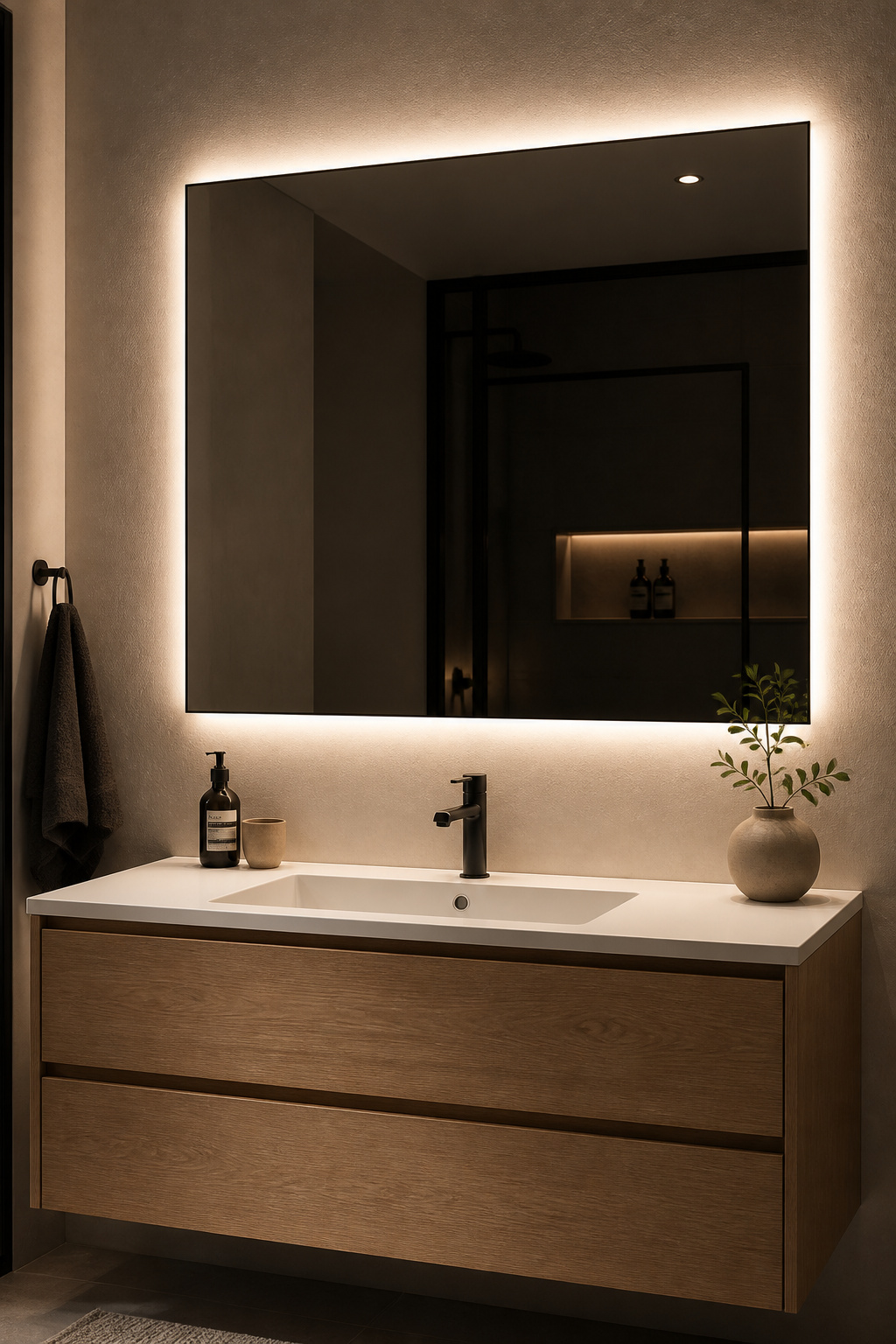
Two specifications matter beyond aesthetic. First, an IP44 rating minimum — this is the moisture protection standard for Zone 2 bathroom use; mirrors without it are technically not bathroom-safe and will fail in a humid environment. Second, a proper demister pad (not a ‘fog-free’ coating, which is largely ineffective): a genuine heated pad, typically 300x400mm, activates with the light and prevents condensation fogging the mirror after a shower. It’s worth paying for.
The mistake most people make with monochrome bathrooms is thinking the goal is to eliminate visual interest. It isn’t. The goal is to build visual interest through texture and finish rather than colour — which is a more sophisticated design challenge and, when it works, a more sophisticated result.
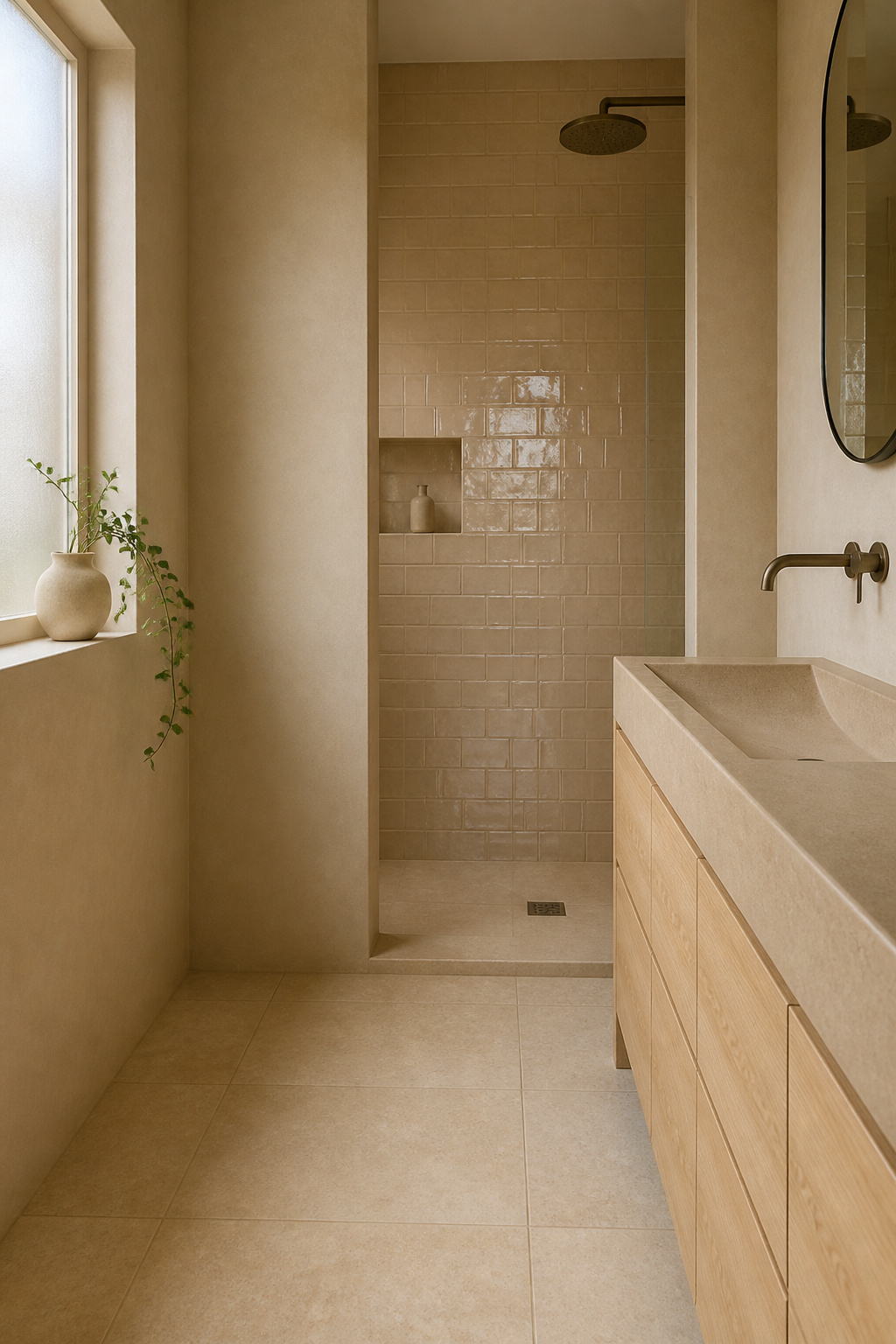
In 2026, warm monochrome is overtaking cool grey as the dominant choice. Warm beige, sand, and taupe palettes — in matte paint, handmade tile, and natural stone — create bathrooms that feel calm rather than cold, a meaningful distinction in a room used for decompression. Small-format handmade tiles in the same colour as larger wall tiles, but with a rougher, more textured surface, add the crafted quality that pure minimalism can lack. For reference on how tile texture and finish choices interact in a bathroom setting, bathroom tile ideas that create mindful spaces explores this approach in detail.
The common mistake is the last-minute pop of colour, introduced because the room feels too restrained. Resist it. A monochrome bathroom derives its authority from commitment to the palette. If the space needs relief, introduce it through texture — a woven linen hand towel, a clay pot — rather than a second colour.
Deck-mounted taps occupy prime countertop real estate and create visual noise. The basin, the tap body, the handles: three elements where, architecturally, one would be preferable. Wall-mounted taps remove the fitting from the surface entirely, leaving only the spout and handle visible, extending from the wall above the basin like a piece of minimal hardware rather than a plumbing fixture.
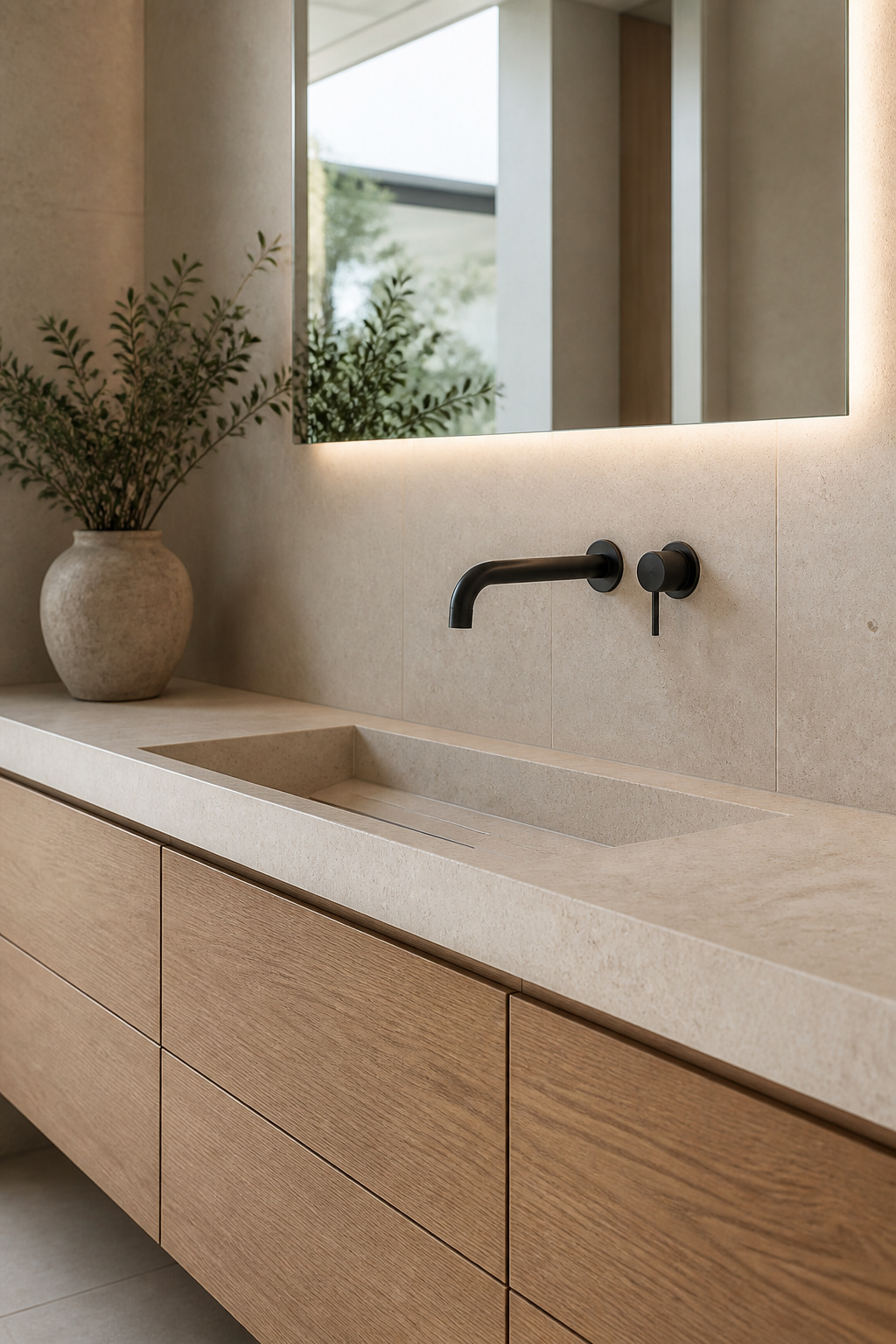
Installation requires planning at the rough-in stage. Supply lines must be run within the wall before it’s closed and tiled, with blocking added to the framing at the tap’s mounting height to provide a secure fixing point. Height calculation matters: the spout should direct water toward the drain, not the side of the basin — typically positioned 3–6 inches above the countertop, with the spout extending roughly 7 inches from the wall for practical hand-washing clearance.
Retrofitting wall-mounted taps in an existing bathroom is possible but involves opening the finished wall, replumbing, and matching the tile. Budget for that realistically. For new builds or full renovations, specifying wall-mounted taps from the start costs no more than deck-mounted and produces a substantially cleaner result. Two-handle versions add a slightly more architectural quality; a single-lever wall tap is the more minimalist choice.
Polished brass has a formality to it — it signals traditional, even classical design. Aged or antique brass, with its muted, lived-in tone, carries none of that formality. It’s warm without being ornate, which is why it’s become the warm-metal fixture choice in contemporary bathroom design rather than its polished counterpart.
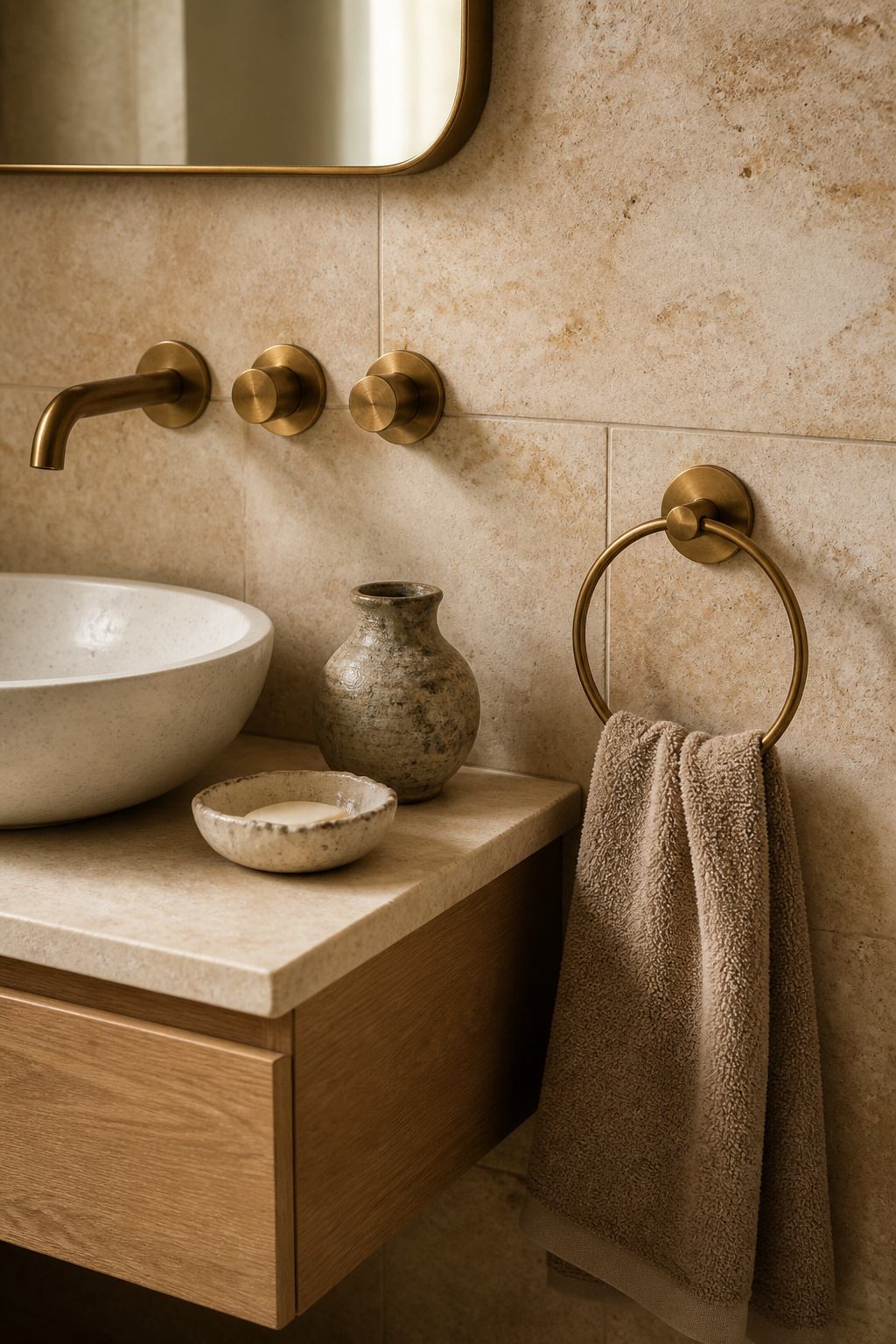
There’s a practical choice to make: PVD-protected aged brass or a living (unlacquered) finish. PVD maintains its tone through molecular bonding — no patina development, no unpredictable darkening, highly resistant to corrosion. A living finish develops character over time, shaped by the environment and handling — it’s preferred by those who want the organic quality of a material that responds to its life in the room. Both are legitimate; the choice depends on whether you value consistency or evolution.
One combination that consistently works: aged brass taps, white oak floating vanity, honed limestone floor tile. All three materials share an earthy quality and a degree of natural variation. For those navigating multiple metals — brushed nickel in the shower, aged brass at the vanity — the rule is to avoid mixing within the same fixture zone. Different areas of the bathroom can carry different finishes; within the same functional group, commit to one.
A single textured stone wall changes a bathroom’s register entirely. It’s the difference between a bathroom that’s been decorated and one that’s been designed. The wall becomes the anchor — every other decision in the room (vanity, fixture finish, floor tile) positions itself in relation to it.
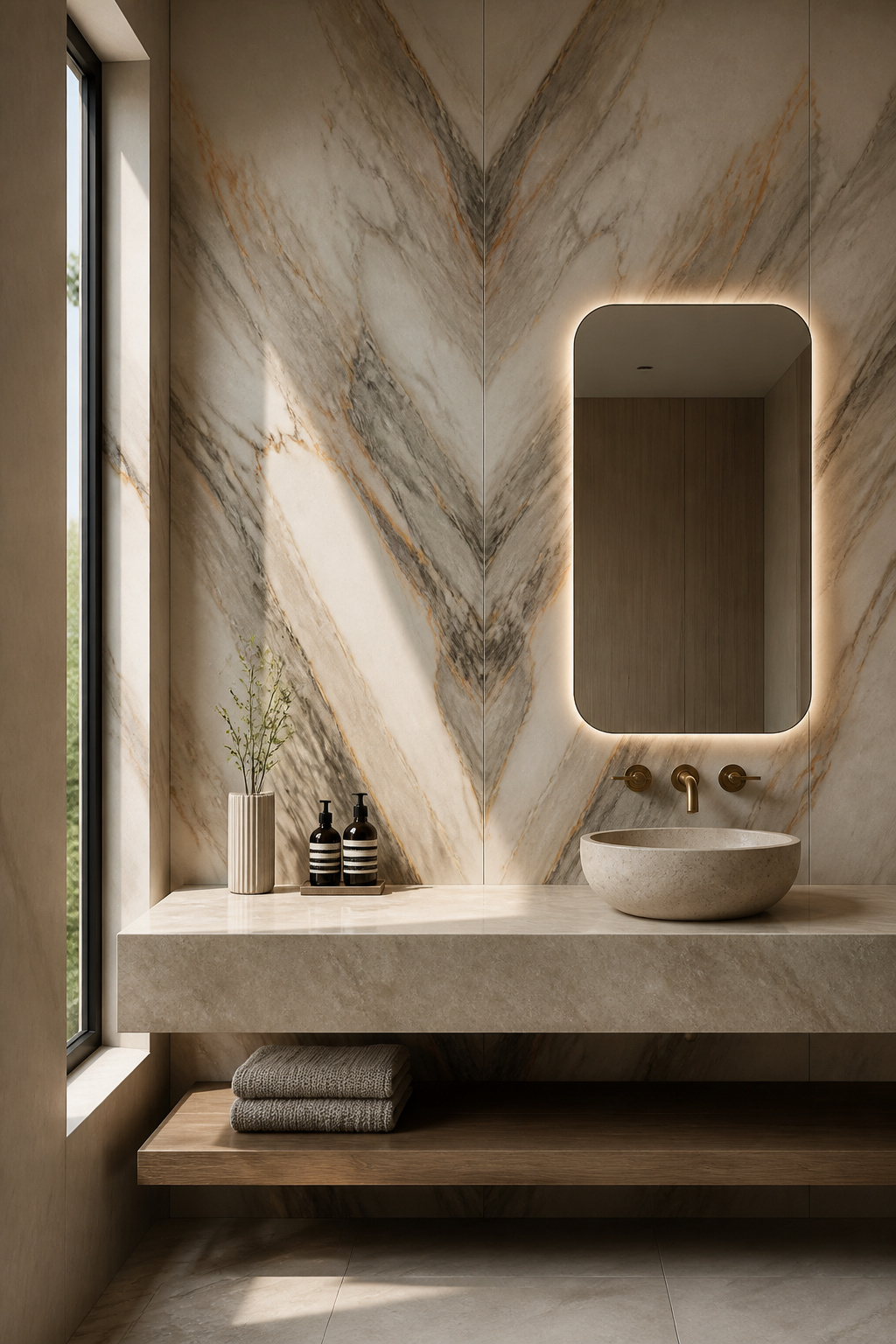
The bookmatched effect — where adjacent tiles mirror each other’s veining in a symmetrical pattern — creates the most dramatic result but requires large-format tiles with strongly directional veining, tiles from the same production batch, and careful setting out before any adhesive goes on. Worth planning for: a bookmatched feature wall in a bathroom is arresting. Applied to a single wall opposite the vanity, it reads as decisive design. Applied to three walls, it overwhelms.
Grout colour has more effect than most people anticipate. For porcelain stone-look tiles, a grout in the lightest tone of the tile at 2–3mm joints becomes nearly invisible. Epoxy grout is worth the premium — it resists staining from toiletries and stays clean far longer than cementitious grout in a wet environment.
Open shelving in bathrooms is easy to get wrong. Within a few weeks of installation, a shelf conceived as a styled display becomes a landing zone for half-used products, orphaned cotton buds, and a soap bar that lost its dish. The problem isn’t the shelf — it’s the failure to treat it as a design element with a fixed brief rather than additional storage.
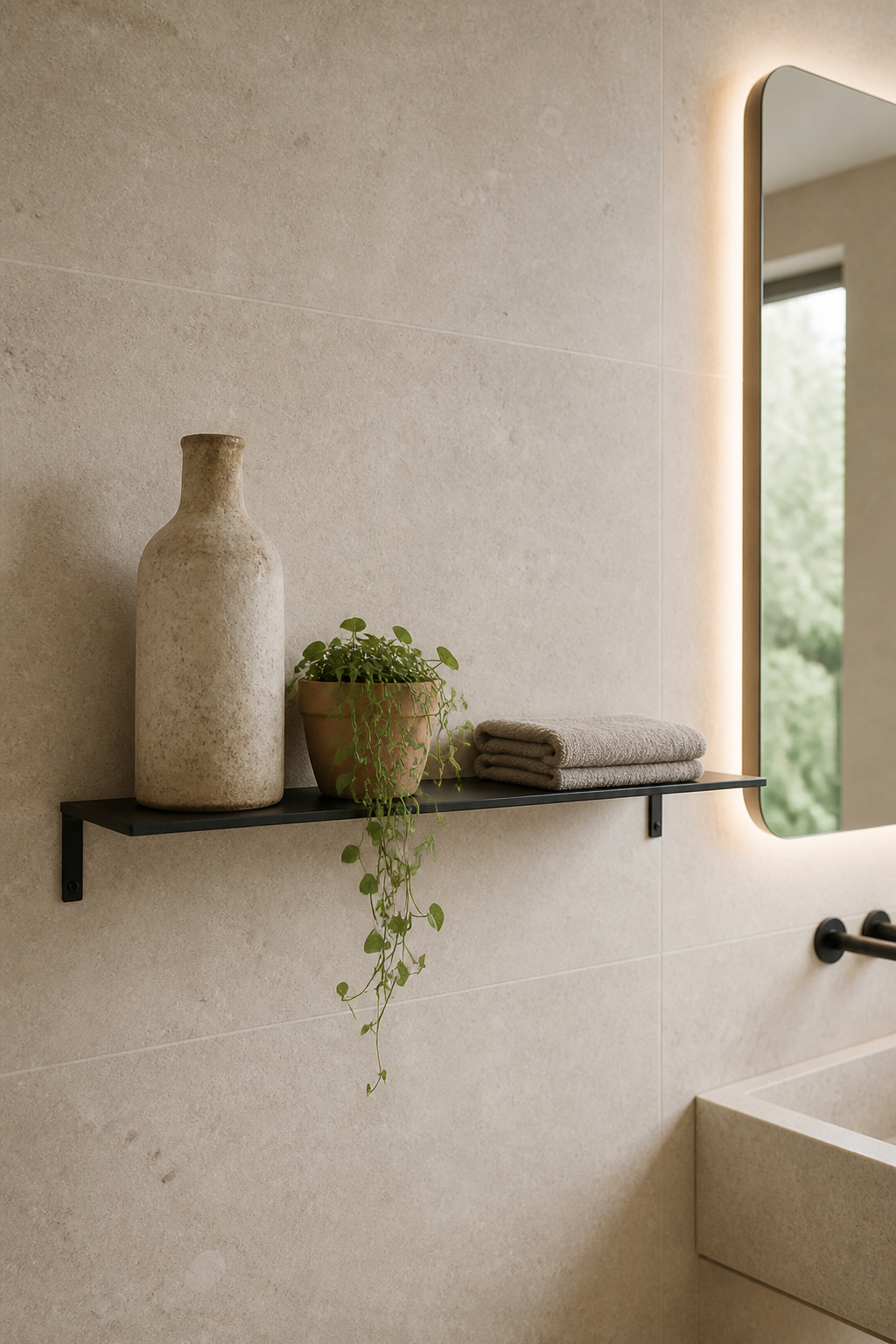
Material selection matters in a humid environment. Teak and sealed hardwood are the most moisture-tolerant timber options; bamboo performs similarly and carries sustainability credentials that suit a Nordic material sensibility. Powder-coated steel or aluminium is the most practical choice for longevity — it won’t warp and carries the additional benefit of looking contemporary. Tempered glass shelves are visually the most minimal option, easy to wipe down, and lightweight; use only tempered glass in a bathroom setting. For ideas on how to develop the styling further, bathroom shelf decor ideas for a historic home covers the composition principles in detail — much of the logic applies regardless of the bathroom’s period.
Keep shelves away from direct splash zones regardless of material. Even the best options perform better when not receiving direct water exposure.
In Scandinavian homes, a heated towel rail isn’t a luxury — it’s the room’s infrastructure. In climates where damp towels and cold mornings are a given, the functionality is non-negotiable. What’s changed is that the design has caught up: contemporary rails in aged brass, matte black, or sculptural geometric forms are doing design work alongside thermal work, contributing to the fixture palette rather than being an afterthought.
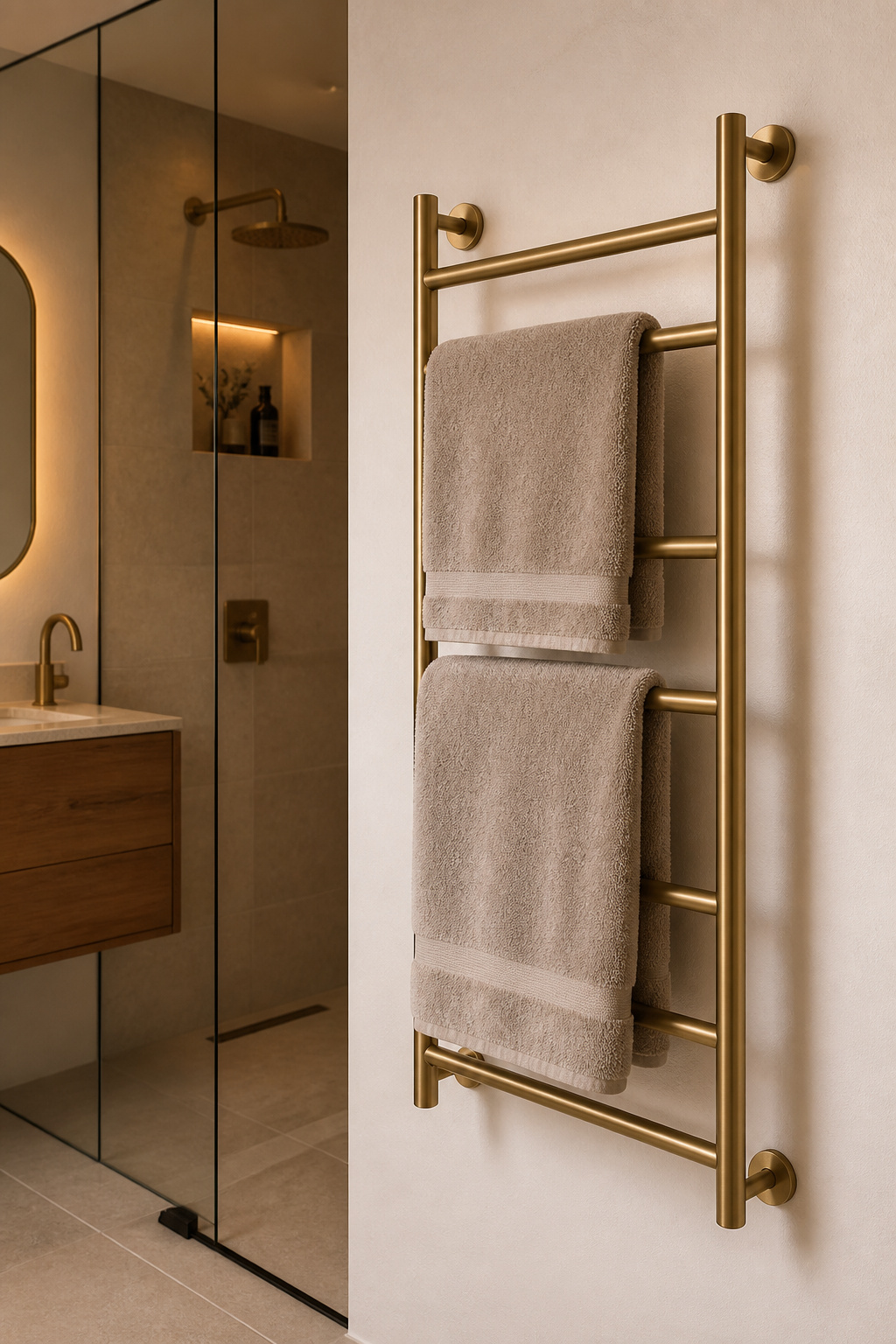
Sizing is the decision most often made too conservatively. A ten by ten foot bathroom with average insulation needs approximately 4,800–7,200 BTUs; a 4–6 bar ladder rail with a surface temperature around 130–140°F handles a standard bath towel efficiently. More bars mean more surface area, more heat, and more towel capacity — for a family bathroom, a wider ladder rail is worth the wall space.
Placement makes a meaningful practical difference: position the rail opposite or adjacent to the shower entry so towels warm while you shower and are within reach when you step out. In finish terms, match or complement the room’s tap and shower hardware — an aged brass rail alongside aged brass taps creates a considered fixture palette; the same rail in matte black against chrome taps reads as an afterthought.
Fifteen ideas covering the full range of a bathroom renovation is a lot to hold at once. The practical approach is to reduce the scope deliberately: choose two or three elements that address the most visible problems in your current space and do those well, rather than attempting a complete transformation and spreading the budget thin.
The sequencing that designers follow is consistent for a reason. Fix the structure first — waterproofing, plumbing rough-in, substrate preparation. This is invisible work that determines whether the visible work lasts. Specify fixtures before tiles: choose your tap finish, shower hardware, and vanity first, then select tiles that respond to those anchor decisions. Surface materials and accessories come last — the backlit mirror, the towel rail, the shelving, the plants. They should answer the room, not try to define it.
For the Nordic approach specifically: spend more on fewer things. One floating oak vanity done properly reads as considered design. The equivalent budget split across six small improvements reads as a room that’s been worked on rather than thought through. The best modern bathrooms aren’t the most decorated. They’re the most edited — and editing takes more discipline than adding things usually does.