Physical Address
304 North Cardinal St.
Dorchester Center, MA 02124
Physical Address
304 North Cardinal St.
Dorchester Center, MA 02124
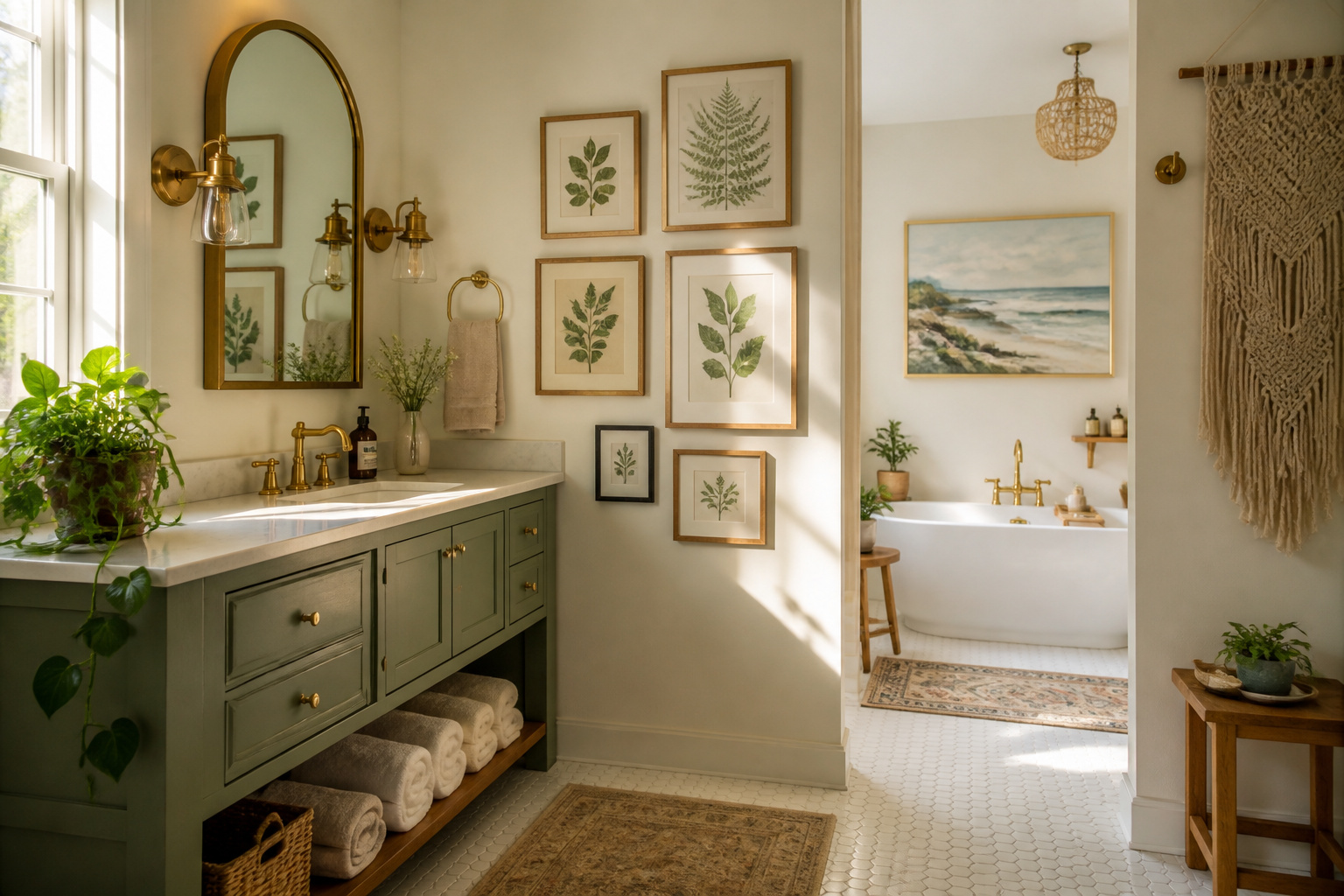
Transform your bathroom with 17 bathroom wall art ideas — botanical gallery walls, coastal watercolors, and calming prints that shift how the room feels daily.
There’s a room in your home you visit more than any other, and you probably haven’t given it much deliberate thought. The bathroom is where most of us start and end every day — a few minutes at the mirror, a quiet shower, the occasional long soak when life finally slows enough to allow one. Yet for a space holding so many micro-rituals, it tends to get the least intentional visual attention of any room in the house.
In mindful space design, the bathroom deserves exactly the kind of thoughtful consideration we extend to the living room or bedroom. Research on biophilic design consistently shows that even brief exposure to calming bathroom wall art — nature prints, restful colour fields, grounding geometric forms — measurably lowers cortisol and shifts mental state. The right bathroom wall art is also the most accessible way to change how a room feels without lifting a tile. These 17 ideas span from a single well-chosen coastal watercolour to a curated gallery wall, all selected for their genuine ability to alter the atmosphere of the space.
A gallery wall might seem ambitious for a bathroom, but in a room with plain white tile and minimal fixtures, it can be the most transformative thing you do. The trick is treating it as a collection rather than a decoration project — choosing bathroom wall art prints that share a visual language while telling individual stories.
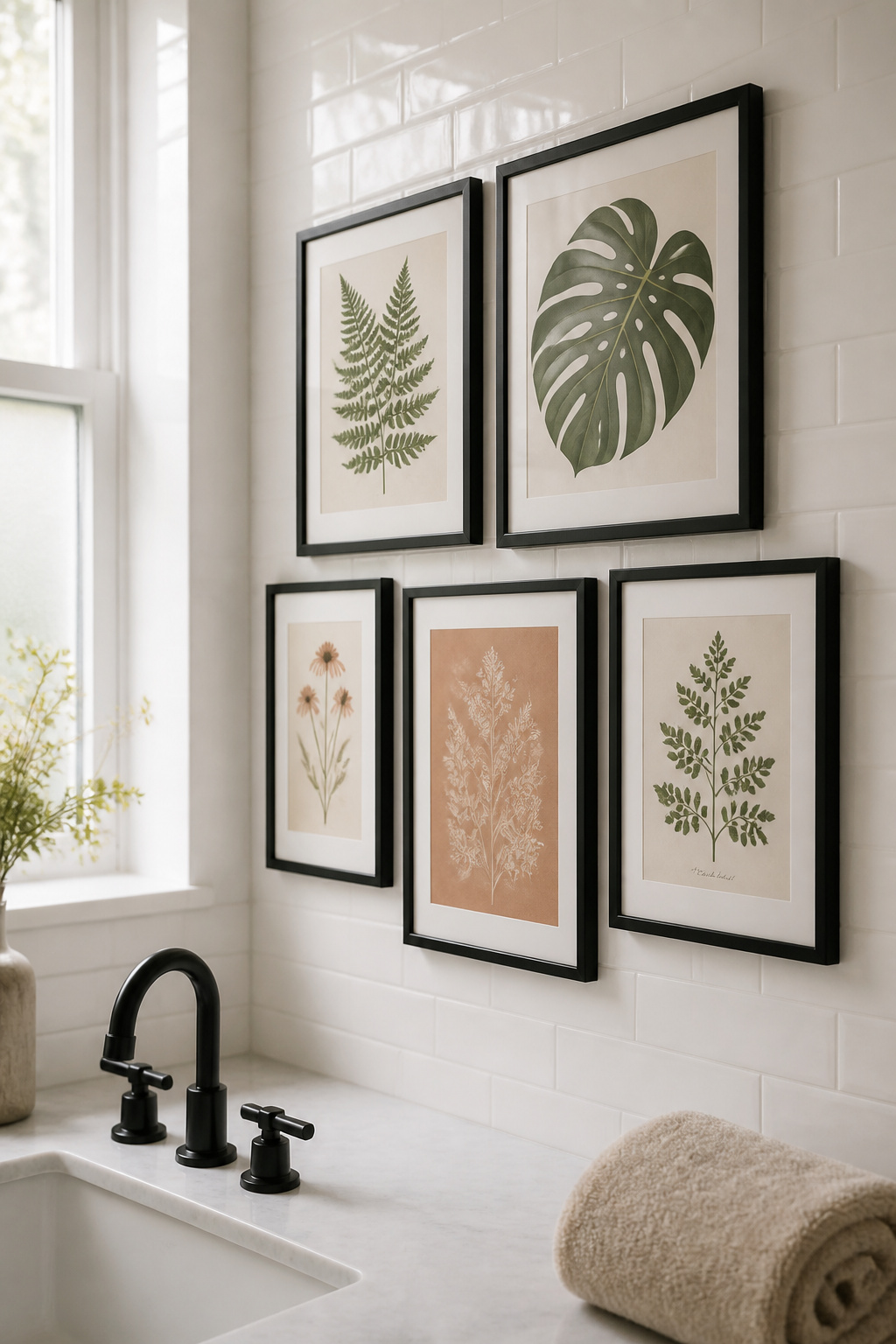
Botanical prints are the most forgiving gallery-wall subject for bathrooms. Their palettes — deep greens, dusty taupes, warm ivories — cohere naturally even when the prints come from different botanical families. More importantly, they tap directly into the biophilic response: research confirms that nature imagery triggers attention restoration pathways that let the mind rest without being understimulated. That’s precisely what you want from a space you inhabit at 7am. For a broader sense of what works in the bathroom context, bathroom decor inspiration to refresh your space is worth exploring.
For the arrangement, plan with paper templates before touching the wall. Cut paper to exact frame dimensions, tape them up, and live with the composition for a day before drilling. In compact bathrooms, aim for 1.5 to 2 inches between frames — tight enough to read as a unified installation. Pull your frame finish from existing hardware. Raw timber frames warp in bathroom steam; sealed hardwood, powder-coated metal, or composite resin frames are the practical choice. Acrylic glazing outperforms standard glass by resisting fogging.
The simplest way to understand why coastal watercolours work in bathrooms is to think about what the room already does. Water. Steam. Warmth. A print extending that visual language — soft blues, misted aqua, the pale grey of a winter sea — doesn’t compete with the bathroom’s function. It amplifies it.
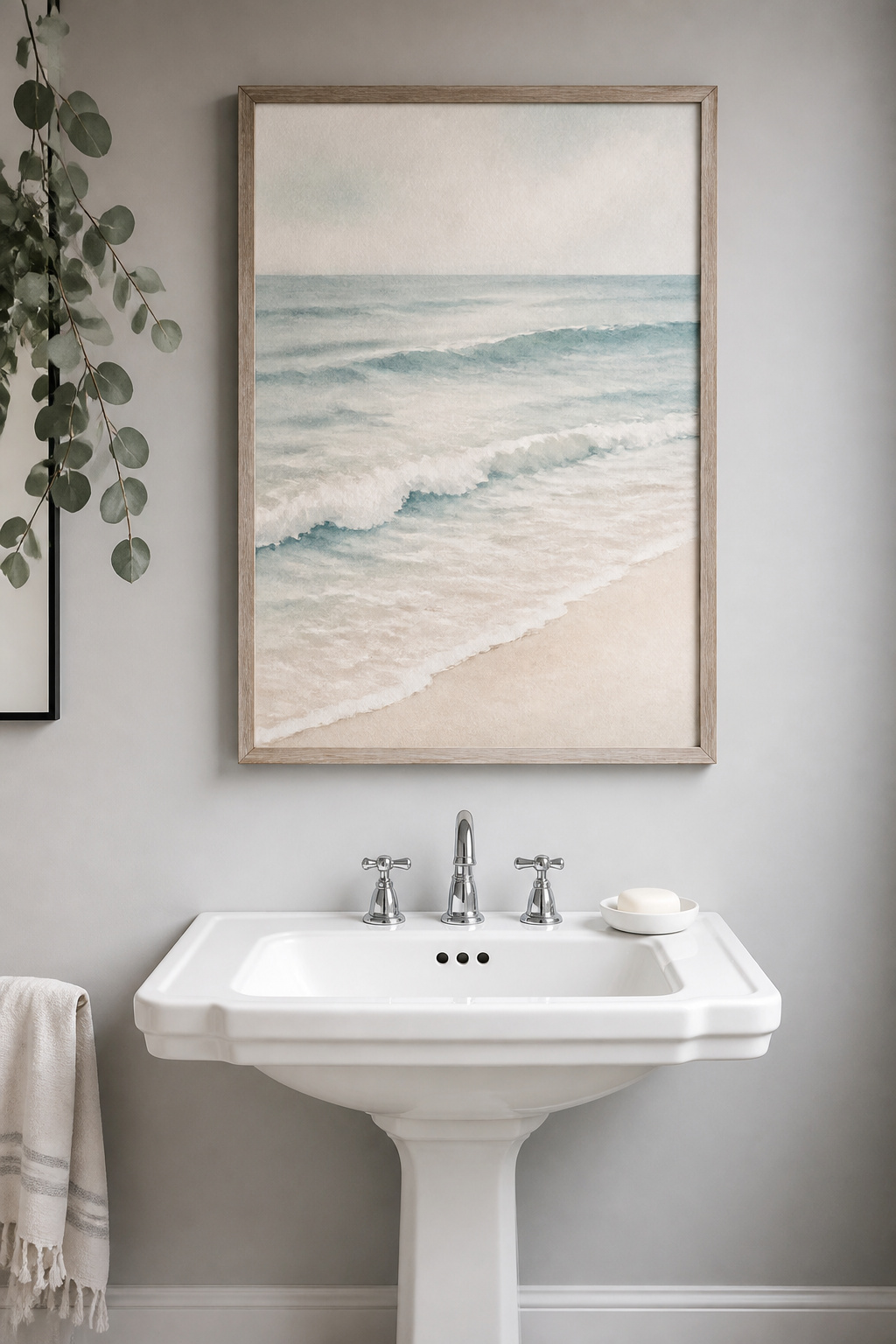
Colour psychology research is consistent: cool tones in the seafoam-to-sage range lower perceived stress and create a sense of openness, particularly in smaller rooms. For a bathroom that skews clinical or utilitarian, a single well-chosen coastal watercolour does more atmospheric work than almost any other intervention at the same price point. The coastal bathroom ideas that bring the seaside home collection offers a useful framework for the full seaside aesthetic.
The palette matters more than the subject. A watercolour of beach grass in grey-green and ivory works as well as a literal seascape — it’s the colour temperature that produces the spa response. Avoid saturated primary blues; instead seek low-saturation, slightly grayed versions: mist blue, duck egg, pale seafoam. In a bathroom under 60 square feet, a single horizontal watercolour at 16×20 or 18×24 inches placed on the wall opposite the door will do more for the room than five smaller prints clustered elsewhere. Hang the centre at 57–60 inches from the floor, or 8–12 inches above the toilet tank if that’s the placement zone.
The appeal of monochrome photography as bathroom wall art is partly visual, partly practical. Practically: it pairs with any tile colour, grout tone, or fixture finish — the most forgiving bathroom wall art choice for people who change hardware or towel colours. Visually: it strips colour complexity from the wall, giving the eye a single restful object rather than a colour field to process.
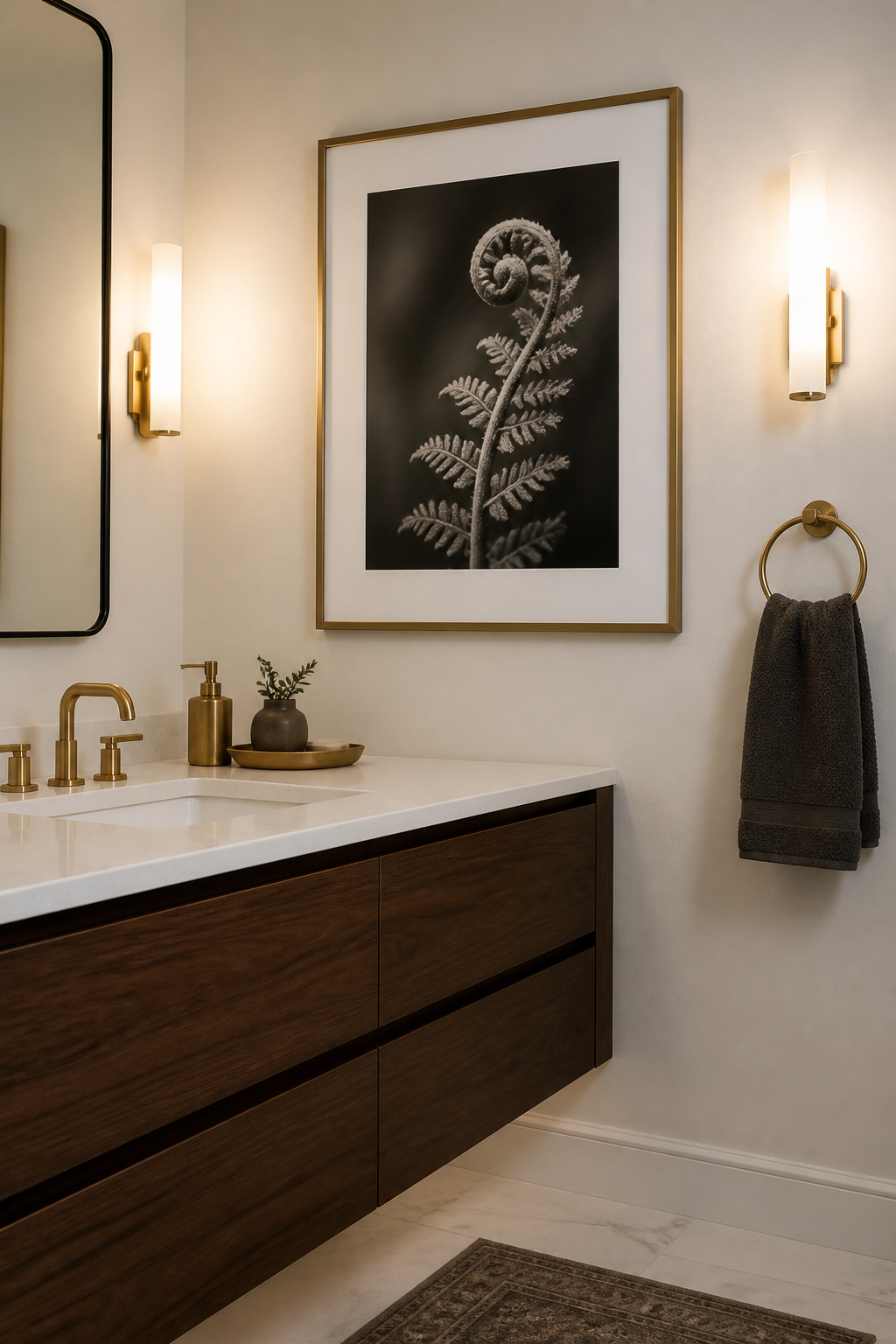
A bathroom with busy tile, mixed-metal fixtures, and coloured towels already presents a lot of visual information. A black and white print introduces visual weight without adding colour — it anchors the room without overwhelming it. Subject matter matters more here than in any other category: avoid anything clinical or hard-edged. Instead, look for nature macro photography (fern fronds, water droplets on bark, dried seedheads), soft atmospheric landscapes (misty forests, long exposures of moving water), or abstract architectural details with a quiet textural quality. For a full treatment of the minimal bathroom aesthetic this pairs with, minimalist bathroom ideas for a serene and stylish space is worth reading.
Warm-toned frames — antique brass, dark walnut, champagne gold — counterbalance the tonal coolness of B&W photography and keep the room from feeling sterile. In bathrooms with very dark tile, black frames disappear; use a lighter finish or mount the print on a white mat that creates separation from the background.
Wabi-sabi — the Japanese philosophy of beauty in imperfection — rarely gets applied with subtlety to bathrooms. The most accessible entry point is framing: choosing frames with natural, slightly uneven textures (washi paper mats, light bamboo, unfinished wood with visible grain) rather than the perfectly smooth lacquered finishes that dominate the market.
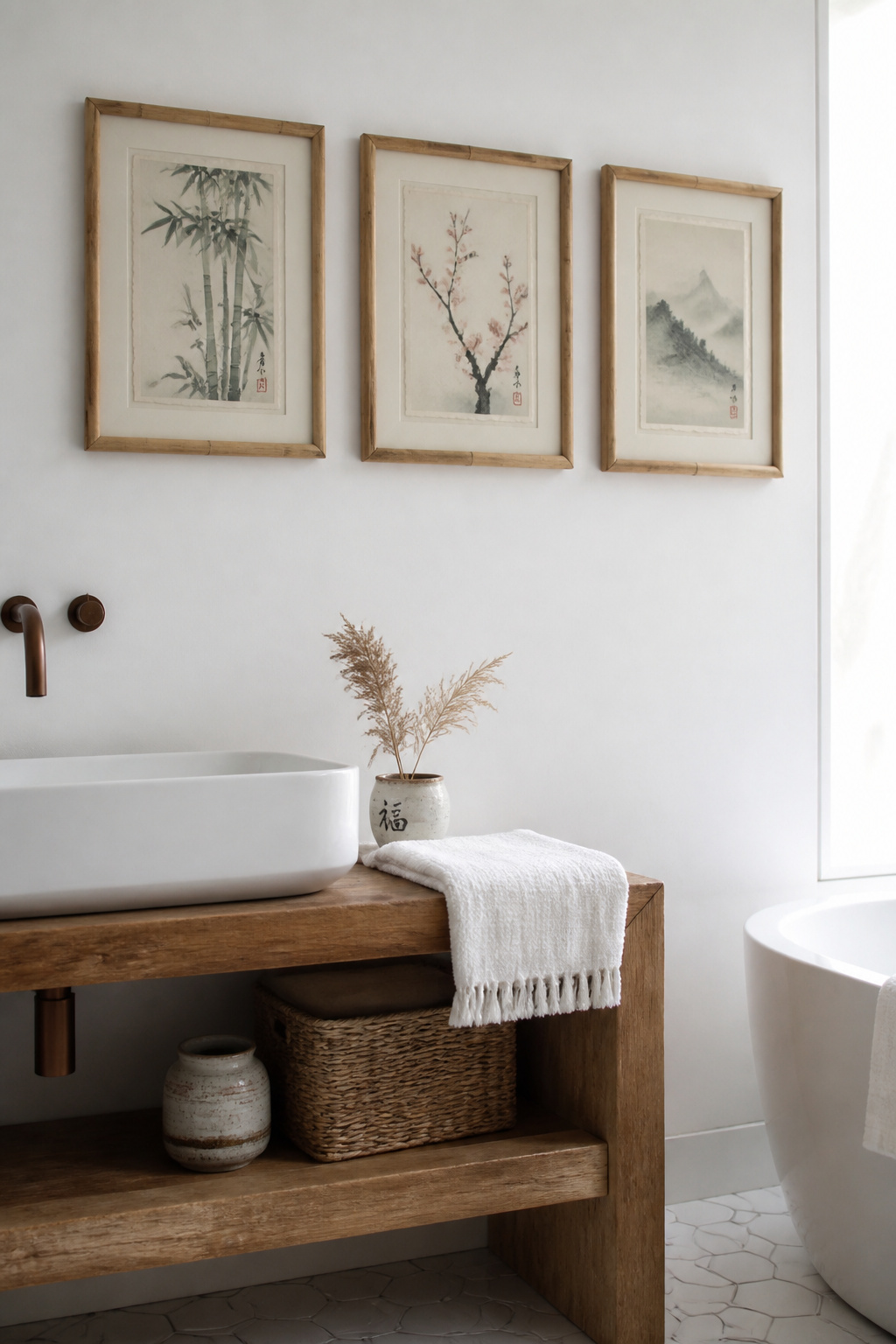
These frames carry a different instruction than conventional frames. A polished chrome frame says ‘museum piece’; a washi-framed print says ‘found object, loved thing’. In a mindfulness-oriented bathroom, that quality matters. Ink wash paintings in the sumi-e tradition, soft botanical watercolours of Japanese garden plants, and muted nature photography in earthy tones all sit naturally in washi-adjacent frames. High-contrast graphic prints fight against the softness the frame is designed to convey.
Bamboo frames sealed with a matte waterproof varnish resist humidity better than untreated hardwood. For hanging on tile: Command Strips rated for 4–8 lbs hold most washi-style frames securely without drilling. Remove slowly at 45 degrees to protect the tile glaze. Never position any bathroom wall art within 18 inches of a running tap or directly in the shower’s steam path.
Fluid art — the acrylic pour technique producing organic, flowing patterns — earns its place in the mindful bathroom for one specific reason: the eye doesn’t need to solve it. Unlike figurative art (which invites narrative) or geometric art (which invites analysis), fluid art asks only that you look. The patterns are complex enough to hold interest, organic enough to feel natural, and undirected enough to let the mind quiet.
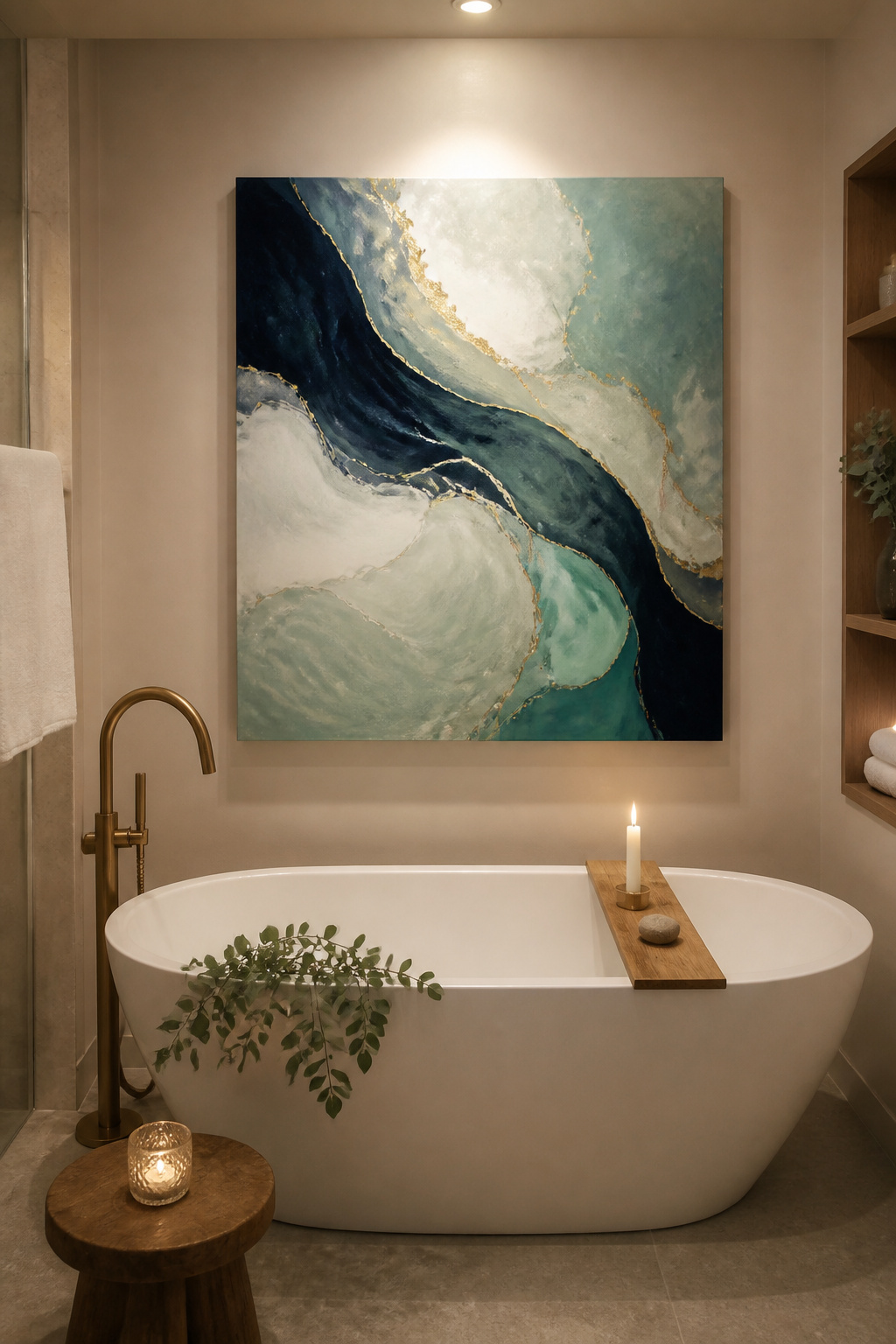
The same neurological pathways that respond to flowing water respond to the movement implied in fluid art. It’s genuinely decompressing for anxious minds. For wellness-oriented bathroom wall art spaces, muted earth tones (warm terracotta, dusty sage, cream) pair with natural stone tile and warm linen beautifully. Ocean palettes (midnight navy, seafoam, translucent aqua) create a water-adjacent visual language that works particularly well above a soaking tub. Avoid neon or acid-palette pours — they’re striking in a studio but disruptive in a decompression space.
Original fluid art at bathroom scale runs $80–$350 from Etsy makers. Giclée reproductions on archival polyester canvas with UV-resistant pigment inks start around $30–$80. Always choose polyester rather than cotton canvas for bathroom settings — polyester handles moisture cycling significantly better.
This is my consistent recommendation when someone asks for one bathroom wall art idea that works in every possible bathroom. A vintage botanical illustration — properly sourced, thoughtfully framed — carries a visual authority that nothing contemporary quite matches.
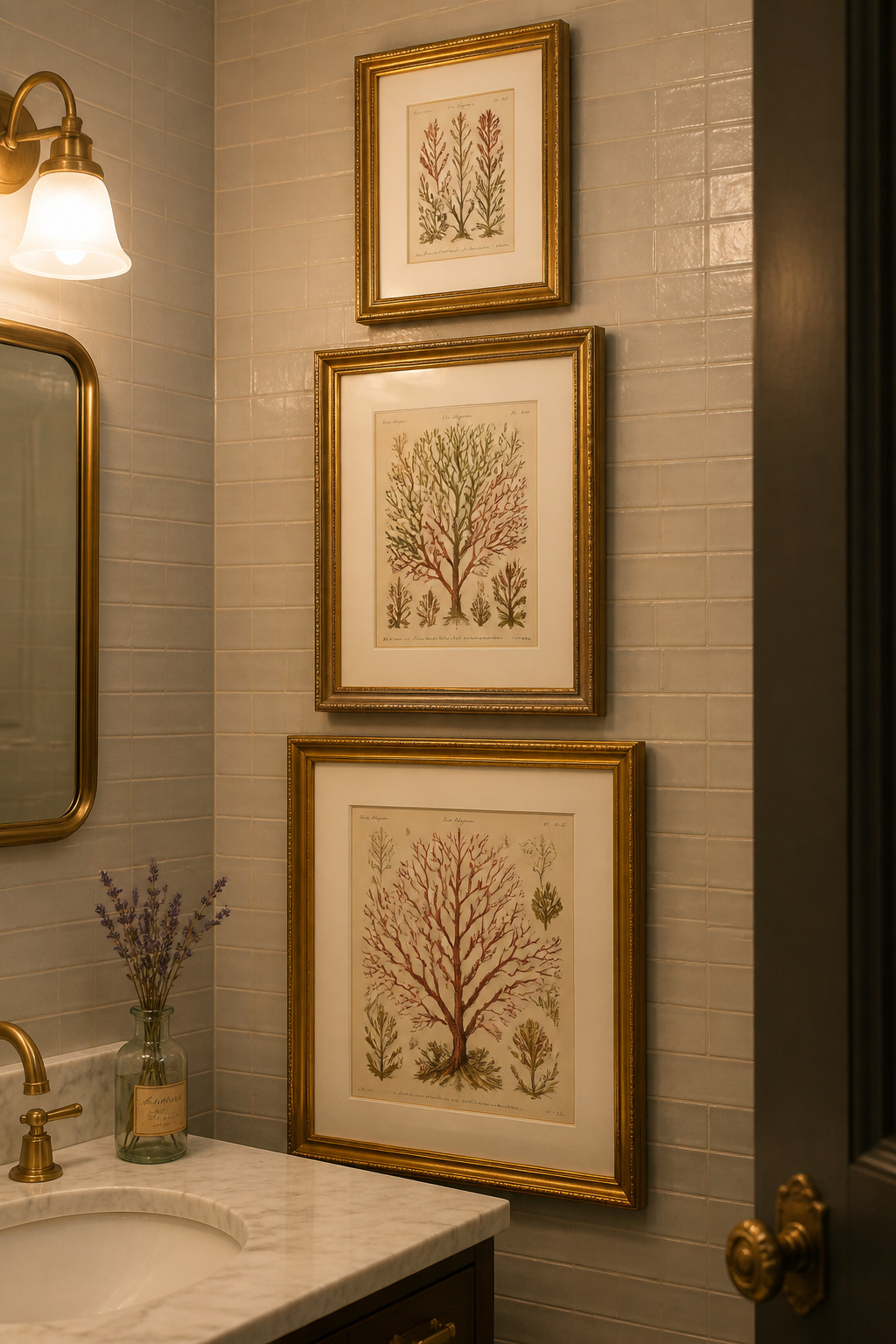
Ernst Haeckel (1834–1919) published 100 chromolithograph plates in ‘Kunstformen der Natur’ (1899–1904) so visually extraordinary they directly influenced the Art Nouveau movement. The Huntington Library in San Marino licences museum-quality reproductions from the original collection — the gold standard for historical accuracy. Alternatively, the Rijksstudio (Rijksmuseum’s free digital archive) offers high-resolution downloads of out-of-copyright botanical illustrations; print these at 300 DPI minimum on archival matte paper through any professional print lab.
On Etsy, look for sellers specifying archival pigment inks, acid-free paper, and at least 300 DPI — these markers distinguish serious print professionals from those producing inkjet prints that fade within two years under bathroom ambient light. For framing: antique or champagne gold is the right register — not bright yellow gold, but the softer tones of aged gilt or brushed brass. This approach to heritage bathroom wall art sits alongside broader warm-material design choices discussed in rustic bathroom decor ideas that feel timeless. Arrange in odd numbers — three or five prints create visual rhythm.
Carl Jung drew mandalas daily. Not as decoration, but as what he called a tool for psychological integration — the circular, radially symmetric form gave his mind a stable, ordered structure at moments of internal fragmentation. Clinical studies since Jung confirm that both creating and viewing mandalas reduces anxiety markers and improves attentional focus.
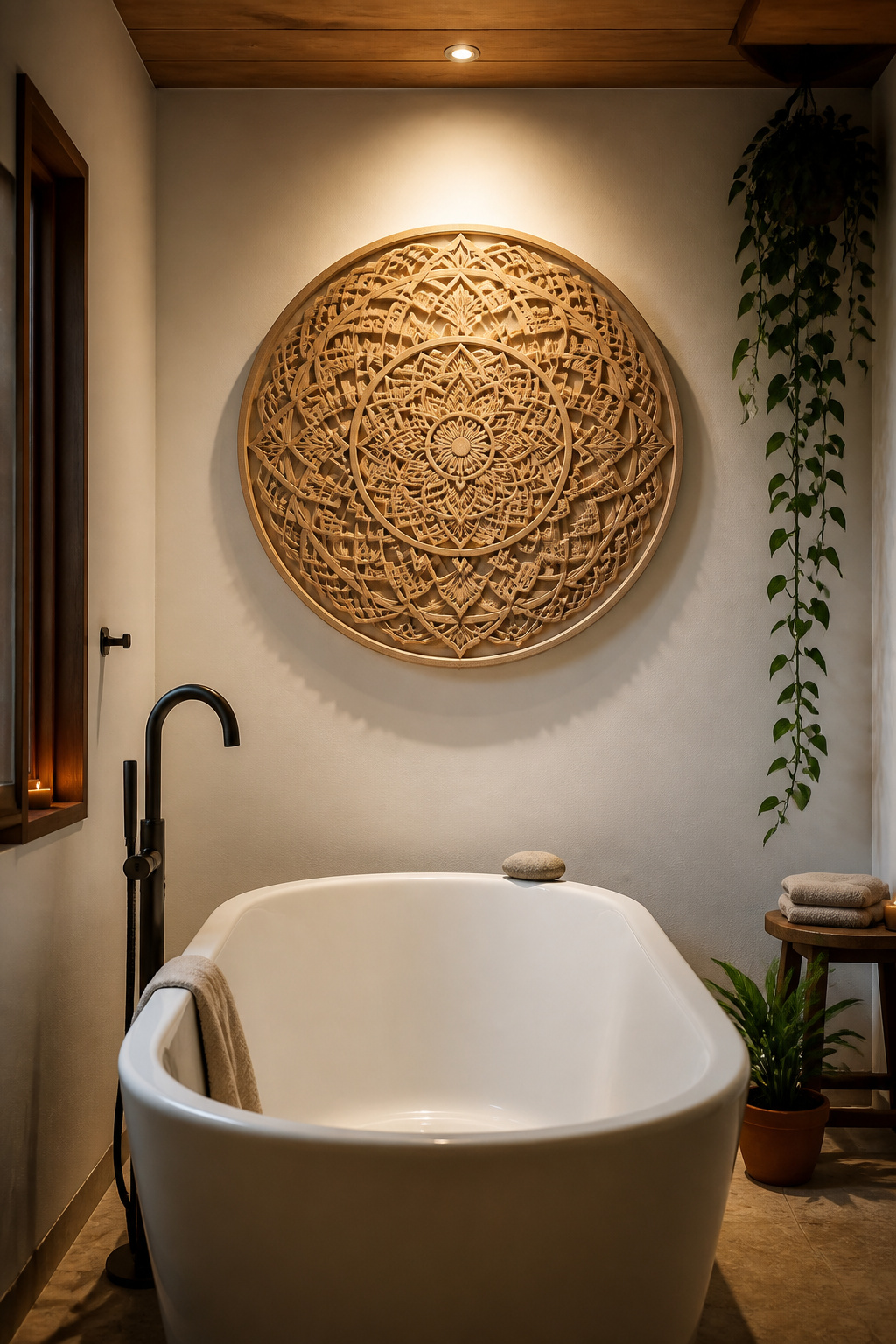
The bathroom is a particularly resonant setting for this bathroom wall art format precisely because it is already the most ritually structured room in the house. You are already there every morning doing the same sequence of actions. A mandala in the visual field of that ritual deepens it without requiring additional time. Above the soaking tub is the single most powerful placement — it creates a focal point visible from the bath’s natural resting position. For the broader visual restraint that lets mandala art breathe, minimalistic bathroom design approaches offers a useful framework.
Canvas mandala prints (always choose polyester canvas over cotton for bathroom settings) are the most widely available option. Hand-carved wooden mandala panels from Etsy artisans run $45–$180 and add genuine three-dimensional depth — the shadow play on carved relief changes through the day. Finish any wooden piece with a coat of tung oil or teak oil before hanging.
The most common mistake with decorative ceramic in bathrooms is confusing it with functional tile. Decorative ceramic wall art — studio-made relief panels, artisan tile sets, hand-thrown wall pieces — is designed to be looked at rather than splashed against. It brings a tactile, three-dimensional quality that no flat print can replicate.
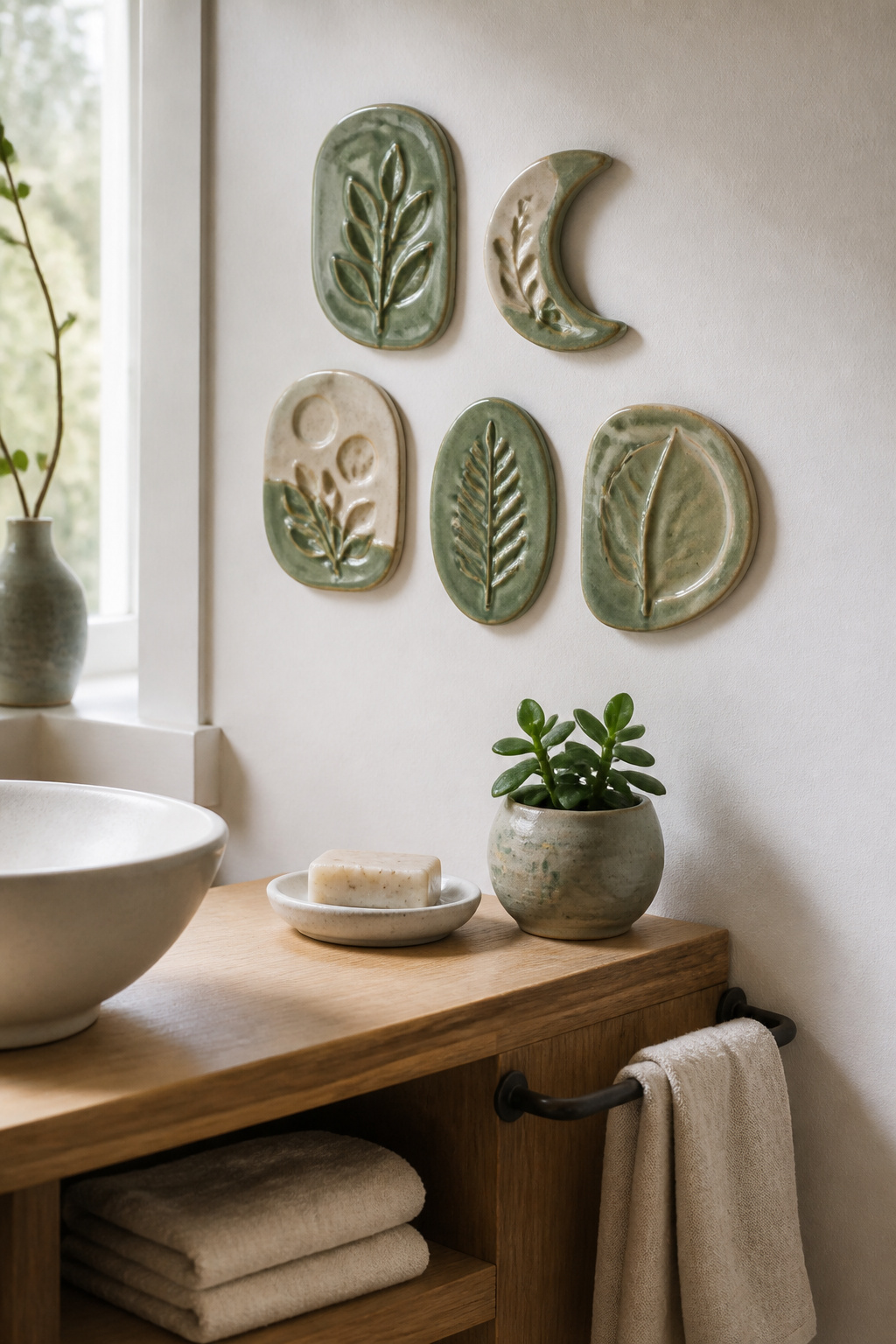
A cluster of five studio-made tiles above a vanity mirror signals design intent that mass-market prints simply cannot. Each piece in a studio-made set shows the slight glaze variation, dimensional unevenness, and surface texture that marks it as made by a specific person on a specific day. Heath Ceramics and Fireclay Tile both produce dimensional relief tiles designed specifically as wall art, available in custom glazes. Individual ceramic wall pieces from Etsy run $15–$80 each; three to five pieces mounted with 2–3 inches between them creates the wall sculpture effect without requiring a full commercial collection.
Installation weight is the critical practical consideration. Pieces under 1.5 kg can be safely mounted on tile using heavy-duty adhesive strips (use two strips per piece for safety margin). Anything over 1.5 kg requires a wall anchor drilled through the tile into the substrate behind. Ensure any ceramic has a glaze rated for indoor moisture — unglazed bisque or bare terracotta will stain within the first humid season.
There’s a sensory dimension to macramé as bathroom wall art that flat prints cannot reach. The knotted texture creates shadow play that shifts through the day as light conditions change — a genuinely dynamic wall surface. There is also something specifically calming about visible evidence of handcraft: the individual knots, the natural cord texture, the slight irregularity of handmade work. It grounds a bathroom in human making.
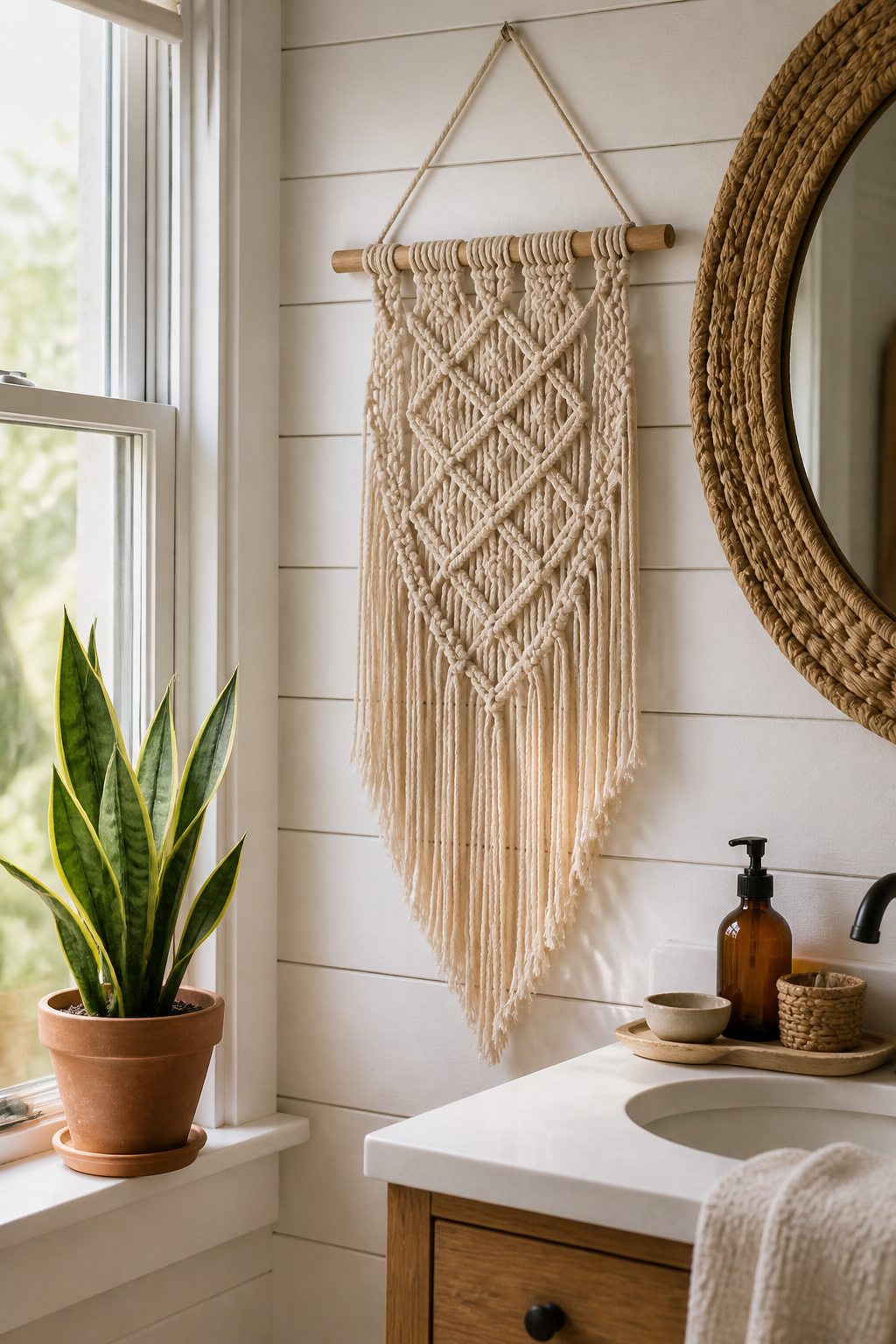
For bathroom use, cord material is the decision that matters most. Cotton is the most common macramé material and the worst choice for humid rooms — it absorbs moisture, stretches, and can develop mould without excellent ventilation. Jute has natural antimicrobial properties that resist mould and mildew, making it the practical choice for any bathroom with regular shower use. Polyester cord in natural ivory tones looks almost identical to cotton while handling moisture with no degradation. For a sense of how macramé reads across different room contexts, boho living room ideas for a warm sanctuary feel shows the material’s full range. For sizing: a 16–24 inch wide piece provides presence without competing with towel rails and mirrors. Hang 12 or more inches from direct steam sources.
If your bathroom is small, this bathroom wall art idea is most likely to change how the room feels in a material way. A horizontal landscape print with a strong receding perspective — a path disappearing into misty forest, a shoreline curving toward a soft horizon — activates depth perception in a way a wall simply cannot. The eye reads it as an opening rather than a surface.
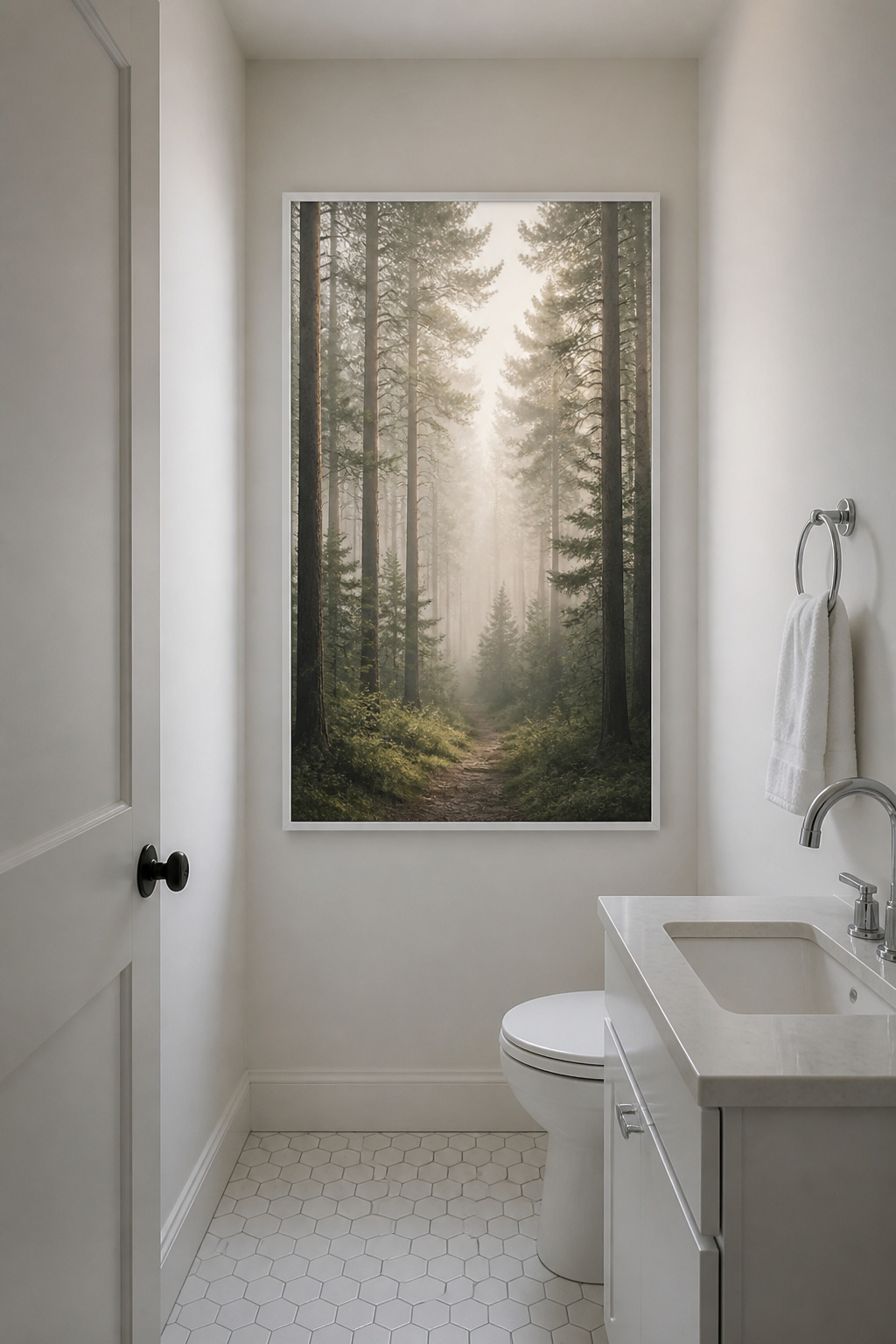
The human visual system perceives depth through atmospheric perspective: near things are sharp, far things are soft and blurred. A good landscape print recreates these depth cues on a flat surface, and the brain responds to the representation with the same spatial interpretation it applies to actual views. In a bathroom where every other surface is tile, glass, or mirror, a well-chosen landscape print is the visual equivalent of opening a window. The small bathroom interior design ideas that really work guide covers the broader spatial principles that make this so effective.
Matte finish is the right call for bathroom landscapes — it eliminates reflective glare from ceiling downlights and wall sconces. If your bathroom is particularly steamy, an acrylic face-mount print (image sealed against clear acrylic, floated on aluminium backing) provides the best humidity protection at $80–$250 for bathroom sizes.
Shodo — 書道, ‘the way of writing’ — is a meditative practice before it is a visual art form. Each brushstroke in authentic Japanese calligraphy represents a moment of concentration and presence. The slight pressure variation, the natural imperfection of the line’s edge, the spontaneous energy of the brush — these are the aesthetic point, not incidental qualities. Bathroom wall art that captures authentic shodo carries that intention into the room with every encounter.
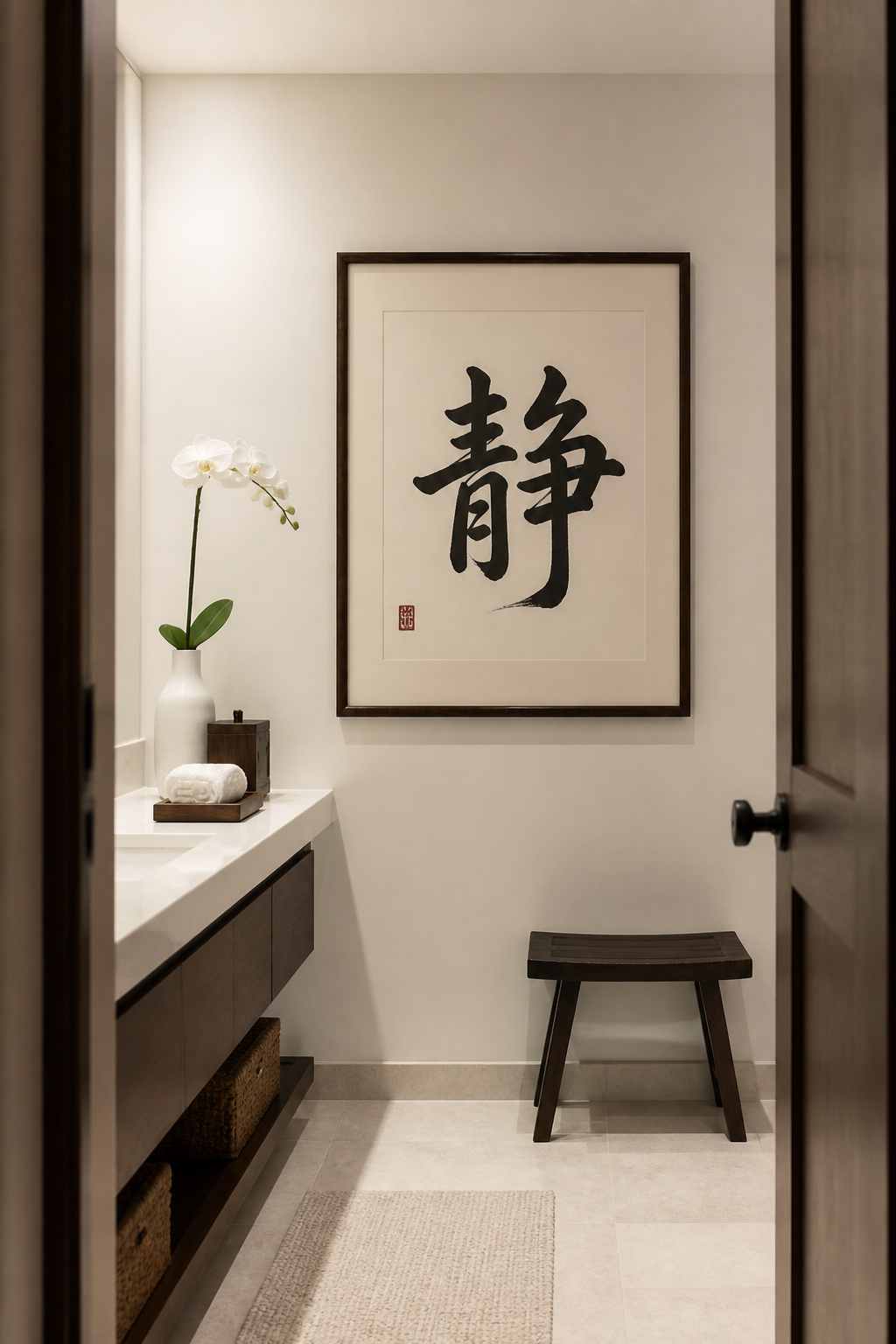
For bathroom use, single-kanji prints work most powerfully as intention anchors. Common choices: 静 (sei: stillness, calm), 和 (wa: harmony, peace), 禅 (zen: meditation), 心 (kokoro: heart, mind, spirit), 明 (mei: clarity, brightness). Each holds a complete concept in a single visual mark. Cultural respect matters here — use kanji purposefully and accurately. Purchasing from Japanese calligraphers directly through Minne, Creema, or the Kyoto Handicraft Center’s international shop ensures authenticity.
A large-format single kanji (16×20 or 18×24 inches) needs room to breathe — the white space around the character is as compositionally important as the character itself. A simple bamboo or dark walnut frame respects the work’s visual philosophy; an ornate gilded frame undercuts it. Place it on the wall opposite the bathroom door at eye level — it greets you every time you enter.
Standard canvas prints in bathrooms deteriorate more quickly than most people expect. Cotton canvas absorbs moisture cyclically, causing stretcher bars to bow and canvas surfaces to buckle. Standard glass-fronted frames create a condensation microclimate behind the image where mould develops invisibly. As bathroom wall art goes, it’s worth getting the material choice right from the start.
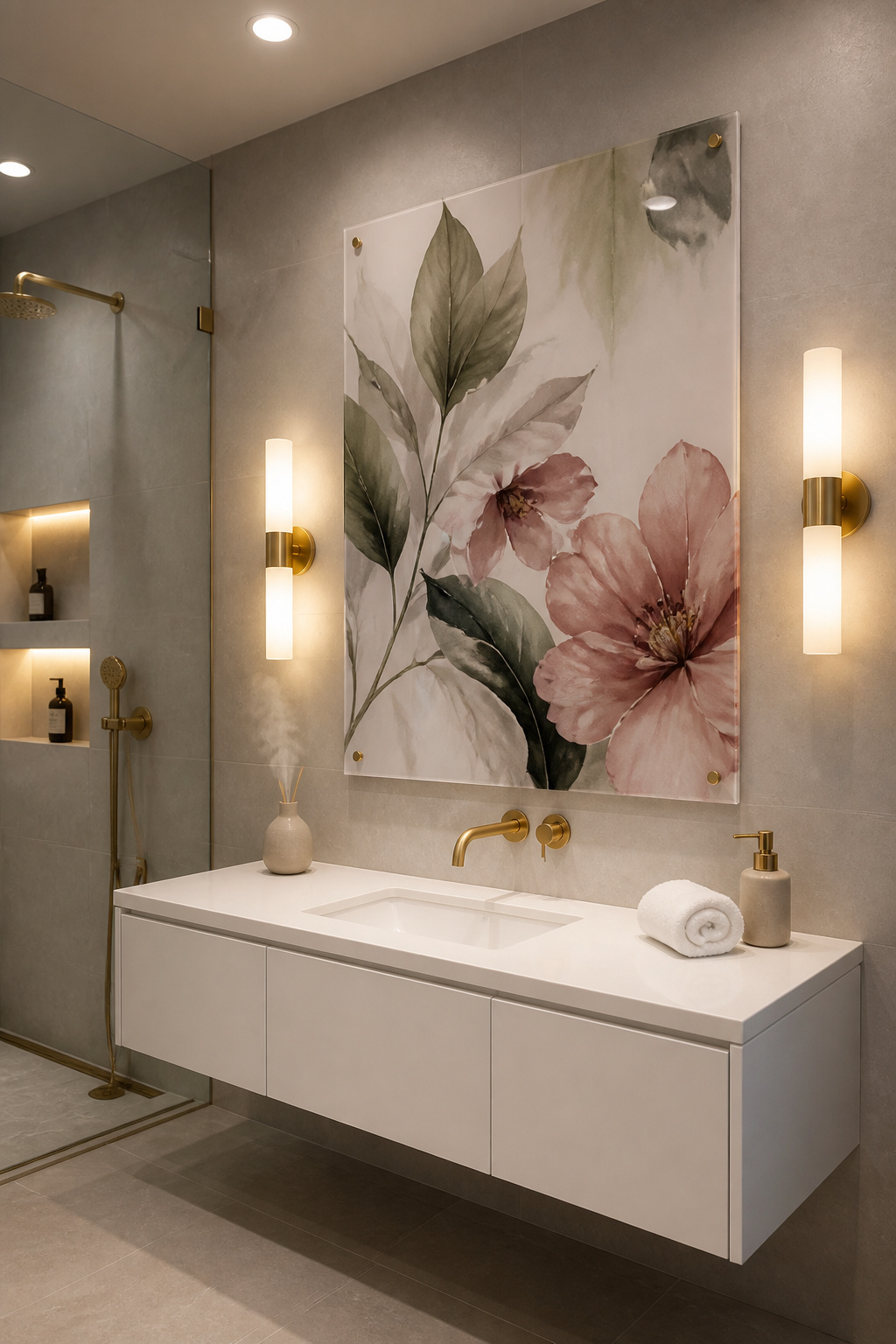
Genuinely humidity-resistant bathroom wall art uses polyester (not cotton) canvas substrate, UV-resistant pigment inks rather than water-based dye inks, and a moisture-sealed aluminium backing. Metal prints (aluminium Dibond, image infused into the metal surface using dye-sublimation) leave nothing that can absorb moisture or mould — they handle bathroom steam without degradation at $45–$150 for bathroom sizes. Acrylic face-mount prints provide the highest visual clarity and are fully sealed; $80–$250 for bathroom sizes. For how this kind of investment fits into a broader bathroom transformation, dream bathroom ideas for a personal spa retreat is a good visual reference. Treated canvas on polyester substrate is the accessible middle ground at $25–$80 — position it away from the direct steam zone.
The instinct in a small bathroom is often to use small art. This is usually wrong. A small bathroom with three small prints is visually fragmented; the same bathroom with one well-chosen large piece of bathroom wall art is visually resolved. The statement print reduces the number of decisions the eye has to make and gives the room a clear compositional focus.
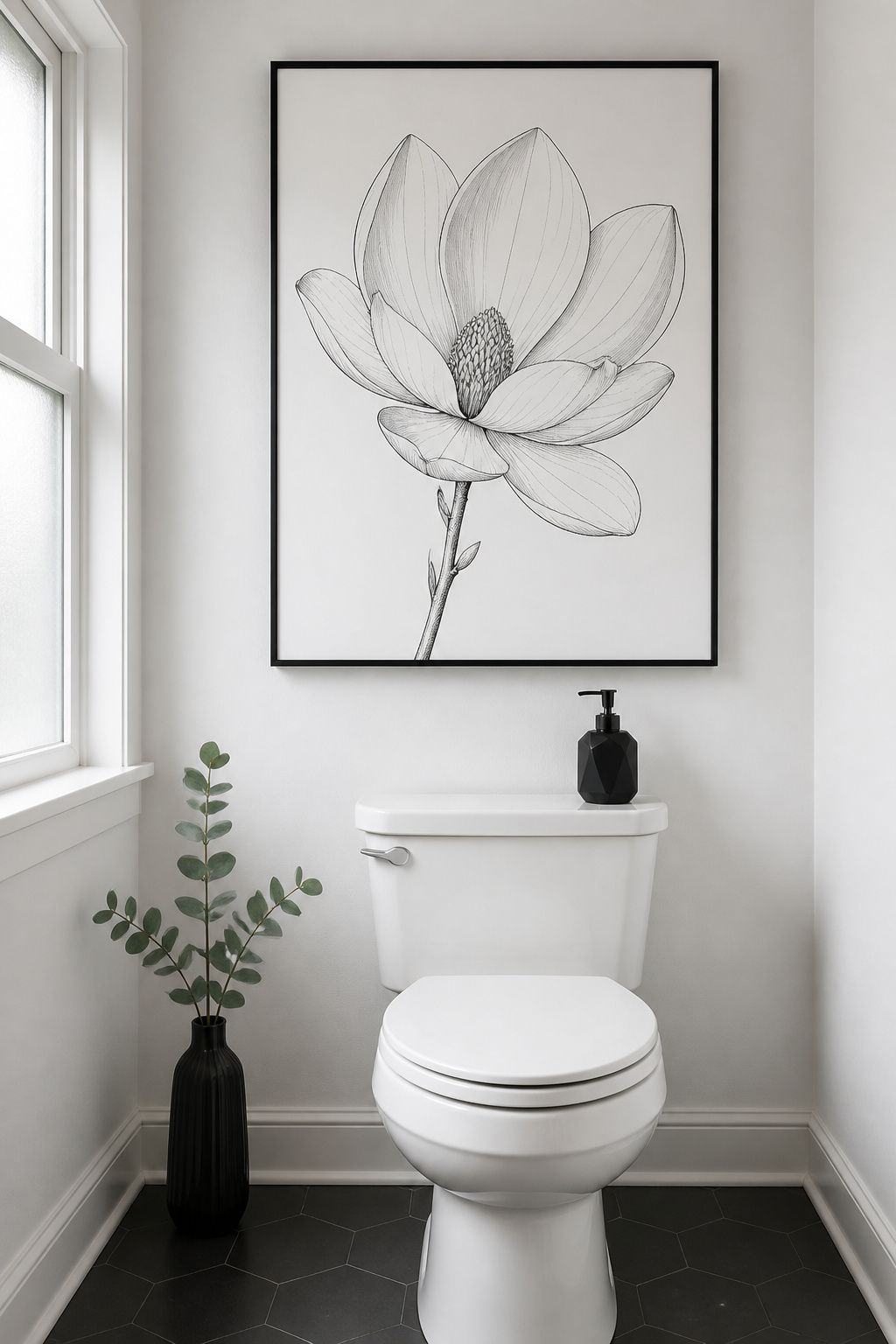
The practical threshold for statement sizing: a print whose width is at least 2/3 the width of the zone above which it hangs. Above a standard toilet tank (18–22 inches wide), that means a print 12–15 inches wide. Above a 36–48 inch vanity, a 24–32 inch print creates the right proportion. A single large botanical illustration (one dramatic cactus flower, one unfurling fern rendered large), abstract colour washes in a spa palette, or a monochrome line drawing at statement size — all hold the eye without demanding interpretation. Hang the centre at 57–60 inches from the floor, with the bottom edge 8–12 inches above the toilet tank. Keep at least 12 inches of clearance from any tap or water source.
There’s a specific wall problem in many bathrooms that triptychs solve neatly: the narrow strip of wall between a door frame and window, or between two cabinet runs, that is 18–28 inches wide. Too narrow for a meaningful gallery arrangement, too wide to leave empty — these strips are bathroom design’s most difficult hanging zone. Three narrow vertical panels fill this space with intentional visual weight while using the vertical orientation to their advantage.
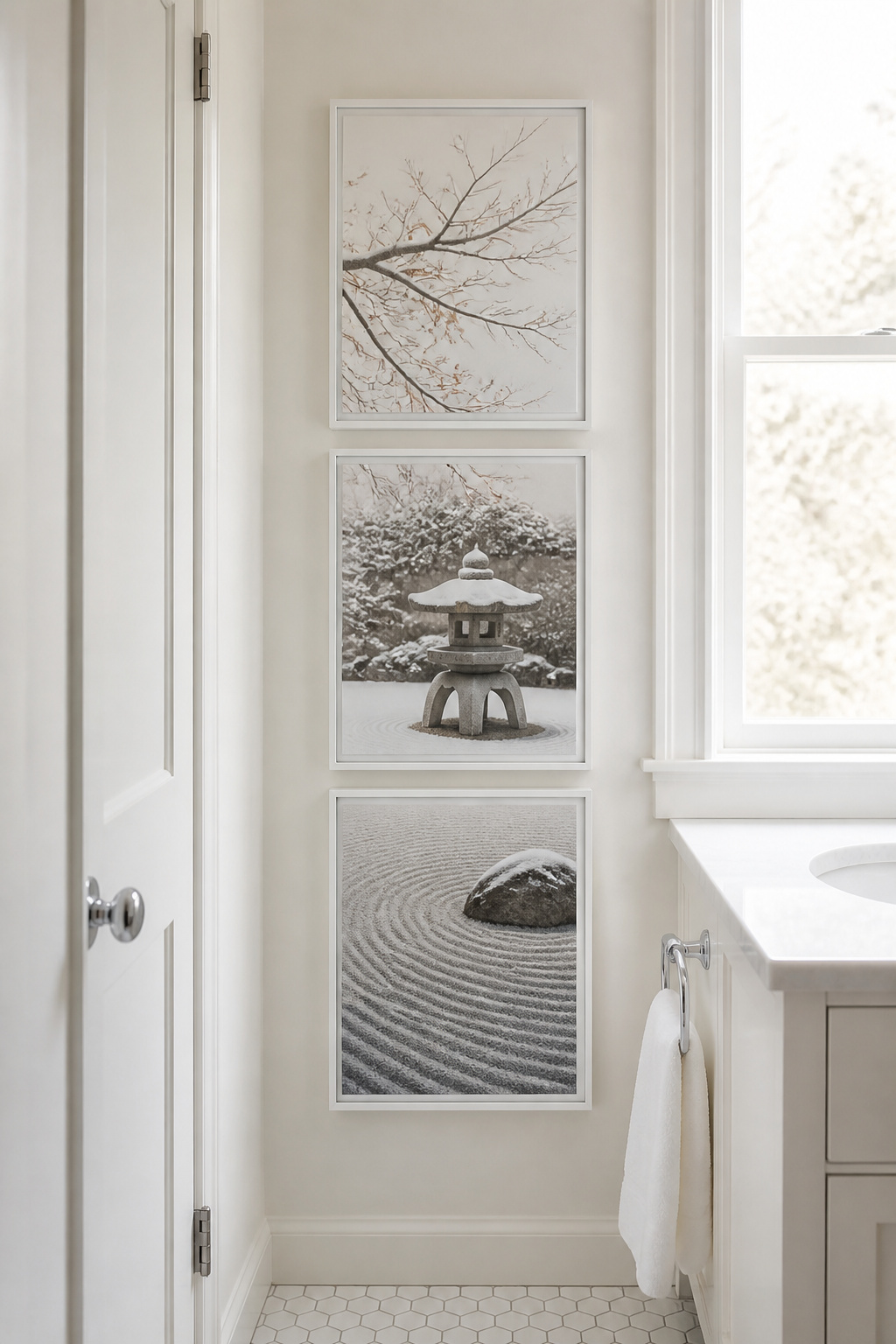
A triptych also resolves the visual complexity problem gallery walls create in small bathrooms. Three panels of the same series present unified visual logic — the eye registers one cohesive artwork rather than three separate decisions. The most cohesive approach: a single image split across three panels, available as ‘split canvas’ sets from most online print services at $45–$120. For a colour-matched approach, choose three different prints sharing an identical palette — three watercolour botanicals all in the same seafoam and sage range will read as a series even with different subjects.
Gap between panels: 1.5 to 2 inches for bathroom triptychs, tighter than living room recommendations because bathroom walls have more competing visual elements. Make all three gaps identical, use a level, and aim for the arrangement’s centre at 57–60 inches from the floor.
A mixed-frame gallery wall is one of the most visually interesting forms of bathroom wall art — and one of the easiest to mishandle. The difference between a gallery that reads as curated and one that reads as accumulated is almost entirely about frame discipline.
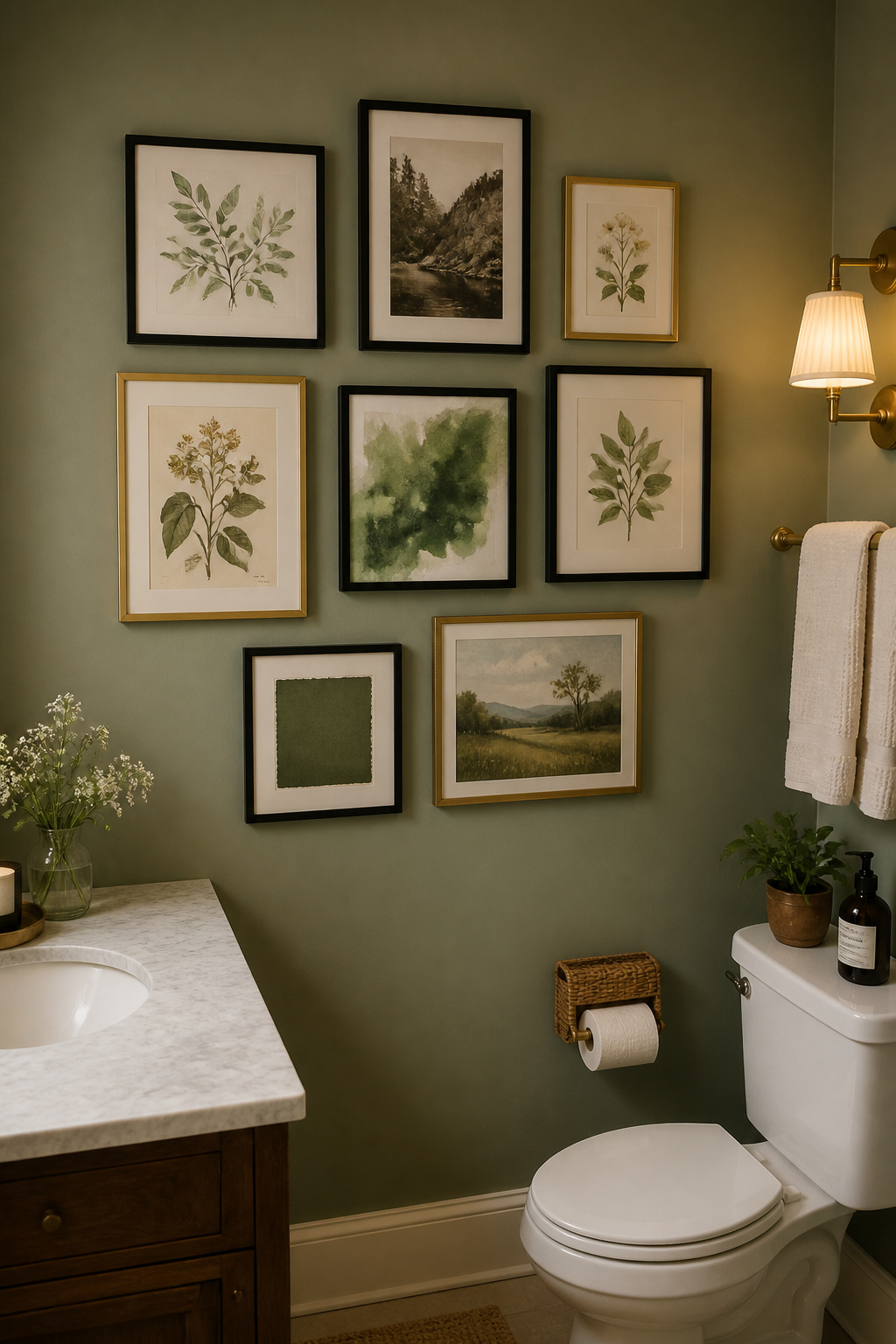
The rule that works consistently: limit yourself to two frame finishes. A dominant finish (60% of your frames, matching existing hardware or the room’s dominant tone) and one complementary accent (40%). Within those two finishes, vary shapes freely — mix square, portrait, and landscape rectangles, thin profiles with slightly chunkier mouldings. This creates visual rhythm without noise. Adding a third finish almost always tips the arrangement from deliberately eclectic into accidentally chaotic in the compressed visual field of a bathroom. The 60-30-10 approach (60% dominant finish, 30% secondary, 10% accent) provides useful scaffolding alongside broader renovation planning — bathroom renovation inspiration ideas offers good wider context.
Before committing a nail to tiled wall: cut paper templates to every frame’s exact dimensions, tape them up with painter’s tape, and live with the composition for a full day. Tile is difficult to repair; the planning step always earns its time.
Sacred geometry art — the Flower of Life, Sri Yantra, Metatron’s Cube — occupies a distinctive category in bathroom wall art. These are symbols with documented use in meditation practice across multiple traditions (Hindu, Buddhist, Hermetic), though they have also become widely available as purely decorative prints bearing only a surface relationship to that heritage.
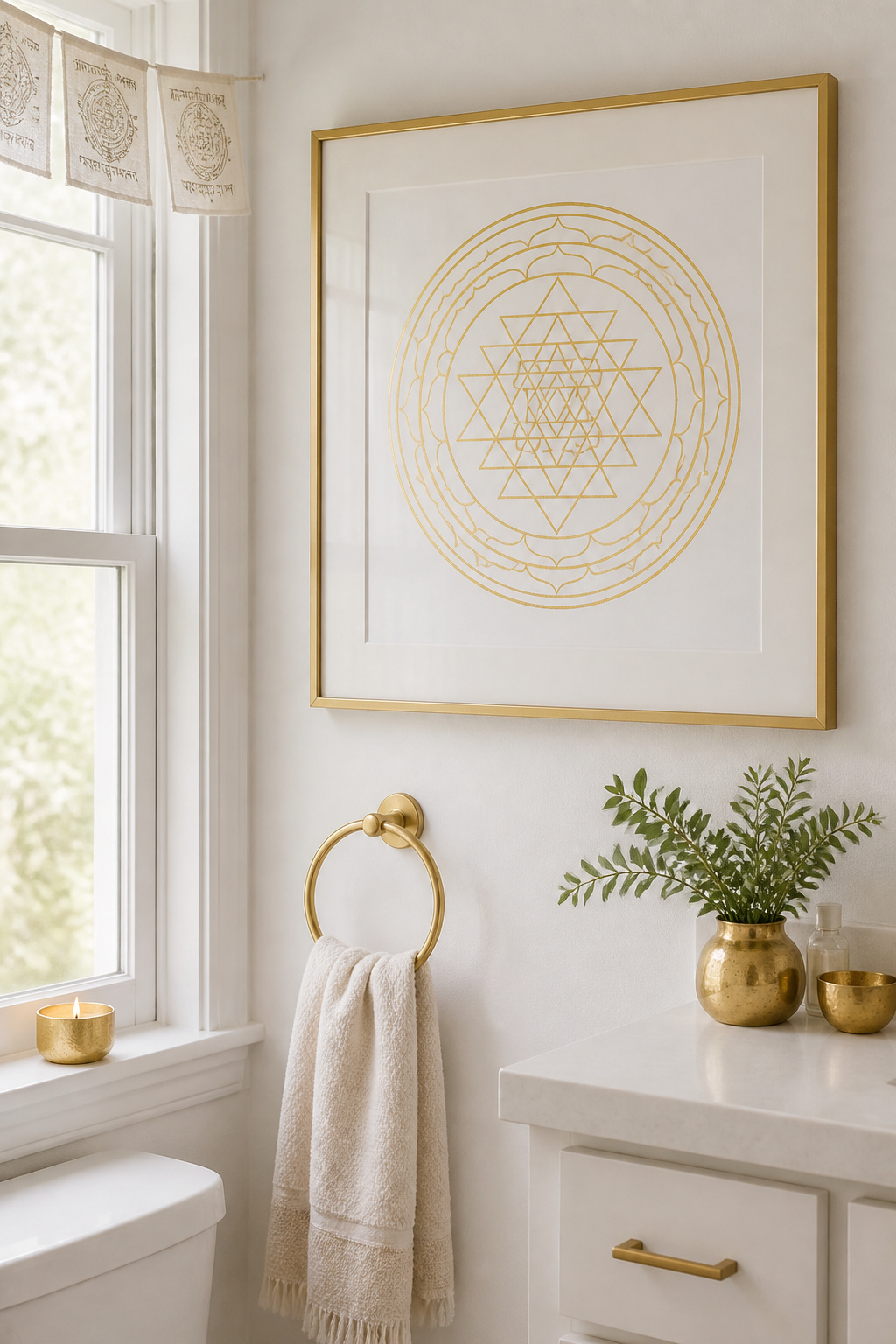
Sacred geometry works best when chosen for its symbolic resonance rather than its visual appearance alone. The Sri Yantra is associated with balance and spiritual alignment; the Flower of Life with the interconnectedness of all living things; Metatron’s Cube with cosmic order and mathematical precision. For colour palette in wellness bathroom spaces: gold on white is the most effective — it reads as refined, works with both warm and cool tile backgrounds, and has a luminosity under bathroom lighting that purely black-printed geometry lacks. Deep indigo on white mirrors the quality of hand-drawn mandalas. Print at a scale where the internal structure is fully legible — a Sri Yantra at 5 inches across reads as an undifferentiated triangle; at 16×20 inches, the full complexity becomes visible and meaningful.
The handmade object has a quality that no commercial print can replicate, and it matters most in the spaces that are most personal. Pressed botanical bathroom artwork you made on a Sunday afternoon, from plants in your own garden — that piece carries a specificity that a purchased print of the same flowers cannot. The making is part of the meaning.
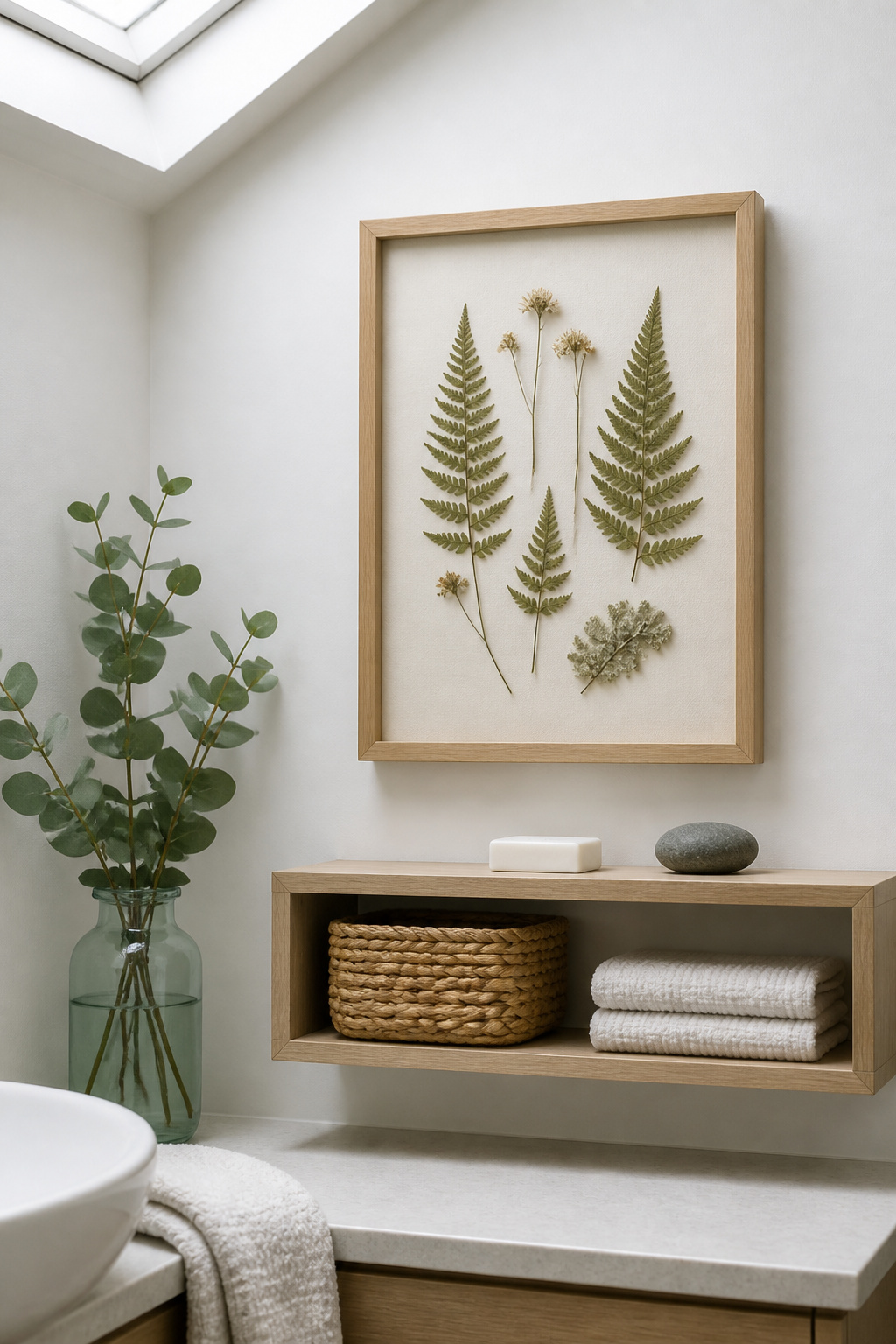
Pressed botanicals sealed under glass are the most humidity-resistant DIY bathroom artwork option. Press leaves or flowers in a heavy book for 48–72 hours, arrange them on acid-free paper, and apply two to three thin coats of clear matte acrylic sealant (Krylon Crystal Clear Matte is widely reliable) before framing. Use a sealed frame with acrylic glazing — not standard glass, which can fog and trap condensation — and run a thin bead of clear silicone sealant around the frame’s backing to prevent moisture ingress from behind.
For three-dimensional pieces, driftwood arrangements (sealed with matte waterproof varnish before mounting) and pebble mandalas (stones adhered to sealed MDF with waterproof exterior-grade tile adhesive) are completely impervious to bathroom atmosphere. Mod Podge Outdoor — specifically the outdoor formula, not the standard indoor version which re-emulsifies in humidity — is the most reliable brush-on sealant for mixed natural material projects. And the single most important preservation practice: run the bathroom’s extractor fan for 30–60 minutes after every shower. Residual humidity is what causes long-term damage to everything in the room, handmade or purchased.
The right bathroom wall art comes down to three variables: the amount of natural light your bathroom receives, the physical size of the room, and what you personally find genuinely calming — not just visually pleasing, but settling in the way that makes you exhale on a hard morning.
Natural light transforms how art reads. Cool palettes (blues, whites, pale greens) benefit from natural light; under warm artificial lighting, they can read as flat. If your bathroom has no window, lean toward warm palettes (gold, terracotta, warm ivory, sage) that glow rather than wash out under warm-white LED fixtures. Small bathrooms — under 50 square feet — are better served by one clear focal point than by a gallery arrangement. Reduce visual complexity rather than adding to it. Larger bathrooms with good light can support gallery walls, mixed formats, and bolder subject matter.
Consistent advice for anyone starting from scratch: begin with one piece. Not a gallery, not a collection ordered simultaneously. Choose a single bathroom wall art print that connects to something you personally find calming — a place you’ve visited, a botanical species you love, a symbol from a practice that matters to you — and live with it for 30 days. A high-quality 16×20 print in a moisture-resistant frame is achievable for $40–$120 total. The most significant investment is not financial; it’s the decision to treat the room you inhabit every single day as a space that deserves the same intention as every other room in your home.