Physical Address
304 North Cardinal St.
Dorchester Center, MA 02124
Physical Address
304 North Cardinal St.
Dorchester Center, MA 02124
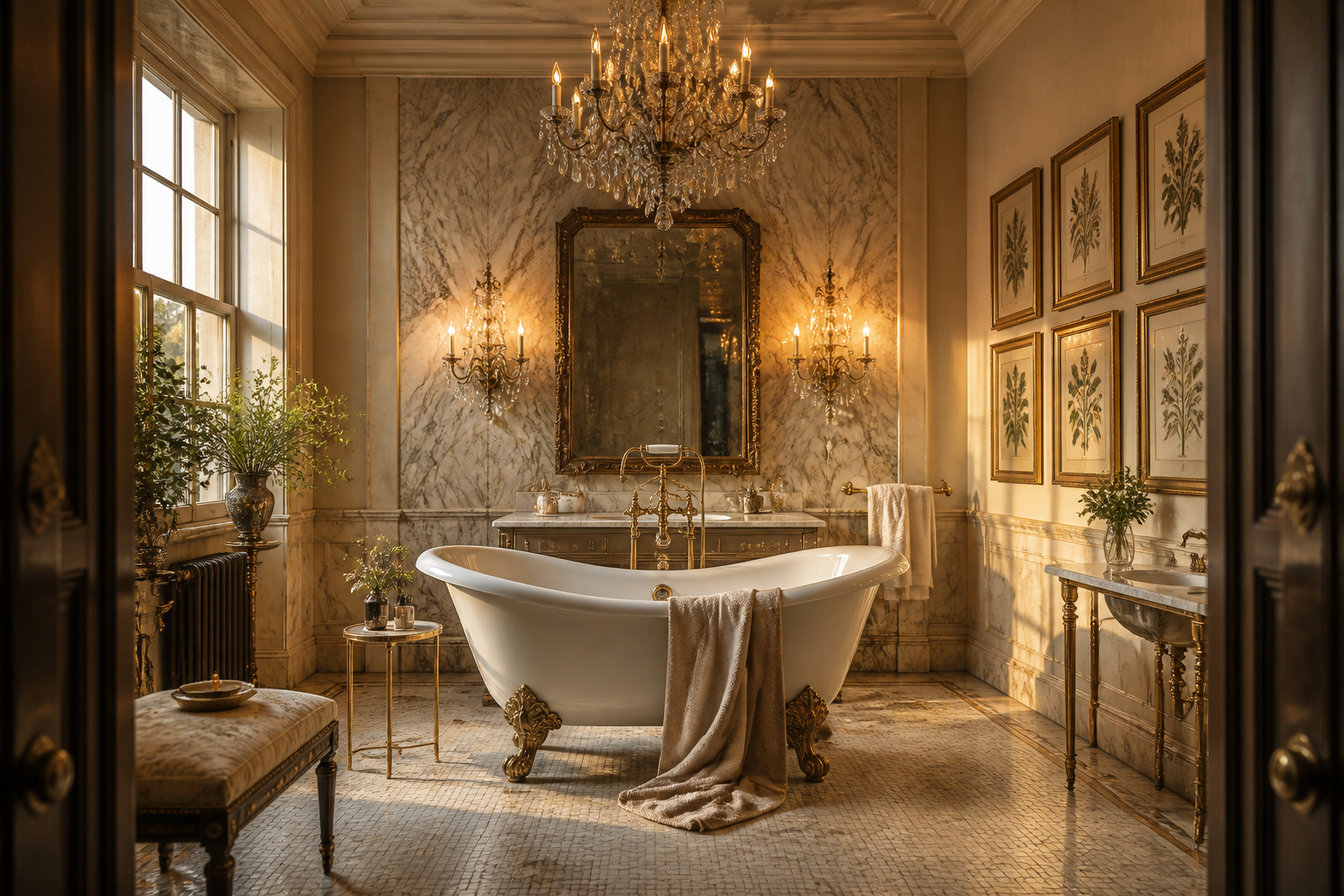
Discover 17 luxury bathroom decor ideas — from clawfoot tubs and book-matched marble to crystal chandeliers and artisan tile — that create genuinely timeless spaces.
The Romans understood something that modern bathroom design has only recently rediscovered: a bath is not a utility room. From the thermae of ancient Rome to the marble-clad washrooms of Victorian country houses, the finest bathrooms in history were designed as experiences — rooms you entered with intention and left feeling restored. That philosophy is the foundation of genuinely good luxury bathroom decor. Not surfaces chosen for their price tag, but materials selected for their provenance, their durability, and the way they age with character rather than against it.
Twelve years of working on period homes has taught me that the bathrooms worth restoring — and worth replicating — share a set of qualities that have nothing to do with trends. They prioritise architectural integrity over decorative whim. They use materials that looked better at fifty years than at five. And they understand that a truly considered bathroom asks for only one hero element: everything else flows from that. These seventeen ideas are drawn from the best of that tradition.
Few objects in domestic architecture carry as much visual authority as a properly positioned clawfoot tub. In 1883, John Michael Kohler added four decorative feet to an enamel-covered cast-iron horse trough and inadvertently created the defining icon of the Victorian bathroom — a fixture so resolved in its design that it has required no fundamental revision in nearly 150 years.
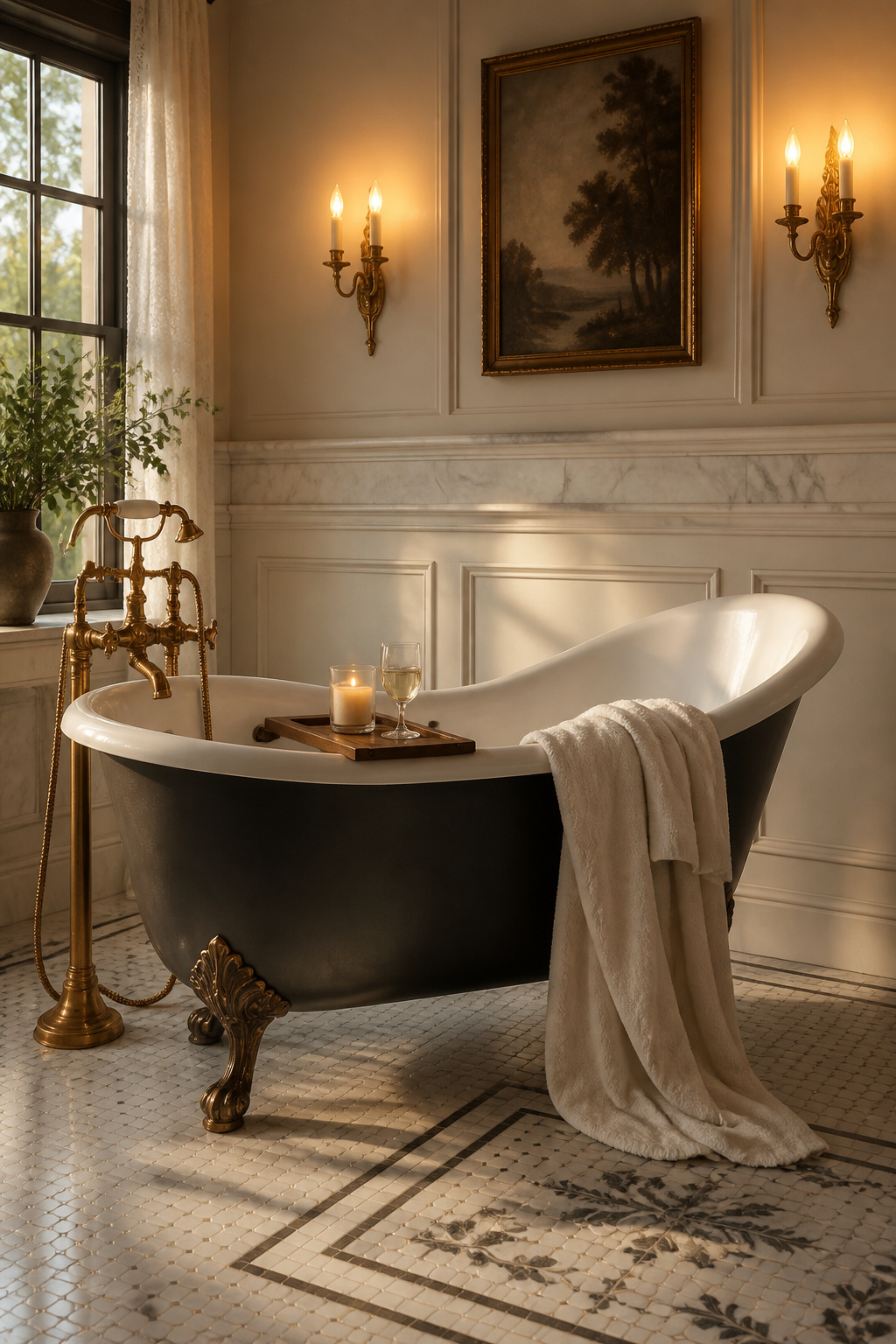
The claw-and-ball foot itself is a much older idea, borrowed from Chinese iconography (a dragon’s claw clutching a pearl) and filtered through English furniture-making into bathroom design. By 1880, David Buick had perfected the process of bonding porcelain enamel to cast iron, creating the smooth, non-porous interior surface that made these tubs genuinely hygienic. Original Victorian cast iron tubs with intact enamel are still worth restoring today — which tells you everything about the quality of the construction.
Cast iron remains the material of choice if your floor can support it. A standard 60-inch cast iron clawfoot tub weighs 350–450 pounds empty — add water and a person and you’re approaching 1,000 pounds of point load. A structural engineer assessment is not optional. Acrylic tubs, which weigh under 200 pounds, are the practical answer for upper-floor bathrooms where reinforcement would be prohibitively expensive, though they lack the heat retention that makes cast iron superior for long soaking. For more options across tub styles and profiles, creative bathtub ideas for your bathroom covers the full range of what works in different spaces.
The floor-mount filler — the freestanding supply line that rises directly from the floor — must be planned before a single tile is set. Repositioning plumbing after tiling is one of the most expensive mistakes in bathroom renovation. Cross-handle valves and a telephone-style hand shower are the period-correct fitting choices; Waterworks, Lefroy Brooks, and Rohl all produce faithful profiles.
Book-matching is a technique borrowed from woodworking’s figured veneer tradition and applied to stone: adjacent slabs from the same block are opened like pages of a book, so the veining mirrors itself across the joint. The effect is singular. Where standard tiling produces a field of related but independent pieces, book-matched marble creates a single continuous composition — a butterfly of natural pattern that no design tool could replicate.
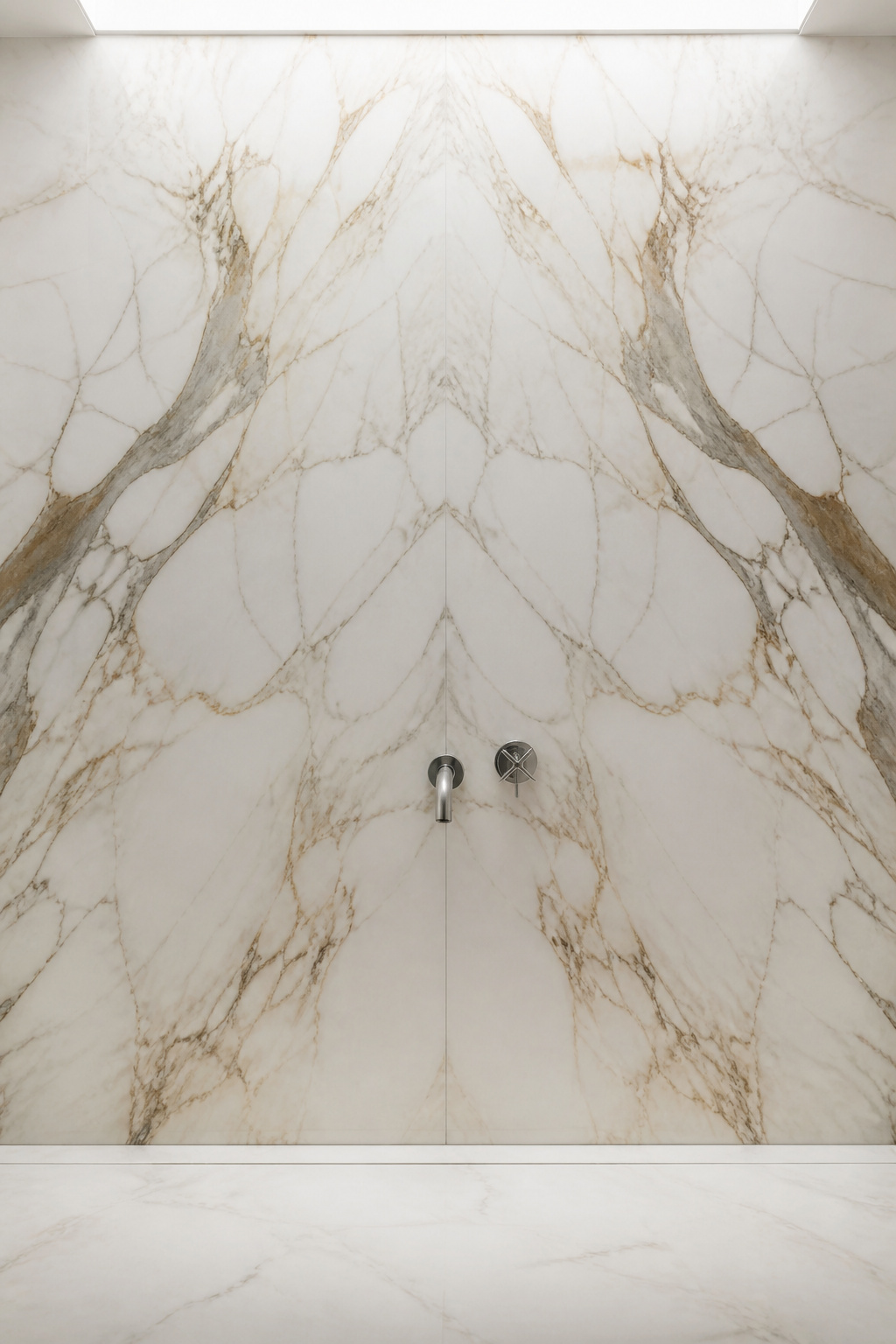
Historically, this approach was reserved for grand public buildings and estate bathrooms where stone came from a single quarry source. Bringing it to a private bathroom signals the same intentionality — and for luxury bathroom decor, that intentionality is exactly the point. Calacatta Gold is the most dramatic choice: bold grey-gold veining on a bright white ground, quarried near Carrara in northern Italy. Book-matched, it creates sweeping symmetrical forms that dominate a room without a single additional decorative element. Statuario offers finer, more refined veining on an even brighter white ground — appropriate for bathrooms where the architecture should lead rather than the stone.
Nero Marquina, a near-black marble from near Bilbao in Spain, book-matched as a feature wall, creates a graphic drama that contrasts powerfully against white plaster and polished nickel or unlacquered brass fixtures. The cost reflects the technique’s demands: more planning, more material waste, more skilled labour — pushing installed costs for premium marble to $180 per square foot and beyond. Annual sealing maintains protection. Etching — the dulling of polished marble by acidic contact — is purely surface-level and can be polished out by a stone restoration professional. Always specify honed rather than polished for bathroom floors; wet polished stone is a serious slip hazard.
There is a meaningful difference between a bathroom fitted with brass and one fitted with unlacquered brass. The lacquered version maintains a static, uniform appearance — consistent but inert, wearing away unevenly as the coating scratches and chips. Unlacquered brass is a different proposition entirely. It oxidises naturally on contact with air, moisture, and skin oils, deepening from bright gold to warm amber, then to rich brown hues over months and years. Waterworks describes this as a ‘living finish’ — each piece developing a patina that is entirely its own.
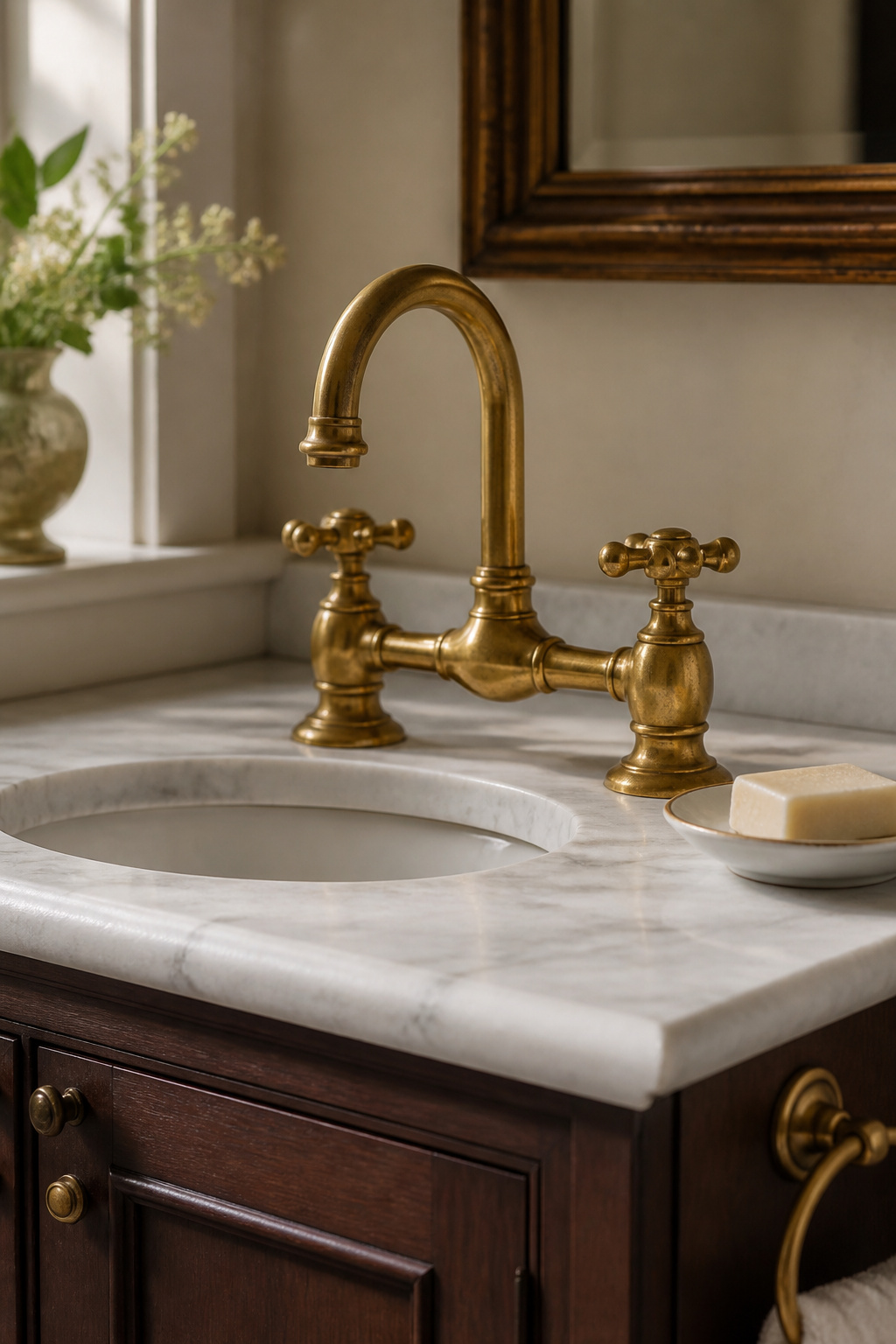
In period-accurate bathrooms, this is not an aesthetic preference but a historical reality. Victorian and Edwardian bathrooms used unlacquered or hand-polished brass throughout — the patina was a sign of quality metal rather than neglect. Rohl’s Unlacquered Brass (ULB) finish is among the most respected in trade circles, available across their Italian Country, Perrin & Rowe, and Lombardia collections. Samuel Heath, a British manufacturer founded in 1820, produces lever, cross, and porcelain-handled fittings in unlacquered brass that would have furnished the finest Victorian bathrooms.
One decision deserves serious thought before procurement: commit to a single metal finish throughout. The historically correct approach is consistency — Victorian and Edwardian bathrooms used one metal across every fixture, not several. If mixing is intentional, the most defensible pairing is unlacquered brass with polished nickel, both of which are warm-toned and develop character over time. Accessories — towel rings, robe hooks, soap dishes — should match the primary fixture finish exactly. Mismatched accessories are the most frequent tell in otherwise well-executed luxury bathroom decor.
Inlaid decorative tiles have been found in European monasteries since the 12th century. The Victorian era transformed them from a niche monastic craft into a global design phenomenon, with Minton, Hollins and Company setting the international quality benchmark through industrialised production of what they called ‘encaustic’ tiles — a name that was, technically, a misnomer. True encaustic work involves wax and heat; these tiles used pigment mechanically pressed into raw cement. The Victorians applied the term because the result resembled ancient Greek enamel work.
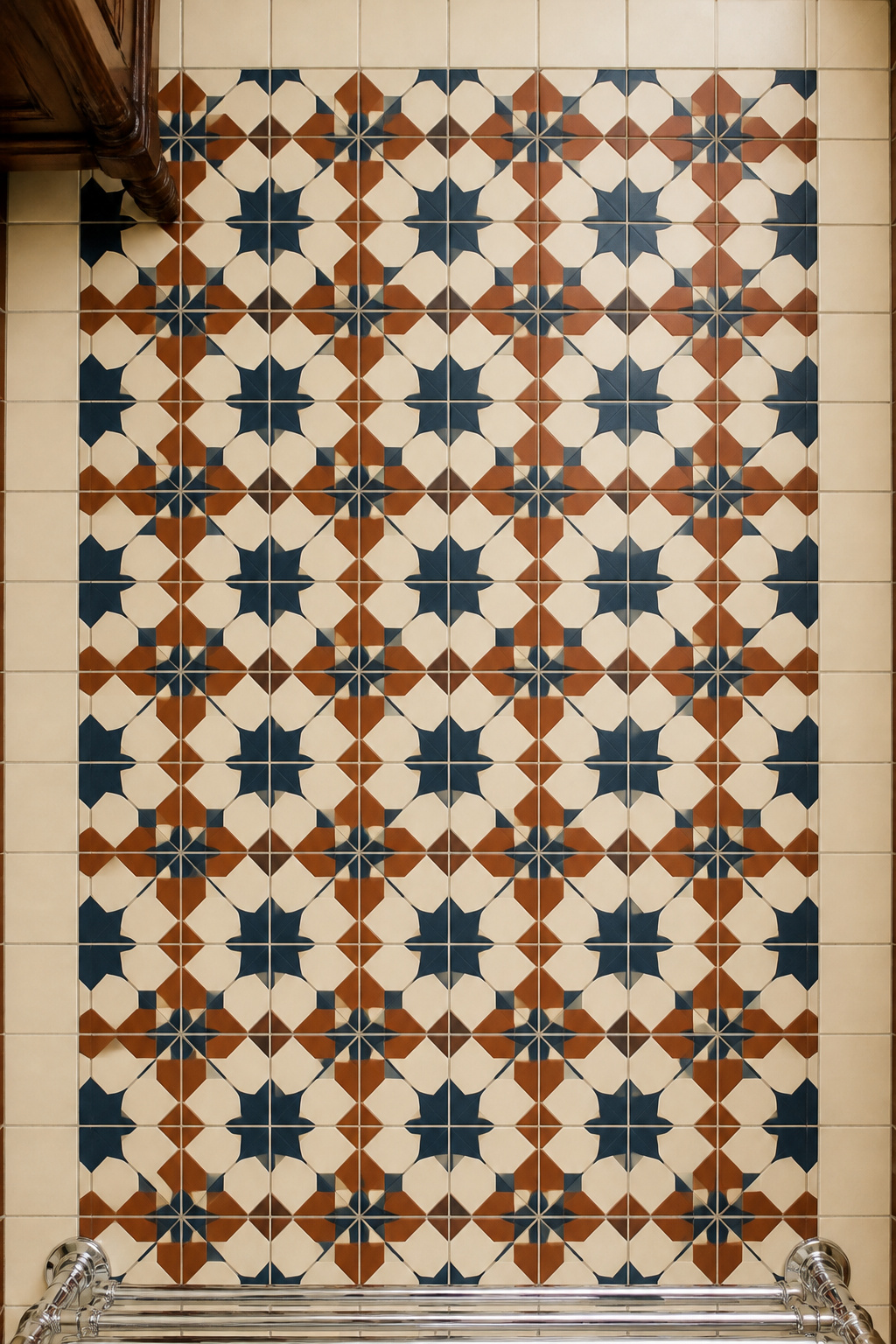
What makes cement tile relevant to luxury bathroom decor today is precisely its making process. Unlike ceramic tile fired at high temperature, cement tile is cast — layers of pigmented cement pressed under hydraulic force, dried, not fired. The colour is integral to the material, not a glaze applied over it. Pattern integrity is the result: the design cannot wear away without the tile itself wearing away. Artisan producers — Clé Tile in California, Granada Tile in Los Angeles, Mosaic House in New York — produce patterns faithful to Victorian and Moroccan originals using the same construction method.
The critical installation note: encaustic cement tile must be sealed before grouting. Not after — before. The cement is highly porous, and without a pre-seal coat, grout pigment permanently stains the tile surface. The full sealing process takes up to ten days across multiple steps. Annual resealing maintains protection. Victorian geometric patterns in 4-inch and 6-inch formats work best on bathroom floors in confined spaces; larger Moroccan-inspired patterns need room to repeat properly and suit generous floor areas or feature walls.
Overhead-only bathroom lighting is a remarkably persistent design mistake. It casts shadows directly downward across the face — making accurate grooming nearly impossible. The Hollywood vanity mirror solved this problem decades ago by surrounding the perimeter with light sources; flanking wall sconces replicate the effect with far more architectural elegance.
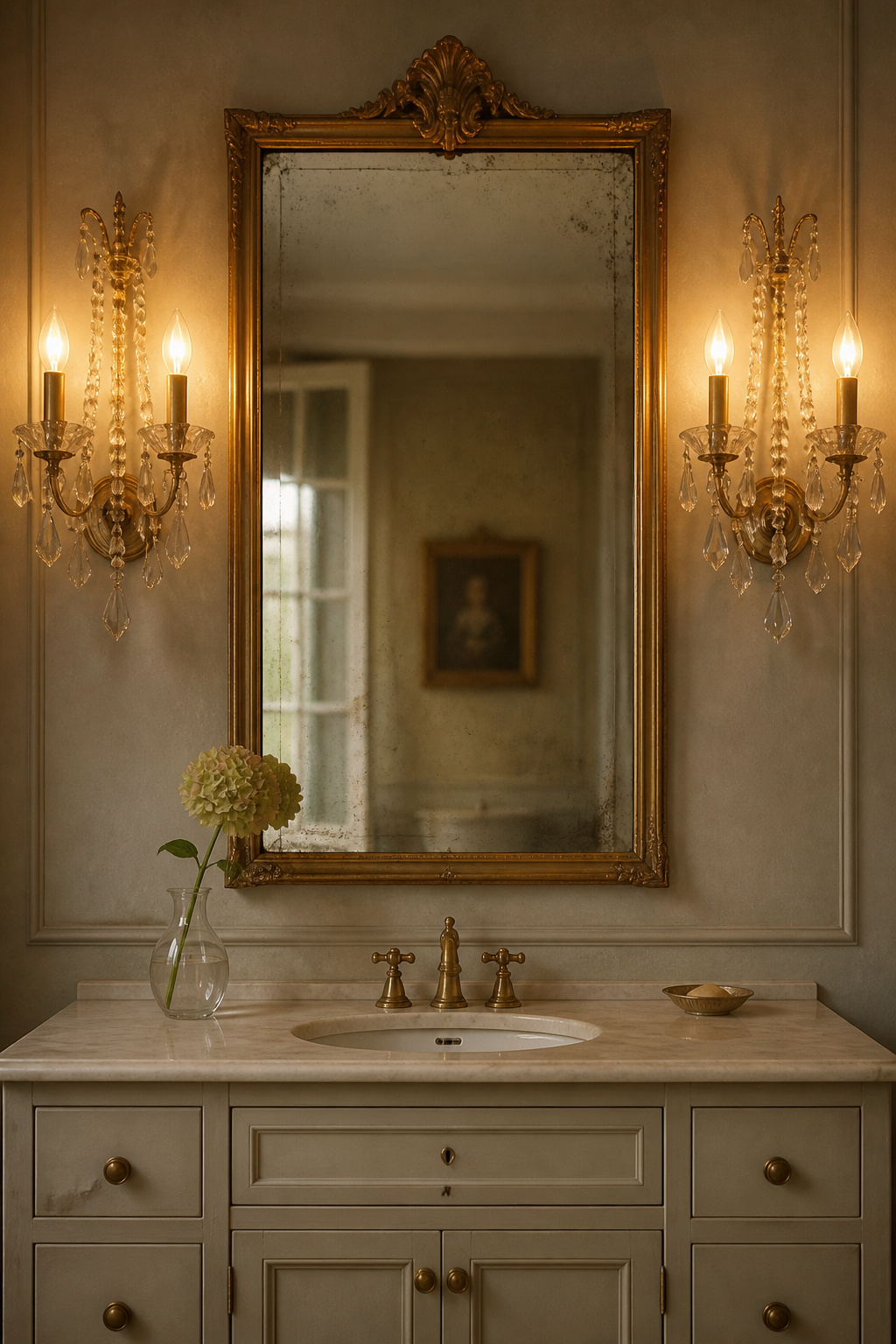
Light sources positioned at eye level on both sides of the face illuminate evenly from left and right simultaneously, eliminating the directional shadows that a single overhead fixture creates. The mounting height that achieves this: 60–65 inches from the finished floor to the fixture’s centre — aligned with average eye level and clear of the mirror’s top edge. Sconces should sit within 1–5 inches of the mirror’s side edges, spaced 36–40 inches apart between centres.
The precedent for this in period design is clear. Victorian bathrooms were lit by gas or candle sconces mounted on either side of the dressing mirror — a functionally superior arrangement that overhead electric lighting disrupted rather than improved. Crystal arm sconces became prevalent in Edwardian bathrooms once domestic electricity arrived, and Art Deco interiors produced some of the most collectable bathroom sconces in history. For colour temperature, 2700K–3000K provides warm, flattering light suited to grooming. For a broader reference on placement and specification, bathroom vanity lighting ideas covers the full decision set in detail.
The vanity is the room’s most used piece and, in a well-designed bathroom, its most architecturally significant element. Standard manufactured vanities — even expensive ones — read as furniture placed in a room. A bespoke piece in period-correct joinery reads as part of the room’s architecture, as natural as the door surround or the cornice.
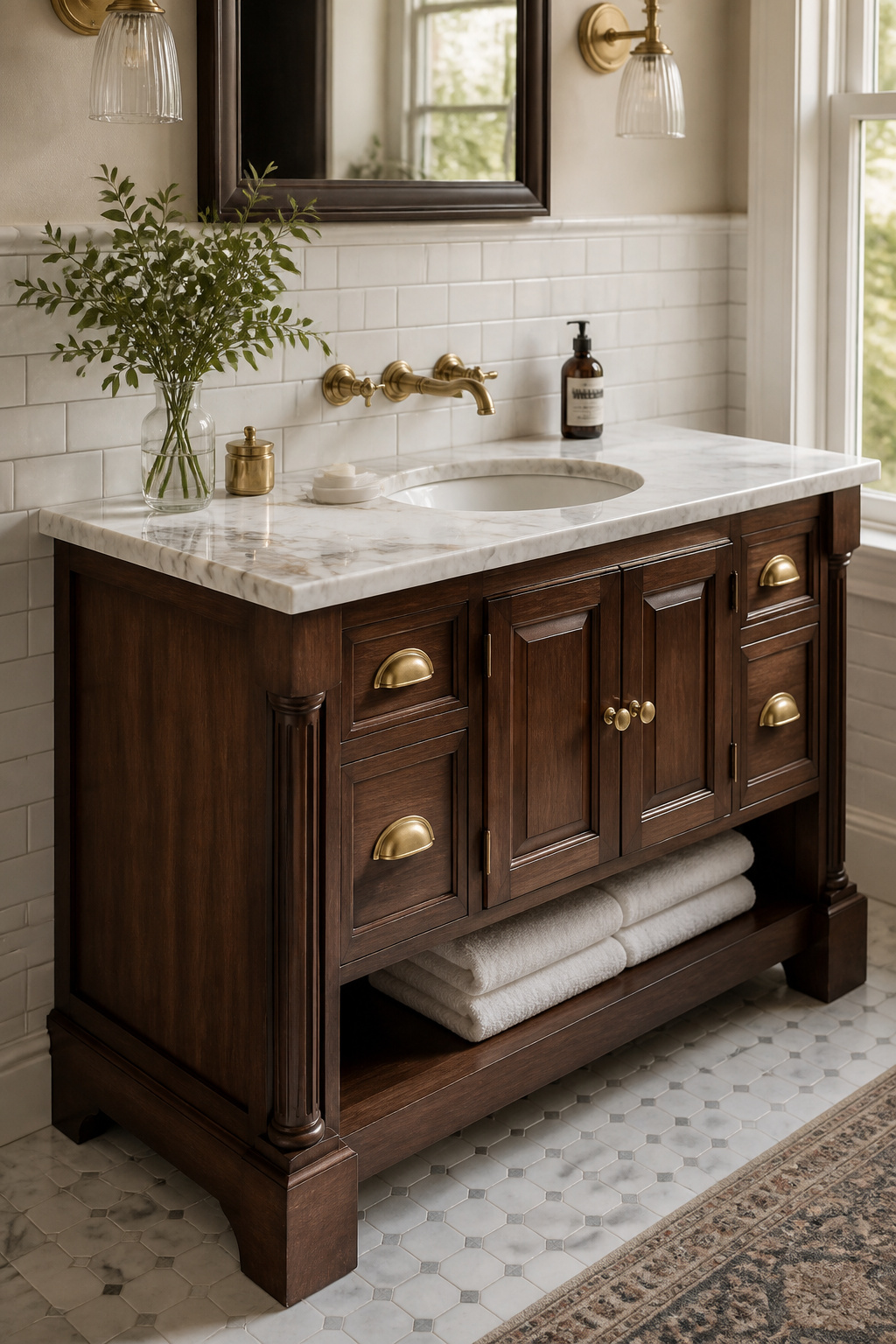
Victorian and Edwardian bathroom vanities relied on rich, dark woods — mahogany, walnut, and oak — with raised panel doors, carved drawer fronts, fluted pilasters at corners, and claw or bracket feet. This is the architectural language of fine furniture applied to bathroom cabinetry. Shaker cabinetry — recessed centre panel, simple pegged joints — represents the American tradition and is appropriate for Colonial Revival and Arts and Crafts homes. Fluted vanities, with vertical groove detailing adding three-dimensional shadow lines to otherwise flat cabinet faces, have seen a significant revival in high-end luxury bathroom decor and bridge period reference with contemporary resolution. For guidance specific to period-appropriate vanity selection, choosing a bathroom vanity for a historic home offers a thorough framework.
One dimension requires particular care. Standard modern vanity depth is 21–22 inches; antique furniture converted to vanity use typically runs 18–20 inches, requiring careful sink selection. The hallmarks of genuine furniture-grade construction: dovetail drawer joints, solid wood boxes rather than MDF or plywood, and soft-close Blum hardware. Countertop pairings that honour the period: honed Calacatta or Statuario marble is the correct choice for Victorian and Edwardian tops. Soapstone — darker, naturally acid-resistant — pairs particularly well with walnut-stained cabinetry.
Heated floors are one of the few luxury bathroom upgrades that delivers exactly as much as it promises. The experience of stepping onto warm stone on a winter morning is genuinely transformative — not indulgent in the pejorative sense, but restorative in the way the best Roman baths understood.
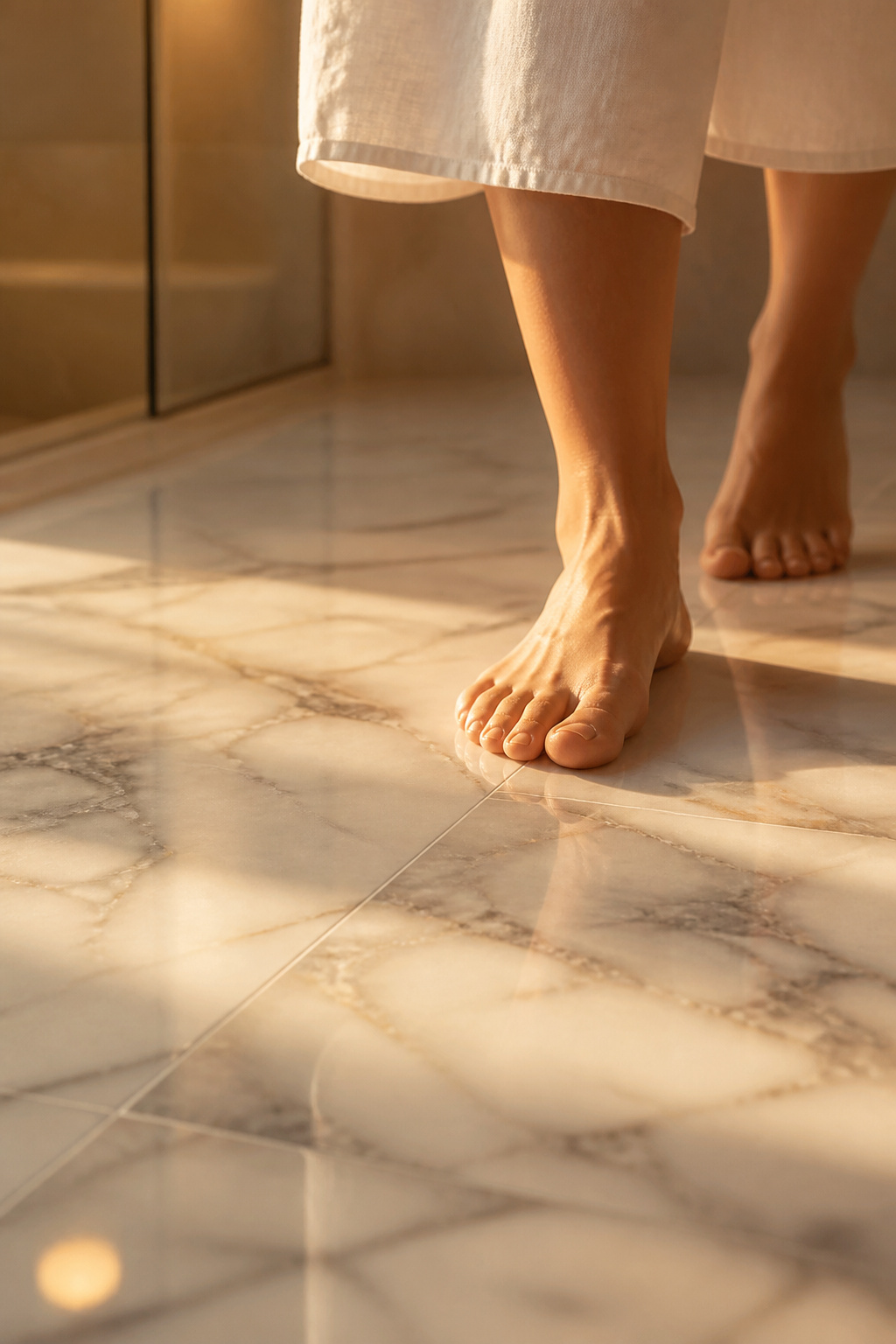
For most renovation projects, electric radiant heating is the correct system to specify. Hydronic systems — which circulate hot water through tubing embedded in the floor — require a boiler, pump, and gas line; the installed cost for a single bathroom runs $4,000–$5,000. Electric resistance cables or mats installed under the tile run $265–$700 in materials for a standard bathroom, with total project costs typically under $1,000. They operate independently of any existing HVAC system and are the practical choice for renovation work.
Stone conducts and retains heat effectively — marble, limestone, slate, and travertine all perform well over radiant systems. This is one practical argument, alongside the aesthetic case, for choosing stone over large-format porcelain in a bathroom worth the investment. Specify honed or brushed finishes for any heated stone floor: polished stone becomes hazardous when wet. Nuheat, Warmup, and Schluter (Ditra-Heat) are the most specified electric radiant brands in professional renovation work. Setting the floor to pre-heat 30–60 minutes before regular use eliminates cold-floor shock without significant operating cost — typically $5–$10 per month for a standard bathroom.
Standard mirror glass reflects accurately but coldly — the modern silver-backed surface has none of the warmth or depth that historic mirror glass possessed. That quality came from age: mirrors backed with tin and mercury developed characteristic spotting, foxing, and darkened edges over decades as the amalgam oxidised. Modern antiqued mirror glass replicates this through controlled chemical treatment of the silver backing — deliberately introducing the random degradation that gives the glass its warmth without the actual mercury, now correctly recognised as hazardous.
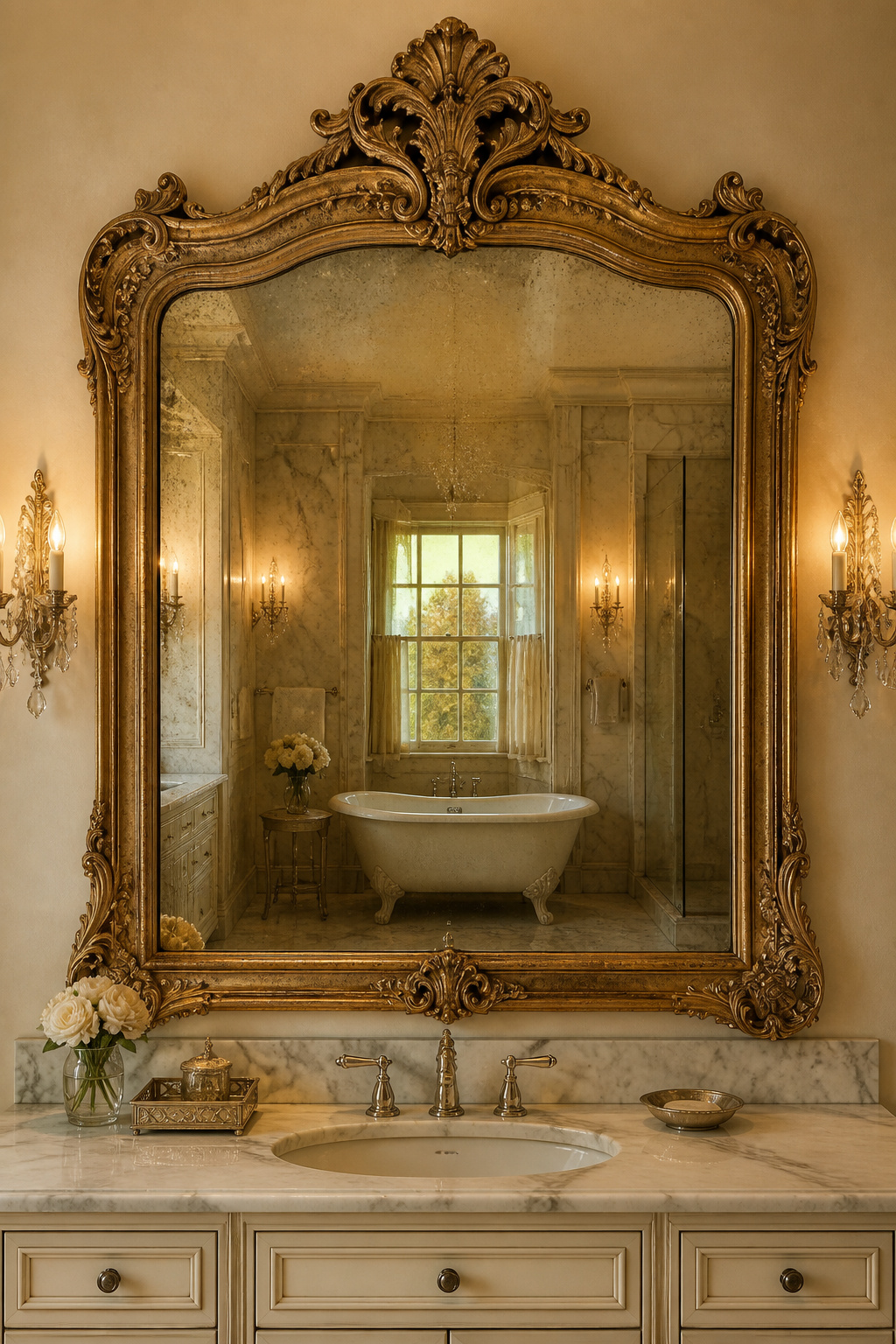
The result reads differently from a standard mirror. Reflections are slightly softer; depth appears greater; the aged texture integrates with period-informed bathrooms in a way that optically perfect glass cannot. Custom antiqued mirror glass is available at any desired distress level, from lightly foxed to dramatically aged. Frame selection for period bathrooms: gilded gesso represents the grandest European tradition, pairing with marble surfaces and crystal fixtures. Ebonized wood frames were popular in Victorian and Arts and Crafts interiors, pairing well with unlacquered brass fixtures and mahogany cabinetry. For a comprehensive guide across period and contemporary mirror styles, bathroom mirror design ideas for every style covers the full range.
On proportions: the mirror should match or be slightly narrower than the vanity below — an oversize mirror extending beyond the vanity sides creates a floating disconnection rather than the cohesion that a properly proportioned fixture provides. For full architectural impact, extending to within a few inches of the ceiling cornice references the floor-to-ceiling mirror tradition of Victorian dressing rooms.
Delft blue and white tile has been produced continuously in the Netherlands since the 17th century — each tile hand-painted in cobalt blue oxide on white tin-glazed earthenware before firing, with the characteristic crackle glaze a feature of authentic production rather than a defect. Talavera tile, from Talavera de la Reina in Spain and Puebla in Mexico, follows a similarly continuous lineage: hand-painted by individual artisans in colourful geometric and floral patterns on a white slip base, kiln-fired, and variable by design.
These are not decorative novelties. They are the products of intact craft traditions that predate industrial tile production by centuries, and they bring to a bathroom wall something no machine-made tile can: evidence of the hand that made it. The design discipline for using them is restraint. Hand-painted tiles work best as a single feature surface — one shower wall, a niche surround, a floor medallion — rather than applied throughout. Their decorative intensity, distributed across every surface, overwhelms; concentrated on one, it creates the kind of focused impact that luxury bathroom decor should always aim for.
Fired Earth produces English Delft glazed tiles with botanical and country scenes in a 4-inch format. Ann Sacks’ MADE collection is produced by Portland artisans in genuine stoneware — handmade enough that production variation is a mark of authenticity. For genuinely bespoke work, studios in Lisbon (the azulejo tradition), Seville, and the English Cotswolds can be commissioned for one-of-a-kind panels.
Two installation details determine whether hand-painted tile reads as refined or amateur. Grout joints of 1/8 inch or less allow the tile pattern to read continuously — essential for tiles designed to be seen together. Grout colour should match the tile’s background exactly: bright white for Delft, cream for Talavera. A contrasting grout colour divides each tile visually and breaks the pattern rhythm the artisan designed.
A bathtub positioned in open space — however beautiful the fixture — lacks the quality that separates good design from considered design: the sense that the space was built around it. Roman thermae positioned the principal bath in architecturally defined niches. Victorian bathing rooms surrounded the tub with marble cladding on three sides. Grand hotel bathrooms of the early 20th century elevated the tub on a platform within a surround of contrasting tile or stone. The tub alcove is not a trend — it is a design intelligence consistent across two thousand years.
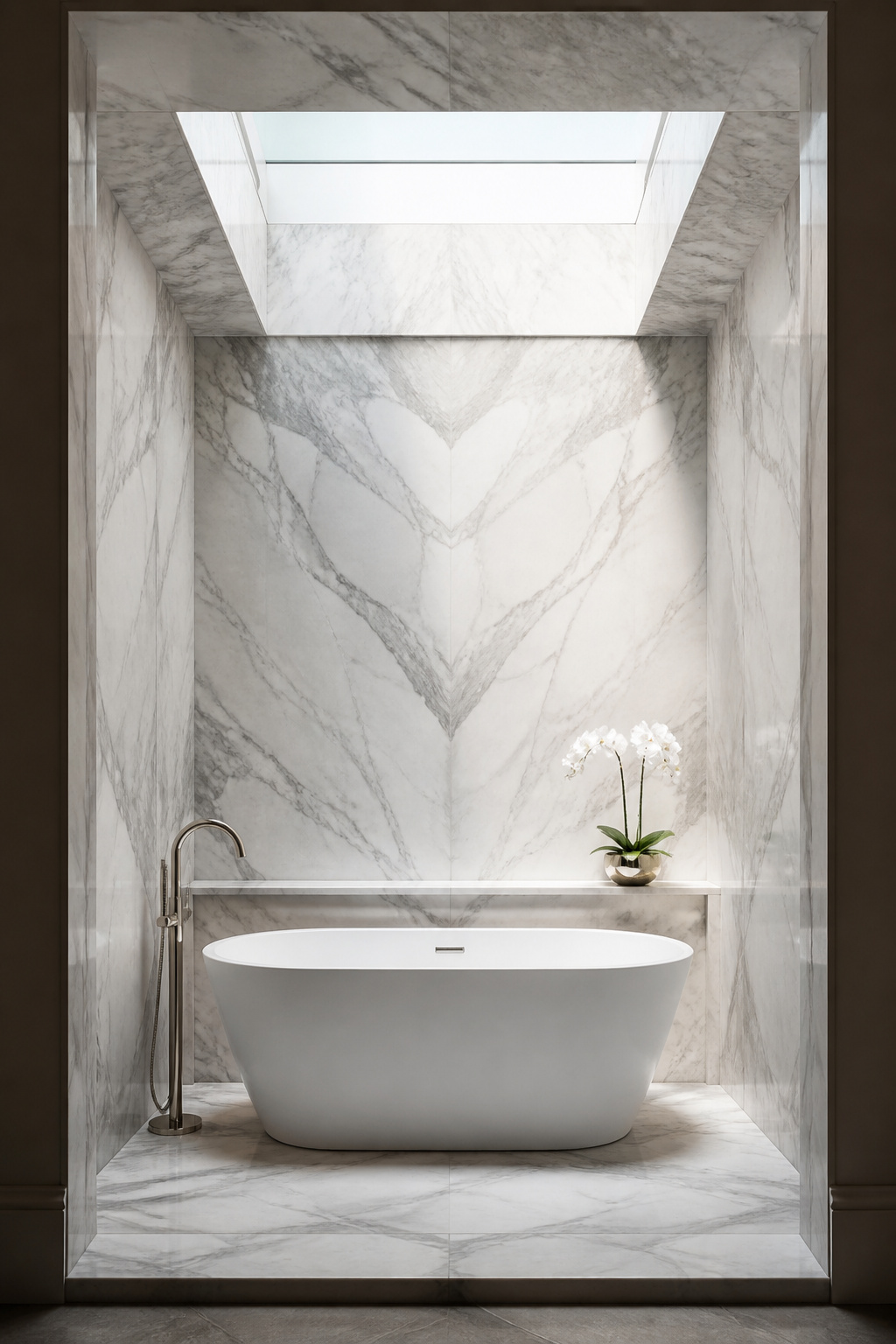
For an in-floor sunken installation, the structural assessment begins before anything else. Modifying floor joists requires a structural engineer’s calculation — this is particularly true above ground-floor level, where joist spans may be insufficient for the concentrated load. Ground-floor slabs can generally be cored and excavated with less complexity. For a range of ideas on how designers have framed the principal bathing space in luxury bathroom design, luxury bathroom ideas for a warm sanctuary is worth exploring.
Waterproofing the recessed area is the most critical technical decision: multiple layers of waterproof membrane applied to the subfloor, walls, and all exposed framing, with particular care at seams and corners — statistically the first points to fail. For the surround itself, book-matched marble slab creates the most seamless impression — material and architecture reading as one unified surface. Tadelakt — a Moroccan lime plaster that is genuinely waterproof when properly applied — creates a seamless, organic surface quality that references the same material tradition as Roman bath plaster, and can’t be replicated by any tile.
A steam shower is not a standard shower with an extra fitting. It is a distinct enclosure with specific engineering requirements, and the difference between a properly designed steam shower and a poorly executed one is the difference between an experience worth having and a damp, inconsistently heated disappointment.
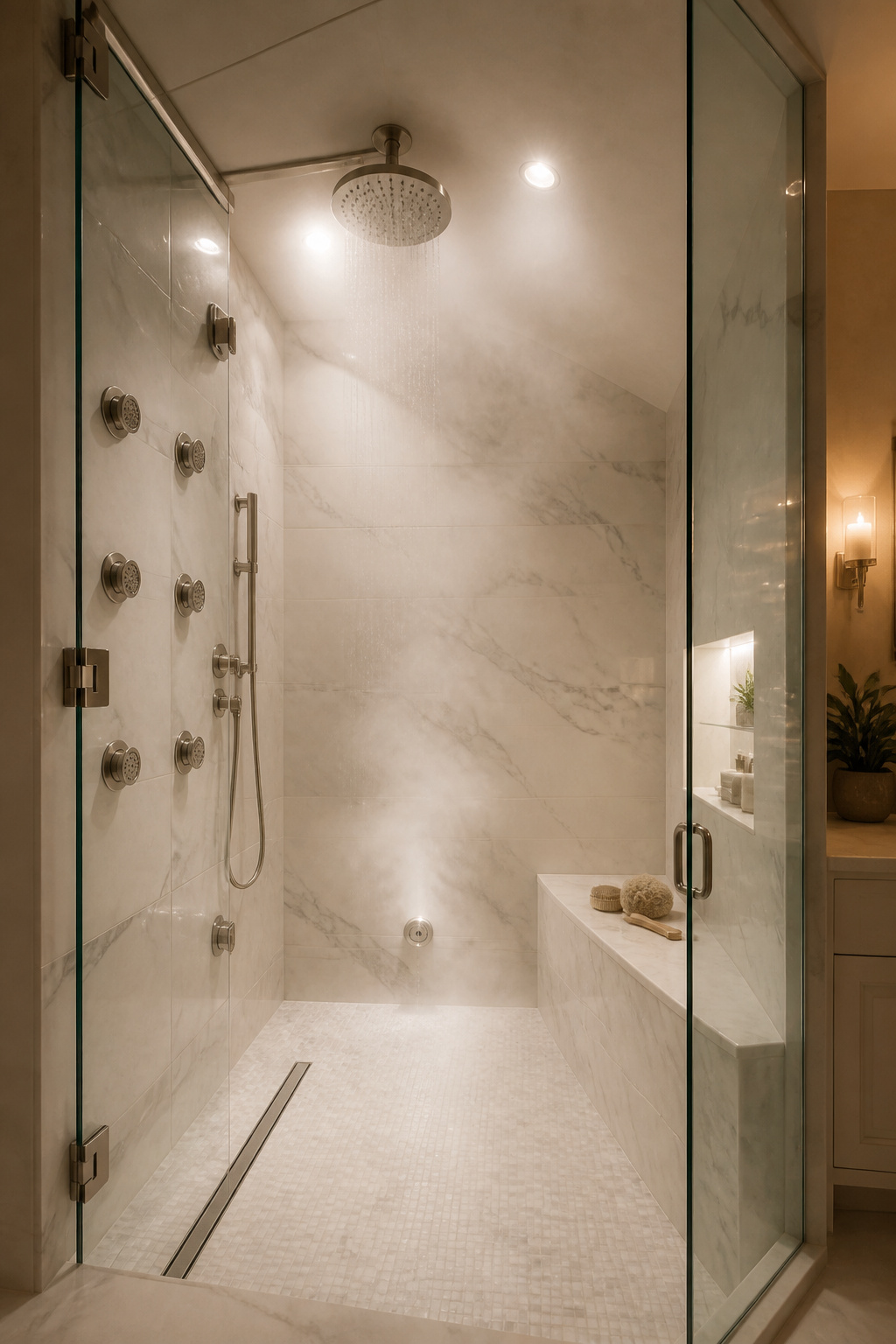
The enclosure must be completely sealed — any gap allows steam to escape, losing pressure and reducing the room effect. The ceiling must slope at minimum 2 inches per foot toward one side to direct condensation to the walls rather than dripping on the bather from above. This is the single most commonly overlooked specification requirement, and its absence is immediately obvious in use. Ceiling height should not exceed 8 feet for consistent steam temperature at body level; above that, steam concentrates at the ceiling while the lower portion of the room stays underheated. ThermaSol, which invented the residential steam shower in 1958, recommends upsizing the generator by one capacity level for each foot over 8 feet. Generators run from 4.5kW to 12kW, sized from the enclosure’s cubic footage.
Body sprays mounted at 40, 60, and 72 inches from the floor provide full-body coverage without cold spots. Each spray head draws significant water volume — a system with eight sprays may require 15+ GPM and a dedicated recirculating pump beyond standard domestic supply. For a broader reference on shower specification and layout, stunning bathroom shower designs covers the full range of architectural and system options. ThermaSol’s PRO Series III, with FastStart technology producing steam in 60 seconds and a lifetime warranty, remains the benchmark for quality in this category.
The most revealing test of a luxury bathroom’s quality is how the cabinetry meets the wall. Builder-grade cabinets — however expensive their finish — sit against the wall. Furniture-grade built-ins become part of it. The difference is structural and material, and it becomes more apparent over time rather than less.
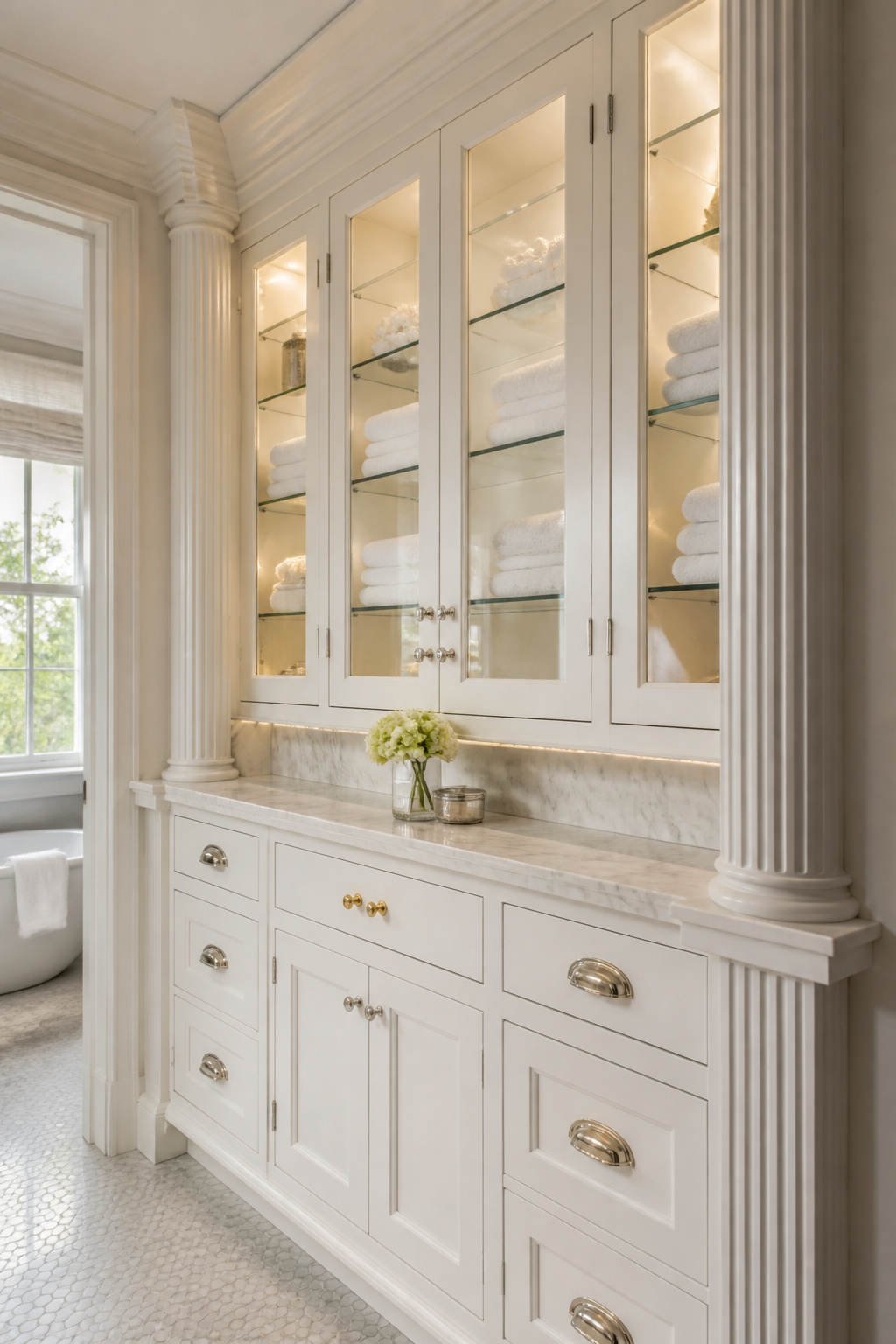
Builder-grade drawer boxes use stapled or glued butt joints that loosen within years of use. Furniture-grade construction uses dovetail joints — the interlocking pattern that gets stronger under load, not weaker. Solid wood cabinet boxes handle the humidity cycles of a regularly used bathroom without swelling or delaminating; MDF boxes do not, regardless of sealing. The cost differential is real — custom cabinetry at $500–$1,200 per linear foot versus builder-grade at $100–$300 — but the cost of replacing failed cabinetry in a tiled bathroom typically exceeds the difference many times over.
Period details that bridge craftsmanship and architecture: fluted half-columns at the corners of built-in cabinetry reference the same design vocabulary as Victorian fireplace surrounds and library cases. Glass-front upper cabinets with low-voltage LED strips inside make storage a feature rather than a utility. Hardware selection follows the same logic as fixture selection: cup pulls and bin pulls in unlacquered brass or polished nickel, matched exactly to the fixture finish, with scale proportional to the cabinet doors they serve. This attention to detail is what separates luxury bathroom decor that reads as considered from that which merely reads as expensive.
The best bathroom windows resolve two competing requirements: maximum daylight and absolute privacy. Frosted glass offers consistent privacy at the cost of any sense of connection to the outside world. Standard blinds provide adjustable privacy but carry the visual weight of an office fitting. Plantation shutters manage both requirements elegantly, and in period bathrooms, they look as though they belong.
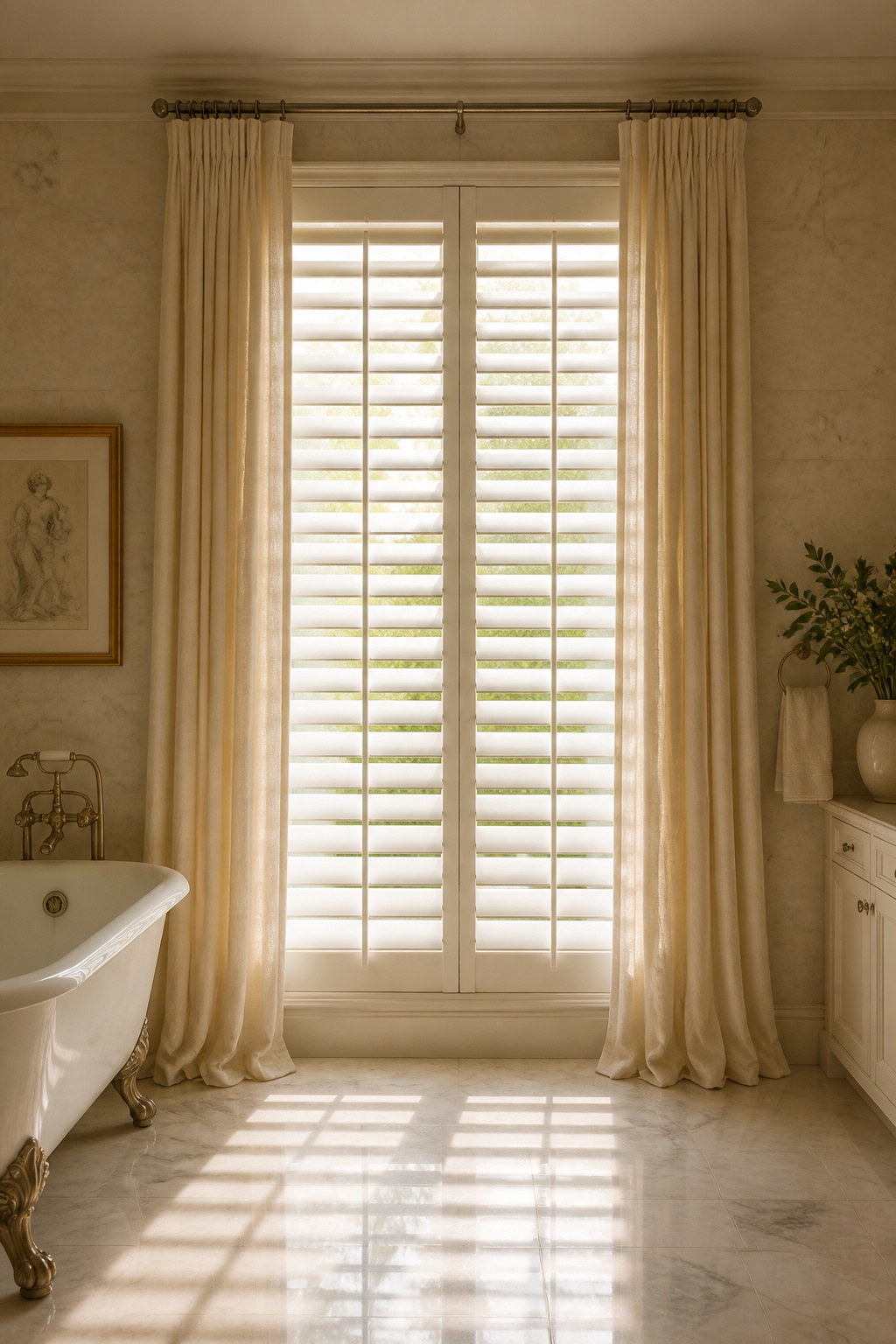
Wide-slat louvres — 3.5-inch or 4.5-inch — tilt to admit diffused daylight while preventing any direct sight lines from outside. Unlike frosted glass, shutters offer adjustable privacy: fully open when the bathroom is unoccupied, closed when in use. Pairing shutters with a draped fabric panel creates the layered window treatment of a grand hotel suite or country house bathroom — the signal that the space was designed, not merely furnished. Solution-dyed linen resists humidity-related colour fading far better than standard dyed linen. Avoid velvet, which retains moisture odour; heavyweight linen, cotton canvas, and silk dupioni are appropriate choices.
Premium basswood is the traditional shutter material — lighter than most hardwoods, it resists warping in humidity. Composite shutters (wood fibre and synthetic material) outperform real wood in sustained humidity and are genuinely appropriate for poorly ventilated spaces, though the paint finish is slightly less refined. Avoid MDF-core shutters in any bathroom: moisture absorption and swelling will make them impossible to operate properly within a few years.
There is a curatorial prejudice against hanging art in bathrooms — a conviction that the humidity will damage anything worth displaying. With proper framing, it is almost entirely unfounded. Botanical prints in particular have a long precedent in intimate domestic spaces: Pierre-Joseph Redouté’s rose engravings, produced for Empress Joséphine’s Château de Malmaison between 1817 and 1824, were displayed throughout the estate’s private rooms, including the bathing apartments.
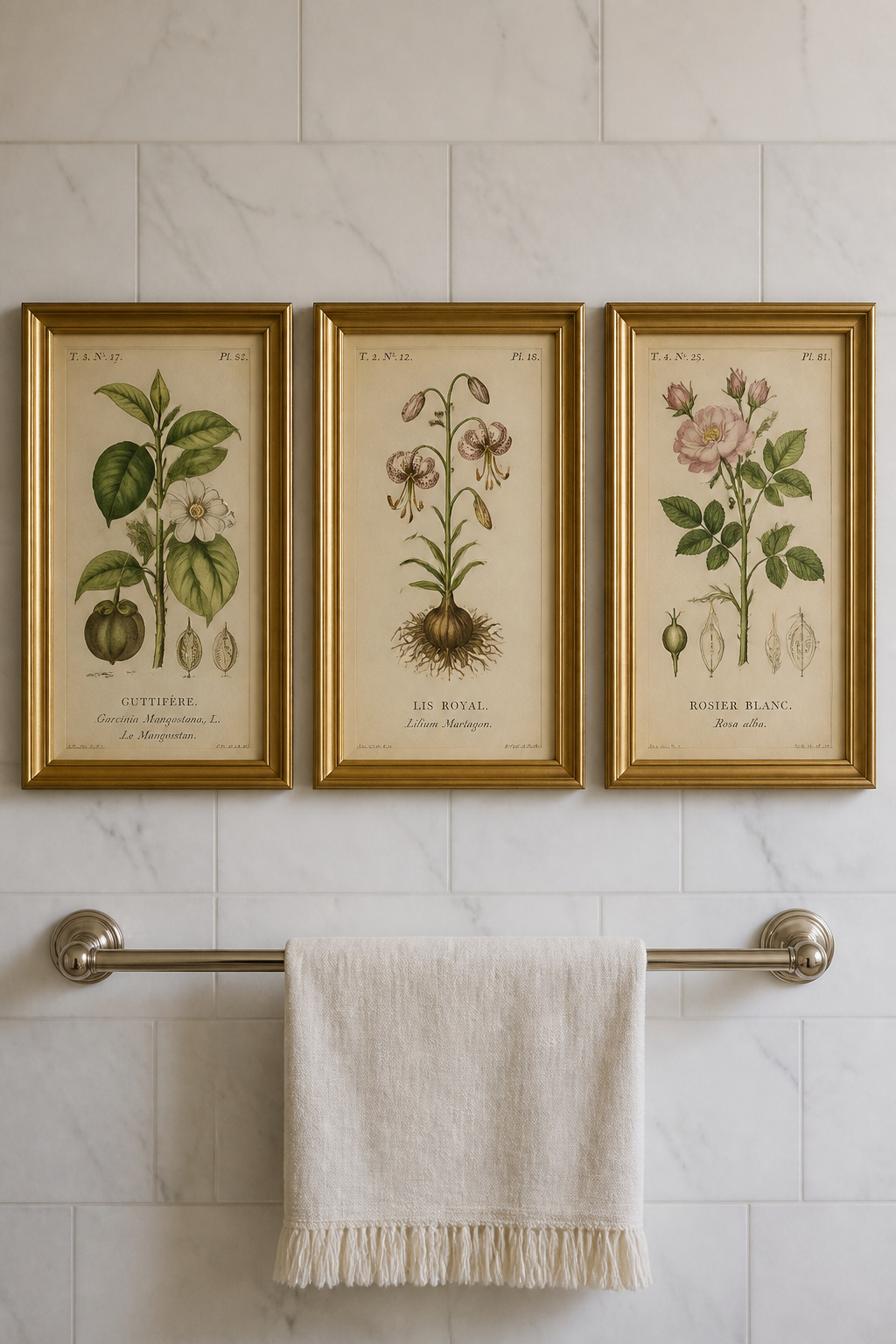
Georg Dionysius Ehret (1708–1770) produced some of the finest botanical illustrations in European history, many available as archival-quality giclee reproductions through Kew Gardens’ print shop and the Natural History Museum in London. These are scientifically accurate, beautifully produced, and appropriate for the walls of a bathroom designed with historical seriousness. Subject matter that works in bathroom contexts: botanicals, shell studies, architectural engravings, watercolour landscapes — subjects suited to contemplative viewing, rather than figurative work that can feel uncomfortably surveilled.
The framing specification matters more than the artwork itself in a humid space. Conservation Clear glass (UV-filtering museum-quality glazing) provides the best long-term protection. Sealed frame construction — where the rabbet is sealed with archival tape before the backing board is attached — creates a humidity barrier that standard framing does not. Aluminium composite board backing is the correct material for humid spaces; fiberboard absorbs moisture and transfers it to the artwork. Adequate extraction ventilation is the most important protective measure of all — a properly ventilated bathroom extends the life of art, cabinetry, and painted surfaces beyond what any framing specification can achieve alone.
Marble is the assumed default of luxury bathroom decor surfaces, and often the right choice. But three other natural stones offer properties marble doesn’t, and understanding them opens design possibilities that marble alone cannot achieve.
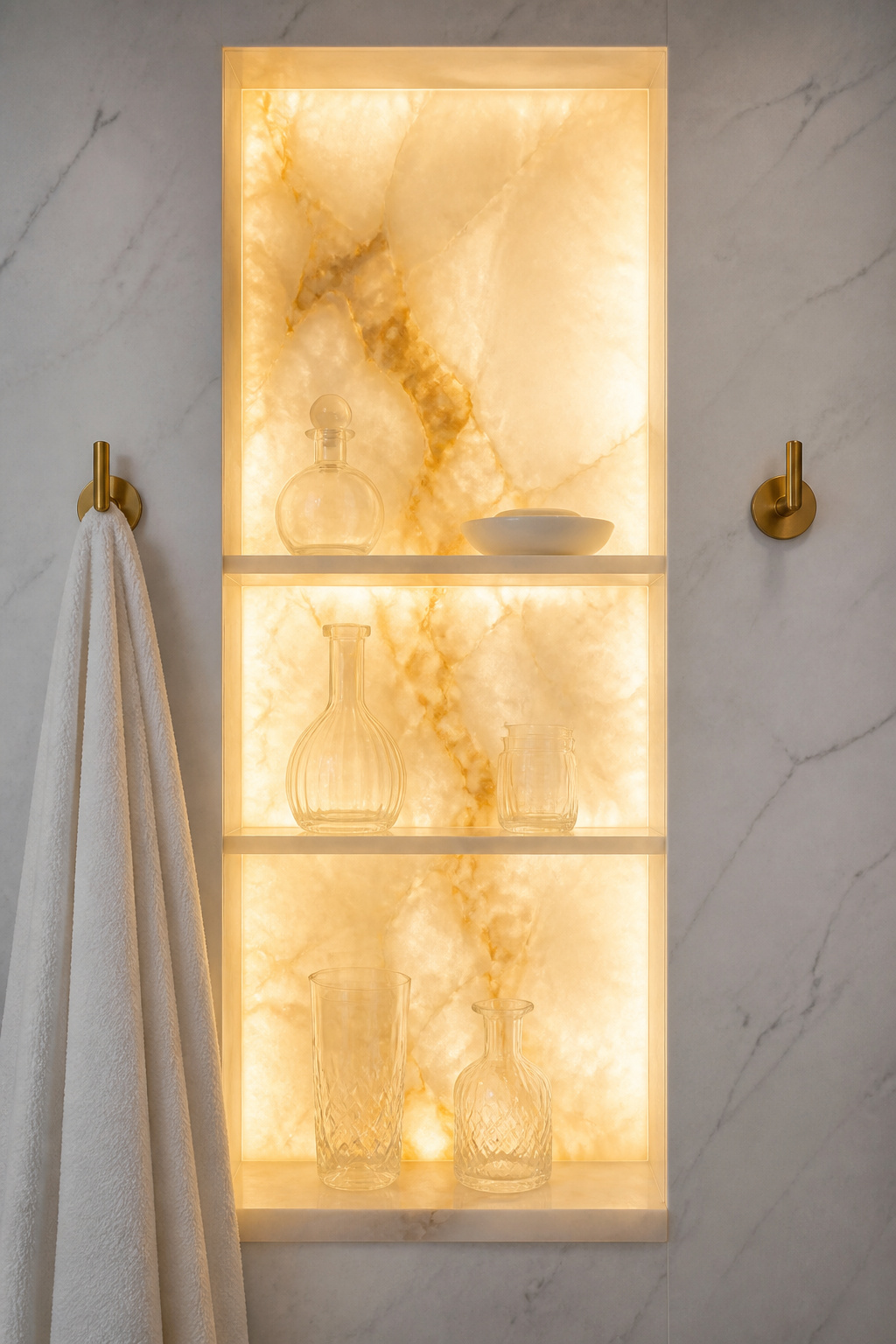
Onyx is one of very few natural stones with sufficient translucency to be backlit. LED panels behind onyx slab create a warm, glowing effect that transforms a niche, vanity front, or feature wall into something closer to a light installation than a surface. Afghan White, Onyx Miel (honey amber), and Verde Onyx (deep green) each have vein patterns that intensify dramatically when illuminated from behind. On the Mohs scale, onyx sits at 3 — comparable to marble in softness, demanding the same sealing care, and equally inappropriate for high-traffic floors.
Quartzite forms when sandstone is metamorphosed under heat and pressure, producing hardness of 6–7 on the Mohs scale — significantly harder than marble at 3–4, and resistant to the etching that acidic toiletry products cause on marble vanity surfaces. One important caveat: some stone sold as ‘quartzite’ is actually soft dolomitic marble — always request a scratch test before specifying. Travertine brings warm, earthy tones and a natural porosity that neither marble nor quartzite possesses. Filled travertine — with voids packed with epoxy or cement then honed smooth — is the correct choice for bathroom floors; unfilled travertine’s open pores trap moisture and belong in outdoor applications rather than wet indoor spaces.
Heated towel rails are among the few luxury bathroom additions that are as functional as they are atmospheric. The practical case is straightforward: towels that warm and dry properly between uses are fresher and more hygienic. The experiential case is equally direct — a warm towel after a bath is a physical pleasure that a cold one is not. That combination of function and sensory reward is exactly what the best luxury bathroom decor should offer.
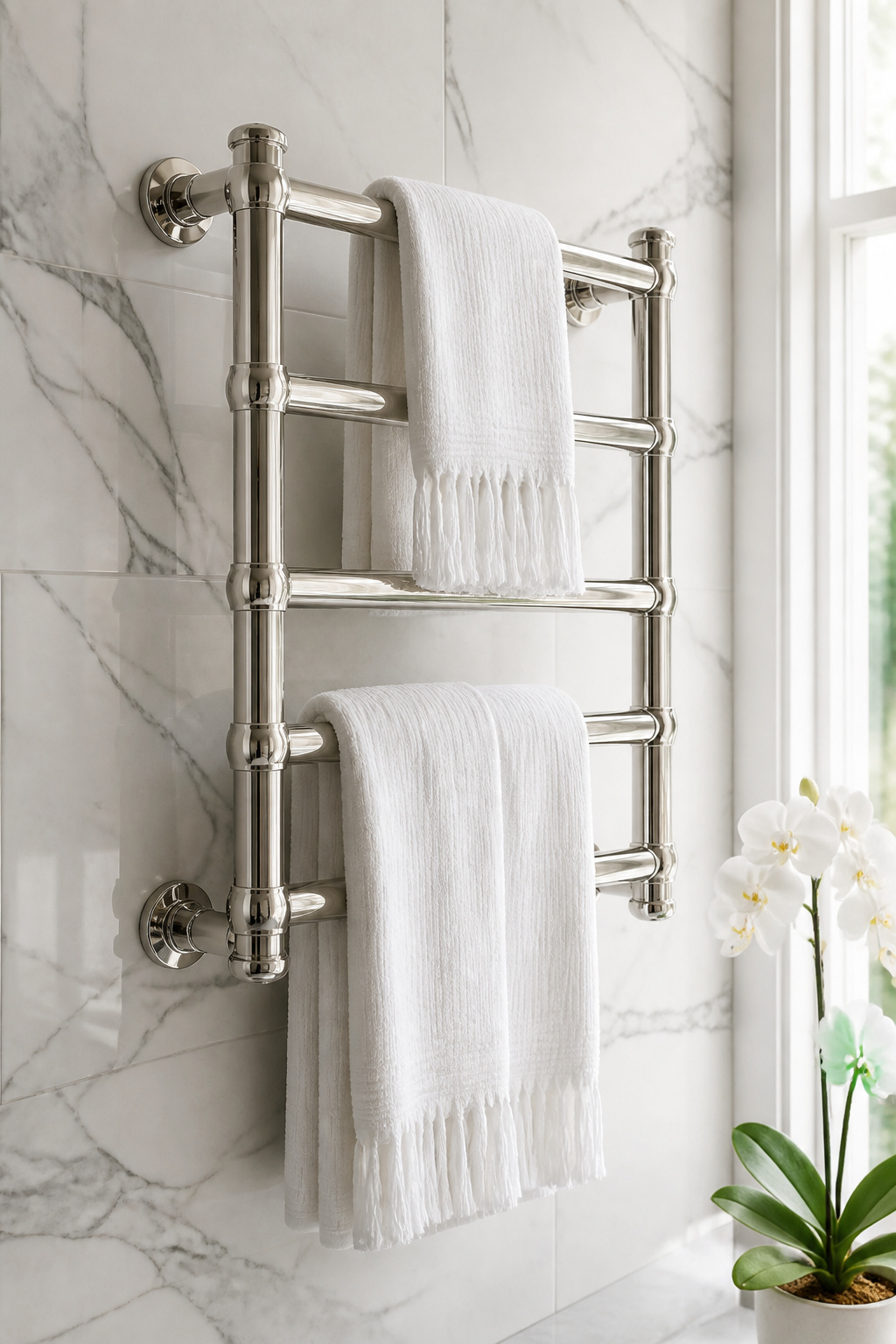
For renovation projects, electric towel warmers are the obvious choice. Hydronic systems — connected to the home’s central heating — operate only when the heating is running and require new plumbing runs that make them disruptive in finished spaces. Electric warmers operate independently, year-round, on a programmable timer. Sizing matters for function: a towel warmer with insufficient BTU output will warm towels without drying them after use. The Runtal Omnipanel OPII15 produces approximately 2,000 BTUs — adequate for genuine towel drying and supplemental room heating. Rail spacing should be at minimum 3 inches apart to allow air circulation.
Runtal and Zehnder (the Swiss parent company whose Studio Collection carries on the Runtal heritage) are the most specified brands in serious residential work. Polished nickel — slightly warmer in tone than chrome, and more resistant to tarnishing under consistent moisture exposure — is the most appropriate finish for period-informed bathrooms.
The bathroom chandelier is the clearest possible statement that a room was designed as an experience rather than a utility. It also requires the most careful planning of any element discussed here — because the NEC code requirements governing bathroom lighting fixtures are precise, non-negotiable, and regularly misunderstood.
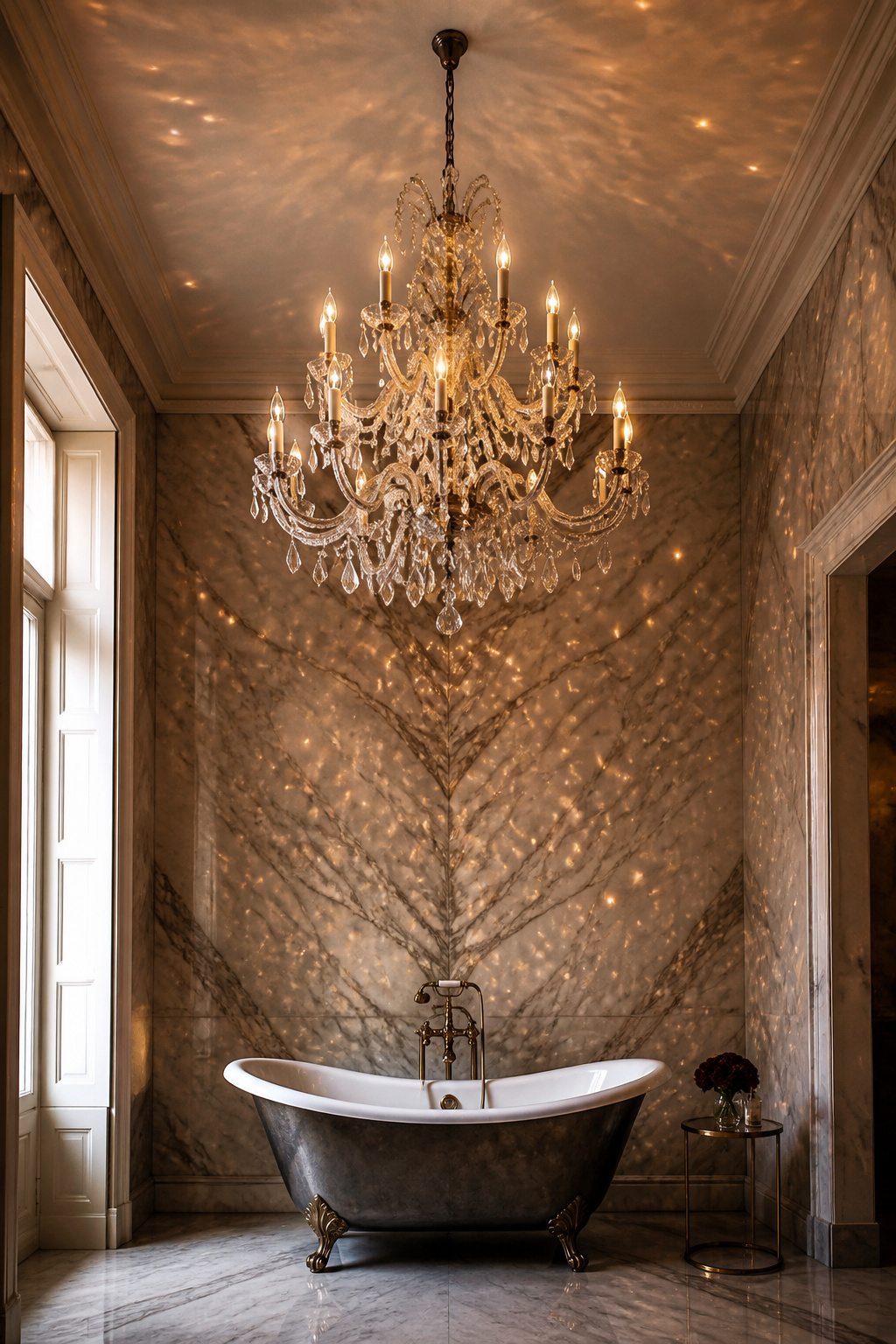
The fundamental code rule: no luminaire may be installed within 3 feet horizontally or 8 feet vertically from the bathtub rim or shower threshold. For any fixture installed within the bathtub area to a height of 8 feet, the fitting must be rated for damp locations at minimum, or wet locations where subject to shower spray. A chandelier positioned above a freestanding tub must have its lowest point at least 8 feet above the highest point of the tub walls — confirmed with a licensed electrician before specification.
Scale follows a reliable formula: add the room’s length and width in feet and convert that number to inches for the appropriate chandelier diameter. A 10-by-12-foot bathroom suggests a 22-inch diameter fixture as a starting point; higher ceilings accommodate larger fixtures without the room feeling overwhelmed. Crystal chandeliers — Schonbek, Waterford, or Baccarat — are the traditional choice for grand installations. Their light-refracting quality creates moving patterns of light on surrounding surfaces that respond to every air current from the bath. Murano glass chandeliers, produced on the island of Murano near Venice where glass has been blown since 1291, represent the pinnacle of artisan chandelier work — each piece unique, carrying documentation of its Venetian provenance. There is no more appropriate room in the house to give a genuinely exceptional fixture a proper home.
The single most useful principle for any luxury bathroom decor project is sequencing. Structural decisions — plumbing rough-in positions, floor load assessments, radiant mat installation, waterproofing — must be resolved before any surface material is specified or installed. The most expensive mistakes in bathroom renovation involve a beautiful surface material installed before the engineering beneath it was properly addressed.
Start with the hero. The most coherent luxury bathrooms I’ve worked on built everything outward from a single defining choice — a book-matched marble surround, a hand-painted tile feature wall, a freestanding clawfoot tub visible from the doorway. A clear hero element simplifies every subsequent decision: what supports it, what steps back, what can be value-engineered without the room losing its character. It also focuses spending where the visual return is highest.
The last 10% of any bathroom renovation is what people actually experience. They don’t see the waterproofing membrane or the floor structure. But they absolutely register whether the door handles match the towel rails, whether the art is properly framed, whether the sconce mounting height is at eye level. Luxury bathroom decor is not a single expensive material. It is the accumulation of decisions made with care — from the rough-in plumbing to the botanical print on the wall, each one supporting the one before it.