Physical Address
304 North Cardinal St.
Dorchester Center, MA 02124
Physical Address
304 North Cardinal St.
Dorchester Center, MA 02124
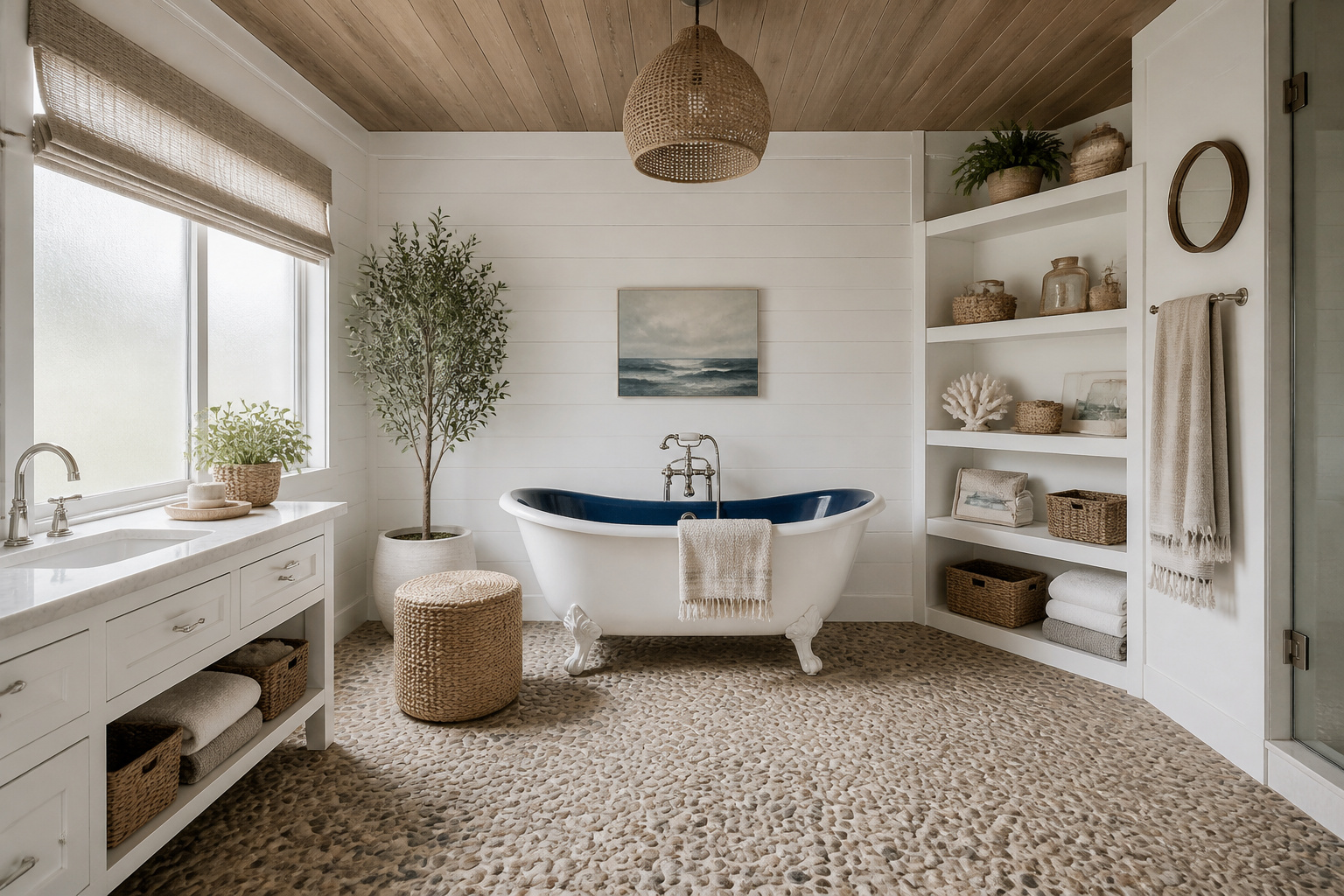
Discover 15 coastal bathroom ideas — from driftwood vanities and clawfoot tubs to pebble tile floors and shell mirrors — to bring the seaside home.
There is something quietly disarming about a bathroom that feels like the sea. These coastal bathroom ideas are not a checklist of nautical accessories — they are about capturing the actual quality of the coast. Not a bathroom decorated with anchors and cartoon fish, but one where diffused light moves across pale walls, where natural stone is raw underfoot, and where the soft roughness of rope or rattan is real rather than decorative. I’ve spent the better part of my design career helping people understand that the bathroom is the one room in a house where sensory experience should come before everything else. And few design traditions deliver that sensory experience better than coastal style done well.
This collection of fifteen ideas They are a considered collection of materials, textures, and approaches that together produce a bathroom that feels genuinely restorative — the kind of space you step into in the morning and briefly forget whatever the day is building toward. Whether you are renovating from scratch or refreshing a tired bathroom on a modest budget, you will find something here that works for your space.
The mirror is the first thing you look at in a bathroom and often the last thing you see before leaving. A shell-inlaid frame turns that daily ritual into something worth pausing over.
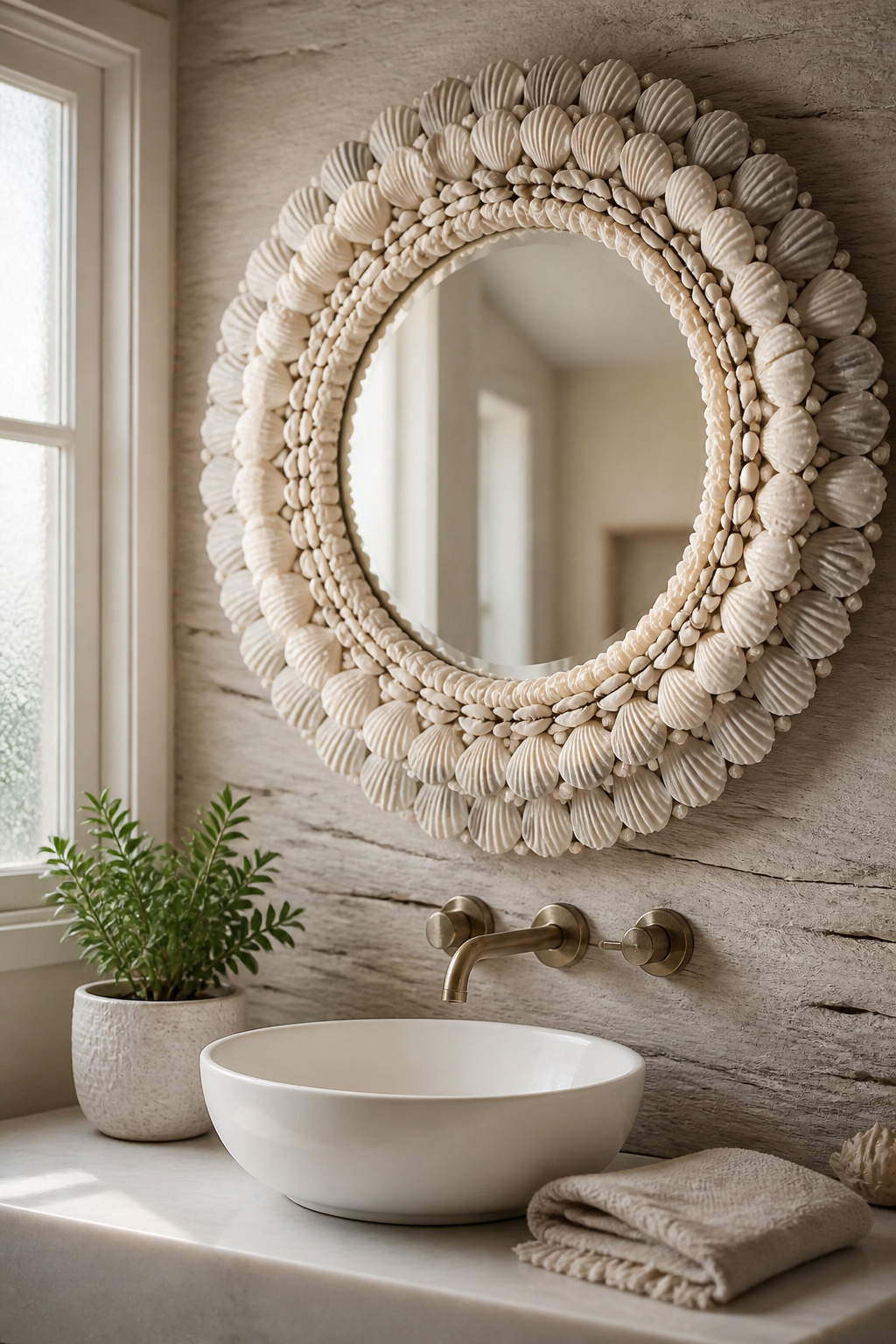
What separates a well-made shell mirror from a cheap one is composition rather than quantity. The best examples use whole, curated shells — cowrie, scallop, turbinella — arranged in deliberate layers, with each piece contributing to a cohesive pattern. Mother-of-pearl inserts catch and shift light differently from any painted surface, adding the kind of depth that genuinely evokes the ocean. A driftwood mirror is the quieter Scandinavian alternative: the bleached, weathered grain provides warmth and coastal reference without leaning into the shell aesthetic at all.
Sizing matters more than most people realise. As a starting point, your mirror should span about 70–80% of the vanity width — a 24-inch vanity pairs well with an 18–20-inch mirror; a 48-inch double vanity can carry a 32–40-inch frame. For shell colour, natural tones — cream, sand, pale grey — integrate more elegantly than painted or dyed shells that compete with tiles and textiles nearby.
Keep the shell mirror as a standalone statement. I have seen beautifully made pieces lose all their impact because a sea-glass backsplash or rope towel ring was fighting for the same attention. In coastal bathroom design, restraint always wins.
The vanity is the structural centrepiece of most bathrooms. In a coastal scheme, a driftwood-inspired unit immediately establishes the character of the whole room — everything else can be modest if the vanity is right.
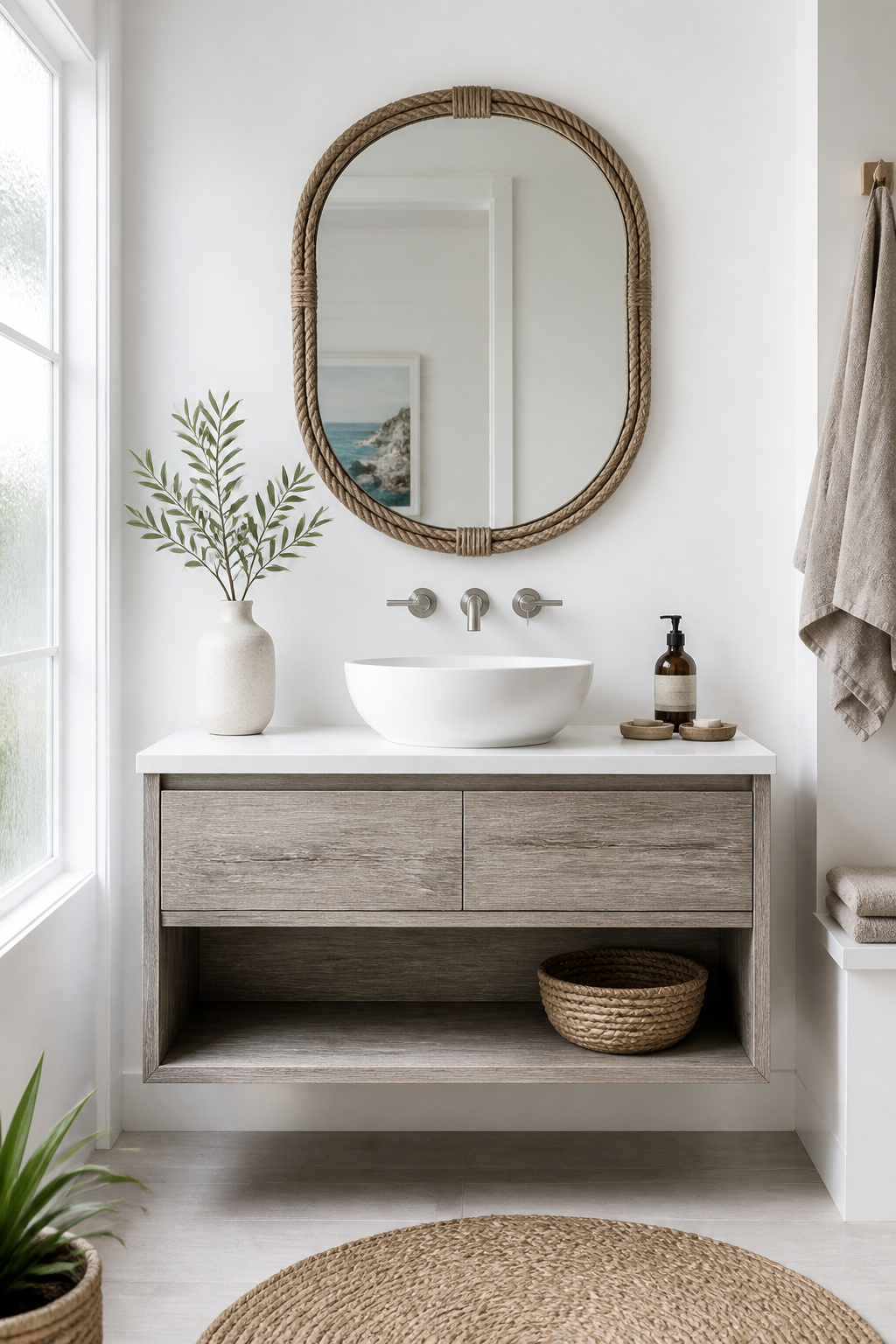
Real driftwood’s naturally bleached, grey-toned grain creates an instant coastal reference without requiring any accessories to complete the picture. Floating designs (wall-mounted vanities) are especially well suited here: they lift the visual weight off the floor and create the airy, spacious quality that defines good coastal bathroom design. Paired with a white quartz countertop and a rope-wrapped mirror, a driftwood vanity becomes a cohesive vignette of three distinct natural textures — timber, stone, and fibre — that feel genuinely collected rather than styled.
If you are working with real driftwood, it must be kiln-dried before use to eliminate any organisms, then sealed with a minimum of three coats of oil-based polyurethane or marine varnish, sanding between each coat. The cabinet box behind the driftwood fronts should be moisture-resistant MDF or marine plywood — raw timber box construction will swell within two years. For those who prefer a more reliable option, choosing the right bathroom vanity design becomes significantly easier with a grey oak laminate finish (IKEA’s Vedhamn or Dekton’s driftwood-look range) — it replicates the look with full waterproofing and zero maintenance, an approach I’d describe as genuinely Nordic in its honesty about materials.
Pottery Barn and West Elm both stock driftwood-look bathroom furniture with proper moisture-resistant construction in the $600–1200 range. For custom work, Etsy makers offer reclaimed wood bathroom vanities from around $400 for a 24-inch single unit.
Blue and white is the bedrock of coastal design for reasons that go beyond aesthetics. The combination has maritime roots — ships, lighthouses, fishing villages, sailor’s clothing — and carries cultural weight that purely visual choices lack. In a bathroom, that weight translates into a quiet sense of rightness.
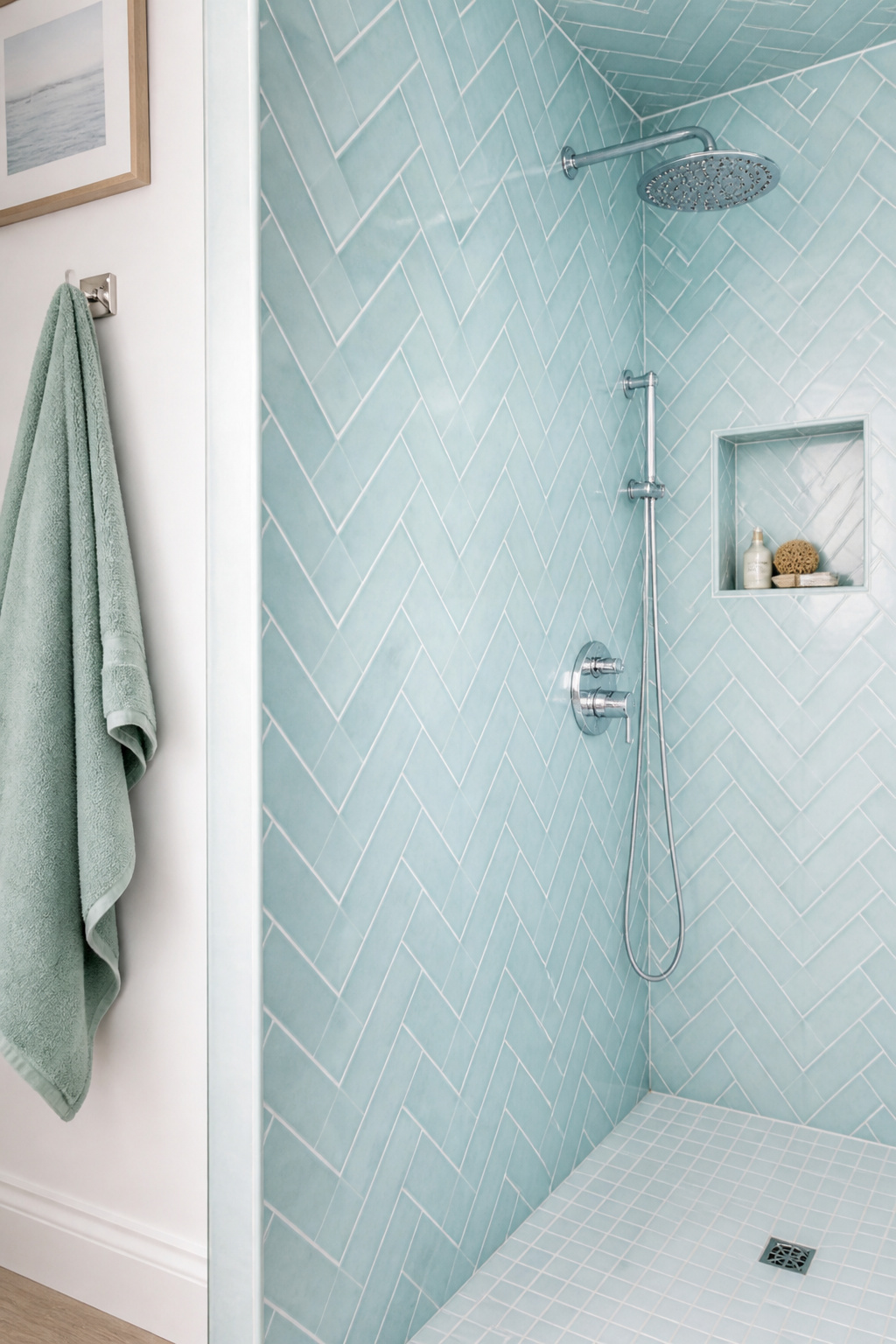
The choice between blue tones shifts the mood of the entire room. Navy creates a bold, confident nautical statement — it works best in larger bathrooms with generous natural light, where it deepens without closing in. Ice blue (pale, almost white in low light, clearly blue in good light) is the most versatile for smaller coastal bathrooms. Aqua and teal read more tropical than Nordic; they work well as an accent on a single feature wall or shower niche but become overwhelming when applied throughout.
Grout colour deserves as much thought as tile colour. White grout on blue tile emphasises each tile individually — crisp and Mediterranean. Dark navy grout on white tile creates subtle definition and coastal sophistication. Off-white or putty grout softens the whole scheme into something quieter and more Scandinavian.
Layout pattern completes the picture. Traditional brick-bond offset is timeless and safe. Herringbone injects movement and depth — particularly effective in a shower enclosure where the angled lines catch the eye from every angle. Vertical stacking draws the eye upward, which is useful in a bathroom with low ceilings. For those looking beyond standard subway tile, bathroom tile ideas that create calm spaces include natural stone, large-format porcelain, and textured ceramic that extend the coastal palette without the obvious nautical reference.
Nothing else in a coastal bathroom makes quite the same statement as a freestanding clawfoot tub. Positioned correctly — with at least 6–8 inches of clearance on all sides — it becomes a sculptural object as much as a fixture, the kind of thing that gives a bathroom genuine character.
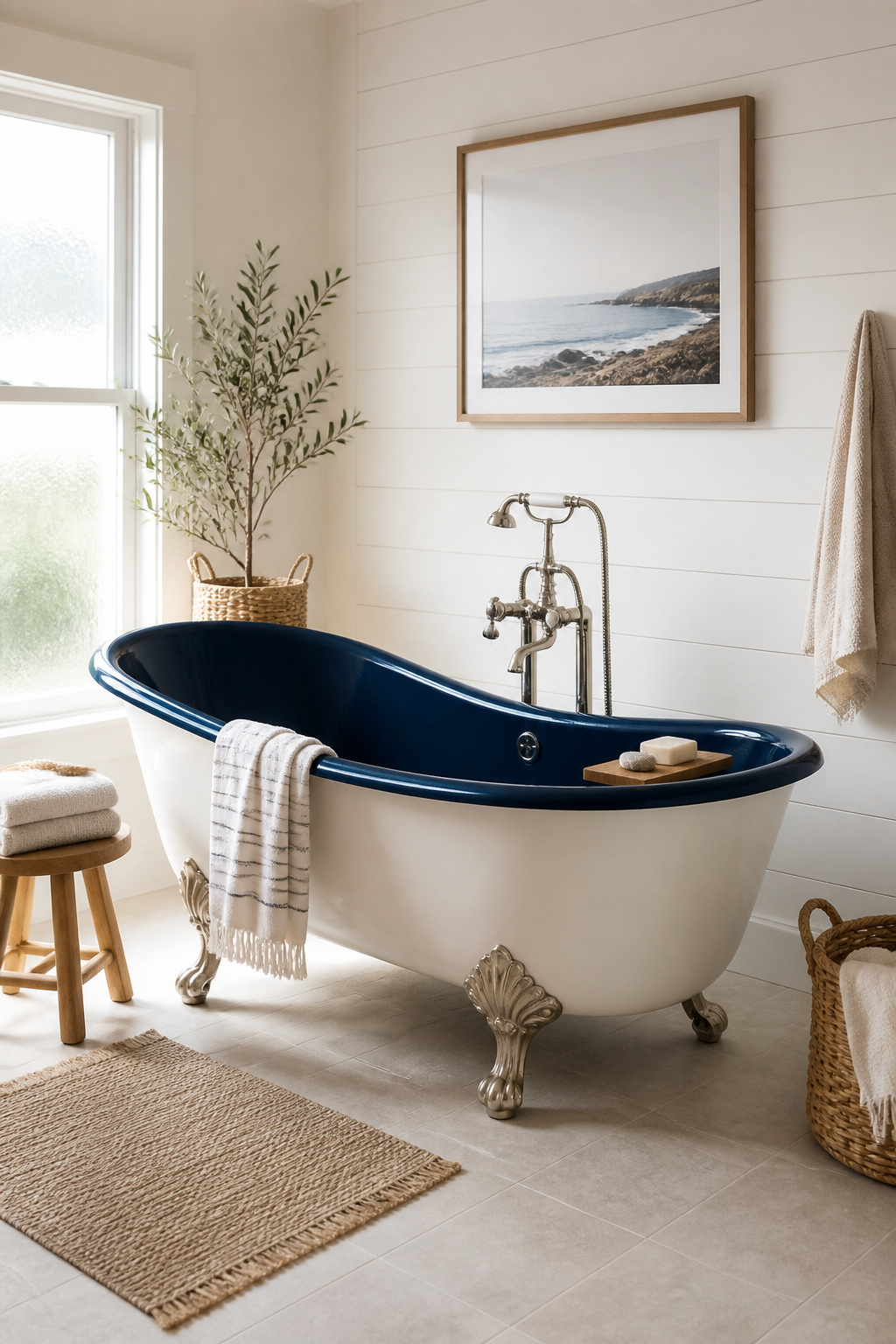
For a maritime feel, the colour combination is straightforward: white exterior, painted navy or deep teal interior. The colour-dipped effect has genuine nautical precedent and creates a focal point that’s worth planning the rest of the room around. The claw feet themselves should match the tapware finish exactly — brushed nickel feet with brushed nickel taps, aged copper feet with unlacquered brass taps. This coherence is what separates a designed bathroom from an assembled one.
Finish options span more than 80 choices across major manufacturers, from chrome and polished nickel to antique brass, matte black, and aged copper. Brushed nickel is the most versatile for coastal schemes — cool but not cold, complementing both blue tiles and white shiplap. Aged copper has a warmly nautical, vintage quality that evokes old ships and seaside workshops. Both finishes resist water spotting better than polished chrome.
Plumbing deserves attention at the planning stage. Clawfoot tubs require a floor-mounted faucet with its own supply lines — budget $400–800 for the faucet and $300–600 for professional installation, above the tub cost itself. Drain configurations include centre drain (for double-ended tubs), end drain (traditional single-slipper style), and rear centre drain for modern renovation layouts. Plan this before the floor is tiled, not after.
The accessory layer in a coastal bathroom has one job: add texture and warmth without adding noise. Natural fibre elements do this better than any other material category.
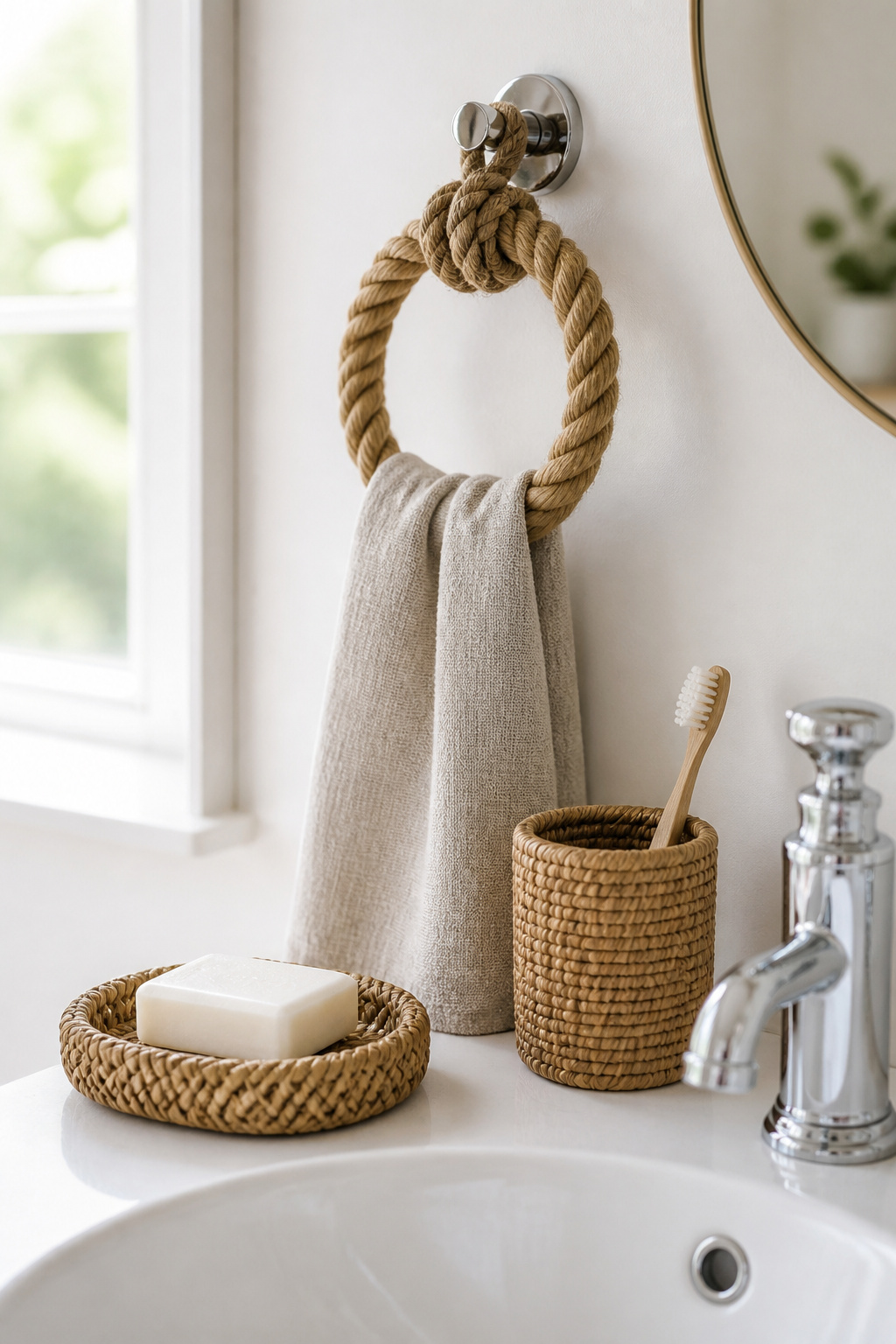
Rope accessories bring the tactile roughness of rigging and dock lines — they contrast with the smooth surfaces of ceramic and chrome in a way that feels entirely natural. A knotted-rope towel ring, a rope-wrapped mirror frame, a jute bath mat: each adds a layer of material story without introducing colour or pattern to compete with the main palette. Rattan’s woven structure creates dappled shadow that shifts through the day, adding the quiet visual movement that makes a room feel alive.
For specific pieces: rope towel rings (Etsy, search ‘nautical rope towel ring’) typically run $15–35 for handmade versions. Rattan soap dishes, toothbrush holders, and cotton bud jars can be found at Anthropologie, H&M Home, and JYSK for $8–20 per piece — affordable enough to build a cohesive set without a significant investment.
The discipline here is restraint. Pair no more than two natural fibre items with two hard or reflective items on any single surface — a rope mirror and rattan soap dish alongside a chrome tap and ceramic basin reads as carefully considered. Stacking a rope towel ring, rattan basket, and jute bath mat in the same eyeline creates what I’d call a craft market effect, which is the opposite of what coastal design should feel like.
Shiplap is embedded in coastal architecture at a cultural level. It originated as exterior cladding for ships and buildings in exposed coastal locations — the overlapping planks shed water efficiently, which is why it migrated indoors to beach houses as a familiar, trusted surface. In Scandinavian design, the equivalent tradition of horizontal plank panelling appears in fishermen’s cottages and summer houses across Norway, Sweden, and Denmark. The reference is genuine.
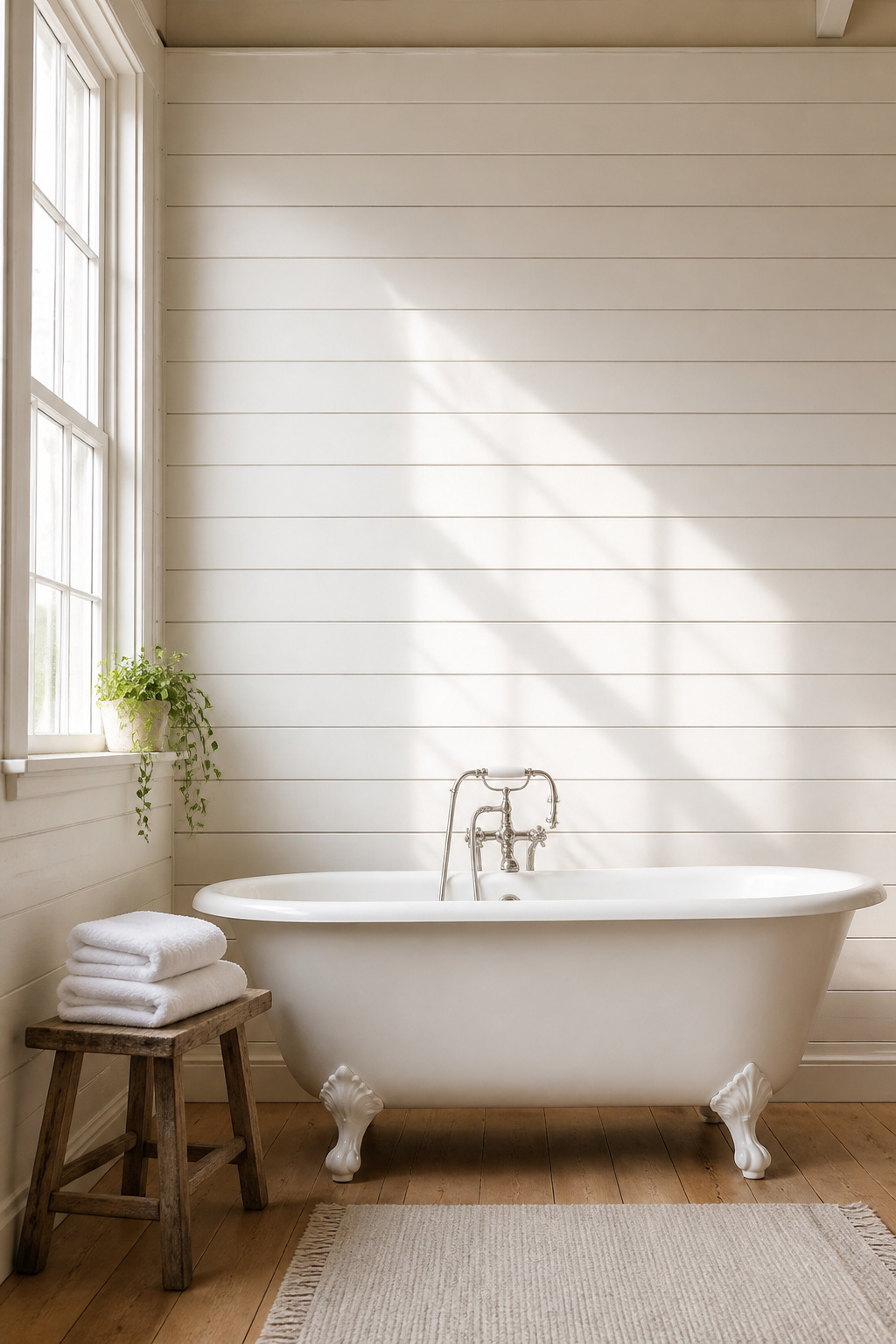
White-painted shiplap reflects light across its surface and makes any space feel larger — practically useful in the compact bathrooms that characterise most homes. The grain texture and the slight shadow in the plank joints add depth that painted drywall simply cannot provide. It is worth noting that farmhouse bathroom ideas that share the same rustic planked walls use shiplap in much the same way, albeit with a warmer palette — the structural principle is identical even when the styling differs.
Material choice is decisive. Cellular PVC shiplap (AZEK, Veranda, Kleer) is 100% waterproof — it will not warp, rot, or harbour mould in any bathroom environment. Moisture-resistant MDF works in dry zones (behind the toilet, opposite the shower) but should not be installed in wet areas. Real timber is the most authentic but requires thorough priming, sealing, and repainting every three to five years.
For installation, partial shiplap at wainscoting height (36–48 inches) is more versatile than floor-to-ceiling application. It protects the most-splashed zone, visually grounds the room, and leaves the upper wall free for a complementary tile or paint colour. A single shiplap feature wall — behind the freestanding tub or the vanity — is the most restrained option and often the most effective.
Pebble tile flooring is the most sensory choice in this entire list. The rounded stones underfoot create a massage effect that genuinely connects the bathroom to the feeling of walking along a beach or river — a psychosomatic trick that costs less than most other flooring options.
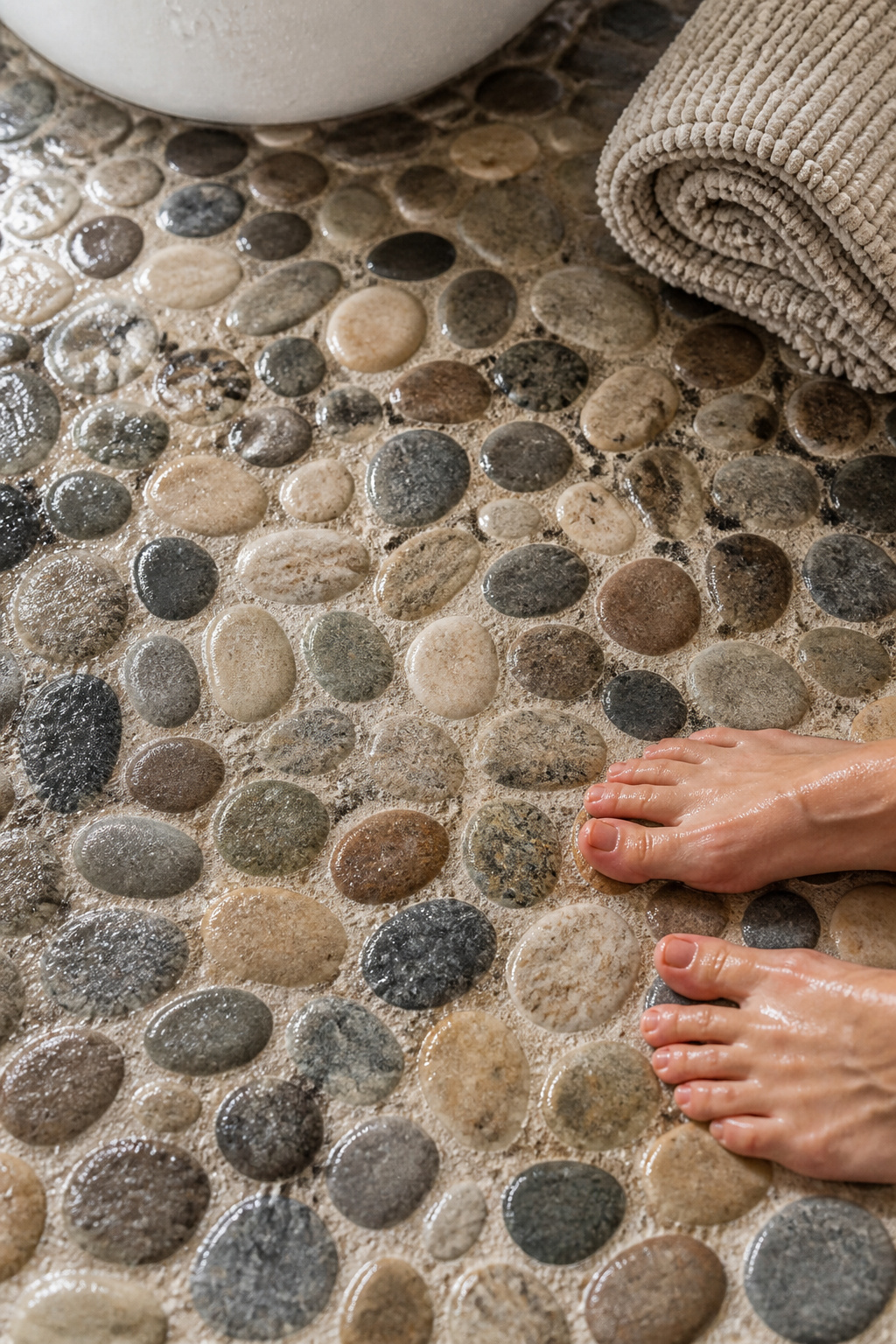
The stones themselves come in natural tones that align cleanly with the coastal palette: warm river pebble (beige-brown), grey ocean stone, and white quartz. Choose based on whether your bathroom runs warm or cool — warm pebble tiles against warm white shiplap walls, grey ocean stone against blue subway tiles. The depth and shadow between individual stones adds a visual texture that flat tiles cannot replicate, grounding the coastal scheme with a genuinely raw, natural quality.
Sealing is non-negotiable. Apply a penetrating stone sealer once before grouting (to prevent grout permanently staining the stone) and once after grouting. Use sanded grout — the wider joints between irregularly shaped stones need the body and structure of sanded grout; unsanded will crack within a season. Maintenance is straightforward: pH-neutral stone cleaner, no vinegar, no citrus, no acidic spray cleaners.
Mesh-backed sheets (typically 12×12 inches) hold the pebbles in position during installation — cut the mesh between stones with scissors to fit edges and curves. The alternative, sliced pebble tile (flat-cut on top, rounded underneath), is significantly easier to clean than fully round stones while delivering the same visual texture. For those finding this step daunting, the process is closely related to other natural stone tile installations — experience with farmhouse bathroom tile ideas with natural stone translates directly.
Textiles are the fastest and most affordable update in any bathroom, and in a coastal scheme they carry more weight than most people realise. The colour and material of your towels, bath mat, and window treatment signals whether the room feels genuinely coastal or merely decorated with coastal objects.
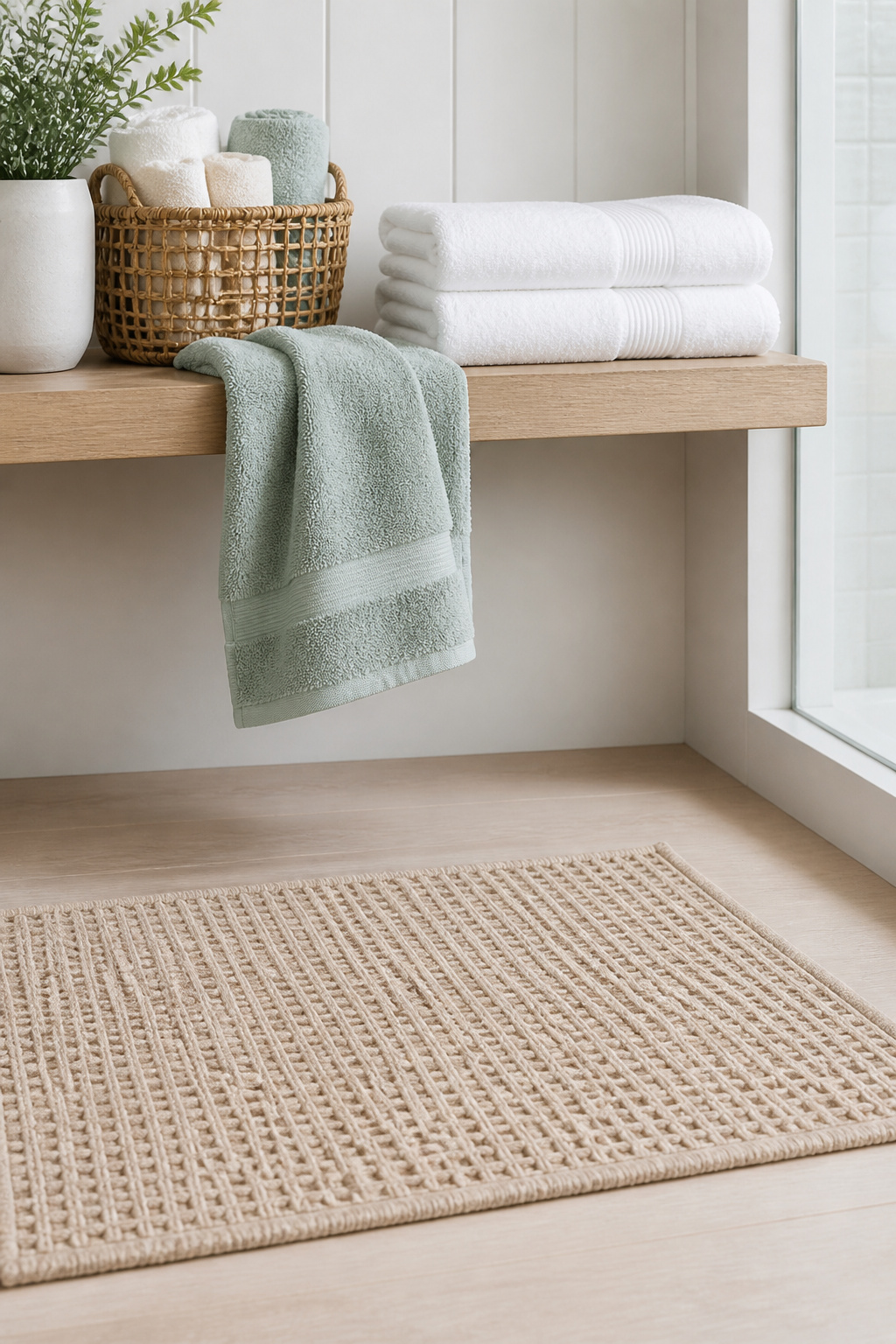
The right palette stays within sea glass tones: seafoam, salt white, sand, dusty aqua. These colours — inspired by weathered ocean glass and shoreline light — read as calm without coldness. Layer two or three tones from within this range (sand bath mat, seafoam hand towels, salt-white bath towels) and the room develops visual depth without introducing competing colours. Bright turquoise or saturated teal in the textile layer pulls the scheme toward tropical resort rather than the quieter Nordic-coastal feel.
Material matters too. Linen absorbs water faster than cotton and dries quicker — important in bathrooms without strong ventilation. It also has natural antibacterial properties, which is genuinely relevant in a damp environment. For cotton, look for 500 GSM (grams per square metre) with zero-twist construction — durable, soft, and quick-drying. Anything below 400 GSM will feel thin within a season. Waffle-weave cotton is the best of both worlds: it dries as fast as linen, feels softer than standard terry, and has the textural quality of natural material.
One underrated styling move: fold hand towels and display them on open shelving rather than stacking them in a drawer. In a coastal bathroom, the textiles are part of the decor layer.
Mass-produced coastal prints — waves, anchors, ‘Live by the Sea’ typography — are the fastest way to turn a coastal bathroom into a caricature of itself. Handmade and found-object art achieves what prints cannot: it carries the narrative of actual things gathered over time.
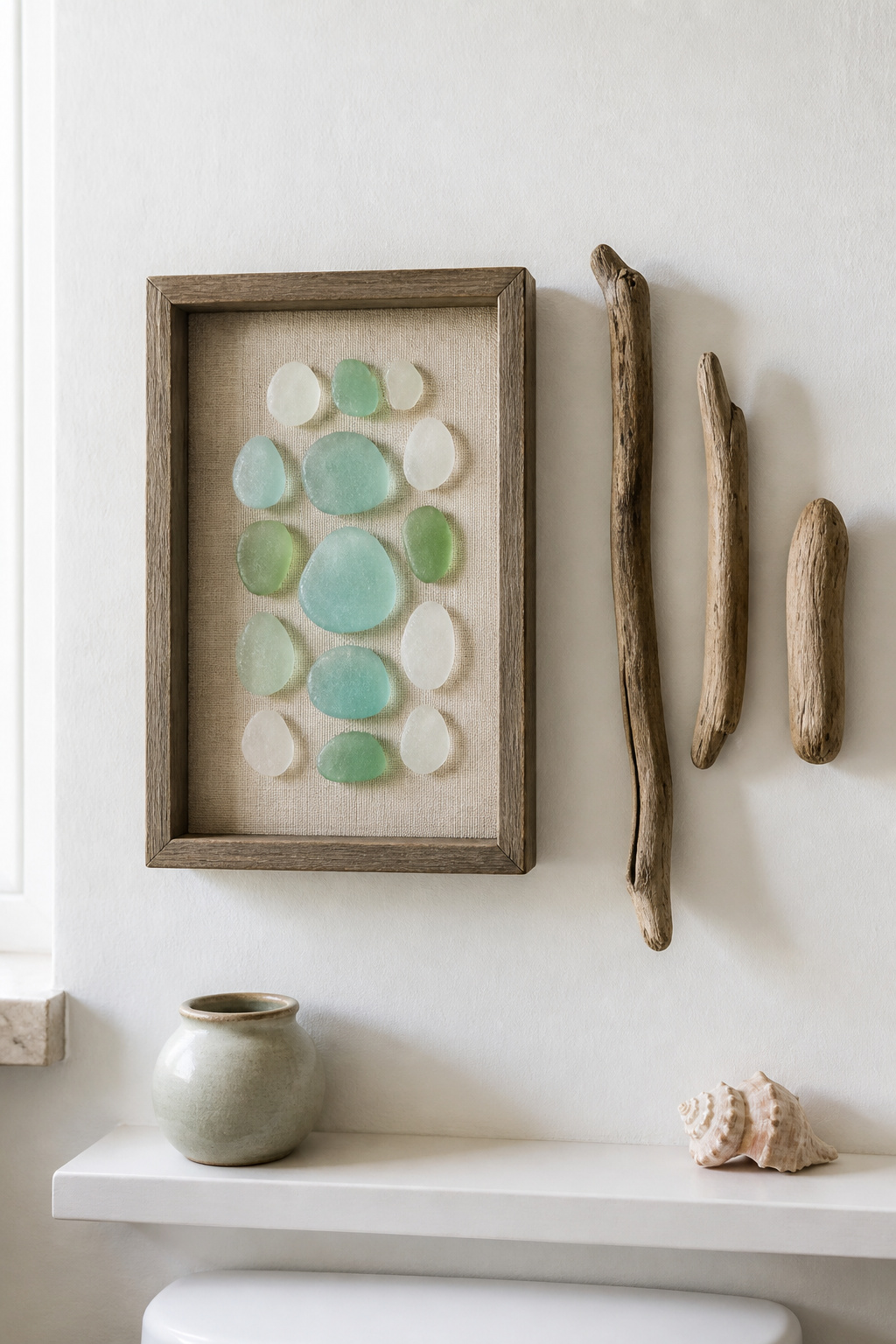
Sea glass art — framed collections, mosaic-framed mirrors, shadow box arrangements — makes a direct reference to the coastal environment in a way that photography cannot. The glass itself was once broken, tumbled, and smoothed by the sea. Driftwood sculptures and arrangements bring irregular natural form into a room dominated by rectangular tiles and straight lines; the contrast is quietly restful.
The practical challenge is humidity. Use stainless steel or brass picture hooks — standard steel hooks will rust in a bathroom within 6–12 months. Frame sea glass collections in shadow box frames with UV-resistant glass and sealed timber backing; MDF-backed frames will swell and warp within two seasons. For driftwood wall pieces, a light spray of water-based varnish prevents moisture absorption without altering the appearance.
Etsy is the right starting point for sourcing. Search ‘sea glass art framed’ for options from $25–150 for small framed pieces; shadow box collections from $80–250. Look for sellers who specify ‘sealed with marine varnish’ or ‘bathroom-safe’ — this signals that the maker understands the environment. The most satisfying option, though, is still a charity shop shadow box frame, 20–30 pieces of sea glass collected from a beach, and an afternoon.
Closed bathroom cabinetry adds visual weight and a formality that works directly against what coastal design is trying to achieve. Open shelving keeps the eye moving, the space feeling spacious, and the room honest — you can only display what’s worth seeing, which naturally enforces the restraint that this style requires.
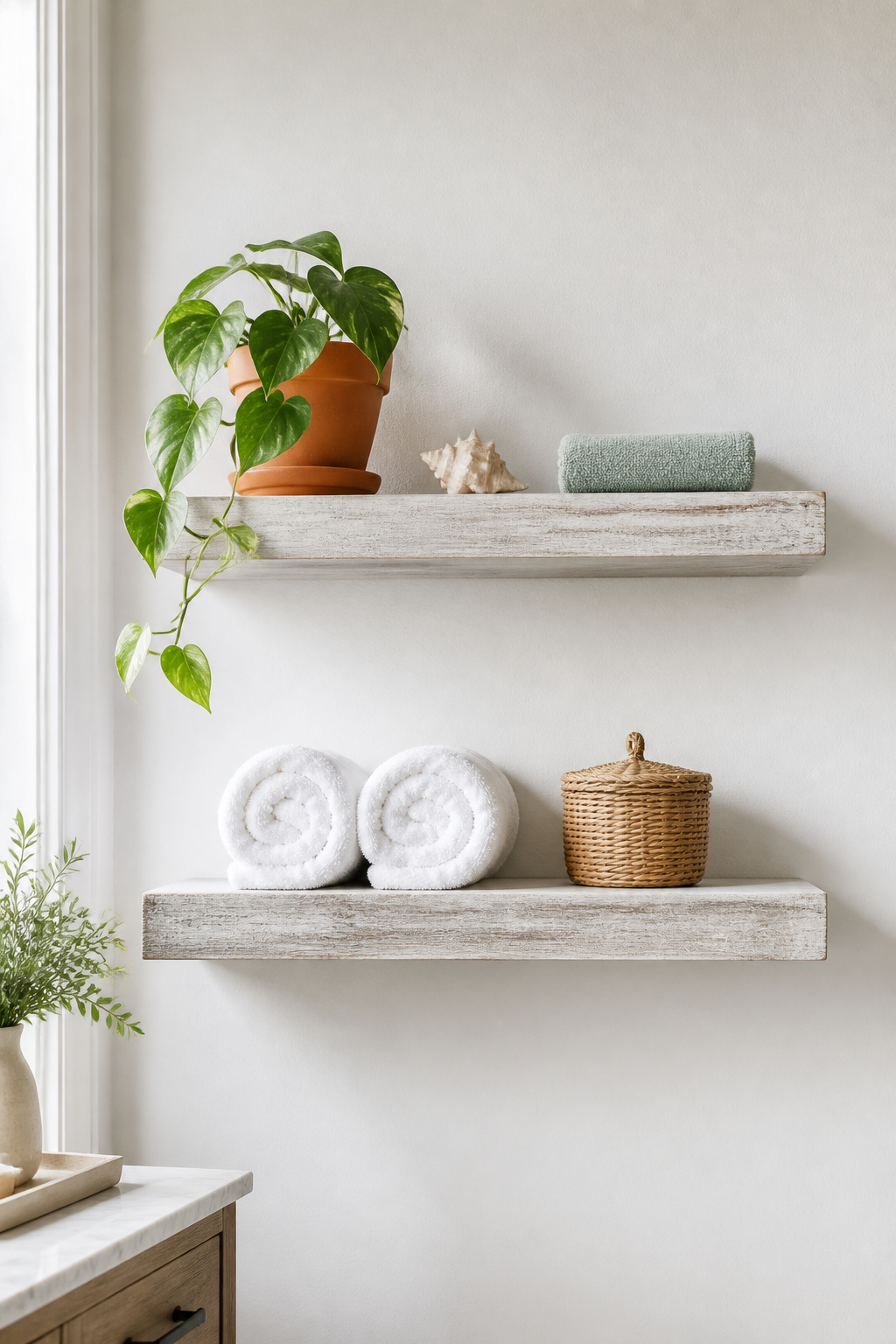
A floating shelf in weathered white pine or natural oak, supported by minimal or hidden brackets, reads as a horizontal plane rather than a storage unit. The shelf appears to float — a visual quality that suits the airy character of coastal design perfectly. For a more Nordic approach, plain white laminate shelves with concealed brackets eliminate the ‘rustic’ accessory element entirely, keeping the focus on what’s displayed rather than how the shelf is constructed.
Shelf depth of 8–10 inches is enough for bathroom items; a 12-inch shelf can accommodate folded towels as part of the display. For those who want detailed guidance, bathroom shelf decor that balances style and function addresses the full range of considerations — from bracket selection to vignette composition — with an approach that translates well into the coastal context.
Styling follows a simple rule: arrange accessories in odd numbers. Groups of three or five create visual rhythm; even numbers feel static and arranged. An effective coastal vignette might be a squat ceramic plant pot (trailing pothos or a small succulent) + a short stack of folded hand towels + a single shell or sea glass object. Three different heights, three different textures, one clear point of rest for the eye. The biggest mistake is over-theming — not every object on the shelf needs to reference the sea.
Stone basin sinks connect the bathroom directly to the geological world of beaches and cliffs in a way that ceramic and glass cannot. The raw texture and warm colour of travertine, basalt, or sandstone introduce something genuinely elemental into the room.
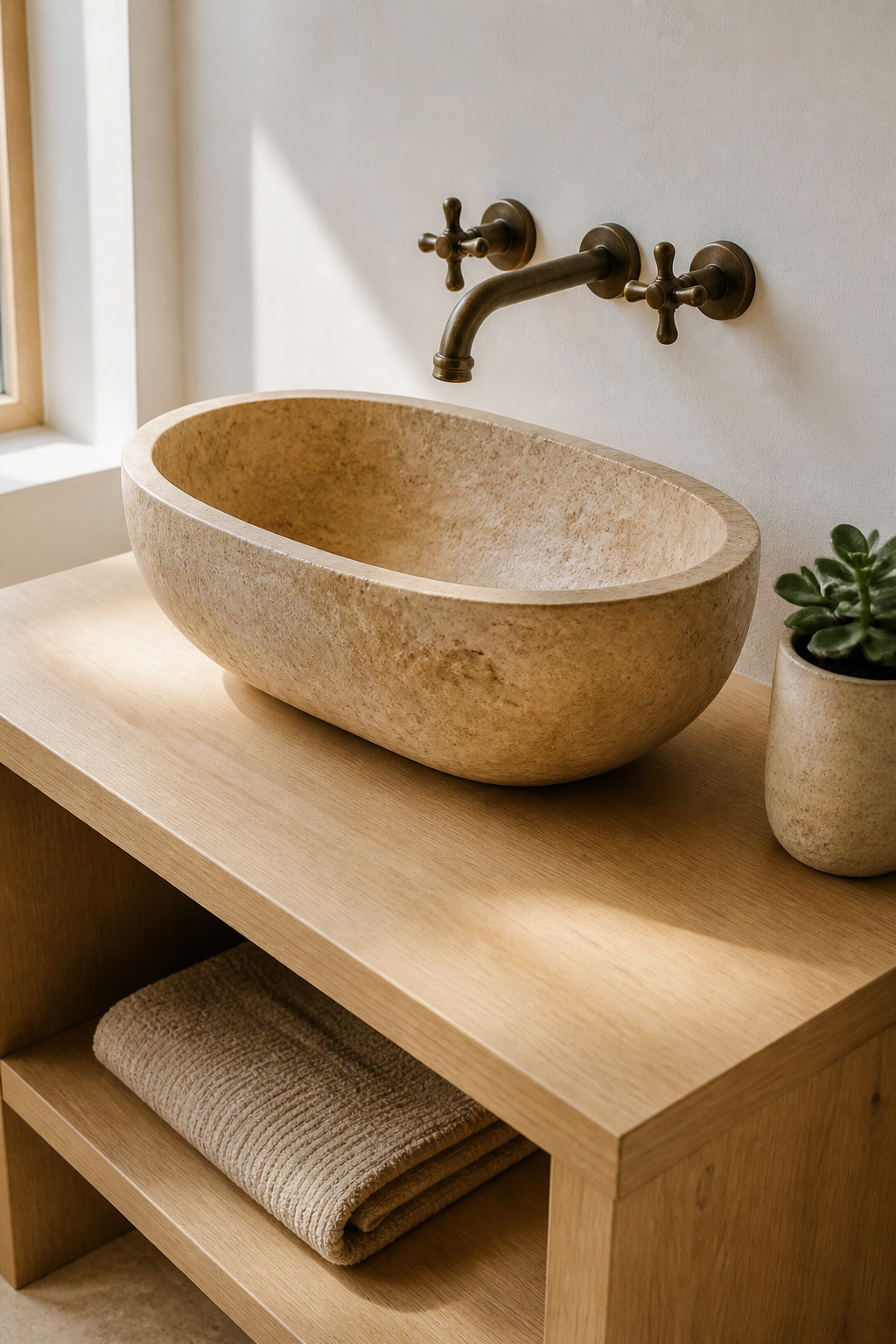
Travertine is the most overtly coastal of the stone options — its warm, porous surface with natural fill detailing evokes smoothed limestone cliffs and tidal rock pools. Basalt offers a darker, more dramatic Nordic-coastal feel: deep grey-black volcanic stone alongside white walls and natural timber reads as austere and powerful. Sandstone basins are rare but carry the actual colour of beach sand — warm, buttery, and distinctive. All three sit best on a minimal flat vanity surface that doesn’t compete with the stone texture; heavily figured marble underneath travertine, for example, creates a confusing visual argument.
Maintenance requires attention. Travertine is porous and must be pre-sealed on installation and re-sealed annually. Basalt is denser with lower porosity — more forgiving, needing re-sealing only every two to three years. All natural stone sinks should be cleaned with pH-neutral stone cleaner only. Avoid vinegar, citrus, and anything acidic — these etch the surface permanently. Many stone sinks arrive pre-sealed from the factory; discuss re-sealing schedule with your installer before first use.
Tapware pairings are straightforward. Brushed brass or aged bronze complements warm stone tones (travertine, sandstone). Matte black or brushed steel works with cooler basalt. The basin height matters: vessel sinks sitting on top of the vanity add 4–6 inches to counter height, so confirm that the total height (vanity plus counter plus basin) reaches 32–36 inches for comfortable everyday use.
Storage is rarely treated as a design choice, but in a coastal bathroom the storage layer is an integral part of the texture palette. A wicker laundry basket and a pair of seagrass shelf baskets contribute to the visual scheme in exactly the way a rug or a cushion does in a living room.
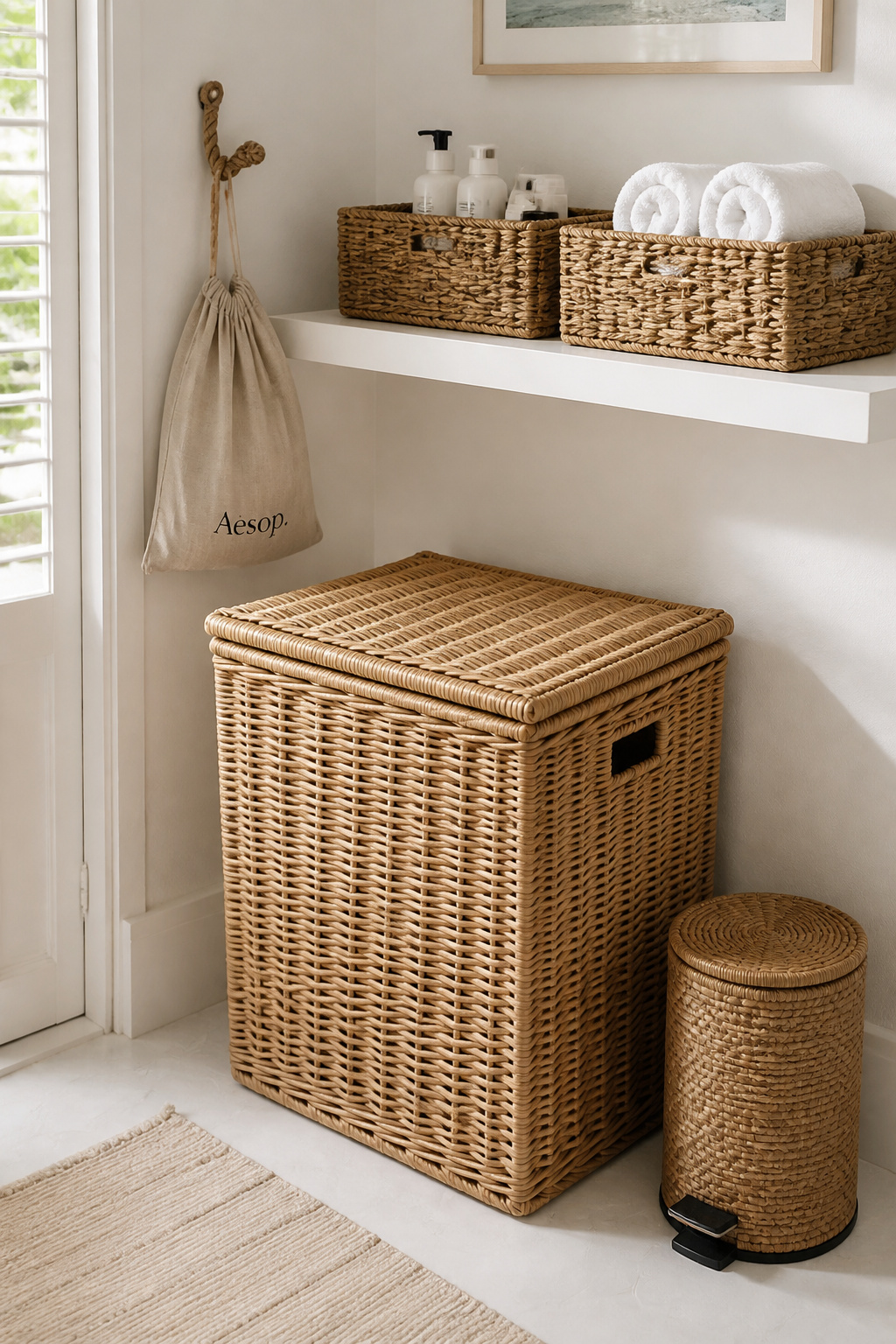
The distinction between rattan and wicker is worth understanding. Rattan is the plant material itself — a species of palm harvested as a cane. Wicker is the weaving technique that shapes it. Most bathroom storage labelled ‘rattan’ is in fact wicker-woven synthetic fibre, which is the right choice for consistently humid environments. Seagrass, however, is naturally water-resistant and genuinely tolerates humidity better than most natural fibres.
For specific pieces: a hinged-lid wicker laundry basket with a removable cotton liner keeps laundry concealed while preventing direct moisture contact with the weave. Seagrass shelf baskets (IKEA BULLIG, H&M Home seagrass range) work well for toiletries and spare towels at $8–15 each. Under-vanity bins in synthetic rattan — fully humidity-resistant — are increasingly available from bathroom accessory brands.
The critical maintenance step is ventilation. Run the exhaust fan for 15–20 minutes after every shower — this single habit prevents the vast majority of mildew issues in natural fibre bathroom storage. For baskets storing damp items, a waterproof liner is essential. Silica gel packets placed inside baskets absorb residual moisture; replace monthly or when they change colour.
Beadboard is one of those materials that carries its heritage so naturally you barely have to work for the aesthetic. Its narrow vertical channels and rounded beads echo slatted wooden decking, beach hut walls, and boat interiors — the coastal association is structural rather than decorative.
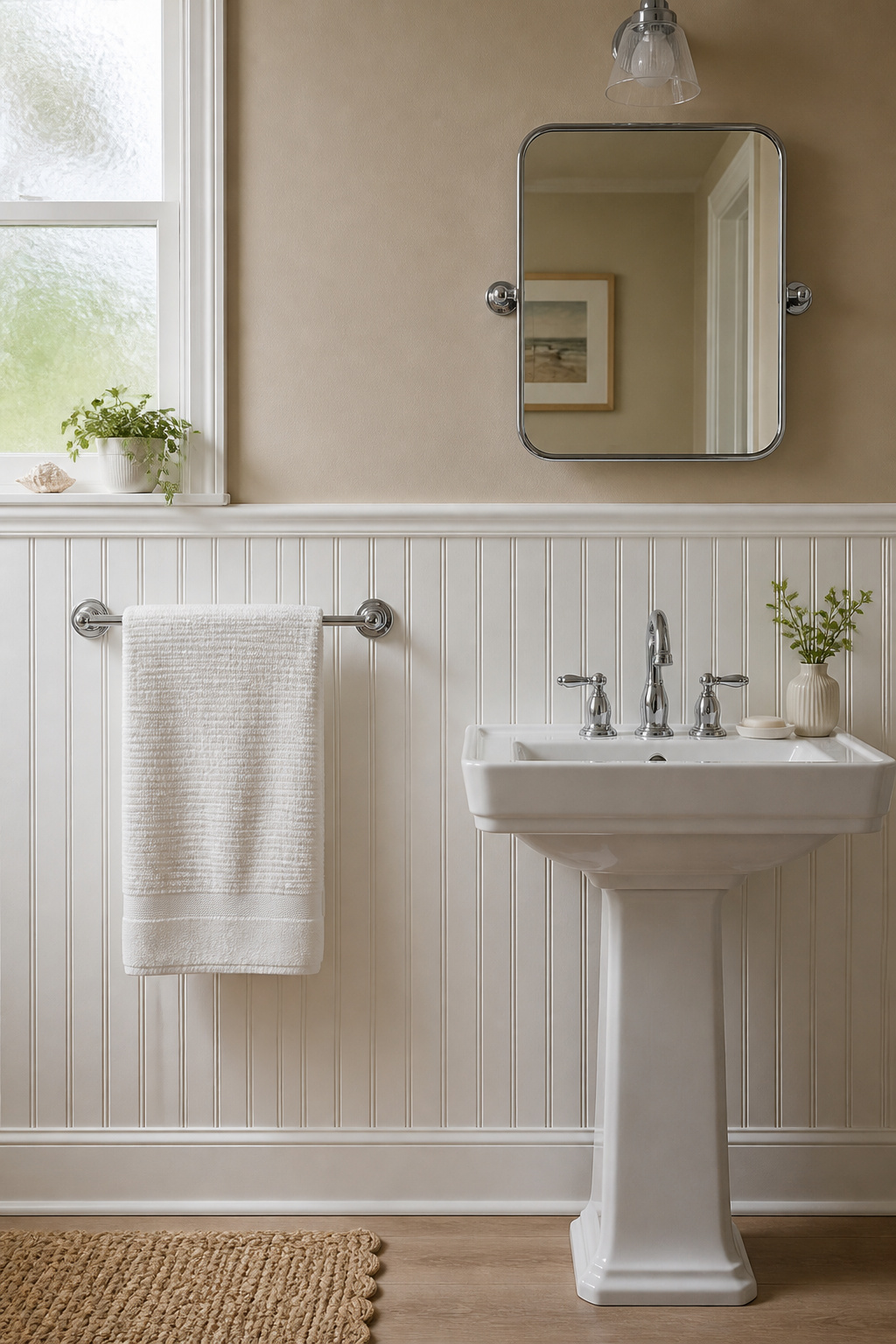
White-painted beadboard acts as a visual background that makes coastal accessories and tiles read more clearly without competing with them. It reflects light across its textured surface, adding a dimension that flat plasterboard cannot offer. In Scandinavian tradition, similar vertical board panelling appears in coastal summer houses and fishing cottages — practical, durable, and quietly beautiful.
Material matters significantly in a bathroom. Cellular PVC beadboard (American Beadboard, AZEK) is 100% waterproof — the definitive choice for shower-adjacent walls or high-humidity locations. Moisture-resistant MDF is adequate for dry zones and more affordable, but should not be used anywhere that regular splashing occurs. Real timber beadboard (tongue-and-groove pine or cedar) is the most authentic option but requires thorough priming, painting, and repainting every three to five years.
Standard installation height runs 36–48 inches — the wainscoting height that protects the most-splashed zone and leaves the upper wall free for tile or paint. Pre-packaged kit heights from American Beadboard run 36, 42, 52, and 66 inches when combined with top cap and baseboard moulding. Full-wall beadboard works beautifully in a small powder room or separate WC; in a full bathroom with a tub, it can feel like a beach hut rather than a considered interior.
The airy quality of a well-done coastal bathroom — that specific sense of light and openness — depends on natural light more than on any other element. You can install every item on this list, but if the bathroom is dark, it will not feel coastal.
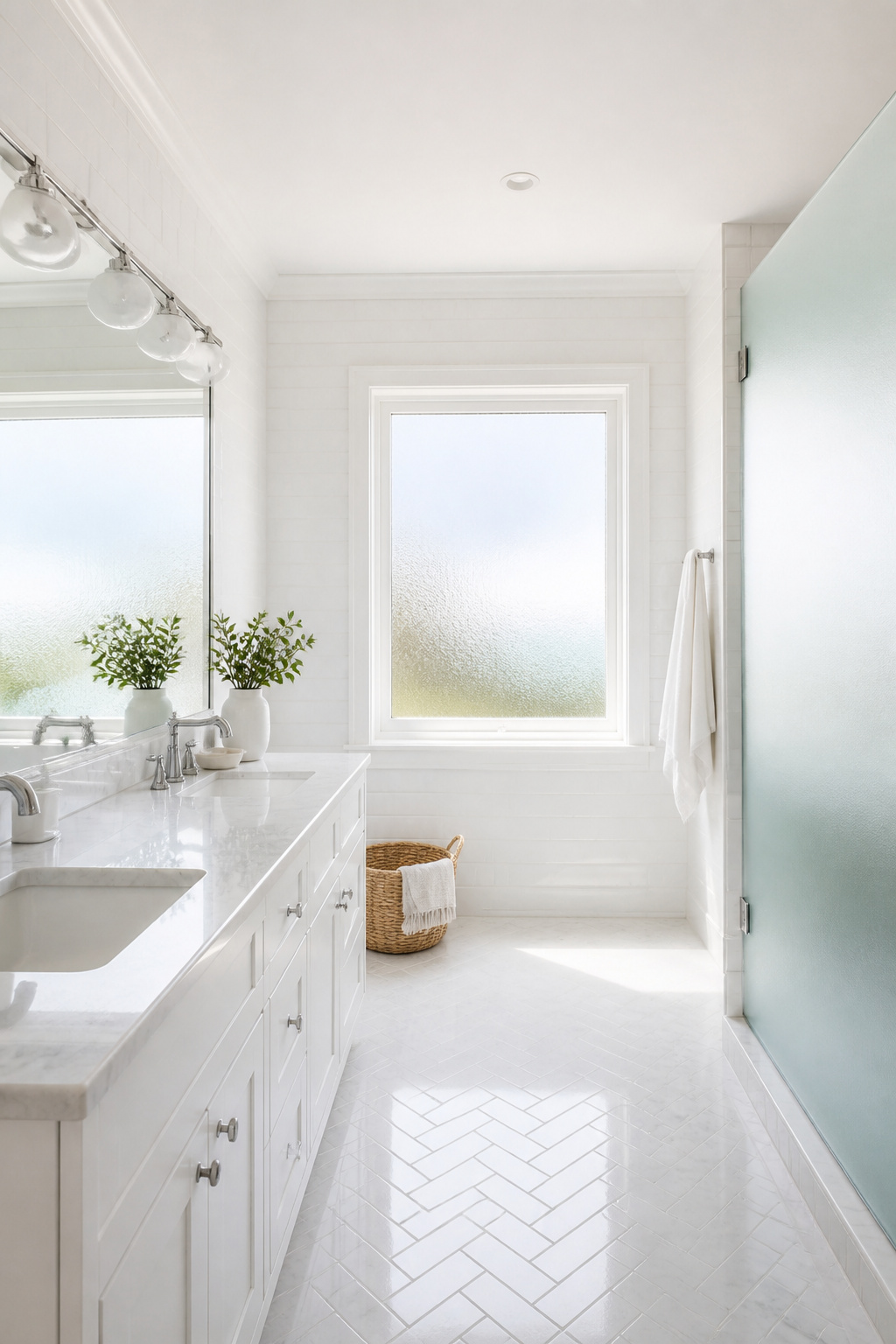
Frosted glass is the solution that balances natural light with privacy. It diffuses direct sunlight into soft, even illumination across the whole room, eliminating hard shadows while keeping the bathroom bright throughout the day. A large mirror positioned opposite the window doubles the perceived natural light by reflecting the window view back into the room — a simple trick that has an outsized effect.
The options for frosted glass cover a useful price range. Self-adhesive frosted window film (Purlfrost, Artscape, Fancyfix) applies in minutes with soapy water, is removable, and costs $15–40 for a standard window — the most accessible starting point. Sandblasted or etched glass is permanent and delivers quality that film cannot replicate, at $150–400 per window for professional work; no peeling, no bubbling, no reapplication. Frosted shower screens are also worth considering — a textured panel eliminates the need to maintain spotless clear glass in a humid environment, which is a practical benefit that matters daily.
For supplementary lighting, stay in the 3000K–3500K (warm white) range — cool white at 4000K+ reads clinical and undermines the warm coastal atmosphere entirely. Globe bulb vanity bars emit omnidirectional light that reduces harsh shadows; they are the most flattering choice for a coastal bathroom vanity. Bathroom vanity lighting that flatters without glare is worth investing in properly — in a bathroom built around texture and natural material, the right lighting makes everything in the room look better.
The simplest coastal bathroom idea on this list is often the most transformative. A sandy neutral paint colour — warm taupe, dune white, pale buff — creates the backdrop against which every other element in the room reads correctly. It is the equivalent of sand on a beach: unremarkable on its own, but essential to everything around it.
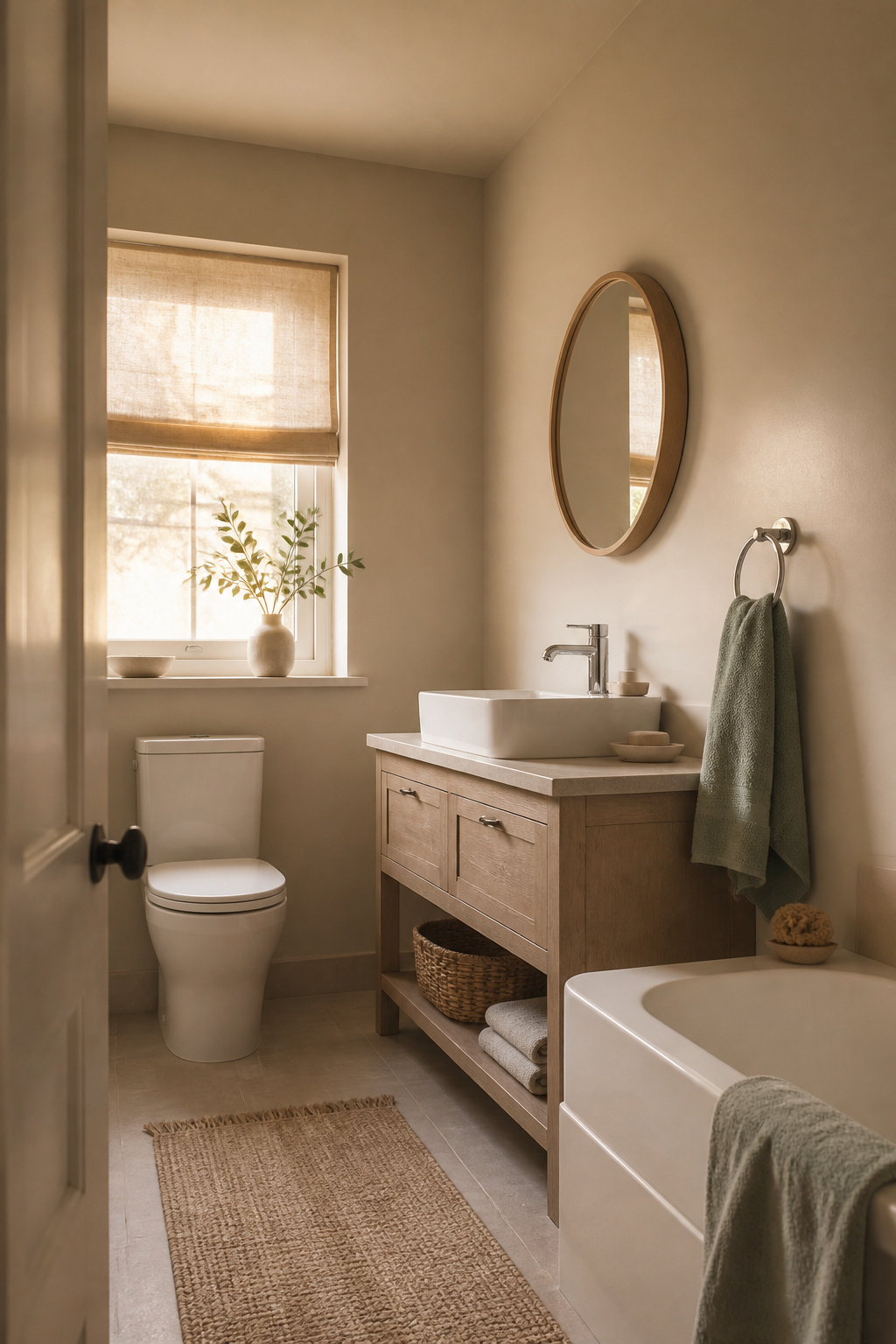
Farrow & Ball Skimming Stone is the designer’s shorthand for this palette — a warm neutral taupe that reads like dry sand in natural light and references the colour of coastal stone walls without being literal about it. Benjamin Moore Palladian Blue HC-144 does something similar but from the blue-grey side of the spectrum: it acts as a painted sky behind white fixtures and natural materials, moving between blue and neutral depending on the light. Sherwin Williams Agreeable Gray is the more accessible equivalent — warm beige with grey undertones, resembling sun-kissed sand, and compatible with virtually every coastal material.
Paint finish deserves as much consideration as colour. Eggshell (a slight sheen) is the right choice for bathroom walls: easy to wipe clean and gently reflective without the full shine of satin. Flat or matte finishes absorb moisture and will mark and stain within months in a bathroom environment.
In north-facing or low-light bathrooms, avoid pure white — it reads grey without strong sunlight. A warm sandy neutral like Farrow & Ball Elephant’s Breath or Dulux Egyptian Cotton maintains warmth regardless of light direction. A timeless bathroom design classic starts with the architecture and palette, not the accessories — the paint colour is where that foundation is laid.
The risk with a list of fifteen ideas is that it produces bathrooms where everything competes. The coastal bathroom ideas that actually work — the ones that feel genuinely restorative rather than themed — are the ones that apply the same restraint the coast itself does.
Start with one structural choice: shiplap, or beadboard, or tile as the primary surface treatment. Not all three. Build the furniture layer around that — a vanity and mirror that complement the surface without matching it exactly. Then add the accessory layer last: textiles, art, storage, plants. In practice, keeping two of these three zones quiet lets the third zone speak clearly.
If budget is limited, the paint-plus-beadboard combination costs under $200 for a standard bathroom and delivers more visual transformation per pound than almost any other intervention. From there, a driftwood vanity or a freestanding tub becomes the investment piece that earns back its cost in daily pleasure. The accessory layer — textiles, baskets, art — can be refreshed seasonally without touching the architecture.
The other principle worth holding onto: every element should earn its place. A coastal bathroom does not need a rope-wrapped mirror and a shell-inlaid frame and a sea-glass art piece and a pebble tile floor and a driftwood vanity. It needs two or three of these things done well, and the courage to leave the rest of the space alone. That restraint — that willingness to let the materials do the work rather than filling every surface — is the clearest way to bring the seaside home.