Physical Address
304 North Cardinal St.
Dorchester Center, MA 02124
Physical Address
304 North Cardinal St.
Dorchester Center, MA 02124
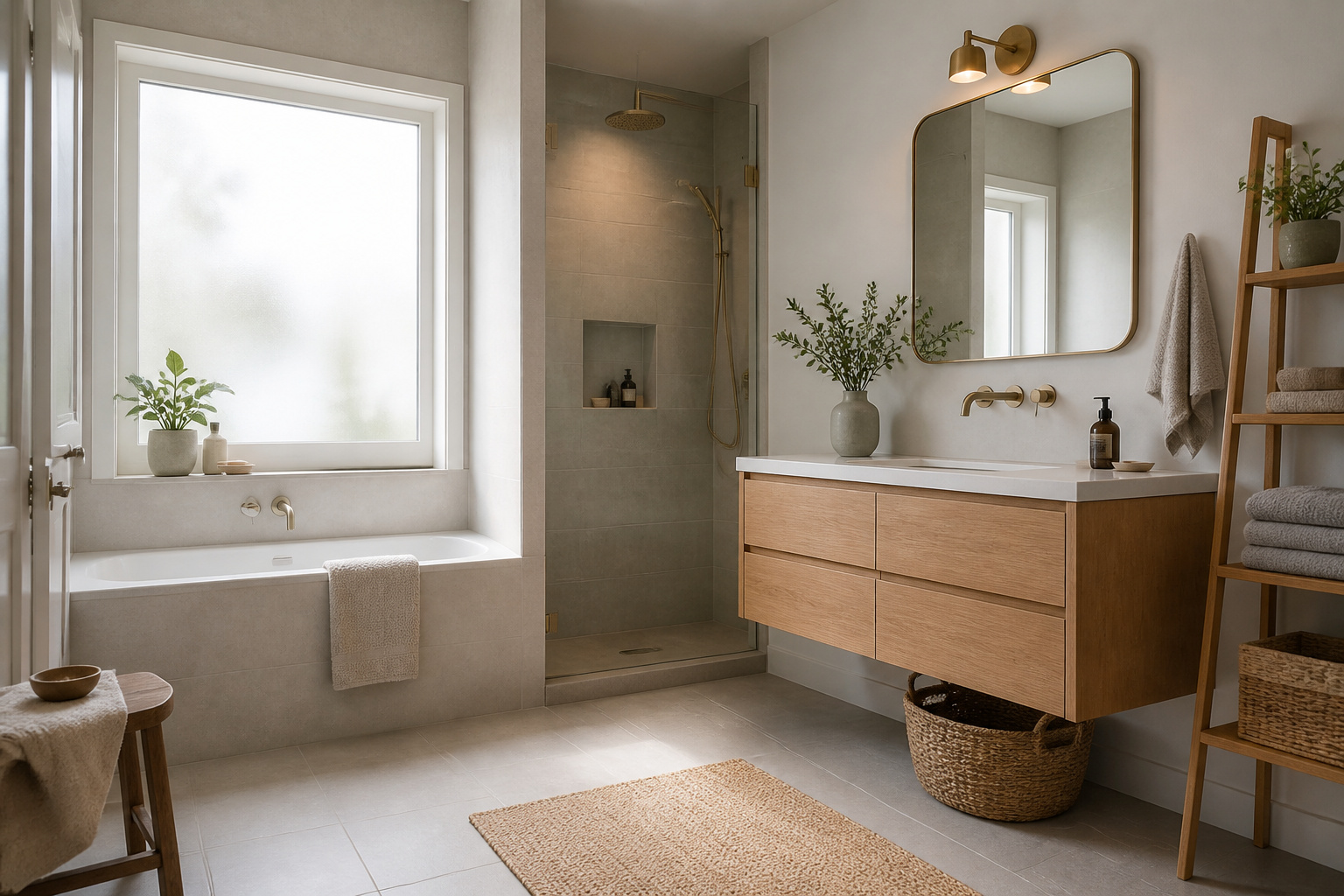
From floating vanities to recessed shower niches, these 15 bathroom storage ideas solve real problems with calm, considered design. Find what fits your space.
Most bathrooms don’t have a space problem. They have a system problem. The counter fills up because there’s nowhere else for things to go. The under-sink cabinet becomes a graveyard for products nobody uses because nobody can see what’s in there. It’s a familiar cycle — and it’s fixable with the right bathroom storage ideas.
Scandinavian design has always understood that a well-organised space doesn’t look organised at all. It looks calm. The storage does its job invisibly, and what remains visible is deliberate. That’s the standard worth aiming for: not a bathroom that looks sorted, but one that functions so smoothly the question of storage never comes up.
These 15 bathroom storage ideas range from a £40 rearrangement of what’s already in your cabinets to a weekend conversion project that transforms the room entirely. Start with the one that addresses your biggest daily frustration. The rest will follow.
There’s a reason floating vanities dominate bathroom renovation guides from Stockholm to Singapore. The wall-mounted design exposes 6–8 inches of floor beneath the cabinet, and that gap is doing more visual work than it looks. By allowing the eye to see the floor running continuously beneath the unit, the room reads as larger — the same principle behind floating TV consoles in compact living rooms. In a small bathroom, it’s a meaningful trick.
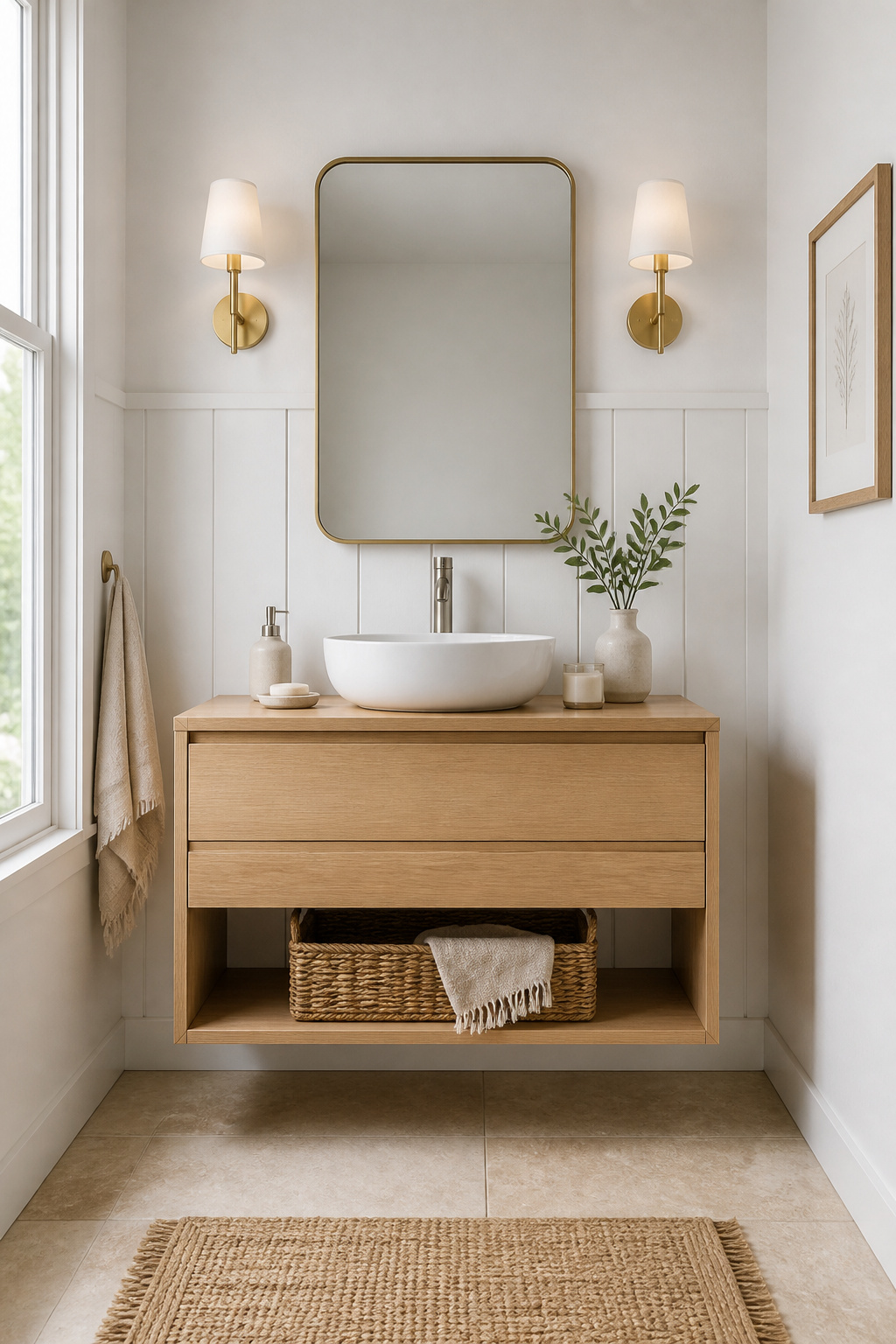
IKEA’s ÄNGSJÖN line runs 30″ wide by 21″ deep — a sensible size that fits a single basin without overwhelming a modest bathroom. Nordic brands like Macro Design and HTH offer similar proportions in white oak and smoked finish options. Below 21″ depth gets awkward: the drawers shrink to the point of impracticality, and reaching the tap at the back of the basin requires more effort than it should.
The drawer configuration matters as much as the cabinet itself. Deep bottom drawers (12–14″ tall) accommodate bottles, a hair dryer, and stacked hand towels. Shallow top drawers (4–5″) are for daily essentials — the things you reach for without looking. Bamboo divider inserts and clear acrylic organiser trays keep both kinds of drawers from collapsing into chaos. Soft-close dampers are standard on mid-range units and above: they catch the drawer 3cm from closed and pull it silently the rest of the way. It’s a small thing that you’ll notice every morning. If you’re considering bathroom vanity choices for older homes, the floating format translates well to period properties with proper wall prep.
Keep the depth at 21″ if your floor plan allows it. Anything shallower makes the drawer internals too narrow to be genuinely useful. As bathroom storage ideas go, the floating vanity is one of the few that simultaneously improves function and the perceived size of the room.
The wall above the toilet cistern is the most consistently wasted surface in British and European bathrooms. Standard cisterns top out at 28–32″ from the floor. Between that point and the ceiling — typically 96 inches up — there’s a column of air that could be doing real work.
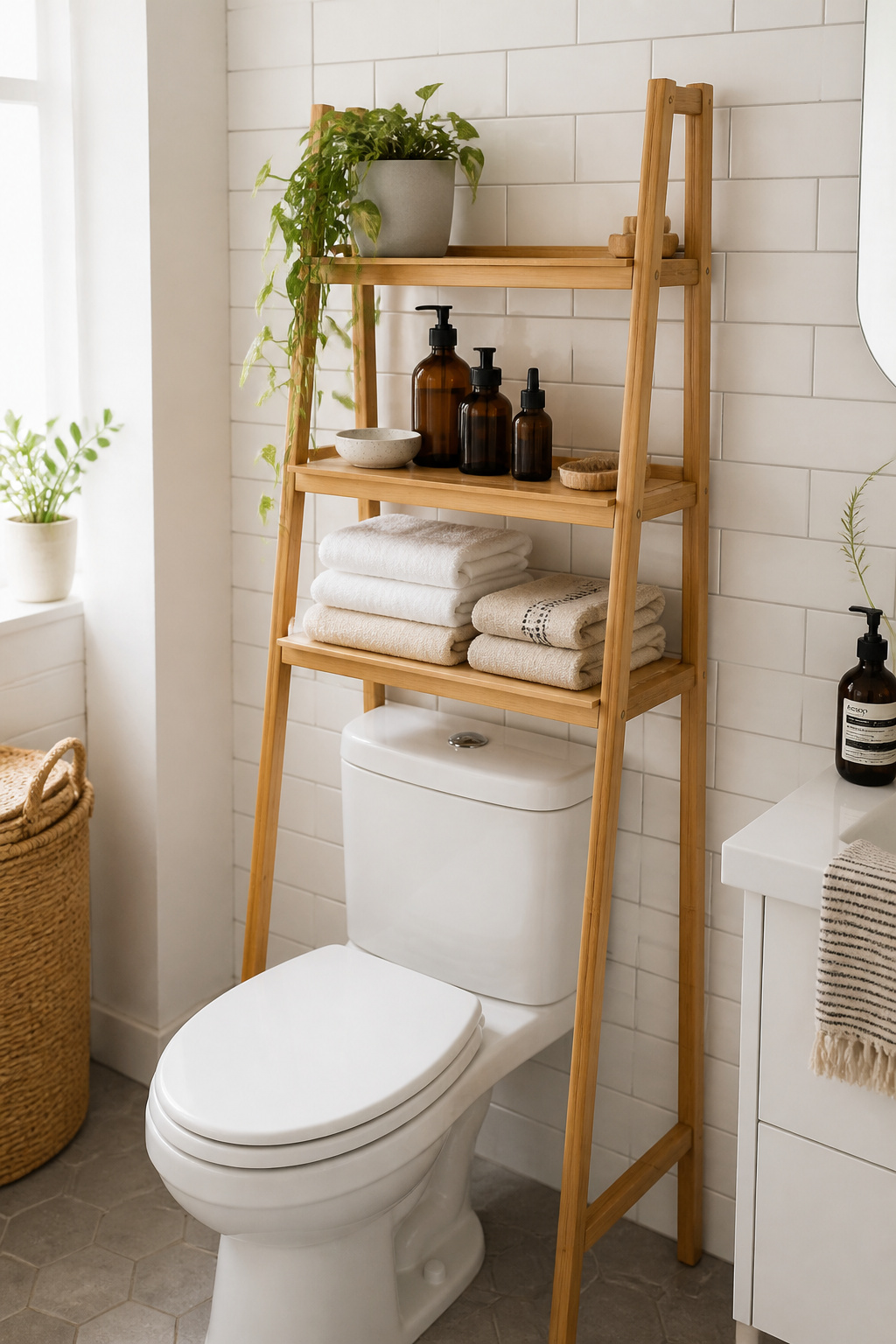
A three-tier open-frame unit exploits that vertical zone without touching any floor space. Bamboo and acacia frames are the right material call: both resist moisture better than untreated pine, and the warm grain suits a bathroom far better than powder-coated metal. Each shelf on a well-proportioned unit is wide enough to hold stacked folded towels, a basket of toiletries, and a plant — meaningful capacity from zero floor commitment.
The choice between open shelving and enclosed cabinet units comes down to what you’re storing. Open shelves suit towels and anything you want visible; enclosed cabinet doors conceal the clutter of everyday products and keep dust out. Hybrid units with a closed upper cabinet and open shelves below offer both. Whatever you choose, keep the total to three categories per unit — towels, plants, and a basket of loose items. A fourth category starts to look like overflow rather than storage.
One practical note: most freestanding over-toilet units aren’t wall-anchored. They brace against the wall at the top and rely on the toilet base footprint for stability. Before buying, confirm that the legs will straddle your specific cistern model — the distance between the legs varies across brands and isn’t always listed in the spec sheet.
Nothing integrates into a shower wall as cleanly as a built-in niche. There’s no protrusion, no bottle-tipping risk, no visual interruption to the tile run — just a recessed shelf that holds shampoo, conditioner, and body wash exactly where they need to be.
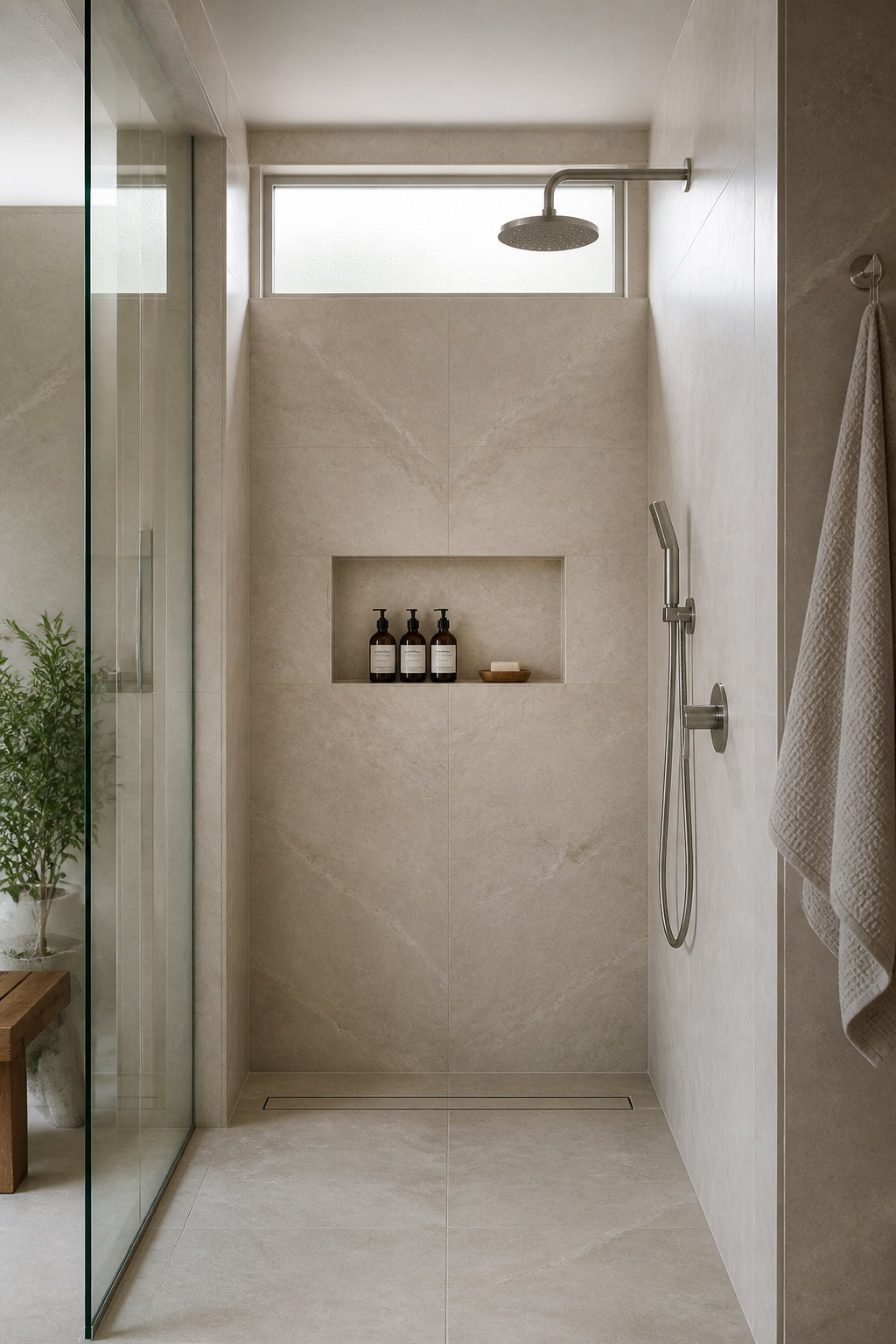
Schluter’s KERDI-BOARD-SN is the industry-standard prefabricated niche insert: available in 12″×6″, 12″×12″, 12″×20″, and 12″×28″ sizes, with a fully sealed body and an integrated KERDI-BAND frame that waterproofs all seams. The 12″×28″ variant holds four to five full-size bottles standing upright — enough for a two-person household. Standard stud spacing of 16″ on centre accommodates a 12″-wide niche with a tile margin on each side; no structural modification required.
Installation height is a more deliberate decision than it appears. Shoulder height (60–65″ from the floor) is traditional, but elbow height (48–52″) means you retrieve bottles without raising your arm above the showerhead. For a shared bathroom used by people of different heights, two niches — one at each height — solve both problems.
For matching tiles, grout colour is the key decision. Matching the grout exactly to the surrounding tile makes the niche disappear into the wall. Contrasting grout frames the niche and turns it into an intentional design feature. Either reads well; neither is wrong. The one thing to avoid: a slight inward pitch. Niches should be level or pitch slightly outward so water drains out rather than pooling inside the shelf.
Among the more permanent bathroom storage ideas on this list, the recessed niche is the one you’ll never regret. The Schluter insert runs about £50–70 and installs in under an hour. A custom niche cut to non-standard dimensions is also possible, but requires a licensed waterproofer to guarantee the membrane seal — not a DIY shortcut worth taking.
Natural fibre baskets are one of the few categories of bathroom storage that improve the look of a bathroom while solving a practical problem. They add organic texture to a room dominated by hard surfaces, and the right material handles bathroom humidity without degrading quickly.
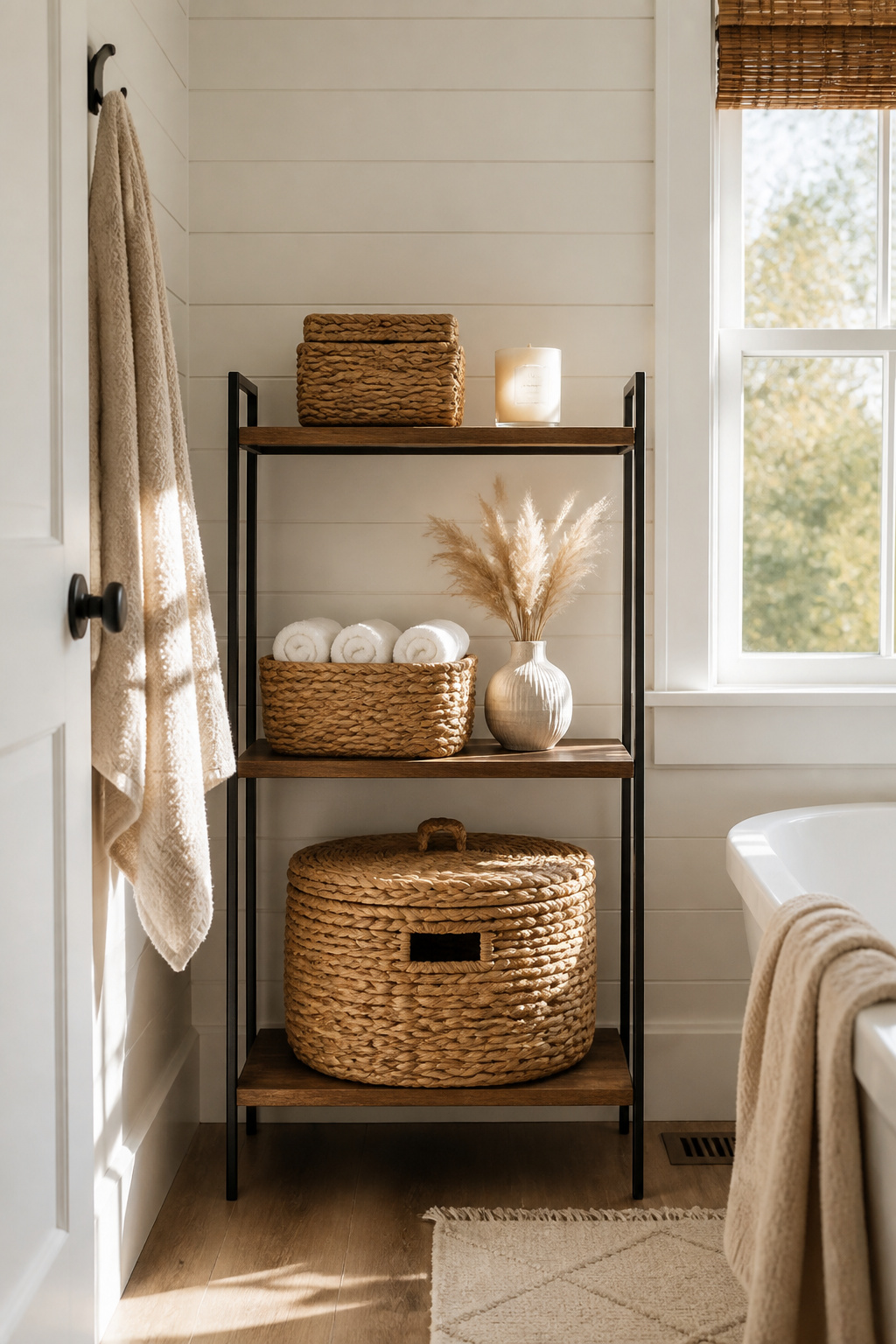
The most important choice is fibre type. Seagrass is the most moisture-tolerant of the natural options — its dense fibres resist humidity better than rattan or water hyacinth, and it’s the material most used in Scandinavian and coastal bathrooms for exactly this reason. Water hyacinth has a softer, more decorative texture but degrades faster under sustained humidity; it’s better suited to the dry side of the bathroom — folded flannels, spare toilet rolls, towels that aren’t coming out of the dryer and going straight in. Rattan frames are stiff and structured, but unless sealed with a clear lacquer, they’re not naturally moisture-resistant enough for anything close to a shower zone.
Position matters as much as material. Open shelves or ventilated under-vanity space allows air to circulate around the basket. A sealed cabinet holds moisture against the fibres and accelerates deterioration. Never store damp towels in a closed basket — it causes mould and fibre breakdown within weeks, and the smell arrives faster than the visible damage.
For under-vanity placement, a 12″×12″×10″ seagrass basket sits neatly alongside the P-trap in a standard 21″-deep cabinet. On open shelves, keep to one size per shelf for a calm Nordic look — varied basket heights on the same shelf read as accidental rather than considered. The same layered approach with organic materials works just as well in a coastal or Nordic scheme.
The medicine cabinet is the original multi-tasking bathroom fixture: mirror and storage occupying the same wall footprint, doing two jobs for the price of one installation. A well-chosen 24″×30″ cabinet provides roughly 6 square feet of interior shelf space — enough for three people’s daily toiletries, a first aid kit, and prescription medications — while the mirrored exterior eliminates the need for a separate mirror above the vanity.
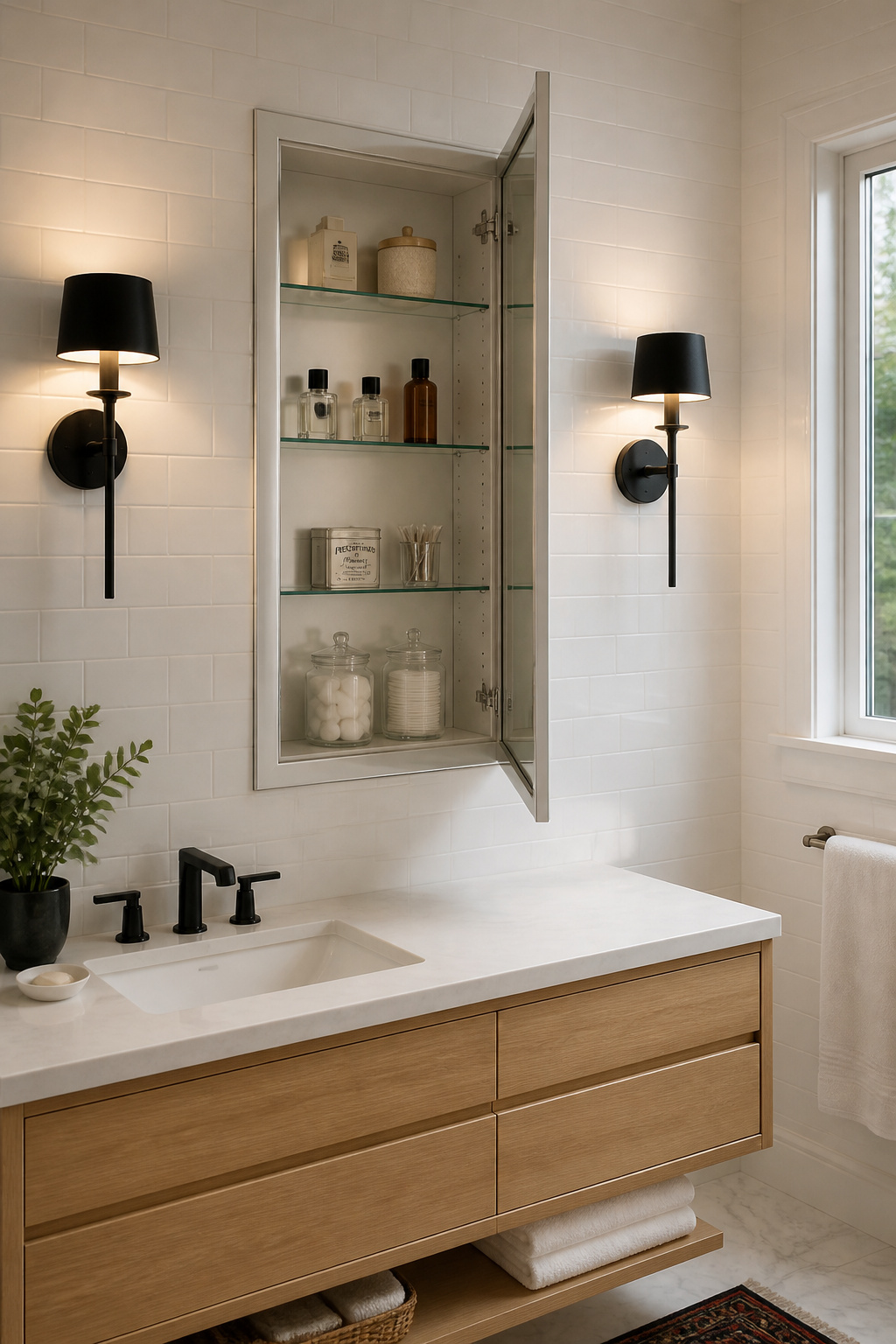
The choice between recessed and surface-mounted is mostly determined by the wall. A recessed cabinet sits flush with the tile or plaster — less than 1″ of protrusion compared to 4–5″ for a surface-mounted model. It looks architectural. But the installation involves cutting into the wall and checking for pipes, wiring, and structural elements in the cavity behind the opening. About 60% of early recessed cabinet failures are moisture-related: if the waterproofing membrane behind the wall isn’t intact, sustained humidity causes the laminated board to deform and hardware to rust. Always verify the wall condition before committing to a recessed installation.
Surface-mounted cabinets are faster, less expensive (typically 15–30% less than comparable recessed models), and reversible. For a rental apartment or a tiled wall you can’t cut, they’re the sensible choice. The 4–5″ protrusion becomes invisible within a week of daily use.
For either type, look for adjustable interior shelves with four to five height positions, a soft-close door hinge, and a door that swings the correct direction relative to your light switch and adjacent wall. LED strip lighting along the top interior edge is worth adding: overhead ceiling lights cast a shadow across the mirror that interior cabinet lighting eliminates entirely. It’s a bathroom storage idea that adds lighting value at the same time.
The bamboo ladder shelf is the most renter-friendly bathroom storage upgrade available. It requires no drilling, no wall anchors, and no professional installation — it leans against the wall at an angle, braced by its own base weight. Move it when you clean, shift it to a different wall when the layout changes, take it to the next flat when the tenancy ends. That flexibility alone justifies the purchase.
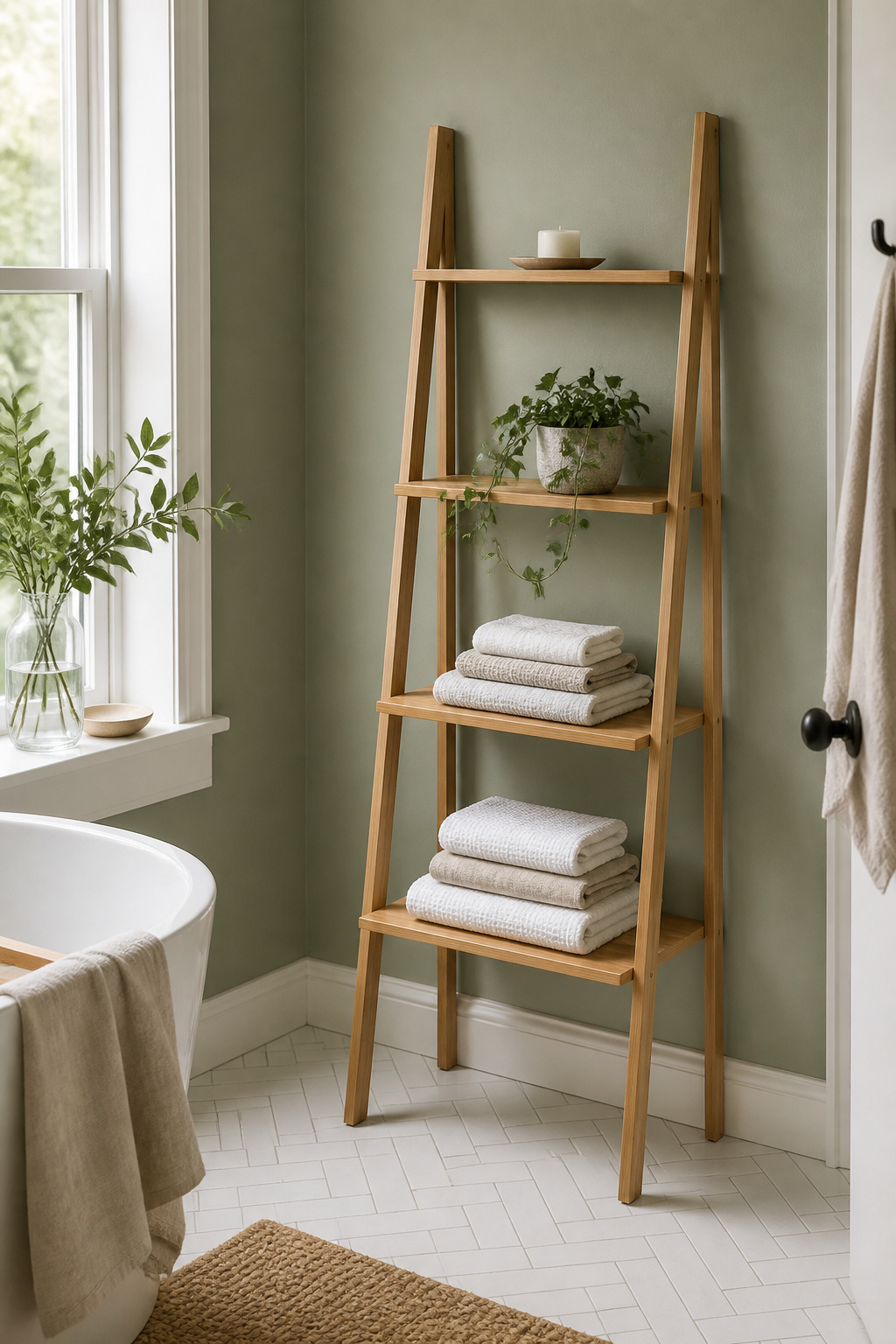
Bamboo is technically a grass rather than a hardwood, and its internal silica content makes it naturally resistant to moisture and mildew at the surface level — significantly more stable in a bathroom environment than untreated pine or MDF. IKEA’s RÅGRUND is arguably the best-known example: 60cm wide, 190cm tall, five shelves, and manufactured from certified sustainable bamboo that regrows from its root system every four to six years. The open-slat shelf design also improves airflow, which means towels and fabrics stored on it dry faster than they would in a closed cabinet.
Standard bathroom ladder shelf dimensions run 60–65″ tall, 18–22″ wide at the base, narrowing to 12–14″ at the top. Four or five shelves at 12–14″ spacing gives enough clearance for folded towels on the lower shelves and smaller items on the upper ones.
Styling is where most people go wrong. The Nordic principle to follow: leave at least 30% of each shelf empty. The negative space is what makes the shelf read as intentional rather than crammed. Group items in odd numbers — a tall plant, a medium candle, a small basket — and vary the heights across those three objects. One basket per shelf contains loose items; everything else should stand on its own. Refer to bathroom shelf decor principles worth following for a fuller guide to styling open shelves without losing the clean-line appeal.
The under-sink cabinet is the most consistently wasted space in most bathrooms. The P-trap and supply lines bisect it into two awkward zones. Items stack in front of the pipe and the back half becomes unreachable. Cleaning products end up mixed with skincare. Nothing is visible, so nothing gets used until it becomes an obstacle.
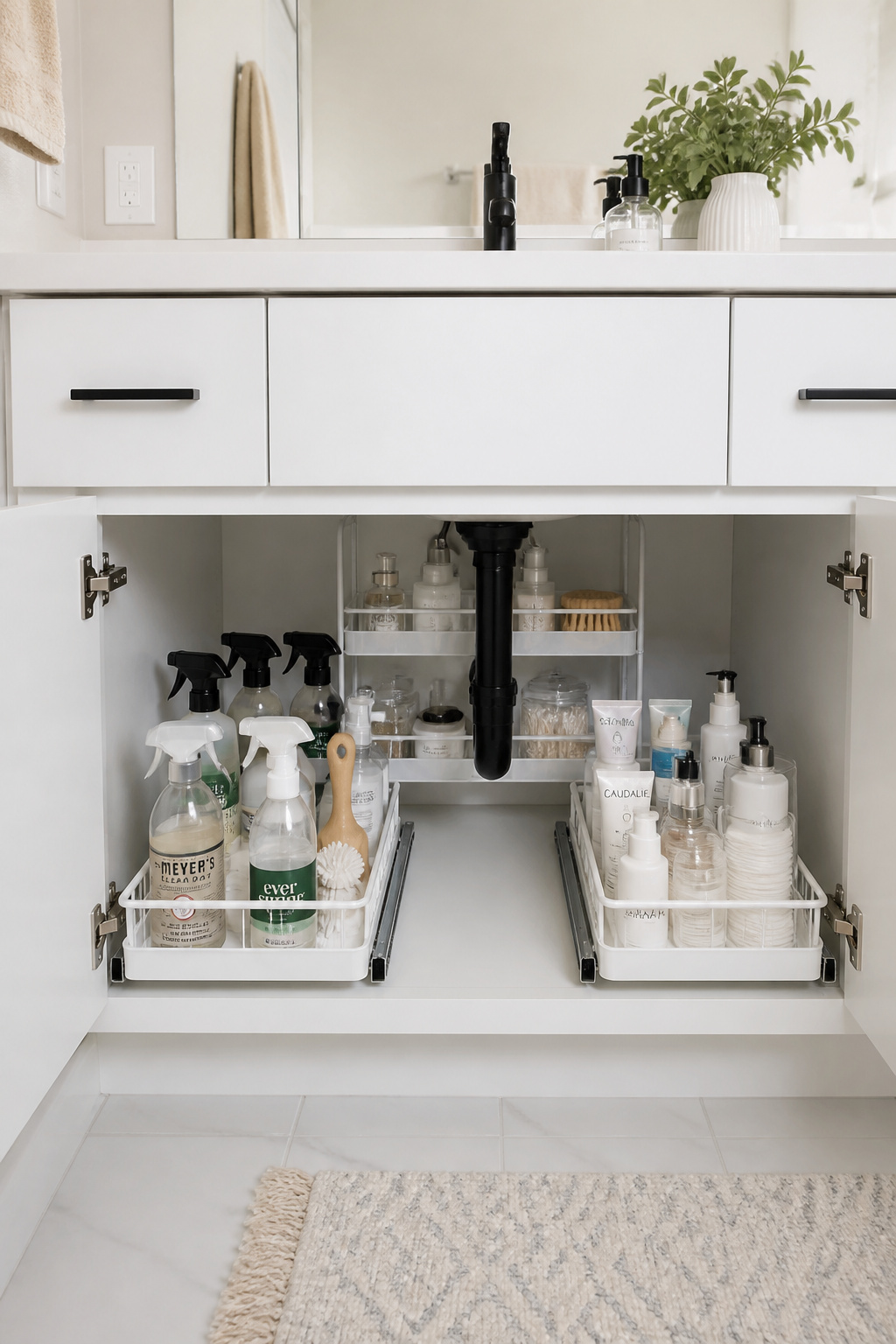
A pull-out organiser fixes this in a single afternoon. The sliding mechanism brings the back zone forward in one motion — the full depth of the cabinet becomes accessible without crouching and reaching. Expandable models that adjust from 11″ to 21″ wide accommodate different cabinet interiors and work around different pipe configurations. L-shaped pull-out bins are designed specifically for the P-trap scenario: one arm runs left of the pipe, one runs right, and the full width of the cabinet becomes usable. For anyone wanting small bathroom storage solutions that maximise every inch, under-sink is where the most dramatic improvement per pound spent usually happens.
Two-tier shelf risers are the simpler, lower-cost option: a second level sits above a riser platform, doubling the usable height for items of similar diameter. Door-mounted organisers on the inside of the cabinet door add a third zone — useful for cleaning products or a spare roll holder.
These bathroom storage ideas for the under-sink zone are the most consistently rewarding: the transformation takes a single afternoon and the improvement is immediately visible. The critical step before buying anything: measure. Note the P-trap diameter (usually 1.25″ or 1.5″), its horizontal distance from the back wall, and the clear height from the cabinet floor to the underside of the sink base. Some organisers have fixed cutouts that won’t clear specific pipe paths. Also leave deliberate access to the shut-off valves — a pull-out that blocks the valves is a future plumbing problem waiting to happen.
Magnetic strips are one of the simplest bathroom storage ideas in this list — no installation skill required — but the impact on the daily experience of the bathroom is disproportionate to their cost. A magnetic strip on the bathroom wall does something that no drawer or basket can: it takes the counter down to zero. Tweezers, nail scissors, bobby pin tins, nail clippers, metal eyelash curlers — all of them lift off the surface entirely, visible at a glance, reachable in a single motion.
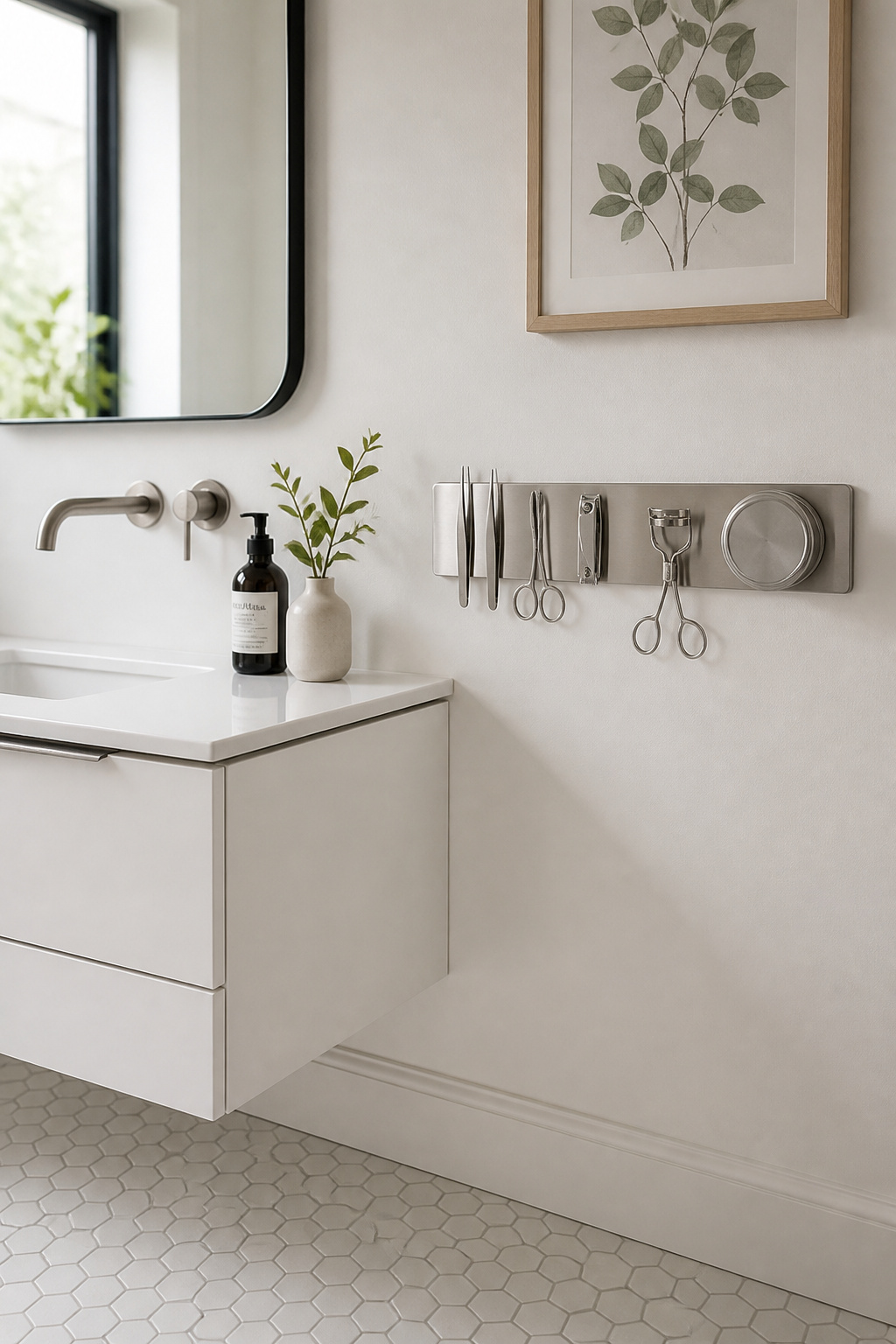
Stainless steel strips are the correct material for a bathroom. 304 stainless is fully corrosion-resistant in a humid environment and wipes clean in seconds. Wooden magnetic strips suit the aesthetic of a Scandinavian or heritage bathroom more naturally, but they must be sealed with a moisture-resistant finish — without it, the wood warps and the embedded magnet backing can delaminate within a year. A quality 12″ strip holds about 1–2 lbs distributed, which is more than enough for the tools in question.
Mount the strip beside the mirror rather than above it. Items held magnetically can occasionally slip free if bumped; positioning the strip to the side of the vanity, rather than over the sink, keeps anything that falls clear of the water. The standard height: eye level, alongside the mirror — the same reach as opening a drawer, without the step of opening anything.
One unexpectedly useful addition: a small metal tin with a lid — a repurposed Altoids tin works perfectly — holds bobby pins, hair grips, and small clips magnetically as a contained unit. The entire tin lifts off, travels to wherever you’re getting ready, and returns to the strip. It’s one of those solutions that costs nothing and works indefinitely.
Of all the bathroom storage ideas that involve wall mounting, pegboard is the most adaptable. Fixed shelving commits you to one configuration. Pegboard doesn’t. Every hook, bin, and shelf position is reconfigurable without tools in under 15 minutes — which means the system adapts as the bathroom’s contents change, rather than the other way around.
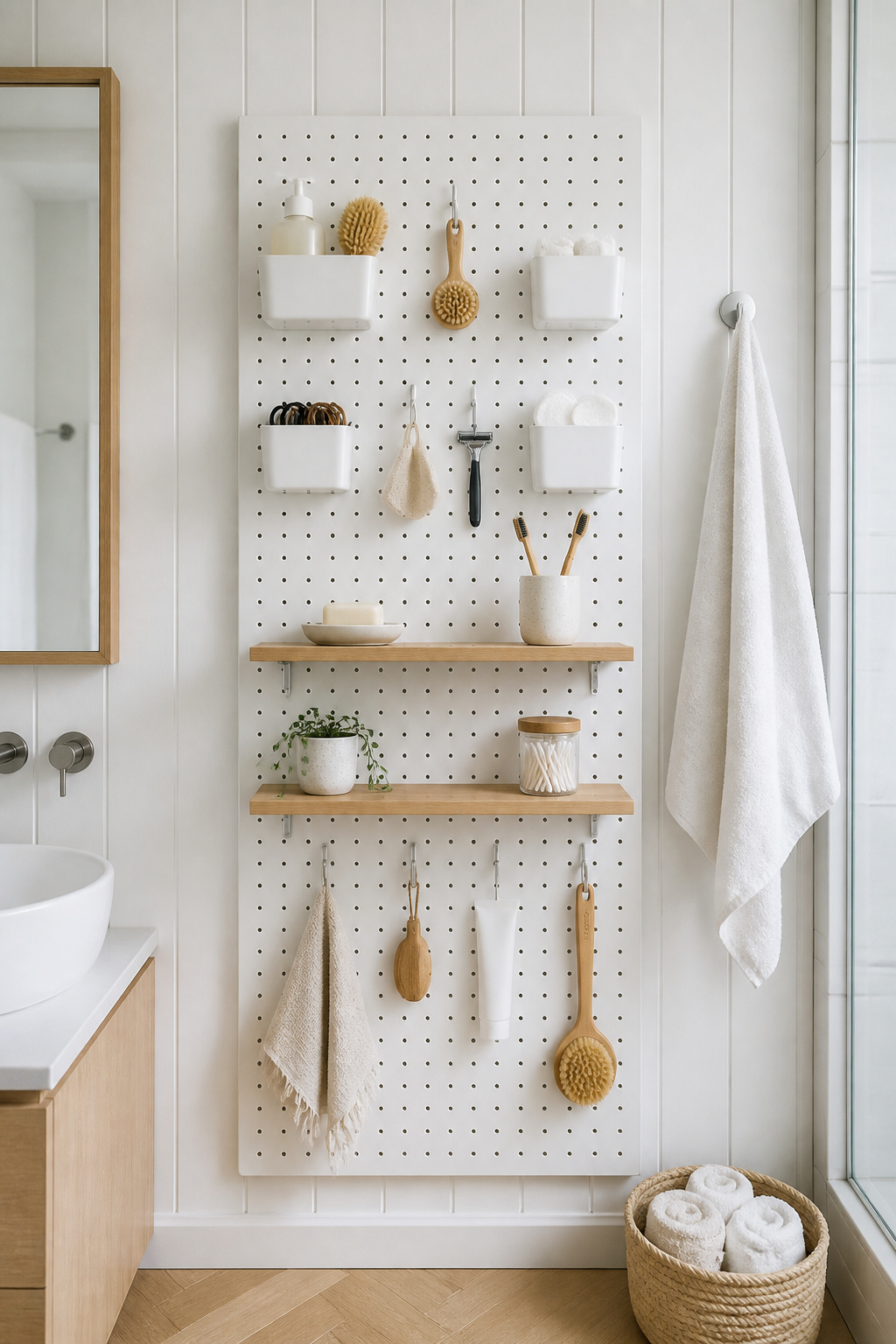
This makes pegboard particularly effective in a family bathroom where the stored items evolve year on year. The same wall that held baby bath products in year one holds a teenager’s hair tools and skincare range in year eight. No redrilling required. A single 24″×24″ panel can support approximately 12–16 small hooks, four to six bins, and two to three small shelves simultaneously — significant capacity from a relatively modest wall section.
Material selection is critical in a bathroom. Standard MDF pegboard is unsuitable: it absorbs moisture, swells, and the holes distort over time until hooks no longer grip. Moisture-resistant (MR) MDF is an improvement — it handles humidity and occasional surface contact in a well-ventilated bathroom — but PVC or plastic pegboard is the safest choice. It’s fully moisture-proof, lightweight, and wipes clean without swelling. Each hook holds approximately 5–10 lbs depending on the quality of the wall anchor behind it.
Install on furring strips — 1″×2″ timber set 16″ apart — to create a 3/4″ air gap behind the board. That gap is essential for two reasons: it allows hook insertion into the back of the holes, and it improves air circulation behind the board. Anchor the furring strips into wall studs. Drywall alone won’t hold the loaded weight reliably. Start the heaviest items at the bottom (close to the stud anchors) and work lighter items upward.
Glass shelves represent a distinct category of bathroom storage ideas: solutions that solve a practical problem while actively improving how the room looks. Solid shelves in a small bathroom create a visual problem: each shelf casts a shadow zone beneath it, and stacked solid shelves progressively darken and compress the space. Glass shelves don’t. Light passes through them, the wall remains visible behind the items displayed, and the bathroom reads as airier than it actually is.
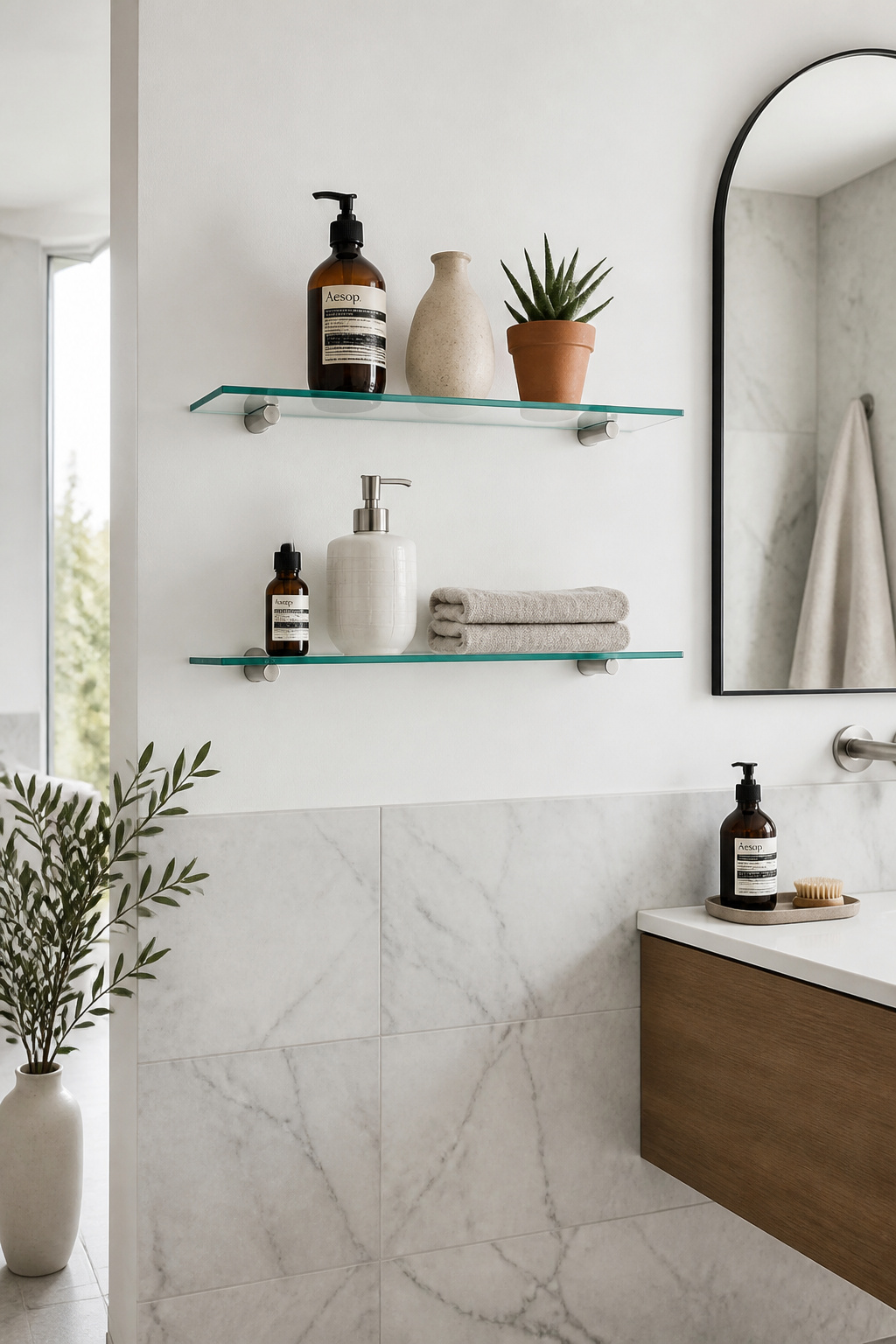
For bathroom use, 8mm tempered glass is the recommended starting point — it handles a standard load of toiletries and fragrance bottles across a 24″ span without flexing. A 10mm shelf is needed for longer spans (30–36″) or heavier loads; a 24″ shelf of 10mm tempered glass can safely carry up to 200 lbs distributed. At the lower end, 6mm glass suits small display shelves holding a candle, a soap dish, or a few small bottles — nothing heavier. The critical specification regardless of thickness: always tempered (safety) glass, never annealed. If a bottle falls and the shelf breaks, tempered glass crumbles rather than fracturing into dangerous shards.
For anyone building up the open-shelf aesthetic, bathroom shelf decor that earns its place offers a deeper look at styling principles that translate well to glass shelves.
Bracket choice is where the visual character is decided. Floating pin brackets — stainless steel pins projecting from the wall with polished channels on the glass underside — produce the most minimal result: the shelf appears to hover. L-brackets in brushed nickel or matte black are the most structurally capable option and suit a broader range of bathroom styles. Avoid chrome-plated brass brackets in a steam-heavy bathroom: they pit and discolour within two to three years in high-humidity conditions. Anodised aluminium or stainless steel brackets only.
A narrow linen tower occupies just 12–16″ of wall width but stands 67–72″ tall — a vertical footprint that delivers storage equivalent to a full chest of drawers from a space narrower than a dining chair. Positioned between two sink stations, it also defines each person’s side, which solves the bathroom’s most common interpersonal problem: counter sprawl.
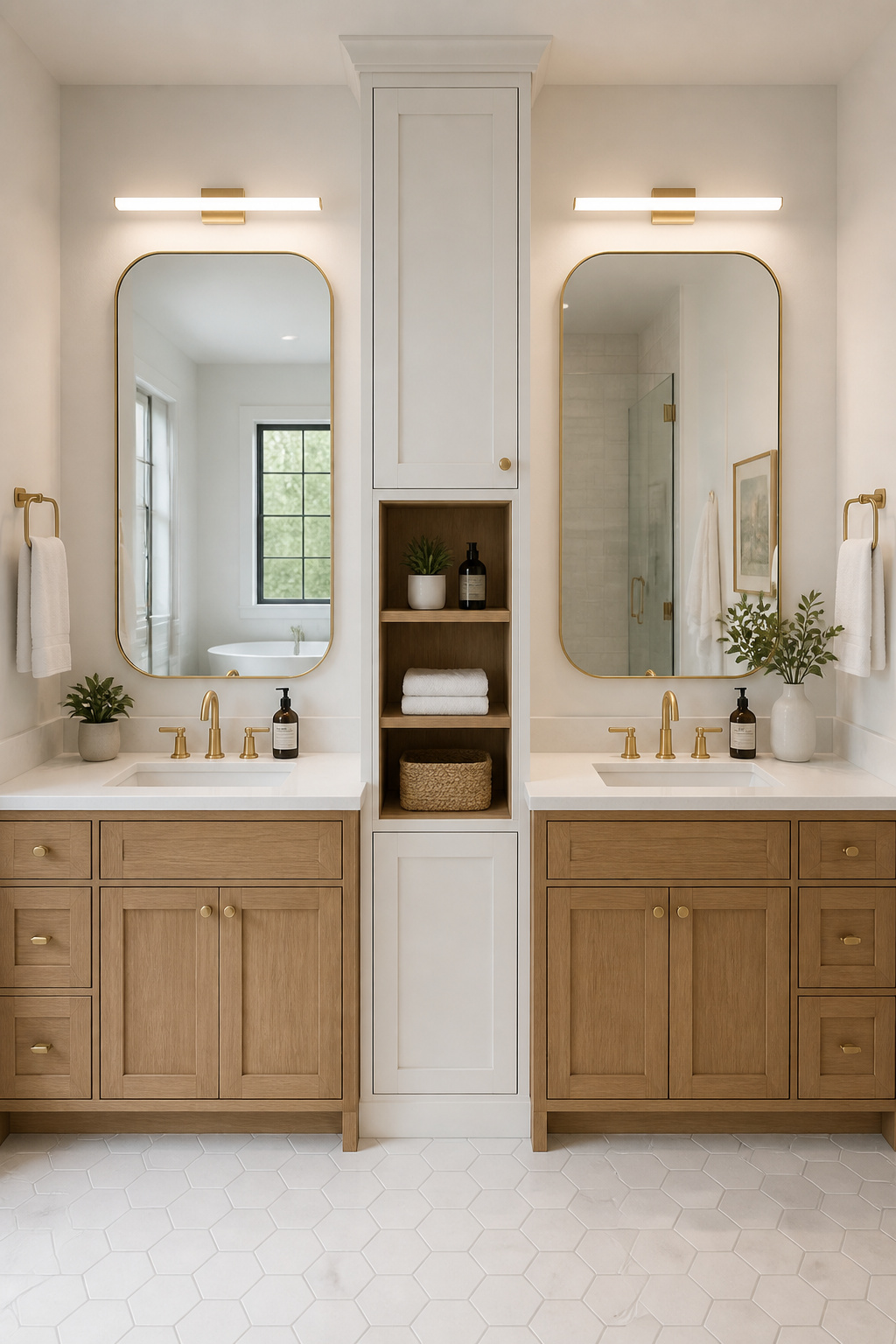
A 16″w × 12″d × 67″h tower — the Costway model at Home Depot is a well-priced reference point — provides four to five adjustable shelves plus a bottom drawer. Plenty of room for six to eight bath towels and toiletries for two people. The closed upper cabinet keeps everyday products hidden; the drawer at the bottom handles frequently accessed items that don’t belong on the counter.
Depth is the measurement most people miss. A standard 21″-deep vanity creates an expectation of matching depth, but a linen tower deeper than 14″ juts out past the vanity edge and looks odd. More significantly, a tower that’s deeper than the vanity on both sides of it catches towels and clothing on its corners. Match depth carefully, or choose a model slightly shallower than the vanity for clean alignment.
Finish matching deserves more attention than it usually gets. Order from the same manufacturer as your vanity where possible — even “white” varies substantially across brands. Wyndham Collection, IKEA GODMORGON, and James Martin all offer coordinating linen towers in their respective finishes. A freestanding model suits renters and anyone not ready to commit; a built-in, framed, and painted version adds perceived value to the home and removes the flexibility of the freestanding option. For more approaches that work in tighter rooms, small bathroom storage that makes use of every inch covers complementary solutions.
A standard 18″ cabinet door needs an 18″ swing arc to open fully. In a bathroom corridor that’s 36″ wide, that’s half the walkway gone every time you need to access the cabinet. A sliding barn door eliminates that problem entirely. It travels parallel to the wall, needs no swing clearance, and opens fully while remaining flush against the adjacent surface.
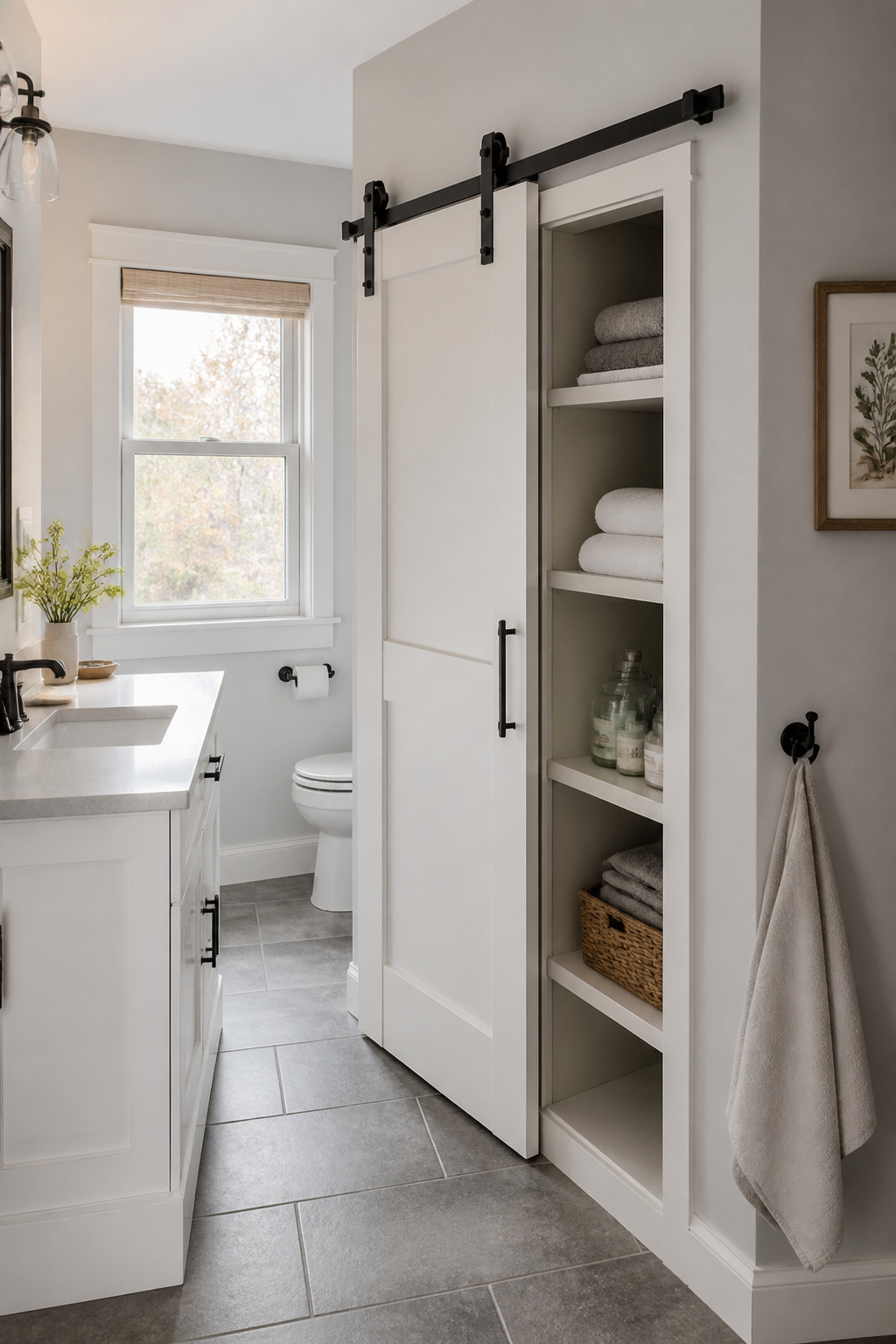
This is one of those bathroom storage ideas that solves two problems — swing clearance and cabinet access — while introducing a hardware detail that elevates the room. The visual side is also worth considering. Barn door hardware — matte black, brushed nickel, or antique brass — adds a design detail to what would otherwise be a plain flat-panel cabinet front. It works in industrial, Scandinavian, and heritage bathrooms without forcing a style choice. The hardware itself becomes a feature.
Installation on tile walls requires tile anchors — split-drive or sleeve anchors with a tile-rated drill bit — unless the studs can be located behind the tile and screwed through directly. Track length should be twice the door width plus 2–3″ for end stops: a 16″ door needs a 36″ track. Before ordering, map the wall carefully. A barn door that slides open onto a towel bar — or can’t stay open because the bar blocks it — is a planning failure that’s expensive to undo.
Soft-close hardware is worth the additional cost. The pneumatic mechanism slows the door in the last 4″ of travel, preventing the sudden impact that damages both the door edge and the stop block over time. In a household with children, it also prevents the cabinet slamming as a source of early morning noise.
Cabinet depth: 12–14″ is the practical sweet spot. Deeper than 16″ in a small bathroom starts to intrude on the walkable floor area without proportionally increasing storage capacity.
The back of the bathroom door is consistent, accessible, and almost universally bare. A standard door is 28–32″ wide — enough for a four-column, eight-row pocket organiser holding 32 individual items — and it opens to 60–70″ of vertical height. That’s a meaningful amount of storage added without touching a single shelf, drilling a single hole, or spending more than about £25.
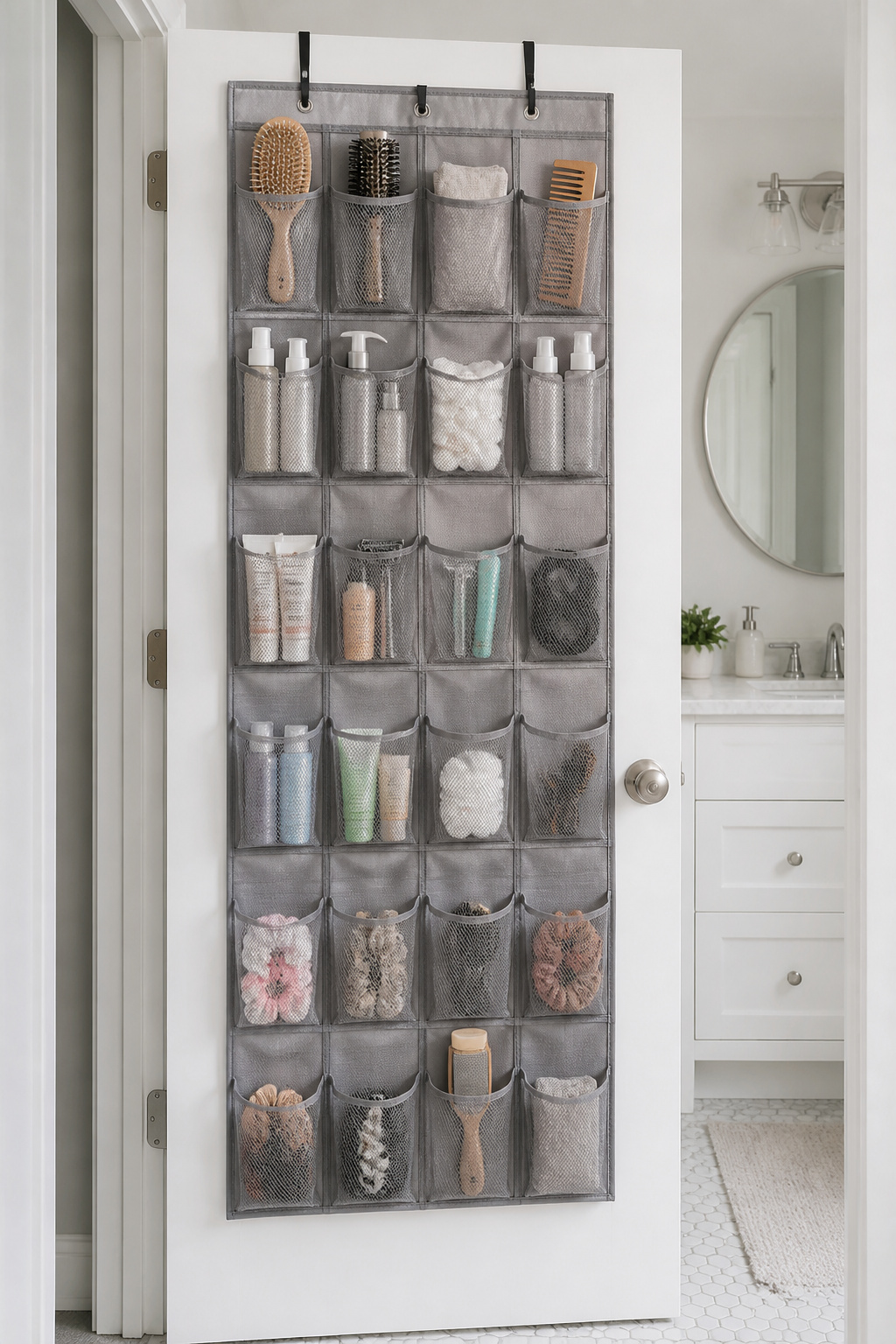
In a shared bathroom used by two or three people, colour-coded organiser columns let each person claim their zone. It’s a practical solution for the counter chaos that happens when multiple people are getting ready in the same space, and it works especially well in a children’s bathroom where accessibility matters more than aesthetics. In a shared family bathroom, this approach to tight-space organisation makes a real difference.
Material choice determines whether the organiser survives the bathroom environment. Polyester or nylon mesh is the right call: it allows air to circulate, so damp items dry faster, and it resists steam and humidity without deteriorating. Canvas cotton organiser pockets absorb moisture and can develop mildew spots in a humid bathroom within a few months — not worth the risk even if the canvas version looks slightly better on a hook. Plastic pockets are fully waterproof but inflexible; they crack and warp over time from the thermal cycling of a bathroom.
Keep total load under 10–12 lbs. Over-door hook pressure causes paint chipping and wood compression over time. Check door clearance as well: over-door hooks add 0.5–1″ to the door’s closed profile, and some bathroom doors already have minimal clearance between the door edge and the adjacent wall when open. Rubber-padded hooks protect painted and varnished door surfaces from marking.
A vintage dresser converted into a bathroom vanity produces something no showroom can supply: a piece with genuine history, imperfection, and a scale of storage that standard vanity units rarely match. A typical 48–60″ wide antique dresser with four to six drawers offers significantly more capacity than most flat-pack vanities in the same footprint — and it becomes the defining feature of the bathroom rather than furniture that blends into it.
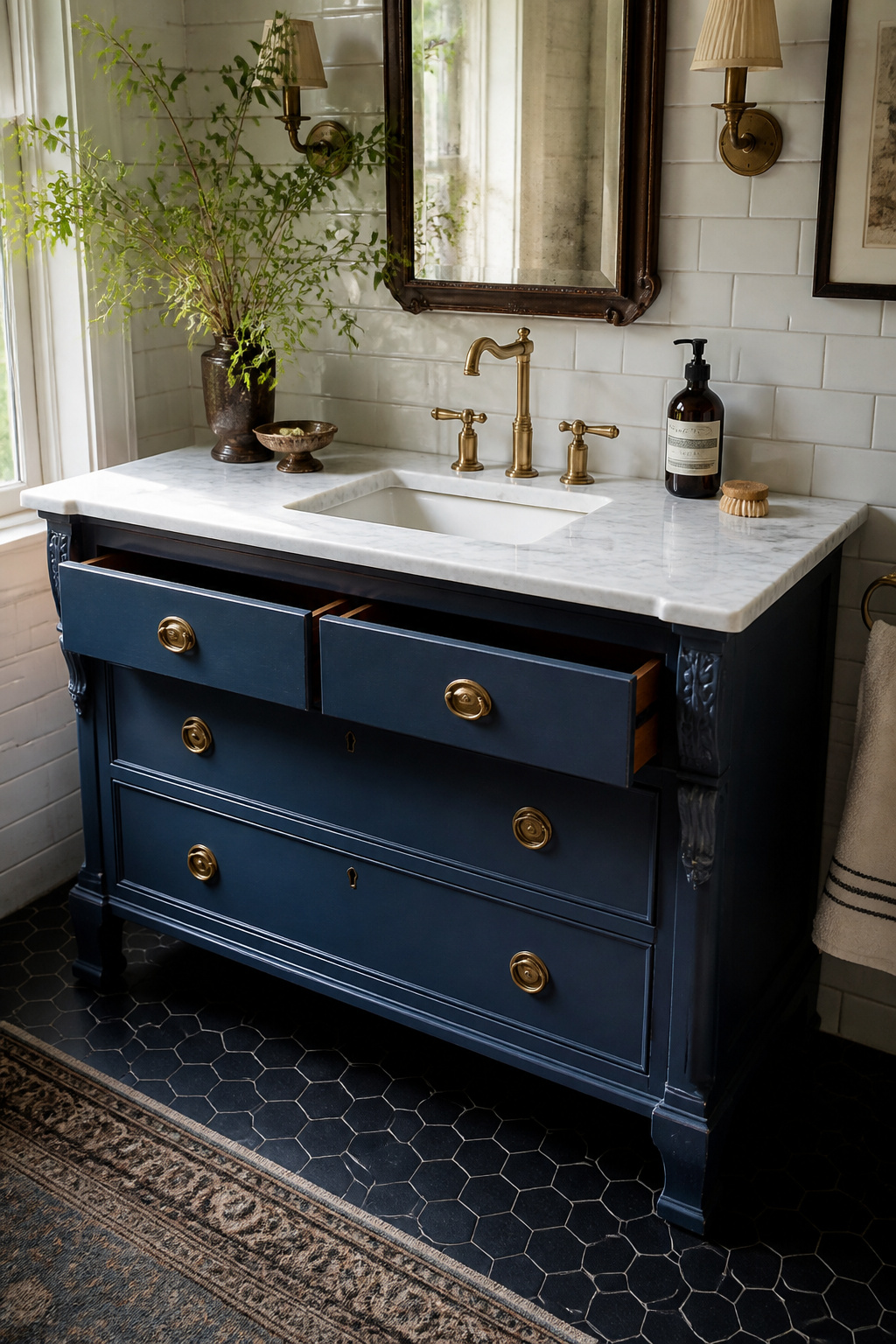
The conversion is less technically demanding than it looks. The top two drawers are removed to create clearance for the drain assembly and supply lines; the remaining lower drawers retain full function. A hole saw, sized to the sink basin, cuts the top from above. Undermount sinks require the top surface to be bonded with adhesive; drop-in basins rest in the opening without bonding. The aesthetic conversion — stripping, painting, and hardware replacement — is entirely DIY territory.
Waterproofing is where material selection has long-term consequences. Marine-grade varnish (Epifanes, Deks Olje D1) applied in three to five coats, sanded lightly between each, penetrates the wood fibres and cures to a durable water-resistant surface. It preserves the natural grain — appropriate for a vintage piece. Epoxy resin creates a 1/8″ thick, glass-like, fully waterproof surface; it’s highly protective but modern-looking, which can clash with an antique dresser’s character. A honed stone or marble top is the most durable option and looks most authentic — the combination of antique timber and natural stone is genuinely striking. For a fuller picture of bathroom vanity design considerations worth knowing first, that guide covers the technical side in more depth.
Choose solid wood — oak, mahogany, walnut — rather than veneer over chipboard. Chipboard delaminates in a humid room within a year or two regardless of how well the top is sealed. The plumbing connection should always involve a licensed plumber; the rough-in must comply with local building codes.
Among the bathroom storage ideas here, the window seat is the most ambitious and the most rewarding in a room with the space for it. In a larger bathroom — a master bathroom or a family bathroom with a generous floor plan — the window wall often presents an opportunity that goes unrealised. The floor space below the window sill, typically at 36–40″ from the floor, is usually occupied by a radiator and nothing else. A built-in bench with a lift-top lid converts it into concealed storage while adding a practical surface for sitting while dressing.
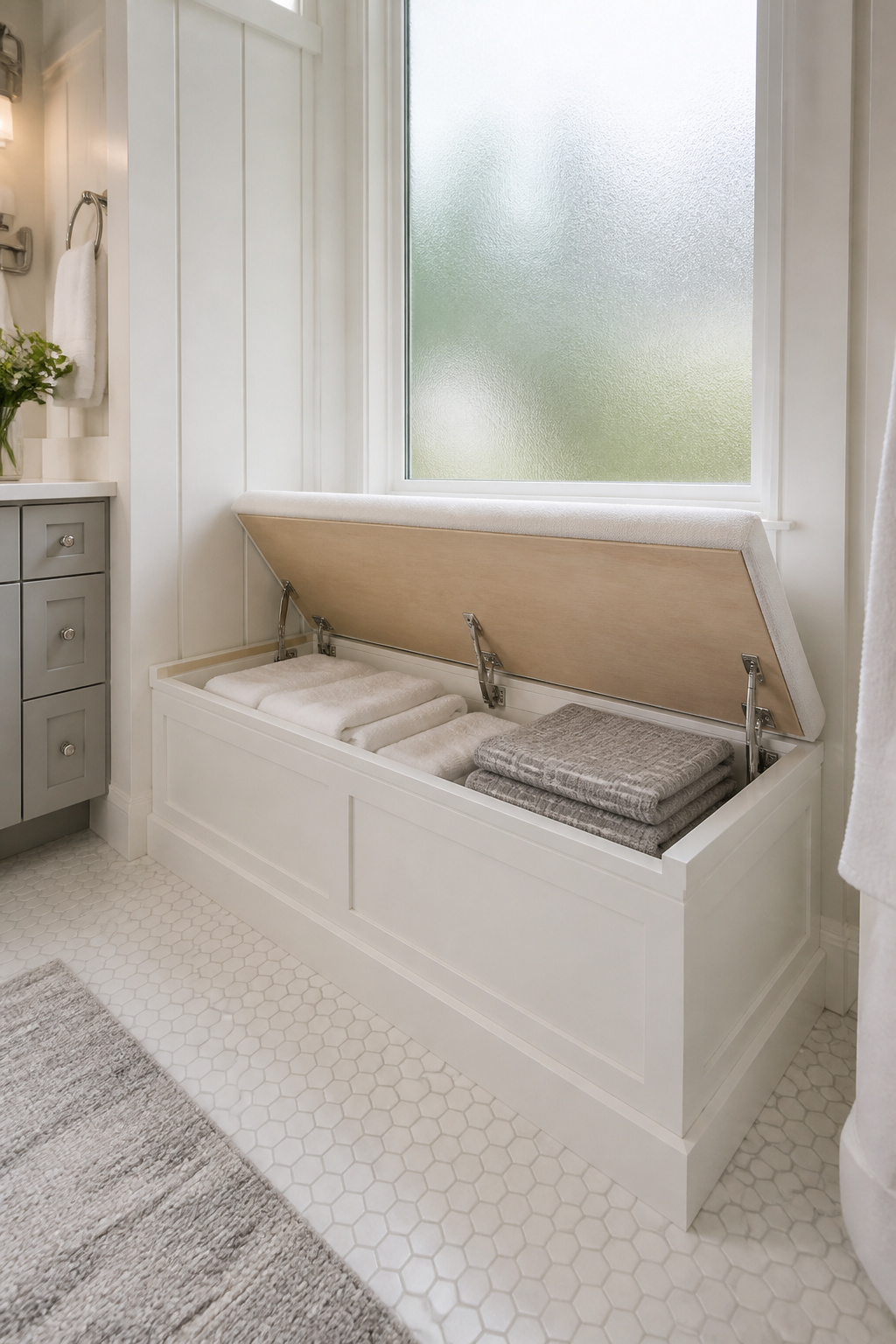
Standard dimensions: bench width matches the window opening (typically 36–48″), depth is 18″, height is 17–19″ — the same as standard seating height. The internal storage volume of a 48″ wide bench runs approximately 2–3 cubic feet: room for spare bath towels, an extra bathmat, seasonal items, and cleaning supplies. A small bathroom doesn’t have space for this; a well-proportioned master bathroom does.
Material selection is critical because a bathroom bench faces sustained humidity, cleaning products, and daily contact. Marine-grade plywood is the correct substrate: it uses phenolic resin adhesive between plies, which resists delamination and fungal growth under wet conditions. Standard moisture-resistant (MR) plywood performs adequately in a well-ventilated space but degrades faster under sustained humidity — delamination at the base edge is typically visible within two to three years. PVC trim on the exterior face and top edge is fully waterproof, paintable, and dimensionally stable; it eliminates the swelling risk where the bench meets the tile floor.
For the lid hinge, a piano hinge running the full width distributes force evenly and is the most stable option. Lid stay supports — not hinges — hold the lid open so nobody needs to prop it. Soft-close pneumatic lid stays slow the last 4″ of closure, preventing slamming. If children will use the bathroom, the lid stays aren’t optional: a heavy lid falling on small fingers is a real hazard.
Good storage doesn’t require doing everything at once. The Nordic approach is to identify the single biggest source of daily friction and address that first.
Start by counting your actual pain points. Too much on the counter means there’s nowhere else for the daily-use items to go — a medicine cabinet, a magnetic strip, or a ladder shelf usually solves this. Can’t reach the back of the under-sink cabinet — that’s a pull-out organiser job. Towels with nowhere permanent to go — a linen tower or an over-toilet shelf. Each problem has a fairly specific solution.
Measure before buying anything. The gap above the toilet, the clear width between sinks, the depth under the vanity from front to P-trap, the clearance behind the door when fully open. These numbers determine what actually fits. A well-chosen 12″ pegboard panel in the right location beats a 48″ custom shelving run in the wrong one.
The cheapest effective bathroom storage ideas — a pegboard, an under-sink organiser, an over-door mesh pocket, a bamboo ladder shelf — all come in under £60 and are fully reversible. The highest-impact permanent upgrades — a recessed shower niche or a mirrored medicine cabinet — are invisible once installed and add genuine value to the home. Save the vintage dresser conversion and the window seat for a planned renovation phase. They deserve proper materials and preparation. But the ladder shelf and the under-sink organiser can happen this weekend. Start there. Every bathroom storage idea on this list exists because a real problem needed a practical, considered solution — and that’s the only standard worth applying.