Physical Address
304 North Cardinal St.
Dorchester Center, MA 02124
Physical Address
304 North Cardinal St.
Dorchester Center, MA 02124
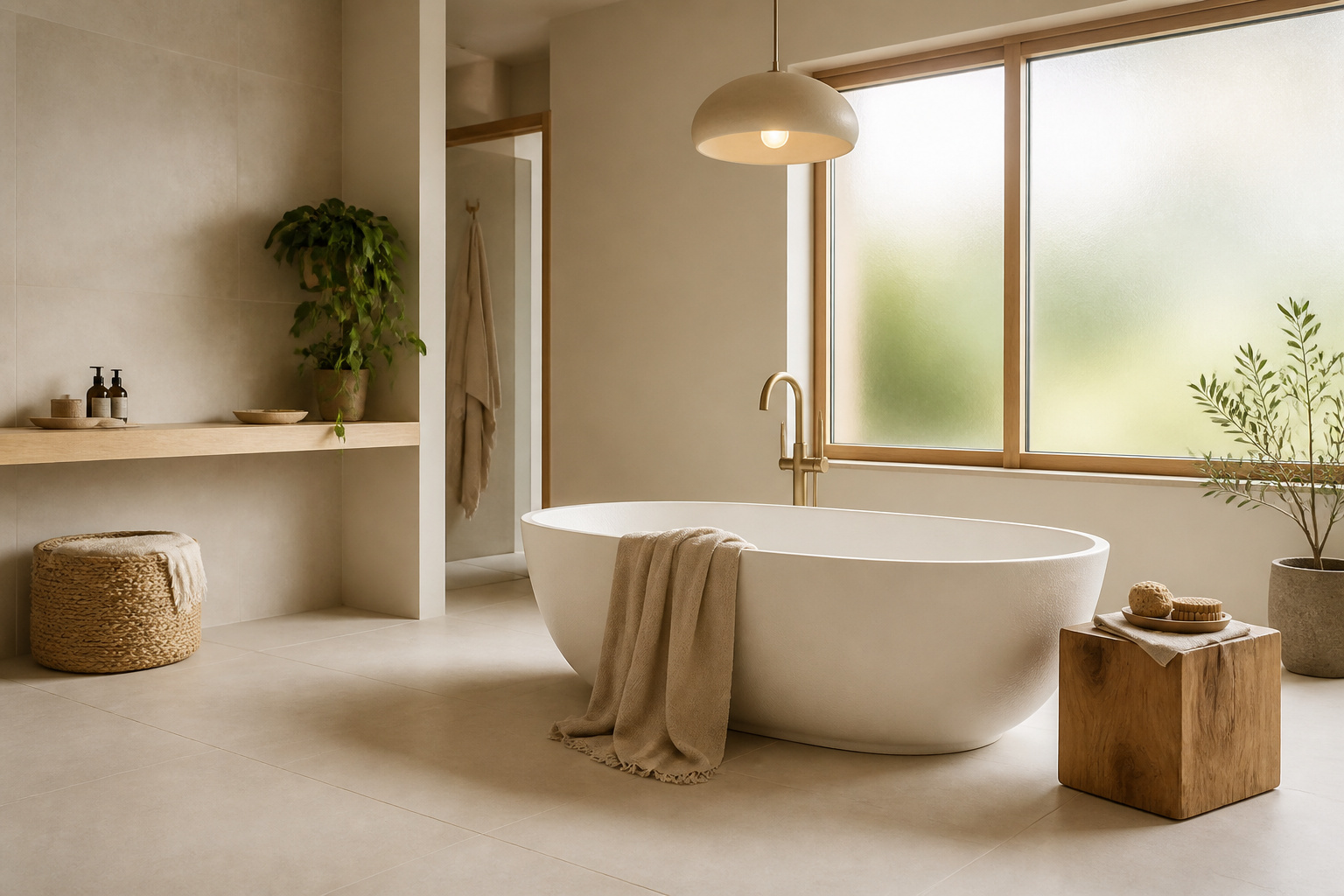
16 bathroom design ideas from Nordic design — natural materials, warm lighting, smart storage, and the details that make a bathroom feel genuinely considered.
Most bathrooms get designed by default rather than by decision — a builder-grade vanity, a single overhead light, white subway tile because it’s safe. The result is a room that works but doesn’t welcome you. These bathroom design ideas draw from the Scandinavian tradition, which has long treated the bathroom as more than functional: it’s where the day begins and ends, and it deserves the same considered thought as any other room. Some of the bathroom design ideas here require a full renovation. Others are changes you can make over a weekend. All of them are worth knowing.
The most common mistake in bathroom material choices is treating every surface as something that needs to be waterproof and wipeable, full stop. Wood says otherwise. Used in the right places, with the right species, it brings warmth that no tile or laminate can replicate — and it’s one of the bathroom design ideas that transforms how a room feels without changing its structure.
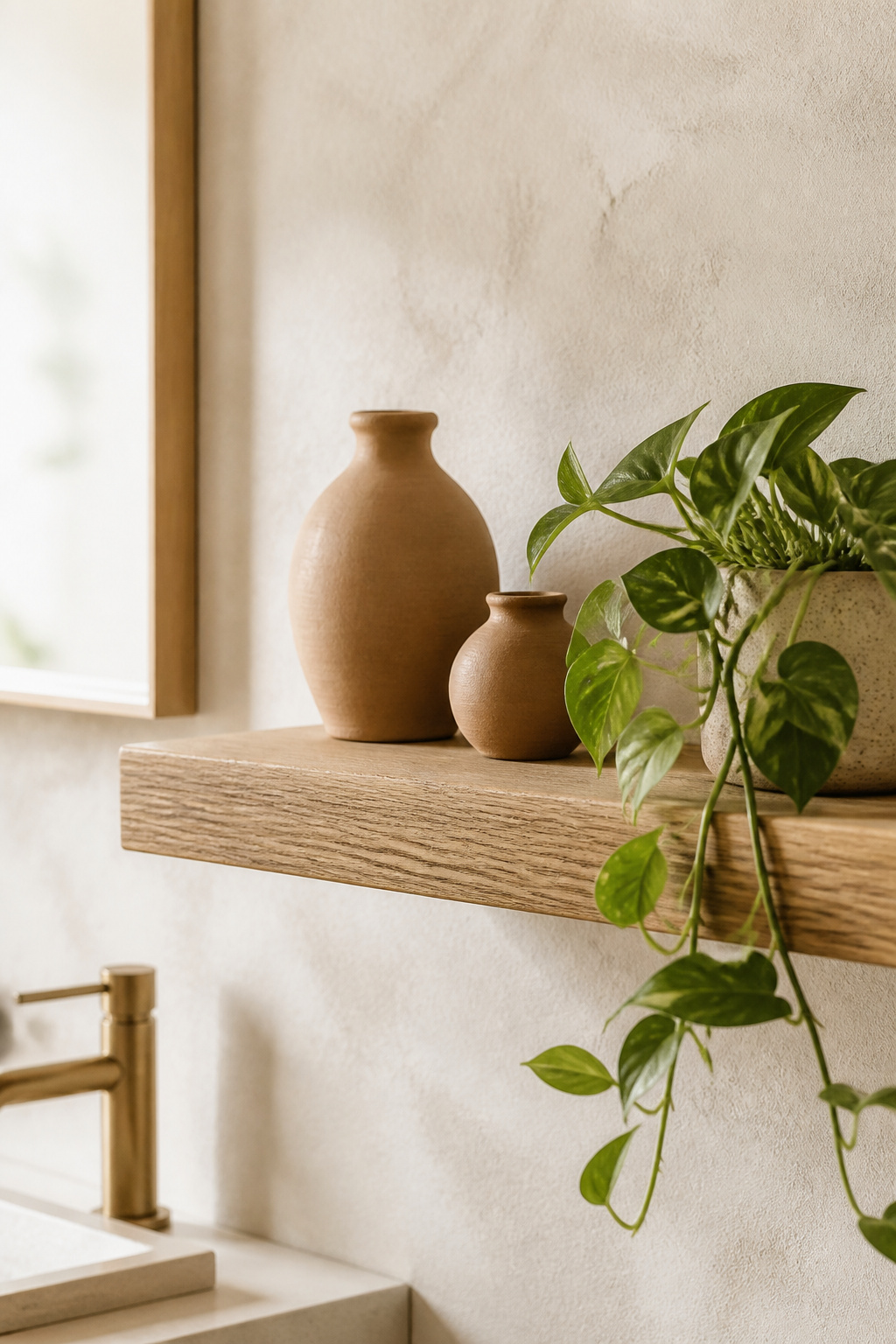
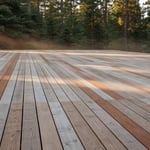
Teak and white oak are the practical choices. Teak’s internal silica content and natural oils have made it the standard for marine use for centuries — the same properties that keep a teak boat deck intact also work in a bathroom. White oak has a cellular structure (tyloses) that physically blocks water absorption at the wood’s surface. Both species have low dimensional movement in response to humidity changes, meaning less cracking and warping over time. Red oak, pine, and maple are attractive but porous — without very heavy applied finishes, they deteriorate in sustained bathroom humidity.
The best applications are vanity cabinet fronts, floating shelves beside the mirror or above the toilet, bath trays laid across a freestanding tub, and slatted teak bath mats. For finishing: polyurethane is the most durable applied film for high-contact surfaces; teak oil for natural-look applications you’re prepared to reapply every 6-12 months. Seal every face of any wood component before installation — unsealed backs and undersides absorb moisture from below and cause delamination far sooner than the visible surface.
Factory-grade catalyzed lacquers (the finish on many production vanities) cure chemically to form a harder film than brush-applied coatings. When comparing vanities, ask what finish has been applied before assuming two products in the same wood species will perform the same.
A freestanding tub is the piece of furniture in a bathroom. It does architecturally what a sofa does in a living room — it anchors the room and gives it a centre of gravity. A built-in tub against a tiled surround can be perfectly good. It won’t hold a room the same way.
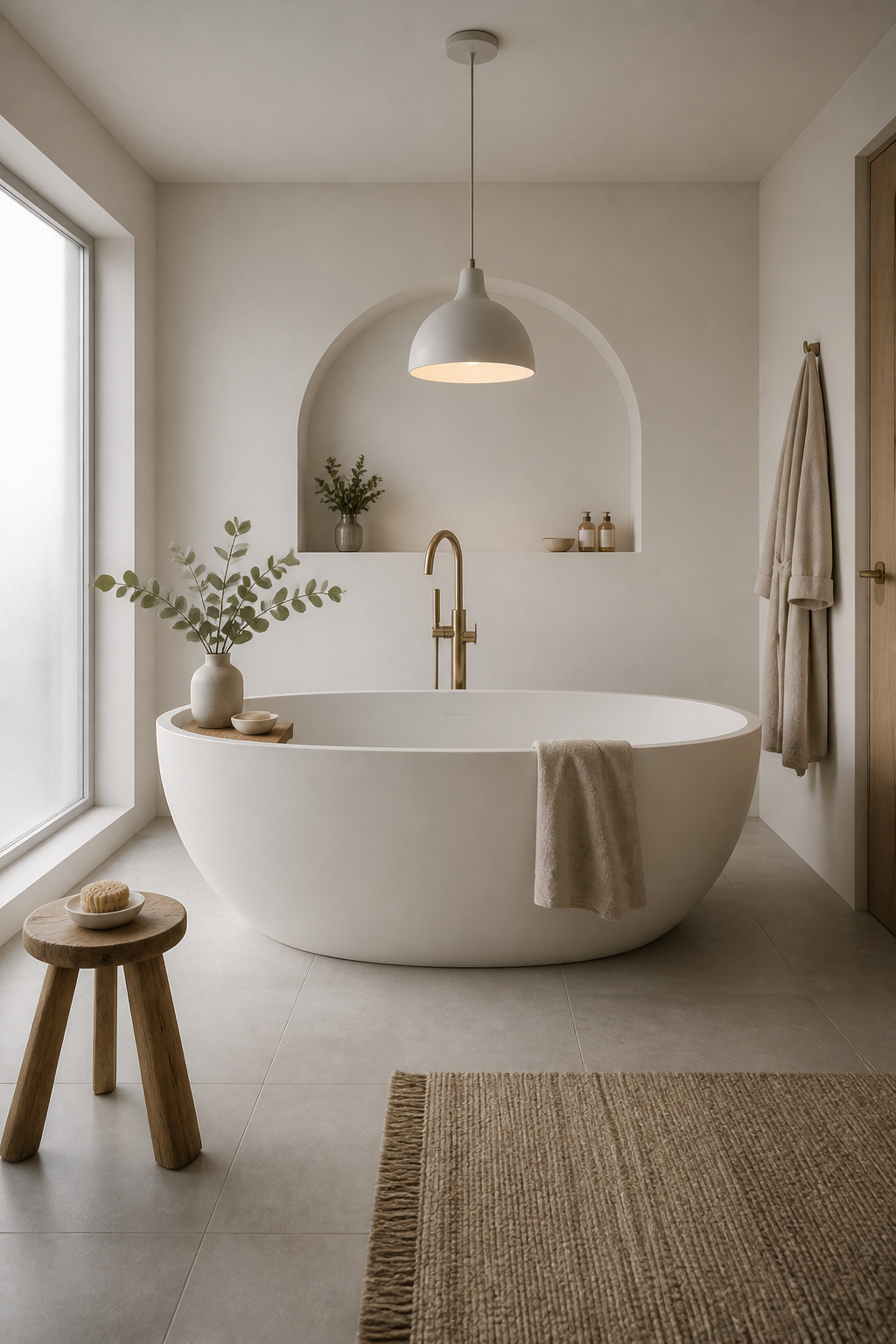
The Nordic approach is to pull the tub away from the wall. Even 18-24 inches of breathing space on the sides changes the read from utilitarian to intentional. Centre-room placement under a skylight or positioned opposite a window is ideal. The tub needs to be seen from all sides to work as a focal object.
On sizing: the average freestanding tub runs 67 inches long, 32 inches wide. Compact models start at 59 x 29 inches. Allow at least 18 inches of clearance on both long sides for comfortable access. For material choices, bathtub ideas for your bathroom covers the full range in detail, but the short version is this: cast iron holds heat longest but typically weighs 250-400 lbs, requiring a structural floor check. Stone resin is 150-300 lbs, retains heat significantly better than acrylic, and has a matte surface quality that reads as premium. Acrylic is the lightest (60-100 lbs) and most affordable, with the widest shape range, but loses heat faster.
For a Nordic aesthetic, stone resin in white or concrete grey fits the palette most naturally. This is a bathroom design idea where the material choice matters as much as the shape — the tactile quality of stone resin against bare feet is part of the experience.
The eye reads continuity. A floor covered in 4-inch mosaic tiles presents dozens of visual interruptions per square foot; a floor in 24-inch porcelain panels presents almost none. In a small bathroom, that difference in perceived space is significant — large-format tiles are one of the most cost-effective bathroom design ideas for making a compact room feel more generous without physically expanding it.
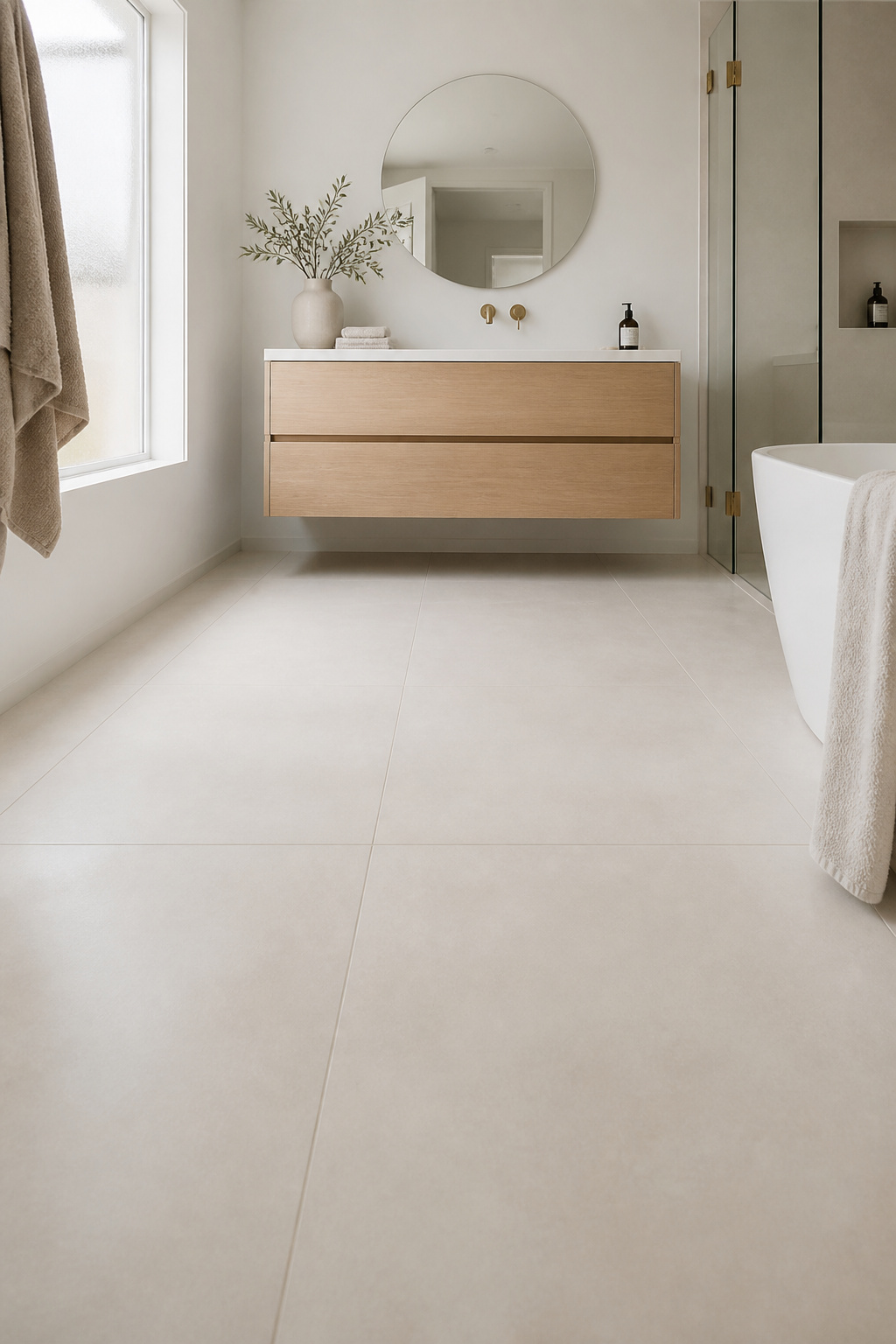
The effect works because the brain processes the continuous surface as a single plane rather than a grid. When grout colour matches the tile closely, the floor reads as nearly seamless. On grout joint width: rectified tiles can work with 1/16-inch joints; non-rectified tiles need at least 3/16 inch. For high-moisture bathroom floors, 1/8-inch joints are the general recommendation. Check the slip resistance specification before purchasing — wet bathroom floors require a minimum COF of 0.6 per ANSI standards. Most matte-finish porcelain meets this threshold; polished finishes often don’t.
If heated floors are part of the plan, tile and natural stone are the ideal materials — they conduct and retain heat efficiently, and most electric mat systems are designed specifically for tile installation. The combination of large-format heated tile is one of the bathroom design ideas that delivers the most noticeable day-to-day impact in cold-climate homes.
Scandinavian storage philosophy is essentially this: if something needs to be stored, it should look like it belongs on display. Closed cabinetry hides everything, which is fine, but it also adds visual weight to walls. Open shelving with considered containers does both jobs at once — it’s a bathroom design idea that creates calm rather than concealing chaos.
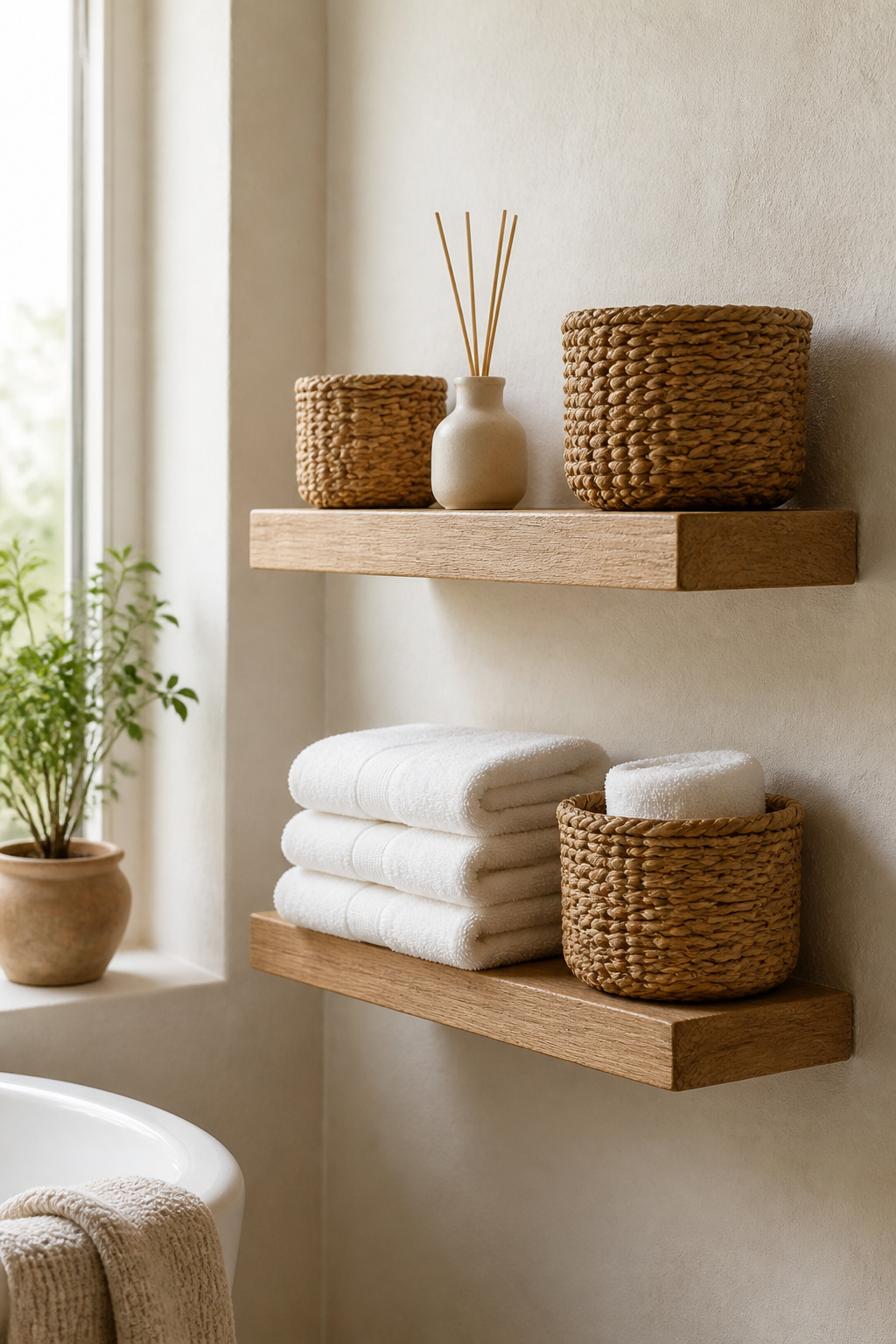
The material choices matter more than the shelf design itself. Seagrass and rattan handle bathroom humidity well — both are naturally resistant to moderate moisture exposure in a way that cotton or jute are not. Wooden trays on open shelves create a defined base for bottles and soap that contains drips and prevents moisture rings. For bathroom storage ideas that actually work, the principle holds across formats: match the container material to the environment.
The practical rules for keeping open shelves looking curated: leave 20-30% of each shelf empty — negative space is an active design element, not wasted area. Decant daily-use products into matching glass or ceramic vessels. Group items in odd numbers with height variation. One caveat: open shelving works in a bathroom if you’re genuinely willing to maintain the edit. It surfaces clutter as readily as it surfaces calm.
Chrome reflects everything around it. In a bathroom with variable light and tile patterns, that can feel busy. Matte black absorbs light rather than throwing it back — it has a quieter presence, a more considered quality. Against warm white or off-white walls, it creates a precise graphic contrast that reads as finished without competing with natural materials elsewhere in the room.
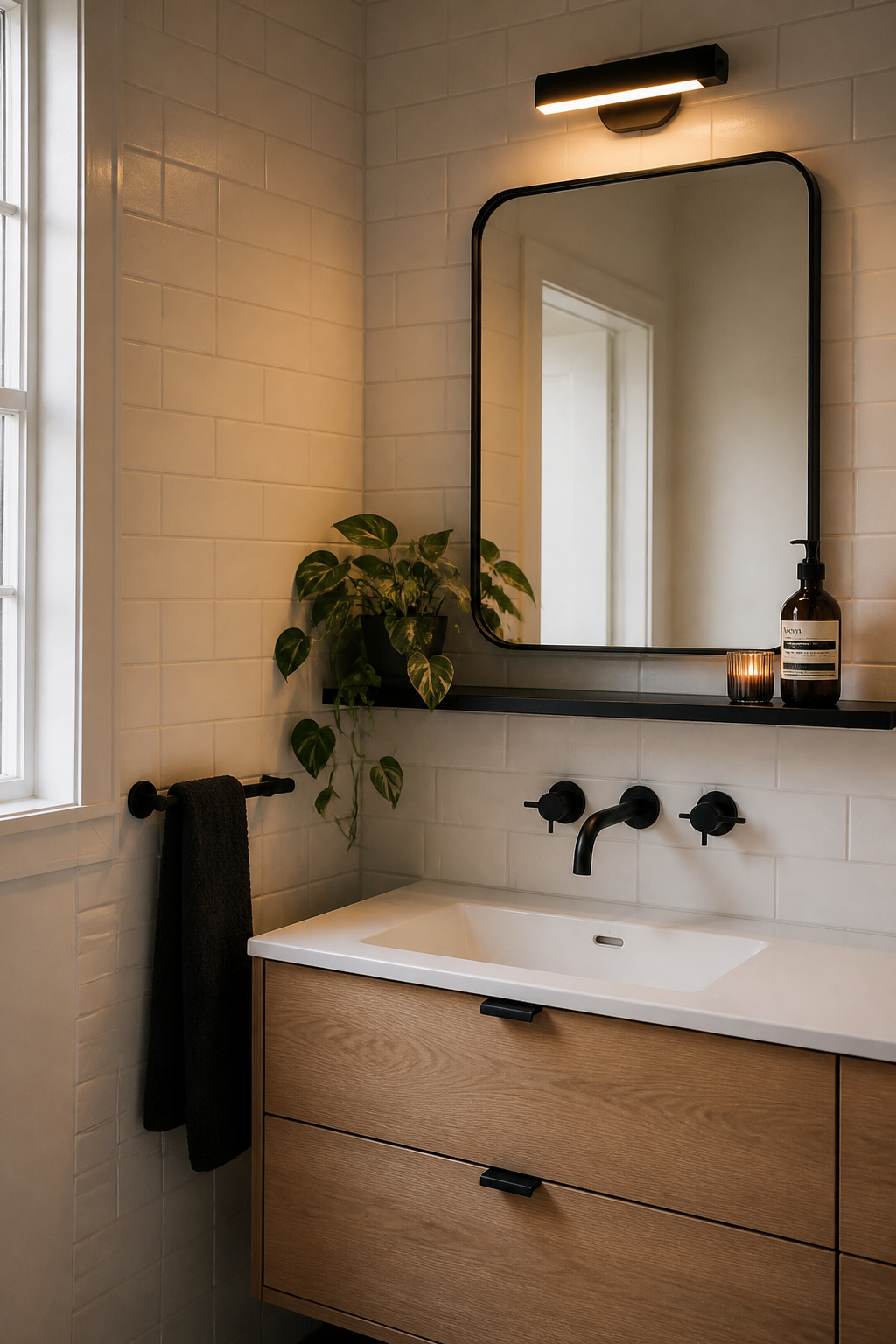
In the Nordic colour vocabulary, black functions as a neutral. It pairs with white, wood, stone, and grey without conflicting colour temperatures. The key condition is full coordination: if you’re going matte black, every metal element in the room should match — basin tap, shower valve, towel rails, toilet roll holder, robe hook, mirror frame, and the waste fittings and overflows. Leaving chrome waste covers in a matte black bathroom breaks the entire scheme.
On finish quality: PVD (Physical Vapour Deposition) is the most durable matte black finish. Hansgrohe’s PVD coating passed a 500-cycle Scotch-Brite abrasion test intact — standard powder coat finishes show wear and chipping noticeably sooner. For daily maintenance: mild pH-neutral soap on a soft cloth. No vinegar, no abrasive pads, no bleach. Dry after use where practical — water mineral deposits show more visibly on matte black than on chrome.
There’s a tactile quality to a stone sink that porcelain doesn’t have. Washing your hands in travertine or slate registers differently — the temperature of the material, the surface texture, the weight of it — in a way that matters even if you’d struggle to articulate exactly why. As bathroom design ideas go, a stone vessel sink is one of the most direct ways to introduce natural material quality into the room without a full renovation.
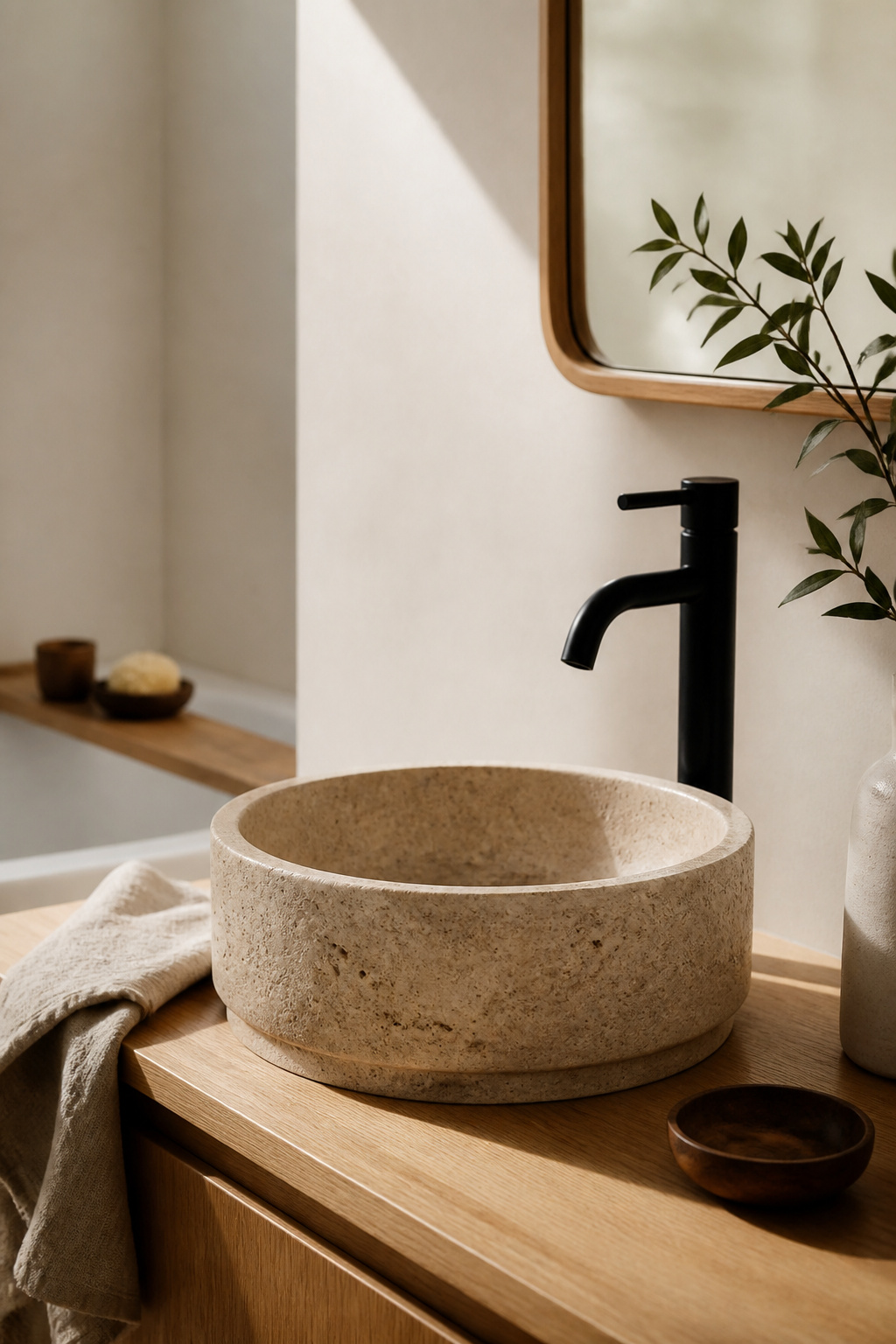
Vessel sinks (above-counter) are the most practical form for stone — the material can be seen fully, no precise undermounting cut is required, and installation is straightforward. Travertine is the most accessible option: warm beige tones, distinctive pitting from its fossilised structure, approximately 55 lbs for a vessel sink. It’s porous and needs sealing every 6-12 months. Slate is denser and harder, darker in colour, lower porosity, and more forgiving in daily use. Granite composite — 80% crushed granite in a resin binder — is the most practical if maintenance is a concern: non-porous, near-stone in appearance, essentially indestructible in normal use, though it lacks the natural variation of real stone.
One practical installation note: a vessel sink sits above the counter surface, which means a taller tap is required — minimum 6 inches of height clearance above the sink rim is typical. Factor the combined vanity-and-vessel height into planning; the finished rim should sit at 34-36 inches from the floor.
The assumption that a bathroom window requires frosted glass or a blind that reduces light while providing privacy is so embedded that most bathrooms are darker than they need to be. Modern glazing makes this compromise unnecessary. This is a bathroom design idea that costs nothing if you’re already renovating and makes a significant difference to how the room feels at every hour of the day.
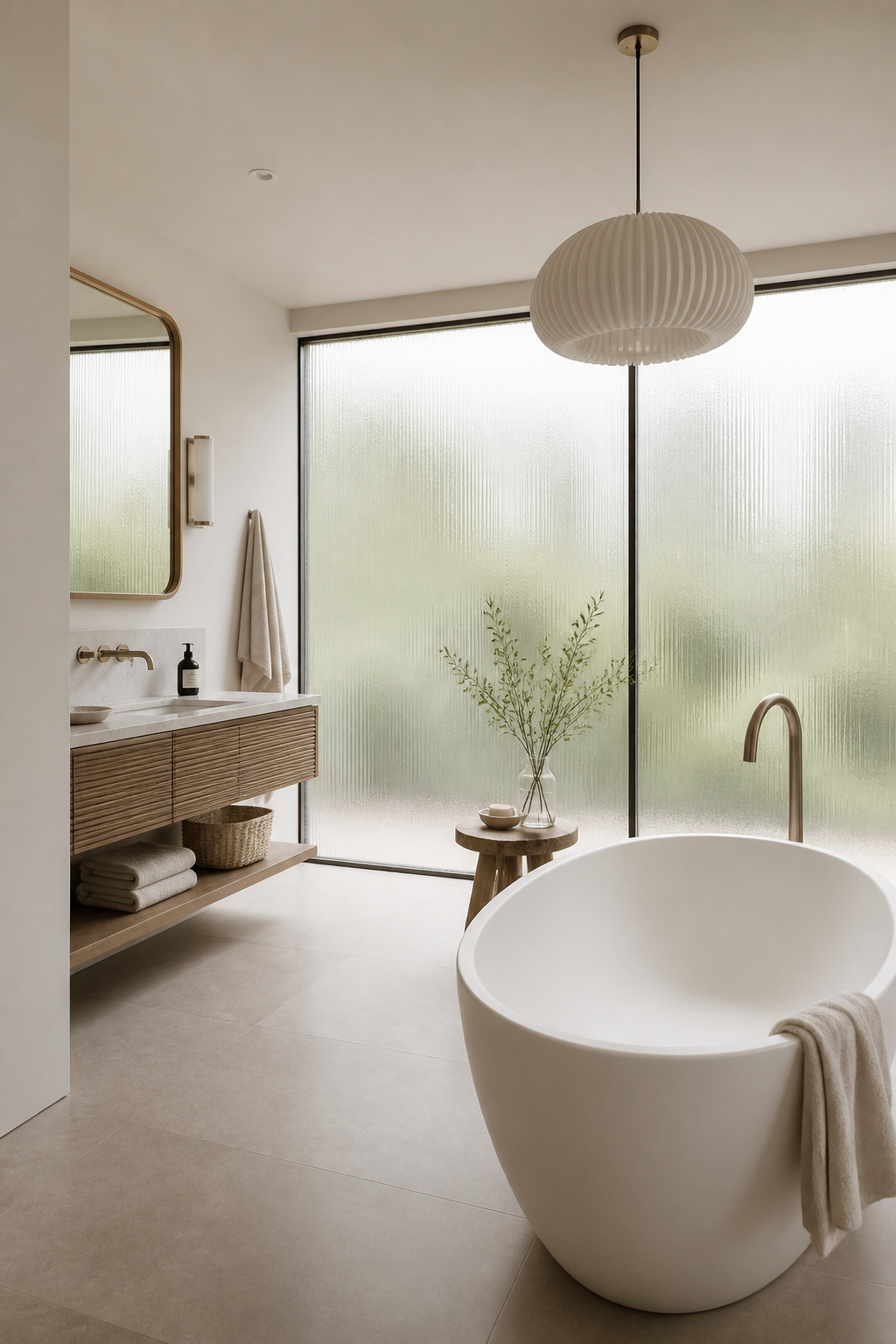
Frosted glass (acid-etched or sandblasted) transmits 80-90% of the light that clear glass would while fully blocking views. High windows — sill above standing eye-height at approximately 64 inches — can remain entirely clear with no treatment and still provide full privacy. Obvious when you think about it, but routinely overlooked.
The goal in a Nordic bathroom is layered light. Natural daylight is the foundation. Supplement with a dimmer-controlled ambient fixture for after dark, and task lighting at face height for the vanity mirror. The bulb temperature standard for any warm, calm bathroom is 2700-3000K throughout. Cooler bulbs (4000K+) create a clinical quality that no amount of warm tile and natural wood can overcome. A bathroom designed around good light is a bathroom design idea that compounds — every other material choice looks better in the right light.
Remove the shower door and something fundamental changes. Without the glass panel, the shower is part of the room rather than a compartment within it. The visual weight lifts. The room feels larger. This is why the doorless walk-in is the standard in Nordic bathrooms rather than an upgrade — it’s the bathroom design idea that most quickly moves a room from functional to spa-like.
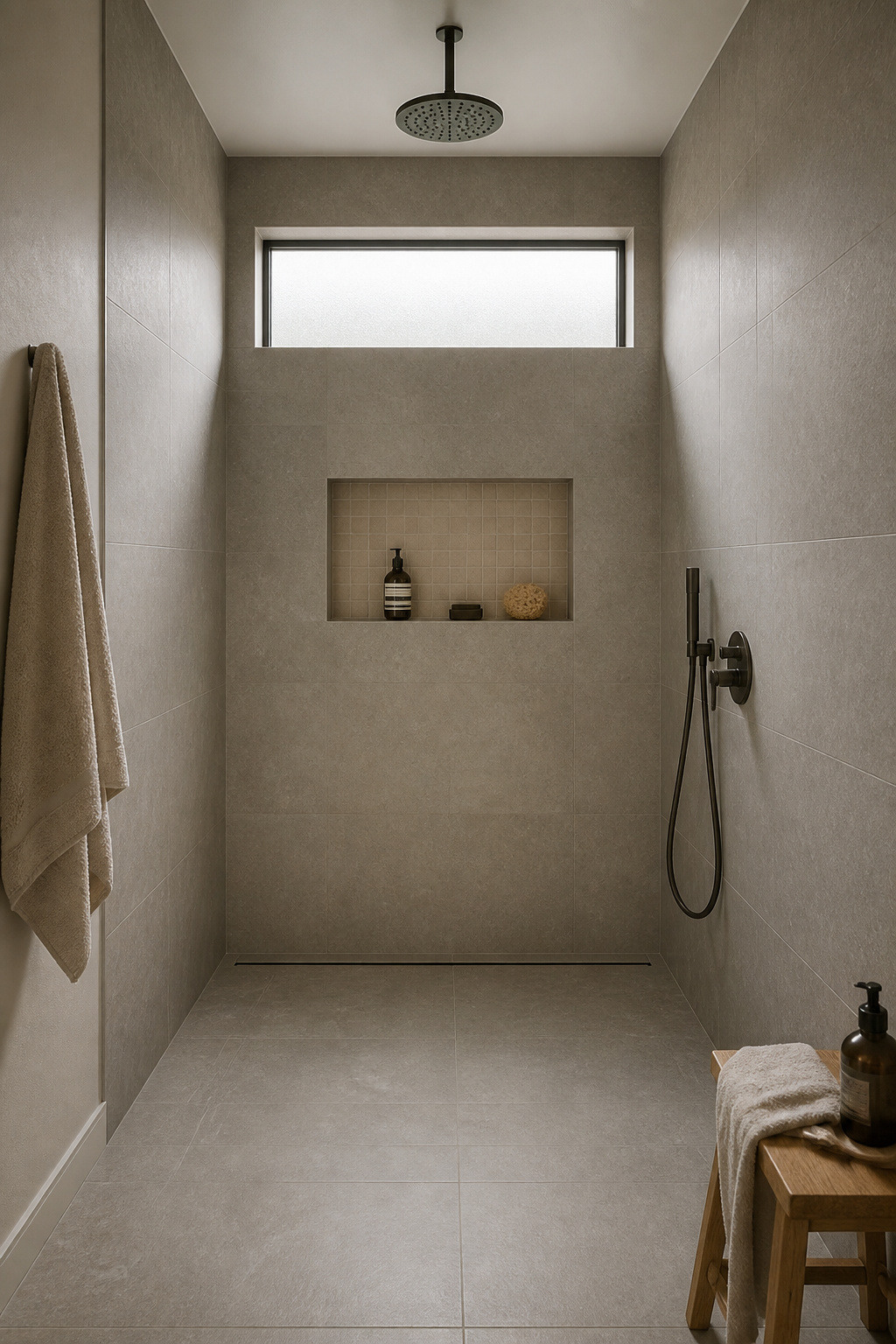
There are also practical advantages: no hinges to corrode, no tracks to collect mildew, no glass to clean. A doorless shower is a genuinely lower-maintenance configuration over a 10-year ownership horizon than any enclosed alternative. For the full range of bathroom shower designs worth exploring, the walk-in configuration in several material treatments is covered in depth.
Rainfall heads range from 6 to 16+ inches in diameter; 8-12 inch models cover most household applications at a standard 2.0-2.5 GPM flow rate. Waterproofing is where shortcuts cause expensive long-term problems: the membrane must extend at least 12 inches past the shower threshold. The floor must slope to the drain (1/8-inch per foot minimum). The practical minimum for the shower area is 42 x 48 inches, though 48 x 60 is the preferred starting point for effective water containment. A linear drain along one wall works better than a centre drain with large-format tiles — it allows the floor to slope in one direction, which is simpler to execute and looks cleaner.
The most reliable bathroom tile choices aren’t trend-responsive. Cream, clay, warm white, slate grey, sand — these tones have been in Nordic and Mediterranean interiors for as long as the materials have existed because they reference the natural world directly and age well. As bathroom design ideas go, choosing earthy neutral tile is the decision you’ll be most grateful for in ten years.
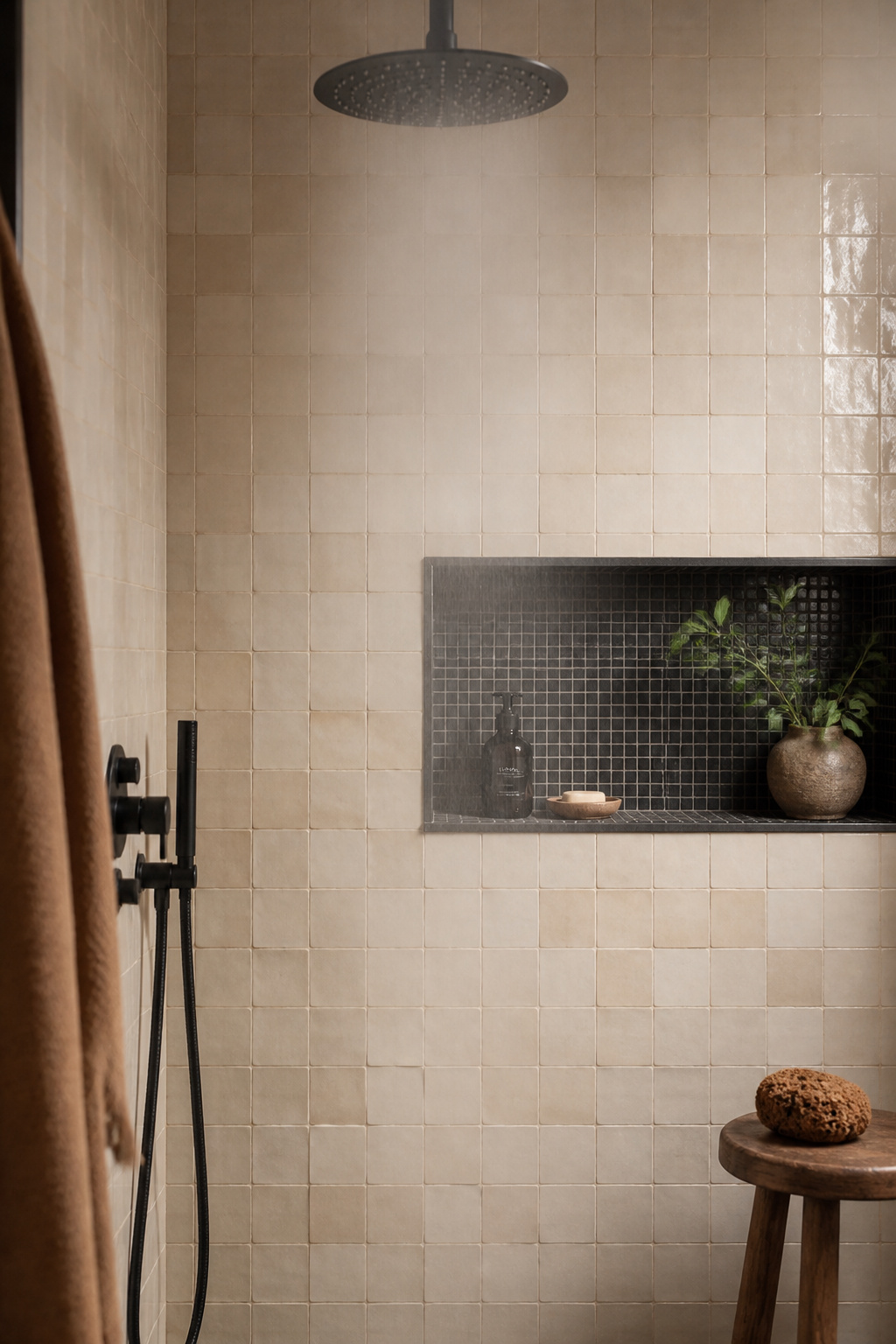
Zellige tile is handmade Moroccan ceramic, kiln-fired with hand-dipped glaze, each tile slightly different in colour, thickness, and surface texture. The variation that mass production tries to eliminate is the point — no two installations look the same, and the result has a depth and warmth that uniformly pressed tile can’t achieve. For bathroom wall tile ideas to consider, zellige has become the choice that costs more but reads as an entirely different category of material quality.
For tile mixing: use one tile for the floor and a different format or texture for the wall, held in the same neutral colour family. A large matte field tile on the floor with smaller handmade ceramic on the shower wall — same palette, different character — adds visual interest without making the room feel patterned. Reserve the more variable, textured tile for a feature area (shower wall, recessed niche) and use a more consistent field tile for large background areas. Mixing warm and cool white tiles across different surfaces is the single most common mistake: the undertone difference reads as an error rather than a deliberate choice.
A plant changes the room in a way that is difficult to explain and impossible to replicate with objects that aren’t alive. There’s a quality to greenery in a bathroom that no manufactured accessory approximates. This is one of the bathroom design ideas that costs the least and delivers the most immediate sensory impact — and the bathroom environment suits a specific group of plants very well.
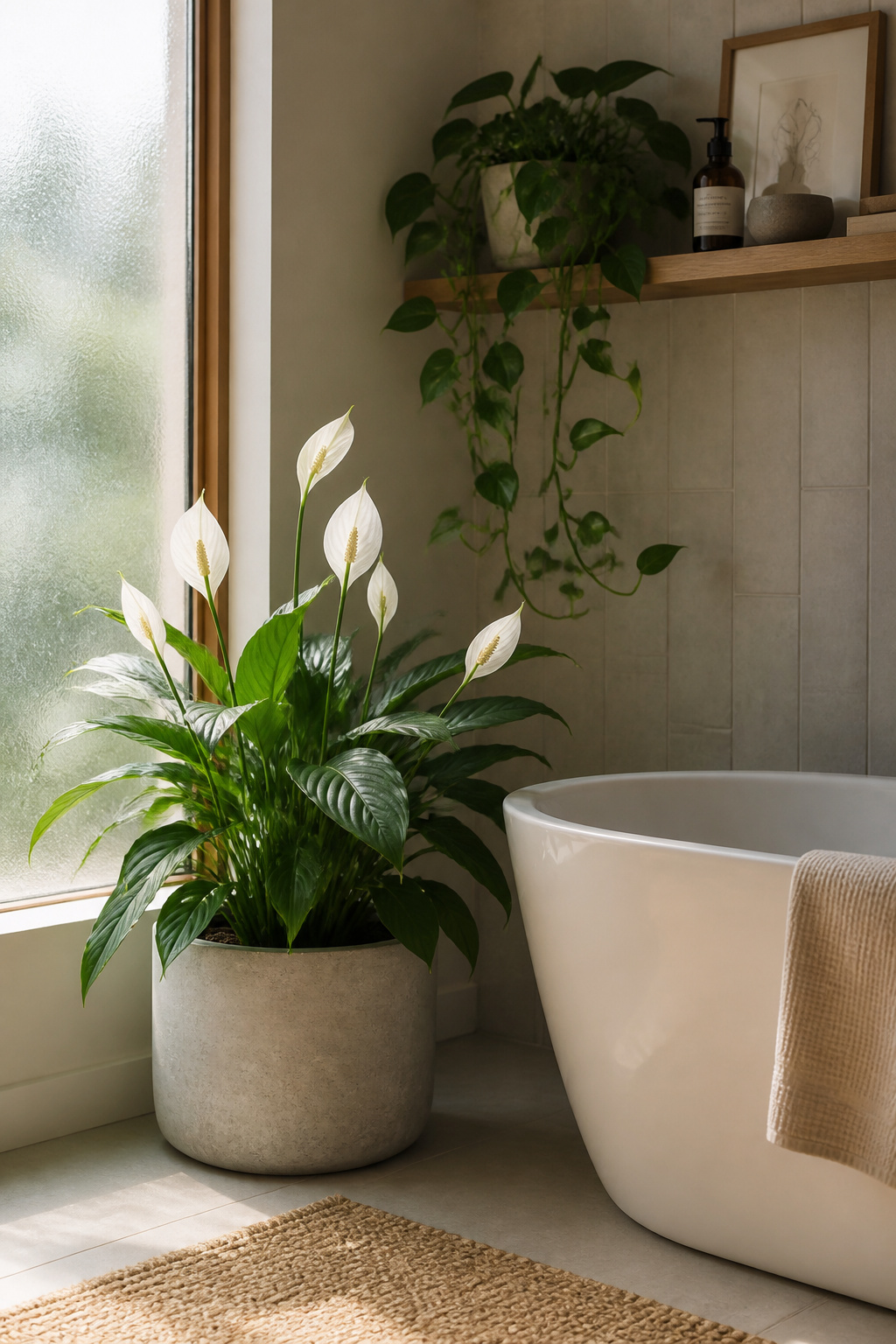
Pothos, peace lily, snake plant, and air plants are the four to know. Pothos adapts to low light and thrives in humidity; in a hanging position, it trails naturally toward the light. Peace lilies genuinely prefer humid conditions and can absorb moisture directly from the air after showers. Snake plants are architecturally upright and handle both low light and fluorescent light without complaint; the humidity slows evaporation from the pot, so watering intervals are even longer than normal. Air plants (Tillandsia) need no soil, no pot, and no conventional watering — bathroom humidity provides most of what they need.
On planters: terracotta and unglazed ceramic handle humidity without degradation and have a warmth that aligns with the Nordic material palette. Concrete planters (matte grey cast or moulded) are ubiquitous in Scandinavian bathrooms — neutral, moisture-tolerant, and they don’t compete with the plants. Keep the planter collection consistent in tone even if not in size.
If there is genuinely no natural light source at all, even the most tolerant species will eventually decline. A small grow bulb near the plants on a timer is a small investment that keeps this bathroom design idea viable in any light condition.
In a Nordic climate, stepping onto a cold bathroom floor in January is a genuinely unpleasant way to start the day. Underfloor heating is not a luxury in that context — it’s a practical response to the environment. Among the bathroom design ideas in this list, this is the one that changes the daily experience of the room more than any material or styling choice.
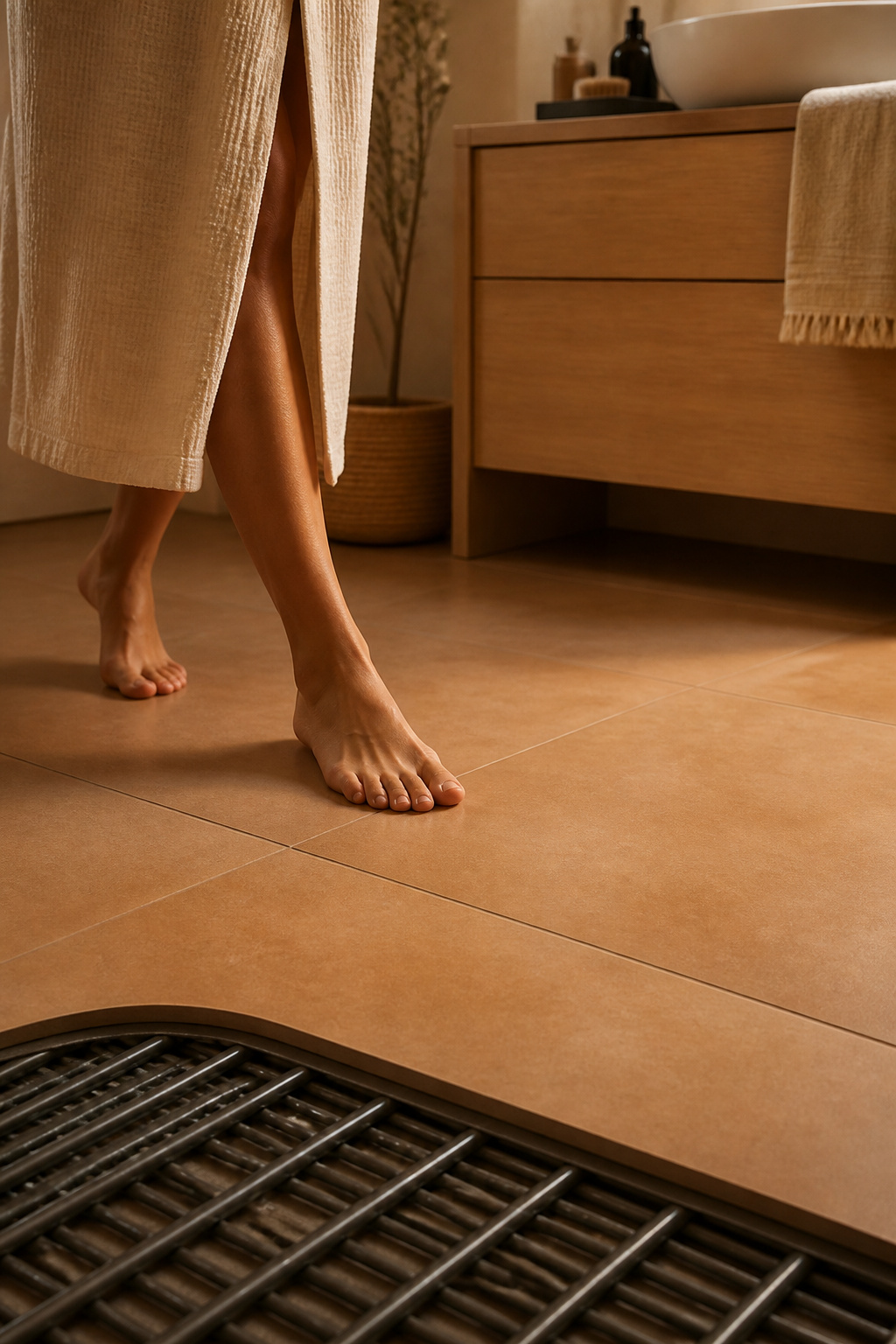
Electric mat systems are the right choice for a bathroom renovation. The system is a heating cable on a mesh backing, rolled out under the tile mortar and connected to a GFCI-protected thermostat. Installation is achievable in a single day, doesn’t require a central boiler, and works with existing electrical service. Tile and natural stone are the ideal flooring material — they conduct heat efficiently and hold it once warm.
Cost perspective: materials run $6-12 per sq ft; electrician adds $200-500; a fully installed floor in a typical 73 sq ft bathroom lands around $2,500. Operating cost is modest — roughly $14-18 per month running 4 hours daily. The upgrade that unlocks full value: a programmable thermostat that warms the floor before you get up. The floor being warm when you need it, without manual activation, is the version that actually changes your daily routine.
Shower caddies are a fixture of bathrooms that weren’t planned carefully enough. They hang off the showerhead arm, accumulate mildew in the joints, eventually rust, and leave marks on the wall. A recessed niche solves every one of those problems by making the storage part of the architecture. It’s one of the bathroom design ideas that separates a designed bathroom from a functional one.
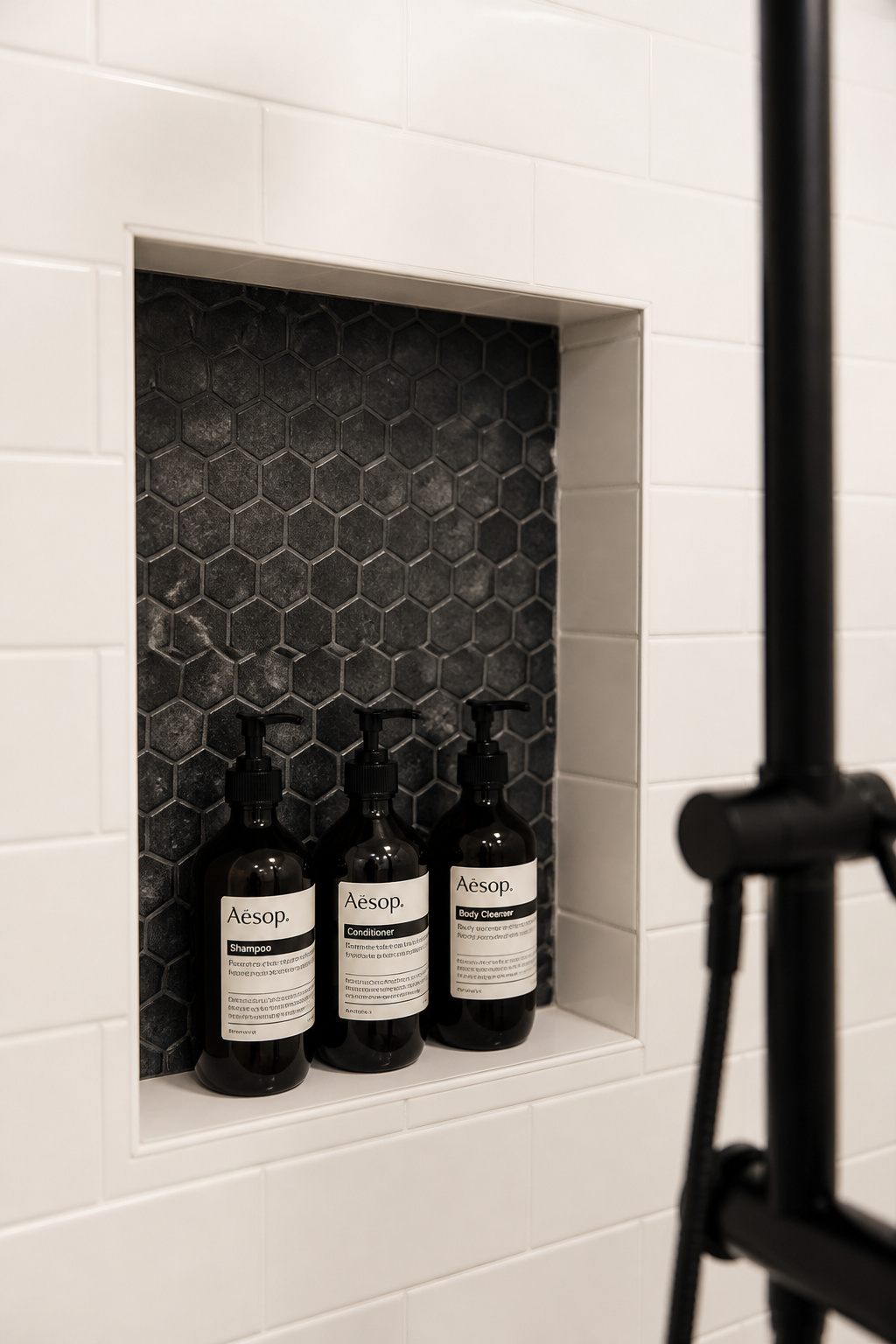
Standard dimensions: 12-14 inches wide (between 16-inch stud spacing), 12-16 inches high for a single shelf or 24-30 inches for a double, and 3.5 inches deep. That’s enough for shampoo, conditioner, and body wash for a household of two. One well-placed niche is usually all a shower needs.
The design detail that elevates a niche from functional to intentional: tile the interior differently from the shower wall. A small mosaic, a contrasting colour, or a section of zellige as a lining makes the niche a feature rather than a hole in the wall. The niche bottom must slope slightly forward — a 1/8-inch pitch ensures water runs out rather than sitting inside. Prefabricated foam niche inserts (Schluter, Wedi, Tile Redi) are pre-waterproofed and designed for direct tile application — they eliminate the most technically demanding part of the installation and are a reasonable choice for any DIY retrofit.
A single overhead downlight does its job. It lights the room. It doesn’t make the room. The difference between a bathroom that feels like a spa and one that feels like a utility is usually nothing more than the number and placement of light sources. This bathroom design detail — adding a pendant or two — is one of the most cost-effective ways to shift that register.
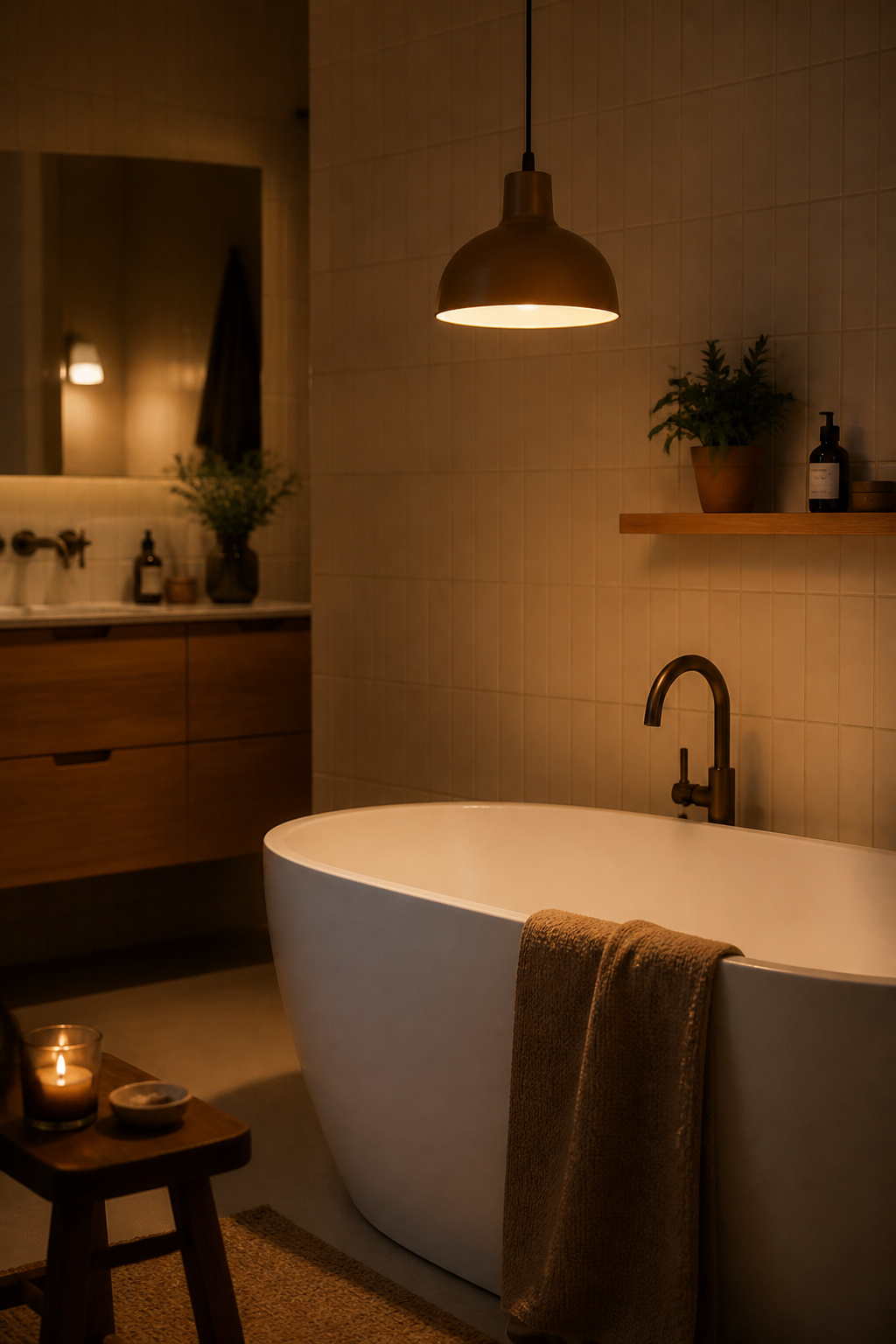
In Scandinavian design, a room with only one overhead light source is considered unfinished. The goal is multiple layers at different heights: ambient (dimmable ceiling source), task (vanity mirror lighting at face height), and accent (a pendant that creates a point of warmth). A pendant beside the vanity mirror provides excellent shadow-free task lighting for grooming while also being a considered object. A pendant above a freestanding tub — hung 6-7 feet from the floor — creates a dedicated zone of warmth without any physical partition.
The IP rating requirement for bathroom pendants: IP44 (splash-proof) for any fitting within 0.6m of a water source. Mullan Lighting’s ceramic IP44 pendants are a reliable reference point for the Nordic aesthetic: unglazed or matte-glazed ceramic at $150-250 per fitting. For bathroom vanity lighting ideas at the mirror specifically, vertical sconces flanking the mirror on both sides provide the most even, shadow-free face lighting.
2700K is the warm white standard — equivalent to a traditional incandescent bulb. At this temperature, warm tile, wood, and stone look beautiful. Cool white at 4000K+ makes the same materials look flat and clinical. The bulb temperature decision matters more than the fitting itself.
The wood-and-stone vanity is one of the most Scandinavian combinations in the home — warm timber grain meeting the still, cool surface of stone. It references Nordic terrain directly: forest and rock. As bathroom design ideas go, this one has the widest price range of any item in this list — it’s achievable from $800 to $8,000 depending on the route you take.
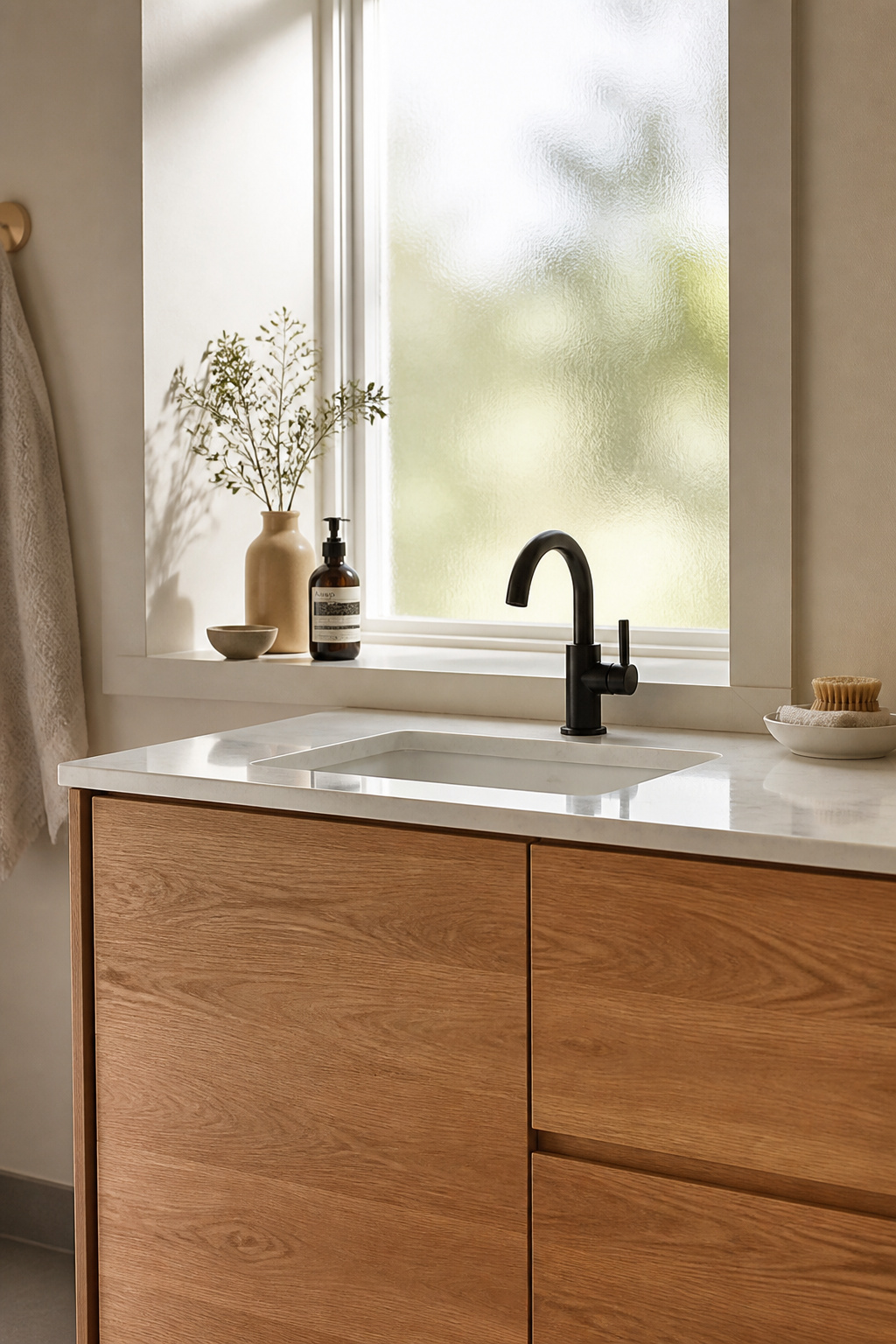
The pairing works visually because the temperatures complement: warm wood against cool stone produces an equilibrium that feels balanced. Practically: stone tops (quartz, sintered stone) are non-porous and require no sealing; wood cabinet fronts are visually warm and easily refinished if they show wear over time.
At different budget levels: the IKEA GODMORGON hack — the cabinet carcass at $200-600 with a custom-cut quartz or sintered stone top — delivers a near-custom result at a fraction of bespoke joinery cost; total materials typically run $800-2,000. Production vanities from brands like James Martin or Wyndham Collection offer genuine wood fronts with stone tops at $1,500-4,000. Custom joinery starts at $3,000-8,000 for a single-basin unit in solid oak or walnut. One detail that makes or breaks the combination: ensure the undertones align. A warm-toned stone with warm oak works. A cool-toned grey stone with cool grey-stained oak works. Mixing a warm wood with a cool stone creates a subtle discord that registers as ‘something isn’t right’ without always being immediately identifiable.
Standard paint makes walls flat. Limewash makes walls interesting. The difference isn’t subtle: limewash penetrates the substrate rather than coating it, creating a surface with visual depth — layers of translucent colour that catch light differently across the day, and mottled variation that means no two walls look the same. It’s a bathroom design idea that delivers a finish that looks like it accumulated over years rather than a Saturday afternoon.
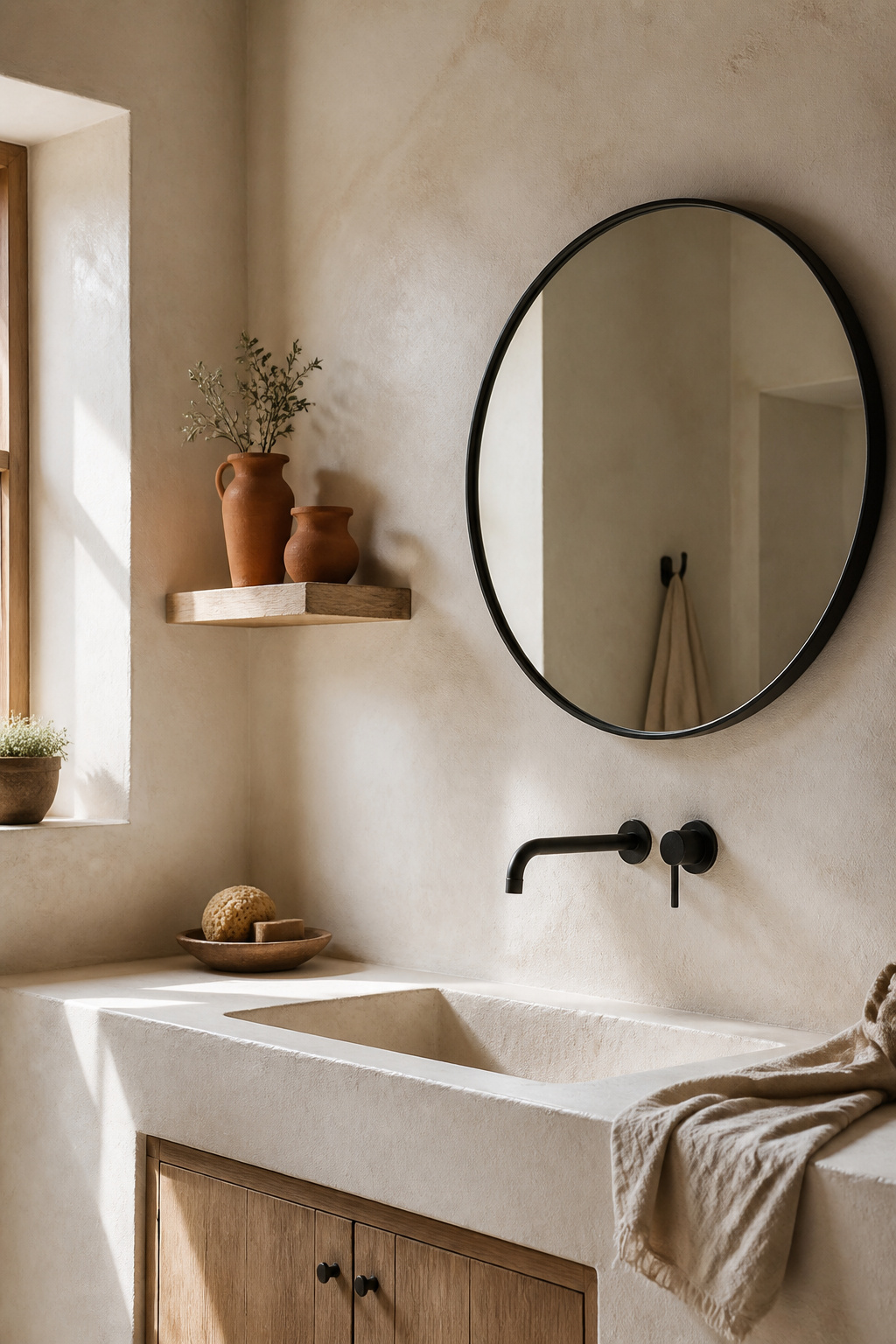
Limewash is slaked lime (calcium hydroxide) in water. Modern formulations from Portola Paints and Romabio make it accessible on standard sealed drywall. The application technique is straightforward: wide natural-bristle brush, random crosshatch strokes, two to three coats, with the option to wipe back the second coat with a damp sponge to create lighter variations. DIY-friendly — the ‘rules’ are looser than Venetian plaster and mistakes are built into the aesthetic.
For bathrooms specifically, limewash has a practical advantage over standard latex paint: its high pH makes it naturally resistant to mould and bacteria, and its breathable structure allows the wall to manage moisture vapour rather than trapping it behind a sealed surface. Romabio’s interior limewash is rated for humid environments. Steam and bathroom conditions won’t damage the finish. The honest limitation: limewash is not for anyone who wants uniform colour. If you want consistency, use paint. If you want depth — limewash.
Every renovation guide covers tile, fixtures, and storage. Very few cover scent. This is a significant oversight, because scent reaches you before you consciously register anything else in a room — it triggers mood directly. A bathroom that smells of cedar and eucalyptus reads as ‘spa’ before the eye has processed a single bathroom design idea. It’s the last layer, and it matters.
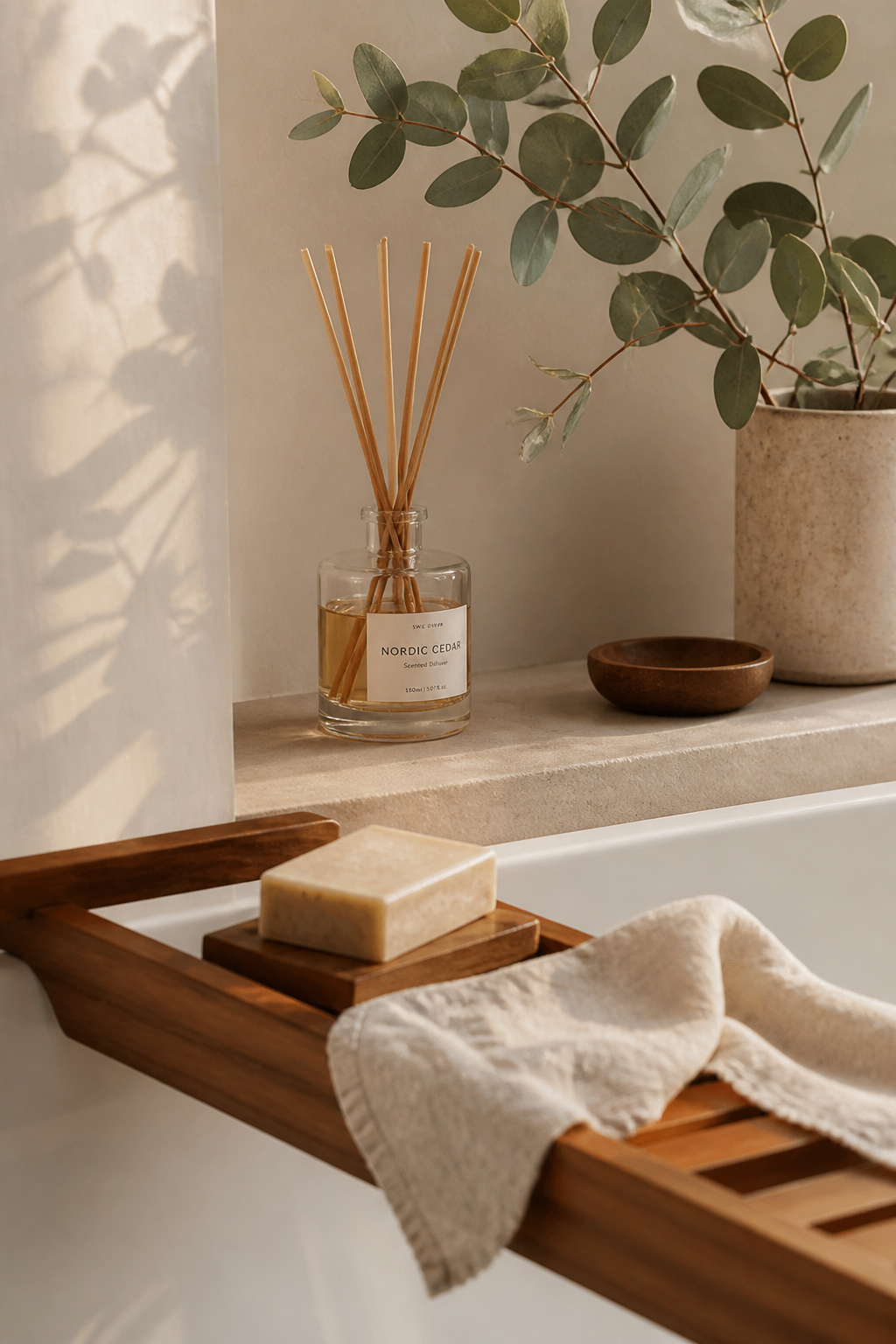
The mistake most people make is using air freshener spray, which masks rather than replaces ambient scent and fades within minutes. A reed diffuser creates continuous, subtle background fragrance for 60-90 days from a 100-200ml bottle. Place it away from direct airflow — extractor fans and open windows accelerate evaporation significantly. Eucalyptus stems hung in the shower release their oils in warm steam and provide 2-4 weeks of scent from a fresh bunch. Cedar blocks in linen shelves and cabinet interiors provide a quiet background cedar note and act as a natural moth deterrent.
The Nordic scent palette: cedarwood, birch, pine, and sea air. Forest and coast rather than floral or sweet. Aery Living’s Nordic Cedar diffuser and Osmology’s Nordic Cedar fragrance are formulated around this profile. NEST New York’s Cedar Leaf & Lavender is a widely available option that leads with cedar. Less is more — a subtle background fragrance is the target. An overpowering perfumed bathroom signals effort rather than ease, and ease is the point of everything that came before it.
Not every bathroom design idea in this list requires a renovation. Some of the most impactful ones — plants, lighting, scent, open shelving — are reversible changes you can make without touching a tile. A useful approach is to work through bathroom design ideas in investment tiers: start with the changes that cost least and require no demolition, then layer in mid-investment changes that don’t break the existing structure (new taps and fixtures in a coordinated finish, a stone vessel sink on an existing vanity), and reserve the full renovation decisions (new tiling, plumbing changes, underfloor heating, new vanity) for a planned project where everything can be sequenced properly.
When a full renovation is on the table, sequencing matters. Decide on the tile and material palette before purchasing any fittings — fixtures need to coordinate with the hard surfaces, not the other way round. Select the showpiece element first (the freestanding tub, the stone sink, the statement tile) and build the rest of the room to complement it. Lighting is always the last decision, and consistently the most underestimated. The right pendant will amplify every other bathroom design idea in the room. The wrong overhead light will flatten them all. A bathroom designed with genuine attention — materials that connect to the natural world, light that shifts with how the room needs to feel, storage that’s built in rather than bolted on — doesn’t require a large budget. It requires clear thinking about what matters and the patience to do a few things well rather than many things quickly.