Physical Address
304 North Cardinal St.
Dorchester Center, MA 02124
Physical Address
304 North Cardinal St.
Dorchester Center, MA 02124
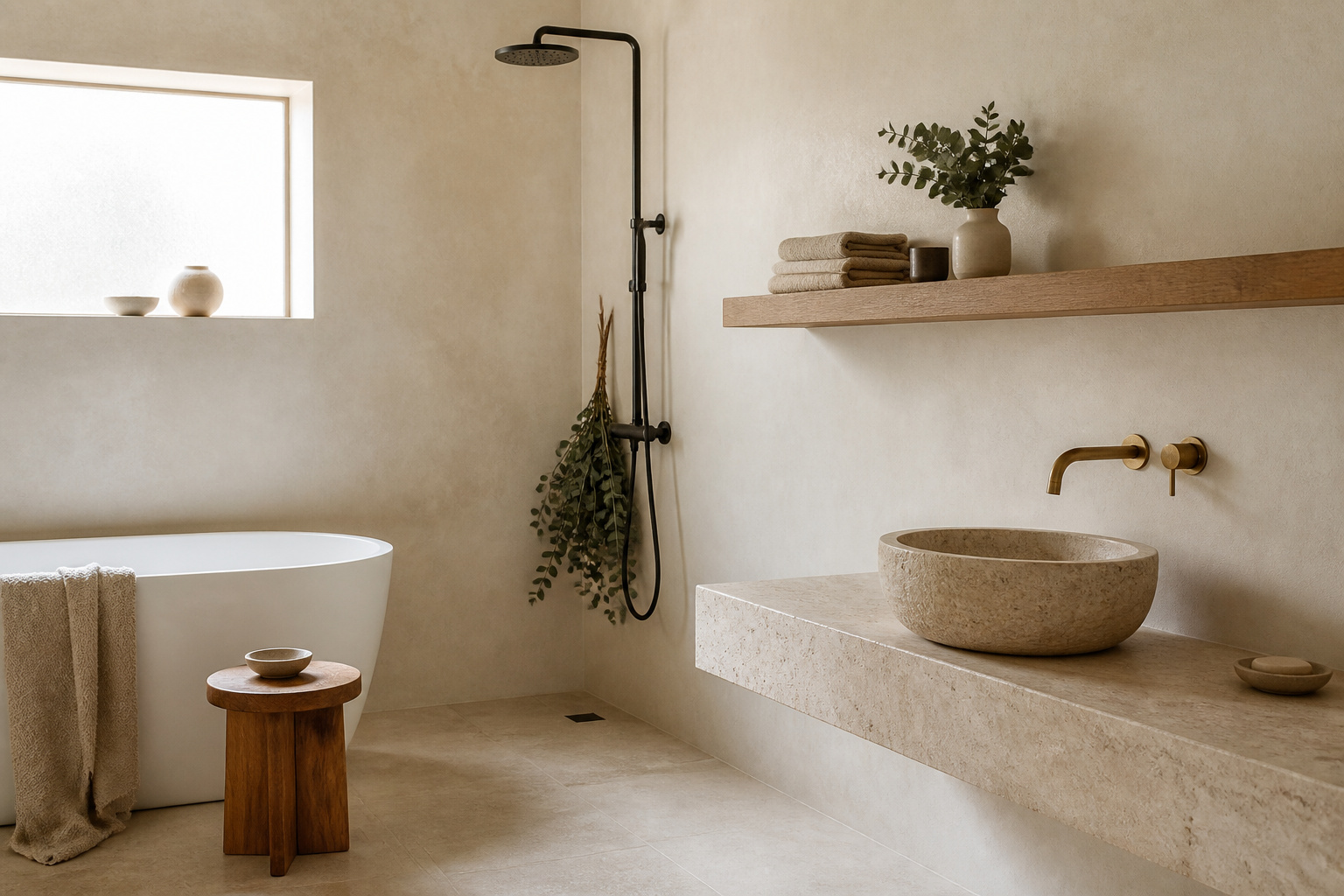
Discover 15 calm and considered bathroom decoration ideas from the Nordic tradition — limewash plaster, terrazzo tiles, teak, brushed brass, and linen towels.
There is a quality that the best Scandinavian bathrooms share, and it has nothing to do with budget. It is the feeling that every object was chosen rather than accumulated — that the plaster on the walls, the timber on the shelf, and the towel on the hook were all decisions rather than defaults. These bathroom decoration ideas come from that tradition: a design culture built around honest materials, diffused natural light, and the conviction that a bathroom can be a genuine retreat rather than just a functional room you pass through twice a day.
I have spent eleven years helping people bring Nordic principles into their homes, and the bathroom is consistently the room where those principles land hardest. It is small enough to be transformed by a single change. It is private enough to take considered risks. And it is used daily, so every material choice is tested against real life rather than left to look good in photographs. The fifteen bathroom decoration ideas below range from surface treatments to textiles, from structural changes that will last decades to additions you could make this weekend.
The appeal of limewash is not something that translates to photographs. In images it looks flat, slightly mottled, maybe uneven. In person it reads as depth — a surface that shifts between grey-white and warm ivory as the light changes through the day, and that looks increasingly right the longer you live with it. That quality comes from the carbonation process: rather than sitting on the wall surface as a film, limewash absorbs into the plaster and hardens chemically over months. It cannot blister or peel because there is no film to lift.
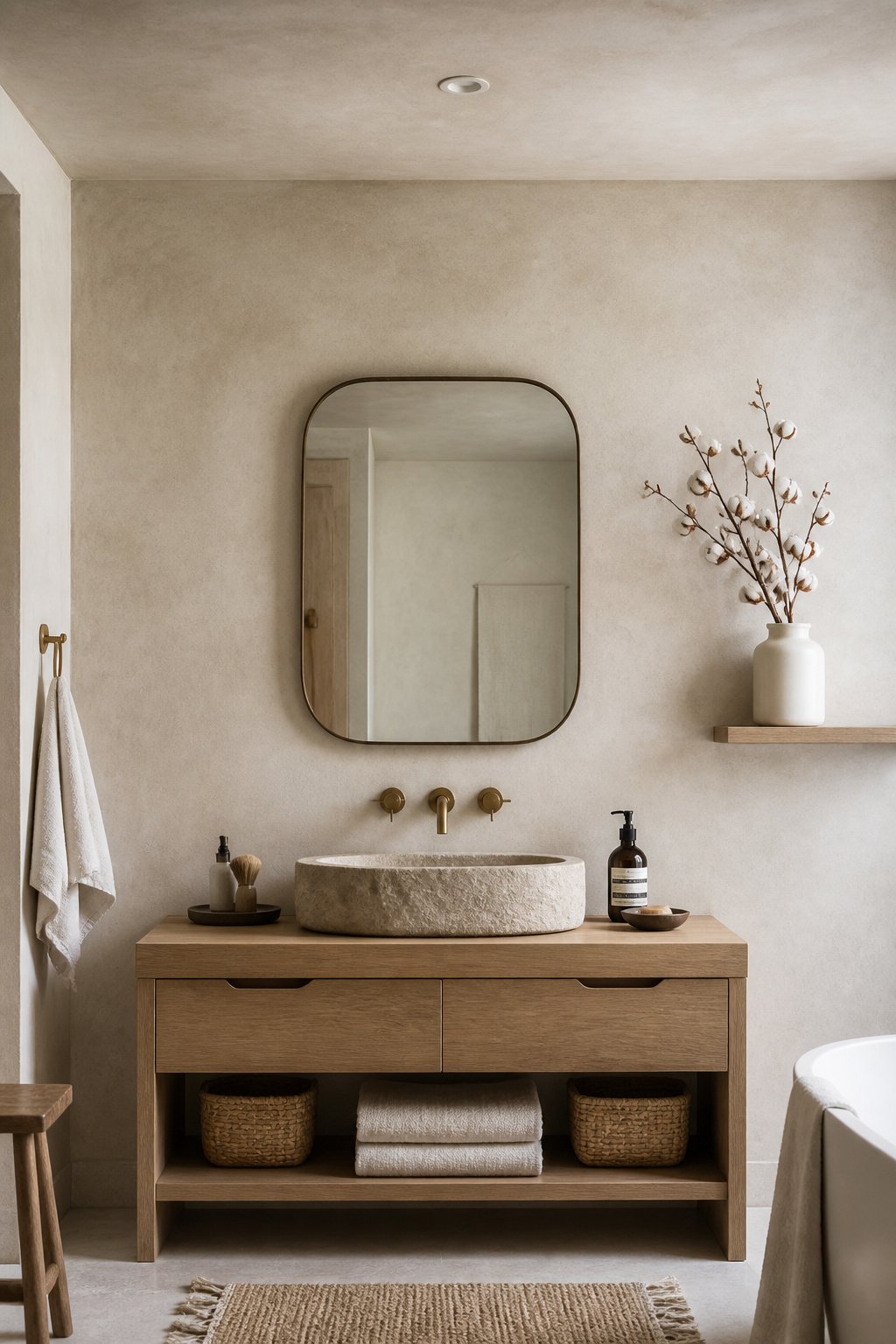
For bathrooms specifically, limewash has a practical advantage beyond its appearance. Its naturally high pH — around 12 to 13 when first applied — actively inhibits mould growth in a way that standard emulsion paint cannot. Keep it away from direct water contact: inside a shower enclosure or directly behind the basin is not suitable. Seal lower walls with a natural-look sealer after three days of curing. Upper walls and ceilings can be left unsealed in a well-ventilated bathroom.
Application requires patience rather than skill. Two coats of bonding primer first, then two to three thin coats of limewash in crosshatch strokes, blending wet-on-wet for the depth that defines the finish. Nordic palette options centre on creamy off-whites — never blue-toned — warm grey, and a muted green-grey that sits between sage and putty. All of these change character completely between morning and evening light, which is exactly what you want in a room you use at both ends of the day.
The wall above the toilet is the most reliably wasted surface in a bathroom. It sees nothing because most bathroom designers treat it as a gap between the cistern and the ceiling rather than a composition opportunity. Two or three floating shelves in solid white oak change that entirely — they create a vertical element that draws the eye upward, add practical storage at a height that genuinely functions, and introduce the material warmth that tiles and fittings cannot provide.
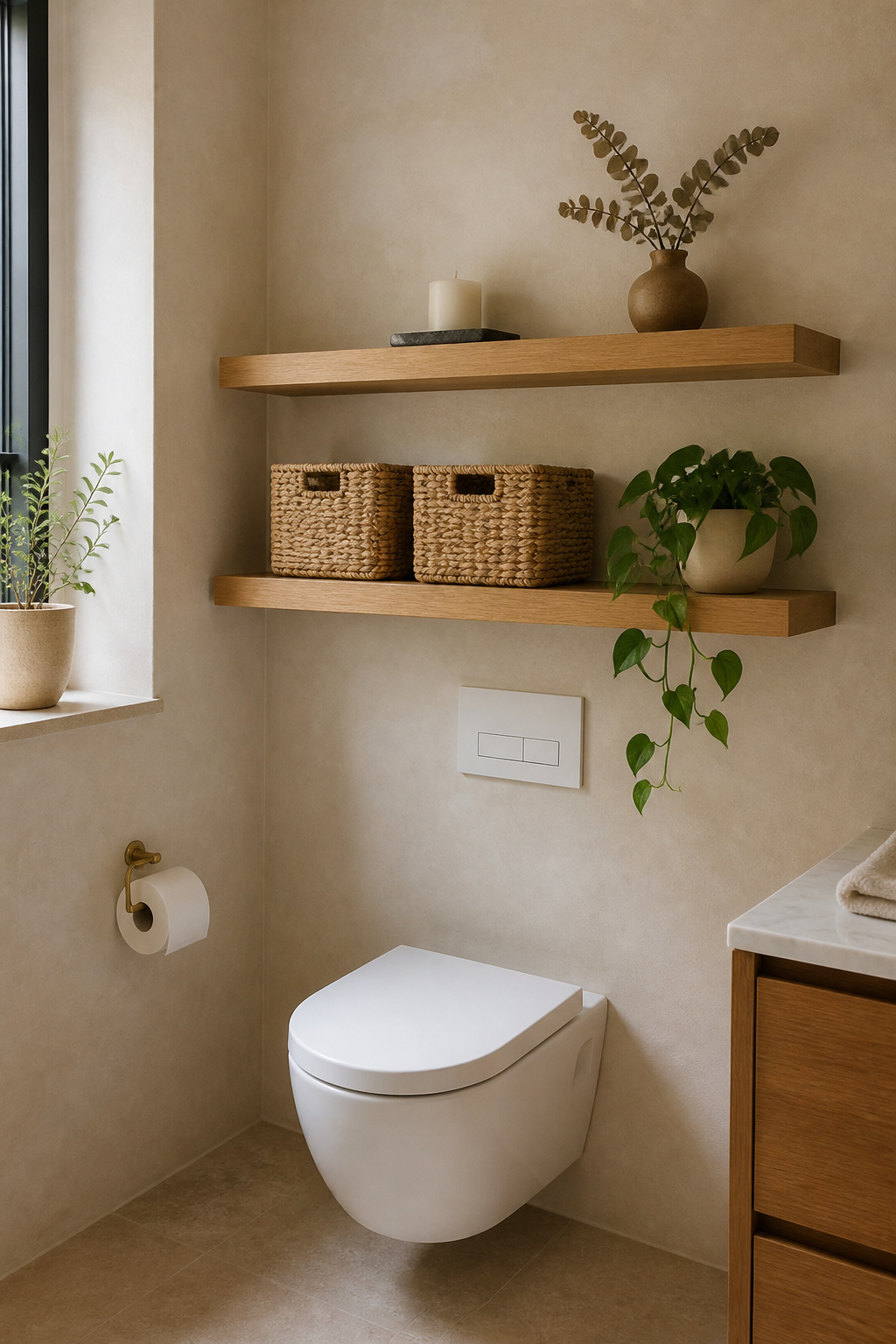
White oak is the right timber for bathrooms because its closed-grain cell structure naturally resists moisture absorption — the same property that made it the timber of choice for whiskey barrels and boat-building. Pine can warp within a year in a poorly ventilated bathroom if not sealed with exceptional thoroughness. White oak, finished with a hardwax oil, handles bathroom humidity without drama. Conceal the wall brackets: exposed brackets read as improvised rather than designed. Use staggered shelf depths if space allows — a slightly deeper shelf at the bottom for baskets, shallower above for ceramics.
Then apply the Scandinavian rule: odd numbers of objects, deliberate negative space between groups, never fill every shelf to capacity. A pothos cutting in a small ceramic vase, a folded hand towel, and a single candle on the shelf below is enough. The restraint is the point. For a deeper look at what works on open bathroom shelving, our guide to bathroom shelf decor ideas covers the full range of approaches.
A vessel basin is the bathroom’s most legible design decision. It sits above the counter surface as a sculptural object, and everything about it — its material, its form, its weight — communicates something about the choices that were made in the room. A honed travertine vessel basin communicates something specific: that the person who chose it preferred an ancient, imperfect material to a smooth, efficient one.
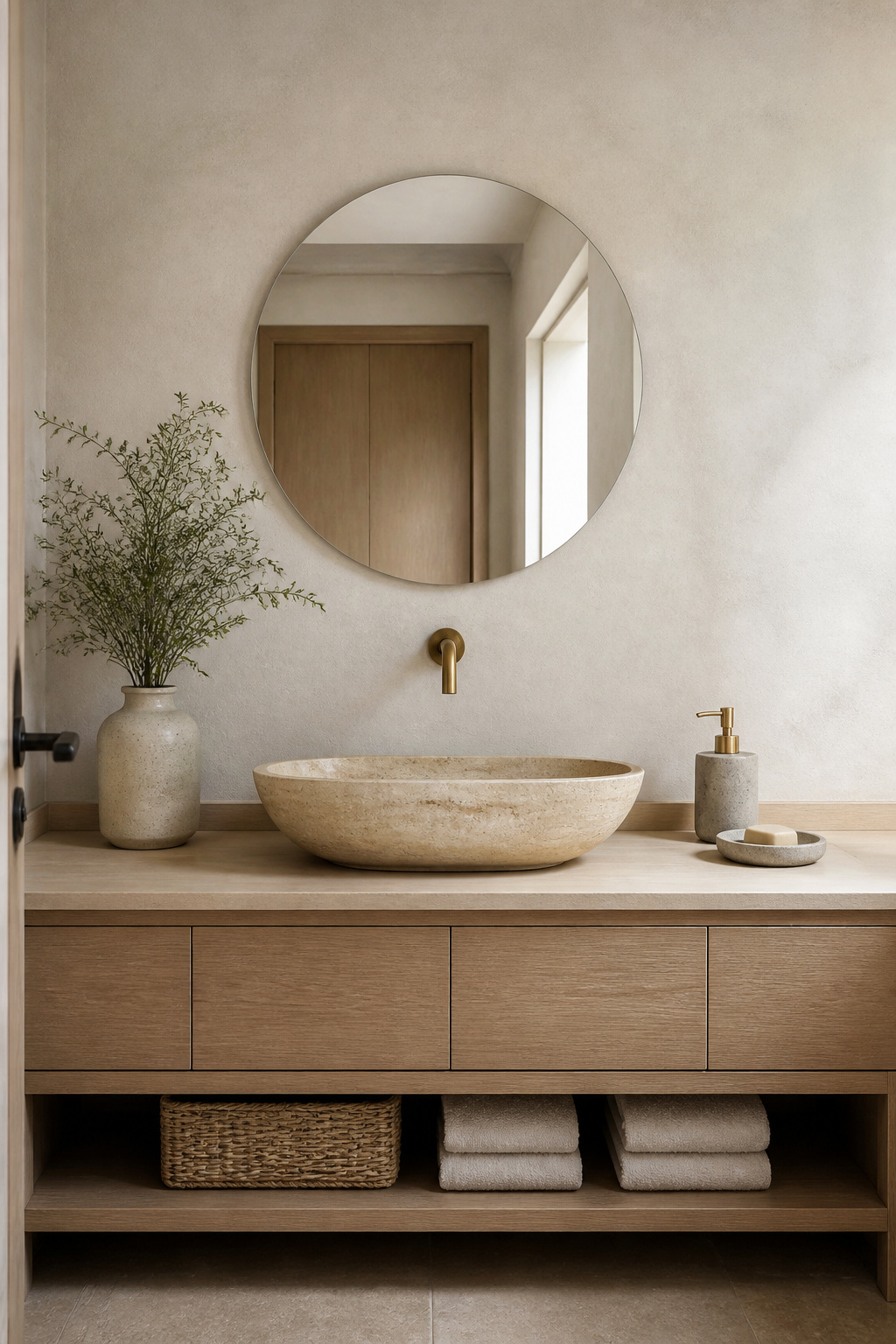
Honed travertine absorbs light rather than reflecting it, reading organic and calm where polished stone would read glossy and demanding. Cast concrete works on the same principle. Between the two, travertine is the more maintenance-intensive: very heavy — a standard 16-inch basin can weigh 25–35 kg — and it needs annual sealing to prevent staining. Cast concrete benefits from re-sealing every year or two. For those who prefer the visual of natural stone without the maintenance commitment, a high-quality matte ceramic vessel basin is the practical compromise — lighter, non-porous, no sealing required. Our full guide to bathroom vanity design covers how to choose the right basin and counter combination for your space.
Pair any vessel basin with a wall-mounted spout rather than a deck-mounted tap. A wall-mounted spout leaves the counter surface completely clear, so the basin reads as the singular object it is intended to be. The spout height should clear the basin rim by at least 15 cm — get this wrong and water hits the basin edge rather than falling to the centre.
Terrazzo is not a trend, though it gets treated like one. It reached peak popularity in mid-century modern architecture, including Scandinavian buildings of the 1950s where its durability and material honesty suited the design culture. That it has returned to contemporary Nordic bathrooms says less about fashion and more about the material’s genuine compatibility with the aesthetic. For a Scandinavian bathroom, the specific version of terrazzo matters — go for fine aggregate, or micro terrazzo, rather than the large high-contrast chip patterns that read more Italian contemporary than Nordic.
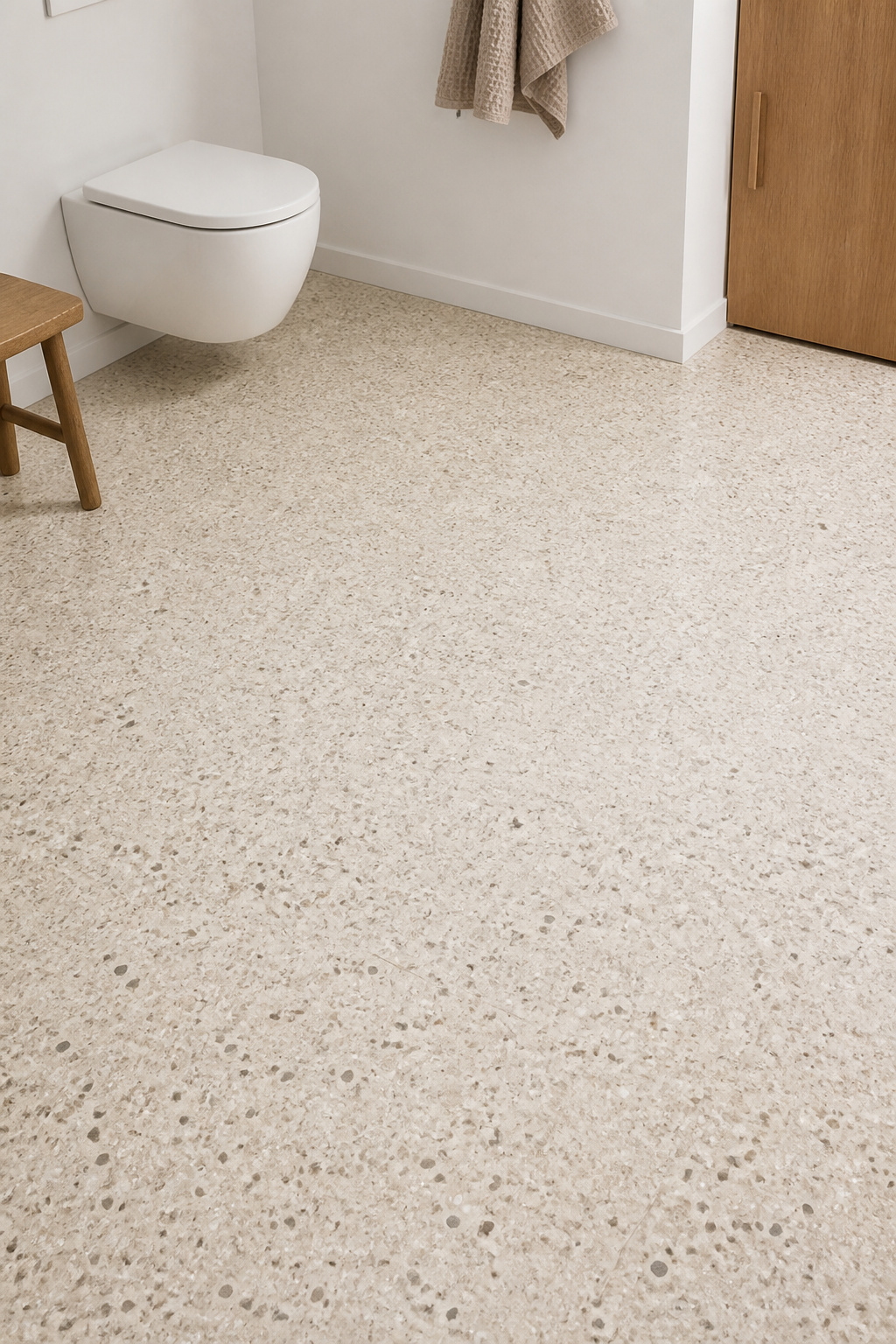
Choose a cream or warm sand base with natural-toned chips in grey, soft taupe, and off-white. In a small bathroom, micro terrazzo reads quieter and more spatially generous than large chips, where the pattern can feel busy before you have added anything else to the room. For a broader exploration of natural tile options, our collection of bathroom tile ideas covers the full range of calm, considered surfaces.
Most terrazzo installations go wrong at the grout stage. The instinct is to choose a dark grout to make the aggregate chips stand out — but this turns the tile surface into a visible grid, the opposite of the calm, continuous field that terrazzo creates. Choose grout in the mid-tone of the tile base: warm grey on a grey terrazzo, cream on a sand-base tile. The grout line disappears into the surface, the aggregate reads as a field rather than isolated elements, and the floor does what terrazzo is supposed to do — become a quiet, beautiful surface rather than a focal point.
The reason brushed brass works in Nordic bathrooms — and that polished brass from three decades ago did not — is the surface finish rather than the material. Polished brass reflects light directly, announcing itself loudly in whatever room it inhabits. Brushed brass has a satin texture that diffuses light, giving the warm gold tone without the flashiness. In a room built around warm whites, natural timber, and matte stone, it reads as the obvious hardware choice.
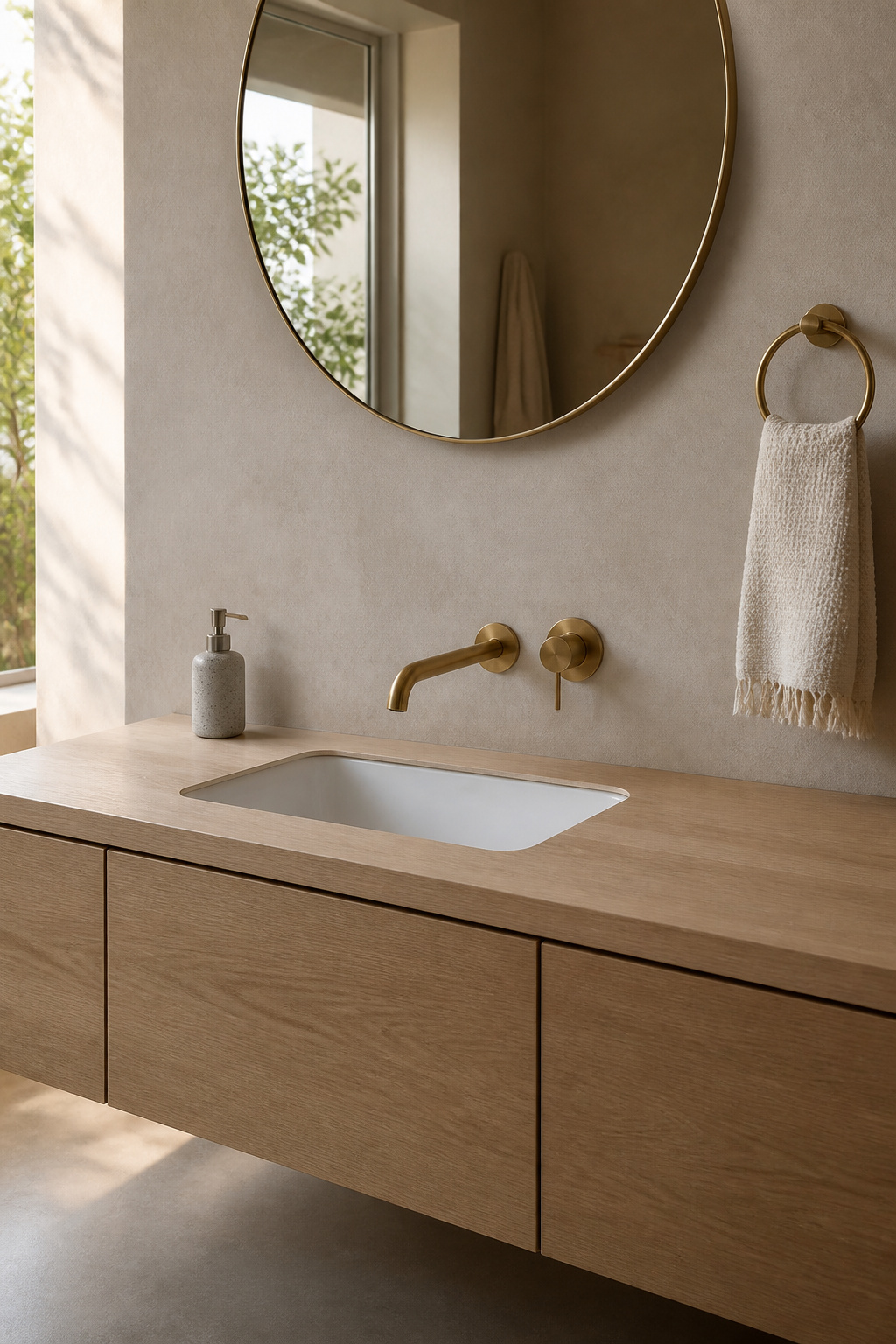
PVD coating — physical vapour deposition — creates a finish approximately three times harder and ten times more scratch-resistant than electroplating. It will not tarnish or develop patina. Unlacquered brass has no coating at all: the copper in the alloy reacts with moisture to develop a darkening ‘living finish’ within months. For a family bathroom, PVD is the practical choice. For a design-led space where evolving character is part of the aesthetic, unlacquered brass is the more interesting option — accept that it will look different in a year, and that this difference is the point.
Undermount basins clean in half the time of top-mount because there is no rim sitting proud of the counter — no grout line accumulating soap and limescale at the basin edge. Commit to brushed brass for every metal element in the room: towel rail, hooks, mirror frame, cabinet handles. Mixing brushed brass with chrome is the one mistake that no amount of otherwise considered design can recover from.
A bathroom built entirely of tile, glass, and stone has an acoustic quality that biophilic design research consistently identifies as a source of low-level stress — hard surfaces and right angles without any natural material to soften them. This bathroom decoration idea takes about forty seconds to execute and changes the room in a way that is difficult to explain in purely decorative terms.
Fresh eucalyptus releases its active compound — 1,8-cineole — when steam heats the leaves above approximately 37°C. The scent fills the shower without any product, diffuser, or effort. A bundle lasts two to four weeks before the leaves begin to crumble and lose their fragrance; compost and replace rather than attempt revival. Hang the bunch behind the showerhead — tied with natural jute twine over a small copper hook — so steam passes through the leaves rather than the water jet directly hitting them. Hot water scorches and rots the leaves within days. For something more sculptural and longer-lasting, dried cotton stems and pampas grass tolerate bathroom steam reasonably well and hold their form for months.
There is a category of bathroom change that costs relatively little but shifts the room’s character entirely. A standard vanity mirror reflects your face. A full-length mirror reflects the room — bounces light from the window back across the space, makes the floor visible from a different angle, and changes the bathroom’s function from a wet utility room to something closer to a dressing space. In a small bathroom, a 60 × 160 cm mirror positioned opposite a window can perceptually double the room’s apparent depth.
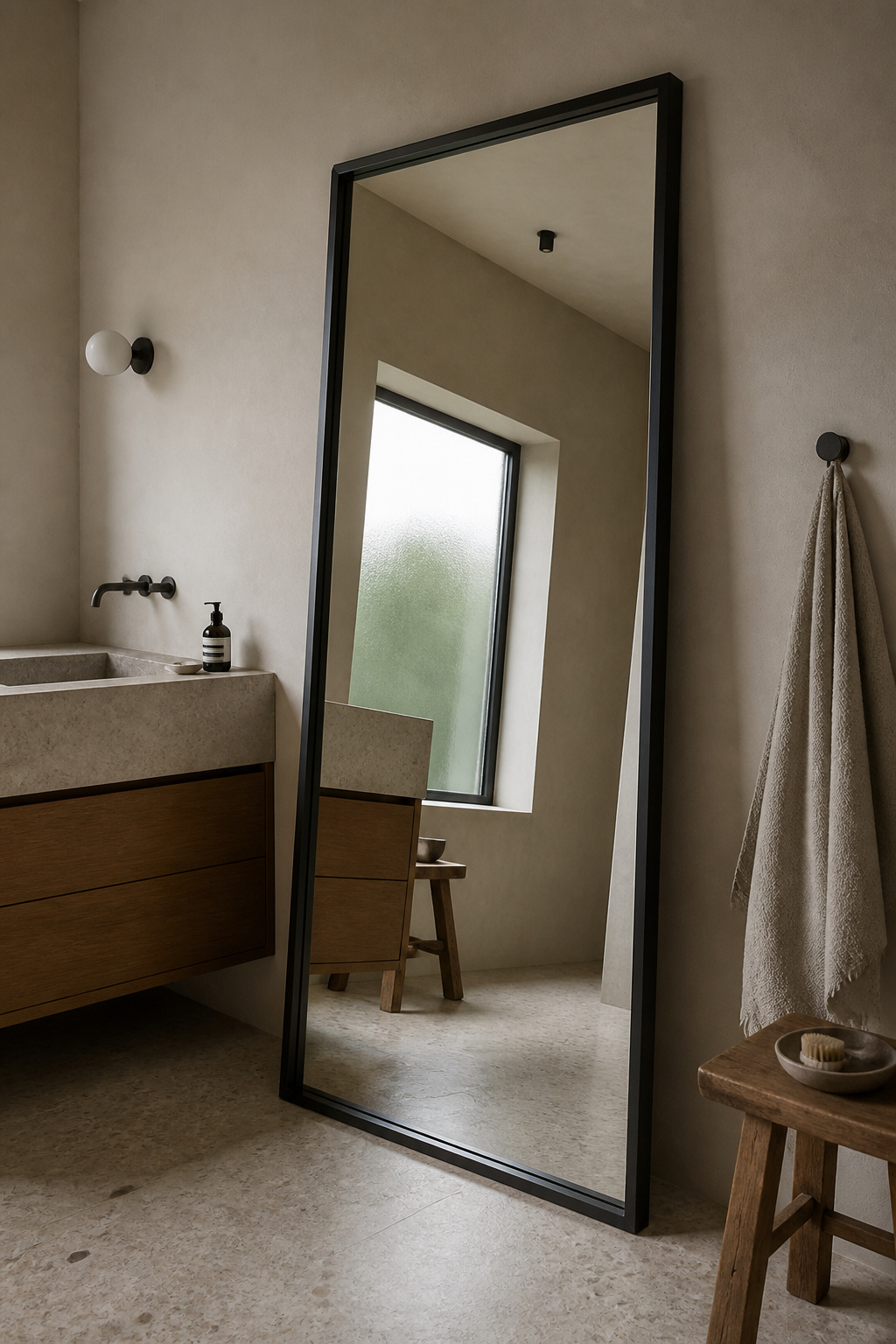
Blackened or powder-coated steel is the frame material of choice for a Nordic bathroom because it performs reliably in humidity and ages without deteriorating. Powder-coated steel and aluminium alloy frames are moisture-proof and non-warping. Raw iron is genuinely not suitable for bathrooms — it oxidises in humidity and will transfer staining to nearby surfaces within eighteen months. It looks right in photographs and fails in practice. The most underused placement option is the back of the bathroom door: a slim-framed full-length mirror mounted here adds the full function — light, space perception, full-length dressing — without occupying any floor area, which is the scarcest resource in a small bathroom.
Hygge is not, primarily, about aesthetics. It is a practice of deliberate comfort — the Danish and Norwegian commitment to creating conditions for embodied ease rather than simply looking at them. In the bathroom, this principle shows up in what touches your skin after a shower: the weight and weave of the towel, whether it dried properly between uses, and whether reaching for it feels like a small pleasure or just a reflex.
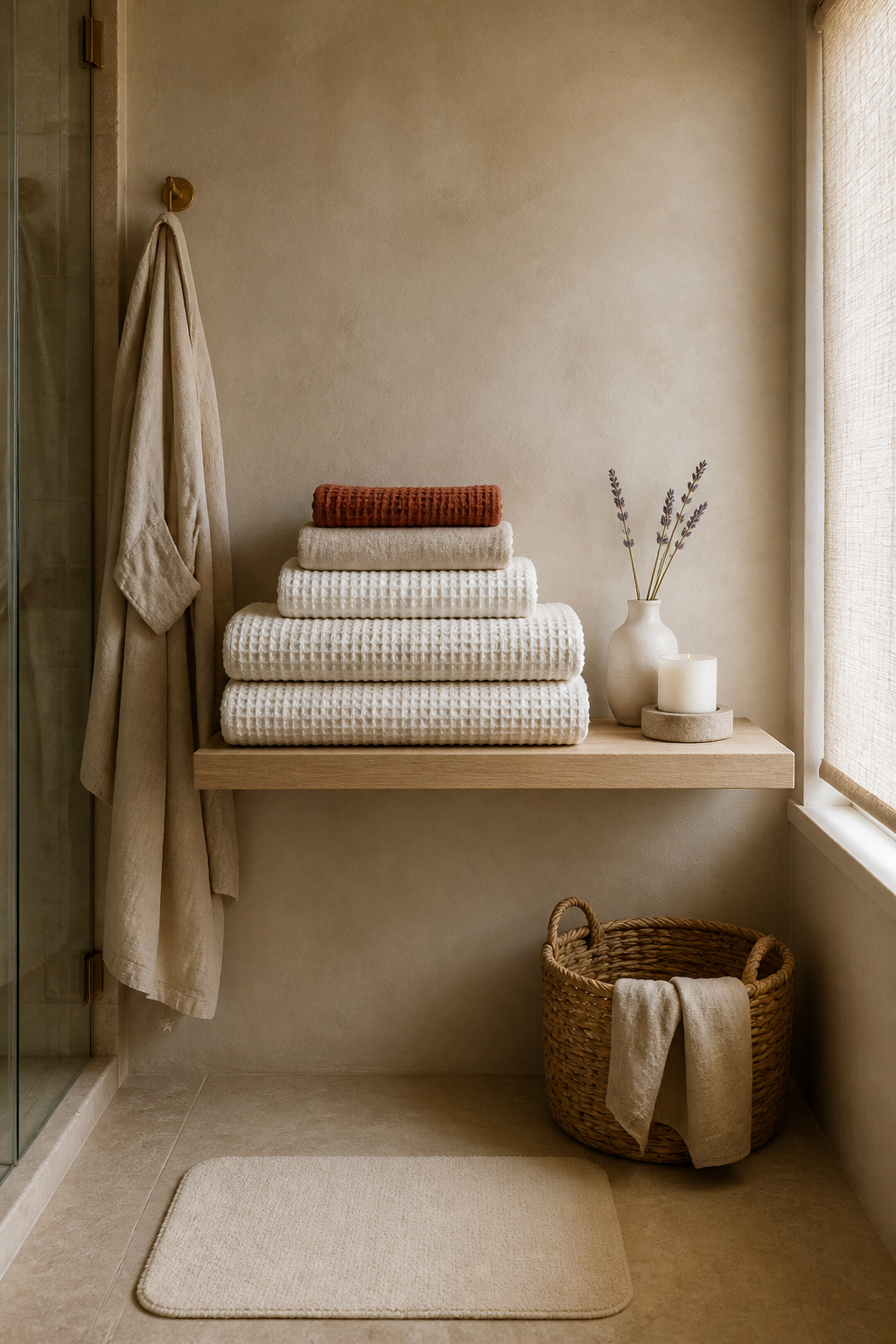
Waffle-weave towels are the practical foundation of a Nordic bathroom textile selection. The grid of pockets in the weave absorbs roughly three times their weight in water despite weighing about thirty percent less than terry — and they dry in half the time. In a bathroom with multiple users or limited ventilation, this drying speed matters. A damp terry towel folded on a hook is heading toward that musty smell within twenty-four hours; a waffle towel hung open is genuinely dry.
Layer a waffle hand towel with a linen flat towel on the same hook or rail — the linen adds the drape and weight that waffle alone cannot provide. Keep the palette to the Nordic neutral range: warm white, undyed linen, pale grey, soft oat. One colour accent — dusty terracotta, soft olive, muted blue — folded among three neutrals adds warmth without breaking the composition. Stack rather than hide: folded towels on an open shelf are a decoration in themselves, and the Scandinavian bathroom treats them as such.
Teak in a bathroom is one of the few cases in interior design where the most beautiful option is also the most practical. Its natural oil and silica content creates a built-in moisture barrier — waterproofing from within, without any sealing, staining, or treatment required. On the Janka scale it scores between 1,000 and 1,155 — not the hardest timber available, but its combination of density, closed grain, and natural chemistry gives it moisture performance that higher-scoring timbers without internal oils cannot approach.
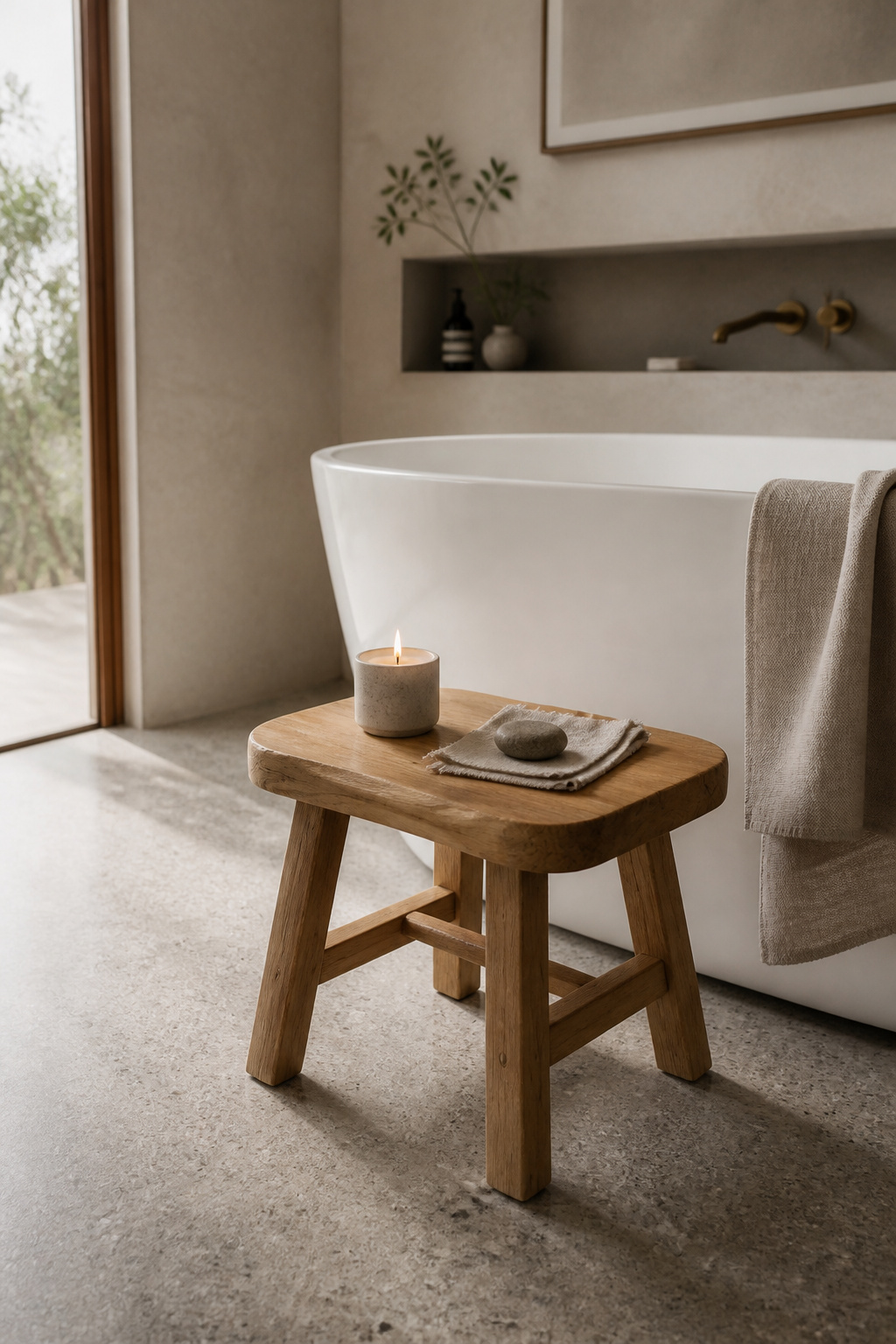
This bathroom decoration idea works because it is both functional and composed simultaneously. A low teak stool (35–40 cm high) beside a freestanding tub holds a book, a carafe, a candle. Inside a large shower, it functions as a seating step for washing feet. It moves from bathroom to bedroom to garden without looking out of place in any of them. Style the stool top with three objects at different heights — a taller bottle, a lower dish, a flat stone — to create a composed still life rather than a flat arrangement. Leave it empty when not in active use. The teak itself is the decoration.
In Scandinavian design, light is treated as a material — it has texture and direction as surely as stone or timber does. The preference, in that tradition, is for diffused light over direct: scattered rather than directional, filling the room evenly rather than casting bright pools and dark shadows. A frosted bathroom window scatters incoming light across its textured surface, maintaining brightness while eliminating glare and providing complete privacy.
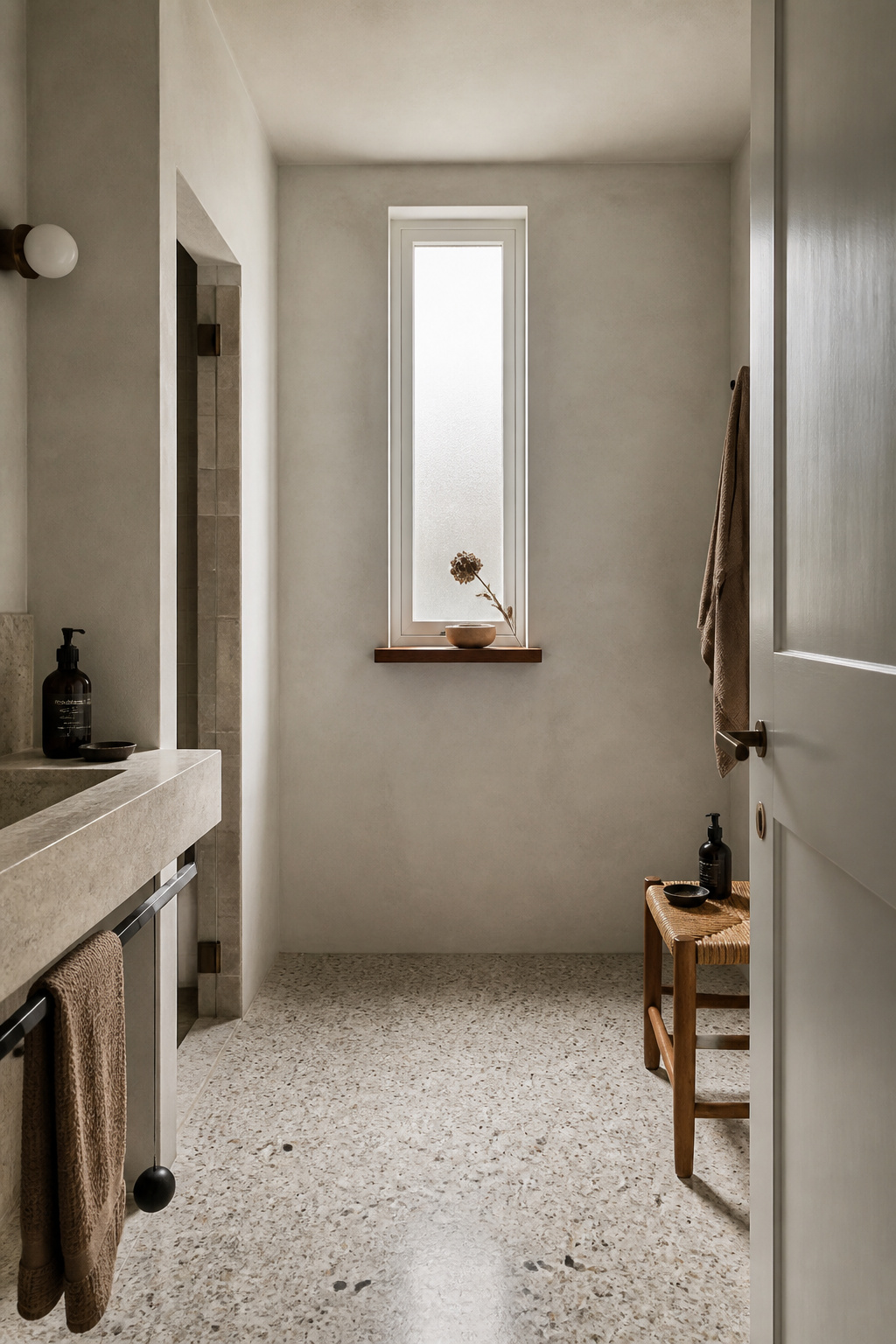
This bathroom decoration idea is also one of the most practical: a narrow window positioned high on the wall bounces light across the ceiling and upper walls first, creating the quality of illumination that makes a room feel considered. For the upgrade itself, frosted window film (static cling, no adhesive) is the most accessible option — it does not warp or mould in bathroom humidity, costs £15–50 per window, and is completely removable, appropriate for renters or for testing the effect before committing. Acid-etched glass is the permanent version: applied directly to the glass surface, it cannot bubble or peel over time. Full glass replacement is only worth the cost during a broader bathroom renovation.
The area between the basin and the mirror is one of the most consistent opportunities for a bathroom decoration idea that does real work — visible from every position in the room, protective of the wall from water and steam, and small enough that a considered material choice does not require a large budget. Pebble mosaic earns its place in the Nordic bathroom because it does what the style values most: it looks exactly like what it is.
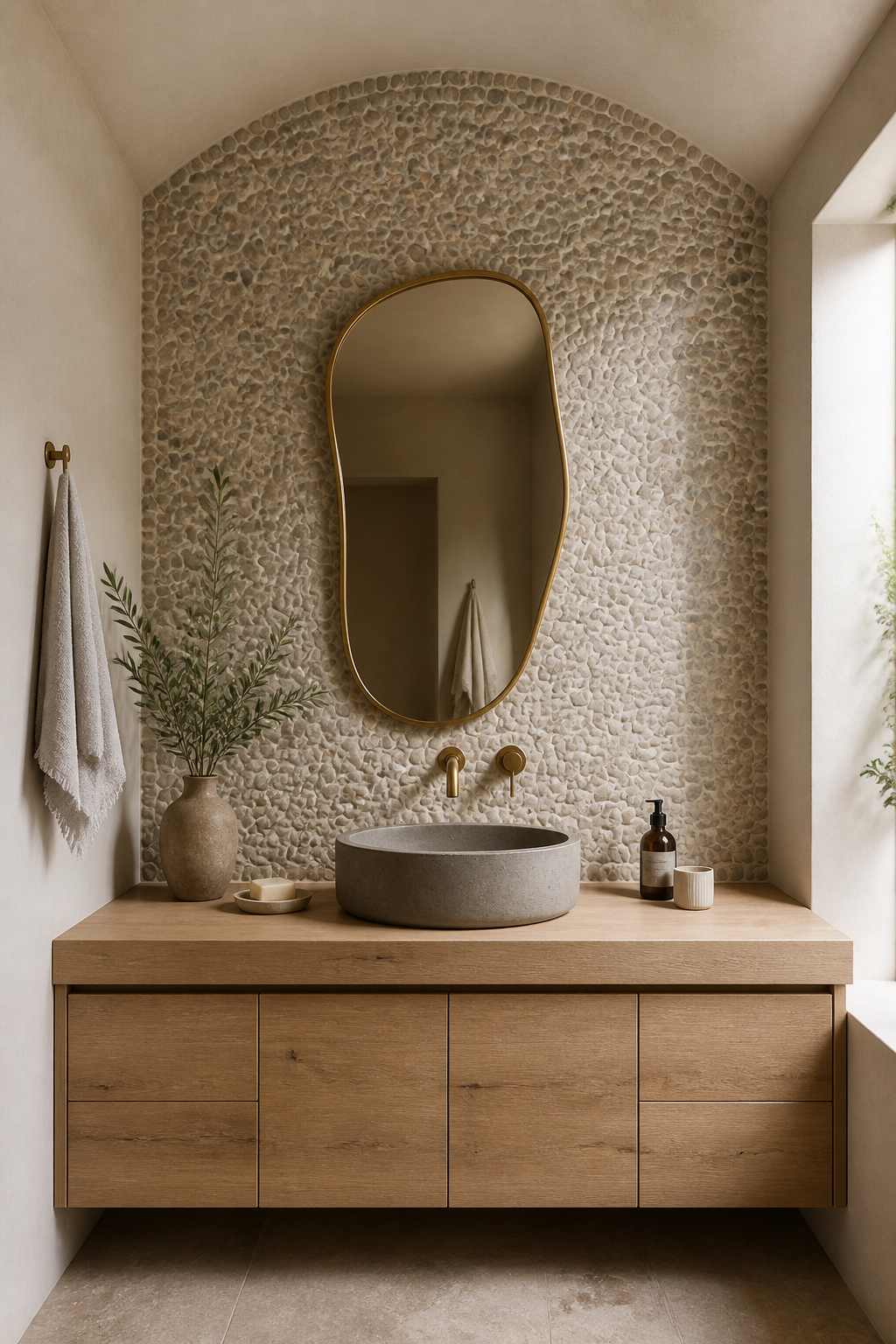
River pebbles come pre-mounted on mesh backing in 30 × 30 cm sheets, making installation straightforward with standard thin-set mortar. The tonal variation within the pebbles — subtle shifts from warm grey to near-brown to off-white — is what the eye reads as natural rather than patterned. A uniform tile at the same scale reads as static; the river pebble surface reads as alive. For a flatter alternative with less surface texture to clean around, tumbled slate offers similar organic variation with a lower profile. For a broader look at what natural stone can do across the full bathroom, our guide to Nordic-inspired bathroom tile design covers everything from limestone to slate board.
Choose a grout in the mid-tone of the pebble collection — a warm grey for a grey-dominated mix, a sand tone for a warmer one — and the surface reads as continuous rather than as isolated stones on a dark grid. Seal the pebbles before grouting (a penetrating stone sealer prevents grout from permanently staining the stone), then seal again once the grout has cured. Two applications total, and the surface will stay clean and well-bonded for years.
The bathroom counter is a small surface with an outsized influence on the overall room. Get the objects on it wrong — too many, too varied, too casually placed — and a beautifully designed bathroom reads as cluttered. This bathroom decoration idea is more about editing than adding: choosing one material for all counter accessories and restricting the number of objects to those that genuinely earn their place.
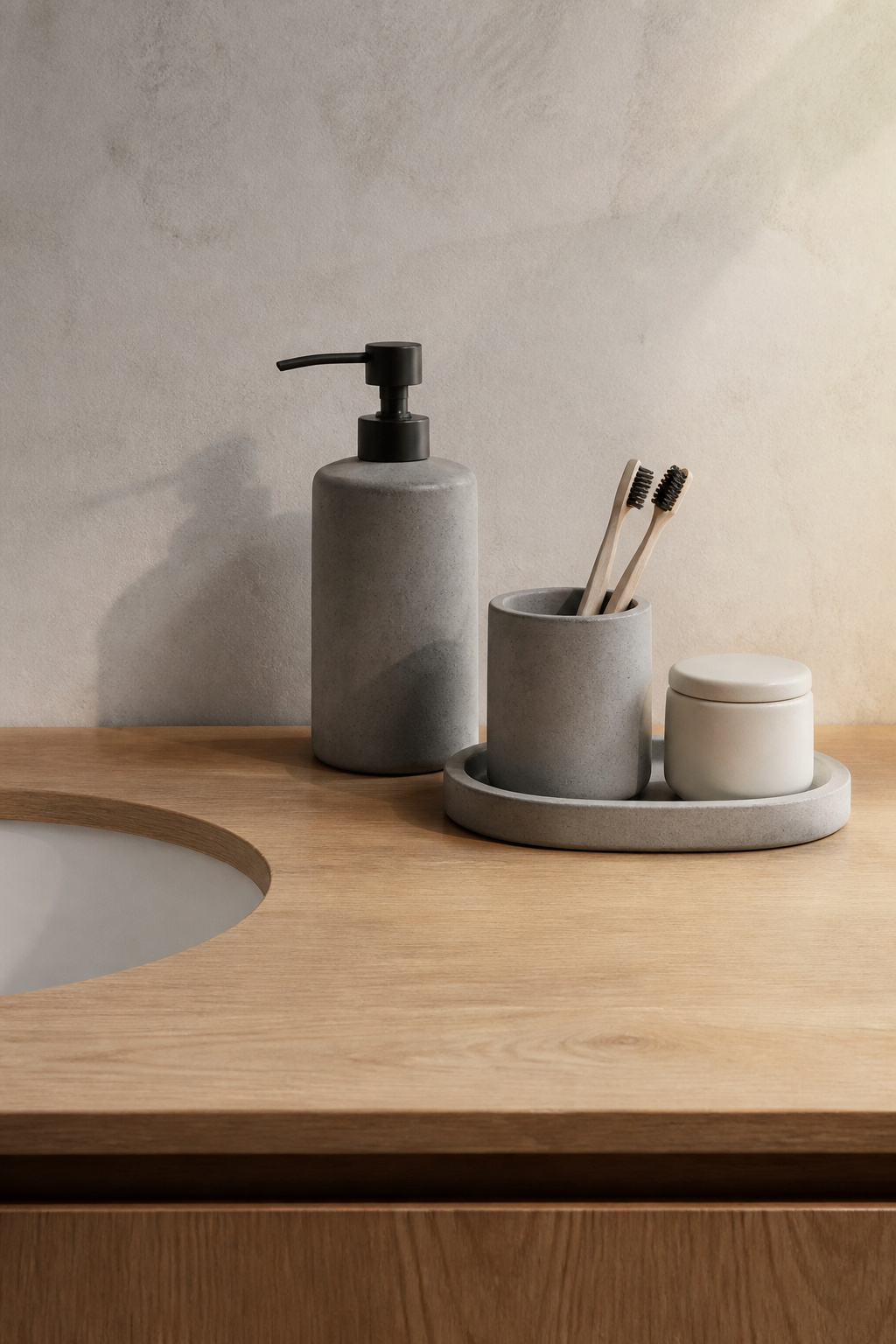
A concrete soap dispenser paired with a matching concrete tray reads as a set rather than a collection — the material repetition creates visual coherence that three different materials would fracture. Concrete accessories are hand-poured in small batches, sealed at manufacture but remaining somewhat porous: water spots accumulate over time and they dislike abrasive cleaners. Soapstone is the maintenance-free alternative — naturally non-porous and impervious to household cleaners. Matte ceramic offers the same visual register at lower cost and weight, completely non-porous and dishwasher-safe.
Three is the Nordic maximum: one for washing, one optional functional object, and the basin itself as the third visual element. A small tray — slate, concrete, or wood — corrals the objects and makes the arrangement look intentional even when everything has been hastily replaced after a morning rush. The tray is what separates a composed counter from an abandoned one.
Most bathroom lighting is wrong in a specific way: a single overhead downlight above the mirror creates downward shadows that exaggerate under-eye circles, flatten facial features, and make a grooming task feel like an examination. Lateral lighting at mirror height — wall sconces mounted on either side of the mirror at face height — eliminates directional shadows rather than just adding more light.
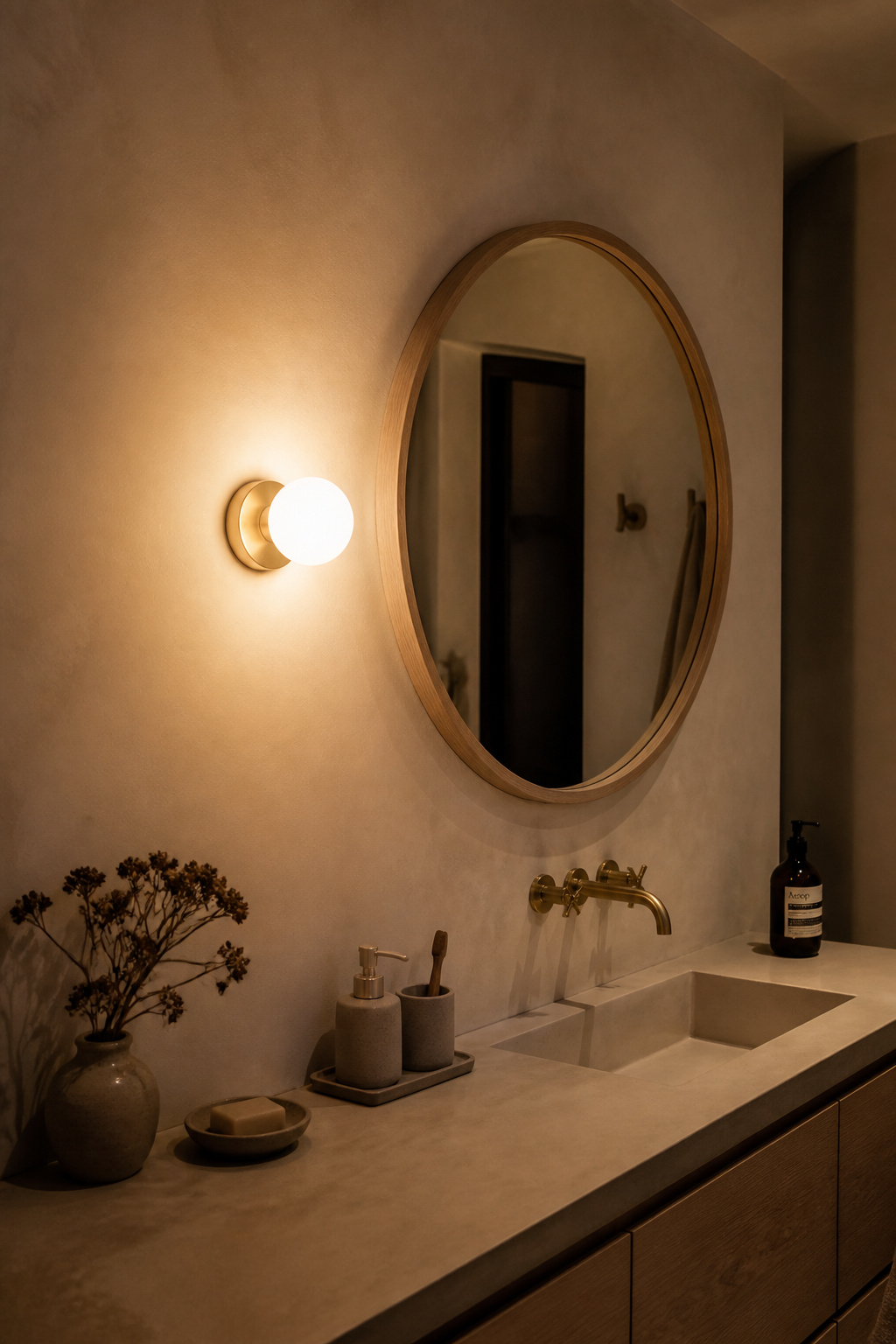
The physics are simple: a light source directly above your head casts shadows downward; sources on either side of your face at face height cast no shadows at all. Sconce centres should sit approximately 150–165 cm from the floor and roughly 35–40 cm from the mirror centre. Two sconces is significantly better than one. If you are starting from scratch with the lighting plan, our roundup of bathroom vanity lighting ideas covers the full spectrum of sconce and integrated mirror lighting options.
The dimmer is what converts the bathroom from a utility space into a retreat. Full brightness for grooming; reduced, warmer light for an evening bath. For the bulbs: 2700–3000 Kelvin with a CRI of 90 or above. Below CRI 90, colours shift — skin tones look grey or jaundiced. Always confirm the specific bulb is rated for dimmer use before installation. Standard LED bulbs on a dimmer circuit buzz, flicker at low brightness, and fail earlier than their rated lifespan.
A fixed glass shower screen reads as infrastructure — permanent, transparent, and completely invisible to the design of the room. A fabric shower curtain in natural linen reads as a textile choice: a deliberate material decision that introduces warmth, drape, and softness into a room of hard surfaces. It is also the most reversible significant change on this list, which makes it an excellent starting point for anyone uncertain about committing to a full bathroom decoration project.
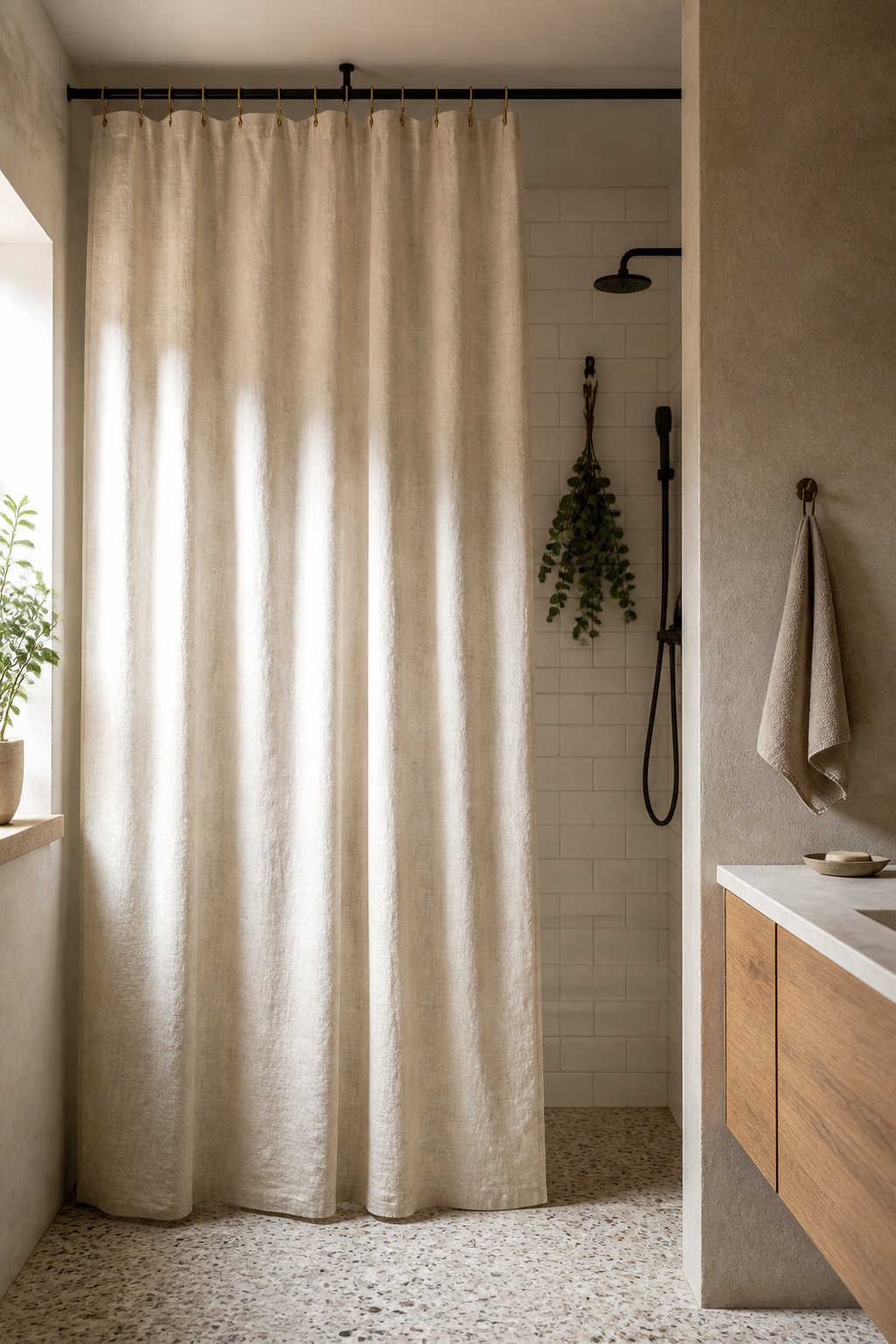
Linen’s distinctive quality in this application is its drape — the way it falls in natural, slightly irregular folds that look styled without effort. The maintenance concern with linen in a humid bathroom is genuine but manageable: leave the curtain fully outstretched after every shower, rinse briefly with clean water, and wash the whole curtain every four to six weeks with a mild detergent. Linen softens over many washes — it is not delicate. For bathrooms with poor ventilation, a high-density linen-look polyester curtain offers the same visual quality with better mould resistance and faster drying.
A ceiling-mounted track draws the curtain from the ceiling rather than from a rod at the top of the tile, making the room feel taller and the curtain more architectural. A tension rod is the quick, renter-friendly solution — choose a thick-diameter rod in brushed brass or matte black to avoid the thin chrome look. Simple, round rings in the same finish as your other bathroom hardware let the curtain hang in clean vertical folds rather than bunching at the rings.
A freestanding tub is the most significant design commitment a bathroom can contain. It occupies the centre of the room, it costs more than any other single fitting, and it signals a specific intention about how the bathroom is meant to be used — not just for efficiency, but for rest. A pendant light positioned directly above makes the tub the room’s obvious and deliberate focal point. Without dedicated overhead light, the freestanding tub competes with everything else in the room for visual weight. If the pendant is just the beginning of a broader rethink of the space, our guide to minimalist bathroom design ideas covers how to approach the full room without overcomplicating it.
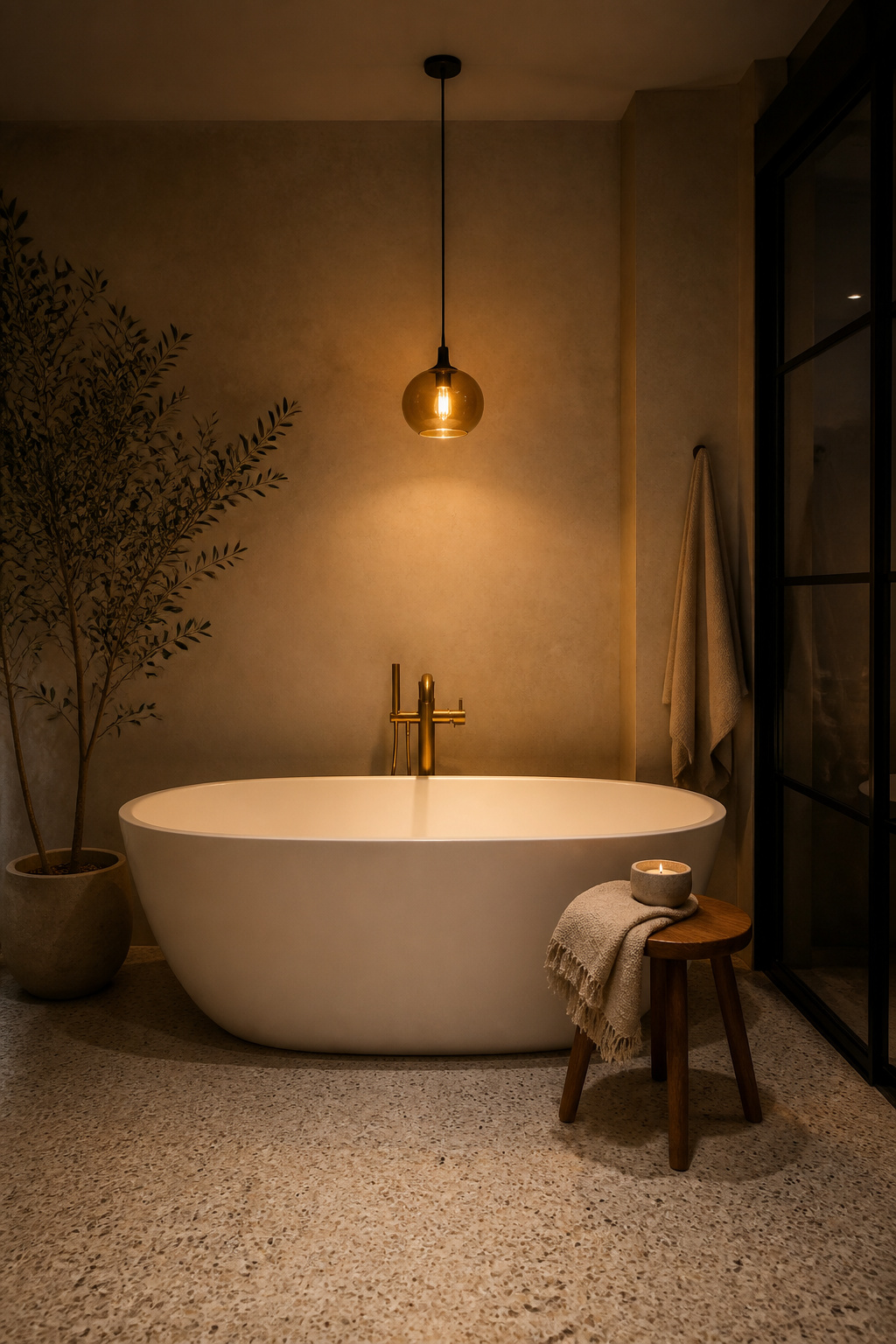
IP ratings are not optional. Zone 2 rules (UK/EU) require a minimum IP44 for any light within 60 cm of the bath; directly above the tub, IP65 is the sensible choice. In the US, NEC code prohibits chain- or cord-suspended luminaires within the zone measured three feet horizontally and eight feet vertically from the bathtub rim — check this carefully before specifying a hanging pendant. The minimum safe hanging height is 2.25 metres from floor to fixture.
Smoked or amber glass is the most forgiving choice for bathroom use — it diffuses the bulb source while maintaining the pendant’s visual presence as a decorative object, and works beautifully with warm 2700K light. Rattan and natural woven fibre shades look extraordinary but degrade in high-humidity environments without strong mechanical ventilation. Spun metal shades direct light downward as a focused pool — slightly harsh above a bath unless the bulb is positioned to bounce off the shade rather than shine directly down.
The Nordic subtraction principle applies here as much as anywhere: for every element you add, assess whether it earns its presence or displaces something that was already working. A bathroom with five well-chosen elements — a limewashed wall, an oak shelf, a good mirror, a proper sconce, and a teak stool — is more satisfying to live in than one with fifteen ideas competing for attention.
In a small bathroom, prioritise changes that affect the wall plane before surface-level accessories. Walls surround you; they have more perceptual impact than what sits on a shelf. A limewash treatment or a frosted window changes the quality of light and surface texture that defines the room’s character. Sequence matters too: the terrazzo tile, the vessel basin, and the pebble mosaic splashback are permanent decisions. The linen shower curtain, the waffle towels, and the eucalyptus bundle are not.
Start with the reversible. A linen shower curtain, a set of waffle towels in the Nordic palette, a eucalyptus bundle on the shower rail. These bathroom decoration ideas cost relatively little, change tomorrow if needed, and are the best research you can do before deciding what the room actually needs from the more committed interventions. The goal, in all of this, is not to execute a style. It is to make a bathroom that feels genuinely calm — a room you are glad to be in rather than simply passing through.