Physical Address
304 North Cardinal St.
Dorchester Center, MA 02124
Physical Address
304 North Cardinal St.
Dorchester Center, MA 02124
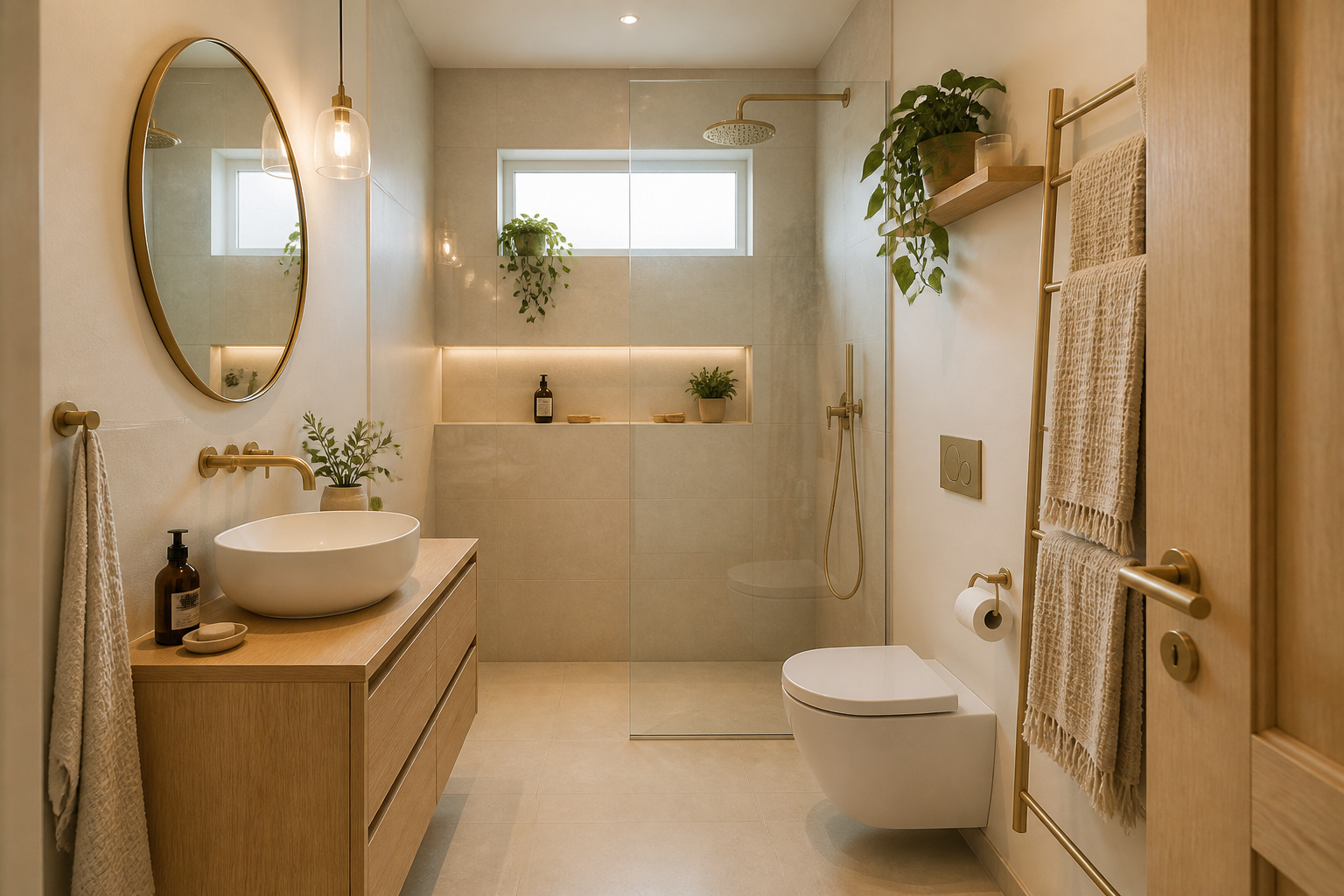
Transform your compact bathroom with these 17 Nordic small bathroom decoration ideas — from pale palettes and floating vanities to hygge textiles and wet rooms.
The moment it clicked for me was standing in a 4-square-metre bathroom in a converted Stockholm apartment — a space so small you could touch both walls without fully stretching your arms. What struck me wasn’t that it felt cramped. It felt considered. Intentional. Impossibly calm.
That’s the Nordic approach to small bathroom decoration that homeowners everywhere have been discovering: constraint isn’t a design problem to apologise for — it’s an invitation to be more deliberate about every single choice you make.
In eleven years designing interiors influenced by Scandinavian principles, I’ve helped dozens of people transform genuinely tiny bathrooms into spaces they look forward to using each day. The secret isn’t budget or square footage. It’s knowing which changes make the greatest impact and in which order to make them. Scandinavian homes have solved the small bathroom problem for generations, simply because the climate makes every heated square metre valuable.
This guide moves through a progressive toolkit: from the foundational decisions about colour and light that set everything else up for success, through to the fine details — textiles, botanicals, hardware — that turn a functional room into something that genuinely feels like a spa. Start at the beginning or jump to wherever your bathroom needs the most help.
Colour is where the Nordic approach to small spaces begins, and it’s subtler than most people expect. The instinct is to use bright white everywhere — to flood the room with light. But the Scandinavian tradition is different. Walk into a bathroom in Copenhagen or Oslo and you’ll notice the whites are warm, slightly creamy, occasionally edged with grey or stone. They feel expansive precisely because they’re not clinical.
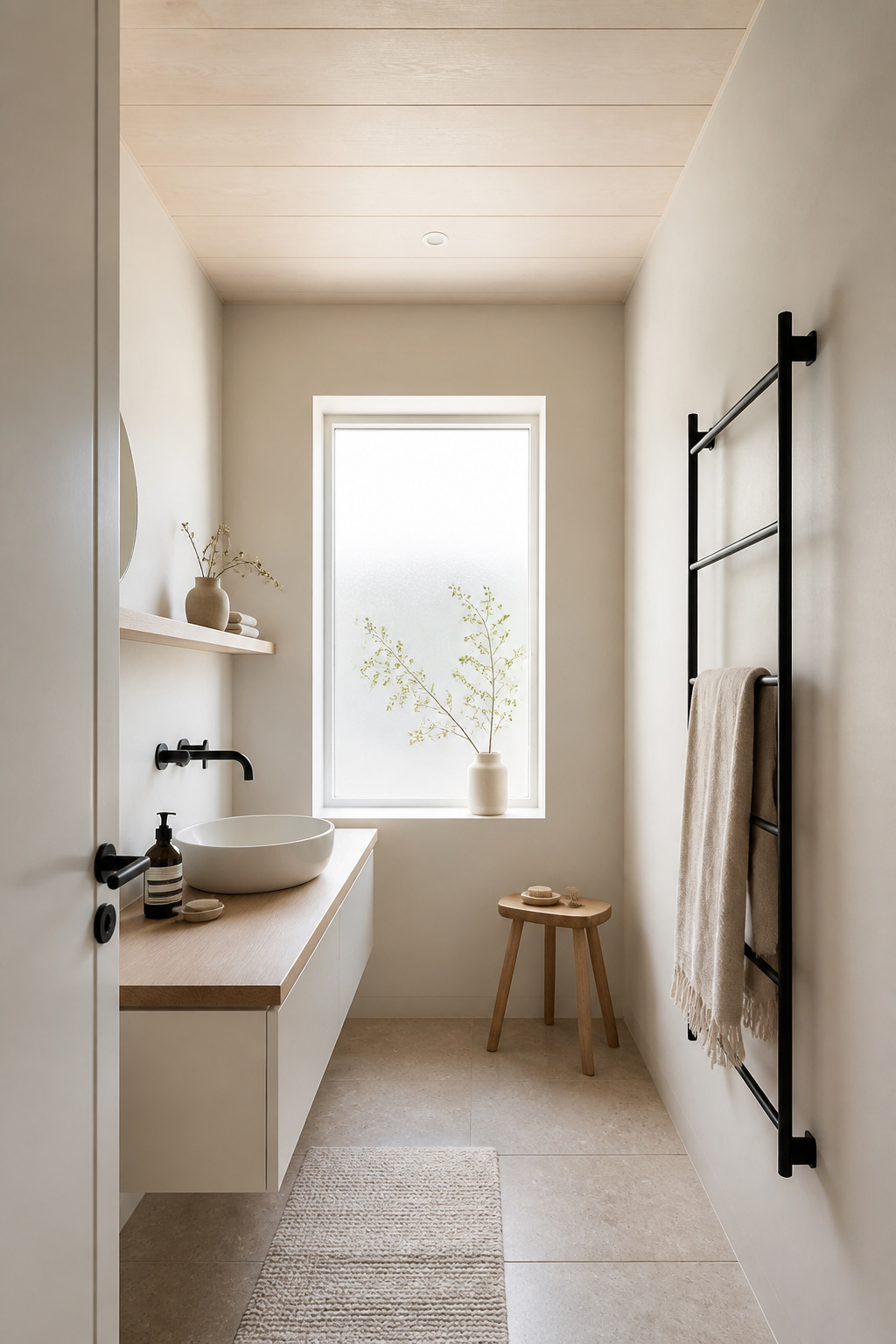
The key principle is tonal layering. Rather than a single shade of white from floor to ceiling, Nordic bathrooms use two or three close values of the same warm tone: a lightest shade on the ceiling, a slightly deeper white or greige on the walls, and a warm stone or pale timber for the floor and vanity surfaces. The result is a graduated depth that the eye reads as continuous space. Nothing is harsh enough to define a boundary. Jotun’s Lys Hvit and Farrow & Ball’s Pointing are the sort of wall tones I return to repeatedly — they hold warmth under both natural and artificial light without tipping into yellow.
The greige trend of 2025–2026 — a blend of warm grey and beige — is particularly useful in bathrooms because it bridges wood tones and metal fixtures without pulling in either direction. If you’re uncertain which direction to take a neutral palette, greige is the safest choice for a floor tile or vanity front.
One detail most people omit is the single dark element. A matte black tap, a brushed iron mirror frame, a thin dark-metal towel rail — something that gives the eye a resting point. Without it, a fully pale palette reads as washed-out. With it, the room snaps into focus. Keep that dark element to around 5–10% of the visual field and it will do everything you need without undermining the airy quality you’ve worked to create. A new tap set in matte black costs less than a feature tile and does more.
Few changes deliver as much impact for as little structural work as getting the mirror right. In a windowless bathroom, a large mirror positioned opposite the main light source can increase perceived spaciousness by around 20% — and that’s before you’ve changed a single tile.
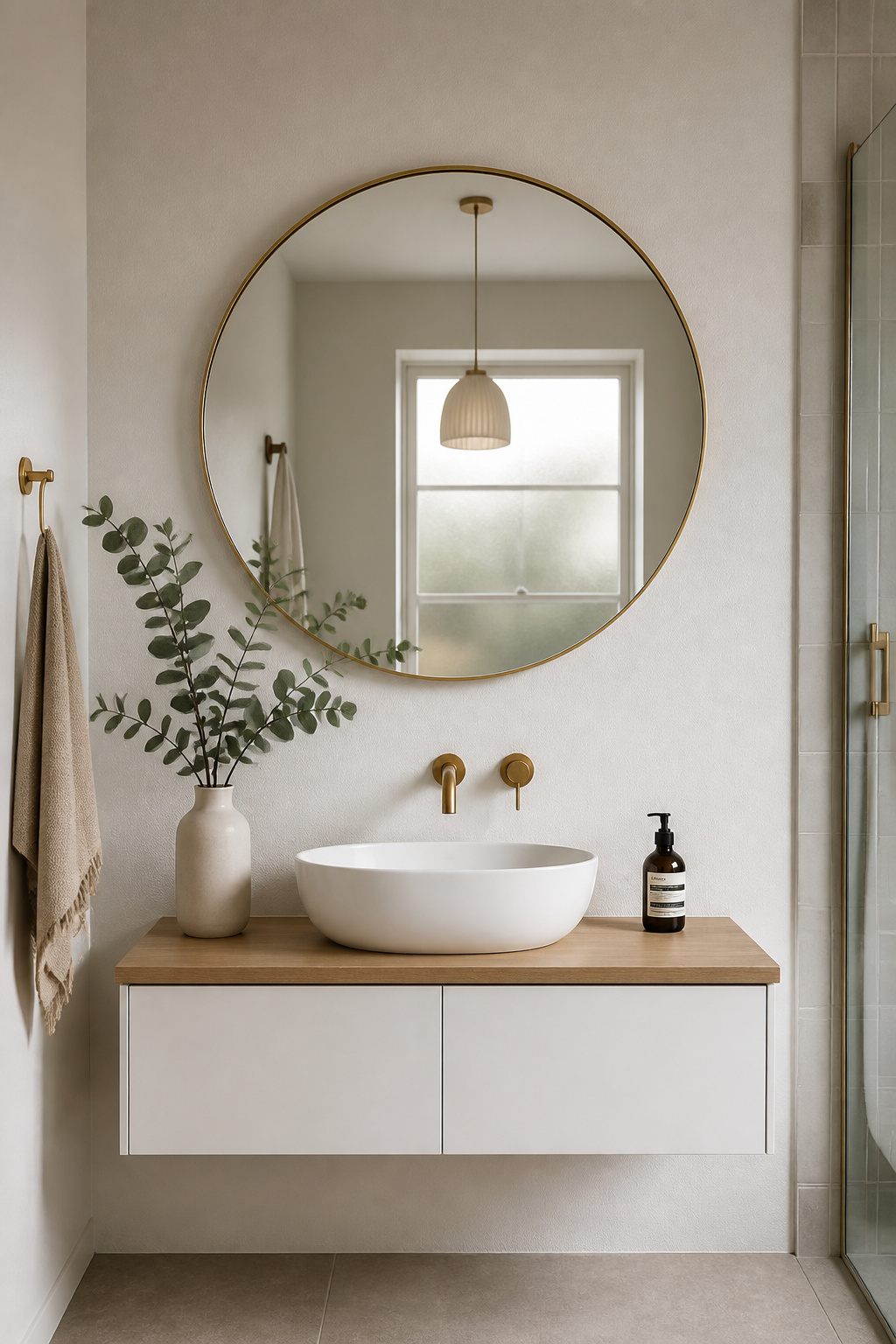
The Nordic preference isn’t for a small vanity mirror centred above a basin. It’s for a mirror that spans the full width of the vanity wall, or gets close. A mirror that matches or exceeds the vanity’s width creates a balanced composition and maximises light reflection throughout the room. Floor-to-ceiling panels are the most space-amplifying option — paired with a thin brass strip frame, they give a genuinely expansive effect. That said, the large organic round mirror has become a defining Scandinavian choice, and for good reason. A 70–90cm diameter circle in brushed brass or natural rattan adds sculptural character without visual weight. The curved edge softens angular tile lines, and in a small bathroom where you want strong focal points without busyness, it earns its place immediately. For choosing a bathroom mirror that suits your style, the real question isn’t size — it’s whether the shape and frame material coordinates with everything else in the room.
One mistake worth avoiding: hanging a mirror smaller than the vanity below it. This is a proportion problem as much as a functional one — a small mirror on a wide wall reads as an afterthought and undermines any sense of deliberate design.
If you’re renting and can’t drill, a leaning full-length mirror in a corner solves two problems at once. It covers full-body appearance and pushes the perceived boundary of the room further back — all without a single hole in a structural wall. A 160–180cm floor mirror leaning at a slight angle in the corner beside the vanity does more for the sense of space in a 3-square-metre bathroom than almost any other single piece. I’ve recommended this to countless apartment dwellers and it never disappoints.
The visual difference between a framed and a frameless shower enclosure is genuinely dramatic in a small bathroom. Framed enclosures — those aluminium channels running along every edge — draw a firm rectangular outline around the shower zone that reads as a room within a room. The bathroom feels divided. Frameless glass removes that outline entirely, so the eye reads the floor and walls as one continuous space, with the shower zone implied by the showerhead and drain rather than marked by any physical boundary.
For bathrooms under 4 square metres, the configuration choice matters as much as the framing. A pivot door requires swing clearance — typically 70–90cm of unobstructed floor space in the opening direction. That’s often space a small bathroom simply doesn’t have between the shower and the vanity or toilet. A fixed panel with an open entry (a walk-in) sidesteps this entirely: no door to swing, no clearance to sacrifice, and the simplest visual profile possible.
The standard frameless panel is 8mm thick; specifying 10mm instead costs a little more and makes a noticeable difference to how the glass feels — a solid, deliberate thud rather than a click. In a small bathroom you’re paying a premium for quality sensory experiences, and the feel of well-engineered glass is part of the daily ritual.
If you’re concerned about maintenance, a nano-hydrophobic coating (ClearShield or EnduroShield are the established choices) bonds to the glass at the molecular level and causes water to bead and run off rather than sit and leave mineral deposits. Properly coated frameless glass needs a weekly rinse rather than daily squeegee treatment — the maintenance objection most people raise essentially disappears.
The floating wall-hung vanity is central to Scandinavian bathroom design, not because it’s a trend, but because it solves a genuine problem with clarity. Mount the vanity on the wall, expose the floor underneath, run the same tile from wall to wall beneath it, and the room reads as significantly wider than it physically is.
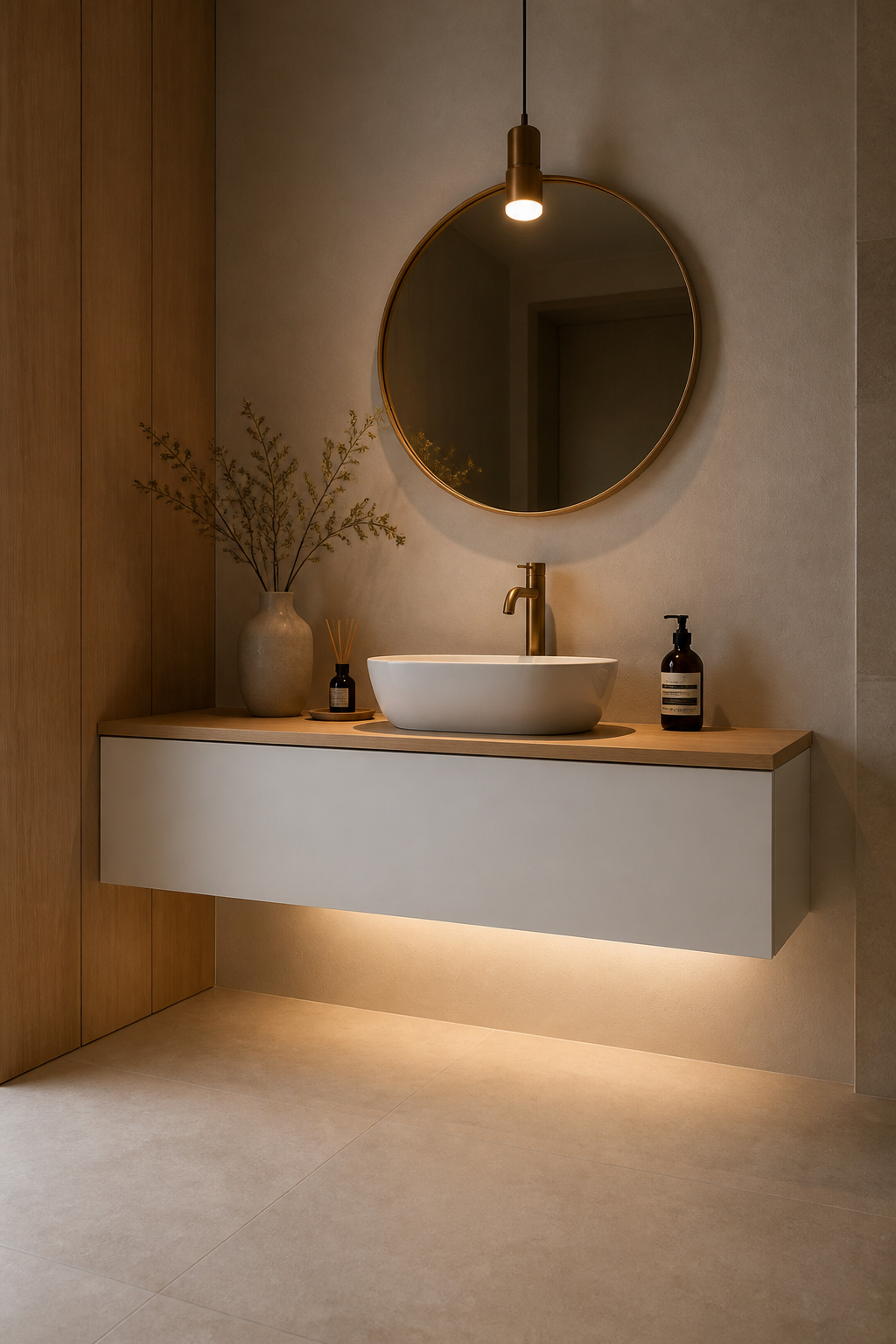
The optical effect is straightforward: a floor-standing pedestal vanity covers a rectangle of floor roughly 60cm × 48cm and terminates visually at floor level. A floating vanity exposes that same area and pushes the visual boundary to the wall behind it. Combined with a wall-to-wall mirror above, you create an uninterrupted horizontal and vertical axis that the eye follows without stopping — the hall-of-space effect that makes a 3-square-metre bathroom feel considered rather than cramped.
Nordic floating vanities typically come at 40cm depth — shallower than the standard European floor-standing vanity at 52–55cm — which gains 12–15cm of standing room in a compact bathroom. For choosing the right bathroom vanity for your space, the depth dimension matters as much as the width; many people overlook it entirely when shopping online. The Nordic convention for handle-free cabinetry — push-to-open mechanisms using Blum Tip-On hardware — maintains a completely flat visual plane at eye level, with no protruding handles breaking the composition.
Resist the temptation to fill the floor beneath the vanity with storage baskets. That undercuts the optical effect entirely. Keep it completely clear — or, at most, use a single folded bath mat narrower than the vanity width. The under-vanity LED strip detail is worth considering: a 10cm strip pointing downward creates the illusion the vanity is hovering, which is a small but genuinely dramatic effect at night and costs very little to install.
Wood in the bathroom is a specifically Nordic idea — it comes from the same tradition as the sauna, which places untreated timber in the most humid space imaginable and trusts the material to endure. In smaller bathrooms away from the shower zone, the right species in the right form delivers warmth that no painted surface can replicate.
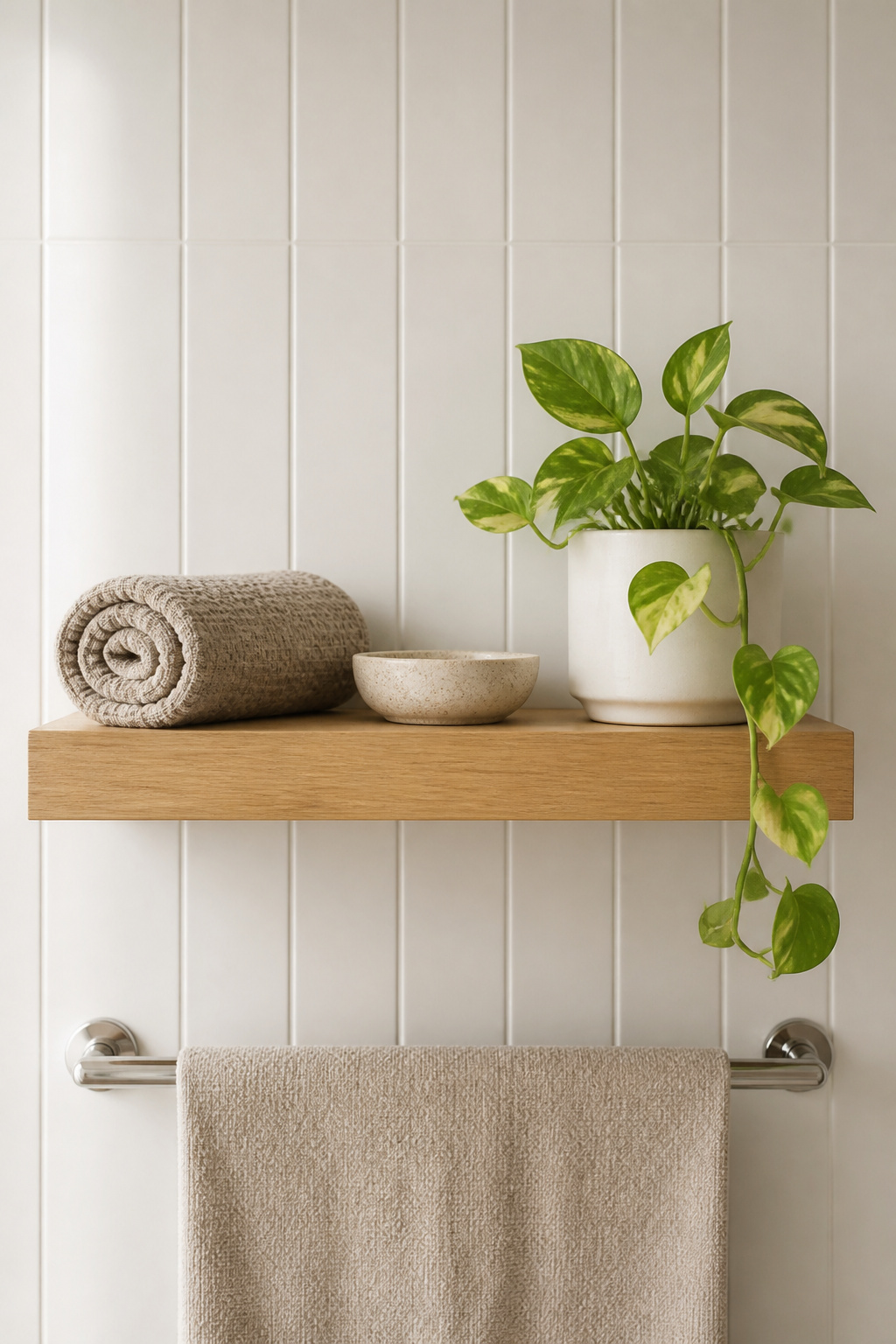
The two species worth knowing are white oak and teak. White oak — not red oak — has tyloses in its cellular structure: microscopic blockages that physically prevent water from penetrating into the wood fibres. That’s why it’s the dominant species in Nordic bathroom vanities, and why it handles bathroom humidity without the constant heavy resealing that red oak requires. Teak brings natural silica and oils that act as a built-in moisture barrier; it’s been used in Nordic sauna and outdoor decking for generations because it needs less maintenance than virtually any other species.
For a small bathroom, the most effective approach is a single piece rather than saturating the room with wood. One floating shelf beside the mirror, or a 40–60cm wide oak vanity top, introduces warmth at exactly the level where you see and touch it most — without closing in the space.
Whatever species you choose, finish it with a hard-wax oil — Osmo Polyx or Rubio Monocoat are the professional-grade products — rather than a film-forming polyurethane. Hard-wax oil penetrates and feeds the wood fibres rather than sitting on top as a layer that can peel under bathroom conditions. It also keeps the natural, matte appearance that makes timber feel genuinely Nordic. Reapply every 12–18 months.
The Scandinavian wet room is perhaps the most counterintuitive Nordic bathroom idea for someone encountering it for the first time. Remove the shower tray. Remove the enclosure. Let the entire floor — tiles, gradient, and all — become the shower. It sounds chaotic. In practice, it’s the most serene and space-maximising shower format you can build in a compact bathroom.
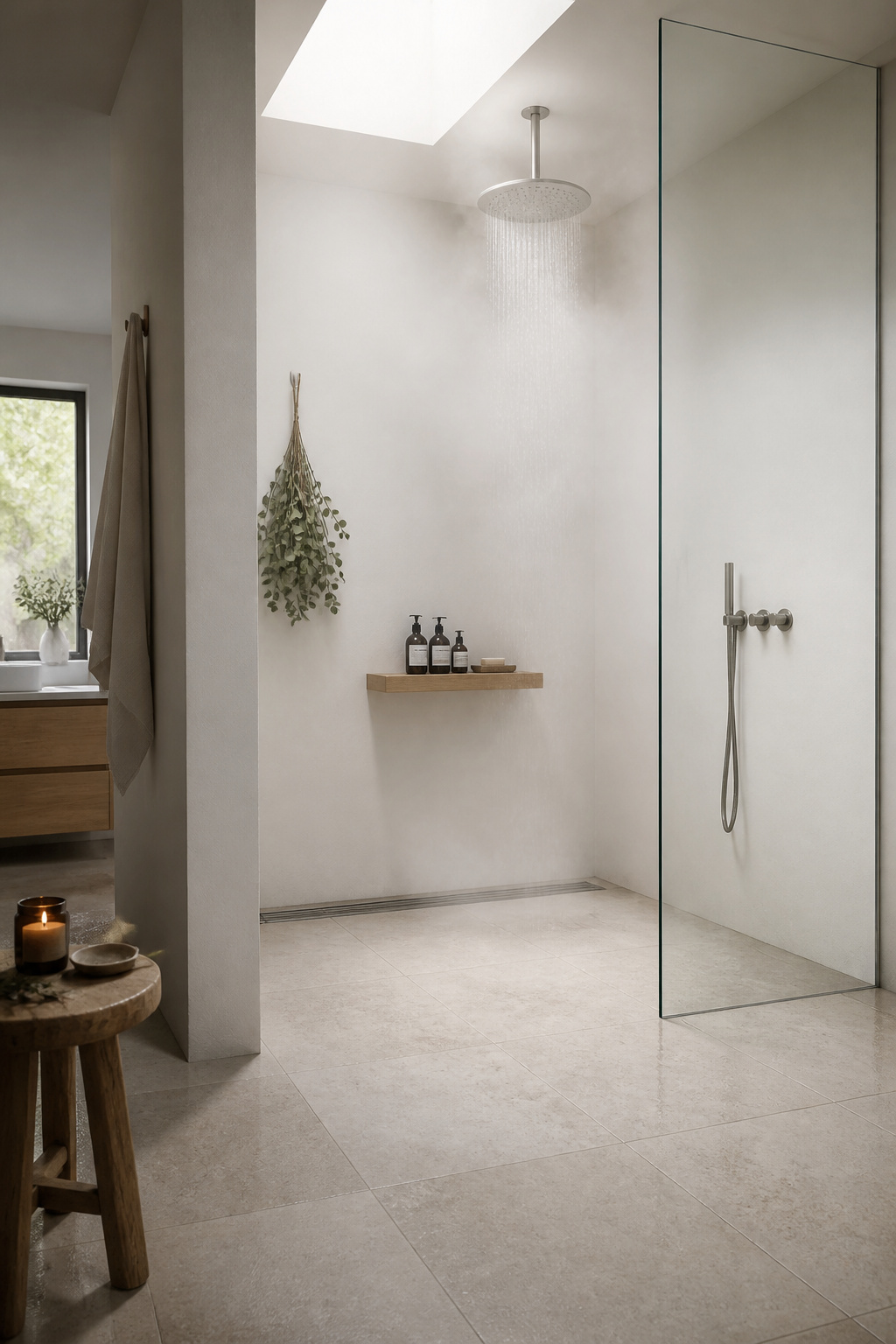
Wet rooms have been common in Scandinavian homes since the 1970s because so many Nordic apartments have bathrooms under 4 square metres where a separate shower tray is simply impractical. The continuous floor plane that results is the most effective single design decision for making a small bathroom read as larger — the eye sees one room, one floor, one unbroken space, rather than a shower tray announcing a separate zone.
Installation requires a tanking membrane applied to the floor and walls up to at least 500mm height, with fibreglass mesh tape over all joints, and a 1.5–2% floor gradient toward a linear drain at the wall rather than the centre. That last choice matters for tiling: with a wall-line drain, the floor slopes in one direction only, so large-format tiles can run the full width without the awkward cuts a central four-way slope forces.
The practical concern everyone raises is water getting everywhere. In reality, a fixed glass panel 100–120cm wide at the edge of the shower zone deflects the vast majority of spray, particularly with a ceiling-mounted rainfall head. A 30-second floor squeegee each morning keeps the space dry and prevents limescale build-up in a room where there’s no transition point between wet and dry zones.
Most small bathrooms waste their greatest untapped resource: height. The area from 150cm to ceiling level — often a metre or more of wall — typically holds nothing but paint and frustration. In a compact bathroom, thinking vertically can multiply usable storage without touching the floor footprint at all.
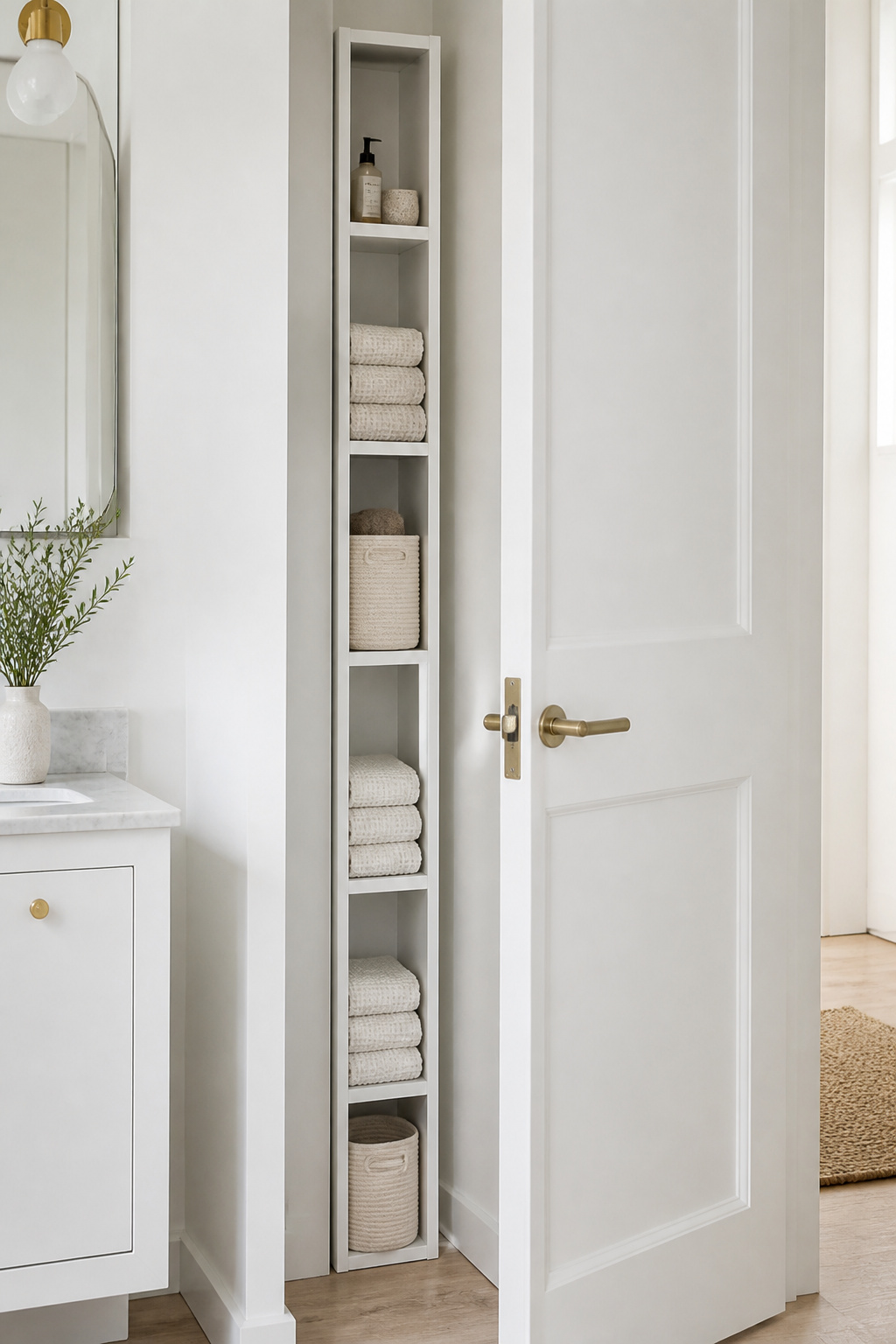
A tall, narrow shelf tower (20–30cm wide, 160–180cm tall) occupies the same floor area as a small cabinet but provides five or six times the surface area stacked vertically. Positioned behind a door in the dead zone that sits empty when the door is open, it doesn’t even register as a piece of furniture — it reads as part of the wall. String System from Sweden and IKEA’s ENHET wall system both apply this principle with Scandinavian economy: modular panels mixing shelves, doors, and small drawers to exactly the configuration you need.
Recessed niches are the cleanest solution for the shower zone and the wall above the toilet. A standard 30×60cm niche cut to stud depth of 8.9cm (3.5 inches) at 120–150cm from the floor holds full-height toiletry bottles without projecting into the room. One vertical niche — 30cm wide, 60–90cm tall, with a shelf at mid-height — reads as a deliberate architectural detail. For bathroom storage solutions that maximise every inch, the height dimension is consistently the most overlooked variable.
One mistake worth avoiding: multiple small horizontal niches across the same shower wall. A pattern of equal-sized cutouts looks excavated rather than designed. One or two deliberate niches at considered heights looks intentional.
Terrazzo is having a sustained moment in bathroom design, and it’s easy to understand why. Its random chip-and-aggregate surface generates visual texture without creating a repeating motif the eye needs to track. At normal room distances, terrazzo reads as surface richness rather than pattern — which is precisely why it works so well in compact bathrooms where a geometric or floral tile adds visual busyness.
Neutral terrazzo — a cream, warm white, or stone-grey base with mixed aggregate — pairs with chrome, brushed brass, or matte black fixtures without competition. The whole-room treatment — same tile on floor and all walls — is the signature look in high-end remodels right now, and the result is a seamlessly sculpted environment that reads as more spacious precisely because no horizontal lines interrupt the wall-to-floor transition.
For small bathrooms specifically, 30×30cm to 40×40cm format tiles hit the sweet spot — large enough to keep grout lines manageable, small enough to navigate corners and edges without excessive wasteful cuts.
The grout colour choice carries more weight than most people expect. Tone-on-tone grout (matching the tile’s dominant base colour) creates a near-seamless surface where the tile reads as continuous. Contrasting grout creates a graphic net-like overlay across every surface that multiplies visual complexity — appropriate for a feature wall, but counterproductive for a whole-room treatment in a compact bathroom. For longevity in wet areas, specify epoxy grout: stain-resistant, requires no annual sealing, and holds its colour without the yellowing that cement grout eventually develops.
In Nordic interiors, every object earns its place by being both useful and beautiful. That’s not abstract — it’s a practical attitude toward what you allow into a small room. Woven storage, used this way, becomes one of the most effective tools in a compact bathroom: it holds real things while adding texture, warmth, and a hand-made quality that plastic bins or chrome wire baskets never approach.
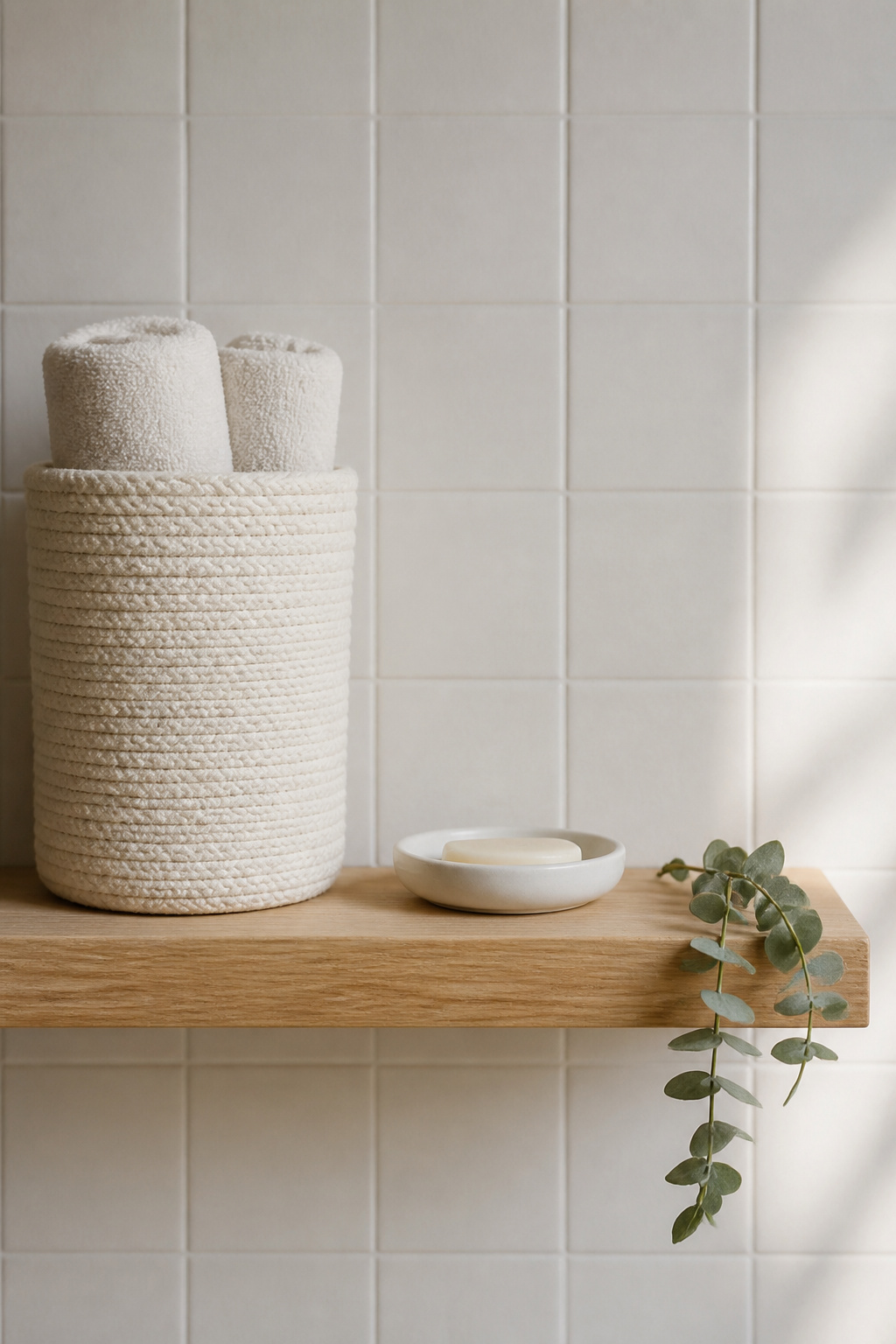
The material you choose matters more in a bathroom than anywhere else. Seagrass and rattan are attractive and affordable, but both can develop mould in consistently humid environments. In a well-ventilated bathroom with a reliable extract fan, seagrass is fine — just keep it at least a metre from the shower zone. In a less ventilated space, cotton rope is the practical answer: washable, humidity-proof, available in off-white and natural tones that sit cleanly within a Nordic palette, with a chunky tactile quality that reads beautifully on a minimal shelf.
Styling the open shelf follows a logic of restraint: fill no more than two-thirds of the available surface, and leave the remaining third empty. That negative space makes the objects present feel chosen rather than accumulated. Group items in odd numbers — a basket, a small plant, a rolled hand towel makes a complete composition. Vary heights and weights within the group. A tall basket beside a low ceramic dish and a hanging eucalyptus sprig is a small arrangement the eye moves through with genuine pleasure. This restrained approach is why bathroom shelf decor ideas consistently outperform generic storage solutions for both function and visual calm.
Standard bathroom recessed downlights are functional and almost universally flat. A single pendant changes the character of a small bathroom completely — it introduces a focal point overhead, draws the eye upward (making low ceilings feel higher), and if the shade is warm-toned glass or natural materials, it transforms the colour temperature of everything below.
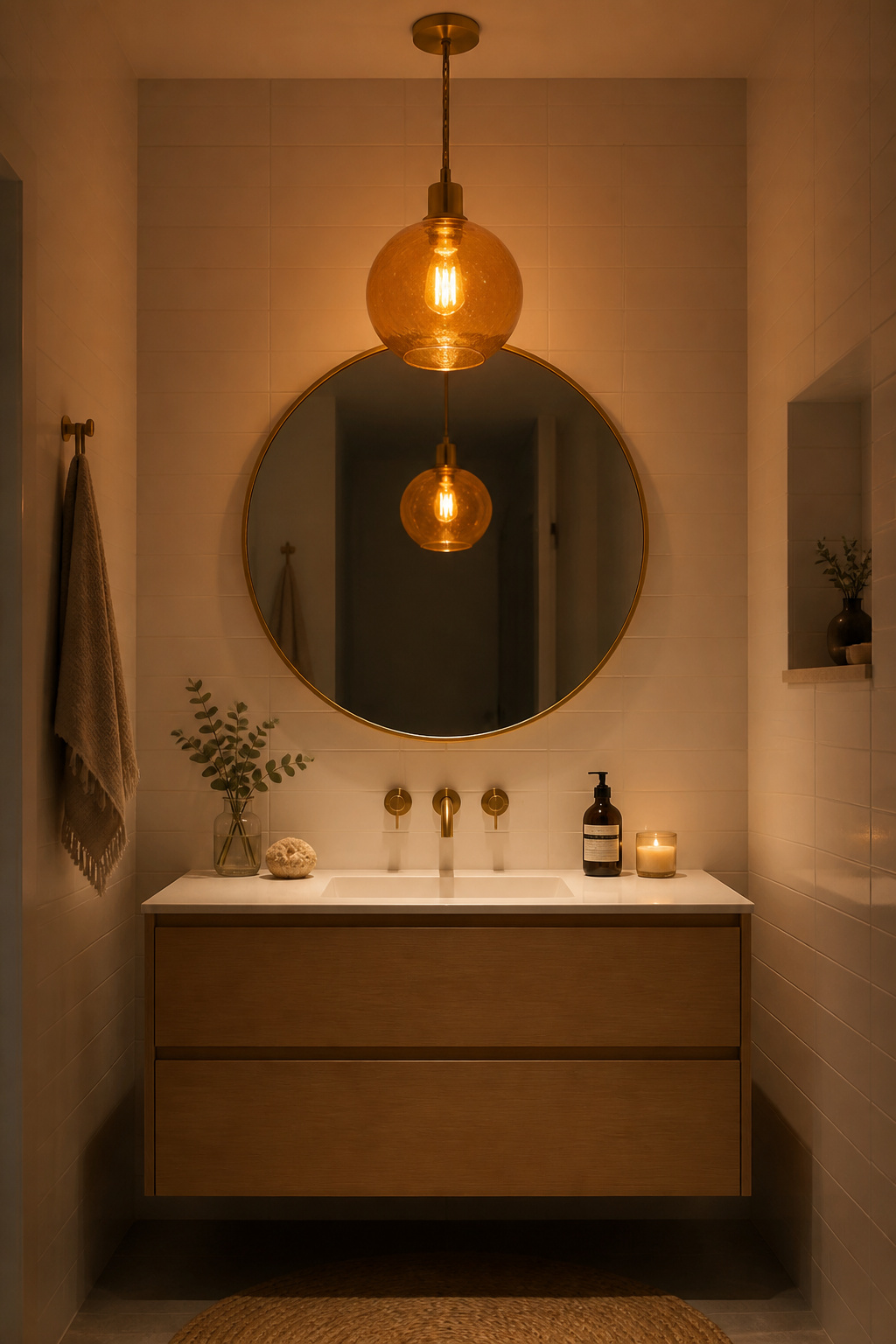
Before choosing a pendant, you need to understand bathroom IP zones. Any pendant positioned directly above a bathtub needs IP65 minimum (Zone 1). A pendant more than 60cm outside the shower or bath zone falls into Zone 2, where IP44 is sufficient — and IP44 opens up the full catalogue of Nordic pendant design from brands like Muuto, &tradition, and Gubi. For bathroom light ideas that create the right ambience, understanding which zone your ceiling position falls in is the practical first step before choosing a shade.
The Nordic preference is for warm light — 2700K to 3000K colour temperature — in intimate spaces. Warm white makes tile read as cream rather than clinical, makes wood glow, and flatters skin tone in ways that cool or neutral white (4000K+) never does. An amber or smoked glass shade multiplies this effect by tinting the light before it reaches the room.
A pendant above the vanity mirror, rather than recessed spots, does something unexpected: its reflection in the mirror creates a doubled light source that makes the whole vanity area feel brighter and more considered than the wattage alone would suggest. Hang the pendant so the bottom of the shade sits at approximately 180–190cm from the floor — intimate without becoming a hazard in a compact space. In a bathroom with a low ceiling (under 230cm), choose a semi-flush Nordic pendant rather than a full cord pendant; in higher-ceilinged bathrooms, the cord length is a design opportunity that draws the eye upward and makes the most of the room’s vertical height.
Scandinavian bathrooms achieve their warmth not through colour but through the careful layering of different tactile surfaces. A room that’s all smooth tile and chrome feels functional at best. A room that introduces smooth stone, natural wood grain, rough linen, and brushed metal creates a sensory richness that takes a small bathroom from serviceable to genuinely restorative — without a single additional square metre of floor space.
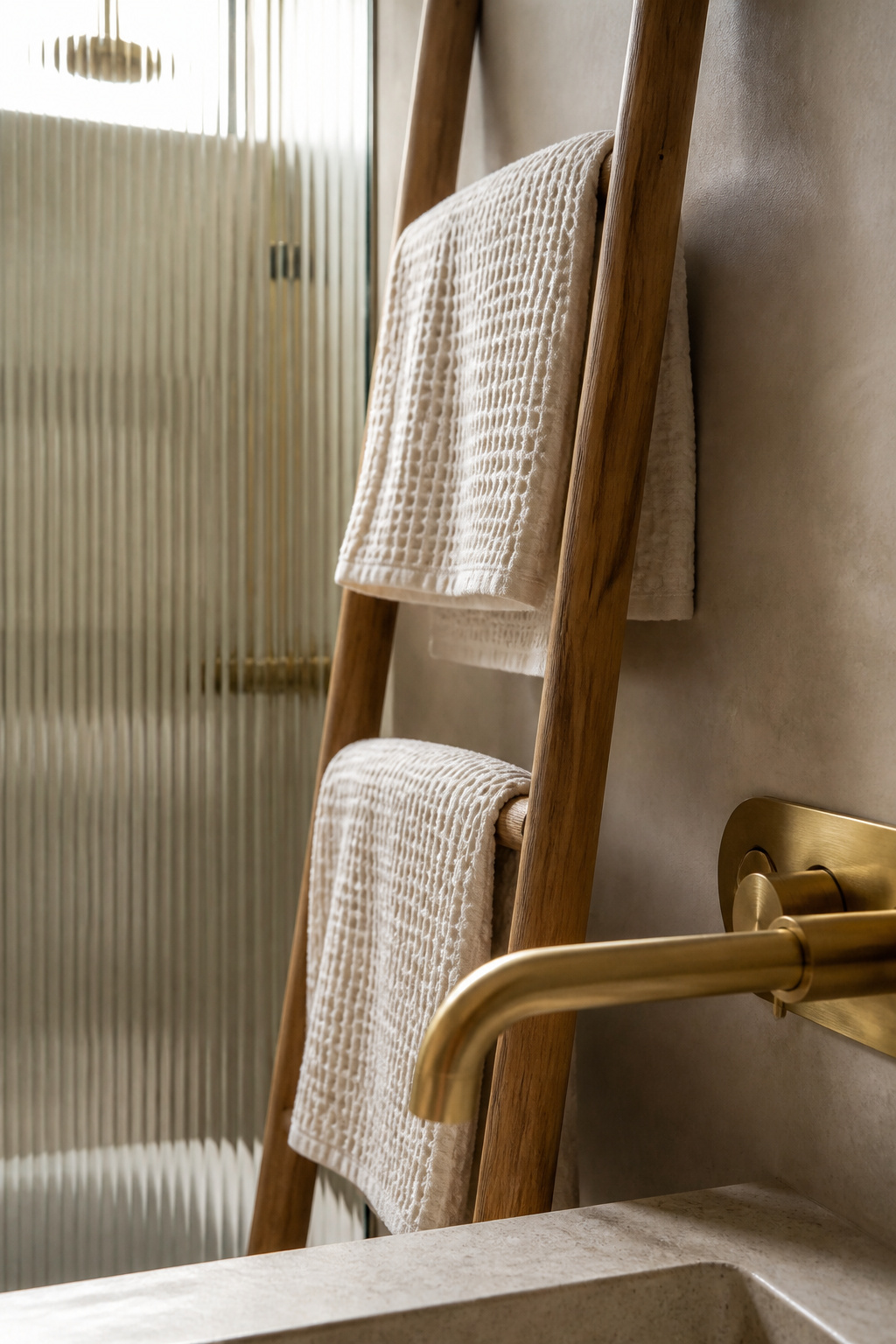
The framework works as a hierarchy of three layers. The base is hard and smooth: tile, stone, glass, ceramic — the neutral canvas everything reads against. The second layer introduces natural character: wood, a stone soap dish, a ceramic vessel, a matt-plaster wall detail. These elements feel different to the touch from the base and carry the personality of the room. The third layer — the warmest, most hygge layer — is soft and organic: linen towels, a cotton bath mat, a woven basket. In terms of visual area they’re the smallest proportion, but the most inviting to the touch.
The rule holding the system together is three texture categories maximum. Exceed three and the room starts to feel busy regardless of how neutral the colour palette is. Minimalist bathroom ideas consistently demonstrate this — the restraint in texture is what makes a room feel calm rather than sparse.
The current Nordic texture signature pairs waffle-weave cotton towels (open weave, dries faster than terry, hangs with an elegant drape), ribbed or fluted glass shower panels (adds linear texture while diffusing light for privacy), and brushed brass hardware (warmer than nickel, less intense than polished gold). These three surfaces share a warmth of tone and a refinement of finish that coheres without matching.
The Scandinavian tradition of bringing plants indoors year-round — a response to long winters and limited daylight — translates perfectly into bathrooms. The humidity that makes most rooms inhospitable to certain plants makes bathrooms ideal for the species that evolved in tropical rainforests: high moisture, filtered light, warm temperatures. A single trailing plant in a small bathroom introduces living organic form that no static décor element can replicate.
Five species have earned their place in Nordic bathroom design through proven performance. Pothos (Epipremnum aureum) is nearly indestructible — tolerates low and medium indirect light, thrives in humidity, and grows trailing so a shelf position creates a cascading effect without effort. The ZZ plant (Zamioculcas zamiifolia) is the zero-maintenance choice: its glossy dark green leaves bring drama to a pale bathroom, and it will tolerate a windowless space watered only every two to three weeks. Peace lily manages genuinely low light and flowers occasionally with white blooms — a quiet complement to a Nordic palette. Boston fern is the most dramatic choice in a bathroom with some natural light, its feathery fronds absorbing steam with visible pleasure. Spider plant, finally, is reliably tolerant of cooler temperatures and lower light, producing trailing baby plants that look beautiful hanging from a shelf edge.
In a small bathroom, restraint matters as much as species selection. One well-positioned plant makes a stronger statement than multiple plants competing for limited visual space.
The most effortless botanical addition of all: a bundle of fresh eucalyptus hung from the shower head. Steam releases the oils for a genuine spa scent, and the silver-green foliage works in any pale Nordic palette. Replace it every two to three weeks. It requires no care, no watering, and no growing conditions to manage — and it transforms the daily shower into something that feels intentional rather than routine. This is the one I recommend to anyone who says they can’t keep plants alive.
Hardware — taps, towel rails, toilet roll holders, hooks — is touched and used multiple times every single day for the entire life of the bathroom. That makes it the most felt choice in the room, even though it occupies the smallest visual area. The Scandinavian attitude treats hardware as the jewellery of the space: each piece minimal in quantity, but as considered as the budget allows.
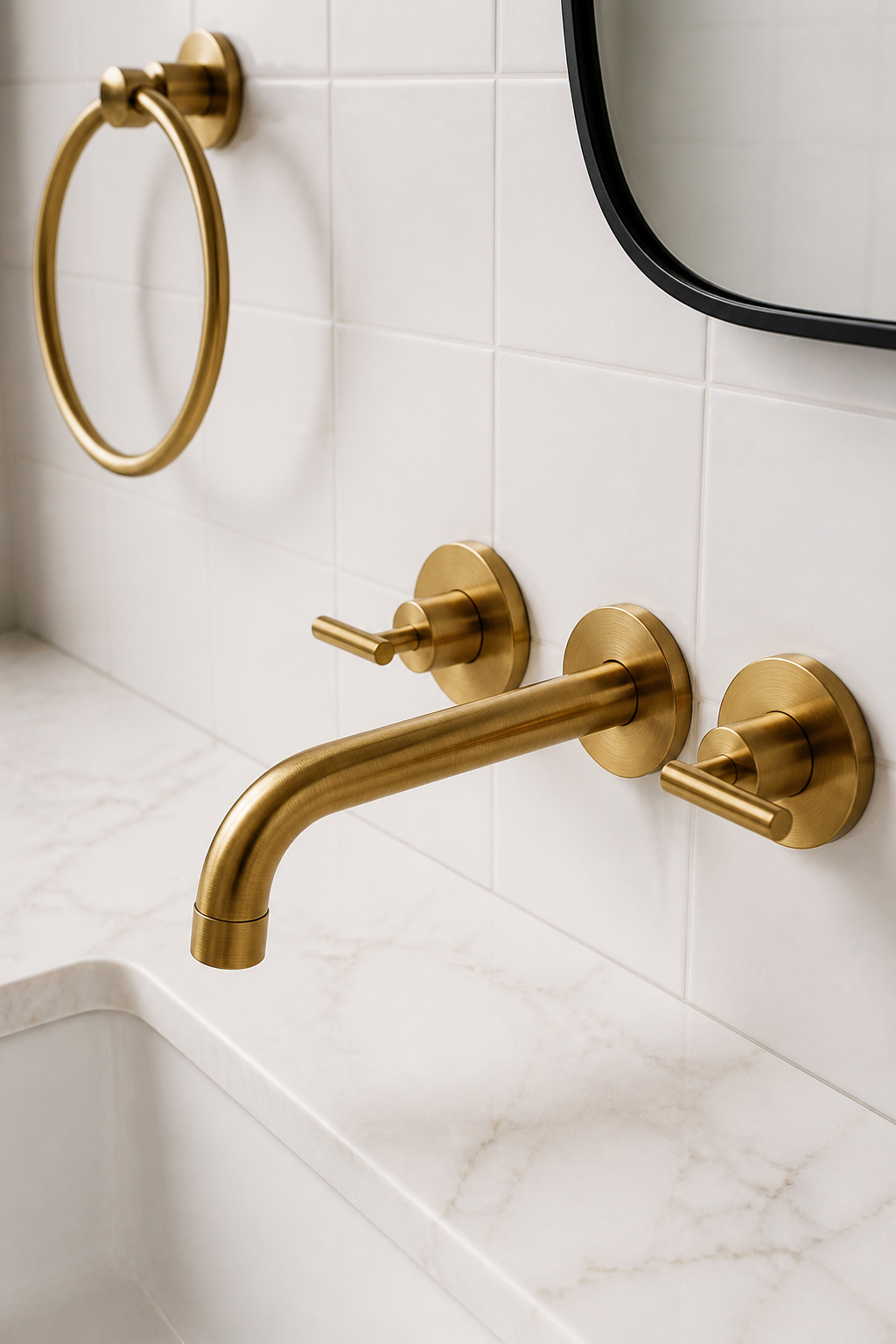
Most brassware is wall-mounted, which makes it expensive to change once installed. A tap set requiring work behind tiles isn’t a casual update — it’s a full replumbing job. This is the strongest argument for investing in quality here: PVD-coated brass or stainless fixtures with a quality valve outlast every tile, every textile, and every accessory in the bathroom. Physical Vapor Deposition coating is the gold standard for finish durability — a molecular-level bond that won’t peel or tarnish the way electroplated surfaces eventually can.
In terms of finish, brushed brass is the Nordic choice for 2025–2026. It ages with a graceful warm patina rather than tarnishing, bridges warm wood tones and cool stone tiles without dominating either, and photographs warmly. Brushed nickel remains a timeless, versatile choice — its warm-grey tone works across both white and greige palettes, and the brushed texture hides water spots more effectively than polished chrome. Matte black is bold and graphic, but requires daily wiping in hard-water areas to maintain.
The Nordic rule for mixing metals: maximum two finishes in one bathroom, with one dominant (taps, shower fitting, towel rail — around 80% of visible hardware) and one accent (mirror frame, light fitting — the remaining 20%). Brushed brass taps and rail paired with a matte black mirror frame is a complete, coherent scheme. Three or more different finishes, however individually attractive, read as fragmented rather than considered. Once you’ve seen this rule applied, you’ll spot its absence immediately in photos where something feels slightly off but you can’t identify why.
A dark wall in a small bathroom is counterintuitive advice, which is exactly why it works so well when you understand the mechanism. Dark colours absorb light and visually recede — a deep green or charcoal wall appears further away than it actually is, creating perceived depth that the room doesn’t physically possess. In a compact bathroom, this effect is disproportionately powerful: one dark wall transforms the space from ‘small’ to ‘intimate and dramatic’ — the kind of jewel-box quality that makes people ask what you did rather than notice the square footage.
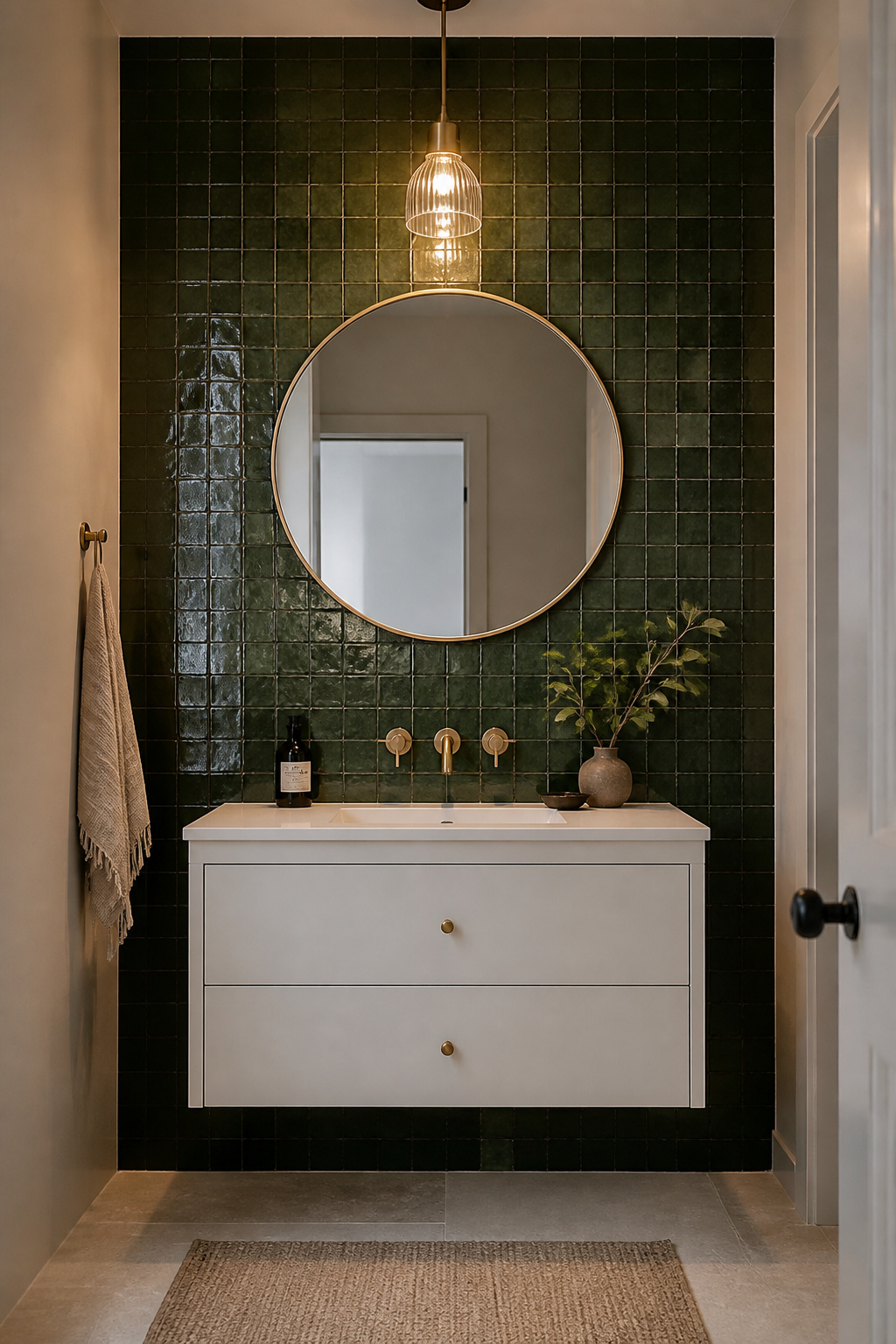
The Nordic palette for this treatment leans toward forest greens, muted teals, and deep navies over stark black — tones that connect the room to Scandinavian landscapes (forests, sea, stone) while adding intimacy without oppression. The key is keeping everything else very pale: a crisp white ceiling, a light stone or terrazzo floor tile, minimal pale surfaces. The dark wall works as a grounding element against all that lightness.
Beyond paint, three material options add substantial character. Zellige tiles — handcrafted Moroccan terracotta tiles, hand-glazed so each carries slight tonal and surface variation — create a rich, light-catching surface that flat paint can’t replicate. In deep green or teal, they read as simultaneously sophisticated and warm. For bathroom tile ideas for a mindful, considered space, zellige in a bold tone is one of the most rewarding investments available. Fluted wall panels catch raking light from a pendant overhead and create dramatic shadow play in the vertical grooves. Limewash paint adds organic tonal movement — patchy, aged, deliberately imperfect — that standard emulsion simply doesn’t offer.
Limit the dark treatment to a single wall, typically behind the vanity or opposite the door. Covering all four walls creates oppression rather than drama.
The ladder towel rail is such a fixture of Nordic bathroom design that it barely reads as a trend — it feels simply correct. Vertical form, multiple horizontal bars, natural or refined materials, equal parts functional and beautiful. In a small bathroom where every object should do more than one job, the towel ladder fulfils that brief with characteristic Scandinavian economy.
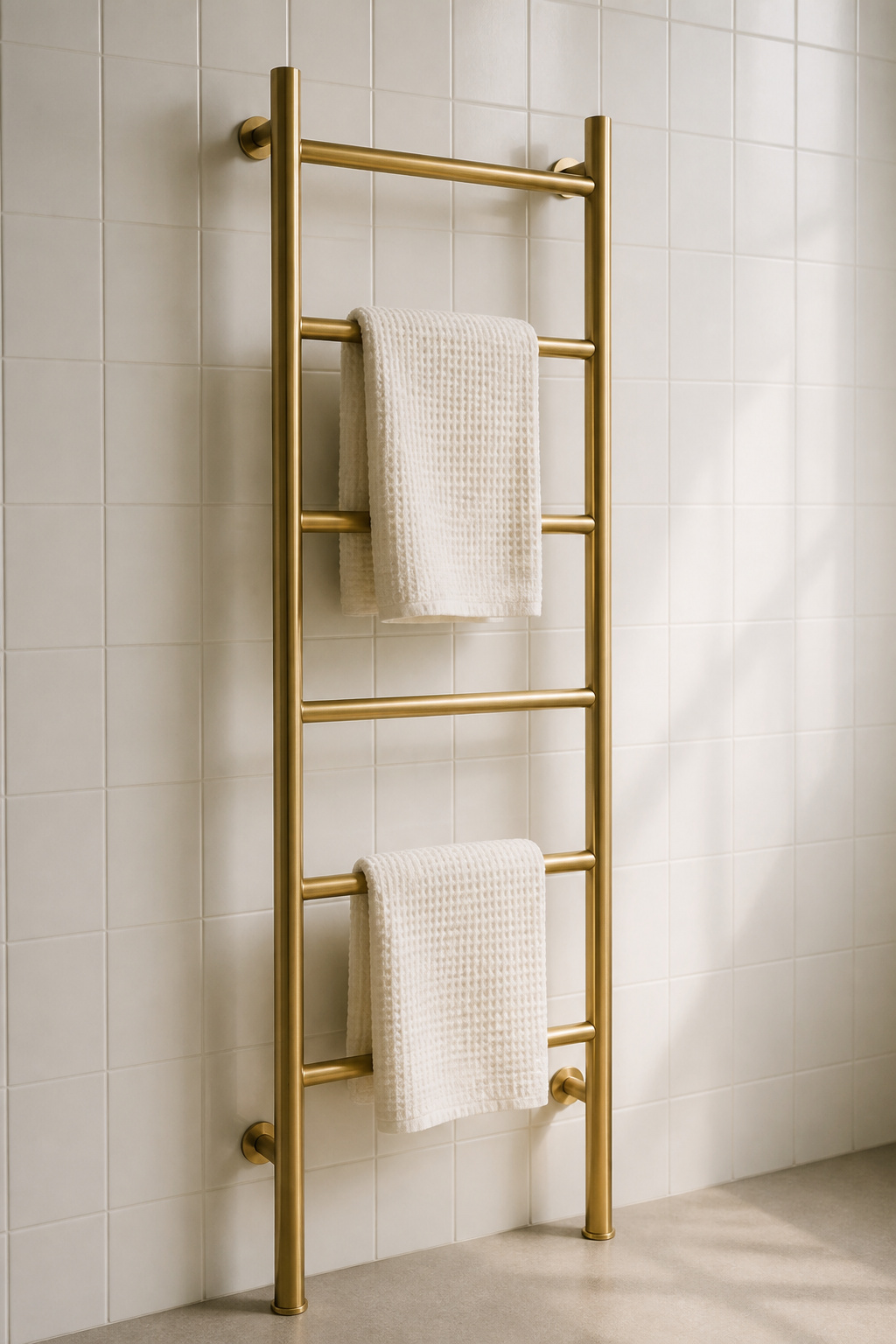
The question most people sidestep — heated or unheated — is worth confronting directly. In a small bathroom with limited ventilation, a damp towel takes considerably longer to dry than in a larger, well-ventilated space. That retained moisture contributes to ambient humidity, which in turn accelerates mould growth on grout lines and silicone edges over time. A heated rail sized at 300–400 BTU addresses this practically: towels dry faster, the bathroom stays drier, and in a Nordic home with cooler ambient temperatures, the warmth in your towel each morning is a genuinely felt comfort. The additional installation cost over an unheated rail — typically £100–300 for a wired setup — pays back in reduced maintenance and improved daily experience.
For material, 304-grade stainless steel is the durability benchmark for heated rails: it resists corrosion in consistently humid environments without special care. Brushed brass (PVD-coated) is the premium choice where the budget extends to it, coordinating with brass taps and fixtures and ageing warmly over time. An unheated white oak ladder is a beautiful craft object in a Nordic bathroom, provided the timber has been properly oiled for humidity. Style the ladder as an edited display: hang only the towels in current daily use, folded in halves or thirds over alternate bars, leaving some rungs deliberately visible.
Hygge is one of those words that gets applied to scented candles and fluffy socks until the meaning thins out. In a bathroom context, it carries genuine design weight: the deliberate act of making a functional room feel like a sanctuary. The vehicle for that transformation is the quality of what you touch — and in a bathroom, you touch textiles with your entire body, every single day.
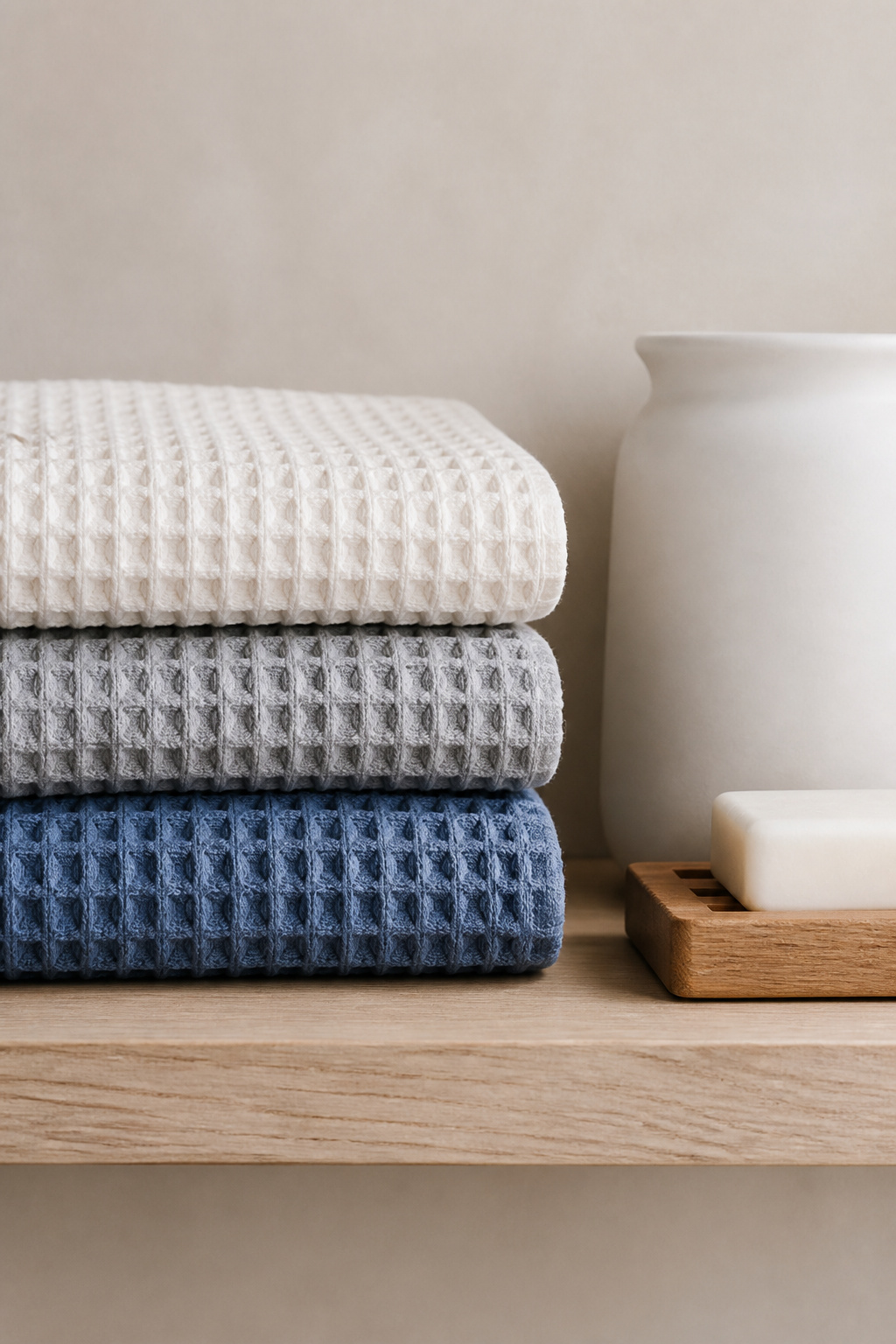
The shift from standard towels to considered ones is one of the most immediately felt changes in a bathroom regardless of size. Waffle-weave cotton is the Nordic textile choice over traditional terry cloth: the open grid structure dries faster (reducing mildew risk in a humid room), hangs with a more elegant drape on a towel rail or ladder, and has a distinctive tactile quality that reads as intentional. For bath sheets specifically, Turkish or Egyptian cotton at 600–700 GSM delivers the weight and absorbency that signals quality in use — not just on first touch. Nordic brands like Tekla and Himla build their collections around coordinated seasonal palettes, making a coherent bathroom textile scheme straightforward to build.
For bath mats, teak or bamboo slatted mats are the traditional Nordic answer in wet rooms and shower zones: they drain immediately, feel warm underfoot over a heated floor, and eliminate the cold-wet-mat experience entirely. In drier areas, a waffle-weave cotton bath mat carries the same textile language as the towels and dries far more quickly than looped terry.
The coordination principle is simple: maximum three tones across all bathroom textiles (bath towel, hand towel, mat, bathrobe if visible). The classic Nordic palette is undyed white, warm grey, and one deeper accent — dusty blue, warm taupe, or deep green. The deeper tone appears sparingly: one accent towel on the ladder, or the bath mat. Tekla and Himla both offer coordinated collections in waffle and terry weaves across consistent seasonal palettes, so buying within a single brand makes the palette work almost automatically — no post-purchase hoping required.
Bringing every element into coherent relation is the finishing discipline — the work that makes the difference between a bathroom that looks designed and one that looks assembled piece by piece over several years of opportunistic purchases. Cohesion doesn’t require everything to match. It requires everything to relate.
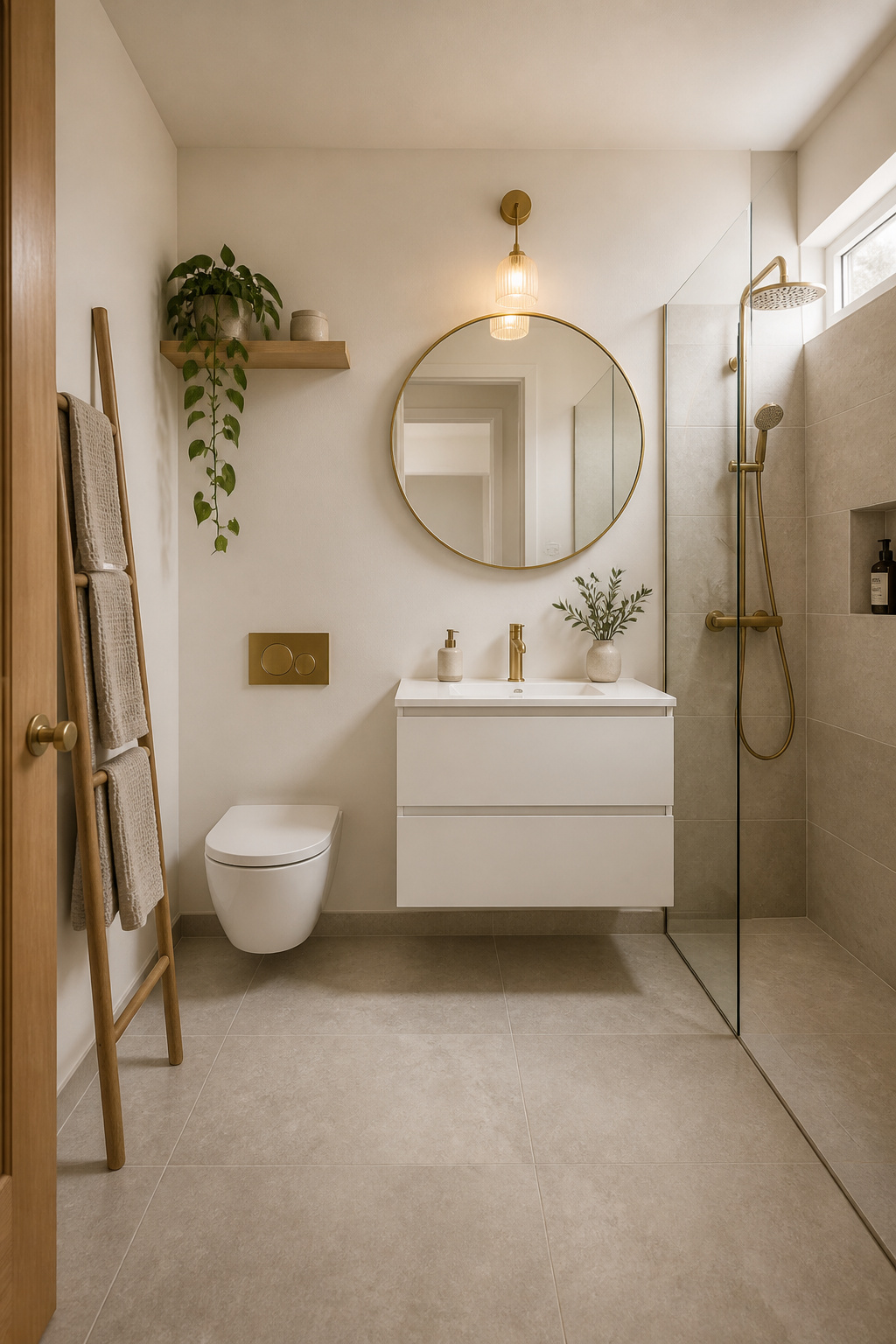
The 60-30-10 rule provides a structural framework: 60% of the visual field in the lightest, most neutral tone (walls and large tile), 30% in the secondary tone (vanity, floor tile, key surfaces), and 10% in the accent (hardware, one deeper textile, a plant pot or ceramic dish). In a Nordic small bathroom, this might be 60% warm white wall tile, 30% warm greige stone floor and vanity front, 10% brushed brass hardware throughout. Each tier is clearly differentiated in intensity while sharing the same warm temperature — and that shared temperature is the invisible element that holds the scheme together.
Temperature is the variable most people overlook when a colour scheme feels slightly off. Warm tones and cool tones can coexist in a large room with sufficient visual separation. In a small bathroom, mixing warm and cool tones across adjacent surfaces creates a subtle dissonance that’s difficult to identify but immediately felt.
Always test tile and paint colours in the actual bathroom at three different times: morning natural light, afternoon natural light, and evening under whatever artificial lighting you’ll live with permanently. The same tile can read as warm cream in morning sun and cool blue-grey under a 3000K pendant. Choose the version you prefer in the light you use most.
The final edit, once everything is assembled, is as important as any preceding decision: remove one item from each surface. What remains reads as chosen. That small reduction is, in the end, the most Scandinavian thing about this whole guide — the understanding that less, chosen well, is always more.
Not every idea in this guide will suit every bathroom — the value is in understanding which changes will have the greatest impact in your specific space and circumstances.
The Nordic prioritisation framework moves in a clear sequence: fix the layout first. The position of a floating vanity, the configuration of a wet room or shower, the placement of vertical storage — these decisions are expensive to change later and everything else sits on top of them. Then invest in quality fixtures and brassware: taps, shower fittings, and towel rail are wall-mounted, daily-use items that live in a bathroom for 20 years. Spend where quality is genuinely felt every day. After that, choose materials — tile and stone — for durability and timelessness over trend responsiveness. Finally, add accessories: plants, textiles, woven storage — the elements that can be refreshed seasonally at minimal cost.
If you’re renting or working with a limited budget, the four highest-impact non-structural changes are these: upgrade the mirror, replace the towel rail with a considered finish, refresh all textiles as a coordinated set, and introduce one well-chosen plant. These four changes can transform the character of a bathroom completely — without permission, significant spend, or a structural alteration.
The goal isn’t a bathroom that looks like a showroom. It’s a bathroom that feels genuinely calm to use — a room that earns a few quiet minutes of daily attention, rather than just tolerating it. Start with the one change that bothers you most in your bathroom today. Everything else will follow from there.