Physical Address
304 North Cardinal St.
Dorchester Center, MA 02124
Physical Address
304 North Cardinal St.
Dorchester Center, MA 02124
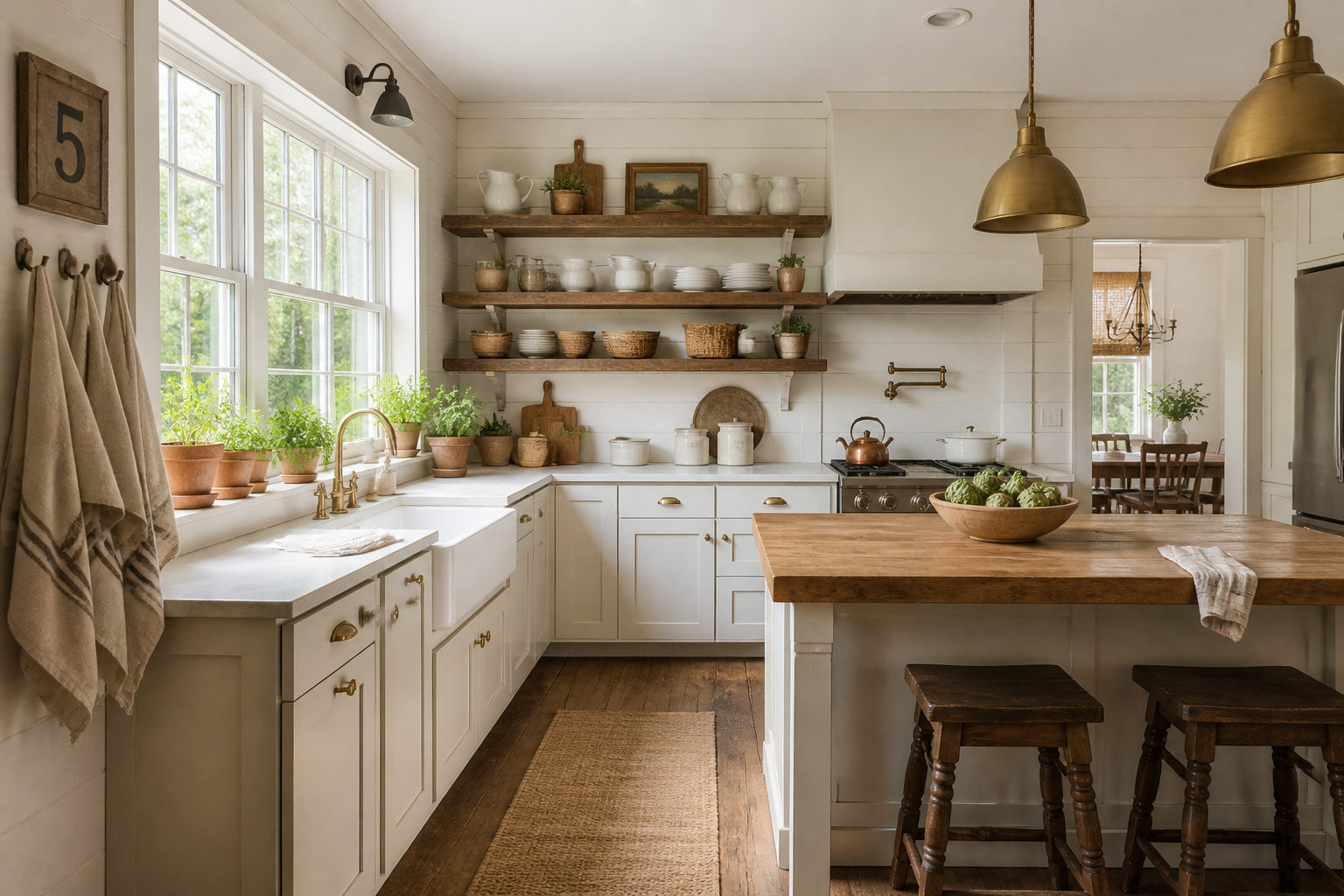
Discover 15 farmhouse kitchen decoration ideas — from reclaimed wood open shelving and fireclay sinks to pendant lights and butcher block countertops.
There is a particular quality to a well-made farmhouse kitchen — a feeling more than an appearance. You notice it in the worn texture of a wooden surface, the weight of a ceramic bowl, the way afternoon light catches the grain of an open shelf. It is not about replicating a specific era or purchasing a coordinated set of accessories. Instead, it is about building an environment that feels genuinely used, genuinely cared for, and genuinely warm.
As someone who has spent years thinking about how Nordic design principles translate into liveable homes, I find farmhouse kitchen decoration compelling precisely because it shares hygge’s central insight: that a home becomes welcoming through the accumulation of honest, functional objects, not through visual performance. The best farmhouse kitchens are assembled rather than decorated.
In this list, you will find 15 farmhouse kitchen decoration ideas that range from significant investments — an apron sink, a butcher block surface — to small, immediately actionable changes: a windowsill herb garden, a set of linen tea towels. Some will transform a space structurally; others will change only the mood. All of them are grounded in the idea that a kitchen is, fundamentally, a place for nourishment — and every decoration decision should support that.
Open shelving is the farmhouse kitchen’s most visible and most debated feature. Done well, it creates warmth, depth, and an invitation to look. Done carelessly, it turns the kitchen into an anxiety-inducing display of imperfect storage. The difference lies almost entirely in the material and the restraint.
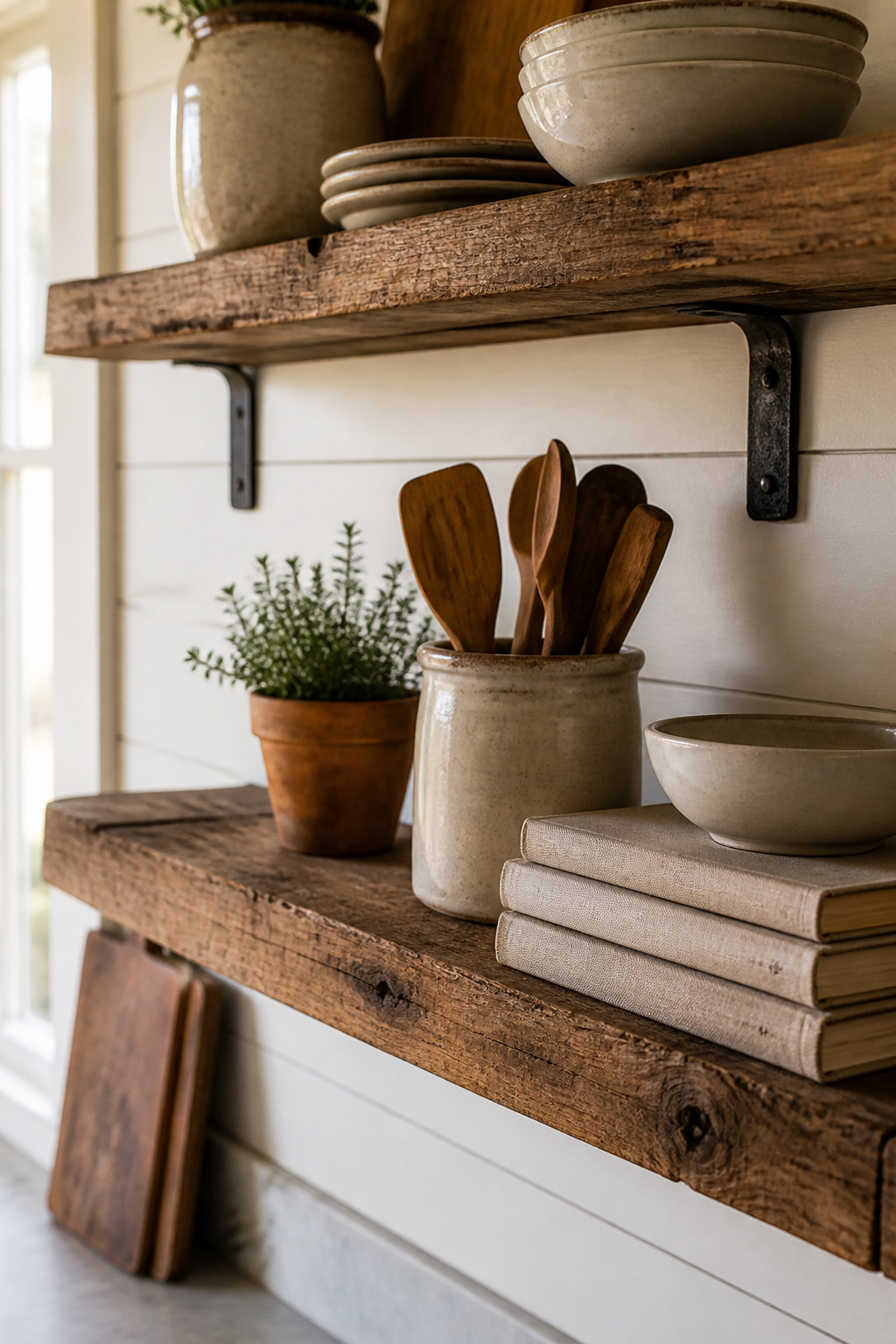
Reclaimed wood is the only honest choice here. Look for genuine salvaged material: old-growth Douglas fir, pine barn siding, or oak rescued from a demolished building. The colour variation, visible knots, and slight surface irregularities are the point — a shelf cut from uniform pine and stained brown is immediately obvious, and it reads as unconvincing.
Standard shelf dimensions work well at 1.5 to 2 inches thick and 8 to 12 inches deep, in lengths of 36 to 48 inches. Mounting options include concealed flat-bar channels routed into the shelf back (the cleanest finish), standard L-brackets in black or aged iron, or floating hardware kits. Whatever system you choose, fix into wall studs — a shelf loaded with ceramics and glassware puts real weight on the wall.
Style the shelf with the two-thirds rule: fill two-thirds of the space, leave one-third as breathing room. Group items in odd numbers with varied heights. Display ceramics, a wooden crock holding utensils, a few books, a small potted herb. Keep cleaning products and mismatched containers behind closed doors.
Shiplap has become one of the most recognisable farmhouse kitchen decoration signals, which means it has also become one of the most used. The question is not whether to use it, but how to use it so it contributes something rather than simply announcing its presence.
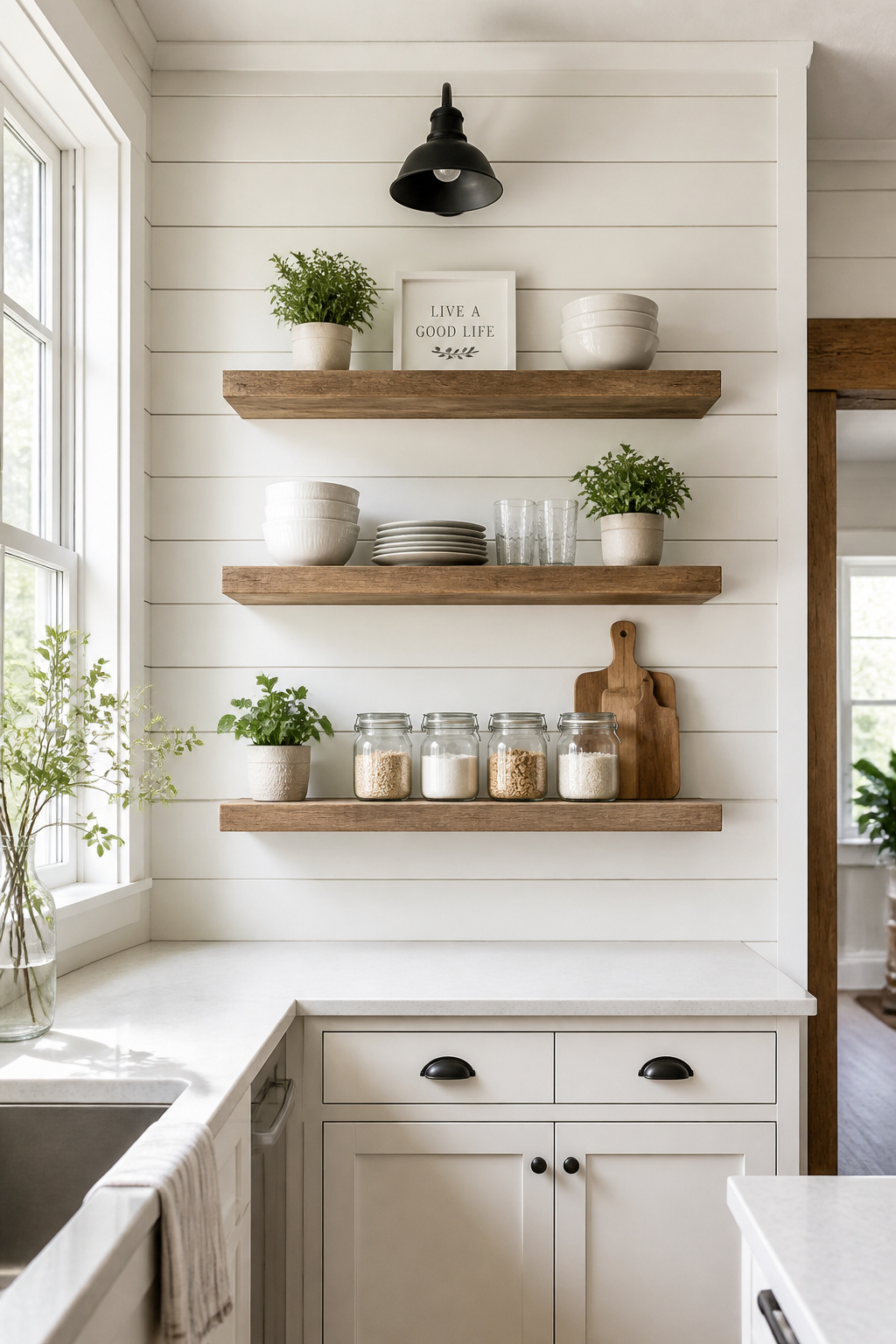
The answer, usually, is an accent wall rather than full-room application. A single wall of shiplap behind open shelving or behind a range gives the kitchen a clear focal point. It adds horizontal rhythm and depth — the shadow lines between boards create visual interest without pattern or colour. Full-room shiplap can make a small kitchen feel claustrophobic, and it requires significant space to read as intentional rather than overwhelming.
Shiplap costs $2.50 to $7 per square foot for materials, with professional installation adding $2 to $3 per square foot — a single accent wall runs $300 to $600 as a mid-range DIY project. The notched edges make boards self-spacing during installation, which makes shiplap more forgiving than beadboard for a first-time project. Beadboard has raised vertical beads and reads more as Victorian cottage; shiplap’s clean horizontal groove is more modern-farmhouse in spirit.
For paint, use satin or semi-gloss finish in a kitchen — these clean easily and resist moisture. Flat paint collects grease in the grooves and becomes impossible to clean within months. Crisp white (Benjamin Moore Chantilly Lace works reliably) or a warm off-white like White Dove are the most versatile choices. Muted sage and dusty blue work for kitchens that can carry colour.
If there is a single piece of farmhouse kitchen decoration that changes everything else in the room, it is the apron front sink. The exposed front panel — typically 8 to 10 inches of visible ceramic or metal — anchors the kitchen visually in a way that no other fixture achieves. It is the element that guests notice first, the piece that makes a kitchen feel designed rather than assembled from available parts.
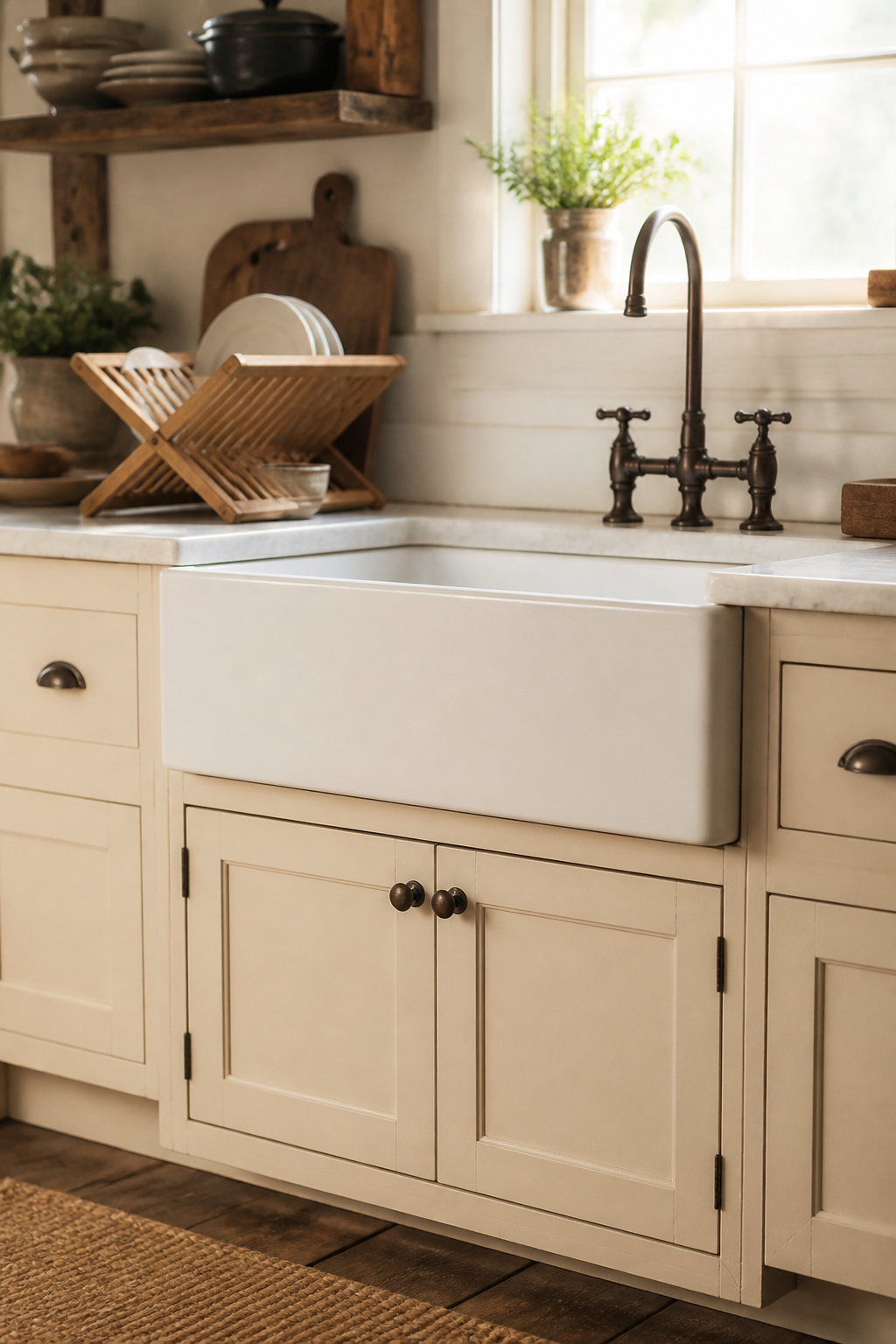
For farmhouse kitchen renovation inspiration in a wider sense, the apron sink is the anchor around which everything else is organised. The design traces back to 18th-century European farmhouse kitchens where water was carried in and drainage was a practical engineering challenge. That history is part of why it reads with such authority — unlike purely decorative details, the apron sink earned its form.
Fireclay is the material to choose. It is fired at over 2,000°F, producing a hard glassy glaze that resists chips and stains more effectively than cast iron enamel. Entry-level 30-inch fireclay models start around $650; premium 33-inch options from Rohl, Kohler, or Franke reach $1,200 to $1,500. Cast iron sinks have a glossier, more reflective surface but the enamel chips when heavy cookware is dropped. Stainless steel apron sinks start around $500 and are lighter and easier to install — a reasonable choice for a high-traffic kitchen where practicality takes priority over material warmth.
Almost every existing base cabinet will need modification: the face frame must be opened and the cabinet reinforced to bear the sink’s weight. A carpenter typically charges $200 to $400 for this work. Measure cabinet depth carefully before ordering — fireclay farmhouse sinks are typically 10 inches deep front-to-back and many cabinets need to be deepened or replaced entirely.
The Nordic principle of functional beauty finds its simplest kitchen expression in natural-fibre baskets. A wicker or rattan basket that holds onions, potatoes, and garlic on the counter or a lower island shelf is simultaneously useful and decorative. It requires no deliberate styling — the basket is already the right texture and colour for a farmhouse kitchen.
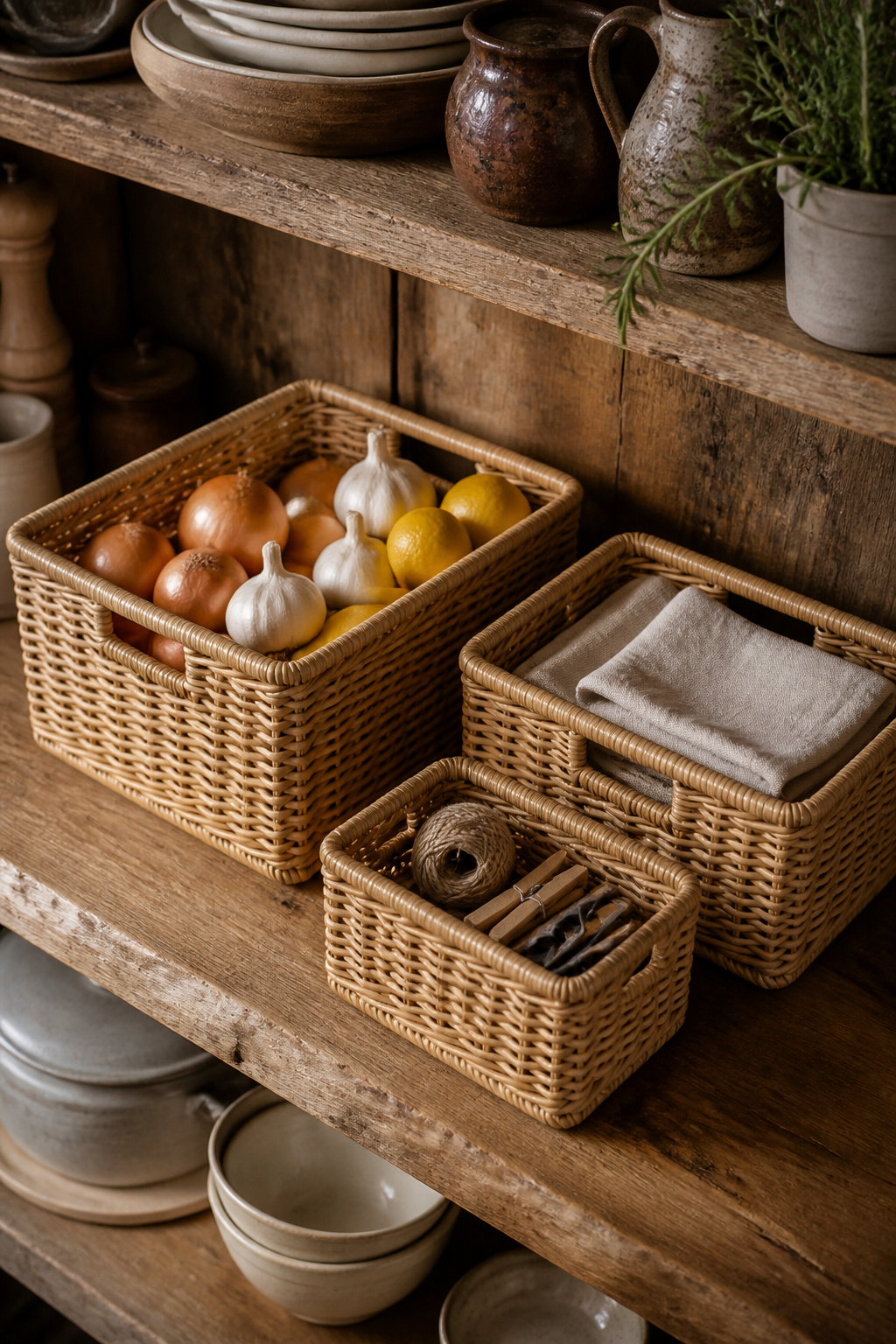
Rattan, seagrass, and water hyacinth are the most common materials. Rattan has a tighter, more uniform weave; seagrass has a rougher texture with a natural green-beige tone; water hyacinth has a more open weave that reads as lighter and airier. Any of the three works in a farmhouse kitchen — what matters more is that you choose one and use it consistently rather than mixing materials throughout.
Good kitchen organisation tips apply to baskets as much as any other storage approach: measure before you buy. On open shelves, baskets 8 to 12 inches wide and 4 to 6 inches tall work for a standard 10-inch-deep shelf. Under a kitchen island, deeper wicker baskets 12 to 18 inches wide hold produce, cookbooks, or kitchen linens. For a pantry, rectangular rattan baskets at 12 x 8 x 6 inches are practically self-labelling by content.
Hand-woven baskets from Vietnam and the Philippines use traditional techniques that machine-made versions cannot replicate — the weave is tighter, the handles are reinforced, and the basket holds its shape over years of use. Size sets in large, medium, and small create a coherent look on shelves without requiring any additional styling. Wipe with a damp cloth for cleaning; avoid prolonged direct sunlight, which bleaches and weakens natural fibres.
A framed chalkboard is one of the more effective farmhouse kitchen decoration ideas precisely because it is never finished. The surface changes — a weekly menu, a short quote, a botanical sketch, a grocery list — and in doing so it signals that the kitchen is a living space, not a showroom.
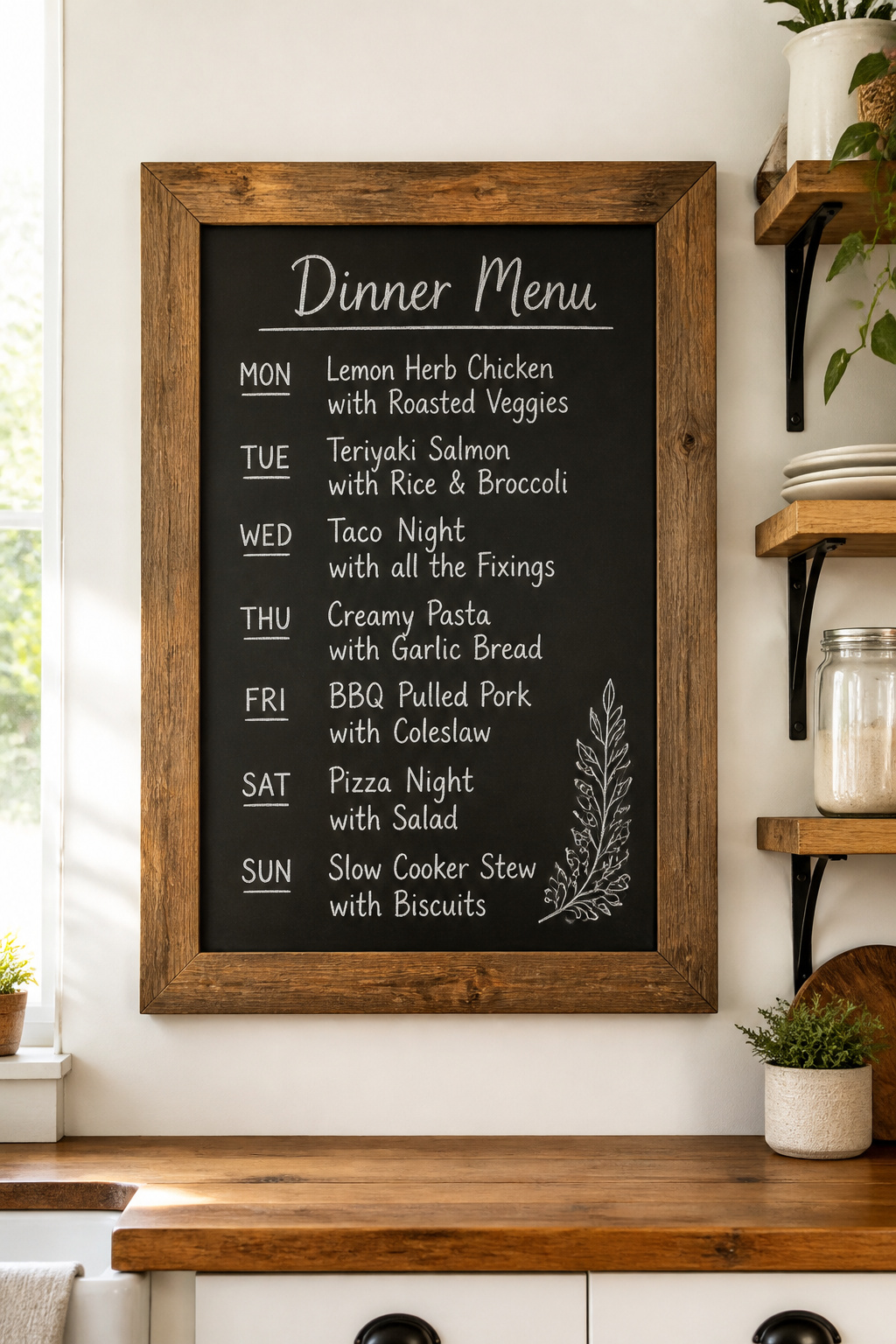
The matte black surface works as a visual anchor in a kitchen with lots of natural wood and white — it provides contrast without competing with any colour already present. It also connects directly to kitchen wall decoration ideas more broadly: the chalkboard serves as both art and information, which means it earns its wall space in a way purely decorative objects rarely do.
For framing, barn-wood or reclaimed-timber frames are the most cohesive choice in a farmhouse context. Thin modern frames look out of place next to shiplap and open shelving. Retail framed options come in useful sizes: a large board with an exterior of 40 x 28 inches and a chalkboard surface of 36 x 24 inches suits most walls above a range or beside a pantry door. A medium board at 27 x 16 inches works in tighter spaces. For a DIY version, a $10 can of chalkboard paint, a salvaged frame, and an hour of work produces a board that is often more characterful than anything purchased.
Season the board before first use: rub the side of a piece of chalk across the entire surface and wipe off. This prevents future writing from leaving ghost marks that never fully erase. Use chalk markers rather than regular chalk — the liquid chalk pen produces clean, legible lines and erases completely with a damp cloth. When styling, err toward simplicity: a single word, a short phrase, or a minimal illustration reads as considered; filling every inch looks anxious.
Galvanized steel — iron coated in zinc — has a dull, slightly mottled silver finish that reads as authentically aged and functional. It is not the polished sheen of brushed nickel or the warmth of aged brass. It is the finish of a material chosen because it works, and that quality is exactly what makes it feel farmhouse rather than decorative.
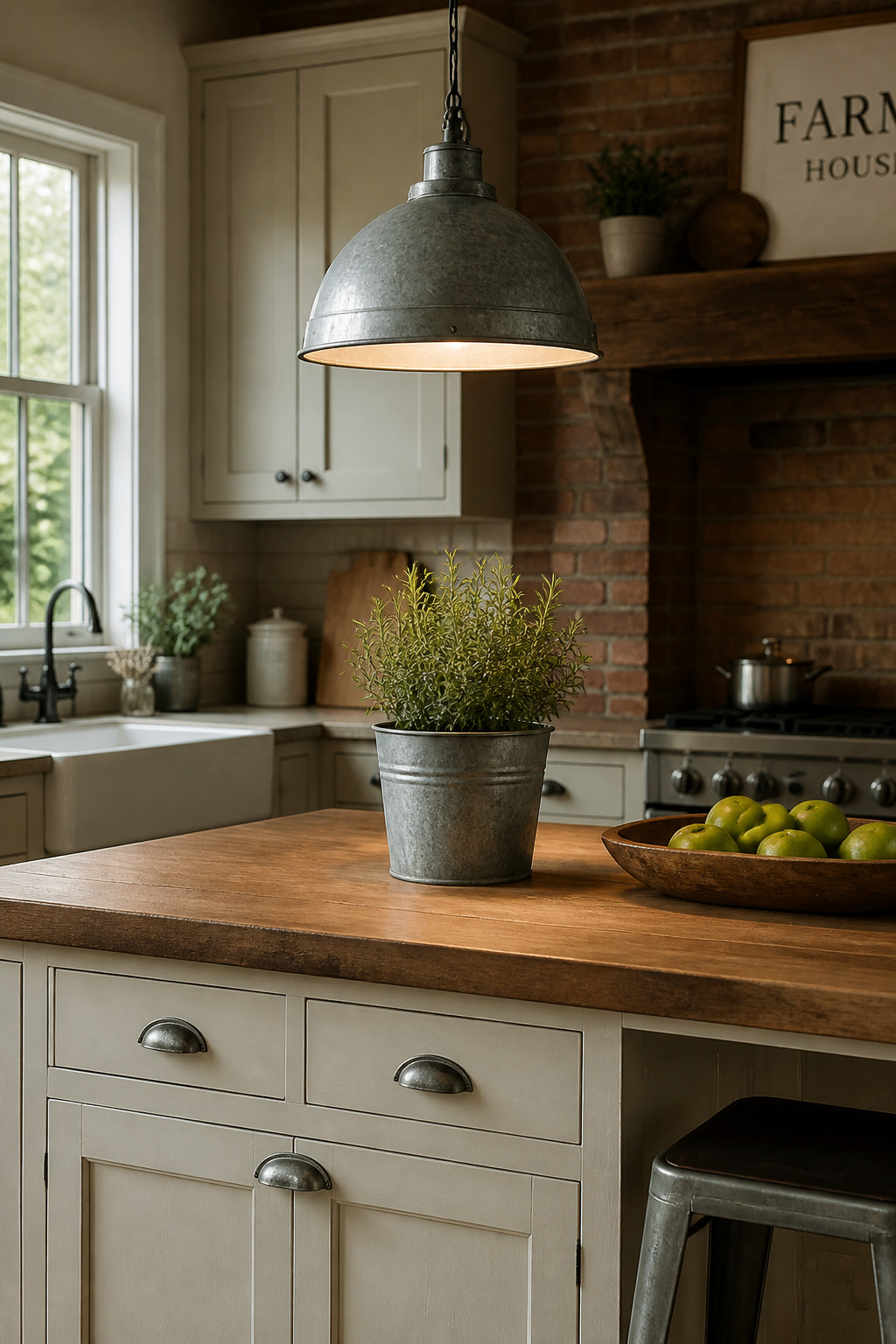
The pairing of warm wood and cool galvanized metal is fundamental to authentic farmhouse interiors. It reflects the historical reality of working farm buildings, where wooden structures met iron tools, buckets, and fittings. That combination — warm and cool, organic and industrial — creates the visual tension that makes farmhouse design feel real rather than themed.
In a kitchen, the most effective galvanized elements are dome-shaped pendant lights (8 to 12 inches in diameter) above the island, bin pulls or cabinet hardware replacing standard chrome or satin nickel pulls, and galvanized bucket planters on the counter or windowsill. Steel Lighting Co. and The Lamp Goods carry reliable options. Each piece serves a function; none of them exists purely as decoration.
The important restraint: limit galvanized metal to two or three elements. Galvanized pendants, galvanized bin pulls, and a single galvanized planter is enough. Adding towel bars, shelving brackets, and backsplash tiles all in the same finish turns a farmhouse kitchen into a warehouse. Also, do not mix galvanized with polished chrome — the contrast reads as accidental, not intentional. Galvanized works with oil-rubbed bronze and aged brass; keep those the only metal finishes in the room.
A row of small herb pots on a kitchen windowsill is one of those farmhouse kitchen decoration choices that costs almost nothing and changes everything about the room’s atmosphere. Plants communicate that the kitchen is tended — that someone notices the space and cares about it beyond its function. In Nordic design, where bringing living elements indoors during grey winters is a deliberate act of warmth, this logic is almost structural.
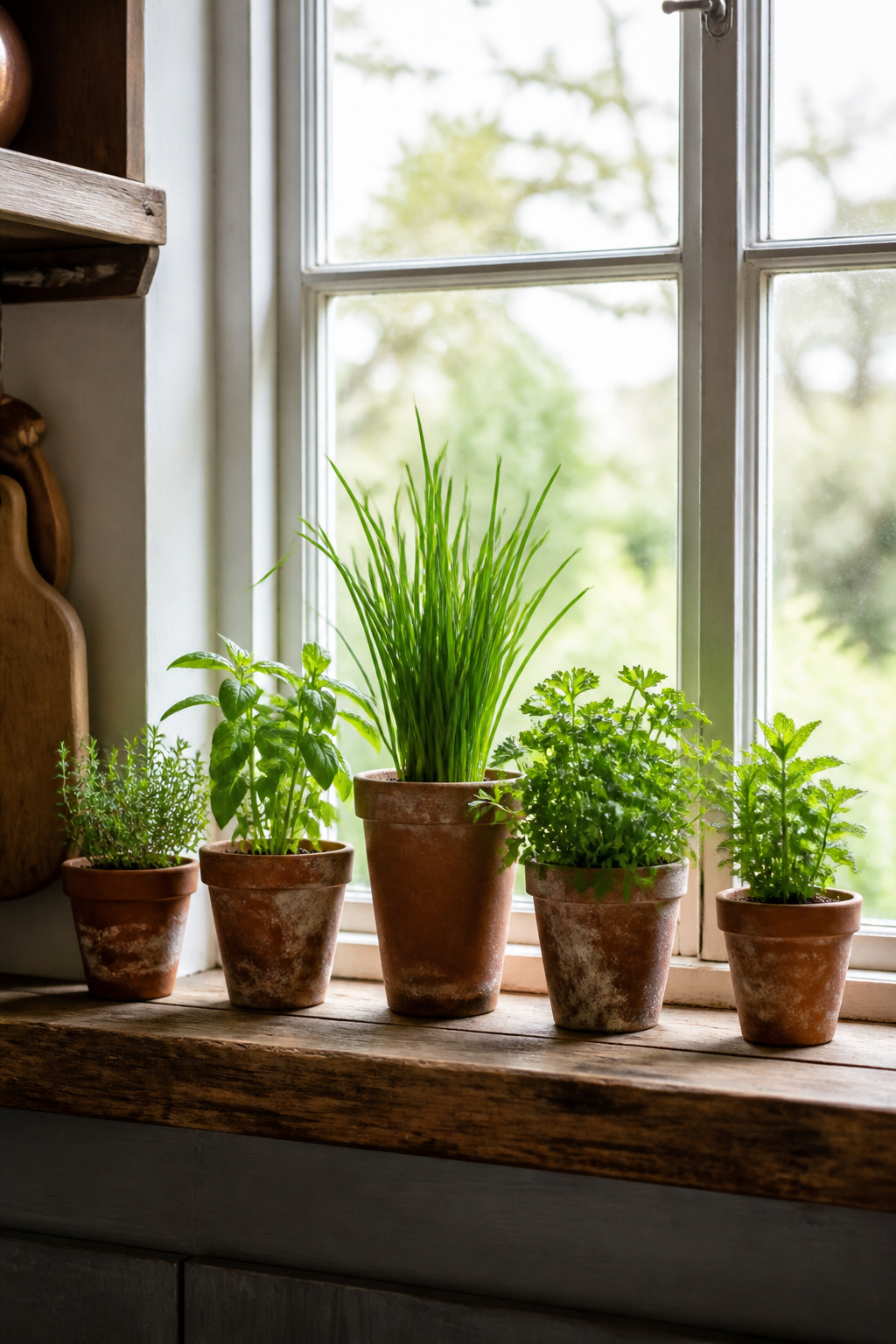
The key is choosing herbs that will actually survive on an average kitchen windowsill, which receives indirect or filtered light for most of the day.
Chives are the most reliable low-light performer: they tolerate three to four hours of indirect light, grow back quickly after cutting, and have a clean upright form that looks tidy in a small pot. Parsley is the most durable culinary herb for indoor conditions — it handles lower light better than almost any other kitchen herb. Mint needs only three to four hours of light and is vigorous to the point of aggression: always grow it in its own pot, never in a shared container.
Avoid basil, rosemary, and thyme on low-to-medium light windowsills. These Mediterranean plants need near-full sun to thrive indoors — in dim conditions they stretch, yellow, and develop root rot within a few weeks. That information saves a lot of dead plants and disappointment.
For containers, terracotta pots in 2.5 to 4-inch diameters are the classic farmhouse choice. They are porous, which helps regulate moisture, and they develop a beautiful white mineral patina over time. Vintage enamel cups and small tins (with a drainage hole drilled in the base) work just as well, and a row of matching small tins in different heights creates the kind of quietly collected look that farmhouse kitchens do best. Every container must have drainage — without it, overwatering and root rot follow within weeks.
Mason jars became a shorthand for farmhouse style around 2015, which means that using them now requires more intention than it once did. The cliché version — rows of empty jars arranged for aesthetic effect — is exactly what to avoid. The authentic version is functional: jars that store actual things, hold actual flowers, or organise actual utensils.
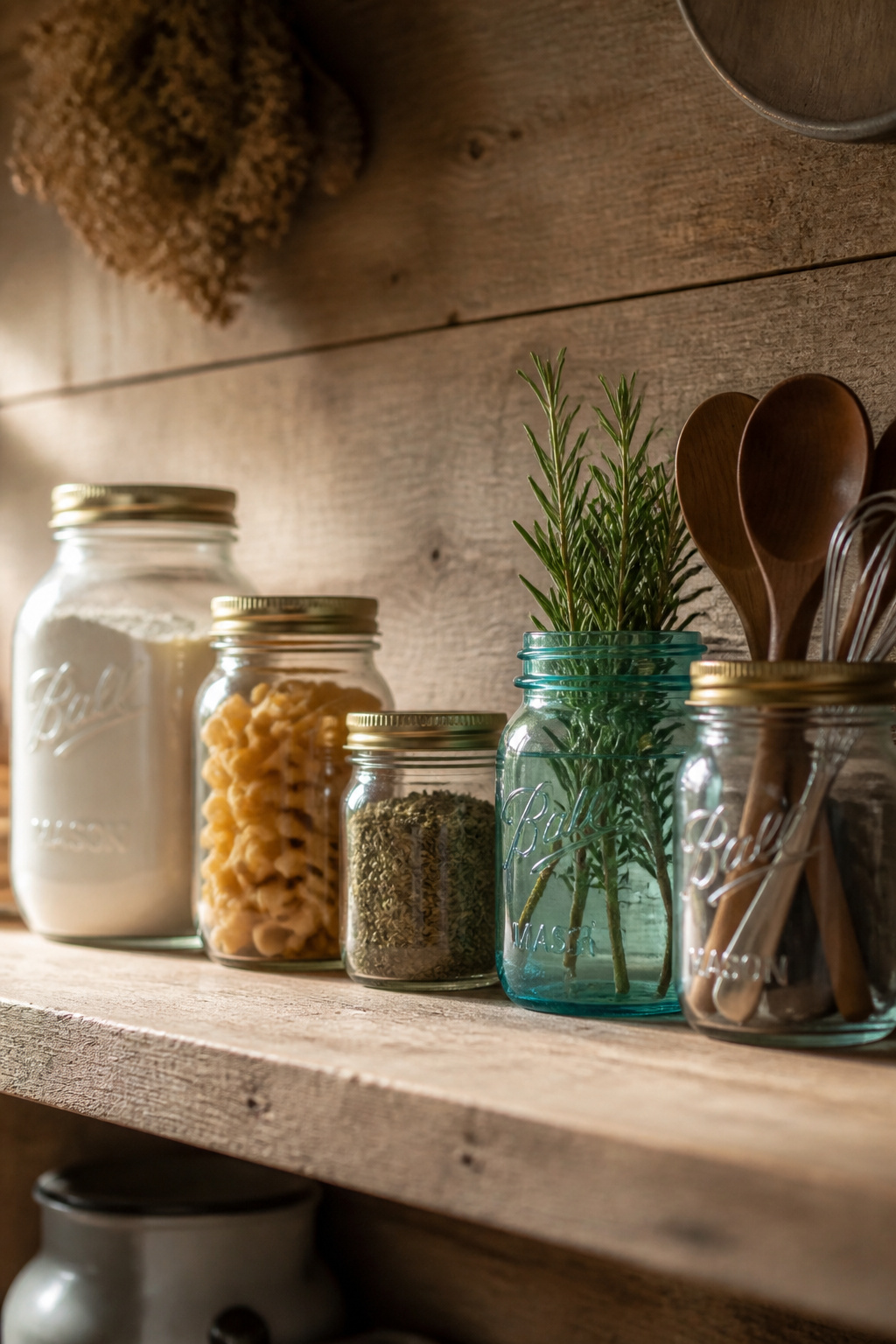
Ball and Kerr both belong to Newell Brands, so their specifications are effectively identical. The useful sizes are the 8-ounce half-pint (spices, small dry goods), the 16-ounce pint (the most versatile, works for utensil storage or mid-sized dry goods), and the 32-ounce quart (flour, sugar, pasta, dried beans). Wide-mouth quart jars are the most practical for a kitchen because the opening is large enough to scoop from without a funnel.
Group three or five jars together in descending height order — a quart next to a pint next to a half-pint. The varying heights create rhythm; the uniform material creates cohesion. Mix in a vintage Ball Perfect Mason jar in aqua glass if you can find one — the blue-green tint adds colour without any other coloured element being needed.
The rule that applies to all of it: everything in the jar should be real. Flour is real. Dried pasta is real. Fresh-cut sprigs of rosemary in water are real. Decorative filler — synthetic flowers, loose buttons, shells — is not farmhouse. It is craft fair. A single vase of wildflowers in a wide-mouth quart jar on a kitchen table is more compelling than twelve empty jars arranged on a shelf.
Textiles are the most underrated element of farmhouse kitchen decoration. They are the first things a visitor touches — the towel handed to them at the sink, the napkin placed on the table. That tactile quality communicates something that visual decoration cannot.
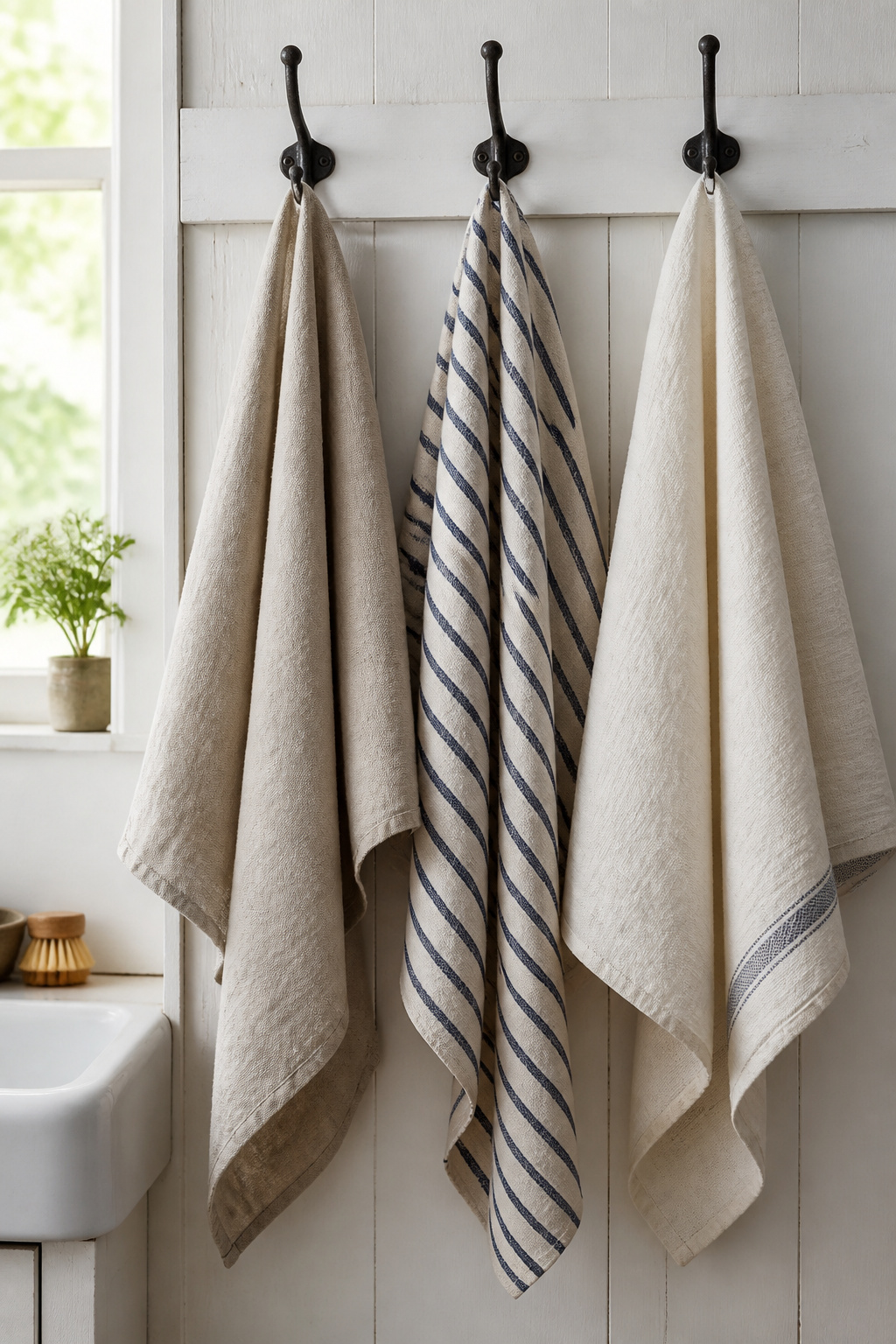
Real linen has a texture unique to the flax fibre: a natural slub — an uneven, slightly rough surface — that cannot be convincingly replicated in cotton or polyester. A heavy linen tea towel at 180 to 220 grams per square metre feels substantively different from a thin cotton version. This difference is noticed even by people who cannot identify what they are noticing.
Grain sack fabric traces to 18th and 19th-century European agriculture. Original grain sacks were woven from rough linen or hemp and printed with the producer’s information. Modern reproductions keep the simple stripe patterns — cream, navy, grey, or red on natural — while using softer, more washable materials. The best sources are Antique Farmhouse, A Cottage in the City, and Etsy handmade sellers (search ‘grain sack dish towel’). Avoid mass-market kitchen towels with printed motifs — roosters, sunflowers, or vintage-truck graphics read as novelty, not farmhouse.
For display, three options work consistently: a wooden or iron hook bar beside the sink with three or four hooks at 8 to 10 inches apart; a towel draped over a drawer pull, folded in thirds lengthways so the stripe pattern shows; or hung through a cabinet door handle. Alternate between plain linen and striped grain-sack if you have multiple hooks — the slight variation in pattern and weight looks genuinely collected.
There is a quality that comes from genuinely old objects that no new object can replicate, regardless of how carefully it is distressed or styled. A French enamelware pitcher that has been used in three kitchens across sixty years has a surface character — slight chips at the rim, colour variation in the glaze — that reads immediately as authentic. A new reproduction has uniformity that, on close inspection, gives it away.
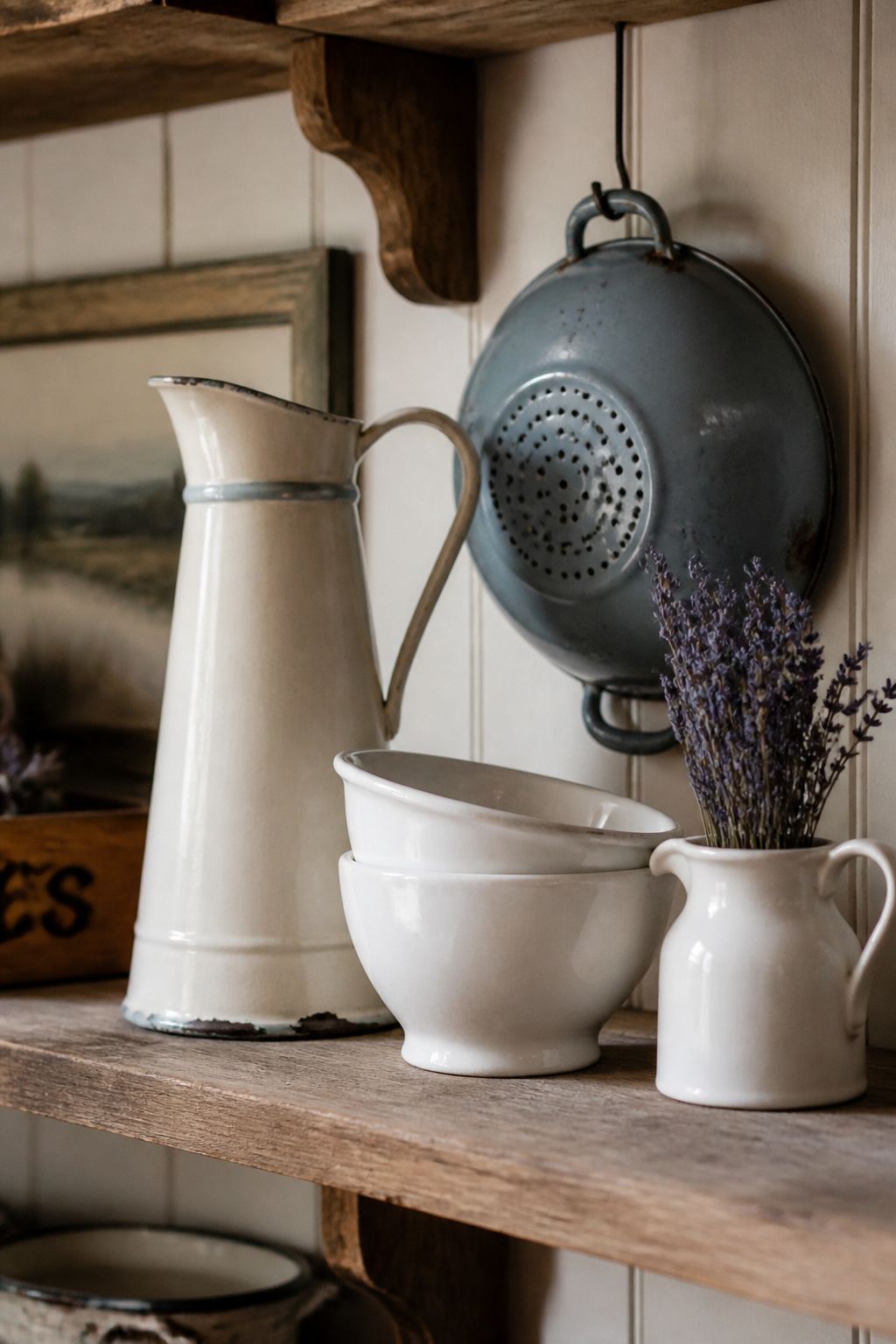
Vintage enamelware and ironstone both carry this collected-over-time quality. French enamelware tends toward bold colour with floral or geometric patterns; Scandinavian enamelware is simpler — white or cream with minimal blue or red graphic lines. Mid-20th-century Scandinavian pieces are now highly collectible and can be expensive. American and Eastern European pieces are more affordable and often just as visually compelling.
Estate sales remain the best source for genuine pieces at fair prices. Estatesales.net and estatesale-finder.com list upcoming sales by location; arrive early for enamelware. Etsy has a wider selection but at higher prices — search ‘French enamelware pitcher’, ‘Scandinavian enamel’, ‘ironstone bowl’. Euroluxhome.com specialises in vintage European kitchenware with reliable provenance.
The critical editing principle: a curated collection of 8 to 12 pieces with a consistent colour story (cream, white, blue-grey) looks deliberate. Forty pieces in different colours on one shelf looks like an overloaded antique booth. Use different forms together — a tall pitcher, a flat pie dish leaned against a wall, a small bowl holding lemons, a colander hanging on a hook — the variety of form creates interest while colour cohesion creates calm.
Ceiling beams are one of the farmhouse kitchen decoration elements that most changes the perceived character of a room. They draw the eye up, add scale and architecture, and create the sense of a space with genuine history — even when the history is entirely fabricated. That last point is worth being direct about.
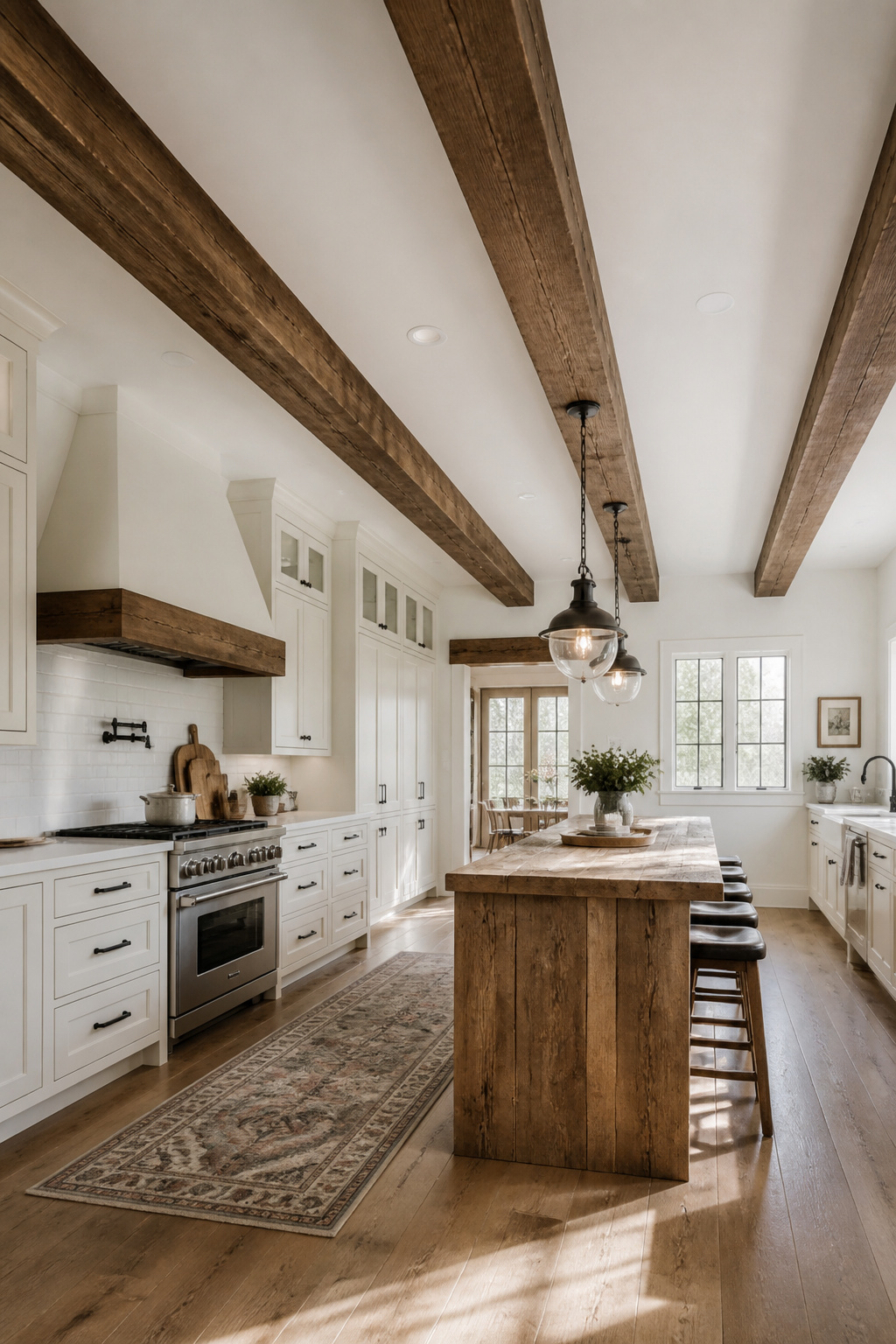
Structural beams require existing timber-frame construction or significant renovation work. They are fixed, expensive to add, and need permits in most jurisdictions. Decorative faux beams from Ekena Millwork are hollow polyurethane shells moulded from real wood planks. They are lightweight, moisture-resistant, and take gel stain convincingly. From normal viewing distance, they are indistinguishable from the real thing. Genuine structural beams cost $75 to $150 per linear foot installed; Ekena faux beams cost $8 to $25 per linear foot and install with basic DIY skills.
For staining, use gel stain cut 2:1 with mineral spirits on the polyurethane surface. Dark Walnut is the most popular colour for farmhouse kitchens — a warm brown that reads as reclaimed wood from across the room. Jacobean is slightly cooler; Provincial is lighter and works in newer farmhouse spaces with white cabinets and light floors. Work stain into the grain texture with a brush, wipe back with a cloth, and build depth with thin coats rather than one heavy application.
Sizing by ceiling height matters more than people expect: 3.5 x 3.5-inch profile for 8 to 9-foot ceilings; 5.5 x 5.5-inch for 9 to 10-foot; 8 x 8-inch for over 10-foot ceilings. Beams need at least 8.5 feet of clearance between the bottom of the beam and the floor — below this, they compress the room rather than giving it character. Standard spacing is 24 to 36 inches apart, running parallel to the longest wall.
Wood countertops are the single most effective farmhouse kitchen decoration element that also changes the functional experience of the space. The warmth of a wood surface against painted or white cabinets is immediately recognisable, and unlike every other material discussed in this list, butcher block improves over time. Every cut mark, small stain, and worn patch adds to the surface rather than degrading it.
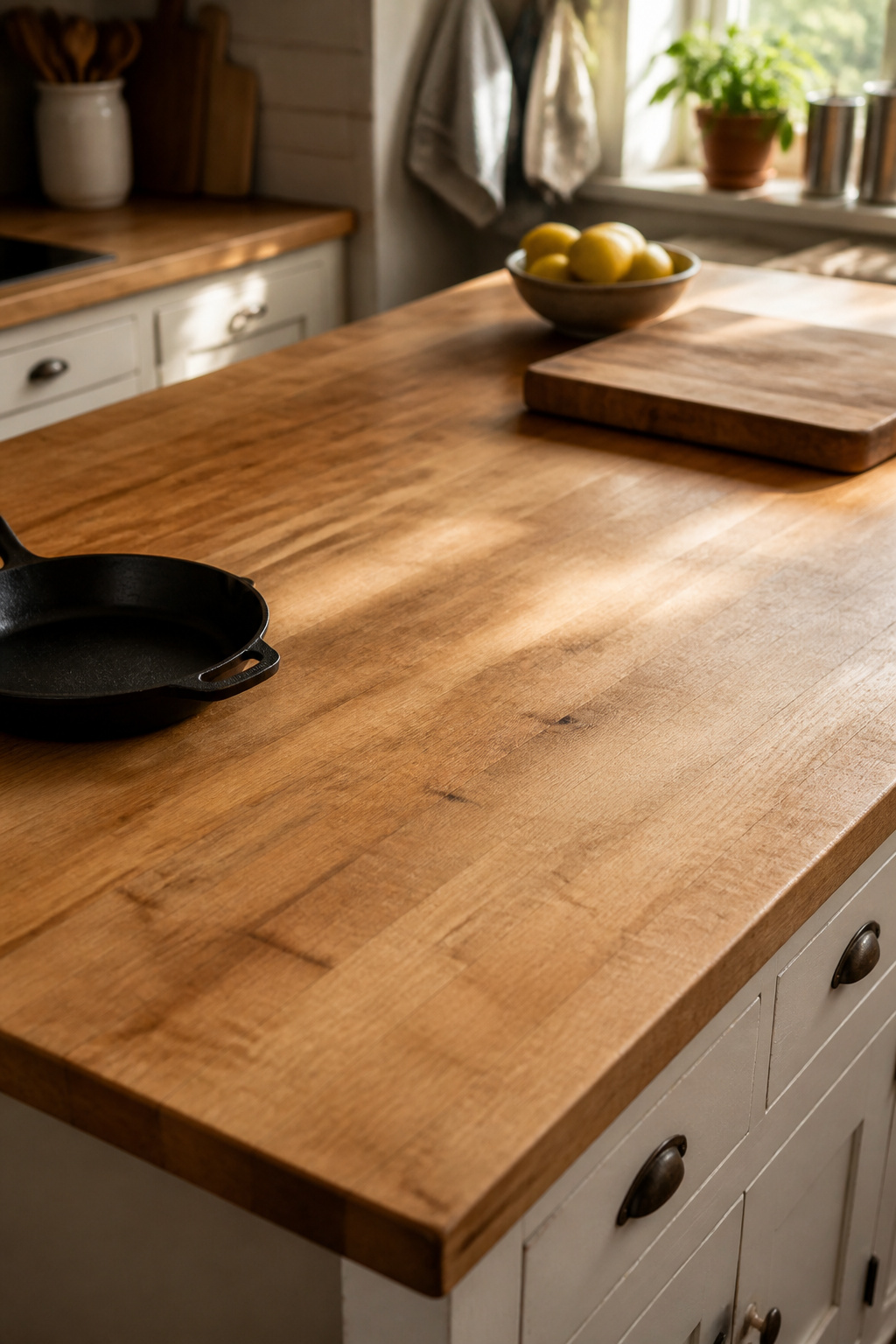
For mindful kitchen countertop decor ideas more broadly, butcher block works best as an island surface rather than a full perimeter installation — the island takes the wear and develops patina beautifully while stone or quartz perimeter countertops handle the range area and constant water exposure near the sink.
Hard maple (sugar maple) is the industry standard: 1,450 Janka hardness, tight closed grain that resists bacteria, mid-range pricing at $40 to $70 per linear foot. Walnut is the premium choice — 1,010 Janka, darker chocolate colour with pronounced grain patterns. It costs 40 to 60 percent more than maple but develops a richer patina over years of use. Both are good choices; the decision comes down to whether you want the brighter, more neutral warmth of maple or the drama of walnut’s dark grain.
Maintenance is simpler than its reputation suggests. New butcher block needs three coats of food-safe mineral oil in the first week, then monthly oiling for the first year. After that, oil every four to six weeks when the wood looks dry. For sections of counter not used as a cutting surface, Waterlox (a penetrating oil-based sealer) provides better water resistance. Fine-grit sanding removes surface stains — this is one of butcher block’s genuine advantages over every other countertop material.
Wall decor in a farmhouse kitchen should follow the same principle as every other decoration choice: fewer, larger, more considered objects rather than many small pieces of equivalent visual weight. An oversized wall clock does in one gesture what twelve small frames scattered across the same wall cannot achieve — it anchors the space, fills the scale of the wall honestly, and serves a genuine purpose.
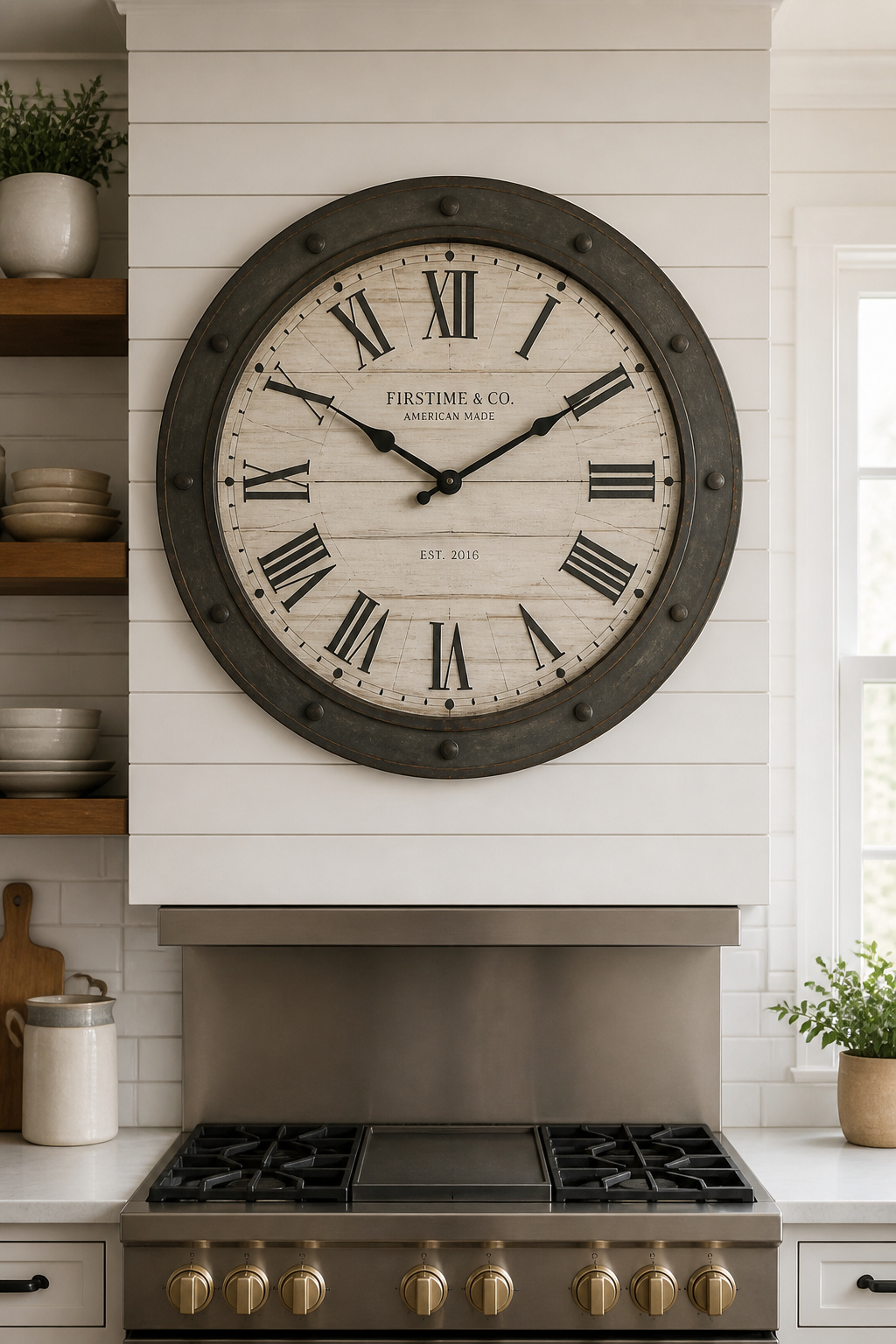
French and European industrial clock styles with Roman numerals and metal frames read as most authentically farmhouse. The 24-inch diameter is the right starting point for a standard kitchen wall; for a larger kitchen or a wall above a range, 28 to 30 inches is proportionally better. The two-thirds rule applies: the clock face should span approximately two-thirds of the available wall width of the section it occupies. A 24-inch clock centred on a 36-inch section above a range hood reads as precisely considered; the same clock on an 8-foot open wall looks stranded.
Vintage metal signs work on the same principle of honest scale. The most convincing farmhouse signs reference something directly relevant: seed company graphics, old dairy labels, hand-lettered typography about food or gathering. Avoid random vintage advertising for unrelated products — a sign for a 1940s automobile brand reads as arbitrary in a kitchen. Quality reproductions in aged metal have intentional variation in paint texture and subtle applied weathering; cheap pressed-tin signs have uniform colour that is immediately obvious from close range.
For sourcing: Antique Farmhouse and Etsy sellers using real metal with hand-applied aging are consistently reliable. Good reproduction signs measure at least 18 inches across — smaller than this and the piece disappears against a kitchen wall.
The farmhouse kitchen decoration does not stop at the walls and surfaces. The table is the literal and symbolic centre of the farmhouse kitchen — it is where the cooking becomes the meal, and where the kitchen fulfils its actual purpose. Natural-fibre table textiles extend the material palette from the shelves and surfaces to the place where people sit together.
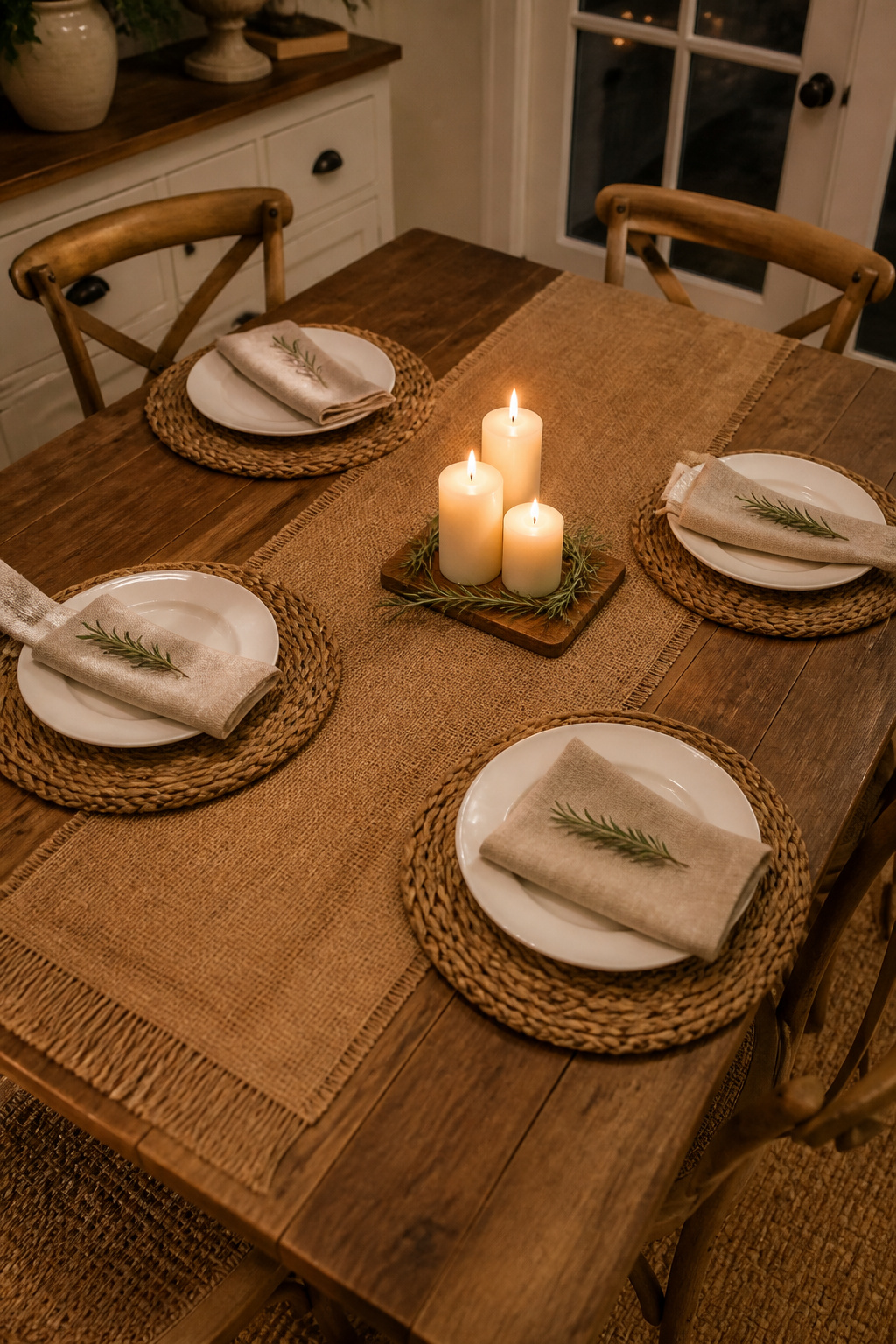
For modern kitchen table ideas that bridge contemporary and farmhouse sensibilities, a linen runner over a simple wooden table is one of the most effective combinations. Standard table runner dimensions are 14 to 16 inches wide, 72 to 108 inches long. A runner should leave 10 inches of table visible on each side — a 12-inch runner on a 36-inch-wide farmhouse table looks narrow and out of proportion.
Seagrass placemats (typically 13 x 19 inches) are the most durable natural-fibre option — they tolerate daily use and clean with a damp cloth. Jute runners have a coarser texture with a more rustic character. Linen runners drape more elegantly and work better for a farmhouse table used for proper dinners rather than casual family breakfasts.
The composed farmhouse table arrangement: a jute or seagrass runner down the centre, individual woven placemats at each setting, linen napkins folded simply on the plate, and a single centrepiece under 10 inches in height. A small crock holding fresh herbs, a group of three candles in varying heights, or a shallow bowl with seasonal produce — lemons in winter, small gourds in autumn — is sufficient. The table should feel ready for a meal, not dressed for a photograph.
Also, avoid matching sets in exactly the same fabric and colour — this reads as a hotel dining room, not a farmhouse kitchen. The natural variation between a seagrass placemat, a linen runner, and a cotton napkin is exactly the kind of considered inconsistency that makes a table feel assembled over time.
Lighting is the element of farmhouse kitchen decoration that most people address last and that makes the greatest difference. Pendant lights above a kitchen island are visible from every area of an open-plan room — they are the first design element a visitor registers from the living room, and they set the kitchen’s tone before anything else is seen.
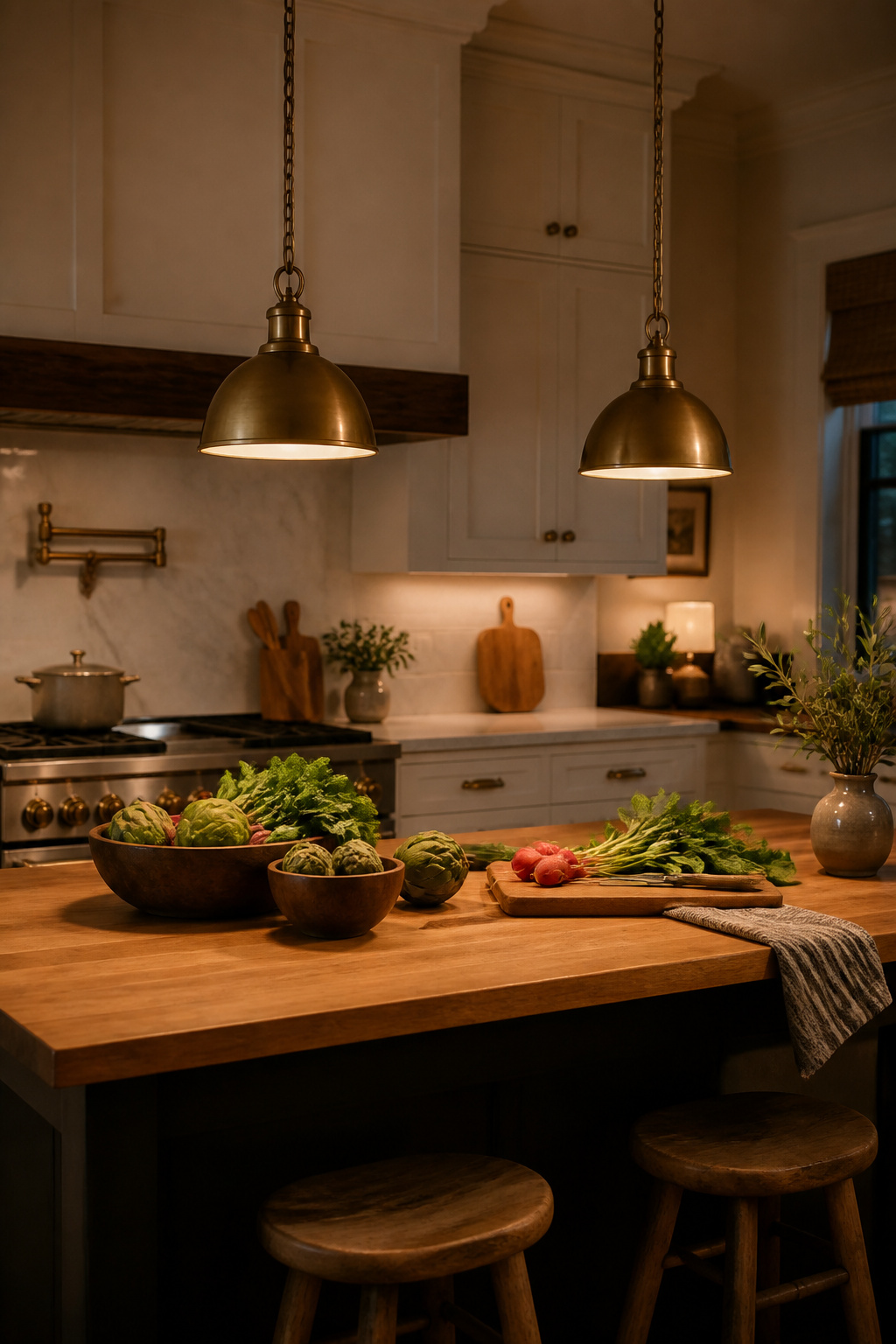
Recessed can lights alone produce flat, institutional light with no warmth. Adding pendant fixtures creates pools of focused light that are simultaneously more functional for prep work and more atmospheric for the gathering that happens at the island. The farmhouse aesthetic depends on warm, directed light sources — the pendant’s metal body is decorative even during the day, and at night it produces the kind of focused glow that makes a kitchen feel like the warmest room in the house. For the full picture of how to approach essential kitchen light fixtures for hygge and function, that principle extends well beyond pendants alone.
Matte black reads as modern-farmhouse: clean, graphic, pairs well with white or grey cabinets, shiplap, and natural wood. Aged brass is warmer and softer — it reads as heritage farmhouse and adds the yellow-gold warmth that many kitchens are missing. Choose matte black if the shelving and countertops are already providing the warmth and you want the lights to anchor visually without drawing too much attention. Choose aged brass if the kitchen needs more warmth or if the cabinets are cream or warm white.
Pendant diameter should be approximately one-third of island width. For a 25-inch-wide island, 8 to 10-inch pendants; for a 36-inch island, 10 to 14-inch pendants. Hang 30 to 36 inches above the countertop surface — at 8-foot ceilings, aim for 30 to 32 inches; at 9 feet, go toward 36 inches. For islands under 5 feet long, two pendants centred 24 to 30 inches apart is the right arrangement; for 6 to 7-foot islands, two or three pendants with centres spaced one-third of the island length apart.
The difficulty with farmhouse kitchen decoration is not finding inspiration — it is making decisions. Every element discussed in this list is compatible with every other, but that does not mean all of them belong in the same kitchen. The most successful farmhouse kitchens are built around a single anchor element, and everything else orbits that choice.
If budget is the constraint, start with what changes the most for the least. Pendant lights and open shelving deliver the most visible farmhouse kitchen decor effect per dollar spent. A chalkboard, a set of linen towels, a mason jar grouping, and a windowsill herb garden can collectively transform a kitchen for under $200 with no permanent changes — this is the rental-kitchen strategy, and it works.
For permanent changes, the hierarchy is clear: an apron sink or a butcher block countertop changes a kitchen permanently and raises its value. Shiplap and ceiling beams change the architecture but can be painted over or removed. Hardware and lighting fixtures change the visual tone and cost relatively little to revisit if your taste evolves.
The principle that applies across all farmhouse kitchen decoration decisions: choose fewer things with more intention. A Nordic kitchen and a farmhouse kitchen share this core value — both understand that the objects you live with daily should be earned, functional, and honest. A kitchen assembled from pieces that each serve a genuine purpose, and that share a consistent material language of wood, linen, ceramic, and metal, will feel warm and coherent. A kitchen with every farmhouse decoration idea applied simultaneously will feel like a catalogue page. The difference is restraint, and restraint is always a design decision.