Physical Address
304 North Cardinal St.
Dorchester Center, MA 02124
Physical Address
304 North Cardinal St.
Dorchester Center, MA 02124
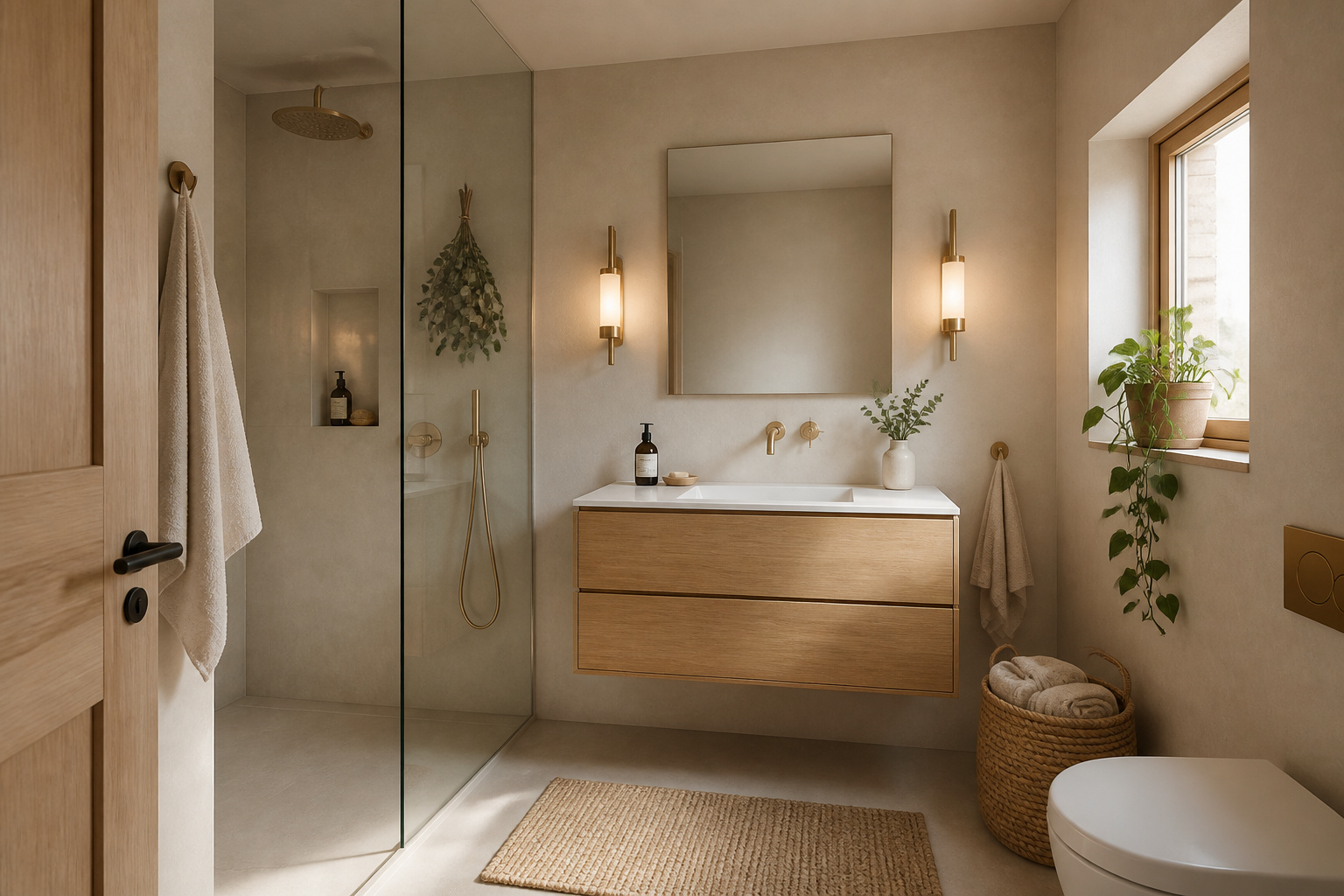
Small bathroom decorating made simple: 18 Nordic-inspired ideas to create a spa-like retreat at home. Natural materials, smart lighting, tiles, and storage.
There’s a useful misconception about small bathrooms — that size is the problem. You simply have to wait until you have a bigger one. In my experience with Scandinavian design, the opposite tends to be true. Constraints sharpen decisions. When you can’t afford clutter or confusion, you make better choices. Small bathroom decorating rewards that discipline with spaces that feel genuinely considered.
These 18 ideas pull from the same thinking that makes Nordic bathrooms so calm: natural materials, honest finishes, and the understanding that a room doesn’t need to be large to feel luxurious. Some require minor renovation. Most require only an edit and a trip to the shops.
Wall-mounted shelving is the hardest-working upgrade in a compact bathroom. Fix a shelf to the wall and the floor clears. In a room measured in single digits of square metres, even 30 centimetres of unbroken floor reads as breathing room. That visual clarity is the first thing you notice in a Scandinavian bathroom: the floor is present, intentional, part of the design.
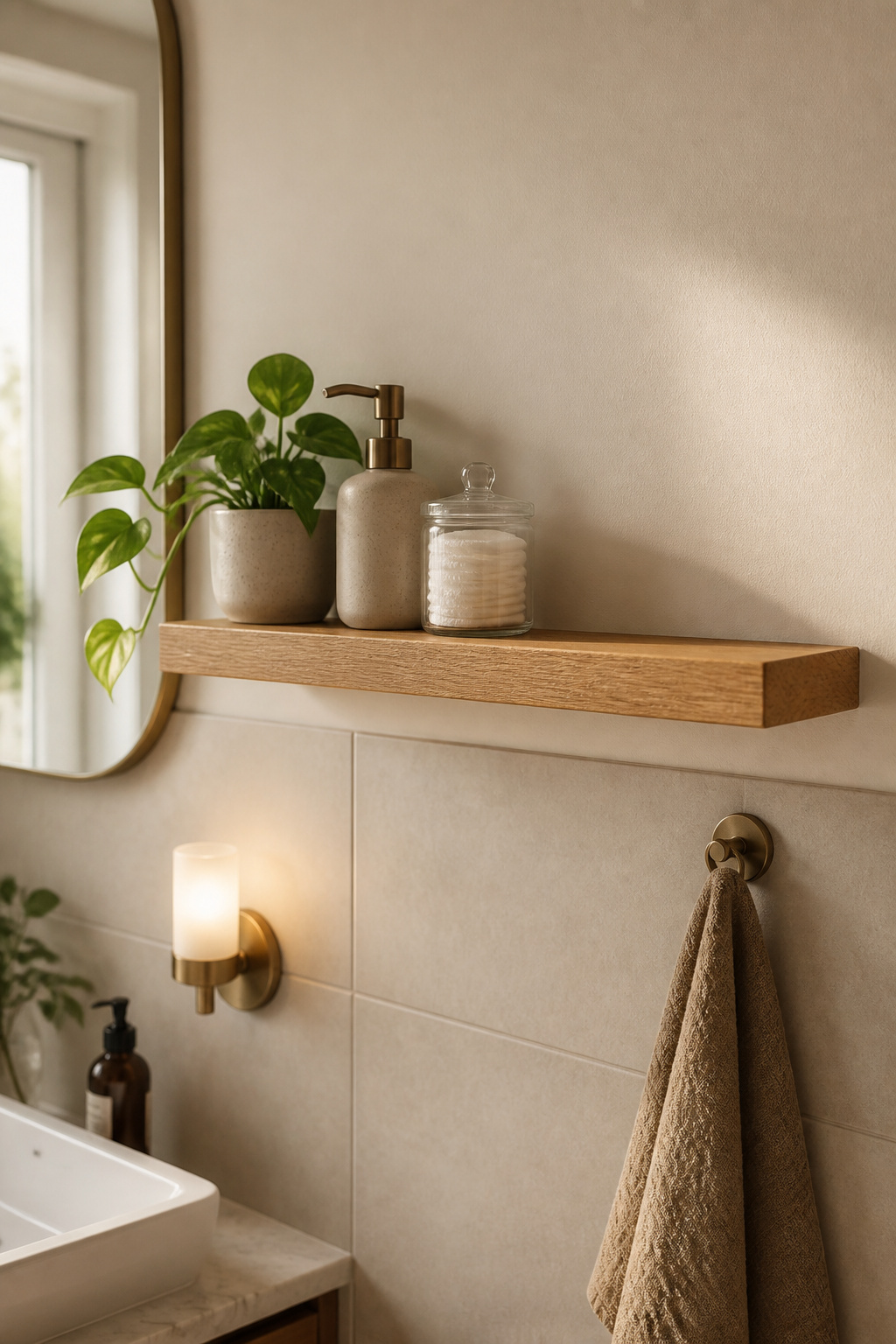
For bathroom shelf decor ideas that last in humid conditions, material choice matters. White oak is the premium specification. Its closed-cell structure physically blocks moisture absorption at the cellular level — not just at the surface coating. Kiln-dried Scandinavian pine with a hard-wearing oil finish is the practical alternative. It’s lighter in colour, equally Nordic in character, and needs re-oiling every 12 to 18 months. Keep shelf depth to 20–25 centimetres. That holds standard bottles without the shelf intruding on movement.
Nordic shelf styling follows a simple principle: divide the shelf into thirds. One third for functional items (a soap pump, a cotton jar). One third for something living (a small plant or eucalyptus stem). One third left empty. That negative space isn’t wasted — it’s doing design work. The most common mistake is filling every centimetre. Five items maximum per shelf, always.
Tiles and porcelain are cold surfaces. They’re functional and durable, but on their own they read as clinical — the temperature of a changing room rather than a retreat. A single wooden element changes this completely. Wood is warmth in Nordic bathroom design, and warmth is the whole point.
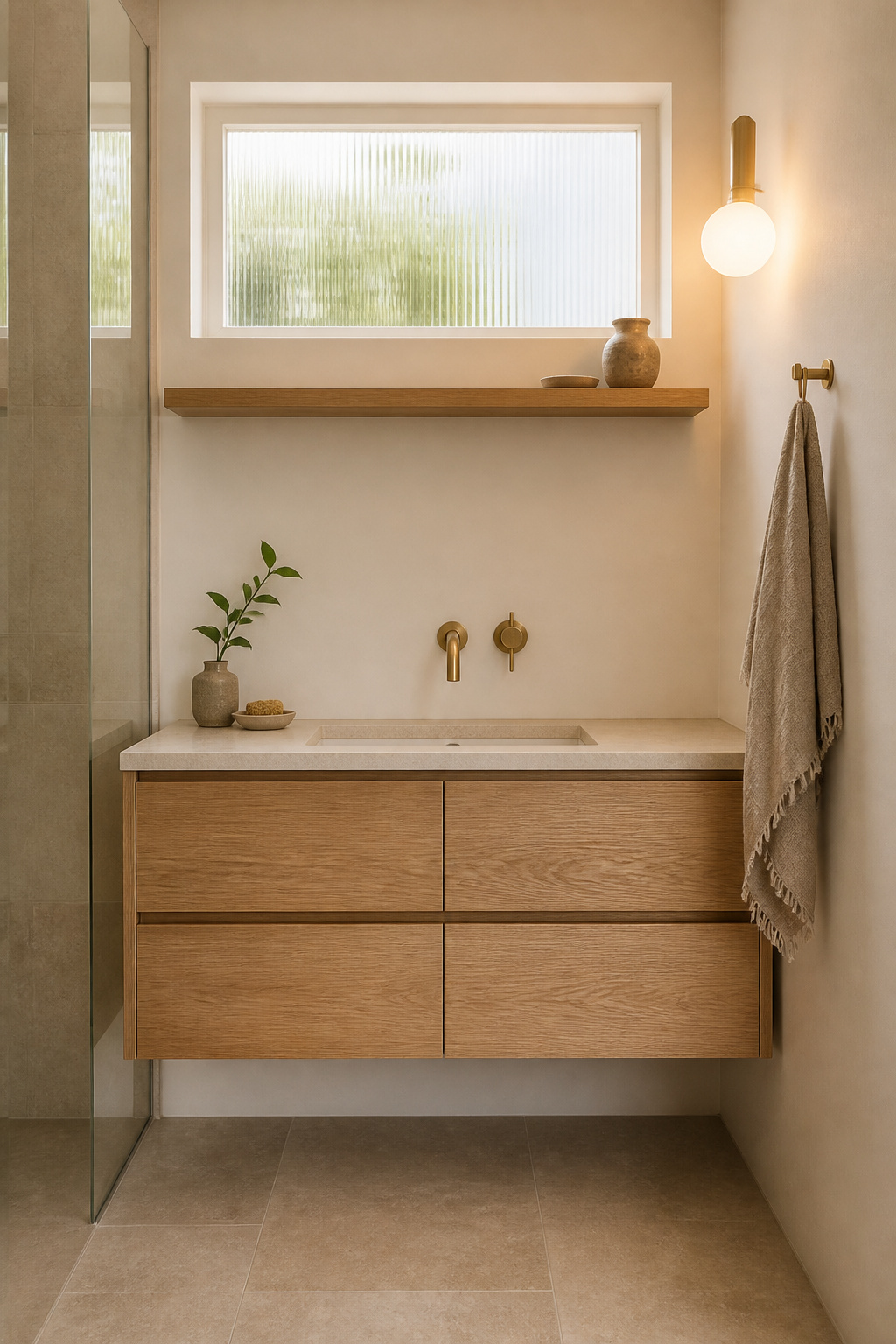
White oak and teak are the two species worth knowing. Teak is the premium option. Its natural silica oils resist moisture without chemical treatment. A well-maintained teak vanity lasts 50 years or more with nothing beyond annual light oiling. White oak does similar work at a lower price. Its tyloses — a plant cell structure — physically block water absorption in a way that open-grained species like pine cannot replicate. If budget is the constraint, strand-woven bamboo rivals teak’s moisture performance at 30–40% of the cost.
In a bathroom under five square metres, limit wood to one primary surface. Either the vanity or a wall panel — not both. Two wooden surfaces in a small room read as a sauna, not a spa. Lighter tones (natural oak, pale bamboo) keep the space open. A wall-hung vanity floating 15–20 centimetres off the floor creates the same visual clearance as floating shelves. The effect compounds.
Every grout line is a visual interruption. Human visual processing reads a floor with fewer lines as more spacious. The surface registers as a single continuous plane rather than a grid of small units. This is why 600x600mm floor tiles in a small bathroom outperform 150x150mm mosaic: roughly one-quarter the grout lines means a floor that reads four times as uninterrupted.
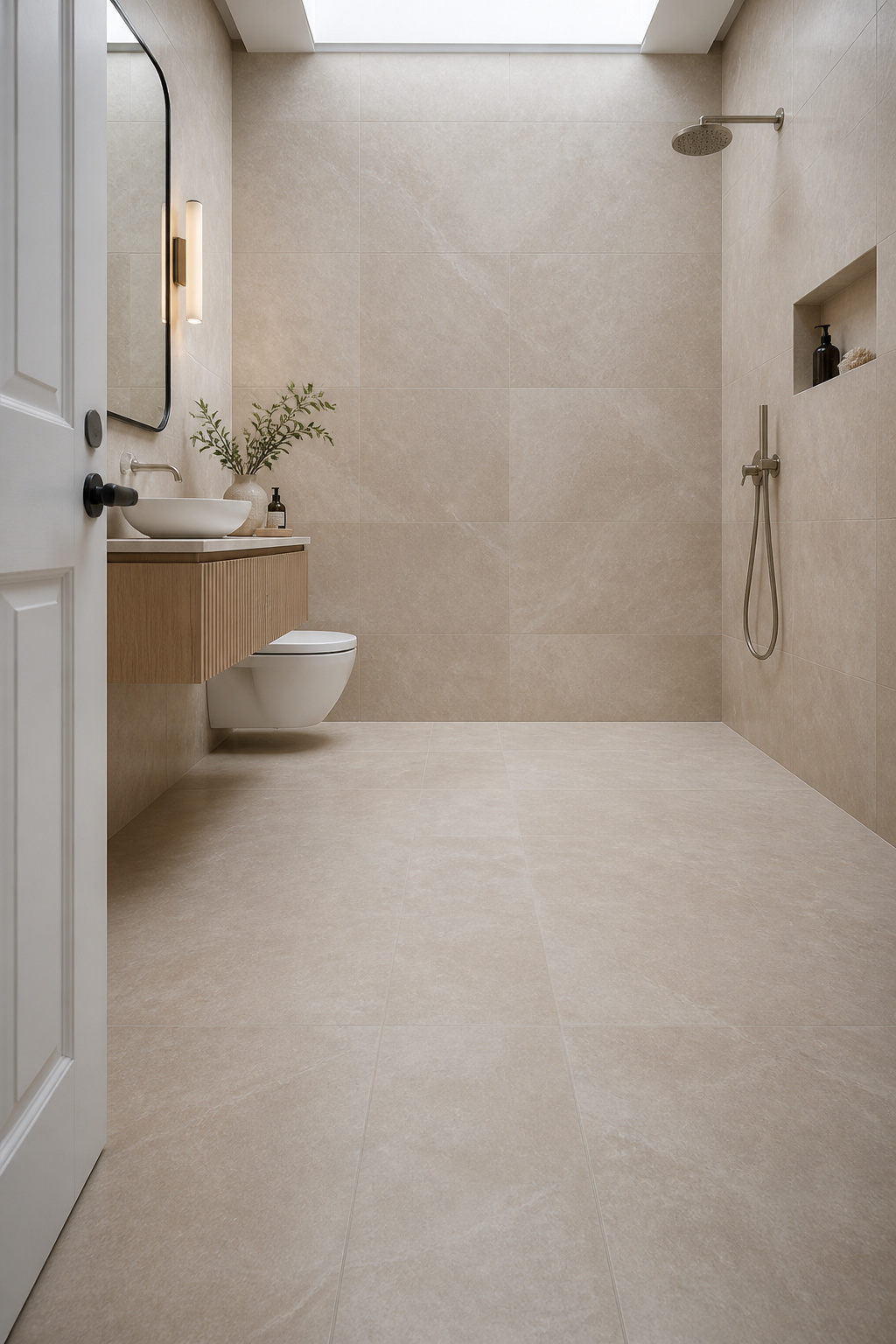
For small bathroom ideas that maximize every square foot, tile sizing is one of the highest-leverage decisions you’ll make. The practical choice for most small bathrooms is 300x600mm rectangular tiles laid vertically on walls. They’re big enough for minimal grout lines, yet proportional enough to avoid overwhelming a compact space.
On the floor, 600x600mm works well in rooms over three square metres. Below that, 300x300mm is the better call. The format matters less than the grout. Use rectified tiles with a 2mm joint and match the grout tone closely to the tile colour. Contrasting grout highlights every edge. Matched grout extends the seamless effect across the whole surface. This decision costs nothing extra and changes the result substantially.
Pure bright white looks clean on a paint chip and clinical in a bathroom. It competes with the tile, the fittings, and the floor simultaneously. Everything appears equally intense, and the room has no focal point. Warm whites avoid this. They carry slight cream, greige, or stone undertones that recede gently. Other elements — the wood vanity, a ceramic accessory, a linen towel — can then read as the features.
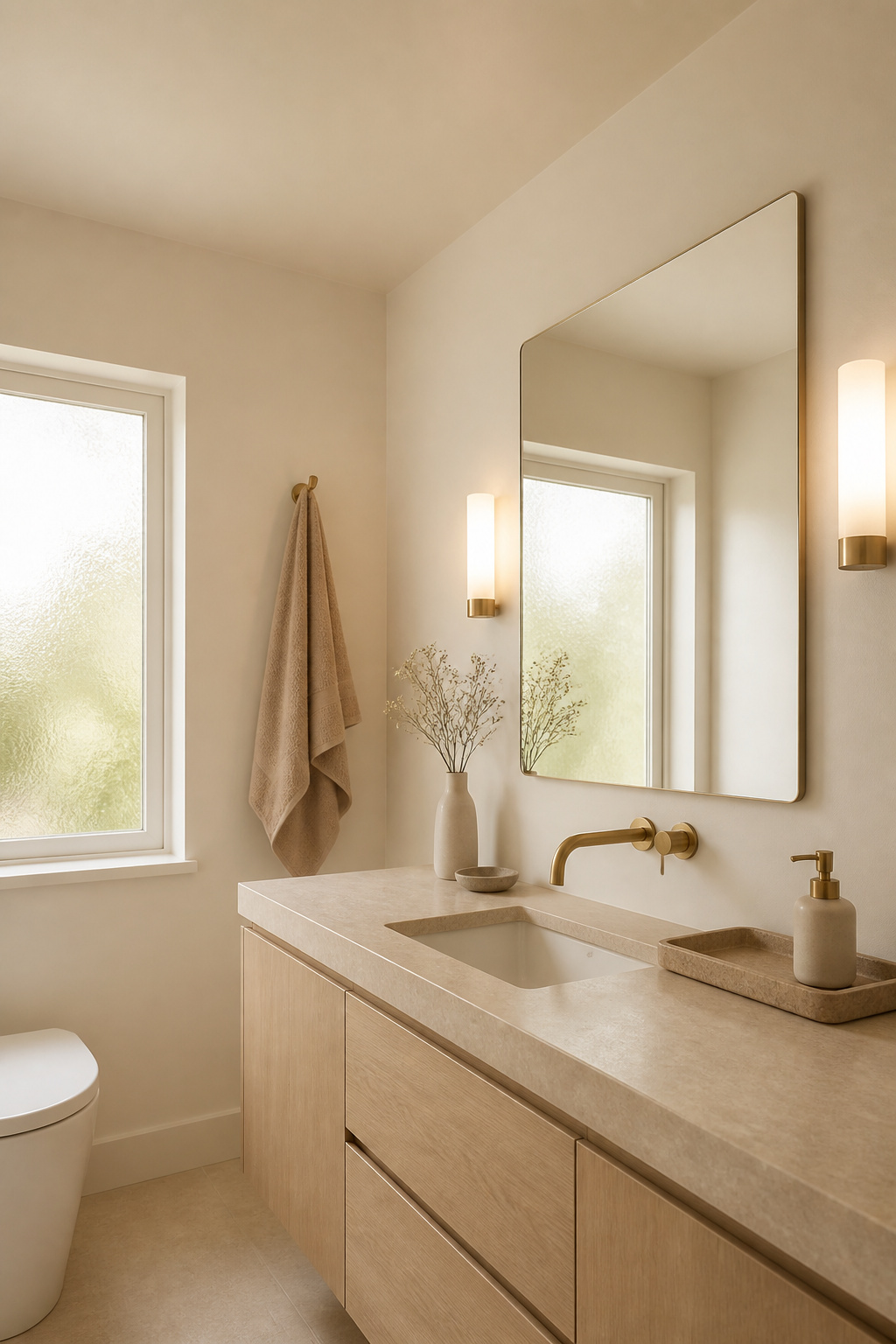
Benjamin Moore White Dove OC-17 (LRV around 83) is the warm white that designers return to for bathrooms with natural wood tones. Chantilly Lace OC-65 is slightly brighter and crisper. It’s better in rooms with limited natural light that need maximum reflectance without turning cold. Farrow & Ball Elephant’s Breath No.229 is the Scandinavian-influenced choice. It’s a complex warm greige with green and beige undertones. It pairs exceptionally well with natural materials and reads differently throughout the day as light changes.
For the ceiling, try painting it the same colour as the walls. The conventional white ceiling creates a visible cut-off at the cornice. Match the wall colour overhead and that line disappears. The room feels simultaneously taller and more contained — the effect is quieter and more sophisticated than it sounds. Stone accessories at counter level add the secondary earthy tone at detail scale, where it’s easy to change if you develop the palette further.
A bathroom without textiles is a functional space. Add a linen towel hung on a simple wooden hook and it becomes, if only slightly, a retreat. The difference is not primarily visual. It’s the signal that someone made a deliberate choice about how this room should feel — not just what it needs to do.
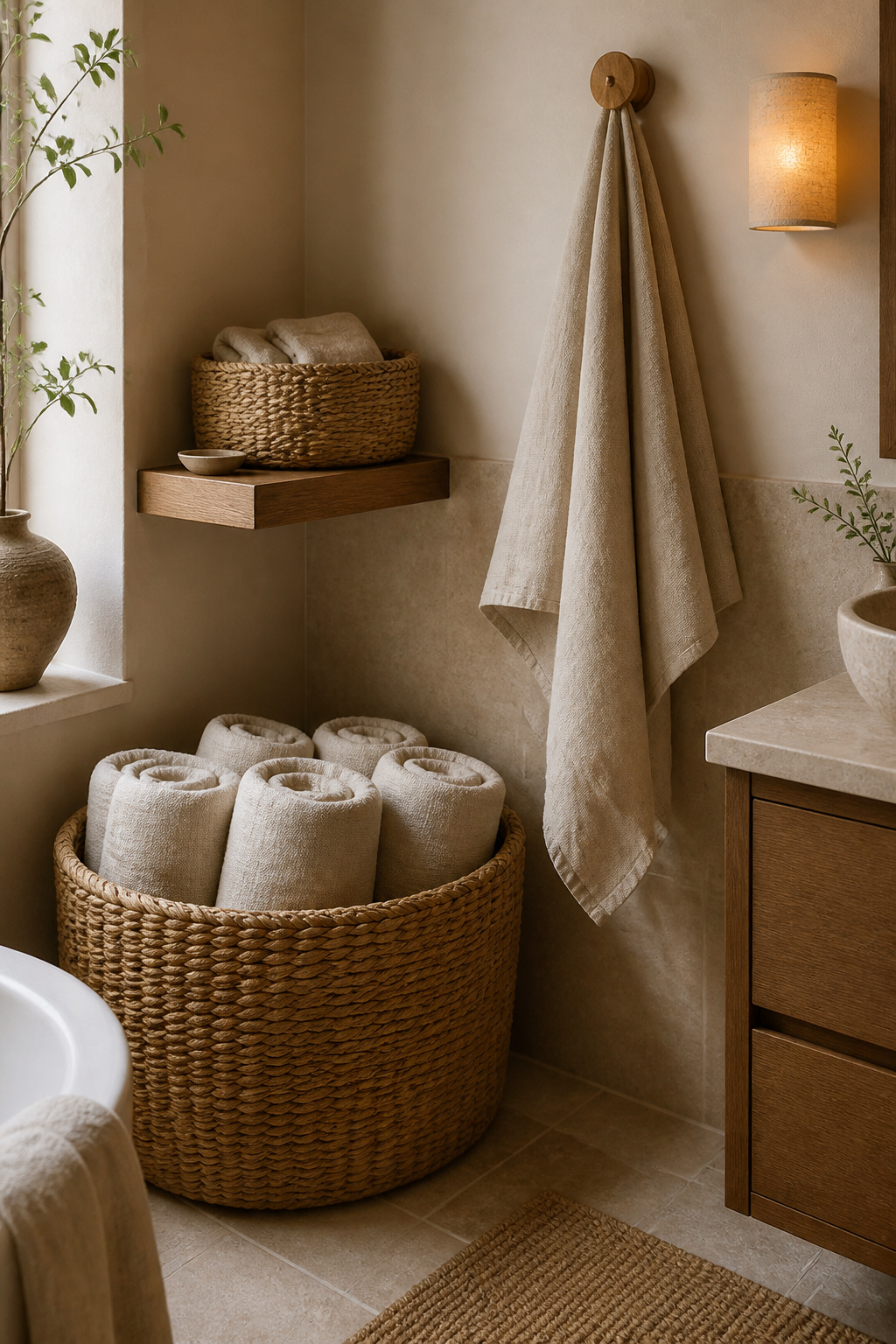
Linen is the Nordic bathroom textile. It’s slightly rougher than cotton to the touch. It softens with washing, dries faster than terry towels, and carries a natural slub texture that mass-produced cotton cannot replicate. It absorbs about 20% less moisture than a thick terry towel initially. In practice, a linen towel on a warm rail is dry within an hour. A thick cotton one is still faintly damp at the fold. A woven basket brings natural material contrast against tile surfaces. It solves towel storage without hardware.
A single large basket — 35 to 45 centimetres in diameter — reads as a design element. Three small mismatched baskets read as clutter. In tight spaces, fewer larger pieces are almost always the right call. If floor space is the constraint, mount a woven basket cubby on its side on the wall. It accepts four to six rolled hand towels without claiming any floor at all.
The single most overlooked upgrade in any small bathroom is the lighting. Most bathrooms have one ceiling fitting. That’s a specification driven by minimum building standards, not good design. A single downward source creates shadows on the lower face. It flattens the room’s visual depth. It makes every decorating decision around it look worse than it should. Changing this costs under £200. It requires no tiles, no plumber, and no permit.
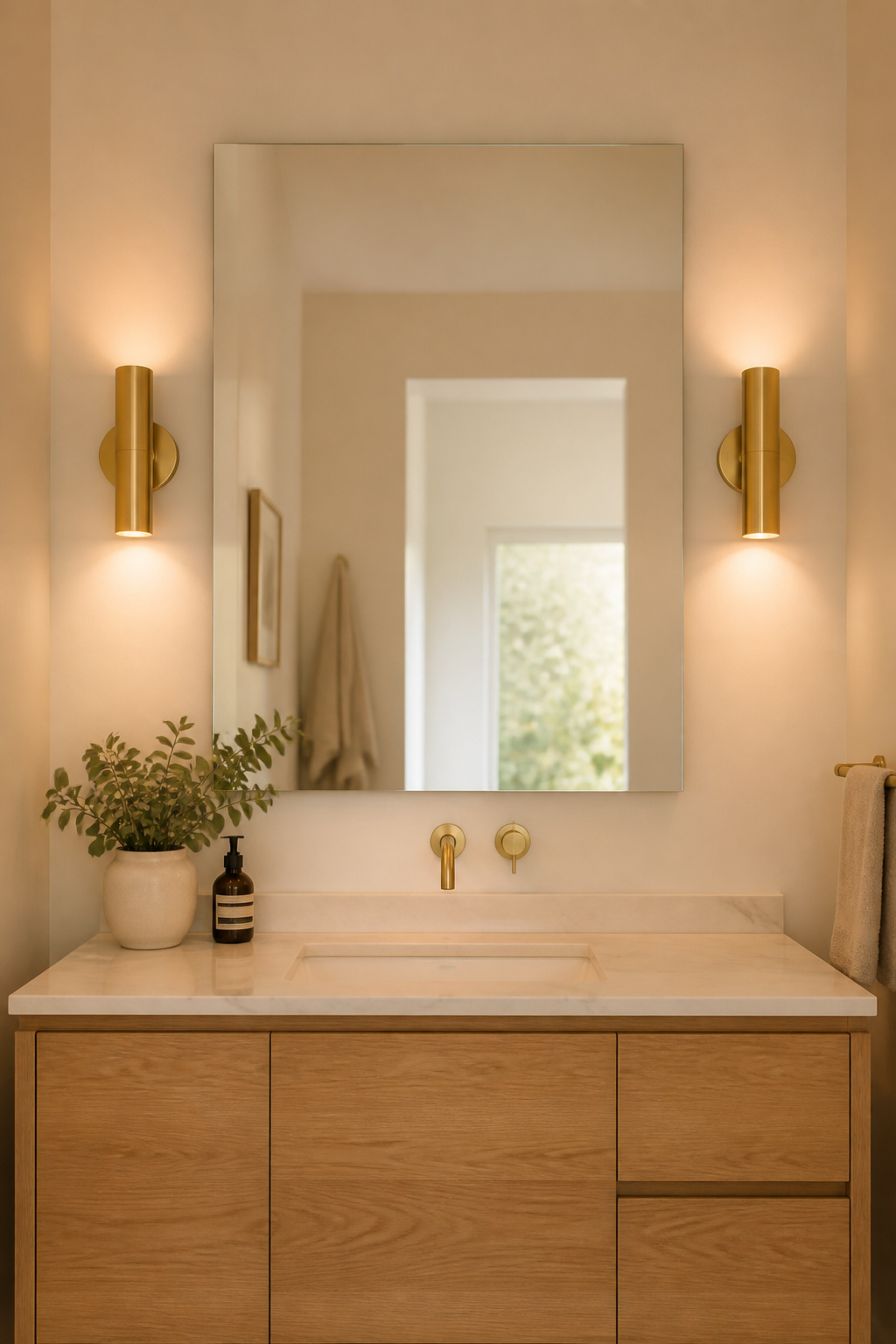
For bathroom vanity lighting ideas that eliminate shadows entirely, the standard is two wall sconces flanking the mirror at face height — 60 to 66 inches from floor to fixture centre. Cross-illumination from both sides removes the downward shadows a single overhead source creates. The light comes from the sides at eye level, the same principle as a professional makeup mirror. Turn off the overhead entirely and rely only on sconces. The atmosphere in the room changes immediately.
The bulb temperature should be 3,000K. It’s warm enough to flatter skin tones and bright enough for grooming tasks. Avoid 4,000K and above. It makes skin tones grey and white tiles look cold. For fixture placement, Zone 2 (beyond 60cm from a bath or shower) requires a minimum IP44 rating. Zone 1 (directly above a bath or shower) requires IP65. Both specifications are clearly marked on any bathroom-rated fixture.
The most effective height-creation tool in a bathroom with a low ceiling costs the same as standard tiling. It simply requires a different instruction to the tiler. Vertical tile orientation — the same tile, turned on its side and laid in a vertical stack or running bond — guides the eye upward along continuous joint lines. Instead of reading across horizontal banding, the eye follows the lines up.
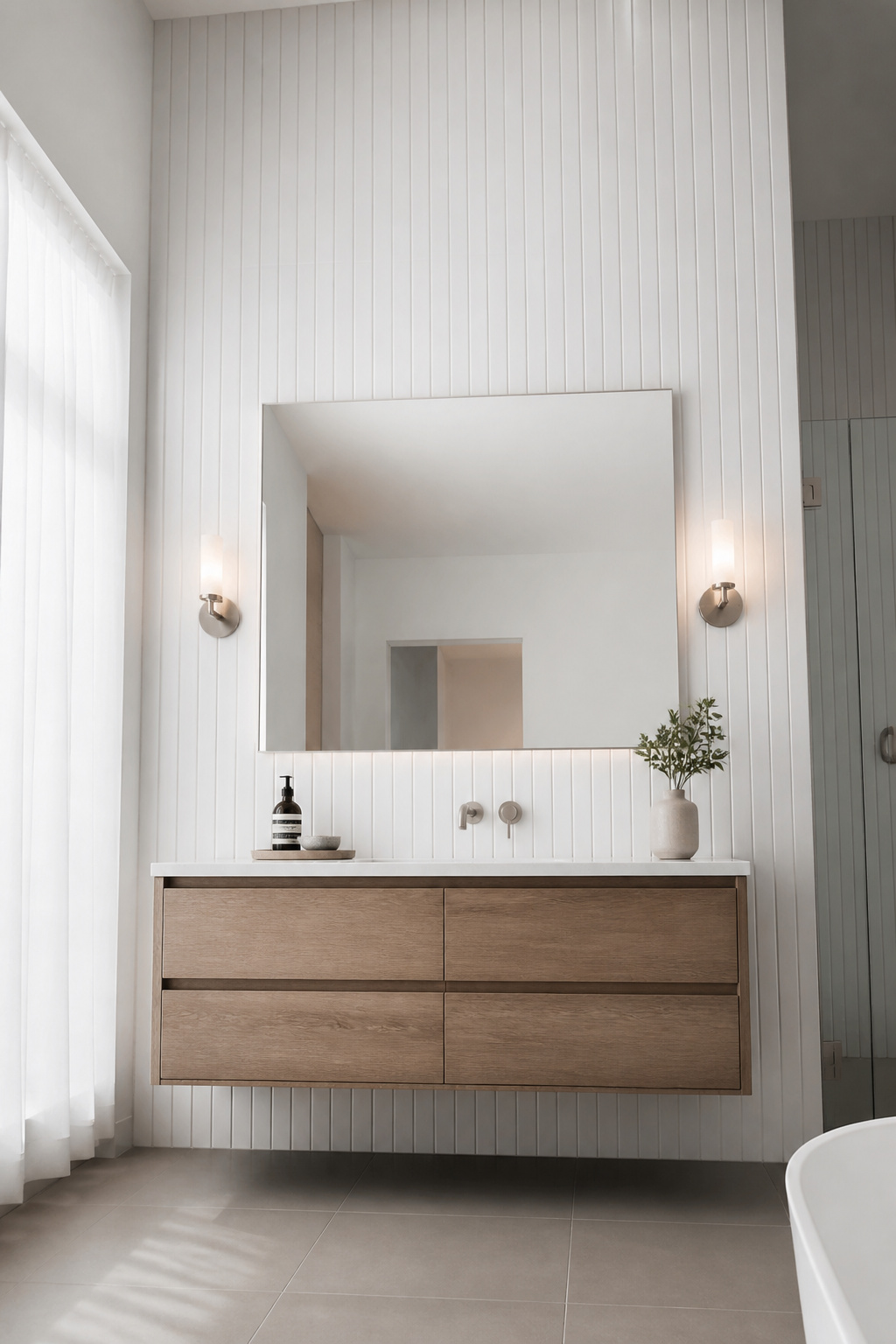
Stack bond (tiles aligned in perfect vertical columns) is the most direct version. Vertical running bond (each tile offset by half a unit, but oriented tall-side vertical) is more dynamic. Both patterns should pair with light tile colours and matched grout to amplify the height effect. Dark grout with vertical tiles creates a ladder pattern. That draws attention to the ceiling line rather than beyond it.
Herringbone laid vertically creates the most visual drama and the strongest height illusion. But it’s also the most demanding installation and the busiest visual choice for a compact space. In rooms under four square metres, vertical stack bond is usually the better call: more Scandinavian in character, easier on the eye, and easier to install. A vertical feature wall on the vanity side paired with plain horizontal tiles elsewhere gives the room two distinct visual planes — grounding the floor, lifting the eye.
The difference between a functional bathroom and a spa bathroom is mostly a matter of intention. Towels are the clearest expression of it. In a hotel spa, towels are rolled or folded consistently, displayed in a single colour family, and treated as part of the room’s presentation. In most home bathrooms, they’re whatever was clean and grabbed from the airing cupboard. The gap is not about money or space. It’s about deciding that towels are a design element.
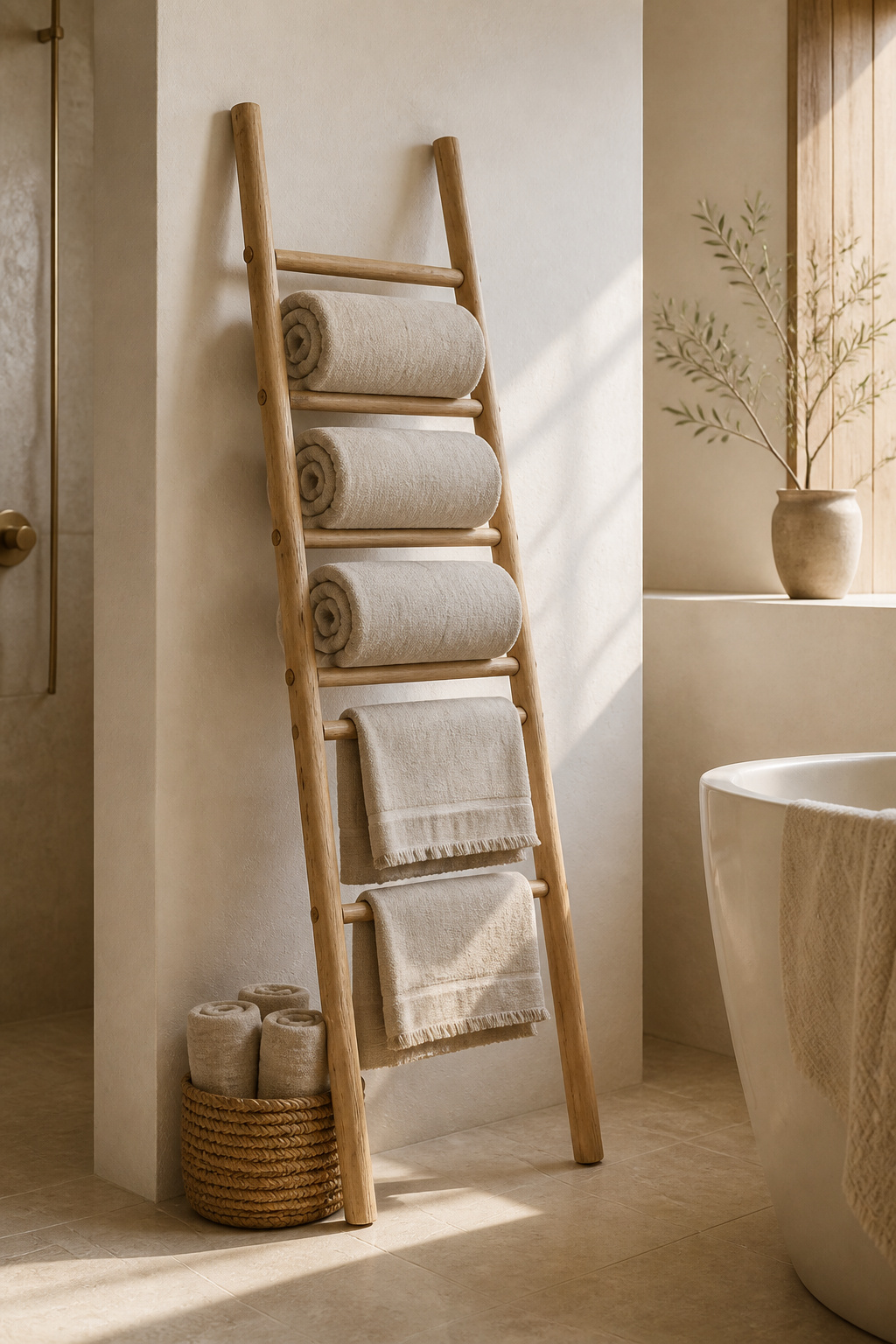
Rolling towels takes three seconds more per towel than folding. It looks dramatically better on an open shelf or in a basket. The cylindrical forms have a sculptural quality that flat stacks lack. For a folded bar display, consistency of fold width matters most. Every towel folded to exactly the same finished dimension reads as intentional. Slightly different dimensions read as haphazard — immediately.
Hardware choice has a practical dimension here. A ladder rack (typically 40–50cm wide, 150–170cm tall) claims no wall space and suits Scandinavian interiors in raw oak or pale pine. A heated towel rail keeps towels dry and reduces bathroom humidity — both real quality-of-life improvements in a space where damp towels contribute to condensation. For the smallest bathrooms, two or three consistent robe hooks on the back of the door preserve wall space entirely. Colour-match towels to wall tones as closely as possible. When linen-tone towels disappear against warm white walls, the room reads as larger, cleaner, and more coherent.
Most bathroom mirrors are too small. The standard error is sizing the mirror to the vanity bowl rather than the total vanity unit. A 60cm mirror above a 90cm vanity leaves blank wall on both sides. That space serves neither decoration nor function. The rule is 70–80% of total vanity width at minimum. In small bathrooms, going to 90–95% of vanity width is consistently recommended as the point at which light-reflection benefits become meaningful.
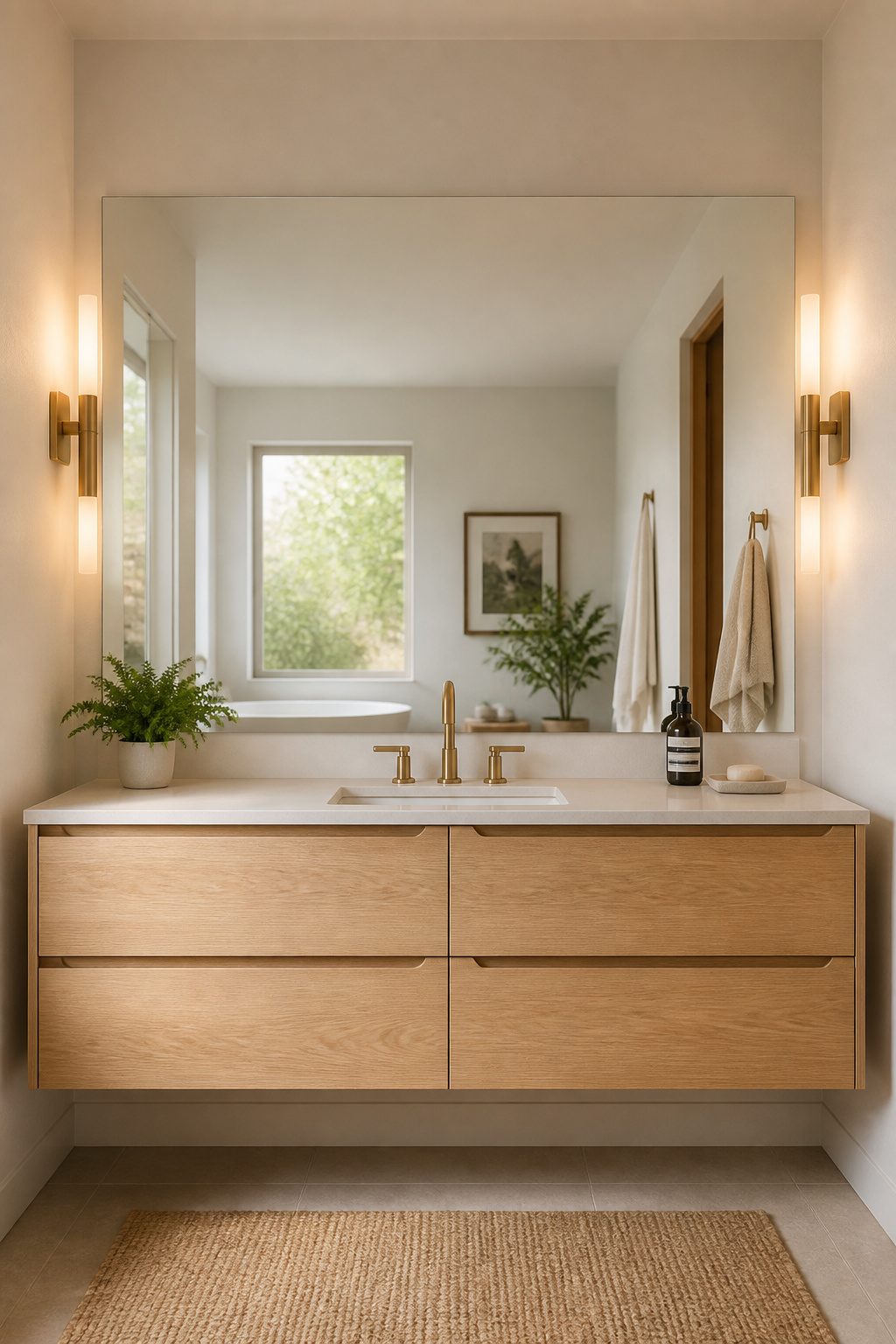
For bathroom mirror design ideas that maximise perceived space, the frameless mirror is the clearest choice. The reflective surface extends to within a few millimetres of the edge. The eye reads reflection rather than border. This is the core trick behind the “bigger room” effect. A framed mirror adds character and warmth (natural wood, brushed metal). But it reduces total reflective area and adds a visual boundary that reads as furniture rather than space. In a room under four square metres, frameless is the more generous choice.
Position mirrors to face or angle slightly toward the primary natural light source. That bounces daylight into the room’s darker corners. LED mirrors — integrated backlighting along the edges — provide uniform edge illumination. This eliminates the hard shadow line between mirror and wall. Combined with flanking sconces, the mirror doubles as a reflector for the artificial light. It effectively multiplies a two-point lighting setup throughout the room.
Three plants perform reliably in bathroom conditions: pothos, peace lily, and Boston fern. This is not an extensive list, but it’s a useful one. These three genuinely thrive in low light and high humidity rather than merely surviving. The wrong plant in a bathroom — a succulent, a cactus — requires constant attention to keep alive in conditions that suit it poorly. The right plant requires almost none.
Pothos is the most forgiving: near-impossible to kill in bathroom conditions, tolerant of low light, happy with infrequent watering. In a humid bathroom, the top inch of soil may stay moist for 10–14 days rather than seven. Peace lily signals when it needs water by drooping visibly. It recovers completely within a few hours of drinking — a plant with built-in communication. Boston fern provides the most dramatic visual effect. It loves bathroom humidity genuinely, with one caveat: don’t place it directly on or adjacent to a heated towel rail, where radiant heat dries it quickly.
The most Nordic bathroom plant addition requires no pot at all. A bundle of fresh or dried eucalyptus hung from the showerhead releases its oil when steam activates it. The scent is immediately spa-like. The visual is simple and clean. The cost is negligible. Bundles last two to four weeks before the scent fades, though dried bundles maintain their visual appeal much longer. The window sill is often the most underused plant location: a single small plant benefits from direct natural light without claiming any floor, shelf, or counter space.
In a bathroom of three to five square metres, every hardware element is visible simultaneously from the doorway. The tap, the towel bar, the toilet roll holder, the robe hooks, and the shower fittings all appear in a single visual field. Finish consistency matters proportionally more here than in any larger room. Mismatched finishes — a chrome tap, a brushed nickel towel bar, matte black hooks — create a sample-room feeling. This happens even when every individual piece is perfectly functional.
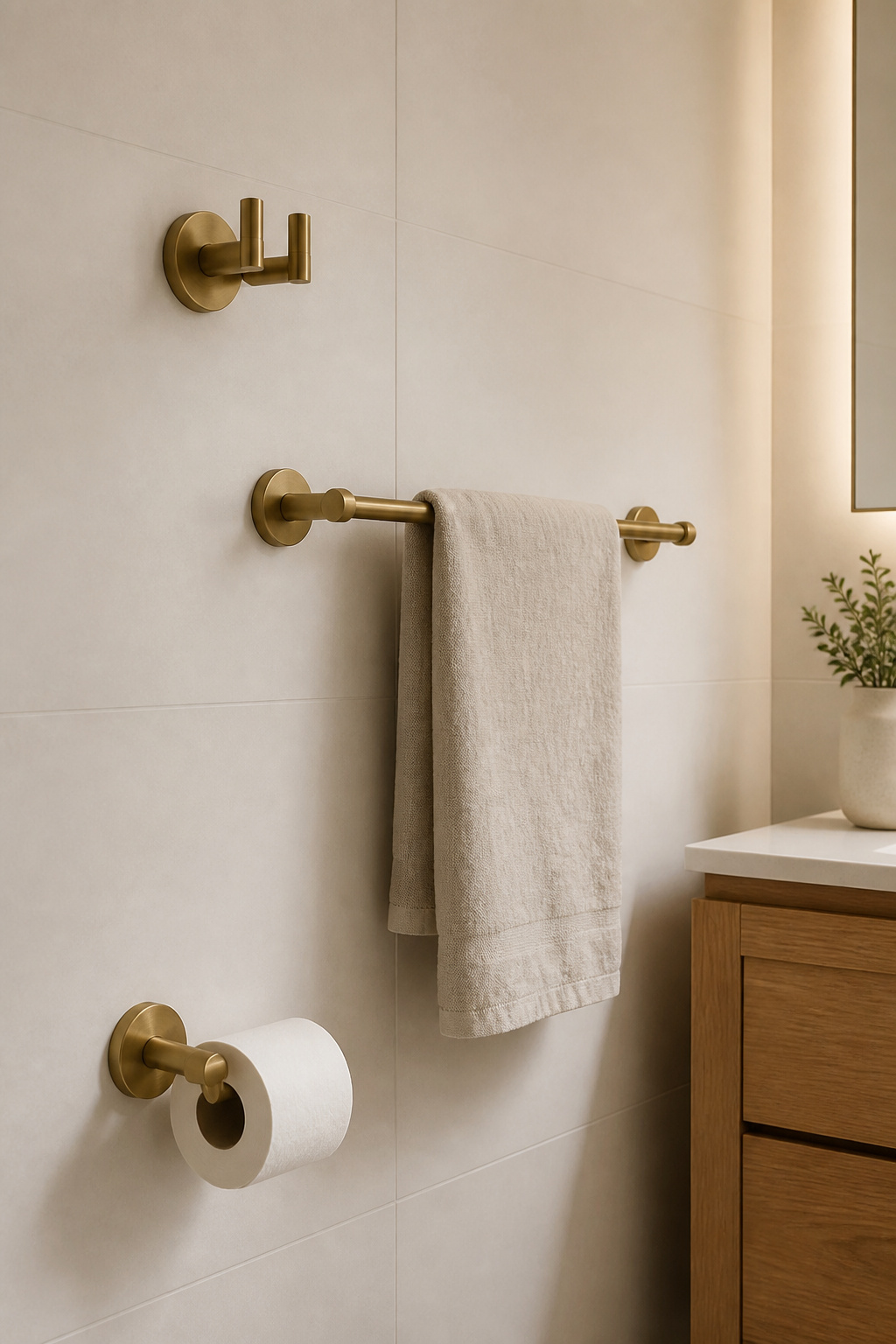
The Scandinavian prescription is simple: one finish throughout, or an intentional pairing of two. Brushed nickel is the traditional Nordic choice. It’s a warm silver tone that sits between chrome’s cold brightness and gold’s richness. It hides fingerprints better than any polished finish and suits white and grey palettes naturally. Brushed brass is the current direction in Scandinavian contemporary design. It pairs particularly well with warm white walls and natural wood vanities. Matte black is the highest-contrast option — graphic and strong against white tile, but it requires a proper anti-fingerprint coating to maintain its look over time.
For placement, robe hooks on the back of the door are the most space-efficient option in a tight bathroom. They contribute zero wall footprint and hold robes, towels, or clothes without competing with shelves or mirrors. Standard height is 60–65 inches from floor to hook. Double hooks take no more wall space than single hooks and are meaningfully more practical: robe on the front hook, towel on the back, both accessible.
Shower caddies and corner shelves — chrome wire frames loaded with bottles of varying sizes and colours — are the visual antithesis of the spa bathroom. They work. But they actively undercut every other design decision in the room. A recessed shower niche solves this. The products sit within a defined rectangular frame. The eye reads a composed element rather than a collection of objects. The niche becomes a small architectural feature rather than an afterthought.
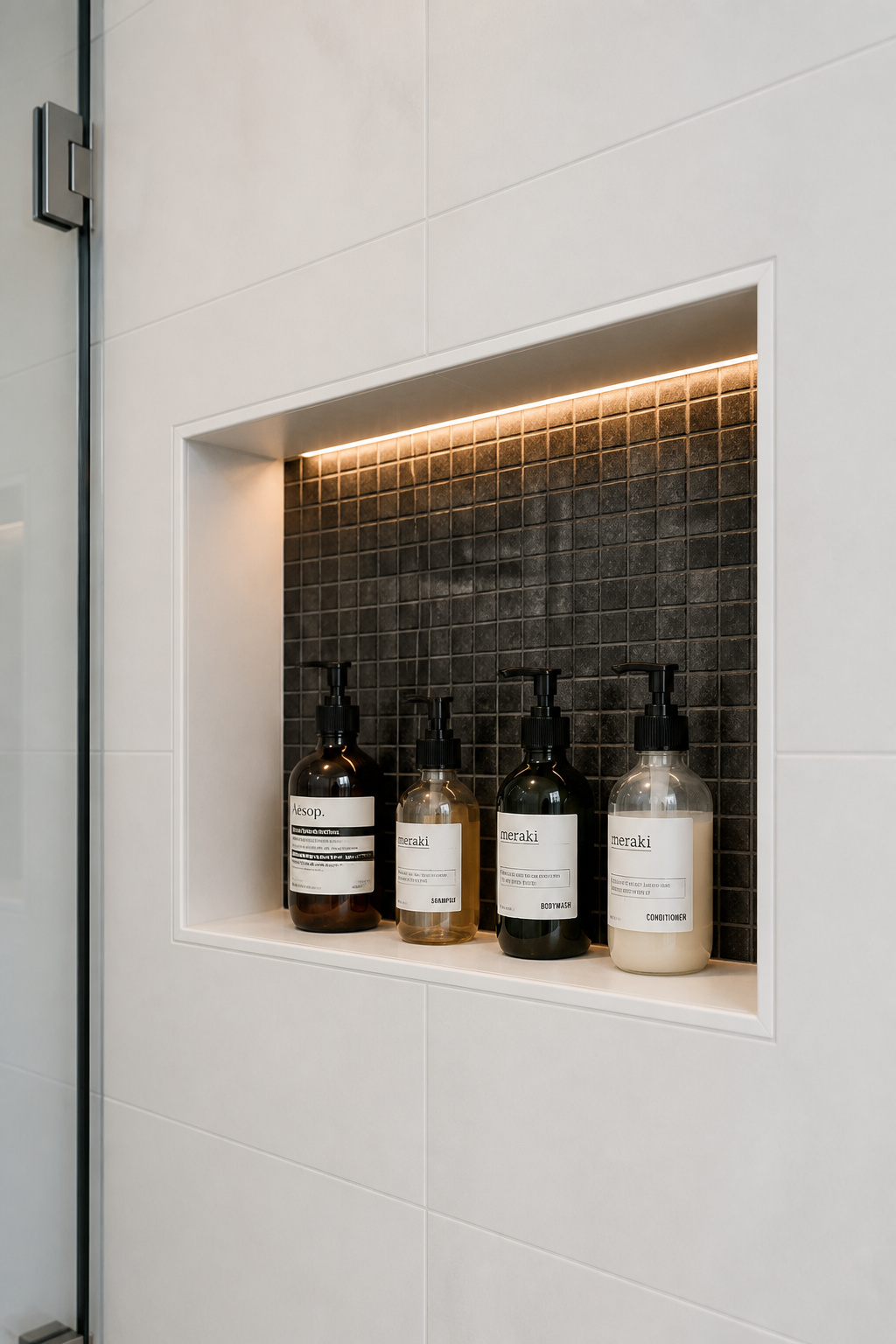
For bathroom shower design ideas that integrate storage seamlessly, the recessed niche is the professional standard. A 12×24 inch (300x600mm) niche fits comfortably within a standard 16-inch stud bay — a clear opening of approximately 14.5 inches between studs. Standard depth is 3.5 inches, exactly the depth of a 2×4 stud bay. That holds most standard product bottles with room to spare. Install at 1,200mm (48 inches) from floor to niche bottom. This puts it at chest-to-eye level for most adults — accessible without bending, visible without effort.
The design opportunity is in the interior tiling. A contrasting tile inside the niche — dark charcoal against white shower walls, a warm clay tone against grey — creates a framed moment. It costs almost nothing extra during the tiling phase. Waterproofing is the critical technical requirement: two to three coats of liquid membrane on all surfaces, with silicone caulk (not grout) in every internal corner. Grout cracks with movement and allows water infiltration. Silicone remains flexible and waterproof. This is the one step where shortcuts create serious problems later.
The bathroom ceiling is the most underused decorating surface in the house. Standard practice is white — a neutral that requires no decision and contributes nothing. The result is a room with a visible cut-off line at the cornice. The walls end, the ceiling begins, and the room’s height is defined rather than suggested.
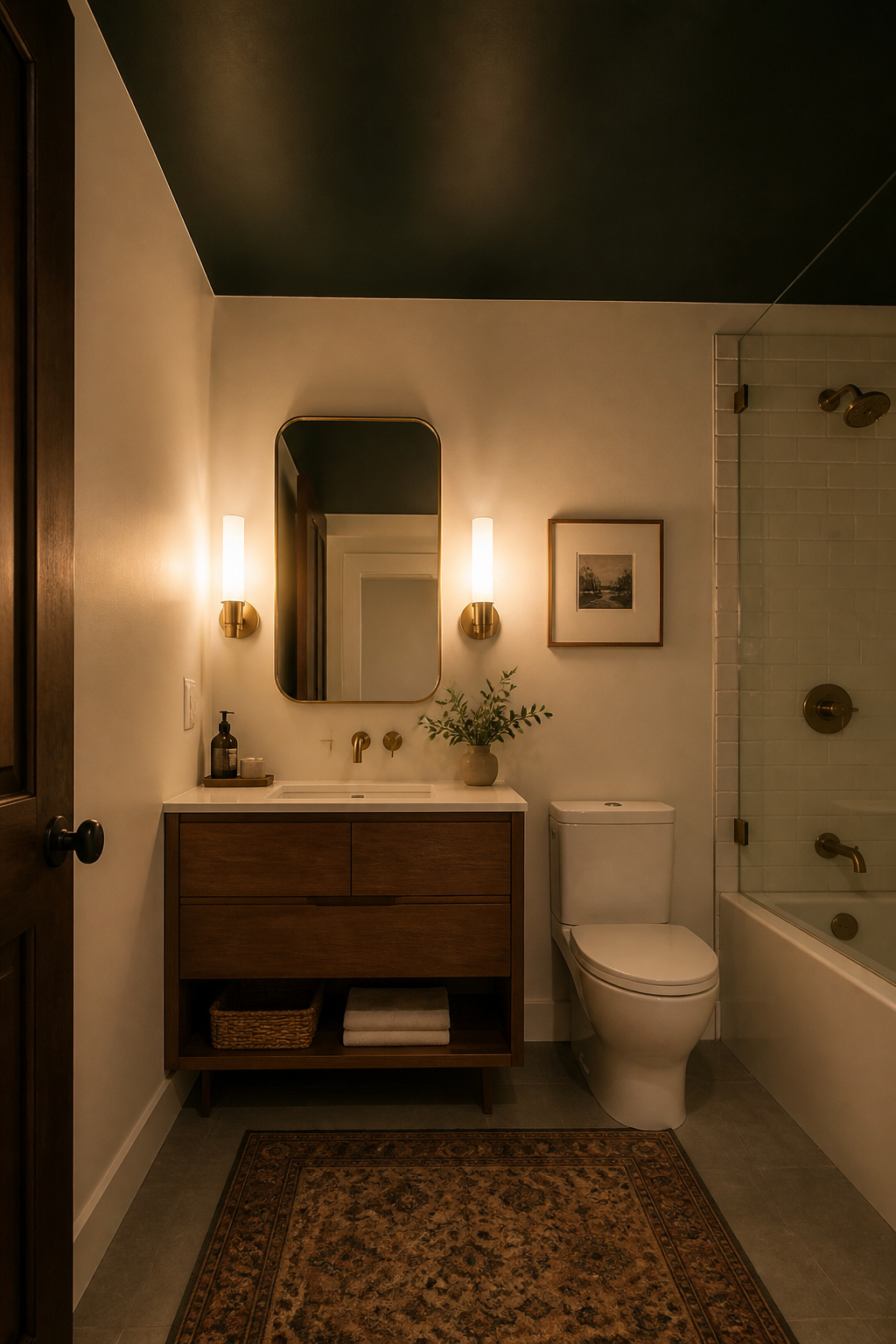
Painting the ceiling the same colour as the walls dissolves this boundary. The eye no longer registers where the wall ends and the ceiling begins. The room reads simultaneously taller and more contained — the jewellery box effect that interior designers describe when small rooms are treated as self-contained spaces rather than compromised versions of larger ones. A deeper or contrasting ceiling colour (deep teal, forest green, charcoal) creates intimacy and drama. That works with the spatial constraints rather than against them. The condition is adequate lighting: a dark ceiling with good sconce light creates a deliberately cocoon-like atmosphere; a dark ceiling with poor light is simply oppressive.
For paint specification, satin is the minimum for bathroom ceilings: durable enough to resist moisture, soft enough to avoid the clinical brightness of high-gloss. Semi-gloss is the professional standard — a harder, smoother surface with excellent moisture resistance and slight reflectivity. In bathrooms with poor ventilation, use paint specifically labelled for bathrooms. These contain mildewcide compounds that prevent the condensation-related peeling that standard paint suffers in sealed, humid spaces.
Mass-produced plastic accessories are the default in most bathrooms. They’re also the fastest way to undercut an otherwise considered design. They are uniform, synthetic, and — in a small room where everything is visible — they announce their retail origins clearly. A handmade ceramic soap dish signals the opposite: craft, intention, a decision made rather than defaulted to.
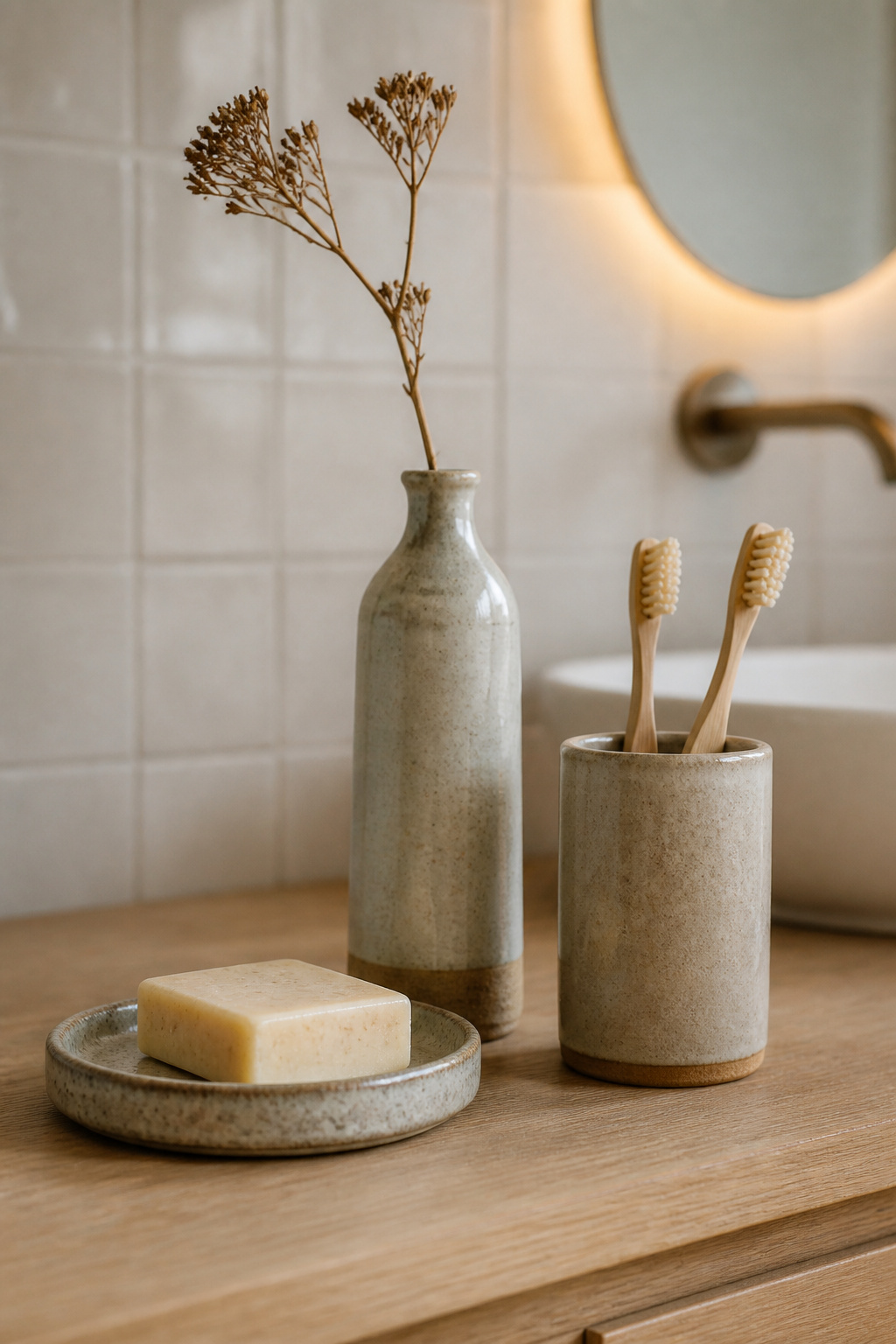
Handmade ceramics have natural variation — slight irregularities in edge, unique glaze pooling, visible throwing marks — that read as intentional rather than imperfect. In a Scandinavian bathroom where most surfaces are hard and reflective, a ceramic vessel at counter level introduces a tactile, organic element at the scale where it matters most. The price gap between mass-produced accessories and handmade ceramics is smaller than most people expect. A well-made stoneware soap dish from Etsy or a craft pottery studio runs $20–$45. That’s roughly comparable to mid-range retail bathroom accessories.
Counter grouping follows one rule: three items maximum. Beyond three, the eye reads clutter rather than curation — regardless of how well-chosen each piece is. Height variation within those three items creates interest: a tall bud vase, a low flat soap dish, a medium-height toothbrush holder. Three different profiles at the same counter level. Buy individual pieces that share a colour family rather than matching sets. Matching sets read as manufactured ensembles. Stoneware is the specification for bathroom use — denser, less porous, and more durable in humid conditions than earthenware.
A bathroom can be perfectly designed visually and still miss the experience of a spa. Scent is processed through a different brain pathway than visual information. It connects to emotional memory directly. A familiar calming fragrance in a functional space changes how the room feels faster than almost any visual element. One good candle, placed intentionally, does more for bathroom atmosphere than most makeovers costing ten times as much.
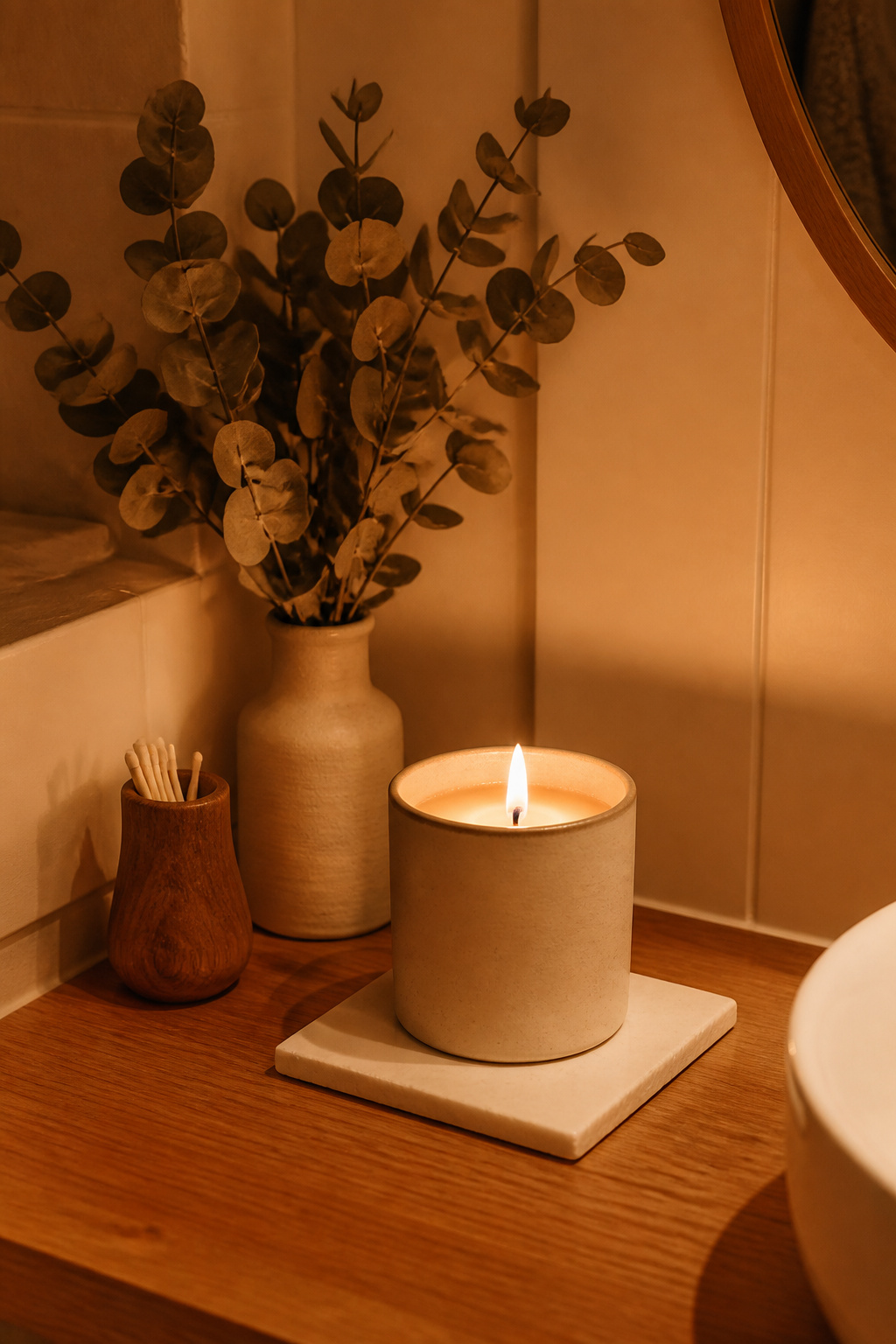
Hinoki cypress is the specific scent worth knowing. Hinoki is the wood used for traditional Japanese bathtubs and bathhouse flooring. Its fragrance profile combines fresh top notes of eucalyptus and white tea with a cedar-pine base and a warm amber finish. Brooklyn Candle Studio and Japan Trend Shop both offer hinoki candles at $25–$45. For a simpler and more accessible version, dried eucalyptus hung from the showerhead releases its oil in steam. The cost is under $10 and the effect is immediate. Nordic spruce and cedar candles from Scandinavian brands achieve a similar forest-atmosphere register from a different tradition.
Soy candles are the practical preference for enclosed spaces. They burn 30–50% longer than paraffin equivalents of the same volume and produce less soot. For placement, always use a ceramic, stone, or glass surface beneath the candle. Tile offcuts from the bathroom renovation are perfect for this — on-theme and cost-free. In windowless bathrooms, run the extractor fan during candle use to maintain air quality. In well-ventilated spaces, this is not a concern.
A plain floor in a room with plain walls and standard fittings looks functional rather than designed. A patterned floor changes this immediately. It provides the visual anchor that signals the whole room was considered, not assembled. And because the floor is largely obscured when the bathroom is occupied — you’re standing on it, not looking at it — it rarely overwhelms the space the way a patterned wall can.
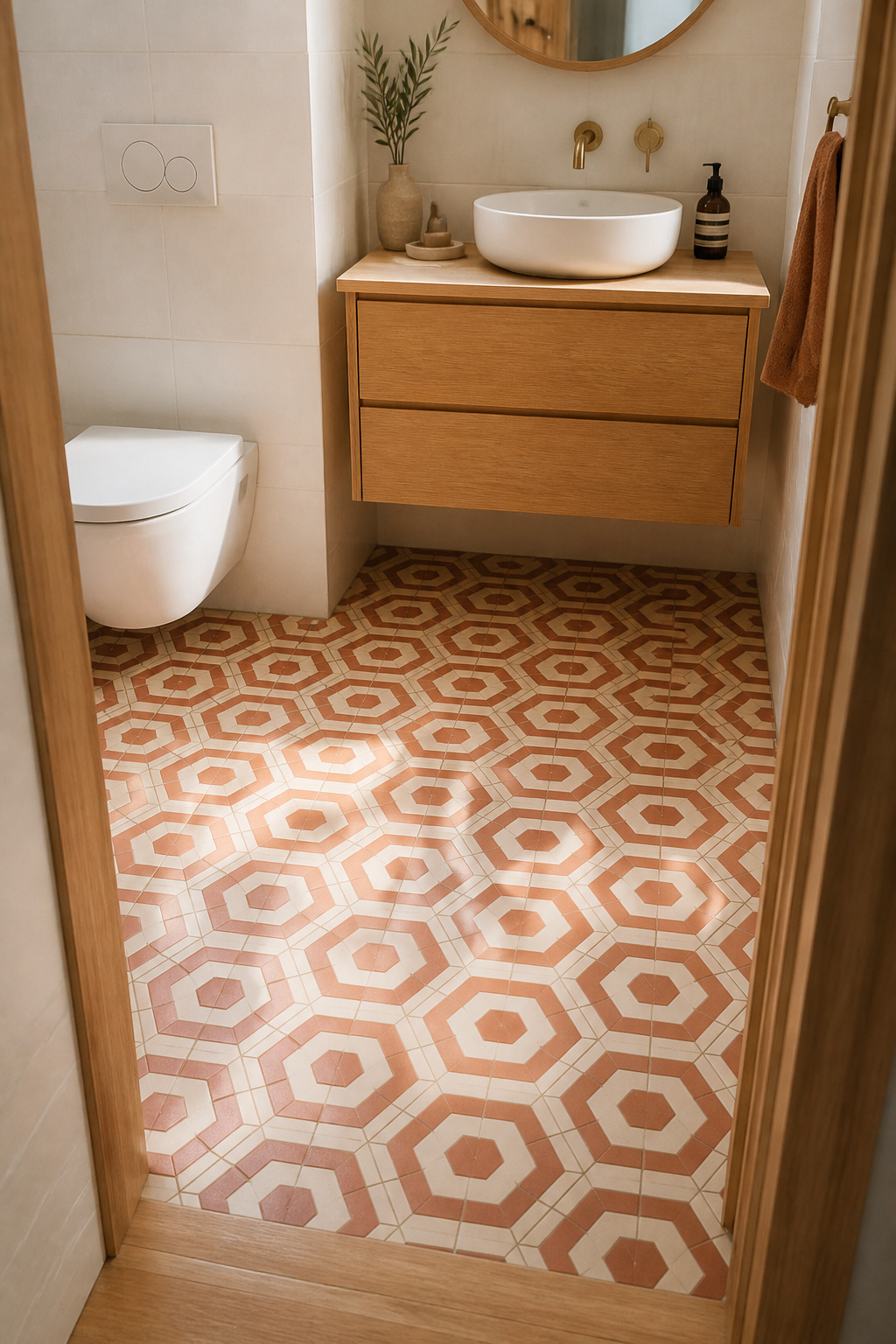
Authentic encaustic cement tiles are the premium version: handmade, with a pigment layer approximately 3mm deep that never wears off. Historic installations over 100 years old are documented still in good condition. They’re porous, requiring sealing every one to two years and pH-neutral cleaners. Cost is $15–$35+ per square foot. Porcelain reproductions achieve the same patterns through printing at a fraction of that — $5–$18 per square foot — require no sealing, and clean with soap and water. The honest trade-off: cement tiles develop a patina and warmth that porcelain cannot replicate. Porcelain looks exactly the same after 20 years as day one. That’s either reassuring or disappointing, depending on your aesthetic philosophy.
For rooms under four square metres, the pattern unit should be no larger than 15–20cm in its longest dimension. Small enough that the motif completes itself within the available floor area. Hexagon tiles at 5–10cm diameter hit the sweet spot: small enough to fully express the pattern, large enough to avoid the dated penny-tile aesthetic. Laying pattern tiles diagonally — rotated 45 degrees — creates a corner-seeking visual dynamic. It guides the eye to the room’s perimeter rather than to the centre wall, a subtle expansion effect in a space where every optical trick helps.
In a bathroom of three to five square metres, every textile is visible simultaneously. A blue bath towel, a striped hand towel, a patterned mat, and a white shower curtain compete rather than compose. The room reads as full regardless of how much space is actually available. Visual noise creates the perception of crowding in the same way physical clutter does. The solution is the same.
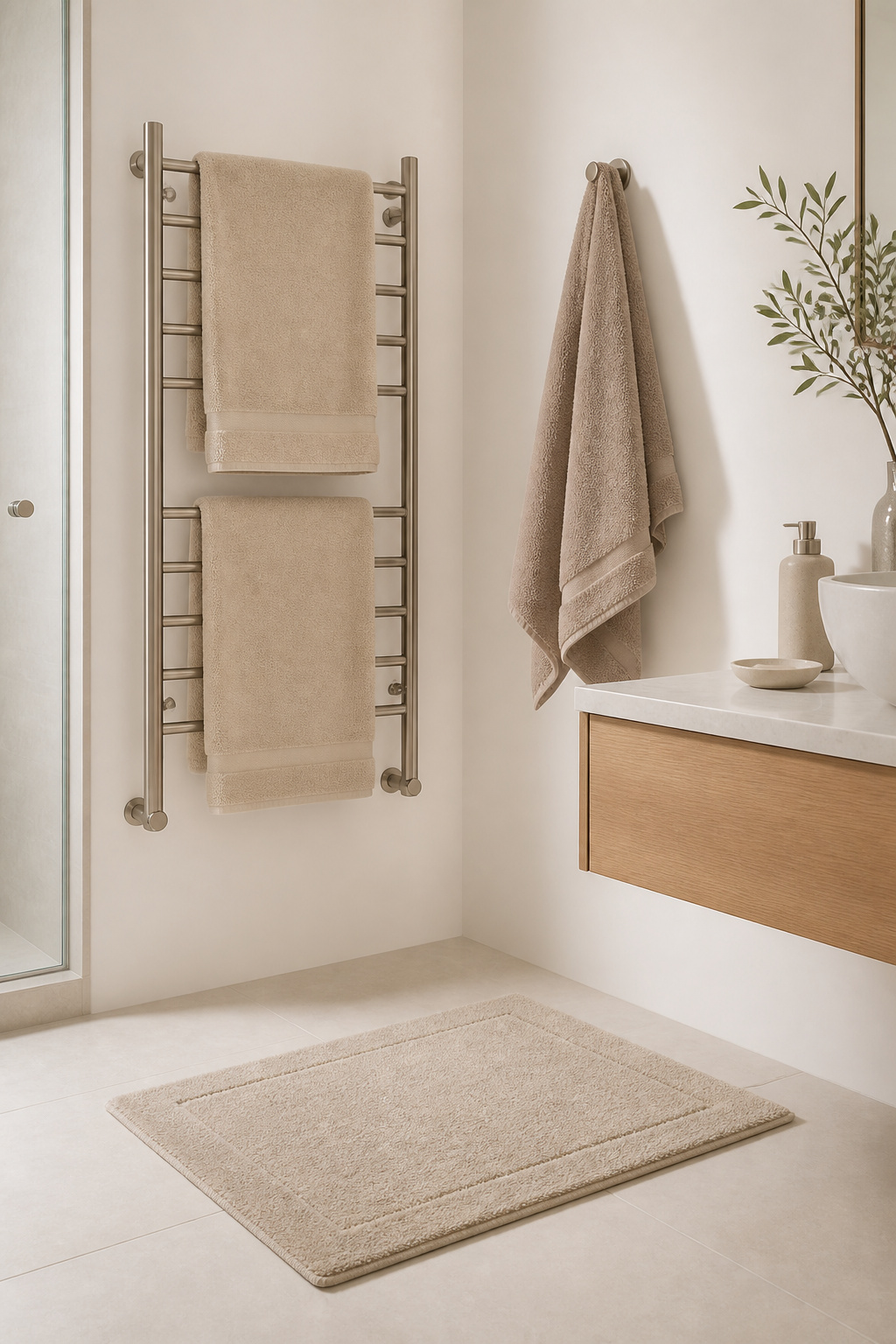
The Scandinavian three-tone textile principle: choose a base colour covering 60–70% of all textile surface (warm white, natural linen, stone, soft grey), an accent that appears in 20–30% (dusty sage, terracotta, deep navy — one, not multiple), and a neutral that grounds the palette (charcoal, black, natural wood grain) in trim and edging details. Within these three tones, every towel, mat, and window covering sits in the same family. The room reads composed rather than busy.
Pattern in textiles works best when contained to one surface. A patterned bath mat against plain towels and plain walls draws the eye to the floor without overwhelming the room. A patterned shower curtain and a patterned mat creates two competing focal points in a space without room for one. When pattern is introduced, keep it geometric and small-scale — a narrow stripe, a simple woven texture, a small check. Figurative or floral patterns have no place in a Nordic minimalist bathroom.
Storage is not the last consideration in small bathroom design — it’s the first. Every item without a designated place becomes a visual element by default: the spare toilet roll on the cistern, the shampoo bottle on the shower floor, the face wash balanced on the soap dish. Each one is a decorating decision made by inertia rather than intention. Together they render all other design choices academic.
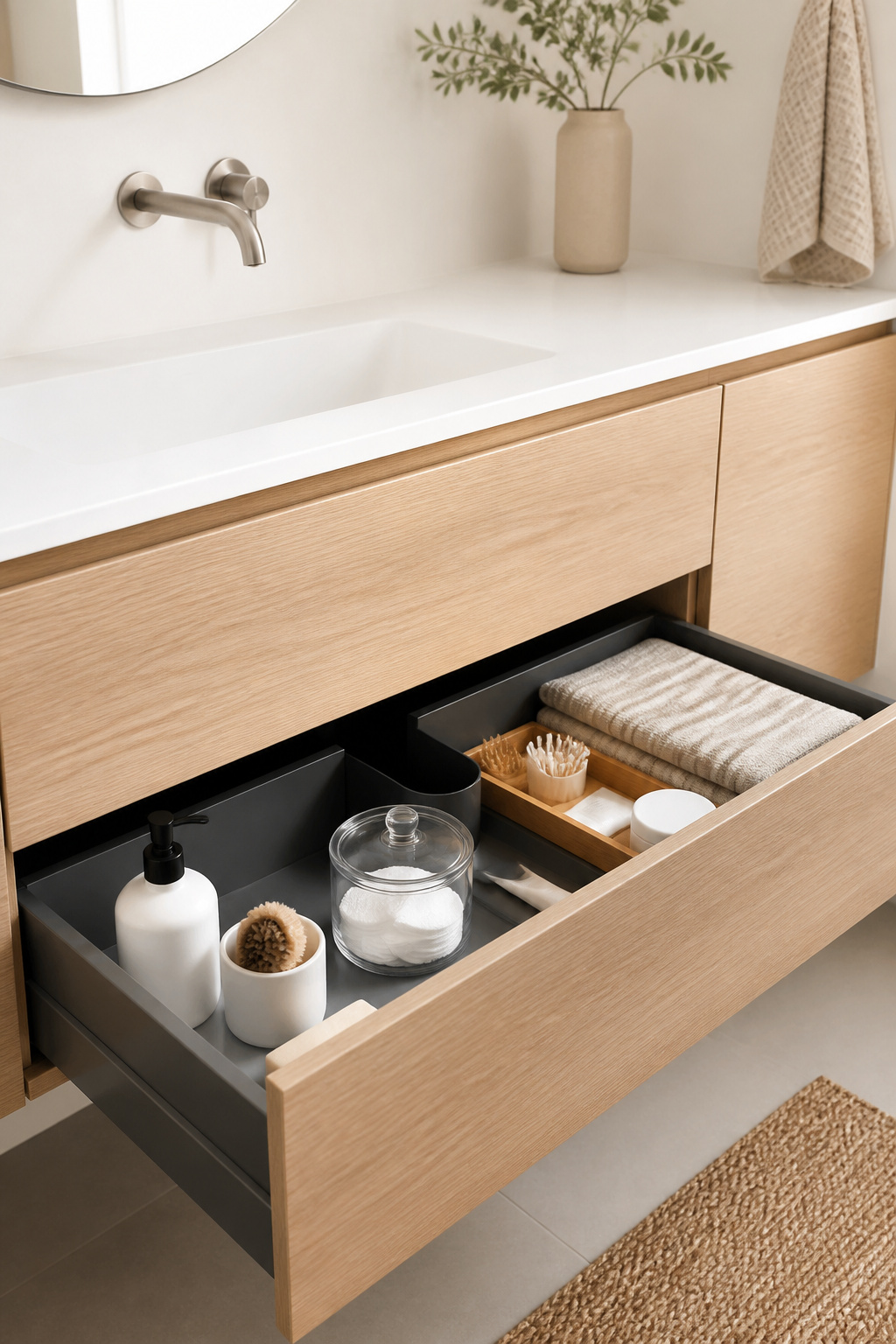
The correct sequence: decide what belongs in the bathroom (and move everything else elsewhere), then specify storage to match that edited list exactly. Professional organisers consistently find that bathrooms can eliminate 40–60% of stored items without any loss to daily function. Decanting daily-use products into consistent ceramic or glass containers — a pump bottle for face wash, a jar for cotton pads, a small bowl for hairpins — eliminates brand packaging chaos. It’s the spa bathroom counter, achieved at essentially zero cost.
For hardware, the recessed medicine cabinet is the most space-efficient option. Standard sizes of 15×26 to 24×30 inches fit within a standard stud bay, project nothing into the room, and provide 3–4 inches of concealed storage at the most-used level. Under-sink pull-out drawers (IKEA’s GODMORGON series provides the most reliable off-the-shelf solution) make the full vanity depth accessible without reaching. Over-toilet ladder shelving — typically 60–75cm wide, 160–180cm tall — provides three to four shelf levels without claiming additional floor space. Find bathroom storage ideas for small spaces that match your actual edited storage needs, rather than buying storage and filling it.
The most practical place to begin is with what you can’t change: the tile colour, the floor size, the window position, the existing fixtures. These fixed elements aren’t limitations. They’re the starting point from which a coherent direction emerges. A bathroom with warm beige tile and a wooden window frame is already telling you something about the palette that will work. A bathroom with cool grey tile and chrome fittings is suggesting a different direction. Work with those signals rather than against them.
Your bathroom doesn’t need to match the rest of your house. Small rooms are the best place to experiment with a bolder palette or a more dramatic approach — the commitment is smaller, the payoff is often larger, and if it doesn’t work, the repaint is manageable.
Of the 18 small bathroom decorating ideas in this article, lighting has the highest return relative to effort and cost. Two flanking sconces at mirror height, a 3,000K bulb, and a dimmer switch transform how every other design decision reads. The tiles look different. The textiles look different. The whole room recalibrates around better light. It’s the change most people put off because it requires an electrician. It’s also the change that makes people wonder why they waited. If you’re starting a small bathroom decorating project from scratch, start there.
Work from fixed to flexible after that: tile and structural decisions first, then fixtures and hardware (choose your finish and commit to it), then large textiles, then accessories. This sequence prevents the frustration of buying accessories that look wrong against tiles chosen later. The accessories and candles and ceramics at the end of this list are genuinely the easy part. By the time you reach them, the room has a clear character. Every addition either supports it or obviously doesn’t. That clarity, more than any single idea, is what makes a small bathroom feel designed rather than decorated.